
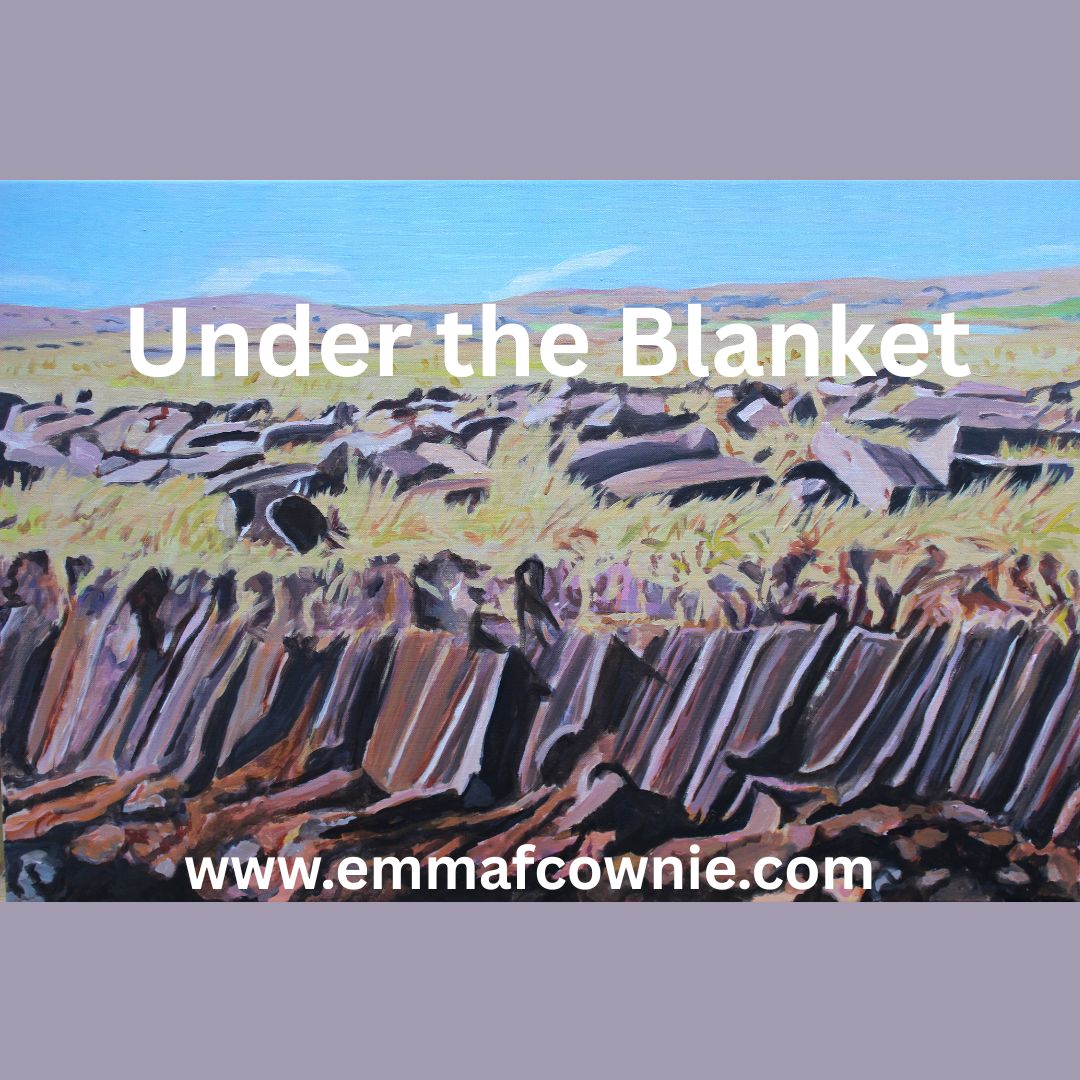
Ireland was once covered in a massive sheet of ice. Then about ten thousand years ago it retreated and trees and grasses sprang up to cover the rocky landscape. Today those trees are long gone. Farmers came and cleared them about 6,000 years ago and the continual rains from the Atlantic soaked and washed the soil reducing the mineral content making it more acidic. Plants like sphagham moss helped keep the land wet. So now West Donegal is covered in something called blanket bog. Blanket bog is a type of peatland found in only a few parts of the world with cool, wet and, usually, oceanic climates. It covers 3% of the world but contains a third of all the carbon in the world.
I love the blanket bog – it covers vast areas. It is a seemingly empty landscape. On an overcast day it has an exhilerating bleakness. On a sunny day, it hints at what a prehistoric Ireland might have looked like (plus a few wolves and lots of red deer). There are few, if any, paths through the bogland. If you venture on the land in summer it is springy underfoot. Most of it is drained with ditches along the road and narrow bog roads leading to “nowhere”.


For generations people who lived on the boglands drained the land then cut and dried the peat, also called turf, to burn. This was cheap fuel to cook and heat their homes. In a land with no oil or coal, the turf was essential. The landscape across west Donegal is marked with the long scars of peat banks. Cutting it is back-breaking work. In the past the surface of the bog was mostly cut away by hand using the traditional turf spade or sleán. Further South mechanised extraction is apparently the norm, using chain cutter, digger, sausage, hopper and milling machines. In Donegal, however, it is still cut by hand.
The Irish government used to burn turf on an industrial scale, enough to fuel a couple of power stations, up until very recently, 2020 in fact. People with “turbary rights” can cut and burn sod peat on their land for their own domestic uses but they are not meant to sell it. However with fuel poverty, older people in particular, will buy it to use it in winter. A load of turf may cost as little as 200 Euros (about 230 US dollars) and can last months.
The government is trying to discourage this not only because of the enviromental costs but also because of the pollution it causes. It smells delicious but its smoky and very bad for the lungs, especially if you have asthma.
There are moves to encourage the rewetting of the bogs. Targets have been set by the EUand a few pilot schemes in Donegal and a lot more in the Midlands, have been rolled out, Cloncrow Bog Natural Heritage Area is a great example of a rewetted raised bog. However, much more funding is needed from the government to encourage widespread adoption and to help the 4% of the population for whom turf is their main source of heating.


The boglands are abundant with wildlife and have been an important part of Irish culture. Bogs were seen as liminal zones – watery places often are. They were seen as places of both life and death—fertile ground for spirits, fairies, and supernatural beings. The bog was also believed to be the gateway to the Otherworld, where fairies, spirits, and even the dead could cross between realms. Many bog bodies and ancient artifacts were likely put there as ritual offerings to appease gods or supernatural forces.
If you want to look at some bog bodies this site has some good photos. I wont post them here, I never really got over looking at the poor soul in the British Museum (Lindow Man) who died in a Cheshire bog. I was fascinated by his face but couldn’t help thinking he could never imagine his mortal remains being looked at by all and sundry over 2000 years later.
One of the most famous mythical figures associated with the bog is Fionn Mac Cumhaill (Finn McCool), the legendary warrior of the Fianna. Some stories say that he and his warriors roamed the boglands, using them as a hiding place during battles.

Bogs have also inspired wonderful poetry. This is my favourite-
Green, blue, yellow and red –
God is down in the swamps and marshes
Sensational as April and almost incred-
ible the flowering of our catharsis.
A humble scene in a backward place
Where no one important ever looked
The raving flowers looked up in the face
Of the One and the Endless, the Mind that has baulked
The profoundest of mortals. A primrose, a violet,
A violent wild iris – but mostly anonymous performers
Yet an important occasion as the Muse at her toilet
Prepared to inform the local farmers
That beautiful, beautiful, beautiful God
Was breathing His love by a cut-away bog.
+ Patrick Kavanagh (One of Ireland’s most famous poets, from Monaghan, d.1967)

And finally…Seamus Heaney’s Poem “Digging” In 1995 Seamus was awarded the Nobel Prize for literature.

Read about Seamus Heaney’s Bog Poems
NOTE: I did not use AI to research and/or write this and I did not use it to “improve” it. I would rather my writing was human and imperfect.
Read More about Boglands
https://www.nature.scot/landscapes-and-habitats/habitat-types/mountains-heaths-and-bogs/blanket-bog
https://talesofforgottenirishhistory.substack.com/p/the-bog-of-allen?utm_medium=web

This is fascinating. I never knew they performed human sacrifices and place them in bogs.
I must confess, I did have a look at the photos. Ugh!
They seem to have been excuted, who knows the reason.
What do your wear whilst you slog in the bog? Waders? Galoshes? Snow Shoe type contraptions? What prevents you from contributing those dainty toes to the landscape? My word!
I try not to walk through bogland – the ground is quite uncertain – it might look solid but it isnt always. It depends if it is drained bogland (which most of it is) If I have to venture onto to the bog I look for rocks (there are plenty in West Donegal)!
Wise Choice. As the ancients taught ‘The wise man tests the trail with a staff; the fool tests it with both feet.’ 🥾
That’s good advice. I took to using walking poles to cope with the rough terrain. I broke my leg 5 years ago and wish to repeat to experience!
I’m sorry you broke your led though. I’ll assume you are not an actress and that it was not a good thing. 💔
No not a good thing at all!
😔