“Announcing SAOIRSE by @charleen_hurtubise, a powerful novel set between the United States and Ireland about a woman who runs from her traumatic past and the secrets she carries to survive. Coming February 24, 2026.”
With artwork by me!
SAOIRSE by @charleen_hurtubiseFrom Ferry Coll – a painting by Emma Cownie (SOLD)
Looking through my recent work, I was surpised to realise that I haven’t painted many paintings of Arranmore Island in the last couple of years despite visiting the islands in the summer. So I have put that right with a series of new paintings.
As always I am entranced by the journey to and from the island. You can read my short History of the Island here
Arranmore is lucky to be served by two ferry companies. There is The Arranmore Ferry (Blue) which is based on the island and Arranmore Ferry (Red) which is not. Yes, I know the names are almost identical, just a small matter of “The”. They both offer a fantastic 15 minute journey from Burtonport (Ailt An Chorráin) to Arranmore Island. On a calm and sunny day the view on the crossing are just heavenly. Sometimes there are dolphins too.
Map of Arranmore and the coast off Burtonport
The ferrys sail through a narrow passage past a scattering of islands on the way to Arranmore.
Rutland Island (Inis Mhic an Doirn) lies between Burtonport and Arranmore, Donegal. William Burton Conyngham (a local landowner for whom Burtonport takes its Anglised form) had warehouses, a street of houses, a post office and a school built c. 1784 to capitalised on a the abundant herring fishing. Unfortunately, the herring disappeared very early in the 1800’s and the station fell into disuse. The island was inhabited until the 1950s. These are the remains of the fish factory and landing stage on Rutland Island.
Opposite is Inishcoo Island with Mount Errigal in the distance peeping out from under the clouds. The jetty in the left hand corner belongs the magnificent Inishcoo House (see painting below)- once a coast guard house, built in the C18th.
Inishcoo House, Ireland (SOLD)
There are several tiny holiday homes dotted across the islands (and cows)
Ferry Home (Arranmore, Donegal) by Emma Cownie SOLD
A you can see the views are quite idyllic. Whether from the ferry or from the island. To be honest, I wish the ferries were like the Circle Line on the London Underground, where you can ride the tube rround and round (it takes and hour and an half apparently, I have never done it) and you could ride them back and forth to the island all day!
Washing Line, Arranmore by Emma Cownie SOLD
Some more recent works….
A Home on Arranmore, West Donegal, Ireland by Emma Cownie
I have been experimenting with different supports and media. The Jessica Brilli painting on wood got me curious about how it would be different from painting on canvas.
Jessica Brilli’s “Cutlass” – Acrylic painting on wood panel
I could find very little information about the experience of painting on wood panels (but lots of information on how to prepare them). So I realised that I had to use trial and error to find out. I ordered some gessoed wood panels from Cork Art Supplies who delivered them very promptly.
My first effort was this painting. I painted a light ground of red ochre in oil before I laid down the painting. I found that achieving fine detail was much easier than on canvas. However, the colours didn’t behave the way I expected them too. My sky started off too dark. I found it was easy to wipe off the oil paint and repaint it a lighter shade. I found that white areas also needed a further layer once they had dried to give them the solidity I required. The painting took much longer than I am used to to dry.
A Place to Rest, Inishbofin, Donegal
I have painted in acrylics on canvas before and struggled with the speed with with the paint dries on the palette. I used to find the the paint had gone hard in the 20 minutes since I started painting. It drove me mad. However, after extensive reserach I worked out how to make a wet palette so that I could slow down the drying time of paint on the palette. I decided to use the quick-drying acrylic paint as an underpainting.
The acrylic painting was more of a sketch than a proper painting. The process forced me to simplify my images further and the final layer of oil paint gave the image a greater depth and richness of colour.
Acrylic Underpainting
Boat at the Pier, Gola (Donegal) – Final Painting
Some of the acrylic sketches really challenged me as the paint did not move and work in the way I was used to with oils. The greens and yellows were too transparent and looked messy. It was impossible to lighten colours, like the leading edge of the fence post, once they had gotten too dark.
Fenced in, Gola – Acrylic Underpainting
The final layer of oil paint, however, enabled me to make my colours much more opaque and to to add much more detail in places, especially on the wire fence.
Fenced In, Gola
My final painting was a studies in mauves, blues and greys. I had added an additional layer of light grey gesso as a ground before I started painting.
Lighting the Way – Acrylic version
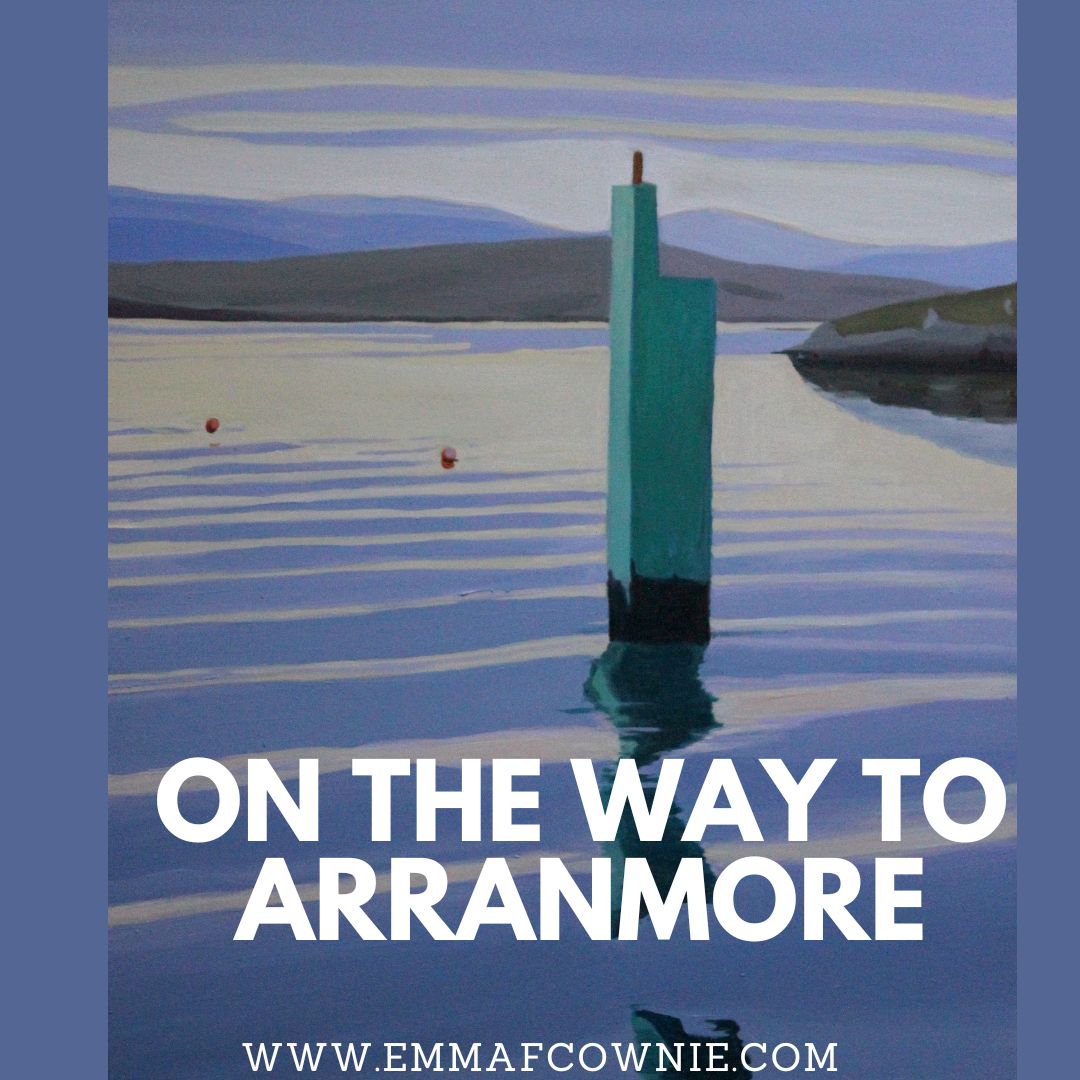
Lighting the Way (to Arranmore) Donegal – Final version
I enjoyed experimenting and I ended up painting several painting at the same time, as I waited for paint to dry between layers. The whole process forced me to confront my short-comings as a painter of acrylics. I did not enjoy that. It made me feel uncomfortable and brought out my “imposter” anxieties. I need to do much more work in this area to develop my skills.
It was also rather time-consuming and probably not a great project to undertake in the winter months, in Donegal, when good light is in very short supply. I am not sure that I would spend so much time on the underpaintings in future, as I liked my first painting the best. Although I would where there are large areas of white. I did enjoy painting on the wood panel and I will continue to experiment with them.