Posted on Leave a comment

A 60 Second Interview Doesn’t Cover it All!

Here is my 60 second interview on Artfinder  in which I explain how painting was an integral part to my recovery from post traumatic stress disorder. I also explain my technique, inspirations, influences and how post trauma impacted on my art. Although I do not mention it explicitly in the interview “Fractured Light” was born and borne out of my worldview being fractured as the result of my post trauma which occurred as the result of a car accident. Thus the fractured perception of this painting represents my perception at the time. As my recovery continues and my mental health improves I find my painting also metamorphizes into being more expressive, coherent, unfolding, lighter and celebratory (if not relieved). Less fractured.

Image

I have to add that my post traumatic illness has revolutionized my way of painting. By husband suddenly became much more interested in my work and has acted as my agent ever since. He was now sure that I had the necessary ‘scar on the soul’ to make it as an artist. That I had made the breakthrough. I still paint prolifically because I need to paint still, not only professionally but must importantly in a therapeutic sense. Painting is when I am most ‘whole’ alive, engaged, fulfilled, free from self and doubts. Principally I write about how art has been a massive and continuing therapeutic benefit to me even though I initially returned to it very ‘broken’ despairing and distraught. I hope to engender some hope in other suffering form this most misunderstood mental health problem. I do not mean to say art was the only part of my therapy. EMDR was a vital core to my treatment and I would recommend this to others also. Now I paint with urgency, painting, painting, painting.

Life is unpredictable, it is best to seize the day and to enjoy the precious gift we have to the best of our ability. Most suffers of PTSD will not relate to this sentiment at present in they are in the terrifying, disjointed, fractured, despairing heart of it. I have been there too! The light at the end of the tunnel probably looks microscopic and is, in fact, a train coming. The light does eventually become bigger and brighter until you arrive on the other side and experience a brightness until then never experienced with such intensity. There can be a rebirth from this dark tunnel.

The intrusive memories have lessened. I re-experienced and reprocessed the negative emotions- the fear, distress, helplessness, guilt, shame, faulty pride etc –  which kept memories from being safely embedded in my hippocampus. Blaming myself for things beyond my control, that were not my fault, never were my fault. Random happenings, with no logic to them, no way of understanding them into reason, they were accidents, not in the script. Life can be like that, period.

Why is not always helpful. How is. How can I get out of this distress?   Perceiving things as they were, not what my brain continually told me meant I had to revisit the trauma, re-experience it and correct the faulty thoughts and destructive emotions which accompanied the memories of it.  Eventually allowing these memories to rest in my long term memory instead of continually stalking and attacking my equilibrium I started to feel better. Although it was exhausting and left me this way afterwards and to an extent now. Still, these months later. It can get better, not perfect. It never was perfect. Ever.

The mind and brain do not like being ill, they rally against it. This is often counter productive. First we have to accept we are in distress, suffering from a mental illness, that we need help from professionals, support form family, faith that we can recover. Check out EMDR professionals in your area. Start the journey to wellness knowing it can be done and will be done. Have faith, you will get better in time. Have courage especially, be brave.

I still have about 40-50% the energy I used to have but I have more peace of mind and gratitude for what I have, not what I wanted to have. I am still in recovery still getting better. It will take more time, months and months if not years. But I have turned a vital therapeutic corner.  So can you. Life has create new possibilities, new avenues to explore, pathways that were never obvious before, and which have ultimately led me back to me, to knowing me, to doing more of what I would want for me, that which expresses me most.

To my fellow PTSD sufferers, you have my love, best wishes, and support here on this blog should you need it. Spread the word – we can recover from PTSD,  one day at a time!  Just live this day, that is enough for now and for always…

I include a painting “Up Cwmdonkin” which was a painting representing a movement in my therapy, a getting better, a unforeseen island of relief in a, until then, daily tempest. I love this as it reminds me of the warm seaside breeze that can caress the autumnal leaves of the trees at the top of Cwmdonkin Park, a park hugged by the house that Dylan Thomas, the famous Welsh composer of words, lived in while growing up. The light wind almost signifies a ‘breathing out’, an emerging respite after months of therapy.

Emma

https://www.artfinder.com/story/emma-cownie/

Image

Posted on 1 Comment

The Inspiration of Maples at Cuckfield

I saw this painting in The National  Museum in Cardiff and it inspired me to start painting after a long period of inactivity – thank you Robert Bevan – after yet another period of inactivity my husband brought me the same painting on a postcard, even I could see the serendipity in that!! I haven’t stopped painting since and have no plans to ever again if I can help it! We need to be inspired by other’s work also, another’s expression of beauty helps inspire one’s own humble attempts at expressing the beauty all around – “Maples at Cuckfield” – a wonderful painter. Image

Posted on 1 Comment

More talk about Art – “In the Light Refracted”

See the original work by clicking here on Artfinder

This abstracted landscape or ‘refractionist’ work sees the light broken down into light filled colour segments or ‘blocks’ to create an almost pre-perceptual  image. The foreground dark reds are juxtaposed against the light-singed orange and lushy leafy greens to suggest a green distant solace from the scorching heat, with the darker blues suggesting a progressively deepened experience of this respite and solace from the sun’s baking rays. Thus we see a transition from scarlety red via the purply blue path through the burnished, charred-edged  oranges and fruity greens to the darker recesses of the oil ink blues like a colour spectrum from hot to cool. Again another use of the refractionist motif. Not only are my paintings often refractionist in terms of e.g. light coming through materials as through tree leaves, shedding light ‘stain glass-like’ but in this case symbolising a progression of temperature and the experience of this variation in heat.   The rich boiling bloody reds in the foreground also contrast to the purply blue colours of the path. This spreading of light across these different temperature textures also has a ‘lava lamp’ effect’ as if the oily colours slide across the canvas. The path’s purply blues suggests a transition, a comfortable inviting passage to the cooling shade of the far trees. The far ice cool blue contrasts from the initial, foreground liquidly purples, which in their calm serenity suggest relief from the distress of the exasperated, bad tempered heat.


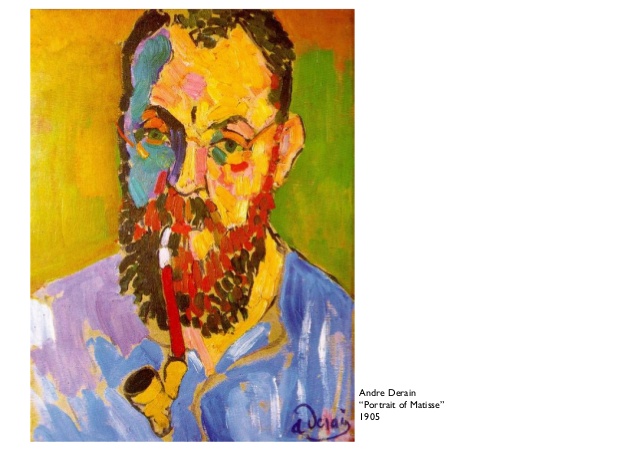
The top of this painting has echos of Cezanne in it; quite accidently I am sure. My husband is a devotee of Cezanne but I have always failed to see the attraction. While in Paris, my husband dragged me reluctantly to an exhibition of Paul Cezanne’s earlier, transformative work. I was far from impressed I must admit, trying desperately to ‘get into it’ especially as my husband looked almost despairing at my inability to ‘get it’.     Most of the ‘classics’ were missing for a start – we wandered through the actual pictorial representation of years of Cezanne’s attempts to find ‘his style’. This was quite encouraging in the end, to think even the ‘greats’ have to delve and dig to unearth  the technique that most expresses their artist soul.    It was reassuring to realise even Cezanne struggled to find his artistic voice. There is hope for us all. I was quite prepared to leave the gallery with this reassurance that maybe even for me… maybe one day. In the final couple of rooms there was a beginnings of the art ephiphany that my husband must have experienced before. Cezanne was beginning to illustrate how we see, not paint what we see with accuracy. He was almost painting the act of ‘seeing’, the experience of it . The breaking down of light, colour, form into ‘patches’ which then all sort of ‘added’ up to the final image; this was illuminating. Why had I not seen this before?

It was a perception in the making according to my husband, who researches neuroscience and is fascinated by perception, how it is constructed. But here we have a painter, an artist, nearly a hundred years ago showing how perceptions is built, via these  ’patches’ 0f colour and form. He added that these ‘patches’ are more representative of what and how we see than some other painting of something which is dead to the experience of viewing it. A facsimile of the image. Expression thus may not just be about the feeling or experience of seeing something but a representation of how we see it. How could I have been so blind!? Thus I now paint to express how one feels while ‘perceiving’ the movement of the heart that accompanies the taking in through the senses. The exhilaration of seeing and perceiving. The wonder in the everyday, the extraordinary in the ordinary.     Perceiving as a ‘dynamic’ act – an act most ‘vital’ not ‘completed’, finished or done with but being done. Not sunk into canvas  or laden with inertia but  alive , invigorating, changing, in construction, moving.  Not categorised but fluid, still being defined, joyful and light not itemised and final. Not an interpretation but being intrepretated.   Active not passive. Now not then. In the present not past tense. Constantly evolving in the moment. Presently present. Here, now, inaffable. Transcending.  This what I hope to achieve on this long  journey to expressing oneself. To learn how to transport the viewer to the now, to a vaguely remembered, or imagined even, place in the heart.  To the obscurely wonderful feeling of being nowhere else but here.Image

Posted on 2 Comments

Down Cwmdonkin

This is an example of my ‘refractionist’ technique at work as I build up the painting, first from breaking down a photo into areas of colour, which I sketch in as mainly black and white, gently adding colours that I feel will represent light on colour at different depths of perception. Then I add to these ‘segments’ individual colours, reflecting light being refracted on different areas and at different distances. Slowly I build up these complementary spectral colours, constantly having to retreat some distance from the canvas to inspect the painting to see if it is coming together or being constructed in a coherently plausibe way. Each segment helps construct the perception of the scene, in this case, building up a picture of a path through a park. In fact, this park is Cwmdonkin Park where the great poet and composer of words, Dylan Thomas used to walk as a boy and young man. His family home is minutes away, hugging the side of this park. The final painting is quite expressionist but also conveys a spectral, refracted light spectrum hence the name ‘refractionist’ as it is the combination of light falling on various materials at different distances that I am attempting to ‘express’ or as my sister, described it, a ‘stain glass’ effect. This is apt as I love paintings that somehow expresses the extraordinary in the ordinary, the supra natural in the natural, the divine in the mundane, hence the spectral feeling I am attempting to communicate through the painting. The fleeting moment of wonder or awe when we walk into a sunlit and stain glassed church almost.