To Celebrate the New Year I am giving 30% off all work on my website – to get the discount you have to enter a code at the checkout. Where’s the code? Join my email list and it will be sent to you, automatically. The sale ends on 15th January.
View from the Pier (Portnoo)-Emma Cownie SOLD
If you have already joined my mailing list and haven’t had my latest newsletter with the sale code check your SPAM folder.
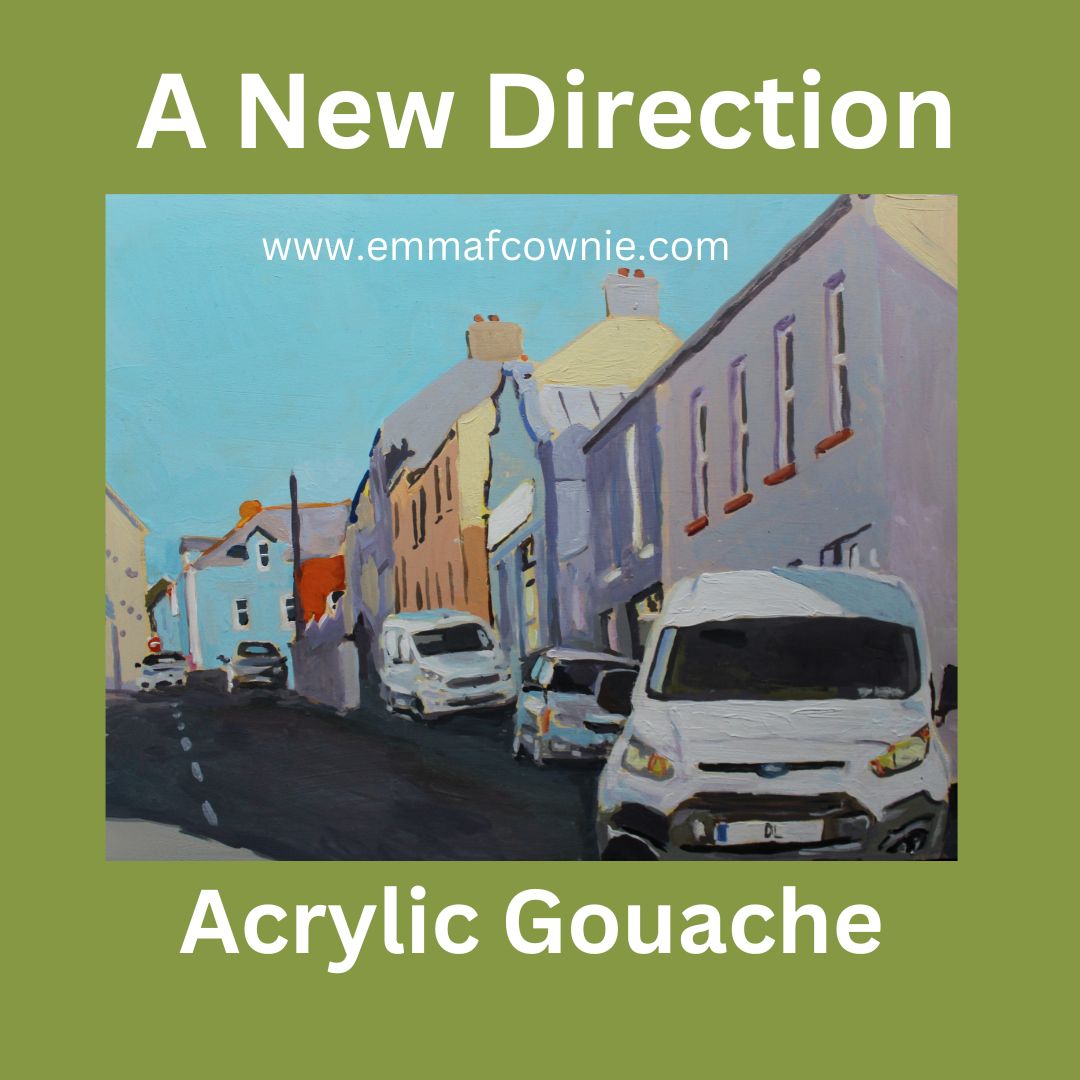
Here is the painting that finished me off. Now I look at it after a month, I am not sure why. I just felt like I had run into the sand and needed a change. I had been doing a lot of reading about composition but I suspect it had more to do with taking too long to paint. Acrylic paint often requires several layers to achieve the opacity of oil paint. I was getting bored and tired and I wanted to try something new. A change is a good as a rest.
Toralaydan Island, West Donegal
So I took a month off posting new work on facebook & instagram, to give myself head space. Some artists love being filmed live and showing their “process” – I am not like that. I get very self conscious and often will immediately screw up a painting if I take photos too early in its development. It’s one of the reasons I cannot bear to paint outside “en plein air” – people understandably want to see what you are painting and that makes me feel very self-conscious. I really dont know how people go on TV shows like “Landscape Artist of the Year” and produce really good paintings, or half-way decent paintings at all, in fact. They must have nerves of steel. I don’t. In fact, I know that many of my paintings can go through stages of looking quite rubbish before they (almost always) emerge butterfly-like from the murk and layers. It’s a lovely (and sadly rare) experience when a painting look interesting/beautiful all they way through the process of coming into being.
I had bought some tubes of Acrylic Gouache in the spring but had not got around to trying them out. Now I opened that box of paints and gave them my full attention. I had been looking for a water-based paint, to reduce the risk to my pets, especially my young inqusitive cats. I had had oil paint/white-spirit incidents with pets in the past when we had a lot more space and I did not want to take that risk now. I also wanted opaque paint. I had discovered that some American artists, whose work I liked, used Nova acrylics which is pretty opaque but they did not have a UK stockist. I was cautious about importing paints from the US as I once ordered a load of paint from a sale from JerrysArtsarama only to get stung by customs and VAT charges. So any saving I had made in the sale were wiped out! I also considered Golden SO FLAT matte acrylic paint but I am not a great fan of Golden colours. Dont get me wrong, some of their acrylic colours are great (light ultramarine for example) and I know many artists rave about them, but I don’t LOVE them. They were also sold in a jar rather than a tube, and I could just see me absent-mindedly sticking my dirty paint brush in a jar and mucking up the colour. I prefer tubes that I can squeeze a tiny bit of paint out onto my wet palette and keep my colours clean.
Not the set I bought – I wish!
I saw that Jacksons Art stocked Turner Acryl from Japan. I watched a couple of videos comparing different makes of Acrylic Gouache and liked the vibrancy of Turner’s paint. There is not a lot of information about acrylic gouache, unlike regular acrylic (I have several books on the technical aspects of using this acrylic). I keep reading the same thing – its a cross between gouache and acrylic. Gouache is a water-based paint which can be opaque (unlike water colours which are usually transculent) and it can be reactivated with water. Acrylic gouache, however, once dry, sets like acrylic and cannot be reactivated with water. It dries pretty quickly too. It dries to a smooth velvety matt finish too. It is used by illustrators, especially anime.
An example of anime art from Instagram from @happy.artistry
Look at the lovely rich colours!
The colours are lovely but I have a lot to learn. There are so many wonderful rich colours and I can see why these [paints are popular with illustrators. Unlike acrylics or gouache, there is little to no colour shift. It is non-toxic. It does not dry lighter or darker. I am finding this hard to get used too. I am overcautious about laying down darker colours. I have to learn this again and again. I often dont make my paintings dark enough as I am afraid the strong colour of the tarmac road will overwelm the painting. I have to repaint the shadows.
I feel out of control with it at times. Sometimes that is exciting, others just scary.
Winter Morning on Academy Road, Derry – Acrylic Gouache on wood Panel 2024 – An early effort
I painted a load of duff pieces before I started to feel I was getting somewhere with “Ardara”.
Ardara – Acrylic Gouache on Wood Panel 2024 – Another early effort
I felt that a new medium required new subject matter to set it apart from the rural scenes I had focused on since moving to Ireland in 2021. My work had previously described by Niall McMonagle in the Irish Independent as a “Clear bright glimpse of a vanishing Ireland”. I wanted to mix things up and paint a more contemporary version of everyday Irish life.
This meant scenes with cars. The Irish love their cars. I have painted cars in the past but not for a very long time. It was usually at night or in the rain (at night) so you could not really see them properly.
My Pop Art – The Driving Rain (SOLD) Oil on Linen Canvas, 2015
Coming out of Shell, Oil on Linen canvas (SOLD) 2020
It was in 2017 that I decided to pursue “Urban Minimalism” for my “Hollowed community” project for the MadeinRoath festival in Cardiff. For a long time, I have sought out empty scenes with no cars or people. It found it cleansing. The Morris Minor (below) was one of few exception to this. This vintage car was parked around the corner from our home in Brynmill. I used to hear the owner drive past our house on the way to the paper shop every morning.
Urban Minimal style – Morris Minor 2018 Oil on Linen Canvas (SOLD)
Now I decided on a volte face and to seek out street scenes with cars to challenge myself. Car are difficult to paint. I know some people will disagree with me, but in themsleves, they are not intrinsically beautiful, although the light reflected on their surfaces can be. I am more a fan of vintage cars like the Morris Minor and old-style minis (genuinely small cars) and enjoy the colours used by Italian manufacturers such as Fiat 500s. Too many cars in Ireland are black or grey. They don’t make for interesting compositions. Surprisingly, Lorries do. In the right place.
Deliveries on Queen Street, Derry – Acrylic Gouache on wood panel 2024
I wanted to paint with speed. I was bored of spending days or even weeks on a large painting. I wanted to work fast keep things fresh. I tried hard to resist overpainting. I left wobbly lines where possible so as to convey some of the energy of the urban areas.
Derry is a very lively city. I also wanted to explore town/city life on both sides of the border in Donegal and Derry, in Northern Ireland. The building stock is very different depending on which side of the border you are. The number plates maybe different but the cars are pretty similar.
Bogside, Derry – Acrylic Gouache on wood panel 2024
Light and shadows continue to be a theme in my work.
Carn (Donegal) – Acrylic Gouache on wood panel 2024
I have found this both challenging and exciting. I have produced quite a few paintings that didn’t work, especially at the start but I just pushed on. I knew that there would be a lot of wastage at the start. The only way I would get the hang of this medium was by painting a lot. I learn through my hands, mixing the paint and then placing the paint on the board. I have not yet achieved the consistency in my work I am used to with oils and acrylics.
I also had to deal with the fear that people might not like this style of paintings or the subject matter. That’s why I had to stay off social media until I felt like I knew what I was doing (sort of). I have shifted styles and subject matter before. There are themes I have focused on before and I am revisiting them. Others are constant – shadow and light. Strong dynamic compositions are also important.
I used to alternate larger landscapes with smaller people/animal paintings. This way I kept my interest in what I was painting. But I seem to get stuck painting landscapes when I came to Ireland. I am not sure it was good for me as an artist. I need to mix things up to keep them fresh. I don’t know where I am going with this but I feel I need to persue this trail for a while longer. I just have to keep going to see where I end up.
There is a unique architectural gem, perched upon the high cliffs above the shores of the north Derry coastline. It is an elegant Roman-style round temple; a beautiful rotunda. It is a wonderful surprise. There is none other in Ireland. It looks out across Lough Foyle to Donegal to the north and on a clear day the Scottish Isles can be seen to the north-east. This remarkable building is Mussenden Temple.
Mussenden Temple from Downhill Strand
It was built by the eccentic and extravagant Earl Bishop of Derry, Frederick Hervey (b.1730-1806). The 18th century is full of mischievious and surprising characters and he’s one of the best. Frederick Hervey was in turns controversial, revolutionary and yet both shocking and popular in his own life time. He came from an aristocratic English family, the 3rd son of an earl with big estates in Suffolk. Having two elder brothers he probably never expected to inherit from his father. He first tried law and then became a vicar hoping for a career in the church. His family connections helped a lot. He became chaplain to the king, George III in 1763, who later called him ‘that wicked prelate’ .
When his eldest brother George became Lord Lieutenant of Ireland in 1766, he managed to wangle the post of Bishop of Cloyne for Frederick and then, shortly afterwards, in 1768, Bishop of Derry, one of the wealthiest Irish sees.
Frederick threw himself into being Bishop of Derry, reportedly visiting every parish in the diocese and embarking on a number of notable building projects in the city of Londonderry including building St Columbs Cathedral’s first spire (it had to be replaced later as it was too heavy) many fine building and the first (wooden) bridge over the River Foyle, earning himself the nickname ‘the Edifying Bishop’.
In 1779 his brother George died and Frederick became the 4th Earl of Bristol, inheriting an income of £20,000 a year. He now even more money. He spent a fortune on building and collecting art.
He was widely travelled and had a fine appreciation of art, especially Greek and Italian. He spent 18 years of his life in Italy and spoke Italian fluently. Frederick was also well-read and he was an expert in flora and fauna and publicised The Giant’s Causeway. The Earl Bishop did extensive research into the origins of the Causeway and promoted his findings to the scientific community and wider world.
He also visited Staffa Island on the Western Isles of Scotland to confirm the links with similar columnar formations. In 1782, he was made a Fellow of the Royal Society for his efforts.
The Earl Bishop was a colourful character and was clearly someone people loved to gossip about. There are many examples of his eccentricity. It is said that he made his clergy run a leapfrog race on Downhill beach to see who would win the best area!
He had an eye for the ladies and was reputed to have had several affairs. Among his mistresses was society beauty Madam Ritz, as well as possibly Emma Hamilton who was also the mistress of Admiral Lord Nelson.
Bramante’s Tempietto, Rome 1502
It was on his tour of Europe that he fell in love with Bramante’s Temple in Rome. He reportedly tried to buy it and have it moved back to Britain but the Pope would not let him. So the Frederick Hervey built his own. Several of them. He built Ballyscullion, near Bellaghy, Co Derry, in 1787 to his own extravagant designs. The façade was inspired by St Peter’s in Rome, and measured 350ft across, with a central rotunda flanked by curved wings and a large pavilion at each end. It sadly, no longer exists.
Ballyscullion House
He also started Ickworth House, in Suffolf in 1795 which was completed by his successors.
Ickworth House, Suffolk, England
His first rotunda, however, was Musseden Temple, built in 1873. It was built as a library on the cliff edge of his estate at Dunbo, County Londonderry, Northern Ireland. Dunbo derives from the Irish Dún Bó, meaning ‘fort of the cows’. Dunbo was renamed Downhill Demense and an incredible 300,000 trees were planted on the estate; although there is little sign of them today.
A huge castle was built with the assistance of number of architects (Frederick kept firing them) including Michael Shanahan of Cork and Placido Columbani of Milan, who was supervising plumbing and the installation of water closets, a swanky innovation for the time. So we are not entirely sure who designed the rotunda/temple on the cliffs.
Mrs Daniel Mussenden (born Fridiswide Bruce, d.1785) Unknow French artist c.1780
The temple was dedicated to his lovely young cousin Frideswide Mussenden (neé Bruce) who had recently married the rich banker, Daniel Mussenden, had given birth to a child. The temple was meant to a be delightful retreat for her to escape to and look out at the wonderful view or read some of the many books there. A fire was kept lit at all time to save the books (and her) from the damp Irish weather. Sadly, Frederick’s terrible reputation with women meant that their “friendship” was gossiped about, in the press. The fragile Frideswide was horrified to be written about in the Freeman’sJournal, even if she wasn’t mentioned by name, and it may well have supposedly sent her into a physical decline, dying at the age of tender age of just 22 in 1785.
There is a minature of her in the National Gallery of Ireland painted when she was 17 in 1780, presumably when she had just married Daniel. She has a very sweet and tender face; you can easily imagine her upset at the nasty rumours.
So the library on the cliffs is a poignant place. Built for a young woman who perhaps only used it for a short time before she died. It was always close to the cliff edge, reported 30 foot away when it was built. I think that is an exaggeration, as maps from the early 19th century do not show that much land between the temple and the cliff edge. The cliff has eroded and about 20 years ago the National Trust did extensive work to stablise the cliff and underpin the temple.
OSNI 1831 Downhill
I am very bad at remembering to take work in progress photos of my work. I often get too caught up in painting the piece. I am also usually very anxious about a painting until I have practically finished it!
This is a painting done with acrylic paints. I work with thin layers of paint, building up the colours and adjusting them, lighter or darker with each new layer. Often I like the painting best when its about a third done – I am confident I know where I am going with it and it still has “potential”.
Here there are still some “problems” to solve, the shadow on the temple needs to be darkened.
Frederick Hervey was a fascinating man, who had a long and varied life and I could write a lot more about him. He was minor celebrity in his day, he travelled widely on the Continent, where he kept company and correspondence with leading philosophers, princes, politicians, scientists, artists, architects and writers—including Voltaire, Goethe, Benjamin Franklin, John Strange, Jeremy Bentham, James Boswell and the Pope. He has been described as “a bad father, and worse husband, a determined deist, [who was] very blasphemous in his conversation”.
Yet he was a generous man who treated the people of Derry well, whether Catholic, Protestant or Non-Conformist (a type of Protestant that was discriminated against by the state at the time). He argued all his life for religious tolerance.
Earl-Bishop with His Granddaughter in Gardens of Villa Borghese c1790 National_Gallery_Ireland.
He believed the answer to the Irish question or the Irish problem of a disaffected Catholic majority is, was not meanness but generosity. Just as God wins our prayers of thanksgiving by His extravagant generosity, so England could learn how to win over Irish Catholics by giving them more, not less. He bankrolled the first Catholic chapel in Derry—Long Tower Church—and personally chose the magnificent Italian marble that adorns the altar.
He undertook public works to relieve poverty, and was a generous patron to the Catholic population of Derry.
He died in Italy in 1803, trying to recover his art collection that had been conviscated by Napoleon Bonaparte. Hundreds of artists attended his funeral in Rome and he was buried at his ancestral home, Ickworth in Suffolk, where there is an obelisk paid for by public subscription by the Catholics, Presbyterians and Protestants of Derry.