Posted on 7 Comments

Me and Social Media

me and Social Media - Emma Cownie

I have been a full-time professional artist for 14 years now. I have used social media (Instagram, Facebook, Twitter/X) and this website hosted by WordPress to show my work for quite a bit longer than that.

I have never used TikTok. I gave up on Twitter/X no long after Musk bought it. It was never particularly good for the still image. Instagram used to be very good for photographers and artists.

A couple of years ago I would regularly get over 200 hundred “likes” on a post on instagram sometimes over 500. Once or twice over a post even got over a thousand likes, but no more. Now I am lucky to get 50. I have noticed that this has happened to a lot of other artists’ accounts too. This has been sapping my confidence and damaging my creativity. “What’s the point if no one sees it. No one will buy it if they dont see it”

Round the Rosses
Round the Rosses – 362 likes in 2019

My work has not deteriotated in quality. In many ways I feel that it has much improved but you’d never think that from the metrics. I appreciate that as Instagram decided to chase the Tiktok market by introducing Reels and Stories that I have resisted that change. I am not a film maker and I dont want to be one.

Lighthouse at Fort Dunree (Donegal)
Lighthouse at Fort Dunree (Donegal) 833 Likes in 2022

I appreciate the beauty of a still image and silence. I never have the sound on if I can help it.

Strangely, I am okay with “Sponsored Content” as I don’t pay to be on the site and I know they have to make their money somehow. What I do have a problem is that when I log on these days my senses are assaulted by all singing and dancing stuff I never asked to see, accounts I never signed up for. The suggested content is overwelming. The infinite feed is insane. “Discover” is rarely of interest so I dont bother with it. The algorithm has bland dull taste.

Lately, I have felt sick logging on and sicker logging off. I used to find artists I liked but now I feel exhausted and used.

Rocky Ground Bun An Inver
Rocky Ground Bun An Inver by Emma Cownie – 92 likes in 2025

All this stuff has been deliberately designed to be addictive. A court case in California earlier this year upheld the view that Meta and YouTube design addictive products that harmed young people. I haven’t noticed the platforms becoming less addictive, if anything they seem to be getting worse.

I will go on my phone to answer comments and queries and find I have got distracted looking at videos of sick or disabled cats in countries many of miles away. It makes me feel stressed. On the days when I dont log in, I feel a lot better.

Emma Cownie Painting of Boats at Inishbofin Pier, Donegal
Boats at Inishbofin Pier, Donegal 1340 Likes in 2022

Last month, the European Commission found Meta in breach of the Digital Services Act for the addictive design of Instagram and Facebook. The investigation focuses on features such as infinite scroll, autoplay, push notifications, and the platforms’ highly personalised recommender systems. Earlier this year the EU told Tiktok to change its addictive design or face a massive fine. Sadly, the UK is no longer in the EU.

I can’t wait for Meta et al to change their addictive designs so that my head no longer feel fried after I have been on their sites for a silly amount of time. So, I have decided to turn off comments and likes on my Instagram account and the “Emma Cownie landscape Artist” Facebook account that is linked to it. I will continue with comments and likes on my other Facebook account for a while longer so I can compare results.

I hope it will save my sanity. It’s just as much work to turn off the comments and like but I feel better having wrested a modicum of control back from the Tech giants.

I am off to wrap some paintings and read a sewing book.

If you want to contact me you can still DM me on these sites or email me at emmafcownie@gmail.com

Posted on 1 Comment

Farewell to Derry City

Farewell to Derry City

 As a good bye to Derry and am holding a sale of paintings of the beautiful city. It runs until the end of the month. Derry is a gem of place and I am sorry that not more people come to visit (and buy my paintings!)

Painting of Derry Panorama_Emma Cownie
Derry Panorama_Emma Cownie
Palace Street Derry _Emma Cownie
Painting of houses on Castle Street, Derry/Londonderry by Emma Cownie
Castle Street, Derry/Londonderry by Emma Cownie
The Peace Bridge (Derry) by Emma Cownie

The sale runs until the end of the month and I offer free shipping too!

See all my Derry paintings here.

Posted on 6 Comments

Ardara – One of the best (and most colourful) villages in Ireland !

ardara 1

Ardara is pronouced “Arr-drahh” sort of prirate-like and not “Ar-dara”. It means Height of the Fort in Irish. I have heard Irish people (on the National TV weather forcast) get it wrong but they lived in far away Dublin. It is a busy little village near the Bluestack mountains in Donegal. Just over 700 people live there but thousands visit, especially in the summer time and many more pass through on the main road from North to South Donegal.

Map of Donegal – Ardara is to the South
Artie our cat from Ardara

Our cat, Artie, was once a stray in Ardara until the Animals in Need Donegal charity, trapped him, neutured him and found him a home with us. They had prioritised rehoming him rather releasing him back onto the mean streets of Ardara because long-haired cats find it difficult to get dry after rain and so they don’t live very long. Thankfully, he’s living a cushy dry indoor life with us and I hope he has a long life ahead of him.

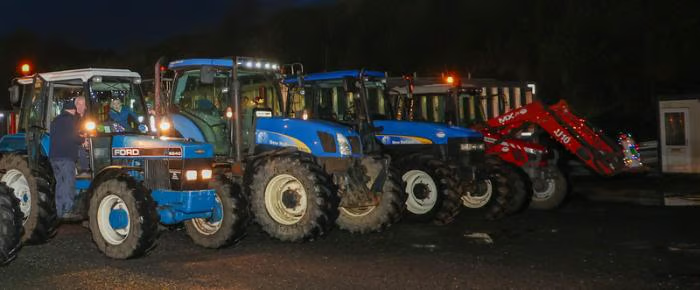
Ardara’s main street rolls down a long hill and turns right – then that’s about it. Before you know it you are back in the countryside. Like a lot of Donegal townlands, or villages, it is small but condensed. There is a lot in a small area. We had previously sat at a junction outside Ardara for 20 minutes and watched as what seemed like hundreds of tractors “zoom” past on a “Tractor Run”, a popular rural fun raising activity in Ireland (and Wales too). When I say “zoom” I mean relatively speaking, as a lot of the tractors were vintage ones that did not really zoom so much as chugg past.

The main street is dotted with lots of cafes, bars and wool/tweed shops. Ardara people are very friendly and welcoming. This is a regional centre for the dyeing and weaving of Donegal wool. This seemed to rub off choice of the colours of the walls of the village itself. The villages in the south of Donegal are a lot more colourful than the ones in the north. They favour white houses. I don’t know why, but I was surprised by the vibrancy of the colours of wool and cloths. They were the exactly same as the colours you see all around your in the Donegal landscape: greens of the grass, browns of the bogs, the pinks, purples, yellows and oranges of the flowers. Some cloths were flecked with an array of lush colours. As an artist it was very inspirational to see these colours.

A couple of years ago we visited the Triona Visitor Centre where a very patient lady answered a lot of my questions about weaving. There is also Campbell’s, Eddie Doherty’s and John Molloy’s to the south of the village. I would happily taken armfuls of coats and jumpers but in the end we limited ourselves to a tweed flat cap for Seamas and a pair of Donegal socks for me! Last of the big spenders, eh? This little village is well worth a visit and the list of upcoming festivals it hosts gives a good excuse call by if you are ever in the north of Ireland!

See more of my paintings of West Donegal here and Arranmore here

Find out More about Ardara

https://www.welovedonegal.com/ardara.html

https://www.govisitdonegal.com/things-to-do/places-to-see/ardara-heritage-town

https://www.donegalcottageholidays.com/join/images-of-ardara/

https://www.ardaradistillery.com/discover-ardara

Posted on 12 Comments

Three Donegal Paintings

Three Donegal Paintings by Emma Cownie

Grief has made me stupid. I struggle with new or complicated things. I am really struggling with writing anything longer than a couple of sentences. WordPress keeps changing how it works too.

 So I am just going to present you with three paintings of beautiful Donegal I have finished recently. I have a small collection of Gower paintings to come too. 

Waiting for the Tide, Rossbeg (Donegal)
Misty Morning on Rossbeg (Donegal) by Emma Cownie
Quiet on Arranmore, Donegal by Emma Cownie
Posted on 3 Comments

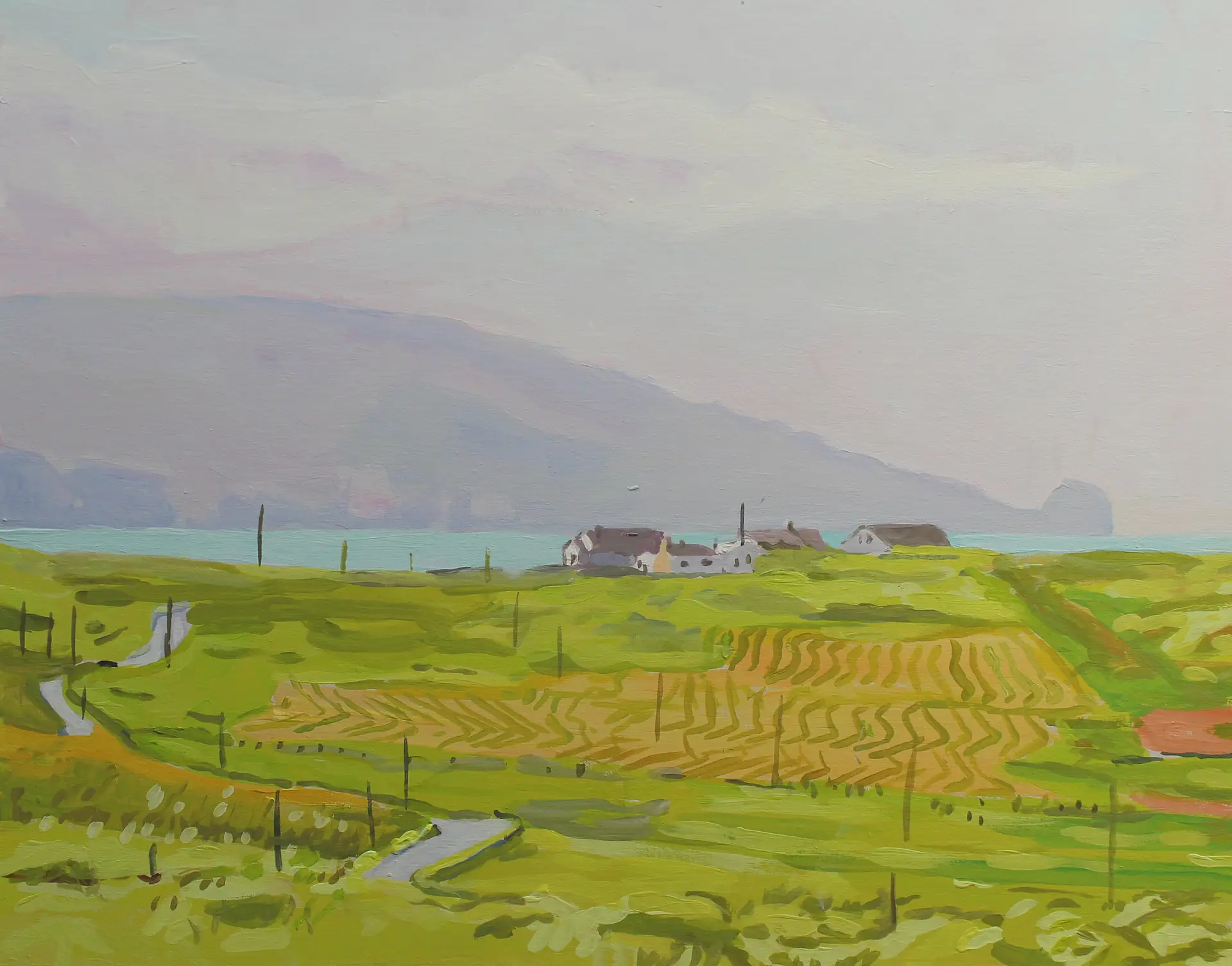
Patterned Fields, Rossbeg (Donegal)

Patterned Fields, Rossbeg by Emma Cownie

One of the joys of acrylic gouache is that it dries very quickly and is opaque – so it lends itself to this sort of mark making.

Posted on 2 Comments

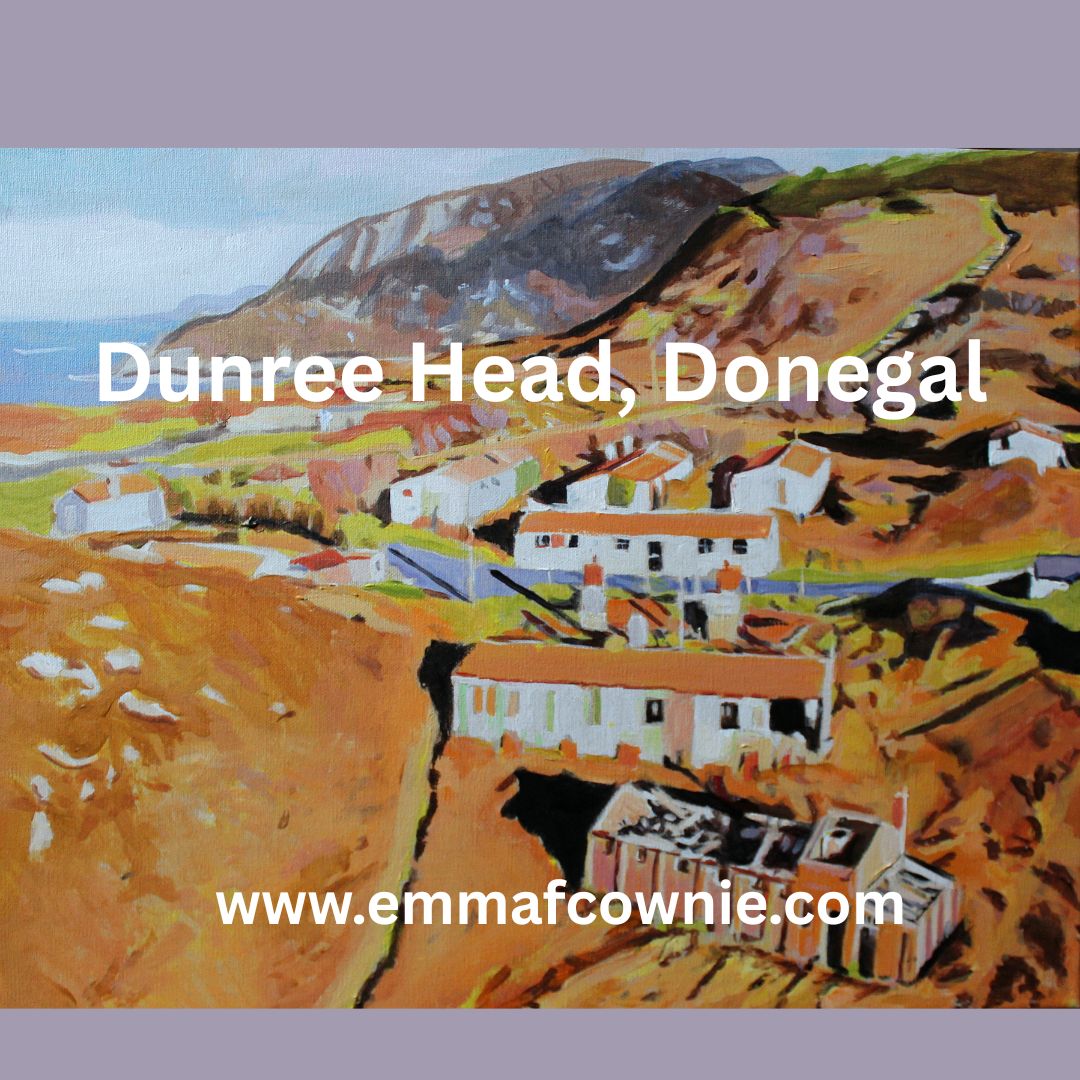
Dunree Head, Donegal

Dunree Head Donegal

 Dun Fhraoigh in Irish means, “Fort of the Heather” – it has been a fort at Dunree for thousands of years, since the Bronze age (over 4000 years ago). When you see the chunk of rock that the “modern” day fort (well Napoleonic era) for has been built on, you understand why.

Its a big chunk of rock! (photo credit: Emma Cownie)

Photo Credi t: The Artillery Club of Ireland
Aeriel View of Dunree Head (Google Maps)

Its location, on the cliffs of Dunree Head, is great for observing and controlling ships moving up and down the majestic Lough Swilly, one of Ireland’s three glacial fjords.

The English built this sturdy fort on the chunk of rock c. 1812-3 with a draw-bridge! The enemy back then, as readers of Jane Austen will know, was the French forces of Napolean Bonaparte. (The story of Jane Austen’s Donegal nieces is worthy of a BBC/RTE mini-series in its own right; linking Kent, Ramelton and Gweedore). The French had attempted landing in Lough Swilly in 1798 with a force of about 8,000 men, which was repelled at sea. The Royal Navy anchored ships in the Lough. There were a lot of big guns here, nine 24-pounders were in 1817.  There was once a Martello-type in the centre of the old fort but it was demolished c. 1900, as it obstructed the field of fire from the new fort on the summit of Dunree Hill.

Although the Irish Free State was created in 1922 and they followed (and still follow) a policy of political neutrality, the British army did not leave Dunree until 1938. This was because Lough Swilly was a “Treaty Port”, and it remained under British military control for defensive purposes.  During the Second World War, it was under control of the Irish Army and it played an integral role in safeguarding Ireland when a number of anti aircraft guns were added to site. The waters off the coast of Donegal are under threat today from Russia’s so-called “shadow fleet”.

I am not particularly interested in military hardware, although I know plenty of people in the world are. I have not been in the military museum. What did take my interest, however, were the barracks. There were brick buildings but also a lot of decaying iron huts that the gunners had lived in. I am nosy and I enjoy seeing how people lived. Although, frustratingly, most of that has gone. There tiny glimpses; brick chimney stacks, the odd rusting bedstead but not a lot.


Army Barracks – Brick and iron. Photo Credit: James Henry Johnston
Dunree Army Huts: Photo credit James Henry Johnston
Dunree Barrack Huts: Photo credit James Henry Johnston

A little further up (a steep) hill from Fort Dunree and the barrack buildings is Dunree Lighthouse. This a puzzling lighthouse. I am used to lighthouses being built atop of great pillars like the one across the Swilly water at Fanad.

The one at Dunree, however, has no tower. It doesnt need one. The light is at ground level. The “ground” however its up high on the cliff way above the Fort. A lantern attached to a house for the Lighthouse Keeper was built, and the light established on 15th January 1876. The light was a non flashing one with a two wick oil burner. Sadly, for the lighthouse keeper, technology did away with his job in 1927 when this light was replaced in December 1927 with an “unwatched acetylene with a carbide generating plant attached to the station”. The light was later converted to electricity in 1969. It must have been a great place to live. 

Lighthouse at Fort Dunree (Donegal)
Lighthouse at Fort Dunree (Donegal) – View from the east. The litchen covered stone wall is testiment to the clean air of Donegal

The lighthouse keeper’s house has a spectacular view across the Lough. Its built of local rubble stone masonry, this building retains its early form and character. Its visual appeal and expression is enhanced by the retention of much of its original fabric including timber sliding sash windows. Both the house and the lantern were built by McClelland & Co. of Derry. The simple outbuilding and boundary walls are very elegant too.

From the outhouse towards the lighthouse


The views at Dunree are spectacular. Lough Swilly is quite majestic, even on an overcast day.  Perhaps, it’s particularly dramatic on a overcast day with the shifting light and colours. You can walk up Dunree Hill and look over towards the Urris Hills and Dunree Bay (Crummies Bay).

There is a regular bus service from Buncrana, a coffee house, museum and public toilet. It might be a good idea to go before they start work on revamping the place!

See more paintings of Inishowen Peninsula here

Read More

https://www.buildingsofireland.ie/buildings-search/building/40901824/dunree-fort-dunree-donegal

https://www.donegallive.ie/news/inishowen/1589360/decision-on-12-5m-fort-dunree-tourism-project-due-early-next-year.html

https://www.govisitdonegal.com/blog/january-2024/between-waves-and-war

Posted on 2 Comments

Termon House Maghery

Termon House, Maghery

Termon House is set above a pebble beach at the north end of Maghery Strand on the West Coast of the Rosses area of Donegal. The elegant white house was most likely built by the Marquis Conyngham or by his predecessor, Montgomery in the 1770’s for the land agent, whose duty it was to collect rent from the local tenants on behalf of the absentee landlord. A Jamaican-born man named Ralph Spence Philips, was in occupancy at Termon House in the 1820s.

Termon House from the Air (Irishlandmark.com)

In 1822 the previous years extremely wet weather rotted all the potatoes in the area which resulted in famine. This was happening across Ireland and around a million individuals came to depend upon government aid during this particular crisis. Government agents in Dublin Castle allocated funds for acquisition of foodstuffs in Ireland, to be distributed to the poor at reduced prices or without cost, and to finance local relief works, such as roads, canals and harbours, or other projects deemed of benefit.

It may well have been Philips who initiated the building of the Famine Walls around the property as a means of feeding the local starving population, although he had no tenants of his own. The Public Works Committee in Dublin Castle, however, rejected Philips application for reimbursement and this meant a personal loss to him of £1500 from paying the labourers at a rate of 1d per day!

Termon House (Dream Ireland image)
The Famine Walls (Go Visit Donegal image)

There is another theory, however, that is that it was the Reverend Valentine Pole Griffith, the Protestant Rector at the height of the Great Famine, 1845-1850, who had the walls built. The Rev Griffith was one of the leading members of the Famine Relief Committee, who worked heroically on behalf of the poor. He set up public works in Maghery, would attend meetings all over the Rosses and write to anyone who he thought could help. The land around Termon House was owned by the Church of Ireland it may well be he who arranged for the massive walls to be built along the road there. On the day we visited it was overcast and my photos do not to justice the scale and extent of the walls.

You can see the famine walls on the right hand side of the house and to the far left side of the outhouses in my painting of Termon House (below). The rocks in the foreground are natural part of the rocky Rosses landscape.

What is undisputed is that this extraordinary and extensive system of walls standing approximately three metres high (10 foot)! The extensive system of tall walls built during this famine around his land is a testament to these hungry builders as they have withstood over 190 years of Atlantic storms.

Today, beautiful Termon House is leased by the Irish Landmark Trust and is available for holiday rental.

More Information

Go Visit Donegal on Facebook

www. maghery.ie/history

Irishlandmark.com

See my paintings of West Donegal here

See My Termon House Maghery Painting here

Posted on 13 Comments

Arranmore Swansong

Gortgar,Arranmore (Donegal)

We have been living with a lot of uncertainty since summer last year. This is why I have found it difficult to write regularly. Last summer, Biddy, our aged Collie-cross was so frail I didn’t come to Donegal with her. I didn’t think the long bumpy car journeys would be fair on her. The vets are an hour away. She was pts in November last year. It was an honour to look after her in her final days and I still miss her. I will write about Effie in a separate post, soon.

Artie and Biddy
Artie the cat and Biddy 2023
Biddy
Biddy in 2019 (Look I have found a stick for you to throw!)

It is with a heavy heart that I say that we are planning to leave Donegal. It’s a difficult place to live without family near by. It’s a stunning place and the recent sunshine has really highlighted that. It is possibly the most beautiful landscape I have ever seen and I will be very sad to leave. I am not entirely sure where we are going. I will let you know when we know.

In the meantime, I have painted a series of small paintings of Arranmore Island.

Gortgar,Arranmore (Donegal)
Painting of Arranmore Island by Emma Cownie
Children at Play – Arranmore Island by Emma Cownie
Arranmore Huddle (Donegal)
Inishkeeragh View, Arranmore (Donegal)

The Quiet Road, Arranmore (Donegal)

If you are interested in buying an Arranmore painting you can here: https://emmafcownie.com/product-category/paintings-ireland-emma-cownie/donegal-paintings-emma-cownie/donegal-islands

Posted on 1 Comment

New Year Sale – 30% off

30% off website

To Celebrate the New Year I am giving 30% off all work on my website – to get the discount you have to enter a code at the checkout. Where’s the code? Join my email list and it will be sent to you, automatically. The sale ends on 15th January.

View from the Pier (Portnoo)-Emma Cownie
View from the Pier (Portnoo)-Emma Cownie SOLD

If you have already joined my mailing list and haven’t had my latest newsletter with the sale code check your SPAM folder.

Posted on 11 Comments

Looking at Paintings in Real Life is Good for you

A long time ago, when I was a student, my favourite place to visit was the National Museum of Wales. The Davies collection in particular. The Davies were two sisters, Gwendoline and Margaret, amassed one of the greatest British art collections of the 20th century and bequeathed it (260 works!) to the National Museum of Wales. That’s Girl Power!

Some of Monet’s paintings at Cardiff National Museum

They had great taste. Those paintings became like my friends. I visited them often and spent a long time looking closely at them. They excited, inspired and comforted me. Even now when I look at reproductions of them online I have a strong reaction to them.

I used to think, this was because I was an artist. I remember peering closely at Monet’s brush strokes and marvelling at how they were laid down. I mean look at this.

A tingle goes down my spine, looking at it. This is what art is meant to do. It’s even better in real life.

Look at Van Gogh’s painting of a rainy day in Auvers. I have never seen better rain (and I have lived in Wales and Ireland – very wet places).

Van Gogh’s painting In its frame

The Mauritshuis Museum in The Hague, is the home of Vermeer’s ‘Girl with the Pearl Earring’. Thew museum recently did some academic research into how visitors responded to artworks. They looked at the neurological mechanisms and emotions underlying the appreciation of perception in art.

Girl with a Pearl Earing

The study used EEG and eye-tracking measurements on 20 participants who followed a set route through the Mauritshuis. Five paintings were included on this route: Girl with a Pearl Earring (Johannes Vermeer), The Violin Player (Gerrit van Honthorst), Self-portrait (Rembrandt van Rijn), The Anatomy Lesson of Dr Nicolaes Tulp, (Rembrandt van Rijn), View of Delft (Johannes Vermeer). They also showed them reproductions of the originals and compared their responses. The EEG results showed that the real paintings created a stronger emotional response compared with the poster versions of the same paintings.

Volunteer in the study looking at “Girl with a Pearl Earing” – Her eye movements are being tracked

“The Girl with a Pearl Earing” created the biggest emotial response. Painting of “The View of Delf” did not score well, and I wondered whether it was because it was a landscape rather than a portrait, not as famous as the “Girl with the Pearl Earing” or people were not familar with the layout of Delf. I have spent a long time looking at historic paintings of London, Swansea and Derry, trying to work out how they relate to the modern day cities. But maybe that’s because I’m pretty geeky. I doubt I had a big emotional response to them, though. Not enough paint!

Screen shot of the results of the study

The EEG results confirm that real paintings (compared to poster versions) also elicited a strong need to approach the paintings. It wasn’t just me wanting to get a close look at the paint! Real art, including the surrounding ambience, lighting, frame also helped evoke an emotional reaction many times more powerful (10x more powerful according to this study) than looking at a poster of a painting.

Some of you will put that in the “No Sh*t, Sherlock” category of scientific “discoveries” – which was my husband’s response when I told him about the study.

I have never seen Vermeer’s painting in real life but my parents have a reproduction in a tiny gold frame. I don’t know if people’s reponses were elicited because its very beautiful, well-composed, very famous, or because its a human face. I suscpect its a combination of all three.

Mona Lisa in the Louvre – I dont remember it looking as big as this when I saw it back in 1988!

Seeing a famous painting isn’t always rewarding. Maybe you too went to the Louvre in Paris to see the Leonardo’s Mona Lisa and were underwhelmed. Its notoriously small and hard to see as it under glass , far away and surounded by tourists.

There have been times I have come across paintings that I didn’t know and looked at them for a long time. I sat in the Tate (in the 1980s way before it became Tate/Tate Modern) with a lot of Rothko paintings and felt incredibly moved. You just cannot convey that with a reproduction.

So I guess this is a round about way to encourage you to go and see art in real life. You will feel better for it. Possibly. I hope you have some sort of emotional response – tears, laughter, anger even. Barnett Newman, Who’s Afraid of Red, Yellow and Blue III, 1967-68 has been slashed three times.

Barnett Newman, Who’s Afraid of Red, Yellow and Blue III, 1967-68. Oil on canvas, 8′ x 18′

We can’t all own Monets and Vermeers (and I don’t think any of us should, they are too important for that) but we can be glad that museums hold them in public collections we can see. I would love to see Picasso’s Guernica in real life. I have had it projected on a class room wall when I have taught lessons about the Spanish Civil War – it is a powerfully brutal work. My board was large no where near the full the size of the painting which is 3.49 meters (11 ft 5 in) tall and 7.76 meters (25 ft 6 in) across. Art stimulates our senses, emotions, and intellect. Guernica was also designed to stimulate our empathy. It is as relevant today as it was when it was painted in 1937.

Picasso’s Guernica, 1937

Cardiff National Museum let me visit the stores to see Robert Bevan’s Maples at Cuckfield in 2013, because my husband put in a request to see it after seeing in the gallery the year before after my car accident. This work inspired me to start painting again. It helped with my recovery from PTSD and burn out.

Seeing paintings in real life really does do you good. Dr. Saundra Dalton-Smith has identified looking at art as a way of getting creative rest, one of seven types of rest all people need. Creative rest involves exposing yourself to sources of awe and inspiration and makes you better able to create and problem solve. Painting pictures is even better for you.

Robert Bevan Maples at Cuckfield, Sussex 1914 National Museum of Wales, Cardiff Photo © National Museum of Wales

Just a reminder that I am offering 20% off all my paintings on my website until 14th October with a code.

Join my mailing list to get the code here.

Shifting Shadows on Three Cliffs Bay (Gower) Context

Read More about the study

https://www.theguardian.com/science/2024/oct/03/real-art-in-museums-stimulates-brain-much-more-than-reprints-study-finds

https://www.mauritshuis.nl/meisje/#Waarom-dit-onderzoek

https://www.theartnewspaper.com/2024/10/03/the-pearly-triangle-neurological-investigation-reveals-secret-of-vermeers-girl-with-a-pearl-earring