Posted on — 6 Comments

How to spot a Fake Artist (Updated Ai version)

https://emmafcownie.com/2017/11/07/how-to-spot-a-fake-artist/

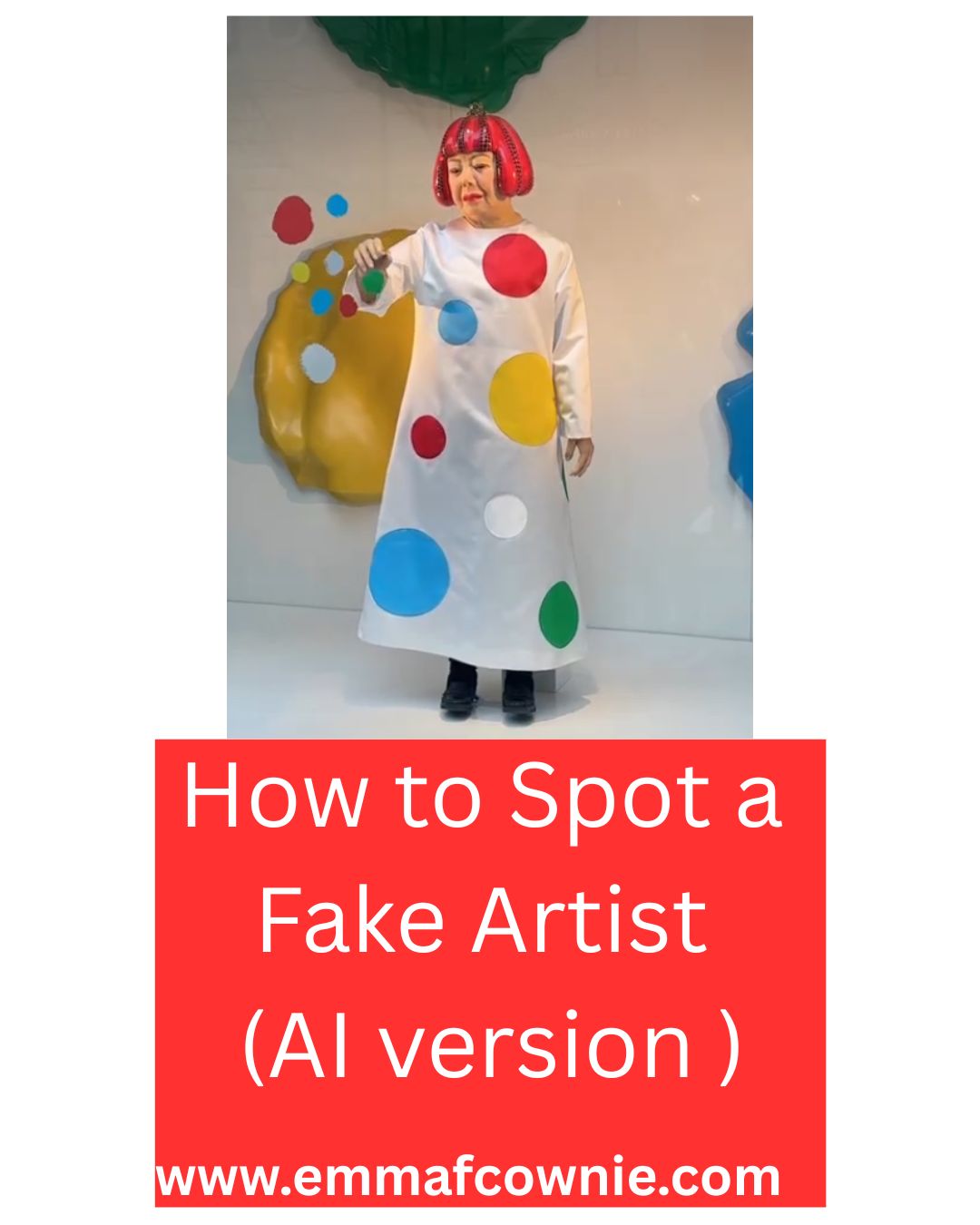
Three years ago a lifelike robot of Japanese artist Yayoi Kusama was installed in luxury shops in London, New York, Toyko and Paris. In London, the Art “robot”  painted  spots on the windows of Harrods as part of a display by luxury retailer Louis Vuitton. She  “smiled” and “nodded” at passers by in a decidely creepy manner. 

No one was going to mistake the robot for the real thing.

93 year old Yayoi Kusama meeting the Robot version of herself at Louis Vuitton Tokyo !

 Yayoi Kusama was a creative genius who had to wait a long time for success and recognition. She however had to take action against scammers in China who put on fraudulent exhibitions of her “work” in 2017. Since her death this year a lot of counterfeit Yayoi Kusama artworks — particularly prints — have appeared on the art market. 

Nine years ago I wrote a blog post about how to spot a Fake Artist. Back then I pointed out that the world is full of fakes and fakers, and thus it has ever been. Art forgery dates back more than two thousand years. Roman sculptors produced copies of  Greek sculptures.  With the advent of Ai, however, it has got harder than ever to spot the fakers. I have seen real artists fooled by Ai generated art on Instagram too.  

The fakers come in a number of guises. The first are accounts that just steal other artists’ work and present them as their own.   Then there are the accounts that pretend to have painted their work with real paint and will sell you a print. No paint was ever involved in these works. 

I am not going to post Ai images on my blog. But I will post links to account that I think are Ai generated. You can tell me if you think I am wrong.

Porter Art Guild 

This is a couple called  John and Tracy Porter from Illinois and Wisconsin. They began as founded a hand-painted furniture company and then graduated to “offering a curated selection of mixed media works that showcase the depth and breadth of their talents”. To be fair to them, their work is gorgeous  – both the photographs and the lush oil-painting-type images. But they are all digital images, not paintings.  Why aren’t they up front about their process? 

Jef Bourgeau

This is more a grey area. Jef  is a Detroit painter, curator, photographer and conceptual artist. He was the founder of Detroit’s MONA but he has turned to digital methods to make his art. He uses oblique descriptions for how he creates his work, including “digital” and “Photoshop, including the latest iteration” (which includes Ai). He says he dont use ai but his detractoors says they are actually just high resolution Ai images printed on fancy paper.

Mae Macpherson  

“Mae” isn’t a real perspon. This is a company founded in “her” name run by three people registered to an address in Edinburgh. On the website it says “The name “Mae Macpherson” is used as a creative brand identity and does not represent a real individual.” Yet they go to a lot of effort to give the impression that she’s a real person. A nice relateable artist. On the website there are videos of an individual opening up prints and spinning them around for the camera. She climbs a ladder and put on the wall. Is she Ai too? 

maemacphersonart
maemacphersonart

Who or what is she? It really annoys me that businsesses like these are pretending to be something that they are not.  These accounts have thousands of followers on Instagram and Facebook and comments gushing about how talented “Mae” is.  How are they going to feel when the find out that Mae isnt a struggling artist but something a computer spat out?

It doesnt not matter to me that people are buying someone else’s  art rather than mine, its the deception that gets me.  The real damage that they do is putting doubt and distrust into people’s minds. If I see paintings that I think are good I now wonder if they are ai. 

So, here’s what my updated checklist of what to look for:-

A photograph of the artist. Even better if the artist is photographed or filmed in the act of drawing, painting or standing in front of her paintings at an exhibition. That way you know the photo hasn’t been lifted from facebook. Look at their fingers? If they have 6 on each hand it might be ai.

A surname, not just “Rosa” or “Luigi”.

A detailed backstory, preferably with details of education and exhibitions.

A website, facebook page, a blog, an Instagram page with a back story of paintings this will help prove that this a real artist and not the product of a factory or ai.

Subject matter – are they generic  Scottish villages/mountains/seascapes/lakes or are they of particular locations that are named?

Do they sell original work -in oil or arcylic paint? Are the canvases a bit untidy,  around the back? Is there a photo of their studio or where ever they paint? 

Ask someone else opinion. Does this art look real? Does it look like a human made it? Any more suggestions to add to my checklist? Let me know!

The Corner of my painting room
The corner of my painting room
Posted on — 1 Comment

AI and the Rot Economy

Stephen Collins

I have tried several times this year to write more about developments in AI (and Art) but I keep giving up because I keep getting sucked down “rabbit holes” and I find it hard to see the wood for the trees. OK here goes – I dislike and distrust AI. It’s overhyped. The visual stuff looks horrible. It’s dangerous. Unregulated it is going to cause a lot of damage in our societies/brains/education/communities/environment. I think that is the nub of it. We are told that our glorious AI-powered future is imminent, yet what we’ve actually got is unprofitable, unsustainable generative AI that has an unassailable problem of spitting out incorrect information. Its an expensive dead end.

If you would like to read a more articulate assessment of the current state of (digital) economy I can recommend Ed Zitron article on the Rot Economy – its in a slightly different league to the Cory Doctorow’s Enshitification explanation of why platforms like Facebook, Instagram, Pinterest and Youtube used to be good to use but are now annoying and almost impossible to use. Can you find the video you just watched on Youtube? Me neither. I have struggled with WordPress ever since it “updated” itself to include all sorts of AI features I will never use. My Windows 11 PC isnt much better. It forever flips a “news” screen in front on my eyes in the midst of me doing something else, like typing a blog

Ed says “Things are being made linearly worse in the pursuit of growth in every aspect of our digital lives, and it’s because everything must grow, at all costs, at all times, unrelentingly … Our digital lives are actively abusive and hostile, riddled with subtle and overt cons. Our apps are ever-changing, adapting not to our needs or conditions, but to the demands of investors and internal stakeholders that have reduced who we are and what we do to an ever-growing selection of manipulatable metrics.” I was delighted (and not surprised) that 95% per cent of the more than 10,000 people in the UK who had their say over how music, novels, films and other works should be protected from copyright infringements by tech companies called for copyright to be strengthened and a requirement for licensing in all cases or no change to copyright law. AI companies have no right to our work.

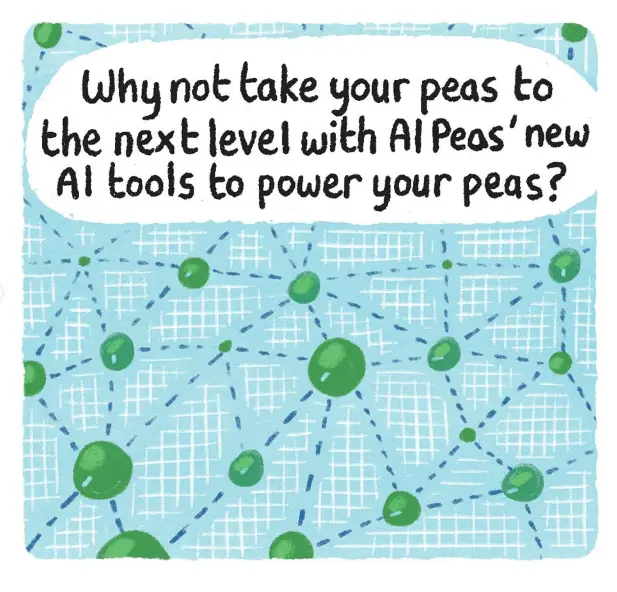
I have decided to give up on writing about AI and so instead I will you with the best commentry on this current state of madness I have come across: AI Peas by Stephen Collins.

Posted on — 15 Comments

20% off sale

20 Sale off Emma Cownie paintings until 14th October 2024 with code

Have you seen this Apple advert? Take a moment to watch it. It makes my blood run cold. Surprisingly the tech bros at Apple thought it was a good idea to show this advert which depicts a tower of creative tools and analog items (like paint, trumpets and record players), being crushed into the form of the iPad. It’s a pretty grim vision of the future. It a good visual metaphor for what is happening to creatives right now.

This year has been the toughest year I have experienced as an artist, for a myriad of reasons, and the art market seems to be struggling generally. Yes there’s war in Ukraine and the Middle East (and elsewhere in the world) and “the Cost of Living Crisis” and terrible cold and wet weather in the British Isles hasn’t helped either.

It seems evident that it’s more difficult getting my work seen. I cant help but think that AI and the “enshitification of the internet” is at least partly responsible. I feel a bit like I am being slowly crushed by the Apple crusher. It’s sapping my creative juices. I don’t quite know what to do about it. Cory Doctorow explains how enshittification works “It’s a three-stage process: first, platforms are good to their users. Then they abuse their users to make things better for their business customers. Finally, they abuse those business customers to claw back all the value for themselves. Then, there is a fourth stage: they die.”

This is probably the reason why I can’t find any useful results on google – lots of top ranking website are full of AI nonsense. It’s also why fewer people are seeing my work on the internet. My posts are pretty much hidden on Facebook, Instagram and invisible on X. Images of my paintings do not show up on Google as much as they did say 3 or even 6 months ago. Many other artists report a similar decline in interest from potential customers.

I have started to visit my local library again in search of real books with in- depth facts. The only decent thing on Google these days is Wikipedia. I find that Youtube playlists are so random as to be useless and a search on Pinterest results in either pins I have seen before (in other words I have already saved them) or one unrelated to the search term I just used. Tech companies are burning up the planet with their massive data centres in the hope that one of them will “win” the AI battle and then charge us all for what used to be better quality and free.

What’s this got to do with you? Everything. Doctorow says that enshittification is coming for all industries. “From Mercedes effectively renting you your accelerator pedal by the month to Internet of Things dishwashers that lock you into proprietary dish soap, enshittification is metastasising into every corner of our lives. Software doesn’t eat the world, it just enshittifies it.” Think about your printer – a new printer is cheap as chips but the ink costs a fortune and you cant use non-proprietary ink and your printer will know, and refuse to work.

Corry Doctorow’s big hope is that “Stein’s Law will take hold: anything that can’t go on forever will eventually stop…if everyone is threatened by enshittification, then everyone has a stake in disenshittification.” Actually, there’s a lot more to it than that. You’ll have to read his articles to find out what USA and EU are planning to do to break the monopolies of the big tech comapnies.

I just hope that independent artists like me survive the process or else everyone will have to console themselves with souless AI-derived art their ipad/smartphone/tablet device instead.

See below for some scary examples of AI “Art”. It’s a nonsense view of Derry if you didn’t know.

“Painting of Derry City by Emma Cownie” – Thanks AI. I can give up now. NOT.

Just in case some of you are saying. It’s Londonderry not Derry. AI is no better at conjuring up a view of Londonderry. Take a look! Although there is a river this time.

“Painting of Londonderry City by Emma Cownie”

How about Three Cliffs Bay? I have painted that many times. Sure AI will do better at ripping me off. Well, no.

Painting of Three Cliff Bay by Emma Cownie – Yes, it looks NOTHING like Three Cliffs Bay

Yes, we can laugh at AI’s efforts and say they look nothing like those places or my paintings but it’s all doing damage. AI can never replace human creativity. AI cannot suffer and struggle like humans. It just produces a wierd pastiche of the thing it is meant to be. It’s expensive rubbish. It’s costing us dearly. Emissions from data centers of the likes of Google, Microsoft, Meta and Apple may be 7.62 times higher than they let on.

We can reverse the enshittification of the internet. Don’t accept those tracking cookies. Try a different search engine. Stay on the website rather than downloading apps (you can use ad blockers on the website you can’t on the app). Don’t buy everything via Amazon if you can buy it in a real life shop.

We can halt the creeping enshittification of every digital device. Put down your phone/tablet and read a book or look at a painting made by a real human being. Join artists’ mailing lists so you can still follow their work no matter what the big platforms do to hide their work.

Shifting Shadows on Three Cliffs Bay (Gower) Context
Shifting Shadows on Three Cliffs Bay (Gower) -Emma Cownie which is also in the sale (with the code)

Read more

Cory Doctorow on Enshittification of the Internet – https://pluralistic.net/2023/08/27/an-audacious-plan-to-halt-the-internets-enshittification-and-throw-it-into-reverse/

https://www.theguardian.com/technology/2024/sep/15/data-center-gas-emissions-tech