


Today is the shortest day of the year. Its very dark up north here. The morning are very dark yet I find it hard to sleep. When the sun appears it illuminates and reveals a verdent but slummering landscape. I am always looking for flashes of red to paint in the deepest winter. In the past it might be a coat, or a door. Today it is a red roof on an old stone cottage. The old houses are disappearing fast here.
This part of Inishowen near Dunaff feels remote. Maybe that’s because we drove through up and through the Urris Hills and Mamore gap to get here. It’s all small long roads like this one. Its tucked away in a north western corner of Inishowen, Malin Head is to the north, close by. I look forward to the days slowing getting longer.

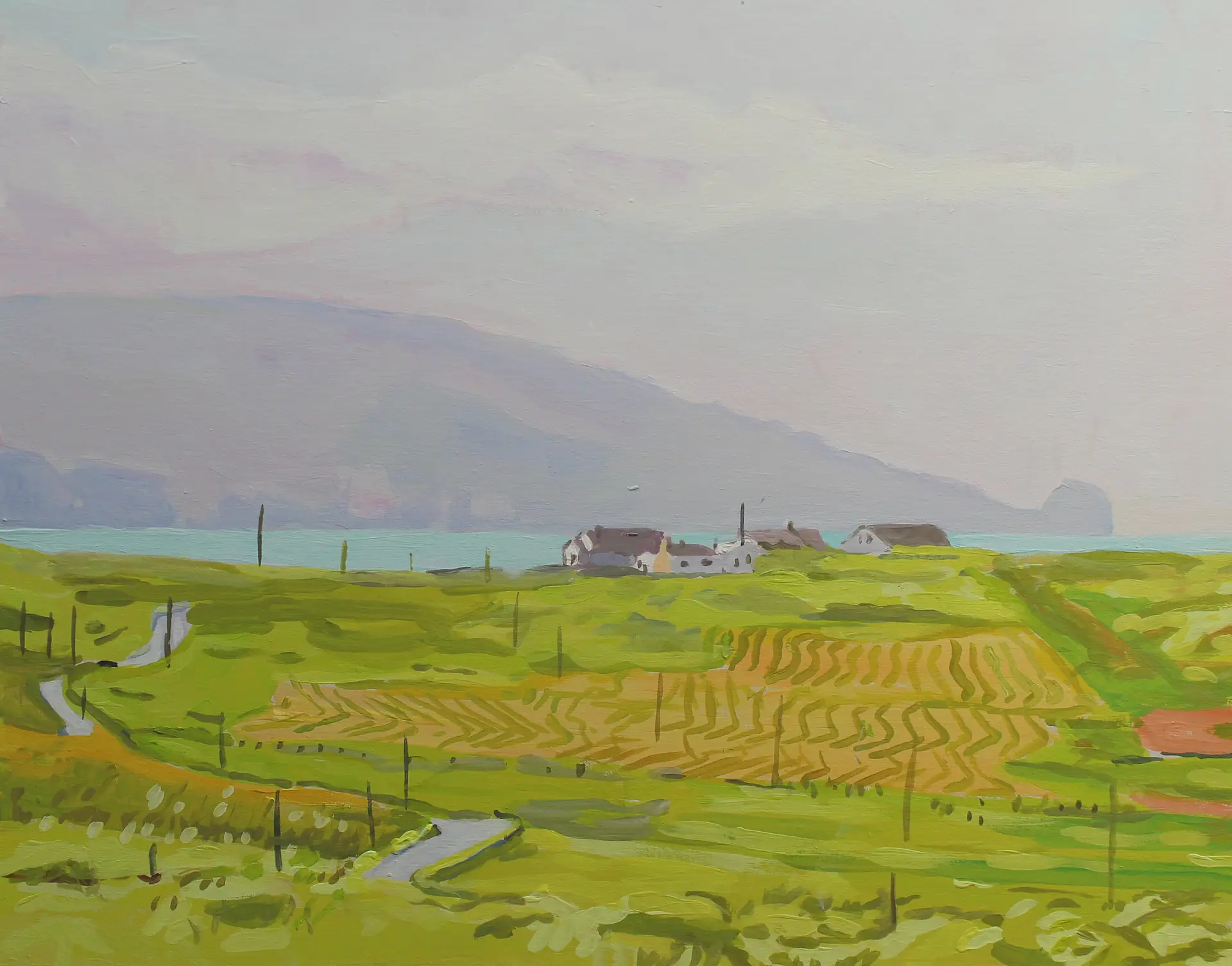

One of the joys of acrylic gouache is that it dries very quickly and is opaque – so it lends itself to this sort of mark making.

Dun Fhraoigh in Irish means, “Fort of the Heather” – it has been a fort at Dunree for thousands of years, since the Bronze age (over 4000 years ago). When you see the chunk of rock that the “modern” day fort (well Napoleonic era) for has been built on, you understand why.

Its a big chunk of rock! (photo credit: Emma Cownie)


Its location, on the cliffs of Dunree Head, is great for observing and controlling ships moving up and down the majestic Lough Swilly, one of Ireland’s three glacial fjords.
The English built this sturdy fort on the chunk of rock c. 1812-3 with a draw-bridge! The enemy back then, as readers of Jane Austen will know, was the French forces of Napolean Bonaparte. (The story of Jane Austen’s Donegal nieces is worthy of a BBC/RTE mini-series in its own right; linking Kent, Ramelton and Gweedore). The French had attempted landing in Lough Swilly in 1798 with a force of about 8,000 men, which was repelled at sea. The Royal Navy anchored ships in the Lough. There were a lot of big guns here, nine 24-pounders were in 1817. There was once a Martello-type in the centre of the old fort but it was demolished c. 1900, as it obstructed the field of fire from the new fort on the summit of Dunree Hill.
Although the Irish Free State was created in 1922 and they followed (and still follow) a policy of political neutrality, the British army did not leave Dunree until 1938. This was because Lough Swilly was a “Treaty Port”, and it remained under British military control for defensive purposes. During the Second World War, it was under control of the Irish Army and it played an integral role in safeguarding Ireland when a number of anti aircraft guns were added to site. The waters off the coast of Donegal are under threat today from Russia’s so-called “shadow fleet”.
I am not particularly interested in military hardware, although I know plenty of people in the world are. I have not been in the military museum. What did take my interest, however, were the barracks. There were brick buildings but also a lot of decaying iron huts that the gunners had lived in. I am nosy and I enjoy seeing how people lived. Although, frustratingly, most of that has gone. There tiny glimpses; brick chimney stacks, the odd rusting bedstead but not a lot.


A little further up (a steep) hill from Fort Dunree and the barrack buildings is Dunree Lighthouse. This a puzzling lighthouse. I am used to lighthouses being built atop of great pillars like the one across the Swilly water at Fanad.
The one at Dunree, however, has no tower. It doesnt need one. The light is at ground level. The “ground” however its up high on the cliff way above the Fort. A lantern attached to a house for the Lighthouse Keeper was built, and the light established on 15th January 1876. The light was a non flashing one with a two wick oil burner. Sadly, for the lighthouse keeper, technology did away with his job in 1927 when this light was replaced in December 1927 with an “unwatched acetylene with a carbide generating plant attached to the station”. The light was later converted to electricity in 1969. It must have been a great place to live.


The lighthouse keeper’s house has a spectacular view across the Lough. Its built of local rubble stone masonry, this building retains its early form and character. Its visual appeal and expression is enhanced by the retention of much of its original fabric including timber sliding sash windows. Both the house and the lantern were built by McClelland & Co. of Derry. The simple outbuilding and boundary walls are very elegant too.

The views at Dunree are spectacular. Lough Swilly is quite majestic, even on an overcast day. Perhaps, it’s particularly dramatic on a overcast day with the shifting light and colours. You can walk up Dunree Hill and look over towards the Urris Hills and Dunree Bay (Crummies Bay).

There is a regular bus service from Buncrana, a coffee house, museum and public toilet. It might be a good idea to go before they start work on revamping the place!
See more paintings of Inishowen Peninsula here
Read More
https://www.buildingsofireland.ie/buildings-search/building/40901824/dunree-fort-dunree-donegal
https://www.govisitdonegal.com/blog/january-2024/between-waves-and-war

Termon House is set above a pebble beach at the north end of Maghery Strand on the West Coast of the Rosses area of Donegal. The elegant white house was most likely built by the Marquis Conyngham or by his predecessor, Montgomery in the 1770’s for the land agent, whose duty it was to collect rent from the local tenants on behalf of the absentee landlord. A Jamaican-born man named Ralph Spence Philips, was in occupancy at Termon House in the 1820s.

In 1822 the previous years extremely wet weather rotted all the potatoes in the area which resulted in famine. This was happening across Ireland and around a million individuals came to depend upon government aid during this particular crisis. Government agents in Dublin Castle allocated funds for acquisition of foodstuffs in Ireland, to be distributed to the poor at reduced prices or without cost, and to finance local relief works, such as roads, canals and harbours, or other projects deemed of benefit.
It may well have been Philips who initiated the building of the Famine Walls around the property as a means of feeding the local starving population, although he had no tenants of his own. The Public Works Committee in Dublin Castle, however, rejected Philips application for reimbursement and this meant a personal loss to him of £1500 from paying the labourers at a rate of 1d per day!


There is another theory, however, that is that it was the Reverend Valentine Pole Griffith, the Protestant Rector at the height of the Great Famine, 1845-1850, who had the walls built. The Rev Griffith was one of the leading members of the Famine Relief Committee, who worked heroically on behalf of the poor. He set up public works in Maghery, would attend meetings all over the Rosses and write to anyone who he thought could help. The land around Termon House was owned by the Church of Ireland it may well be he who arranged for the massive walls to be built along the road there. On the day we visited it was overcast and my photos do not to justice the scale and extent of the walls.


You can see the famine walls on the right hand side of the house and to the far left side of the outhouses in my painting of Termon House (below). The rocks in the foreground are natural part of the rocky Rosses landscape.
What is undisputed is that this extraordinary and extensive system of walls standing approximately three metres high (10 foot)! The extensive system of tall walls built during this famine around his land is a testament to these hungry builders as they have withstood over 190 years of Atlantic storms.
Today, beautiful Termon House is leased by the Irish Landmark Trust and is available for holiday rental.


More Information
See my paintings of West Donegal here

“Announcing SAOIRSE by @charleen_hurtubise, a powerful novel set between the United States and Ireland about a woman who runs from her traumatic past and the secrets she carries to survive. Coming February 24, 2026.”
With artwork by me!


See more original paintings of Donegal here

“Is this a fast painting or a slow one?” My husband asks.
This question gives me pause.
“A fast one” I reply.

My paintings usually take days to complete. On average three days. A smaller one quicker. Commissions are still “slow” paintings.
Lately, though I have taken to completing paintings in a single sitting. This may well be several hours, but its a single sitting.

The results are more sponanteous-looking. The process feels slightly out of control. Often I think “I have bitten off more than I can chew” here. But I stick with it. Years of painting have taught me to ignore the impulse to give up. To push on, even when when it looks a bit ugly.
There may well be things wrong; colours or details but they dont matter too much. I will alter them if they really bug me. Mostly I dont. The brush strokes are broken and incomplete. In some places they are deliberately rough. The canvas shows through in places. Often I am uncertain if I like the painting when I stop. Its usually a bit of a surprise. I have to fight my perfectionism.

I am racing ahead of my thoughts. Ahead of my critical mind that tells me its not good enough and to keep painting. Now I refuse to listen and keep going. It’s intense and exhausting.

My father died in June this year. He was 92. My heart is broken. He was a lovely, funny and kind man and I miss him terribly.


I am delighted to announce that I have made Jacksons Art’s extended long list for their 2024 Art Prize. The list was announced on 14th but as I didnt get an email from Jacksons, I assumed I hadn’t made the cut. So imagine my delight when I find a “Congratulations” email that isn’t telling me I have won a load of bitcoin has arrvived in my inbox.
It reads “With 12,964 entries submitted, from 129 countries, the selection process was incredibly competitive. As an artist on the Extended Longlist of 3,168 works, you are in the top 25% of entries. The full list is available to view here. ” I am on page 5 if you want to look.

Update
The excitement only lasted a morning. Turns out that my email provider had hidden the “Congratulations” in a folder it calls “Promotions” which is mostly emails from Art suppliers. It had been there for a week before I spotted it. Strange how I had no problems seeing the “Thank you for Taking Part” email yesterday afternoon. Oh, well.

I am delighted and honoured to have been interviewed by Aaron S (@aaronsehmar on Instagram) for his Flying Fruit Bowl podcast. If you haven’t come across his podcast and website check it out – he’s a thoughtful and insightful interviewer who is a very talented photographer in his own right. He’s interviewed a diverse range of talented artists. There is a lots to discover. It’s like a breath of fresh air.
Flying Fruit Bowl Instagram account

DIRECT DOWNLOAD: https://open.acast.com/public/streams/65a7aa539b536b00171d8ee3/episodes/67acc03e9c6f7f7f2859bc1a.mp3
APPLE MUSIC: https://podcasts.apple.com/us/podcast/the-flying-fruit-bowl/id1548279888
SPOTIFY: https://open.spotify.com/episode/02nik9zJGEU7zLMtPzIjih
This is going to be short. I am snatching a few minutes whilst the puppy sleeps.
Long story short; our beloved Biddy, who has been with us for 15 years had to be put to sleep. In our grief we made a truly daft decision and immediately got a puppy AND moved house in winter. My mother said it was compliment to Biddy that we wanted another dog straight away. I think she was being kind, but she does love animals so maybe not.
So enter Effie. Or the “Scruffy One” as my husband called her as we watched her and her sister (our choice of two) cavort around the farmer’s yard with great energy. This was the one my husband picked.
She was covered in mud (poop) and slightly pink from blood. Her litter-mates picked on her. The farmer said ‘I think she will be the kinder dog”. Kind means gentle in this part of County Derry. Yes we picked the underdog.

So we took home a mucky pup and gave her a shower. She has dealt with the transition to indoor life with three cats very well. We, the humans have found it a tougher transition.

There is a lot to learn with collies. They are not like other dogs. They are super smart but also very sensitive. We are exhausted from trying to keep up and understand her. I have been doing a lot od reading. I find Barbara Skyes’ books on Border Collies really helpful. We still haven’t quite finished moving house!

She is pretty much house-trained after 3 weeks (probably slow for a collie) but needs to be made to chill out and nap several times in the day or she gets fractious and grumpy at night. Every morning is a new start even if she went to bed sulking with us, and greets us both with a kiss (lick on the ear) and chest (to gently rub).

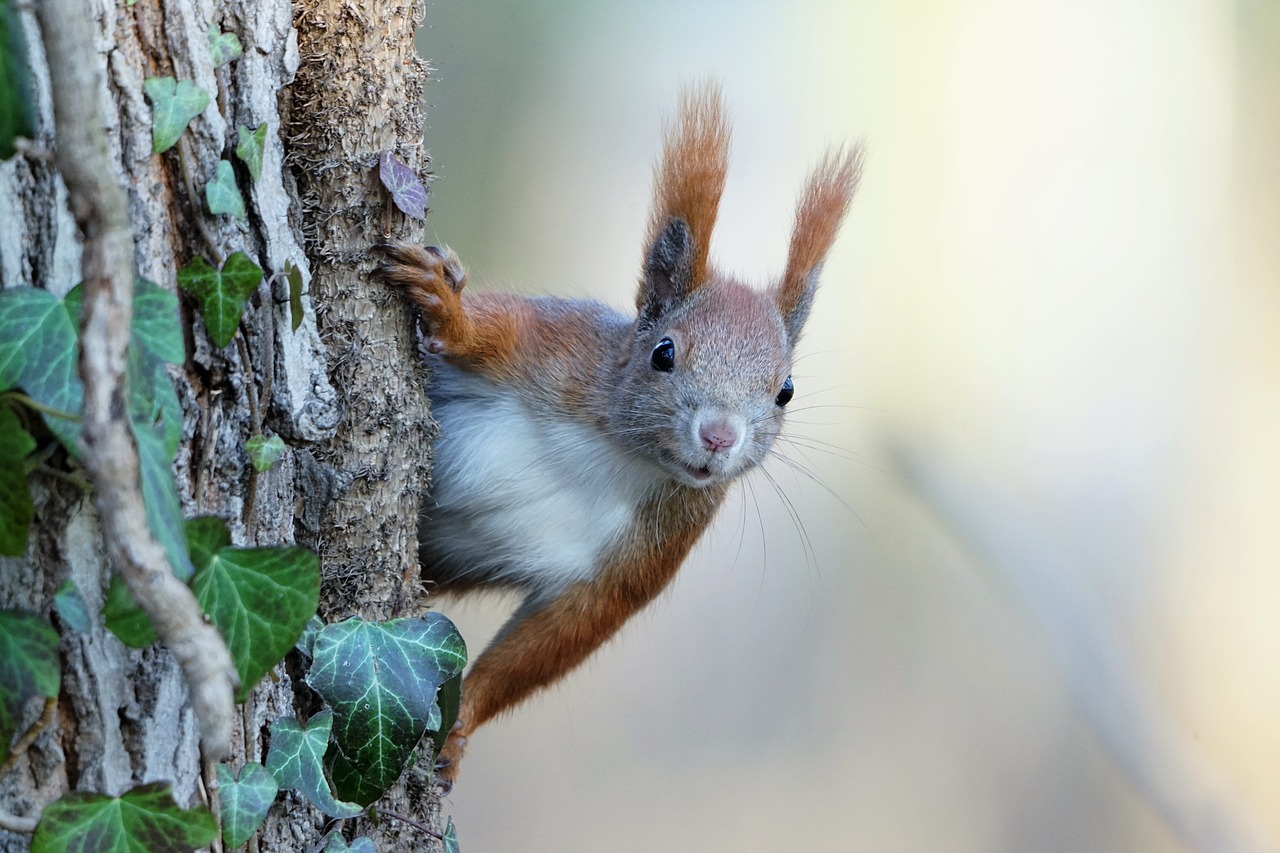
And the red squirrels? We saw two this week. For the first time in my life. They are very rare in Britain. They are more common in Ireland but shy. We saw two on Inch Island when we were out exercising Effie.

She has to be exercises away from other dogs and grass until we’ll after her second vaccination. We saw them scampering across a lane from a wooded area. They are very different from their grey American cousins. They are smaller, delicate with russet red coats and tuffed ears. When they run their bodies and tails undulate in an elegant way. The second time I saw one I could see it had a white chest. It was fleeting sighting so I don’t gave a photo but I can offer a couple of paintings I did many years ago.
Times up. Effie stirs.


