Today is the shortest day of the year. Its very dark up north here. The morning are very dark yet I find it hard to sleep. When the sun appears it illuminates and reveals a verdent but slummering landscape. I am always looking for flashes of red to paint in the deepest winter. In the past it might be a coat, or a door. Today it is a red roof on an old stone cottage. The old houses are disappearing fast here.
This part of Inishowen near Dunaff feels remote. Maybe that’s because we drove through up and through the Urris Hills and Mamore gap to get here. It’s all small long roads like this one. Its tucked away in a north western corner of Inishowen, Malin Head is to the north, close by. I look forward to the days slowing getting longer.
Dun Fhraoigh in Irish means, “Fort of the Heather” – it has been a fort at Dunree for thousands of years, since the Bronze age (over 4000 years ago). When you see the chunk of rock that the “modern” day fort (well Napoleonic era) for has been built on, you understand why.
Its a big chunk of rock! (photo credit: Emma Cownie)
Photo Credi t: The Artillery Club of Ireland
Aeriel View of Dunree Head (Google Maps)
Its location, on the cliffs of Dunree Head, is great for observing and controlling ships moving up and down the majestic Lough Swilly, one of Ireland’s three glacial fjords.
The English built this sturdy fort on the chunk of rock c. 1812-3 with a draw-bridge! The enemy back then, as readers of Jane Austen will know, was the French forces of Napolean Bonaparte. (The story of Jane Austen’s Donegal nieces is worthy of a BBC/RTE mini-series in its own right; linking Kent, Ramelton and Gweedore). The French had attempted landing in Lough Swilly in 1798 with a force of about 8,000 men, which was repelled at sea. The Royal Navy anchored ships in the Lough. There were a lot of big guns here, nine 24-pounders were in 1817. There was once a Martello-type in the centre of the old fort but it was demolished c. 1900, as it obstructed the field of fire from the new fort on the summit of Dunree Hill.
Although the Irish Free State was created in 1922 and they followed (and still follow) a policy of political neutrality, the British army did not leave Dunree until 1938. This was because Lough Swilly was a “Treaty Port”, and it remained under British military control for defensive purposes. During the Second World War, it was under control of the Irish Army and it played an integral role in safeguarding Ireland when a number of anti aircraft guns were added to site. The waters off the coast of Donegal are under threat today from Russia’s so-called “shadow fleet”.
I am not particularly interested in military hardware, although I know plenty of people in the world are. I have not been in the military museum. What did take my interest, however, were the barracks. There were brick buildings but also a lot of decaying iron huts that the gunners had lived in. I am nosy and I enjoy seeing how people lived. Although, frustratingly, most of that has gone. There tiny glimpses; brick chimney stacks, the odd rusting bedstead but not a lot.
Army Barracks – Brick and iron. Photo Credit: James Henry Johnston
A little further up (a steep) hill from Fort Dunree and the barrack buildings is Dunree Lighthouse. This a puzzling lighthouse. I am used to lighthouses being built atop of great pillars like the one across the Swilly water at Fanad.
The one at Dunree, however, has no tower. It doesnt need one. The light is at ground level. The “ground” however its up high on the cliff way above the Fort. A lantern attached to a house for the Lighthouse Keeper was built, and the light established on 15th January 1876. The light was a non flashing one with a two wick oil burner. Sadly, for the lighthouse keeper, technology did away with his job in 1927 when this light was replaced in December 1927 with an “unwatched acetylene with a carbide generating plant attached to the station”. The light was later converted to electricity in 1969. It must have been a great place to live.
The lighthouse keeper’s house has a spectacular view across the Lough. Its built of local rubble stone masonry, this building retains its early form and character. Its visual appeal and expression is enhanced by the retention of much of its original fabric including timber sliding sash windows. Both the house and the lantern were built by McClelland & Co. of Derry. The simple outbuilding and boundary walls are very elegant too.
The views at Dunree are spectacular. Lough Swilly is quite majestic, even on an overcast day. Perhaps, it’s particularly dramatic on a overcast day with the shifting light and colours. You can walk up Dunree Hill and look over towards the Urris Hills and Dunree Bay (Crummies Bay).
There is a regular bus service from Buncrana, a coffee house, museum and public toilet. It might be a good idea to go before they start work on revamping the place!
I am delighted to announce that I have made Jacksons Art’s extended long list for their 2024 Art Prize. The list was announced on 14th but as I didnt get an email from Jacksons, I assumed I hadn’t made the cut. So imagine my delight when I find a “Congratulations” email that isn’t telling me I have won a load of bitcoin has arrvived in my inbox.
It reads “With 12,964 entries submitted, from 129 countries, the selection process was incredibly competitive. As an artist on the Extended Longlist of 3,168 works, you are in the top 25% of entries. The full list is available to view here. ” I am on page 5 if you want to look.
Carn (Donegal) – Bridge Street in Carndonagh, Donegal
Update
The excitement only lasted a morning. Turns out that my email provider had hidden the “Congratulations” in a folder it calls “Promotions” which is mostly emails from Art suppliers. It had been there for a week before I spotted it. Strange how I had no problems seeing the “Thank you for Taking Part” email yesterday afternoon. Oh, well.
This is going to be short. I am snatching a few minutes whilst the puppy sleeps.
Long story short; our beloved Biddy, who has been with us for 15 years had to be put to sleep. In our grief we made a truly daft decision and immediately got a puppy AND moved house in winter. My mother said it was compliment to Biddy that we wanted another dog straight away. I think she was being kind, but she does love animals so maybe not.
So enter Effie. Or the “Scruffy One” as my husband called her as we watched her and her sister (our choice of two) cavort around the farmer’s yard with great energy. This was the one my husband picked.
She was covered in mud (poop) and slightly pink from blood. Her litter-mates picked on her. The farmer said ‘I think she will be the kinder dog”. Kind means gentle in this part of County Derry. Yes we picked the underdog.
Effie was born in a barn
So we took home a mucky pup and gave her a shower. She has dealt with the transition to indoor life with three cats very well. We, the humans have found it a tougher transition.
First night in a big basket
There is a lot to learn with collies. They are not like other dogs. They are super smart but also very sensitive. We are exhausted from trying to keep up and understand her. I have been doing a lot od reading. I find Barbara Skyes’ books on Border Collies really helpful. We still haven’t quite finished moving house!
We think Artie has had experience with collies before
She is pretty much house-trained after 3 weeks (probably slow for a collie) but needs to be made to chill out and nap several times in the day or she gets fractious and grumpy at night. Every morning is a new start even if she went to bed sulking with us, and greets us both with a kiss (lick on the ear) and chest (to gently rub).
Nellie and Flossie with Effie
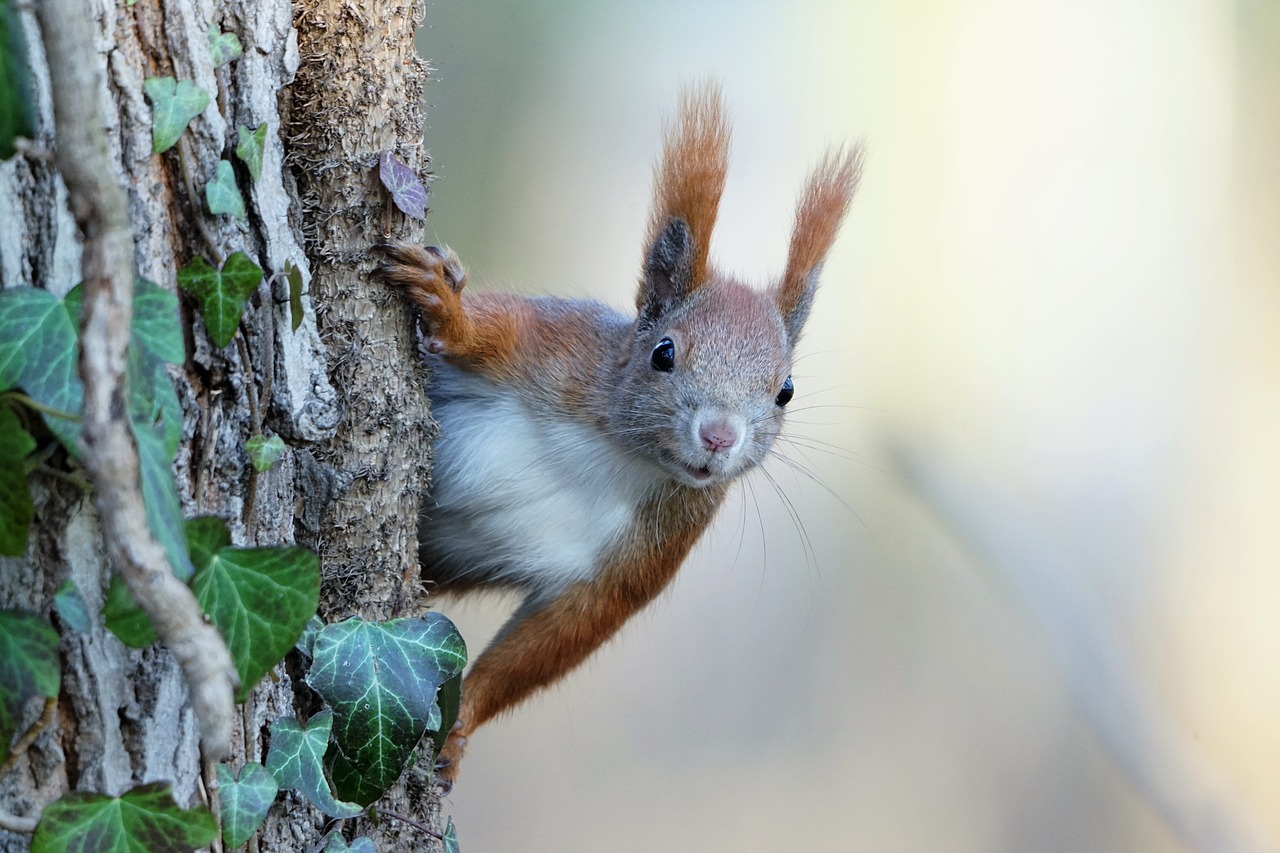
And the red squirrels? We saw two this week. For the first time in my life. They are very rare in Britain. They are more common in Ireland but shy. We saw two on Inch Island when we were out exercising Effie.
My favourite image of her – asleep!
She has to be exercises away from other dogs and grass until we’ll after her second vaccination. We saw them scampering across a lane from a wooded area. They are very different from their grey American cousins. They are smaller, delicate with russet red coats and tuffed ears. When they run their bodies and tails undulate in an elegant way. The second time I saw one I could see it had a white chest. It was fleeting sighting so I don’t gave a photo but I can offer a couple of paintings I did many years ago.
Times up. Effie stirs.
Red Squirrel – oil on canvasRed Squirrel in the Snow -oil on canvasRed Squirrels (from Pixabay)
We have been exploring Malin Head a fair bit recently. I really enjoy it’s wildness and dramatic beauty. It’s one of those rare places that is quiet. By quiet, I mean a lack of human busyness. There’s plenty of nature noise like the wind, the hissing of the grasses and leaves as they are blown.This has to be one of the most exposed spots in Ireland.
There is good scattering of robust cottages and relatively few cars. The narrow, winding roads mean that they are not pelting by. Its the quiet and still I hunger for – even when its blowing a gale! The fresh air here is like a refreshing drink of water.
Here are two new Malin Head paintings. The first is “Midsummer at Malin Head” which is a sturdy cottage surrounded by vigorous growths of monbretia. We are a bit early for its distinctive firey orange flowers – the come out from July to September.
The second painting is John’s Cottage, Malin Head (photography with permission of John Gallagher). John was born in the cottage but he now lives with his family (and dog) in a neighbouring cottage a stone’s throw from here.
In the distance are the Urris Hills, also on the Inishowen Peninsula. We spent two days last autumn there, looking for my husband Séamas’s drone crashed on Croaghcarragh (a peak between Urris Hills and Mamore with Mamore Gap in between) after he flew it backward into the mountainside! I spent a longtime waiting for him as various spots on the mountain, looking out towards Dunduff, Clonmany and Malin. The view was magnificent in that direction too. The howling gale that threatened to blow us off the mountain was pretty sobering. Fortunately, the drone was found and it still worked after a night out in the wilds. DJI make pretty tough little drones!
The name will be familar to British ears who ever listened to the daily shipping forecast on BBC Radio. It is broadcast late at night just before 1 am and very early (5.20am). Anyone who is a night owl or insominiac will have listened to it. The list of shipping zones and forecasts is not only practical but also poetic and rather mysterious. Following the litany of locations and numbers is very soporistic. Listen to the clip below. The actual broadcast is from 2.46 onwards ZZzzzzzzzzz
Shipping Forcast (1993) – almost always broadcast on the radio, you have to use your imagination!
Many British people may not know where Malin Head it is anymore than than they know the location of German Bight or Viking. To Irish ears, however, it is well-known as the most northerly tip of the island of Ireland and also features on Met Eireann’s, sea area forecast, broadcast on RTE.
UK_shipping_forecast_zones
Malin Head to Mizen Head
People regularly tranverse the length of Ireland from Malin Head, Donegal, to Mizen Head, Cork. It’s a fair stretch. Just under 400 miles (640 km). Some incredible people have cycled it in just over 15 hours. Ordinary mortals take about 4 days.
Amazingly some super-human runners have done it in about the same time – 4 days! I recently listened to a radio interview with the heroic Sophie Power. Sophie is from England and she recently ran the length of Ireland in under 4 days. This is a World Record. She beat the previouis record by three hours. Being a mother, she had to fit it in during her children half-term holiday and didn’t get to pick the day with the nicest weather – just the Tuesday of half-term and so she started off in driving rain! Many years ago I used to run (only piddly 10ks and 5ks) and I would certainly prefer to run in rain than heat.
Incredibly Sophie ran most of the distance without sleep, snatching the odd half an hour on her second and third day. She ended up hallucinating, and with a knee injury that had to be braced. When she finished the race in Cork she had developed heat stroke! That alone shows you how far south Cork is. There’s no way she’d get heat stroke in Donegal! She’s planning to come back and run the Cork Marathon.
Sophie Power at Malin Head
At the Edge of the world
Standing at Malin Head is like standing at the edge of the world. To the north is nothing can be seen but sky and sea. A long way off is Iceland and much. much further away to the north-west is North America. It feels very remote (but surprisngly accessible from Letterkenny and Derry/Londonderry) but to fishermen and sailors, I’m sure it’s not. Scotland is surpisingly close to the north-east. If you have ever flown from England to Belfast on a clear day, you can see the Scottish Isles and the Isle of Man scattered across the Irish Sea, pretty close the Antrim coast. Donegal is just a bit further along.
On the most northerly tip of the island of Ireland, you will find a tower that was built in 1805 during the Napoleonic wars as a lookout tower to defend against any attacks by the French. You can see at the top left hand side of my painting above. Edges of places are places to look out from – for invaders, or for incoming storms. Weather reports that were important to local and international shipping were first recorded at Malin Head in 1870. It was in that year the tower became a signal tower for Lloyds of London. Semaphore was used to connect with ships at sea and the lighthouse on nearby Inishtrahull. In 1902 the first commercial wireless message was sent from Malin Head to the S.S.Lake Ontario by the Marconi Company.
Divers’ magnet
There are the wrecks of many ships lying off the coast in this area. Many of these such as SS Audacious, SS Carthaginian and RMS Justicia date to the time of the First World War, when Ireland was still part of the British Empire.
In 1917 two German mines sankLaurentic and although her crew successfully abandoned ship, but 354 of them died of hypothermia in her lifeboats.Interestingly, Laurentic was carrying about 43 tons of gold bars when she sank. Most of the 3,211 bars were salvaged by 1924; three more bars were found in the 1930s, however 22 gold bars have still not been recovered.
The Great Emergency/Second World War
During the Second World War, Ireland was neutral. The Irish army built lookout posts in places along the coast to prevent any violation of this neutrality. This was important as this part of Donegal is so close to Northern Ireland, which not not neutral and was bombed by the Germans. There is an EIRE 80 sign built of stones during the war so aircraft would know that they were over Ireland (not Northern Ireland). They acted also as a navigational aid for pilots. Eire 79 is at Fanad Head to the west. Eire 81 is at Glengad Head, further along the Inishowen Peninsula, to the east. You can see it on the map below. The SS Athenia, a passenger ship carrying 1,418 people was torpedoed by a German U-boat just hours after war had been declared in 1939 off the coast of Malin Head! Most of the passengers survived but 117 perished.
Tourism Sign at Malin Head
Some scenes from the film Star Wars: The Last Jedi film was shot at Malin Head. I have to admit that I am not a Star Wars fan – I never made it through awhole film. I have to admit that I’m more of a Star Trek fan. Apparently, it is possible to have a tour of the locations used for the film from local tour guides. The road leading up to Bamba’s Crown has been renamed locally from the R242 to the R2D2 in recognition of the Star Wars connection. Also beside the tower, there is a short lovely refreshing walk along the cliffs to Hell’s Hole. The cliffs are massive here and even on a relatively calm day the sea is restless and a bit intimidating It needs to be remembered that this not just a sea here but an Ocean.
Birds Eye View of Malin Head, Donegal- Emma Cownie
While many of you are baking in England and dealing with a hosepipe ban, in Donegal it’s cloudy with occasional showers. I thought I would share you my recent newletter. They have ended up being quarterly. It depends of how much news I have and how busy I have been. I always make it strong on the visuals and light on the words! I also make the typeface large for reading on smart phones!
We are about to decamp to Donegal for the summer/early autumn. I have mixed feeling about returning to oil paints. It’s been a quite a steep learning curve getting comfortable with acrylic paint but I feel like I finally got there. I am not sure what it will be like to paint in oils again; oh the the joy of easy blending! I am looking forward to being able to paint larger canvases. I will continue my practice of laying down an underpainting in grey-scale paint, regardless.
Here are some of my recent acrylic paintings, mostly of Inishowen Penisula (Donegal)
Kinnagoe Beach – Emma Cownie
Down to the Rusty Nail, Inishowen_Emma Cownie
Fanad (SOLD)
On the Way to Kinnagoe Bay (Drumaweer, Greencastle) (SOLD)
And finally a few also of my favourite, Gola Island.
Still, On Gola (Donegal)
The Turn in the Road, Gola – Emma Cownie
A Sandy Road Through Gola-Emma Cownie
The weather forecast is for cool weather, so I will be packing some light jumpers. I have found, however, that forecasts are pretty unreliable for Donegal so it could be very pleasant. I am looking forward to the sweet breezes!