Posted on 15 Comments

Catching the Morning Light

When I get hold of an idea I can get quite obsessive about it. Lately, it’s been early morning light. I think it sprang from a post I wrote about transposing some of the techniques I used for my “Urban Minimal” project to what I only half-jokingly called “Rural Minimal”. I think that my rural Gower houses did fulfil the spirit of “Rural Minimal” but it got me think about shadows. Now, shadows were my first love. They still are. It’s hard to find any painting of mine without blue/mauve/purple/brown shadows. I go through tubes of Lukas 1862 Mauve at a steady rate. Many of my Gower woodland paintings used early morning winter light.


ENCHANTED WOOD 2
Enchanted Wood  Limited edition mounted print (unframed) 

[wpecpp name=”Enchanted Wood Large Print ” price=”45″ align=”left”]

And why do I love shadows so much? It’s because they act as a foil to the light. The orange next to the dark mauve positively leaps off the canvas. Perhaps, its a cheap way of thrilling the viewer? I am always very impressed by artists who capture a gloomy or overcast landscape. Plein Air painters prefer overcast conditions because they are more constant and American artist, Jeremy Sams,  demonstrates this really well in his painting. He says “The good thing about painting on an overcast day is that you don’t have to chase shadows. The light remains very constant and my acrylic paints stay wet for a good long while.”

IMG_1404
Jeremy Sam’s Plein Air Study

However, I love shadows. They make a composition interesting and dynamic. So, anyway, the post about Rural Minimal got me thinking about shadows in rural settings. I realised that because I have been focusing on my Gower Walks and working to bus timetables that I was mostly walking in the late morning and finishing up in the early afternoon. I was becoming increasing frustrated that my lovely walks weren’t inspiring the sort of paintings I like to make. The light wasn’t right. Midday light, especially in the summer, has a tendency to bleach out the details. This is what shadows “do”, they show us the details of the landscape.

IMG_0519d
Light Shadow (SOLD) 

I have always been a morning person. Each morning is like a fresh start to me. What ever happened yesterday, last night is gone.To be honest, I think that have always done my best work by 11 am. When I was writing my PhD thesis, many years ago, I’d do my best writing between at 8 and 11 am. To be honest, most of the work I did after 11 am was fact checking (this was in the days before the interest when you had to look things up in books) and faffing, but I’d dutifully stay at my desk til 5 pm.

IMG_9875c.JPG
Bernard Street Bus Stop (Back of Brynmill Launderette) SOLD  


So I decided that I need to seek out early morning light on Gower. This long spell of hot weather meant that morning skies were often (but not always) clear. That meant getting up early.  I have been dragging myself out of bed just after sunrise. It’s summer and the sun rises just after 5 am in here Wales. It is painful getting up that early but once I have had a cup of coffee I can face the outside world, just about.

The first time I drove down to Three Cliffs Bay, 6 miles away, I was so tired that I actually forgot my camera! I felt so stupid but I got back in my car and drove back home to fetch the darn thing, delaying my “start” by 30 minutes.

Pobbles Bay on Gower
Pobbles Bay after 8am

Compare the light and shadows to yesterday morning (when I remembered my camera) and actually got there for about 6.30am.

Pobbles Bay, Gower
Pobbles Bay 6.30 am

It’s different. Not necessarily better, just different. Do you know what, it doesn’t matter. I like both conditions.  The changing tides always also variety and interest. Summer Morning light has a beautiful rich quality to it and I like seeing how it changes, the shadows shorten, darken, light break over the cliffs, as the morning progresses. I have sat down on the cliff tops and watch the light change.

Early Morning, Three Cliffs
Early Morning, Three Cliffs (SOLD)  (Oil on Linen canvas, 80×60 cm, unframed)


I like seeing nature first thing. I like seeing the dew. In this very dry summer it’s a godsend. The grass on rolling fairways of Pennard golf course has turned the colour of straw except for the patches where the dew collects in the morning. There it’s a fresh green. Walking down towards the sea, along the sandy path by the golf course, I often see the white tails of wild rabbits dashing into the undergrowth. Their numbers in the UK have fallen in recent decades but thankfully, there seem to be plenty on Gower.

Bunny
Welsh Wild Rabbit

Free-range cows roam the cliffs of Pennard and South Gate as well as the valley next to Three Cliffs Bay. They are usually busily eating the grass they can find down in the marshy valley or in the shadows of the thorny gorse bushes, or even in the Golf Club car park before the golfers arrive!

Cow in Car Park at Pennard
Cow at Pennard


Cows chewing the cud (mid morning) and cows at work, eating grass (early morning).

I delight in the long shadows and the reflections at low tide. How the reflected light is more golden than the light on the rocky cliffs.


Three-cliff-reflections
Three Cliffs Reflections  (SOLD Oil on Linen canvas , 80x50cm, unframed)

At high tide the colours all change again.


I have got up early and visited Rhossili, Penmaen and Three Cliffs Bay six times in the past fortnight. This includes the morning I thought the light cloud would clear but instead it thickened. A passing Jack Russell was photographed, as well as the rabbit above. So, I sat down and sketched.


I will keep going until this weather goes off, while may well be very soon. I will be working from this research for quite a while after it has clouded over again.

A while back, last June in fact, I read an excellent blog post by American artist Luann Udell entitled “How Long Did It Take You To Make That?” in which she discusses all time-consuming processes and skill that go into creating her pieces. It occurred to me that while the actual time it takes to paint my work may take anything from one to three days, depending on the size of the canvas, the actual thinking, planning, gestation, waiting for the weather and preparation takes a lot longer. I should also include in that waiting for the seasons to change. Just yesterday I was remarking to my husband that the heather was starting to flower and so another visit to Rhossili Downs would be in order soon. Nothing stays the same in nature, or in life! My job is to observe and attempt to capture some of those fleeting changes.

Enquiries about Commission Always Welcome – Find out more here

Posted on 30 Comments

Gower Coastal Walk: Tor Bay & Oxwich Bay

I am shattered. My legs are so stiff, I can hardly walk up and down stairs. I have been this way for days. My problem is that I can do activities, running, yoga, walking but often “pay for it”afterward. I don’t really understand how much this is to do with life post-PTSD, if at all because you never fully recover from PTSD, but you learn to manage with what you have. Maybe it’s middle age. Maybe I do too much or just can’t tell when I am doing too much. I am pig-headed. When I see a sunny forecast I am looking at maps and bus timetables and planning my next walk. OK. A word about bus timetables. The ones for Gower are very confusing. The ones for the Swansea (including Limeslade, Caswell and Pennard Cliffs) are great. I understood them. The buses ran frequently. Once you get past Pennard Cliffs and change bus companies, however, the timetable becomes impenetrable. I have spent hours looking at the little rows of numbers and columns of place names trying work out how they connect or don’t. I have woken up in the night worrying how I am going to complete this coastal walk. It seems that I can get to several of the places I want to go in the morning OK; Oxwich, Rhossili, Llangennith (if I can get to the bus stop at 7.40am). It’s the coming back that’s a much dodgier affair. There seems to be one bus in the late afternoon. Maybe. If I have downloaded the correct timetable from the internet as there often seem to be several versions and I am not sure when one is the one the bus drivers will be using (see my earlier blog for my rant about lack of tourist or bus information.in Swansea). Part of the problem is that I am trying to get to places outside the main tourist season June-August when there are slightly more buses running. Maybe this wouldn’t matter if I knew that I could walk 20 miles in a day, or 11 miles, but so far I have only done 3 or 4 miles and found them pretty tiring. So this is a long-winded way of saying that I have broken my rules. Just to remind you. They are:- 1. Travel in a clockwise direction around the Gower coast 2. Travel by public transport and by foot. 3. Walk on sunny days. So Rule No. 2. I’ll fess up. For some parts of the coastal walk, I got in my car and drove to the places that I was struggling to figure out the public transport links for. That was until Ceri from woman walking blog recommended traveline.com to me.
Oxwich Map.JPG
Map of Oxwich Bay
Rule 1. Clockwise direction? Not always. This particular walk was done in two parts. The first from Tor Bay in a westerly direction (with both human and canine company) on a breezy, sunny day but the second part was done from Oxwich (alone) in an easterly and thus anti-clockwise direction (and looped back to my car). It wasn’t very sunny. So I broke all the rules on that day. It didn’t feel good but nevermind. I’m just doing it badly. It’s a coping strategy. I came across it recently. The thinking goes, if you are paralyzed by anxiety and a fear of failure: “Just Do It, Badly.”Once the summer bus timetable is action, perhaps I’ll be a perfectionist and do it “properly”. We’ll see. I’ll pick up from last week’s blog about Three Cliffs Bay. The climb up from western side of Three Cliffs Bay itself is pretty tiring as its very sandy but the view at the top is worth every bit of the struggle.
IMG_5297
Top of the Cliffs above Pennard Pill
At the top is an Iron Age fort. The Iron Age was a very long time ago – about 2,500 years.  It has a fantastic view of Three Cliffs Bay (the ramparts are covered in primroses). Following the coastal path around the very windy edge of the cliffs, you eventually reach around the top of Great Tor and Tor Bay below.
IMG_5364
Path around Cliff Tops
IMG_5471
The Spine of Great Tor
At low tide Tor Bay can be reached by walking along the beach from Three Cliffs Bay in the east and also from Oxwich Bay in the west, but at high tide the sea cuts off the little bay. It then can only be reached by a path down from the cliffs. This path is very sandy at the bottom end making it considerably easier to walk down than up it! This is a detour and not part of the coastal path walk!
IMG_5589
Down to Tor Bay
IMG_5592
Empty Beach at Tor Bay
It was a windy day and the clouds and their shadows were racing across the sands. It was really delightful watching the light and colours change on the cliffs tops and beach. We saw only three people and one day on this mid-week walk.
IMG_5525
Light and shadows  on Great Tor
My two canine companions Biddy and Mitzy had a great time, especially when they found something really stinky to roll in, on top of Little Tor. There were streaks of “it” in their coats. Like brown dog-highlights. Urgh! It smelt really bad even out in the fresh air, despite a dip in the sea. It was even worse in close quarters in the car home. Needless to we drove with the windows open and they were bathed as soon as they got through the front door with lots of lovely dog shampoo.
IMG_5605
My walking companions (the ones with 4 legs are smelly)
On the path above Tor Bay is a curious stone building with two archways going nowhere. A useful shelter if you are caught out in the rain or in a hail storm was we were a few months back. It’s actually a lime kiln. Gower is dotted with these buildings in which which limestone was burnt or calcined to produce quicklime.
IMG_5508
The Lime Kiln
IMG_5512
Lime Kiln (Close Up)
The path then undulates along the headland until it reaches little five bar wooden gate with a wonderful view of Nicholston Burrows (dunes) and Oxwich Bay on the other side.
IMG_5574
Oxwich Bay & Nicholaston Burrows
The path continues until you are given the choice of carrying on down through the woods on the right on down to the sandy beach on the left. I took the long sandy path through the dunes down to the beach, the smell of the sea calling me all the way. If the tide is out you can then loop left round to Tor Bay or right and walk along Oxwich Bay. Oxwich Bay is a wide expanse of water and sand. It’has a sandy beach which is about 2 1/2 miles long, flanked by sand dunes, patterned by a maze of tracks. Beyond the dunes lie lakes, woodlands, salt and freshwater marshes. Apparently, it’s rare to have so many different habitats in such a relatively small area in the UK. They are all part of the Oxwich nature reserve. The beach and the dunes are bisected by Nicholaston Pill, a small river that flows out from the marshland and reeds. I’d forgotten that there’s a little wooden bridge over the river, tucked away in the dunes. There was a middle-aged couple sitting on the sand dunes with their dog. I stopped and we had a long chat, in which we discussed in quick succession; the weather, buses, Cardiff, Swansea’s one-way traffic system, the council, the Slip Bridge and buses again.
IMG_1856
Some very large flotsam
Eventually, after a very long walk on soft sand, past much flotsam, I reach the end of the beach. There lies the village of Oxwich. In summer this is a very busy beach.  This is the second largest beach on the Gower peninsula after Llangennith. There is a large car park, a flat beach, a cafe, and toilets so it’s rather popular with visitors, apparently, an incredible a quarter of million of them each year! There are several caravan parks within walking distance too. When we first came to Gower we used to come here and I once attempted to surf here. It didn’t go well as I paddled too far out and got scared.
IMG_1812.JPG
Oxwich Bay Hotel
Set just a step back from the beach is the Oxwich Bay Hotel. It is an imposing building, its steeply pitched tiled roof reminding me of French architecture for some reason. The tiny village Oxwich lies on a road leading inland from the sea. That because this was not a fishing village. It probably won’t surprise you to learn that the woodland areas of Oxwich were quarried for limestone and exported, using Oxwich bay as a small port.  So the cottages of Oxwich were once the homes of the local quarrymen. At the start of the Napoleonic Wars, in which Britain declared war on France, the Royal Navy was forcibly “recruiting”, or press-ganging, men from communities situated along the British coast. This included the Gower coastline. Late one Thursday evening in October 1803, the HM Press Gang called at Oxwich and took 5 sailors, one of whom was a ship’s boy, who had happened to come ashore from a merchant vessel. Once upon a time, all the houses in Oxwich would have been thatched. Now few are except the cottage that has gained fame for being the place the Methodist Minister, John Wesley once stayed in 1764. It was known as the “Nook”. The well-traveled Wesley was impressed by the people of Oxwich as he noted in his diary that “all the people talk English, and are in general, the most plain, loving people in Wales’. There is no pub in Oxwich and it has been suggested that the influence of John Wesley may have had a bearing here!
4c403077606c422d8a0500a32d9c52dd.jpg
John Wesley’s Cottage, Oxwich
So I broke the rules (including the staying on the official coastal path one) but I have made it past my “block”.  I have had to pay the price as must have walked for about 5 miles on the sand. Hence the very stiff calves. Maybe, next time I will take the woodland walk! I did it badly today but I did it. Next time I will walk Oxwich Head and experience mild peril.
Painting of Great Tor, Gower, Gower Walk
Posted on 24 Comments

The ever changing landscape

I am very lucky to live close to the sea. I can never get over my excitement at seeing the sea, even when I live so close to it. I would say that all of the Welsh coast is pretty special. The coast along Pembrokeshire, Ceredigion and the Llyn Peninsula are spectacular however, the Gower peninsula is the coast I visit most often as it’s the easiest to get to for to get to and its paintings of the Gower peninsula that work on most often.

swanseaGower has some incredible coastlines and fabulous beaches. I have always wanted to walk its length but never got my act together to do it. I made plans to do so in 2016 but being made redundant from my teaching job in that year, sort of threw everything out of kilter for me.

The best beaches always involve a bit of a hike but its always worth it. From an artist’s point of view its always different. Whether its high tide, low tide, summer, spring or a blustery winter’s day. What’s the main difference between the seasons? The light. Whether the sun is high or low in the sky, the angle of the rays, the quality of the light. Is it sharp or is it hazy?

Drifting Clouds on Three Cliffs
Floating Clouds over Three Cliffs

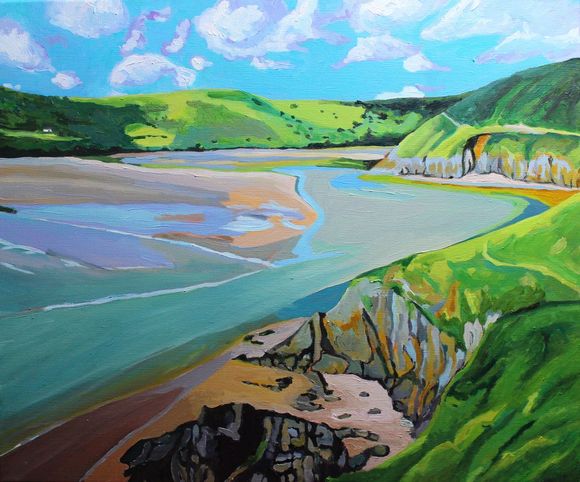
I have painted Three Cliffs Bay quite a few times. I am find it interesting to reflect on the different ways I have approached what is in some ways the same subject matter. In winter the sea is a grayed jade the wet sands are pinkish, the dry sand different shades of yellow. The colour of foliage is very muted; the grass on the clifftops is more yellow than green and the bracken is brown. The cliffs are warm grey in direct sunlight, a cooler grey in shadow.


Even on brighter days when the sea has more violet the colours of the cliff tops is more yellow ochre than orange.

Coloured Sands at Three Cliffs
Coloured Sands at Three Cliffs Bay

Three Cliffs Bay at High Tide

Three Cliffs Bay at High TideWhat surprised me when I compare these winter paintings with some that I had done in the summer is that the wet and dry sand is the same ruby/pink/yellow tones, although it seems obvious that it would be now I think about it. What is different, is the sky and the colour of the grass and bracken on the cliffs. The sky is a lighter turquoise and the sea is has more jade and turquoise. The clouds reflections in the surf is still violet. The grass is wonderfully verdant, a sharp green.


This is the oldest painting and it was done in high summer when the grass is a deeper green.

Pobbles and Three Cliffs

Of course, looking through these paintings, I immediately wish I had done some autumn paintings when the bracken is a rusty red. I have painted Rhossili Bay in autumn but not Three Cliff. I can’t think why not. Of course, last autumn I was focusing on my “Hollowed Community Project” and painting houses. I hope that I will be able to come back and paint Three Cliffs again this autumn.


Posted on 6 Comments

Is it Three Cliffs Bay or Three Cliff Bay?

Looking Back from Three Cliffs Bay
Looking Back From Three Cliffs Bay
Looking Back From Three Cliffs, Gower 2017 


Oil Painting of Three Cliffs Bay, Gower, Wales. This is an unusual view from Three Cliffs Bay in Gower, Wales, looking back towards Parkmill from the top of granite rock monuments of one of the three cliffs.

I loved the array of colours and found it an arresting view, away from the bustle of the waves and shouting exuberance, to the calm and reflective.


However, when I came to write this post this morning, I was suddenly seized by the terrible thought that I might have been guilty of getting a Gower place name wrong. I thought so anyway.   I have been calling Three Cliff Bay, Gower, Three Cliffs Bay. So what? However, I have noticed last week that a local artist and blogger called it Three Cliff Bay, with no “s”. So I decided that I had been erroneously been adding an extra “s” to the cliff part of the name. Entirely understandable because you would assume that if it’s in the plural, it would have an “s” at the end.  Perhaps I not been paying close enough attention! I felt bad, that I had got it wrong. I’d be a poor landscape artist if I couldn’t get the name of the place I had painted correct!

However, I decided this need further investigation. Trying to check this on the internet, did not clear up the matter. Plenty of others also call it Three Cliffs with an “s”. The Visit Swansea Bay website for one calls this area Three Cliffs Bay as does as Trip Advisor and the local campsite, which calls itself Three Cliffs Bay Holiday Park! You think they would know what its called, as they live there?

However, I think it’s a little more complicated than that. Google Maps actually has both names. But when I studied their map a little closer – it seems that they use Three Cliffs Bay for the tidal beach and Three Cliff Bay for the sea part of the bay. The Ordnance Survey just has Three Cliff Bay for the sea part of the bay. So finally, I turn to my trusted authority on all things Gower related – a book. Wynford Vaughan-Thomas’s 1976 edition of “Portrait of Gower” which is full of facts, stories and gossip about old Gower and its people (Wynford was a Swansea-born Historian who was taught English at school by Dylan Thomas’s father).

Wynford-vaughan-thomas
Wynford Vaugh-Thomas in his BBC days

His section on what he calls “one of the great Gower views” he calls it Three Cliffs Bay. So there. Phew! That’s good enough for me. I have worried about nothing and wasted half an hour fact checking.

It is called Three Cliffs Bay. Unless you happen to be out at sea and then is Three Cliff Bay! Unless you know better!

© Emma Cownie 2017