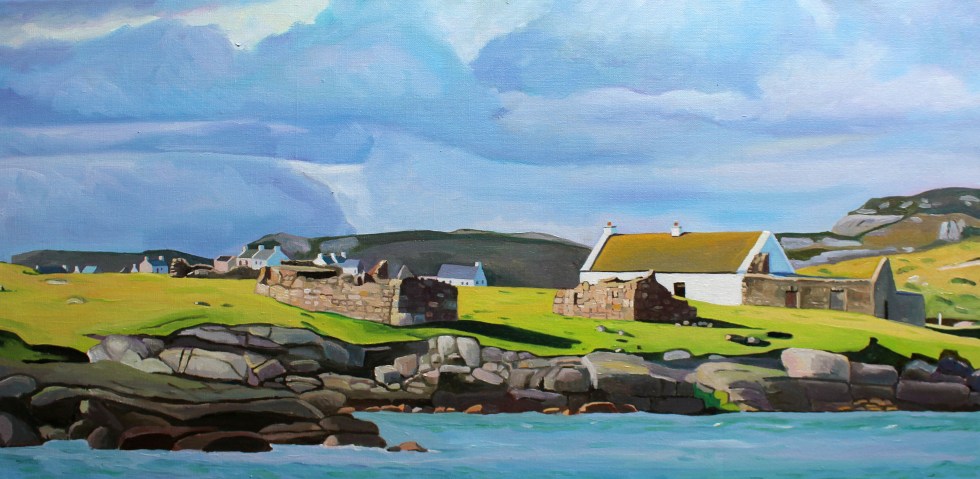
Star of the BBC Shipping Forecast
The name will be familar to British ears who ever listened to the daily shipping forecast on BBC Radio. It is broadcast late at night just before 1 am and very early (5.20am). Anyone who is a night owl or insominiac will have listened to it. The list of shipping zones and forecasts is not only practical but also poetic and rather mysterious. Following the litany of locations and numbers is very soporistic. Listen to the clip below. The actual broadcast is from 2.46 onwards ZZzzzzzzzzz
Many British people may not know where Malin Head it is anymore than than they know the location of German Bight or Viking. To Irish ears, however, it is well-known as the most northerly tip of the island of Ireland and also features on Met Eireann’s, sea area forecast, broadcast on RTE.

Malin Head to Mizen Head
People regularly tranverse the length of Ireland from Malin Head, Donegal, to Mizen Head, Cork. It’s a fair stretch. Just under 400 miles (640 km). Some incredible people have cycled it in just over 15 hours. Ordinary mortals take about 4 days.
Amazingly some super-human runners have done it in about the same time – 4 days! I recently listened to a radio interview with the heroic Sophie Power. Sophie is from England and she recently ran the length of Ireland in under 4 days. This is a World Record. She beat the previouis record by three hours. Being a mother, she had to fit it in during her children half-term holiday and didn’t get to pick the day with the nicest weather – just the Tuesday of half-term and so she started off in driving rain! Many years ago I used to run (only piddly 10ks and 5ks) and I would certainly prefer to run in rain than heat.
Incredibly Sophie ran most of the distance without sleep, snatching the odd half an hour on her second and third day. She ended up hallucinating, and with a knee injury that had to be braced. When she finished the race in Cork she had developed heat stroke! That alone shows you how far south Cork is. There’s no way she’d get heat stroke in Donegal! She’s planning to come back and run the Cork Marathon.

At the Edge of the world
Standing at Malin Head is like standing at the edge of the world. To the north is nothing can be seen but sky and sea. A long way off is Iceland and much. much further away to the north-west is North America. It feels very remote (but surprisngly accessible from Letterkenny and Derry/Londonderry) but to fishermen and sailors, I’m sure it’s not. Scotland is surpisingly close to the north-east. If you have ever flown from England to Belfast on a clear day, you can see the Scottish Isles and the Isle of Man scattered across the Irish Sea, pretty close the Antrim coast. Donegal is just a bit further along.


Lookout on Malin Head
On the most northerly tip of the island of Ireland, you will find a tower that was built in 1805 during the Napoleonic wars as a lookout tower to defend against any attacks by the French. You can see at the top left hand side of my painting above. Edges of places are places to look out from – for invaders, or for incoming storms. Weather reports that were important to local and international shipping were first recorded at Malin Head in 1870. It was in that year the tower became a signal tower for Lloyds of London. Semaphore was used to connect with ships at sea and the lighthouse on nearby Inishtrahull. In 1902 the first commercial wireless message was sent from Malin Head to the S.S.Lake Ontario by the Marconi Company.
Divers’ magnet
There are the wrecks of many ships lying off the coast in this area. Many of these such as SS Audacious, SS Carthaginian and RMS Justicia date to the time of the First World War, when Ireland was still part of the British Empire.
In 1917 two German mines sank Laurentic and although her crew successfully abandoned ship, but 354 of them died of hypothermia in her lifeboats.Interestingly, Laurentic was carrying about 43 tons of gold bars when she sank. Most of the 3,211 bars were salvaged by 1924; three more bars were found in the 1930s, however 22 gold bars have still not been recovered.The Great Emergency/Second World War
During the Second World War, Ireland was neutral. The Irish army built lookout posts in places along the coast to prevent any violation of this neutrality. This was important as this part of Donegal is so close to Northern Ireland, which not not neutral and was bombed by the Germans. There is an EIRE 80 sign built of stones during the war so aircraft would know that they were over Ireland (not Northern Ireland). They acted also as a navigational aid for pilots. Eire 79 is at Fanad Head to the west. Eire 81 is at Glengad Head, further along the Inishowen Peninsula, to the east. You can see it on the map below. The SS Athenia, a passenger ship carrying 1,418 people was torpedoed by a German U-boat just hours after war had been declared in 1939 off the coast of Malin Head! Most of the passengers survived but 117 perished.

Some scenes from the film Star Wars: The Last Jedi film was shot at Malin Head. I have to admit that I am not a Star Wars fan – I never made it through awhole film. I have to admit that I’m more of a Star Trek fan. Apparently, it is possible to have a tour of the locations used for the film from local tour guides. The road leading up to Bamba’s Crown has been renamed locally from the R242 to the R2D2 in recognition of the Star Wars connection. Also beside the tower, there is a short lovely refreshing walk along the cliffs to Hell’s Hole. The cliffs are massive here and even on a relatively calm day the sea is restless and a bit intimidating It needs to be remembered that this not just a sea here but an Ocean.

Read more
https://www.inishview.com/activity/the-tower
https://www.authenticvacations.com/star-wars-filming-locations-ireland
https://www.odohertyheritage.org/maps

I did this interview back in March this year with artist and magician Michael Callahan and co-host Ann Rosenquist Fee, executive director of the Arts Center, St Pauls, Minnestota, USA. In it I talk about how I came to be an artist, my process, my love of colour and paint brushes!

Urban Minimal
Several years ago I embarked on what I called an “Urban Minimal“project; focusing on the streets of Brynmill, in Swansea, South wales, where we used to live. This work culminated in an exhibition in the Cardiff MadeinRoath festival (read more here).
My original “rules” for urban minimalism composition and painting

Urban Minimal in Derry/Londonderry
I am developing this approach with Derry. I like to paint relatively ordinary street scenes without people. The sunlight and the colours give them drama and beauty. Each of the painting is really about light. I am still attempting to simplify forms but this is something I am always failing at.
On the plus side, I think that my colours have become much softer and more subtle. I think this is partly a response to the northern light which is bluer and less golden than that in Swansea. Its is also because I have got better at achieving naturalistic colours. My confidence has also improved. In the past I chose brigher colours to make a painting more exciting.
I have slowly come to the realisation that such excitment is like hidden sugar in my food. Yes, its initially appealling but it can give you a bit of a headache!
I have enjoyed exploring the streets of Derry. I feel I know the place a bit better for painting them.
Its hard to find a car-free Queen Street but early on a Sunday morning it is possible.
Eagle-eyed readers will spot a car in the mid-distance. I thought I’d see whether a car would negatively disturpt the composition. I don’t think it did.

Some of my earlier paintings of Derry.


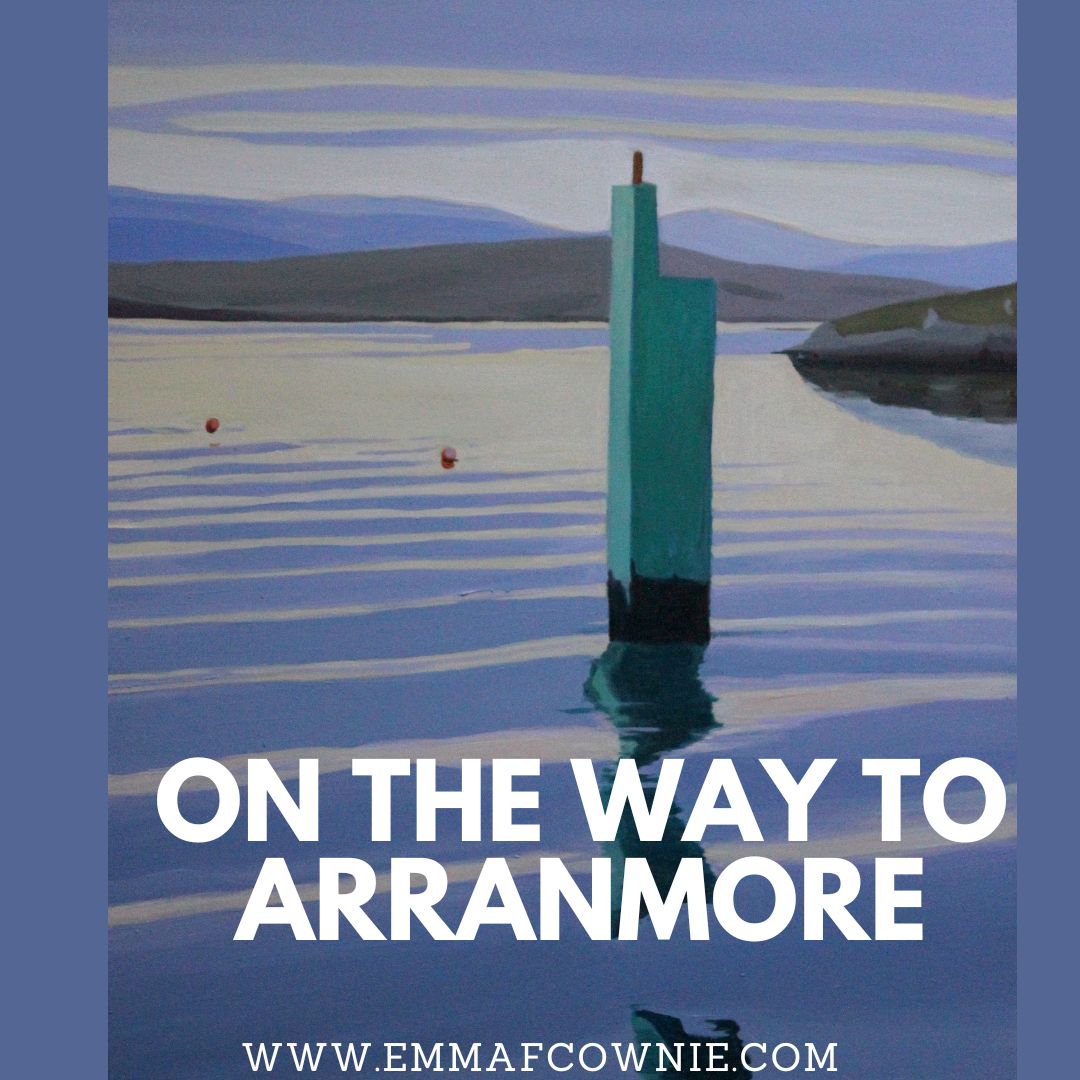
Looking through my recent work, I was surpised to realise that I haven’t painted many paintings of Arranmore Island in the last couple of years despite visiting the islands in the summer. So I have put that right with a series of new paintings.
As always I am entranced by the journey to and from the island. You can read my short History of the Island here
Arranmore is lucky to be served by two ferry companies. There is The Arranmore Ferry (Blue) which is based on the island and Arranmore Ferry (Red) which is not. Yes, I know the names are almost identical, just a small matter of “The”. They both offer a fantastic 15 minute journey from Burtonport (Ailt An Chorráin) to Arranmore Island. On a calm and sunny day the view on the crossing are just heavenly. Sometimes there are dolphins too.

The ferrys sail through a narrow passage past a scattering of islands on the way to Arranmore.


Rutland Island (Inis Mhic an Doirn) lies between Burtonport and Arranmore, Donegal. William Burton Conyngham (a local landowner for whom Burtonport takes its Anglised form) had warehouses, a street of houses, a post office and a school built c. 1784 to capitalised on a the abundant herring fishing. Unfortunately, the herring disappeared very early in the 1800’s and the station fell into disuse. The island was inhabited until the 1950s. These are the remains of the fish factory and landing stage on Rutland Island.

Opposite is Inishcoo Island with Mount Errigal in the distance peeping out from under the clouds. The jetty in the left hand corner belongs the magnificent Inishcoo House (see painting below)- once a coast guard house, built in the C18th.

There are several tiny holiday homes dotted across the islands (and cows)


A you can see the views are quite idyllic. Whether from the ferry or from the island. To be honest, I wish the ferries were like the Circle Line on the London Underground, where you can ride the tube rround and round (it takes and hour and an half apparently, I have never done it) and you could ride them back and forth to the island all day!


Some more recent works….

Getting There

I was delighted a while back to be asked by one of my very favourite artists of all time, Jessica Brilli, to trade paintings. Jessica has been a big influence on my own style of painting so I feel very appreciated and validated by her contacting me to say she loved my work and wanted to own some and have my work in her home.
I have always have found myself drawn to and influenced by painters who have a special relationship with colour and light and Jessica Brilli’s work is full of sunshine and nostalgia. She combines American realism with graphic design elements, simplifying elements and focusing on everyday scenes and objects. She was Jessica was also awarded as Pollock-Krasner Foundation grant in 2021!

The paintings we traded: – My painting of Gola Island called “With A Road Running Through It” a rural minimal oil painting.


In return, Jessica sent her painting “Cutlass” of a vintage American car – acrylic on wooden panel. I was very excited to open up the packaging and see one of her paintings in the flesh. I didn’t realise that it was painted on wooden panel rather than canvas. I really liked the weight and solidity of the wooden panel. It was also a real pleasure to see the brush stokes and the layers of paint close up. You cannot get a sense of these things in photos at all. So I have been quietly obsessing about how this painting was made as well as the elegance of its composition. There is a pleasing tension in the slight unbalance of shadows and tiny brush marks that suggest great confidence in the artist’s execution. I really enjoy looking at it.

Jessica Brilli’s “Cutlass” – with me holding it


I was fascinated by the vintage tape measure Jessica also sent me – it was a weighty object. I was quite struck by its solidity. I think I am too used to plastic tape measures that have beeb made in China. It also only measured inches – not cm. I am only used to tape measures with both inches and cms on them. It amde me realise that despite all the American culture we are exposed to in filsm amd TV shows, we have very few American goods here on this side of the Atlantic. It felt quite exotic and exiting.
I would like to thank Jessica once again for agreeing to trade paintings with me. I am honoured to have her painting in my home. It has given me a real boost. I am now exploring the world of wood panels!
https://www.instagram.com/jessica_brilli_artist/


 It took me a long time to really understand what colour opacity and the transparency of paint meant in terms of my painting. I am still learning how to use this knowlege.


My left leg and ankle is now at the rehab stage of my recovery (if you would like to know how I ended up with a broken leg you can read about it here). That means I can put partial weight on the leg and I have to do a series of exercises 5 times a day. My ankle is incredibly stiff and my leg is pretty weak from almost 2 months of inaction. When I try to lift my toes, I can feel the plates in my leg. It’s very wierd. It feels a bit like aliens have control of my ankle! The muscles get sore. It’s also very tiring. Actual walking seems a long way off!
In terms of practicality, it means that I am pretty much confined to my bedroom and cannot use my usual oil paints. This is due to the lack of room and the fact that oils are much too messy for a bedroom. So I have dedicated myself to spending this time with my watercolours. I have learnt a lot about the qualities of the different colours and how I can and can’t use them over the past few weeks. I have been frustrated and pleased in equal measure.
In between the exercises, I have been painting birds in watercolours. I have painted many garden birds in oils over the years. I am particularly fond of sparrows. Here’s a selection of my oil paintings to illustrate:-


I have also painted many robins, wrens, blackbirds and a few puffins too!


I have decided that watercolour is a medium that works really well for painting garden birds. It is quite possibly better than oils. Its transparency is particularly well-suited to conveying the lightness of birds. I am experimenting with tight control of the paint versus letting it bleed in parts of the painting. The results of interesting and varied.
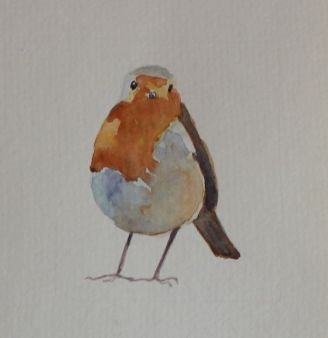
I have been trying out different watercolour papers too. My earliest birds were painted on Etival 300g/m (140 lb) rough texture paper. It was what I happened to have in the cupboard.


Out of curiosity, I tried a different make, Bockingford. Their paper is Acid-Free, and archival quality. I tried two weights. First I tried very heavy 425g/m (200 lb) paper, rough texture. I liked the substantial thickness of this paper, and the paintings turned out well enough but the grain of the paper doesn’t photograph well. I might try scanning them instead, when I am finally up and about.


The second Bockingford paper I tried was a lighter 300 g/m rough texture paper. I think that this suited me best in terms of how the paintings look in photographs.


I have ordered some Bockingford 300 g/m cold press (not) texture paper to try out too. That should be coming early next week. So trying that out will come as a welcome break from my rehab exercises!

Watercolours are not usually my thing but circumstances have changed that, for the time being. When I came out of the hospital after my operation to fix my broken left leg, I knew that I going to off my feet for at least 6 weeks. I also knew that it would probably take another 2 to 3 weeks to be fully mobile again. I had all sorts of vague ideas about oil painting again but when I got home I realised that they were hopelessly impractical. My house is full of steep and narrow stairs, so that meant I was going to pretty much confined to my bedroom.
My husband, Séamas, went to a lot of effort to set up the bedroom ready for me. He dismantled the round kitchen table and reassembled it in the bedroom. He also brought up an armchair and two dining chairs for me to sit on and rest my recovering leg on. The table is not very big so that means that the only sort of paint I can hope to use in this limited space are watercolours.

I have a love-hate relationship with watercolours. They are portable and come in cute little boxes but they are the least forgiving of all mediums. If you make a mistake it shows. I used to dabble in them many years ago but I always prefered to use acrylics, oil pastels and oil paints, because with all of those mediums you can scrape back or paint over mistakes. Not so with watercolours. They show you up are the second-rate artist you fear you are!

In my first efforts with the watercolours I used them in pretty much the same way I always had done.
Whilst I was reasonably happy with the foliage and grass in the picture, I thought the sky was too muddy.

I decided I needed some technical help. So I got Séamas to go up to the attic and dig out my tiny Collins Gem book on Watercolour Tips by Ian King. What a marvel this book is!
It has many excellent pointers on mixing watercolour paint, making washes, the translucent nature of some colours, as well as the importance of simplifying the composition.

So I took these points on board, in particular the importance of simplifying the image. I realised that less is more. It changed what I painted. I was much happier to edit my compositions in a way that I don’t usually in my oil paintings. So I decided to simplify my compositions as much as possible and paint a series of studies of the houses on Gola Island.
I was cautious, however, of unintentionally taking on another artist’s style of painting. I wanted the skills but not the style. I didn’t want to paint like these watercolourists, I wanted to paint my way, but in watercolours. I also wanted to keep the paint as “light” possible to keep the painting looking fresh and airy.


It might sound odd, but I wasn’t familiar with the properties of the colours in my paint-box. Blue watercolour paints act differently to blue oil paints. I needed to experiment and learn how they were different.
In the end, to help me understand what each colour could do I painted each one on a piece of paper so I could look at it when deciding which color to use. This helped me enormously.

I also struggled with how to paint a “simple” wash for some time. One online artist recommended mixing up a lot of paint so that it was “like tea”. This did not do the trick for me. I was reassured by another artist that washes were actually pretty tricky and some colours were harder to use than others. I found this reassuring. I helped me keep perservering. There’s nothing like someone saying “Oh, but it’s easy” to make you want to give up when it’s not easy!
Eventually, after a conversation with my mother (who was a keen water colourist), I tried a different brush and also several pots of water. One to rinse my brush in, the others to dip my brush into before I put it in the watery paint mix. That seemed to work for me. I felt slightly more in control of the process and my skies were less lumpy.
I have a long way to go but I am lot happier with my paintings and I hope that I can use these skills to paint “en plein air” when my leg is better it is safe to go outside again, whenever that will be. Until then, I will keep practicing!


I would like to thank Séan Ó Domnhaill for the use of his photographs of the red-roofed Post Office on the Outer Hebrides and the Isle of Lewis.
See my oil paintings here
For some of the tips on watercolour paintings that I looked at :-Olly Pyle’s
https://www.ourlandscape.co.uk/post/basic-watercolour-kit-where-to-start
I particularly liked Anthony’s site:-
https://watercoloraffair.com/complete-guide-to-watercolor-wash-techniques/