Watercolours are not usually my thing but circumstances have changed that, for the time being. When I came out of the hospital after my operation to fix my broken left leg, I knew that I going to off my feet for at least 6 weeks. I also knew that it would probably take another 2 to 3 weeks to be fully mobile again. I had all sorts of vague ideas about oil painting again but when I got home I realised that they were hopelessly impractical. My house is full of steep and narrow stairs, so that meant I was going to pretty much confined to my bedroom.
My husband, Séamas, went to a lot of effort to set up the bedroom ready for me. He dismantled the round kitchen table and reassembled it in the bedroom. He also brought up an armchair and two dining chairs for me to sit on and rest my recovering leg on. The table is not very big so that means that the only sort of paint I can hope to use in this limited space are watercolours.
Organised chaos on the ex-kitchen table
I have a love-hate relationship with watercolours. They are portable and come in cute little boxes but they are the least forgiving of all mediums. If you make a mistake it shows. I used to dabble in them many years ago but I always prefered to use acrylics, oil pastels and oil paints, because with all of those mediums you can scrape back or paint over mistakes. Not so with watercolours. They show you up are the second-rate artist you fear you are!
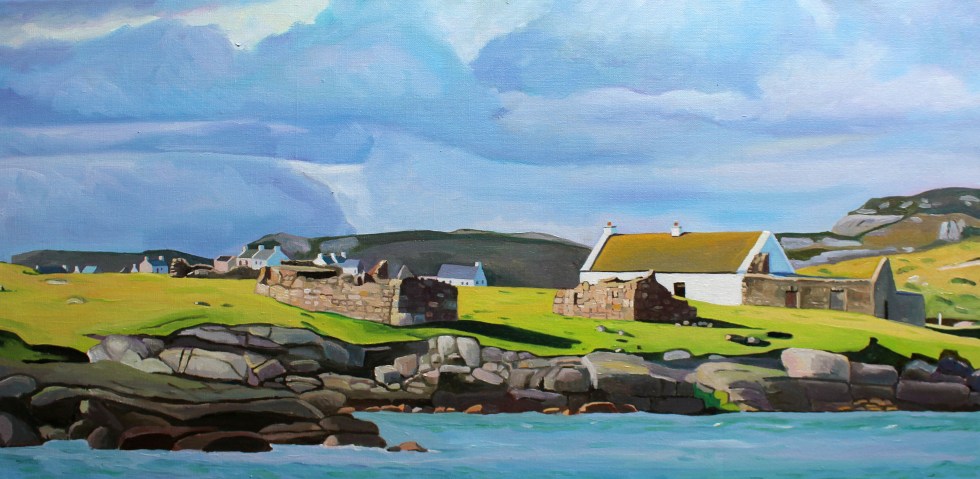
Cloughcor Cottage Arranmore
In my first efforts with the watercolours I used them in pretty much the same way I always had done.
Whilst I was reasonably happy with the foliage and grass in the picture, I thought the sky was too muddy.
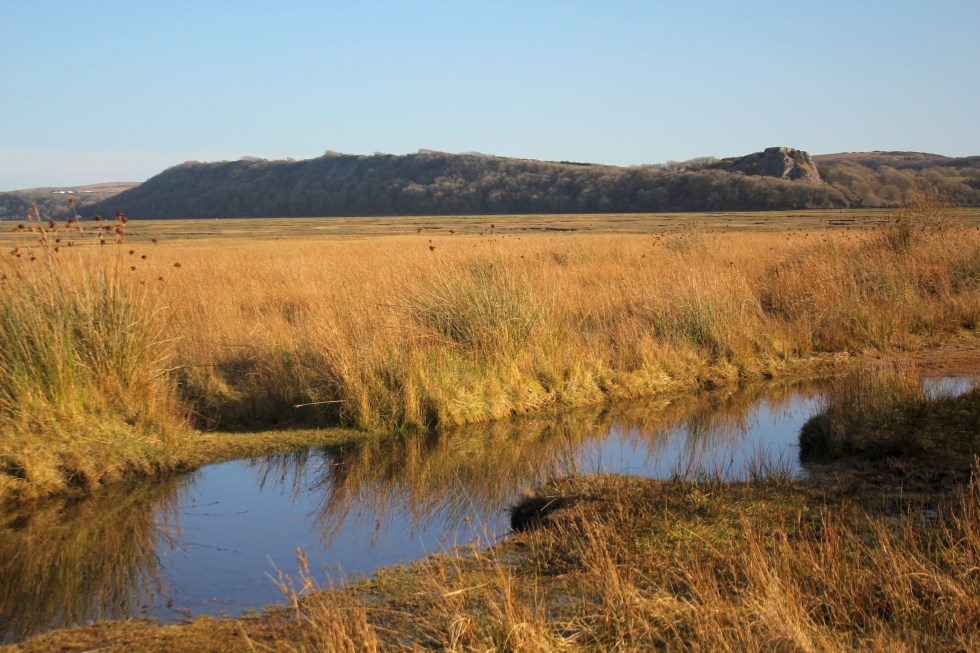
Crug Hywel, Brecon Beacons
I decided I needed some technical help. So I got Séamas to go up to the attic and dig out my tiny Collins Gem book on Watercolour Tips by Ian King. What a marvel this book is!
It has many excellent pointers on mixing watercolour paint, making washes, the translucent nature of some colours, as well as the importance of simplifying the composition.
Four sketches of Table Moutain
So I took these points on board, in particular the importance of simplifying the image. I realised that less is more. It changed what I painted. I was much happier to edit my compositions in a way that I don’t usually in my oil paintings. So I decided to simplify my compositions as much as possible and paint a series of studies of the houses on Gola Island.
I was cautious, however, of unintentionally taking on another artist’s style of painting. I wanted the skills but not the style. I didn’t want to paint like these watercolourists, I wanted to paint my way, but in watercolours. I also wanted to keep the paint as “light” possible to keep the painting looking fresh and airy.
Gola Houses (watercolor)
It might sound odd, but I wasn’t familiar with the properties of the colours in my paint-box. Blue watercolour paints act differently to blue oil paints. I needed to experiment and learn how they were different.
In the end, to help me understand what each colour could do I painted each one on a piece of paper so I could look at it when deciding which color to use. This helped me enormously.
My watercolours
I also struggled with how to paint a “simple” wash for some time. One online artist recommended mixing up a lot of paint so that it was “like tea”. This did not do the trick for me. I was reassured by another artist that washes were actually pretty tricky and some colours were harder to use than others. I found this reassuring. I helped me keep perservering. There’s nothing like someone saying “Oh, but it’s easy” to make you want to give up when it’s not easy!
Eventually, after a conversation with my mother (who was a keen water colourist), I tried a different brush and also several pots of water. One to rinse my brush in, the others to dip my brush into before I put it in the watery paint mix. That seemed to work for me. I felt slightly more in control of the process and my skies were less lumpy.
I have a long way to go but I am lot happier with my paintings and I hope that I can use these skills to paint “en plein air” when my leg is better it is safe to go outside again, whenever that will be. Until then, I will keep practicing!
Post Office at Baile Ailean
I would like to thank Séan Ó Domnhaill for the use of his photographs of the red-roofed Post Office on the Outer Hebrides and the Isle of Lewis.
It was a year ago that I painted my first painting of Donegal. Here it is. It is a small one.
Old School, Owey Island
It’s quite a modest painting. You could say that I started off tentatively. I was feeling my way. The light in Donegal is very clear and the scenery is beautiful. That’s an overused word in this age of social media, but it is beautiful.
My husband, Seamas (he likes counting things) tells me that I have painted over 50 Donegal paintings (including 3 commissions). That pretty much averages out at one a week. I am pleased to say that I have already sold over half of them.
I discovered that I had to use a different palette from the one that I use in Wales. The greens and yellows were more yellow ochre than lemon yellow and the sea was more turquoise (but not quite as turquoise as I first painted) thanks to the clear water.
On The Way To Arranmore
From Ferry Coll SOLD
Over to Owey Island, West Donegal, Ireland
I loved the rocky landscape of the Rosses. It was a landscape like no other I’d seen before. Someone has said to me that it’s quite alien, like a moonscape in places. I love the granite rocks. We have a massive one behind our cottage in Donegal. I feel very affectionate towards it. It’s a protective presence, especially when it’s windy.
Over to Tullyillion
Of course, when you are in a different country to the one you were brought up in, everything seems fascinating. I have loved painting both the modern Donegal houses as well as the old cottages.
From Cruit Island
Over to the Rosses
House by the Wild Red Flowers (Arranmore)
I will freely admit I am quite obsessed by landscape spotted with old cottages on the Donegal islands, on Arranmore and Gola in particular.
Spring Light on Gola
Across to Inishbofin
This Beauty That will Pass
A House on Gola
Up From the Pier (Gola)
Oileán Ghabhla (Donegal)
Around Cloughcor (Arranmore)
Cottage on Inishcoo
On Eighter Island
The Red Roofed House, Arranmore (Private Collection)
I haven’t really got to grips with the mountains of Donegal. What I mean is that I need to visit them a lot more, walk up them and get to know them better. So far I have just admired the “Seven Sisters”, including Mount Errigal and Muckish from a distance.
Across to Dunfanaghy
Mount Errigal from Ballymanus Beach, Donegal
Over to Kinclassagh
The Pig’s Back (Muckish) Donegal
Swirling Clouds Round Errigal
Of course, the real joy of Donegal is the clouds. The changes skies. I am used to it raining, (I have lived in Wales for over 25 years) but the light is different by the North Atlantic Ocean. It is often more slivery, and more changeable.
From Magheraclogher Beach (Bunbeg)
Near Dunmore Strand
Rain over Dunfanaghy
Two Cottages
I think about Donegal every day when I am in Wales. My husband will place his current favourite Donegal paintings in the bedroom and in the lounge so he can look at them whilst we still have them.
Here’s my most recent painting Donegal painting. I am currently working on a painting of Arranmore Island, unfortunately, it rained so much here yesterday, the light went and I have yet to finish it.
Back Road to Burtonport
I have been ill this week so this is a short post.
In last week’s post, Seamas, my husband and I were standing on rocks looking out towards Gola island in Donegal. This week we are looking back inland to Dunmore Strand, and beyond to Mount Errigal.
Dunmore Strand (with Mount Errigal in the distance)
As soon as I saw this scene I knew I wanted to paint it. I loved the dark shadow under the protruding lip of the undulating dunes. It gave the impression that the grasses were merely a thick blanket laid across the top of the sand.
Scattered along the beach and in the water, were granite rocks. These were so large that they were more like massive boulders. They were a beautiful pinkish colour close up. The sand was also very slightly pinkish but closer to the shoreline it was almost white. Lines of seaweed marked the rising and falling tide.
The tiny white houses gave a sense of sense scale of the dunes. They reminded me a little of boats on the surface of a heaving sea; humans eeking out an existence on the edge of nature. The ocean itself was calm and benign. It was as clear as glass at the shoreline and further out was a beautiful turquoise. It is not always this smooth creature, in autumn, I have seen it roaring and thrashing the shoreline like a wild beast.
Mount Errigal dominates this part of West Donegal, known as Gweedore. The mountain looks close but it’s an optical illusion, it’s actually about 10 miles away to the east. The top of Mount Errigal was swathed in clouds. The mountain always seems to have clouds around its shoulders, or totally smothering it. I had to wait for about 3/4 of an hour for the mists to part for a clear view of the peak. The clouds near to me were dirtier rain-filled clouds that were building and threatening to release their burden on the land somewhere nearby.
Another wonderful thing about this beautiful beach is that on this chilly April afternoon is that there was not another soul there. The only people we saw were the postman in his van on the way down the long lane to the beach.
My next post will peer “through a glass darkly” at Seamas’s Donegal family history (it is very dark in places) and the History of Gweedore along with the controversial issue of modernizing landlords.
Life as an artist is a very insecure one, you never know where your next sale is going to come from. You can plan and prepare for exhibitions and work on your social media, but it’s impossible to know how many people will see and respond to them.
That’s why it’s really important to take stock, and celebrate the success you have achieved and thank all the supporters and collectors who have helped you over the year; whether it’s a positive comment on a blog post, a “like” on facebook or an instagram post, the sale of a mounted print, a greeting card, a commission or the sale of a painting. They all help keep me going! You may not believe it, but artists have fragile egos (this one has, anyway) and they need encouragement, especially if they venture off into new directions, as I so often do.
Here’s a review of some of my sales of paintings and mounted prints from the first part of 2018. Many were sold via the online gallery Artfinderbut increasing I have sold direct via my own website. Each painting is a unique work. I don’t paint generic people or landscapes. They are all real people and locations. In April’s collection you can see many of the Gower painting I did as part of the Gower Coastal Path Project. Bloggers’ comments and encouragement really helped me complete that project. Thank you, all.
January Sales 2018February Sales 2018
March Sales 2018
April Sales 2018
My next post will complete the review. Thank you to the brilliant people who have supported me and bought my work this year, I couldn’t do it without you!
We didn’t get an “Indian Summer” in September, which when we usually get one in Wales. What we have had, instead, is a series of sunny days in late October/early November. The sparkling autumn light is stunning. From a painter’s point of view is more interesting than summer light. So last week I drove down to Three Cliffs Bay to enjoy the light. I was surprised by the dark blue of the calm sea. It was quite a different colour from the summer sea.
Three Cliffs Autumn Light
I was hoping that there would be plenty of orange bracken and there was. Not on the slope of the the Three Cliffs, as they are covered in grass, but on the slopes of Cefn Bryn, in distance.
Painting of Pobbles Bay, Three cliffs, Gower
These colours sum up the Welsh landscape for me. In fact, I think I like the Welsh landscape in autumn/winter best. The red and the green of the bracken and the grass also put me in mind of the red and the green of the Welsh flag.
Welsh Flag (an interpretation)Light on Great Tor (Gower)
I find it ironic that there’s less light around but its better quality, from an artists’ point of view. I still have not adjusted to the clocks going back last month, and I am still waking at 5 -5.30am! It does not seem to matter what time I go to bed, I awake in the dark feeling ready to rise. So I get up and here I am tapping away at my computer in the dark waiting for the sun to rise. Soon I will have to get my SAD lamp out to stop the slow slide in winter gloom. Before, you ask, yes, SAD lamps work for me.
Does anyone else suffer from this problem? Does anyone have any tips for sleeping in later?
Update: I sat with my SAD lamp on for 20 minutes around 7 pm last night and it seemed to help me go back to sleep when I awoke at 4.30 am, and I didn’t get that “wake up” surge of hormones til 6.30. A definite improvement.
The Rosses (in Gaelic, Na Rosa) is a region in the west of County Donegal, Ireland. The name comes from “Ros”, the Irish word for headland. It is a curiously rocky place. Not rocky, in the sense that national parks in the American west, like Utah and Arizona, are made of 100% rock, but rather the bedrock is covered with a thin layer of earth, with slabs of rocks and boulders poking through. It’s a barren but beautiful landscape, studded with a myriad of lakes and inlets of the sea.
Aerial View of the Rosses, from the aeroplane (with Mount Errigal in the background).
It may feel like the edge of the known world but this area has been inhabited “since time immemorial” according to Wikipedia. Coastal places like the Rosses, in Donegal, looked out onto a massive highway – the sea. Missionary Celtic saints were busy in this area in the 6th century AD. These saints relished a challenge and liked to travelled up and down the Celtic waterways to spread Christianity to nearby Scotland. In the 1990s it was fashionable to argue that these Irish monks had in fact, “saved civilisation” by copying the books being destroyed elsewhere by Germanic invaders, eventually bringing them back to the places from which the books had come. Part of this movement included women like St. Crona or St. Crone (Cróine) , a female religious of royal blood. She found a monastery in Termon near Dungloe. She was a cousin of the the better known St. Columba (St. Columcille in Irish) one of the Twelve Apostles of Ireland, who founded the monastic settlement at Iona.
Much later (about a thousand years or so) in the 16th century, a number of ships from the Spanish Armada sank off or landed off its coast. Some 24 to 26 Spanish Armada ships are believed to have foundered off the Irish coast in 1588 while returning from a failed invasion of England by King Philip II. This is not just local myth as the wrecks of two Spanish ships were discovered by archaeologists in shallow water near Burtonport, Donegal, in 2008/9.
What happened to the survivors of these wreck is unclear. We know that as many as 9,000 Spanish soldiers and sailors lost their lives off the Atlantic coast of Ireland, either through drowning or were killed by English troops or Irish chieftains after they were washed ashore. However, not all died. Some Irish who were sympathetic to the Spaniards sheltered them and some kept them on as soldiers. Local legend, credits black-haired locals as being descents of these men, but they are possibly the descents of much earlier people who came from the Iberian peninsula after the end of the last ice age.
I found this area both beautiful fascinating. Donegal manages to combine a sense of isolation with company, should you want it. This area is littered with houses, old and modern. Many homes are built on the rocks, or have massive rocks in their gardens. People have had to work around the boulders and outcrops.The prevalence of pines dotted across the landscape gives the area a Scots or Canadian feel to it; Caledonian in fact.
Cruit Island
Although in many senses there is plenty of space, houses seem to huddle together in clusters, isolated but within sight of others. A lot of them (the newer ones, anyway) face out towards the Atlantic Ocean. It seems that in many cases old cramped cottages have been replaced by larger modern buildings. Many tiny cottages, or abandoned derelict buildings are overshadowed by bigger ones. The smaller cottages ended up as holiday homes for visitors. Most of the houses are painted white, but with some older stone cottages and out-houses are left “au naturel”.
On one of the few sunny afternoons we had, we raced round taking photographs of the houses on the rocks. Each bend in the narrow road revealed different vistas. It was hard to decide which one I liked the best. Not only did these houses look out to the sea, behind them were hills and mountains. My painting “Round the Rosses” captures a typical cluster of old and new homes perched on the top of rocky landscape. The light from the afternoon sun glints in the windows of the large house, that faces out to the ocean. The older, smaller buildings look to the east; away from the force of rain and storms and towards the rising sun.
I am delighted to have sold this painting, Three Cliff Reflections, to a collector in Scotland. As is so often the case, the collector has a connection to the location in the painting, having visited it and climbed to the top of the peaks quite recently. I hope that the painting brings back happy memories of the summer.
As a painter, I feel that I have succeeded if I my work can provoke an emotional reaction. I would feel that I had gone wrong somewhere if someone said “that’s interesting” or “it’s technically skillful” about one of my paintings. Not that there’s anything thing wrong with being skillful, I just don’t want it to be the first thing they say.
They don’t have to be entirely happy emotions, either. I once had a friend who said a painting of mine, “Park Bench in the Snow” made her want to cry.
Park Bench in Snow
I am not sure why she wanted to cry, I think she said something about it reminded her of the film “It’s a Wonderful Life”. That film always makes me cry too. Mind you, I was particularly fond of this painting and was pretty sad when I had to part with it. I didn’t cry though. I do have favourites, and this was one.
Quite a few of my people portraits have a bitter-sweet quality to them as I am drawn to the fragility or vulnerability of the sort of people who are frequently overlooked by our instagram obsessed society.
Brief Encounter
Or amusing quality, I hope. I like observing little moments that are easily missed. Like these two children at the Uplands markets examining an old manual typewriter.
What does it do?
I also like watching for moments between dogs and their owners, in particular.
Just a Second
Back to Three Cliffs Bay. This painting “Human Concern” (below) was based on a scene I observed at Pobbles Bay, last summer. Pobbles Bay is right next the Three Cliffs Bay. The little Jack Russsell stood and watched his humans off in the sea, with such intensity. It amused me. I also found it very touching.
I have a confession to make. This walk was done out of sequence. It was done on March 28th, on the day the clocks went forward. That seems a long time ago. It was a beautiful day but very cold. Back in March when I had only got as far as Pennard and Three Cliffs, I sort of panicked. This was because I could not make head nor tail of the bus timetables and doubted that I could make it around the coastal path by public transport. So my husband, Seamas, suggested that we drive to the most out of the way places in Gower and do circular walks and then I would fill the rest in with public transport. Another blogger has since directed to the invaluable traveline.info which helped me made sense of the bus connections, when the online bus timetables seemed incomprehensible to me.
So we decided to go to Whiteford Point. It is a mini-peninsula off the northern corner of Gower peninsula. This is seen by many as the wildest and most remote part of Gower. We drove along the narrow lanes to the northern tip of Gower, to the village of Llanmadoc. Llanmadoc Hill is quite imposing as you approach it from the South East. I generally think of Gower as having two big hills (Cefn Bryn and Rhossili Downs) but Llanmadoc Hill at 152m is pretty high too. You get a sense of how it dominates this corner of the peninsula from Cedric Morris’s painting of it in 1928.
If you drive through the ajoining villages of Cheriton and Llanmadoc, you will come to Cwm Ivy Court Farm.
Far Hill Above Cheriton, 2016 (SOLD)
On the opposite side of the leafy lane is an open gate to a field, which acts as a temporary but well-used car park. When we arrive after lunch, it is pretty full. There is an honesty box built into the wall for walkers to put their car park fee of £1. Considering the National Trust charge up to £5 at Worms Head, it seem like a bargain.
We then walk down the lane past a small number of houses, the last one has a ice-cream tub of drinking water for passing thirsty dogs. Once you pass through the five-bar gate you are on National Trust land.
In 1953 it was designated a Site of Special Scientific Interest as it is an internationally important feeding ground for wading birds and wildfowl. Not long after in 1965, Whiteford Point came up for sale by auction and there was great worry that it might fall into the “wrong hands”. Fortunately, the National Trust was able to buy it. This was the first property to be acquired as a result of something called “Enterprise Neptune”, which was the National Trust’s campaign to protect Britain’s coastal heritage. So this area is a now a nature reserve owned by the National Trust.
Whiteford Point
If you follow the lane down hill there there is a choice.
Straight ahead is are the marshes and sands dune and eventually open beach that joins with the wide expanse of Broughton Bay, to the west. If you take a turn right through another wood gate you are then in Whiteford Burrows.
Pine Trees
Whiteford (pronounced Whit-ford) is apparently derived from the Danish ‘Hvit-Fford’, meaning white ford. The Vikings left their mark on the outward-facing west coast of Gower, in their placenames at least. Look at left side of the map above. Worms Head, Burry Holmes and Whiteford are all derived from Scandinavian words. Perhaps, the Viking who traded and marauded up and down the Bristol Channel as late as the 11th Century, only ever gave names to the landmarks they could see from the water, but they certainly stopped by at Swansea, whose name is also Scandinavian in origin. It means “Swein’s Eye” or Island. There used to be an island at the heart of Swansea until the Victorian diverted the river. The Welsh call it “Abertawe” which means the mouth of the River Tawe.
Once into the the nature reserve you pass the very cute Burrows cottage, which used to be a forester’s cottage (you can rent it) and further along the path Cwm Ivy Bunk House (which you can also rent by the night). There are no other houses on Whiteford Point. It is a very lonely place from a human point of view. It is however, full of undisturbed wildlife.
Either side of the path are many grand pine trees, smothered with massive pine cones. They are Scots and Corsican pines. I think gives the place a Mediterranean air. They were planted from the 1930s onwards. There are hundreds them, thousands. I have read somewhere that there were 20,000 in the 1970s. They help certainly help stabilise the dunes and stop the sand blowing away. You can see these trees from miles around.
The pine trees as Seen from Hills Tor
I get excited when I see what I think are public toilets in a very tasteful wooden chalet on the path ahead. I am always looking for “proper” places to relieve myself instead of the inevitable bushes.
Not toilets!
Ah, what a fool, I am. As I get closer I realise my mistake. Its not a nice artisan toilet block. It’s a bird hide for watching wildlife on the salt marsh to the right. The door is open and we can see its empty. So we go in and peer across the flat marsh. We don’t have the patience to wait.
[wpecpp name=”Woods at Whiteford Sands Large Mounted Print” price=”45″ align=”left”]
Once we have passed the bunk houses we follow a sort of path through the pine woods, climb a stile over a wire fence and we are on the burrows. Whiteford Burrows, or sand dunes, cover an area of three square miles. It’s bigger than it sounds. There is a vast expanse of beach on the other side of the dunes, leading out along the edge of the Loughor Estuary.
It was a long walk along the beach – it a very empty beach. Two miles of it to Whiteford Point. People are small dots off in the distance.
Whiteford Sands (towards Broughton Bay)
The landscape here is reduced to stripes of colour: Sky-sea-beach-dunes. The tide is out and the sea is very distant.
Whiteford Sands
I am slightly unnerved by the signs saying informing me that Burry estuary was used as a shelling range by the British army during World War Two and the unexploded bombs are still likely to turn up in the sand dunes. Yikes! I take this seriously, I remember a World War Two bomb that was recently found in the near by Loughor River although I can’t find the story online. In 2015 a family found what they thought was a “buoy” covered in barnacles on the northern side of the estuary, at Burry Port. The kids spent quite a bit of time jumping on the strange object and had their picture taken next to it. You have probably guessed it by now. It wasn’t a buoy it was an old Second World War bomb. The beach was cleared and the “buoy” was blown up.
That’s NOT a buoy!
Shells still turn up at Whiteford Point too. In September 2014, for example, some sixty shells were exposed at Whiteford Point, and bomb disposal teams were summoned to deal with them. The firing range was also used on a regular basis for the firing of chemical shells during the Second World War, including ones containing mustard gas. Earlier this year there were reports of the Ministry of Defense blowing “something” up earlier this year in the Loughor Estuary so I don’t fancy taking my chances and stick to the beaches. I expect most people do the same and the dunes are left undisturbed.
Beware Unexploded Shells!
At Whiteford Point there is a curious cast-iron light house. It is the only wave-swept cast-iron tower of this size in Britain.
Whiteford Lighthouse
It reminds me of a giant bird cage. The local seabirds, gulls and cormorants use it as a convenient perch. It is not close to the beach but it can be reached at low tide, although its a long rocky walk over the seaweed-covered rocks.
[wpecpp name=”Wave-Swept Iron Tower Large Mounted Print ” price=”45″ align=”left”]
It reminds me that much of the Gower coast was always hazardous to shipping. This area in particular was very treacherous and a large number of ships were wrecked at both nearby Broughton Bay (where ships used to be able to anchor in the bay until it was silted up in mid-nineteenth century) and here along Whiteford Sands.
Tragically, the lighthouse failed to prevent a one of the biggest shipping disasters in the area, which took place in January 22nd 1868. On this calm winter night 16 ships out of a fleet of 19 sailing out of Llanelli, sunk in a single night and possibly up to 30 or more lives were lost. These ships had been towed out of Llanelli by steam tugs. They had been cast off and rounded Whiteford point, aiming to clear Burry Holmes with the ebb tide. This was in the age of sail and the ship needed a breeze to power them on their way.
Unfortunately, the wind died and a heavy swell tore the ships from their anchors and drove many of the ships onto the rocks at Broughton Bay, or smashed them against each other. As it was such a quiet night, no one on shore had any idea of the disaster that was happening in the estuary. A large buoy and chain and the remains of a wooden hull near Whiteford Point are all that is left of these ships.
Although the beach seems utterly deserted the air is filled with the high pitched piping sounds of little wading birds.
They are too far off to identify with any certainly, but I think they might be oyster catchers. We are feeling tired after our long walk along the beach. We sit on the edge of the dunes for a rest and chocolate biscuits, listening to the euphoric trilling of skylark song.
Around the tip of Whiteford Point the path reappears and winds its way along the edge of the pine woods. The path is very water logged and at many points it resembles a series of small still lakes rather than a path. So we hop from muddy patch to muddy patch.
Looks like a lake but its the path!
Here there is lots of bird song – blackbirds, ravens, rooks and we saw linnets, larks and tiny robins. On this side of Whiteford Point, it is very flat marshland. The sea is but a distant memory. This is clearly a river estuary and the river is far off beyond clumps of pine trees. The marshes are covered in lush grass and edged by yellow reeds. There are shaggy marsh ponies, who seem very small in comparison to their cousins who graze on Cefyn Bryn and Fairwood Commons.
Weobley Castle in the distance
As we get closer to Cwm Ivy, our starting point, we can see the village Llanmadoc spread up the hillside. We pass the late Medieval sea wall. There has been a sea wall at Cwm Ivy since the late 17th century when it was used to reclaim the marshland from the sea. The coastal path used to follow the wall round to Llanmadoc. Not any more, not since 2014 when the wall was breached by storms. The Welsh Government Shoreline Management policy stopped the National Trust from repairing the wall and breech. This ‘No active intervention’ policy of letting nature take its course was a controversial decision at the time. So this fresh water marsh has now returned to being a salt marsh. The breach is too big to jump over, there’s no bridge so you have to take a diversion at Cwm Ivy to reach the rest of old coastal path (which we did on another day).
The walk took us three hours, but as much of it was on sand so it was pretty tiring. We only took 4 biscuits with us, thinking that our lunch would see us through. I decided that I should have taken a couple of bananas and sandwiches too as you always need more food than you think you will need. If you don’t eat them I know of two helpers who will happily finish them off for me.
Biscuit? Yes please!
Next week: My final very long walk around the Gower Coastal Path.
When I get hold of an idea I can get quite obsessive about it. Lately, it’s been early morning light. I think it sprang from a post I wrote about transposing some of the techniques I used for my “Urban Minimal” project to what I only half-jokingly called “Rural Minimal”. I think that my rural Gower houses did fulfil the spirit of “Rural Minimal” but it got me think about shadows. Now, shadows were my first love. They still are. It’s hard to find any painting of mine without blue/mauve/purple/brown shadows. I go through tubes of Lukas 1862 Mauve at a steady rate. Many of my Gower woodland paintings used early morning winter light.
[wpecpp name=”Enchanted Wood Large Print ” price=”45″ align=”left”]
And why do I love shadows so much? It’s because they act as a foil to the light. The orange next to the dark mauve positively leaps off the canvas. Perhaps, its a cheap way of thrilling the viewer? I am always very impressed by artists who capture a gloomy or overcast landscape. Plein Air painters prefer overcast conditions because they are more constant and American artist, Jeremy Sams, demonstrates this really well in his painting. He says “The good thing about painting on an overcast day is that you don’t have to chase shadows. The light remains very constant and my acrylic paints stay wet for a good long while.”
Jeremy Sam’s Plein Air Study
However, I love shadows. They make a composition interesting and dynamic. So, anyway, the post about Rural Minimal got me thinking about shadows in rural settings. I realised that because I have been focusing on my Gower Walks and working to bus timetables that I was mostly walking in the late morning and finishing up in the early afternoon. I was becoming increasing frustrated that my lovely walks weren’t inspiring the sort of paintings I like to make. The light wasn’t right. Midday light, especially in the summer, has a tendency to bleach out the details. This is what shadows “do”, they show us the details of the landscape.
Light Shadow (SOLD)
I have always been a morning person. Each morning is like a fresh start to me. What ever happened yesterday, last night is gone.To be honest, I think that have always done my best work by 11 am. When I was writing my PhD thesis, many years ago, I’d do my best writing between at 8 and 11 am. To be honest, most of the work I did after 11 am was fact checking (this was in the days before the interest when you had to look things up in books) and faffing, but I’d dutifully stay at my desk til 5 pm.
Bernard Street Bus Stop (Back of Brynmill Launderette) SOLD
So I decided that I need to seek out early morning light on Gower. This long spell of hot weather meant that morning skies were often (but not always) clear. That meant getting up early. I have been dragging myself out of bed just after sunrise. It’s summer and the sun rises just after 5 am in here Wales. It is painful getting up that early but once I have had a cup of coffee I can face the outside world, just about.
The first time I drove down to Three Cliffs Bay, 6 miles away, I was so tired that I actually forgot my camera! I felt so stupid but I got back in my car and drove back home to fetch the darn thing, delaying my “start” by 30 minutes.
Pobbles Bay after 8am
Compare the light and shadows to yesterday morning (when I remembered my camera) and actually got there for about 6.30am.
Pobbles Bay 6.30 am
It’s different. Not necessarily better, just different. Do you know what, it doesn’t matter. I like both conditions. The changing tides always also variety and interest. Summer Morning light has a beautiful rich quality to it and I like seeing how it changes, the shadows shorten, darken, light break over the cliffs, as the morning progresses. I have sat down on the cliff tops and watch the light change.
Early Morning, Three Cliffs (SOLD) (Oil on Linen canvas, 80×60 cm, unframed)
I like seeing nature first thing. I like seeing the dew. In this very dry summer it’s a godsend. The grass on rolling fairways of Pennard golf course has turned the colour of straw except for the patches where the dew collects in the morning. There it’s a fresh green. Walking down towards the sea, along the sandy path by the golf course, I often see the white tails of wild rabbits dashing into the undergrowth. Their numbers in the UK have fallen in recent decades but thankfully, there seem to be plenty on Gower.
Welsh Wild Rabbit
Free-range cows roam the cliffs of Pennard and South Gate as well as the valley next to Three Cliffs Bay. They are usually busily eating the grass they can find down in the marshy valley or in the shadows of the thorny gorse bushes, or even in the Golf Club car park before the golfers arrive!
Cow at Pennard
Cows chewing the cud (mid morning) and cows at work, eating grass (early morning).
I delight in the long shadows and the reflections at low tide. How the reflected light is more golden than the light on the rocky cliffs.
Three Cliffs Reflections (SOLD Oil on Linen canvas , 80x50cm, unframed)
At high tide the colours all change again.
I have got up early and visited Rhossili, Penmaen and Three Cliffs Bay six times in the past fortnight. This includes the morning I thought the light cloud would clear but instead it thickened. A passing Jack Russell was photographed, as well as the rabbit above. So, I sat down and sketched.
I will keep going until this weather goes off, while may well be very soon. I will be working from this research for quite a while after it has clouded over again.
A while back, last June in fact, I read an excellent blog post by American artist Luann Udell entitled “How Long Did It Take You To Make That?” in which she discusses all time-consuming processes and skill that go into creating her pieces. It occurred to me that while the actual time it takes to paint my work may take anything from one to three days, depending on the size of the canvas, the actual thinking, planning, gestation, waiting for the weather and preparation takes a lot longer. I should also include in that waiting for the seasons to change. Just yesterday I was remarking to my husband that the heather was starting to flower and so another visit to Rhossili Downs would be in order soon. Nothing stays the same in nature, or in life! My job is to observe and attempt to capture some of those fleeting changes.
Enquiries about Commission Always Welcome – Find out more here
Last summer I started my series of “Urban Minimal” paintings of the streets of Brynmill, Swansea. These paintings were my “Hollowed Community” project which were exhibited in the that year’s Madeinroath Festival. That’s not a typo, by the way. The festival organisers stipulate that you type it as one word Madeinroath, rather than three “made in roath”. Roath is a suburb of Cardiff, by the way. They also stipulate that the “in” in “Madeinroath”has to be in red too. It’s driving my spell checker crazy!
My “rules” for composition and painting this project were:-
No cars
2. No People
3. Bright light. There must be shadows – at diagonals if possible.
4. Simplified forms – there must be little detail in the final painting. I want to explore the interplay of the geometry of shadows and man-made structures – the tension between the 3D buildings and the 2D shadows. Simplified blocks of colour.
These rules worked well in an urban setting, especially with the sea light we have in Swansea.
Since then, I have been caught up in my Gower Coastal Walk.
By my calculations, I have three, maybe four more Gower walks to do in order to complete the length of coastline but other commitments are keeping me from finishing. Firstly, I have a pile of exam scripts to mark. I am rusty and I mark slowly these days. Secondly, a summer virus has made me feel under the weather.
I haven’t consciously applied the urban minimal rules in a non-urban setting. What’s the problem? The applying Rule #1. “no cars” and #2 “no people” rules is easy enough. As is #3 “Bright light”. Then there comes the difficulty. The second part of Rule #3 “There must be shadows – at diagonals if possible.” Walking late morning, mid-day day means that there are few long shadows and they are difficult to find on beaches too. Although, there have been a few.
Langland (SOLD)
High Tide at Three Cliffs Bay (SOLD)
Finally, Rule #4 “Simplified forms – there must be little detail in the final painting. I want to explore the interplay of the geometry of shadows and man-made structures – the tension between the 3D buildings and the 2D shadows. Simplified blocks of colour.” I never really followed this rule to the letter as I thought details, such as window sills, and reflected light on glass, breathed life in pictures. It was knowing where to add detail and where to simplify that was important.
Coloured Sands at Three Cliffs Bay (SOLD)
Here, I have just been very cautious about going “too far” with this in a rural setting. But I have been edging that way, such as with my treatment of sand. Other aspects of my composition such as clouds and vegetation have not really been “minimal”, not in a conscious way anyway.
I think I need to challenge myself and make myself think about how I am tackling these subjects. I think my recent paintings of rural buildings (that’s cottages to you) has been much more successful.
Port Eynon Shadow (SOLD Oil on Linen Canvas, 46x38cm, unframed)
You may well say are just rural buildings instead of urban buildings. Yes, but they are stepping stones. I am still thinking about how I apply these rules when there isn’t a building in the picture!
Afternoon in Port Eynon (Oil on linen canvas 33x41cm unframed) (SOLD)