I have tried several times this year to write more about developments in AI (and Art) but I keep giving up because I keep getting sucked down “rabbit holes” and I find it hard to see the wood for the trees. OK here goes – I dislike and distrust AI. It’s overhyped. The visual stuff looks horrible. It’s dangerous. Unregulated it is going to cause a lot of damage in our societies/brains/education/communities/environment. I think that is the nub of it. We are told that our glorious AI-powered future is imminent, yet what we’ve actually got is unprofitable, unsustainable generative AI that has an unassailable problem of spitting out incorrect information. Its an expensive dead end.
If you would like to read a more articulate assessment of the current state of (digital) economy I can recommend Ed Zitron article on the Rot Economy – its in a slightly different league to the Cory Doctorow’s Enshitification explanation of why platforms like Facebook, Instagram, Pinterest and Youtube used to be good to use but are now annoying and almost impossible to use. Can you find the video you just watched on Youtube? Me neither. I have struggled with WordPress ever since it “updated” itself to include all sorts of AI features I will never use. My Windows 11 PC isnt much better. It forever flips a “news” screen in front on my eyes in the midst of me doing something else, like typing a blog
Ed says “Things are being made linearly worse in the pursuit of growth in every aspect of our digital lives, and it’s because everything must grow, at all costs, at all times, unrelentingly … Our digital lives are actively abusive and hostile, riddled with subtle and overt cons. Our apps are ever-changing, adapting not to our needs or conditions, but to the demands of investors and internal stakeholders that have reduced who we are and what we do to an ever-growing selection of manipulatable metrics.” I was delighted (and not surprised) that 95% per cent of the more than 10,000 people in the UK who had their say over how music, novels, films and other works should be protected from copyright infringements by tech companies called for copyright to be strengthened and a requirement for licensing in all cases or no change to copyright law. AI companies have no right to our work.
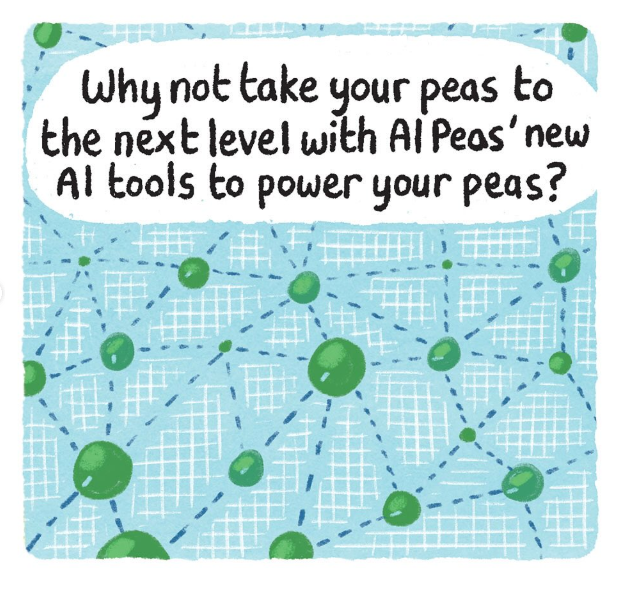
I have decided to give up on writing about AI and so instead I will you with the best commentry on this current state of madness I have come across: AI Peas by Stephen Collins.
Have you seen this Apple advert? Take a moment to watch it. It makes my blood run cold. Surprisingly the tech bros at Apple thought it was a good idea to show this advert which depicts a tower of creative tools and analog items (like paint, trumpets and record players), being crushed into the form of the iPad. It’s a pretty grim vision of the future. It a good visual metaphor for what is happening to creatives right now.
This year has been the toughest year I have experienced as an artist, for a myriad of reasons, and the art market seems to be struggling generally. Yes there’s war in Ukraine and the Middle East (and elsewhere in the world) and “the Cost of Living Crisis” and terrible cold and wet weather in the British Isles hasn’t helped either.
It seems evident that it’s more difficult getting my work seen. I cant help but think that AI and the “enshitification of the internet” is at least partly responsible. I feel a bit like I am being slowly crushed by the Apple crusher. It’s sapping my creative juices. I don’t quite know what to do about it. Cory Doctorow explains how enshittification works “It’s a three-stage process: first, platforms are good to their users. Then they abuse their users to make things better for their business customers. Finally, they abuse those business customers to claw back all the value for themselves. Then, there is a fourth stage: they die.”
This is probably the reason why I can’t find any useful results on google – lots of top ranking website are full of AI nonsense. It’s also why fewer people are seeing my work on the internet. My posts are pretty much hidden on Facebook, Instagram and invisible on X. Images of my paintings do not show up on Google as much as they did say 3 or even 6 months ago. Many other artists report a similar decline in interest from potential customers.
I have started to visit my local library again in search of real books with in- depth facts. The only decent thing on Google these days is Wikipedia. I find that Youtube playlists are so random as to be useless and a search on Pinterest results in either pins I have seen before (in other words I have already saved them) or one unrelated to the search term I just used. Tech companies are burning up the planet with their massive data centres in the hope that one of them will “win” the AI battle and then charge us all for what used to be better quality and free.
What’s this got to do with you? Everything. Doctorow says that enshittification is coming for all industries. “From Mercedes effectively renting you your accelerator pedal by the month to Internet of Things dishwashers that lock you into proprietary dish soap, enshittification is metastasising into every corner of our lives. Software doesn’t eat the world, it just enshittifies it.” Think about your printer – a new printer is cheap as chips but the ink costs a fortune and you cant use non-proprietary ink and your printer will know, and refuse to work.
Corry Doctorow’s big hope is that “Stein’s Law will take hold: anything that can’t go on forever will eventually stop…if everyone is threatened by enshittification, then everyone has a stake in disenshittification.” Actually, there’s a lot more to it than that. You’ll have to read his articles to find out what USA and EU are planning to do to break the monopolies of the big tech comapnies.
I just hope that independent artists like me survive the process or else everyone will have to console themselves with souless AI-derived art their ipad/smartphone/tablet device instead.
See below for some scary examples of AI “Art”. It’s a nonsense view of Derry if you didn’t know.
“Painting of Derry City by Emma Cownie” – Thanks AI. I can give up now. NOT.
Just in case some of you are saying. It’s Londonderry not Derry. AI is no better at conjuring up a view of Londonderry. Take a look! Although there is a river this time.
“Painting of Londonderry City by Emma Cownie”
How about Three Cliffs Bay? I have painted that many times. Sure AI will do better at ripping me off. Well, no.
Painting of Three Cliff Bay by Emma Cownie – Yes, it looks NOTHING like Three Cliffs Bay
Yes, we can laugh at AI’s efforts and say they look nothing like those places or my paintings but it’s all doing damage. AI can never replace human creativity. AI cannot suffer and struggle like humans. It just produces a wierd pastiche of the thing it is meant to be. It’s expensive rubbish. It’s costing us dearly. Emissions from data centers of the likes of Google, Microsoft, Meta and Apple may be 7.62 times higher than they let on.
We can reverse the enshittification of the internet. Don’t accept those tracking cookies. Try a different search engine. Stay on the website rather than downloading apps (you can use ad blockers on the website you can’t on the app). Don’t buy everything via Amazon if you can buy it in a real life shop.
We can halt the creeping enshittification of every digital device. Put down your phone/tablet and read a book or look at a painting made by a real human being. Join artists’ mailing lists so you can still follow their work no matter what the big platforms do to hide their work.
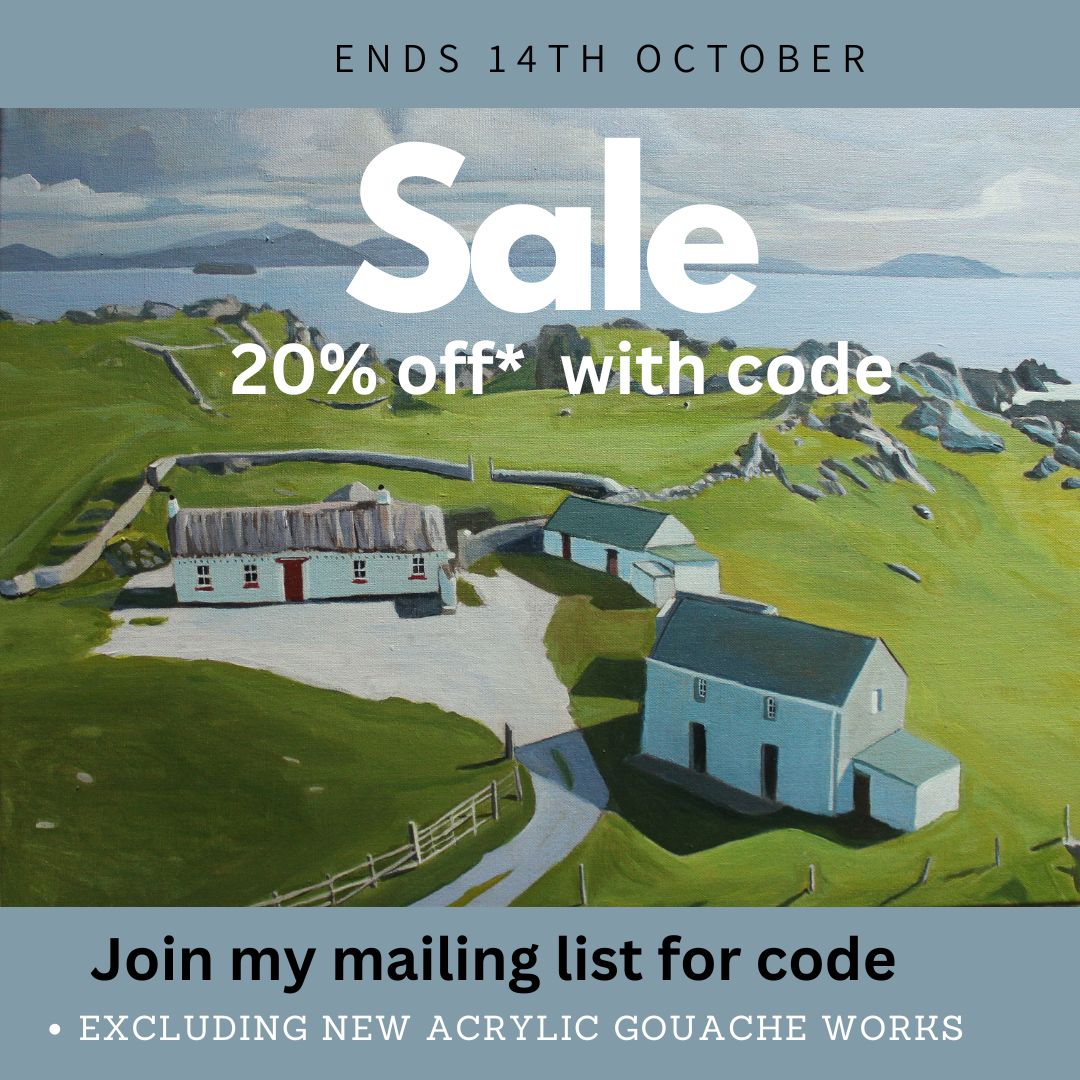
Oh, did I mention I have a 20% off sale on? Starting Sunday until Monday 14th. You have to join my mailing list for the code 20% code but you can unsubscribe at any time.
The robots are coming for our Art. Artists are losing their ability to make a living and we will all be poorer financially and creatively for it. I have been trying to ignore Artificial Intelligence (AI) and Art. Don’t get me wrong. In its place, AI can be very useful. I am aware that as I mistype this text, my computer is offering up corrections. That’s an example of AI. The human element, however, is vital to decide whether to accept the suggested changes or not.
So What’s the Problem?
The type of AI I am concerned with here is something called Generative AI. It is based on deep-learning models that can generate high-quality text, images, and other content based on data (which can be text, numbers and or images) they were “trained” on. The supposed promise of generative AI is that it will generate the image in your imagination if you can describe it. Although, it may take a few goes to find a version that you like.
The thing is that I don’t like it. It doesn’t matter if they are AI “paintings”, illustrations, cartoons or photographs. I find them a bit unnatural and creepy. Many people describe these images as soulless.
An example of AI Landscape Design
One of the joys of being an artist is creating something from nothing. Well, not nothing exactly but being inspired by an idea, a view or a scene and drawing, painting or photographing to make something that did not exist before. The process is an act of creation, from noticing a particular colour or light, composing the layout of the work to the execution of the piece. The landscapes I paint mean something to me; they capture a place, a feeling or a time. I hope they mean a lot to the people who buy them too.
Process or Work in Progress – something AI doesn’t do.
The problem I have with AI generated Art is that it is automated Art. It has no meaning. Work generated by AI isn’t novel. It’s banal—or worst of all, in the art world—derivative.
I know, someone will say: “Good Artists Copy: Great Artists Steal”. I am not sure who said this first. A lot of people are credited with saying it including Pablo Picasso, Steve Jobs, T.S. Eliot and Igor Stravinsky.The difference is that those artists were inspired by what had gone before and gave it their own interpretation. Picasso’s later work only makes sense in the context of theAfrican sculptures that inspired him. Picasso, however, was a very skilled draughtsman and supremely confident painter and you can see from the images below that he was not merely copying the sculptures but had imbibed, digested and reformulated their essence in his own way.
These AI generated images (above ), however, are pale imitations and are quite “dead” in comparison to Picasso’s work. They come from a site called artvy.ai which specialises in generating art in the style of named artists. They include a disclaimer that their images are meant to “provide inspiration” and not be “replicas of the artists’ work”. This is significant as the AI Art companies say this to avoid being sued for copyright infringement. These images also miss the physicality of real world art – the actual texture of the paint and the surfaces. An AI version of Jackson Pollock or Claude Monet just doesn’t cut it for me; without the texture of the paint they have had their spirit removed.
Some commentators see this use of others’ work as inspiration for new work by humans as broadly analogous to what AI art does. Yes, there are artists who use AI art in their own creations as a means or tool to create meaning. American artistEric Millikin is one such artist, he uses AI in an interesting and genuine creative manner as one of many tools. That’s different. Whether he owns the copyright to this work, however, is a grey area. People who create work using AI do not own the copyright. Most jurisdictions, includingSpain andGermany, state that only works created by a human can be protected bycopyright.
The problem is that AI Art is getting better and they are using living artists’ work to improve. In doing this, they are killing off thousands of jobs, such as illustrators, cartoonists and designers. AI companies are not going to compensate those people. It will also put young people off from going to art school. Artists will have to give up Art as they can’t make a living at it. Why bother spending years honing your skills and unique style if AI can do it better and faster? Why bother taking 10-20 years learning colour theory and anatomy if AI is just going to rip off your work in seconds?
Jon Stewart – a bit sweary but very funny take on AI
This is because AI needs real artwork images to “train” on/with. This is known as scraping. Generative AI has only been around for 2 years and already it has gobbled up most of the internet. Last year alist of 16,000 artists whose work had allegedly been scrapped by AI company Midjourney was leaked by John Lam Art.
Screenshot from X.com
You can read this listhere. It includes artists such as Jackson Pollock, Pablo Picasso, Bridget Riley, Damien Hirst, Rachel Whiteread, Tracey Emin, David Hockney and Anish Kapoor.
Interestingly, Hollywood writers also realised that AI was a profound threat to their livelihoods. Last year they organised a strike that lasted 146 days. They demanded that the studios not use AI to generate “original” scripts. In September, they won. News and Tech companies have also ramped up action against AI scrapping. Last summer, Twitter (now X.com) banned AI from scrapping tweets on its site. Nearly 90 percent of top news outlets like “The New York Times”, “The Guardian” and the BBC also block AI data collection bots from OpenAI and others. Big companies like Getty Images are alsosuing image-generating AI for scraping their data without permission.
Individual visual artists are not doing so well. In Japan the battle is already lost. AI companies can use “whatever they want” for AI training “regardless of whether it is for non-profit or commercial purposes, whether it is an act other than reproduction, or whether it is content obtained from illegal sites or otherwise.” This position led to Japan being called a “machine learning paradise.”
In the USA the artists are fighting back. That list of 16,000 artists that John Lam leaked came to 24 pages when printed out. It forms Exhibit J in a class action brought by10 American artists in California against Midjourney, Stability AI, Runway AI and DeviantArt for copyright infringement.
Unfortunately, the Federal US judge hearing the case, inlate October 2023, sided with the AI companies against the 10 artists. The judge made a distinction between works that are copyrighted and works that are not. This is despite the fact that the U.S. Copyright Office considers a copyright to exist “from the moment the work is created,”. However, the agency notes that copyrights have to beregisteredworks to bring a lawsuit for alleged infringement in the USA.
The fight is not over yet. However, the judge invited the plaintiffs to refile an amended claim,which they did in late November 2023, with some of the original plaintiffs dropping out and new ones taking their place and adding to the class, including other visual artists and photographers. The artists argue that the AI companies, by scraping the artworks and using them to train AI to produce new, highly similar works, is infringing their copyright.
Close up of X.com screenshot
The companies’ new counterargument claim they do not replicate the artists’ original work exactly. The arguments are quite lengthy and you can read about them in more detail here.
It doesn’t have to be this way, some companies such as Adobe, Shutterstock and iStock are using AI Art ethicially without infringing artist’s copyright. As AI generated Art cannot be copyrighted that means that big corporations like MacDonalds, Nike, Disney won’t ever want to use it for logos and merchandising as they will not be able to sue anyone for copyright infringement. So it many end up as regarded as little more than very fancy clip Art. They will have destroyed thousands of creative jobs for what?
These companies wont be using AI Art anytime soon
So how do we fight the Rising Tide of AI?
There are a number practical but steps you can take:- Don’t post your work online. That’s a tough one if you are hoping customers will find your work online. Karla Ortiz, one of the 10 artists in the California lawsuit against AI companies, did that at one point.
If you do publish images of your work you can watermark your works – yes, if you apply heavy watermarking, posting such a picture defies the purpose of the publication itself. Light watermarking will not prevent your work from being used by an AI.
Make sure that your pictures are posted on-line in a lower quality. Again that’s a tough one if you are hoping to sell online. Also you can publish copyright notices on your website
Use incorrect tagging, so robots will not consider your artwork as proper for image generation. For example instead of #modernartpainting you use #happycowsonameadow
Some AI companies provide ways to opt images out of being used in training data. You can visit https://haveibeentrained.com/ and block your website from being crawled by AI bots (go to https://haveibeentrained.com/domains and add your domain) You can also check if your image was trained on by some biggest image-generating AIs.Of course, your work is protected only if people who manage AIs training engines opt-in to respect your opt-out.
Finally you can do what is called “poisoning the well”. Researchers at the University of Chicago have created cloaking tools for artists to add to images they upload to the internet that is intended to poison the AI database. These are called Glaze and Nightshade, they are free to download and can interfere with AI models directly. It is recommended that artists use Glaze first and then Nightshade on their work. These tools mess up training data in ways that could cause serious damage to image-generating AI models but are not obviously visible to human eyes, they are time-consuming though. I downloaded the program but my PC didnt have enough memory/RAM to run it. I am waiting to get an account so I can do it online on their web version.
Or possibly, you do nothing and hope the AI storm passes you by. Afterall people who buy paintings in real life will probably not suddenly put AI art on the wall. It doesn’t have the same kudos. This “Industrialised Art” may well be acessible but it will have little value. AI Art may be cheap, quick and easy to make but it’s ultimately bad for you, like fast food. It’s poor quality as it lacks emotion. Ultimately, it has little long term value, except as one of many tools used by human artists as part as a process. Process is everything.