



To Celebrate the New Year I am giving 30% off all work on my website – to get the discount you have to enter a code at the checkout. Where’s the code? Join my email list and it will be sent to you, automatically. The sale ends on 15th January.

If you have already joined my mailing list and haven’t had my latest newsletter with the sale code check your SPAM folder.

A long time ago, when I was a student, my favourite place to visit was the National Museum of Wales. The Davies collection in particular. The Davies were two sisters, Gwendoline and Margaret, amassed one of the greatest British art collections of the 20th century and bequeathed it (260 works!) to the National Museum of Wales. That’s Girl Power!

They had great taste. Those paintings became like my friends. I visited them often and spent a long time looking closely at them. They excited, inspired and comforted me. Even now when I look at reproductions of them online I have a strong reaction to them.
I used to think, this was because I was an artist. I remember peering closely at Monet’s brush strokes and marvelling at how they were laid down. I mean look at this.
A tingle goes down my spine, looking at it. This is what art is meant to do. It’s even better in real life.
Look at Van Gogh’s painting of a rainy day in Auvers. I have never seen better rain (and I have lived in Wales and Ireland – very wet places).

The Mauritshuis Museum in The Hague, is the home of Vermeer’s ‘Girl with the Pearl Earring’. Thew museum recently did some academic research into how visitors responded to artworks. They looked at the neurological mechanisms and emotions underlying the appreciation of perception in art.


The study used EEG and eye-tracking measurements on 20 participants who followed a set route through the Mauritshuis. Five paintings were included on this route: Girl with a Pearl Earring (Johannes Vermeer), The Violin Player (Gerrit van Honthorst), Self-portrait (Rembrandt van Rijn), The Anatomy Lesson of Dr Nicolaes Tulp, (Rembrandt van Rijn), View of Delft (Johannes Vermeer). They also showed them reproductions of the originals and compared their responses. The EEG results showed that the real paintings created a stronger emotional response compared with the poster versions of the same paintings.

“The Girl with a Pearl Earing” created the biggest emotial response. Painting of “The View of Delf” did not score well, and I wondered whether it was because it was a landscape rather than a portrait, not as famous as the “Girl with the Pearl Earing” or people were not familar with the layout of Delf. I have spent a long time looking at historic paintings of London, Swansea and Derry, trying to work out how they relate to the modern day cities. But maybe that’s because I’m pretty geeky. I doubt I had a big emotional response to them, though. Not enough paint!

The EEG results confirm that real paintings (compared to poster versions) also elicited a strong need to approach the paintings. It wasn’t just me wanting to get a close look at the paint! Real art, including the surrounding ambience, lighting, frame also helped evoke an emotional reaction many times more powerful (10x more powerful according to this study) than looking at a poster of a painting.
Some of you will put that in the “No Sh*t, Sherlock” category of scientific “discoveries” – which was my husband’s response when I told him about the study.
I have never seen Vermeer’s painting in real life but my parents have a reproduction in a tiny gold frame. I don’t know if people’s reponses were elicited because its very beautiful, well-composed, very famous, or because its a human face. I suscpect its a combination of all three.

Seeing a famous painting isn’t always rewarding. Maybe you too went to the Louvre in Paris to see the Leonardo’s Mona Lisa and were underwhelmed. Its notoriously small and hard to see as it under glass , far away and surounded by tourists.
There have been times I have come across paintings that I didn’t know and looked at them for a long time. I sat in the Tate (in the 1980s way before it became Tate/Tate Modern) with a lot of Rothko paintings and felt incredibly moved. You just cannot convey that with a reproduction.
So I guess this is a round about way to encourage you to go and see art in real life. You will feel better for it. Possibly. I hope you have some sort of emotional response – tears, laughter, anger even. Barnett Newman, Who’s Afraid of Red, Yellow and Blue III, 1967-68 has been slashed three times.

We can’t all own Monets and Vermeers (and I don’t think any of us should, they are too important for that) but we can be glad that museums hold them in public collections we can see. I would love to see Picasso’s Guernica in real life. I have had it projected on a class room wall when I have taught lessons about the Spanish Civil War – it is a powerfully brutal work. My board was large no where near the full the size of the painting which is 3.49 meters (11 ft 5 in) tall and 7.76 meters (25 ft 6 in) across. Art stimulates our senses, emotions, and intellect. Guernica was also designed to stimulate our empathy. It is as relevant today as it was when it was painted in 1937.

Cardiff National Museum let me visit the stores to see Robert Bevan’s Maples at Cuckfield in 2013, because my husband put in a request to see it after seeing in the gallery the year before after my car accident. This work inspired me to start painting again. It helped with my recovery from PTSD and burn out.
Seeing paintings in real life really does do you good. Dr. Saundra Dalton-Smith has identified looking at art as a way of getting creative rest, one of seven types of rest all people need. Creative rest involves exposing yourself to sources of awe and inspiration and makes you better able to create and problem solve. Painting pictures is even better for you.

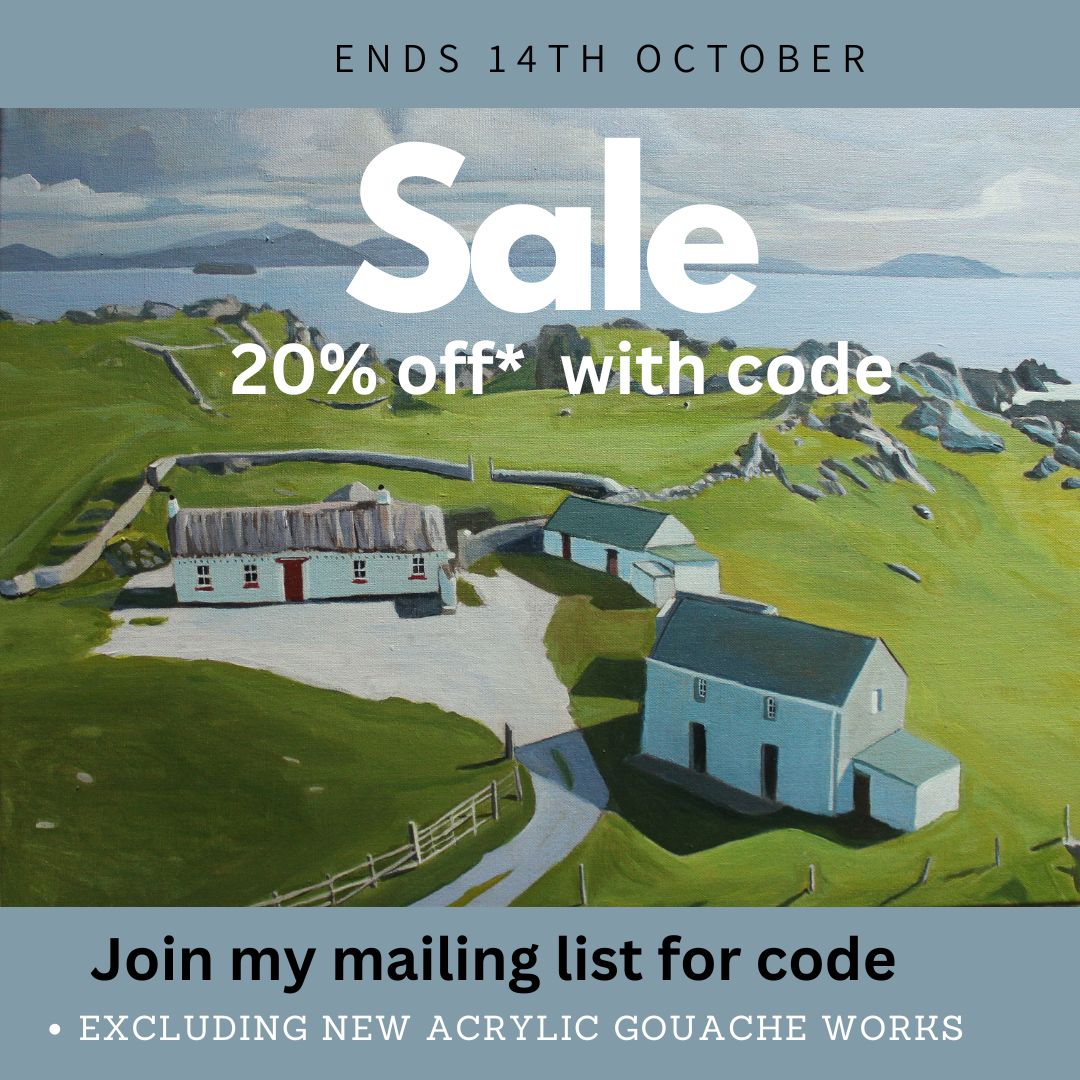
Just a reminder that I am offering 20% off all my paintings on my website until 14th October with a code.
Join my mailing list to get the code here.

Read More about the study
https://www.mauritshuis.nl/meisje/#Waarom-dit-onderzoek
Have you seen this Apple advert? Take a moment to watch it. It makes my blood run cold. Surprisingly the tech bros at Apple thought it was a good idea to show this advert which depicts a tower of creative tools and analog items (like paint, trumpets and record players), being crushed into the form of the iPad. It’s a pretty grim vision of the future. It a good visual metaphor for what is happening to creatives right now.
This year has been the toughest year I have experienced as an artist, for a myriad of reasons, and the art market seems to be struggling generally. Yes there’s war in Ukraine and the Middle East (and elsewhere in the world) and “the Cost of Living Crisis” and terrible cold and wet weather in the British Isles hasn’t helped either.
It seems evident that it’s more difficult getting my work seen. I cant help but think that AI and the “enshitification of the internet” is at least partly responsible. I feel a bit like I am being slowly crushed by the Apple crusher. It’s sapping my creative juices. I don’t quite know what to do about it. Cory Doctorow explains how enshittification works “It’s a three-stage process: first, platforms are good to their users. Then they abuse their users to make things better for their business customers. Finally, they abuse those business customers to claw back all the value for themselves. Then, there is a fourth stage: they die.”
This is probably the reason why I can’t find any useful results on google – lots of top ranking website are full of AI nonsense. It’s also why fewer people are seeing my work on the internet. My posts are pretty much hidden on Facebook, Instagram and invisible on X. Images of my paintings do not show up on Google as much as they did say 3 or even 6 months ago. Many other artists report a similar decline in interest from potential customers.
I have started to visit my local library again in search of real books with in- depth facts. The only decent thing on Google these days is Wikipedia. I find that Youtube playlists are so random as to be useless and a search on Pinterest results in either pins I have seen before (in other words I have already saved them) or one unrelated to the search term I just used. Tech companies are burning up the planet with their massive data centres in the hope that one of them will “win” the AI battle and then charge us all for what used to be better quality and free.
What’s this got to do with you? Everything. Doctorow says that enshittification is coming for all industries. “From Mercedes effectively renting you your accelerator pedal by the month to Internet of Things dishwashers that lock you into proprietary dish soap, enshittification is metastasising into every corner of our lives. Software doesn’t eat the world, it just enshittifies it.” Think about your printer – a new printer is cheap as chips but the ink costs a fortune and you cant use non-proprietary ink and your printer will know, and refuse to work.
Corry Doctorow’s big hope is that “Stein’s Law will take hold: anything that can’t go on forever will eventually stop…if everyone is threatened by enshittification, then everyone has a stake in disenshittification.” Actually, there’s a lot more to it than that. You’ll have to read his articles to find out what USA and EU are planning to do to break the monopolies of the big tech comapnies.
I just hope that independent artists like me survive the process or else everyone will have to console themselves with souless AI-derived art their ipad/smartphone/tablet device instead.
See below for some scary examples of AI “Art”. It’s a nonsense view of Derry if you didn’t know.

Just in case some of you are saying. It’s Londonderry not Derry. AI is no better at conjuring up a view of Londonderry. Take a look! Although there is a river this time.

How about Three Cliffs Bay? I have painted that many times. Sure AI will do better at ripping me off. Well, no.

Yes, we can laugh at AI’s efforts and say they look nothing like those places or my paintings but it’s all doing damage. AI can never replace human creativity. AI cannot suffer and struggle like humans. It just produces a wierd pastiche of the thing it is meant to be. It’s expensive rubbish. It’s costing us dearly. Emissions from data centers of the likes of Google, Microsoft, Meta and Apple may be 7.62 times higher than they let on.
We can reverse the enshittification of the internet. Don’t accept those tracking cookies. Try a different search engine. Stay on the website rather than downloading apps (you can use ad blockers on the website you can’t on the app). Don’t buy everything via Amazon if you can buy it in a real life shop.
We can halt the creeping enshittification of every digital device. Put down your phone/tablet and read a book or look at a painting made by a real human being. Join artists’ mailing lists so you can still follow their work no matter what the big platforms do to hide their work.
Oh, did I mention I have a 20% off sale on? Starting Sunday until Monday 14th. You have to join my mailing list for the code 20% code but you can unsubscribe at any time.
Read more
Cory Doctorow on Enshittification of the Internet – https://pluralistic.net/2023/08/27/an-audacious-plan-to-halt-the-internets-enshittification-and-throw-it-into-reverse/
https://www.theguardian.com/technology/2024/sep/15/data-center-gas-emissions-tech


