To Celebrate the New Year I am giving 30% off all work on my website – to get the discount you have to enter a code at the checkout. Where’s the code? Join my email list and it will be sent to you, automatically. The sale ends on 15th January.
View from the Pier (Portnoo)-Emma Cownie SOLD
If you have already joined my mailing list and haven’t had my latest newsletter with the sale code check your SPAM folder.
The name will be familar to British ears who ever listened to the daily shipping forecast on BBC Radio. It is broadcast late at night just before 1 am and very early (5.20am). Anyone who is a night owl or insominiac will have listened to it. The list of shipping zones and forecasts is not only practical but also poetic and rather mysterious. Following the litany of locations and numbers is very soporistic. Listen to the clip below. The actual broadcast is from 2.46 onwards ZZzzzzzzzzz
Shipping Forcast (1993) – almost always broadcast on the radio, you have to use your imagination!
Many British people may not know where Malin Head it is anymore than than they know the location of German Bight or Viking. To Irish ears, however, it is well-known as the most northerly tip of the island of Ireland and also features on Met Eireann’s, sea area forecast, broadcast on RTE.
UK_shipping_forecast_zones
Malin Head to Mizen Head
People regularly tranverse the length of Ireland from Malin Head, Donegal, to Mizen Head, Cork. It’s a fair stretch. Just under 400 miles (640 km). Some incredible people have cycled it in just over 15 hours. Ordinary mortals take about 4 days.
Amazingly some super-human runners have done it in about the same time – 4 days! I recently listened to a radio interview with the heroic Sophie Power. Sophie is from England and she recently ran the length of Ireland in under 4 days. This is a World Record. She beat the previouis record by three hours. Being a mother, she had to fit it in during her children half-term holiday and didn’t get to pick the day with the nicest weather – just the Tuesday of half-term and so she started off in driving rain! Many years ago I used to run (only piddly 10ks and 5ks) and I would certainly prefer to run in rain than heat.
Incredibly Sophie ran most of the distance without sleep, snatching the odd half an hour on her second and third day. She ended up hallucinating, and with a knee injury that had to be braced. When she finished the race in Cork she had developed heat stroke! That alone shows you how far south Cork is. There’s no way she’d get heat stroke in Donegal! She’s planning to come back and run the Cork Marathon.
Sophie Power at Malin Head
At the Edge of the world
Standing at Malin Head is like standing at the edge of the world. To the north is nothing can be seen but sky and sea. A long way off is Iceland and much. much further away to the north-west is North America. It feels very remote (but surprisngly accessible from Letterkenny and Derry/Londonderry) but to fishermen and sailors, I’m sure it’s not. Scotland is surpisingly close to the north-east. If you have ever flown from England to Belfast on a clear day, you can see the Scottish Isles and the Isle of Man scattered across the Irish Sea, pretty close the Antrim coast. Donegal is just a bit further along.
On the most northerly tip of the island of Ireland, you will find a tower that was built in 1805 during the Napoleonic wars as a lookout tower to defend against any attacks by the French. You can see at the top left hand side of my painting above. Edges of places are places to look out from – for invaders, or for incoming storms. Weather reports that were important to local and international shipping were first recorded at Malin Head in 1870. It was in that year the tower became a signal tower for Lloyds of London. Semaphore was used to connect with ships at sea and the lighthouse on nearby Inishtrahull. In 1902 the first commercial wireless message was sent from Malin Head to the S.S.Lake Ontario by the Marconi Company.
Divers’ magnet
There are the wrecks of many ships lying off the coast in this area. Many of these such as SS Audacious, SS Carthaginian and RMS Justicia date to the time of the First World War, when Ireland was still part of the British Empire.
In 1917 two German mines sankLaurentic and although her crew successfully abandoned ship, but 354 of them died of hypothermia in her lifeboats.Interestingly, Laurentic was carrying about 43 tons of gold bars when she sank. Most of the 3,211 bars were salvaged by 1924; three more bars were found in the 1930s, however 22 gold bars have still not been recovered.
The Great Emergency/Second World War
During the Second World War, Ireland was neutral. The Irish army built lookout posts in places along the coast to prevent any violation of this neutrality. This was important as this part of Donegal is so close to Northern Ireland, which not not neutral and was bombed by the Germans. There is an EIRE 80 sign built of stones during the war so aircraft would know that they were over Ireland (not Northern Ireland). They acted also as a navigational aid for pilots. Eire 79 is at Fanad Head to the west. Eire 81 is at Glengad Head, further along the Inishowen Peninsula, to the east. You can see it on the map below. The SS Athenia, a passenger ship carrying 1,418 people was torpedoed by a German U-boat just hours after war had been declared in 1939 off the coast of Malin Head! Most of the passengers survived but 117 perished.
Tourism Sign at Malin Head
Some scenes from the film Star Wars: The Last Jedi film was shot at Malin Head. I have to admit that I am not a Star Wars fan – I never made it through awhole film. I have to admit that I’m more of a Star Trek fan. Apparently, it is possible to have a tour of the locations used for the film from local tour guides. The road leading up to Bamba’s Crown has been renamed locally from the R242 to the R2D2 in recognition of the Star Wars connection. Also beside the tower, there is a short lovely refreshing walk along the cliffs to Hell’s Hole. The cliffs are massive here and even on a relatively calm day the sea is restless and a bit intimidating It needs to be remembered that this not just a sea here but an Ocean.
Birds Eye View of Malin Head, Donegal- Emma Cownie
Fanad is a finger of land that lies between Lough Swilly and Mulroy Bay on the north coast of County Donegal, Ireland. It is not that easy to get to and the the survival of the Irish language is testiment that relative isolation.
Lambing season at Fanad Head (Donegal) SOLD
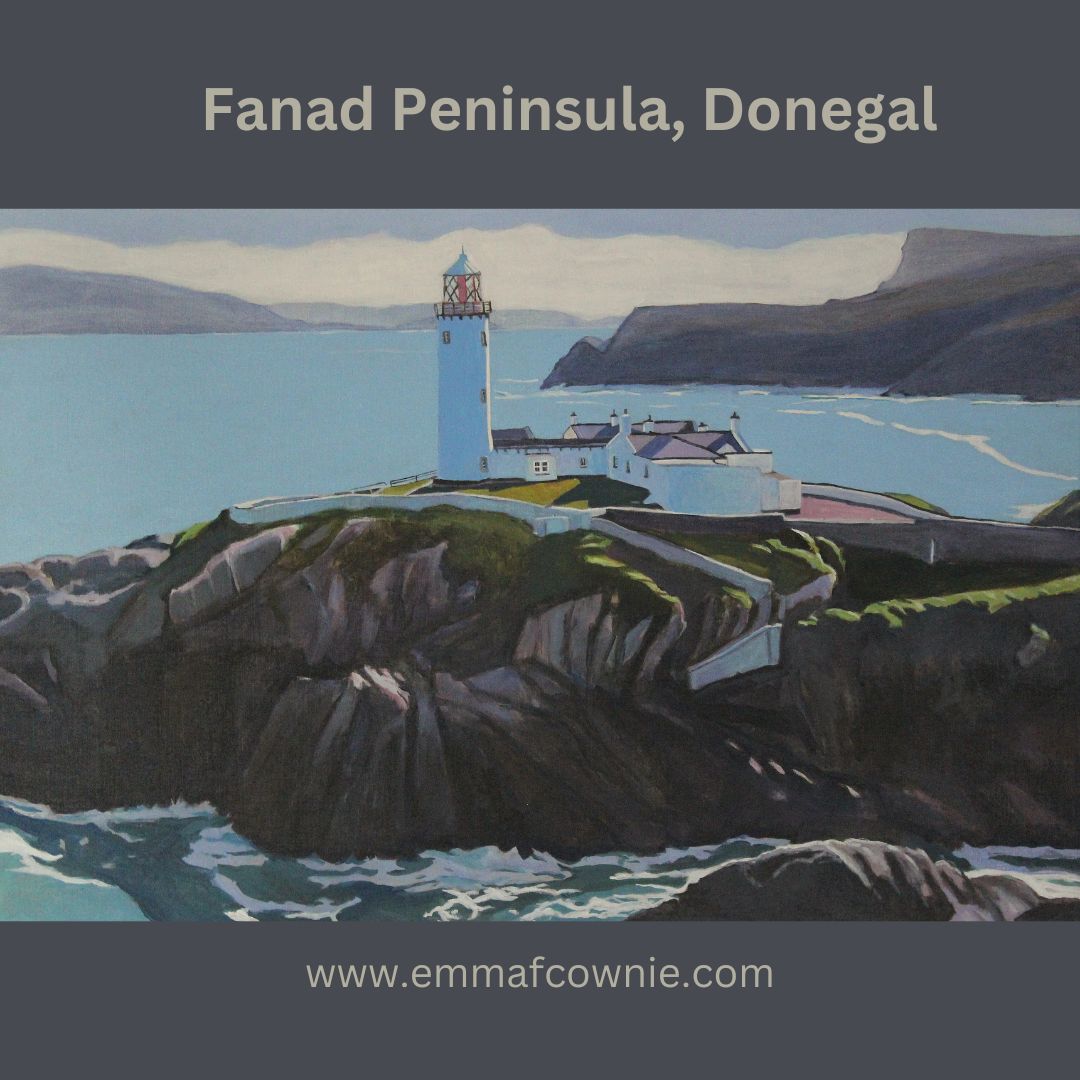
Fanad Lighhouse (Donegal). Is one of the 12 Great lighthouses of Ireland. It was built in 1886 at Fanad Head (although the station was originally established in 1817). The lighthouse, or more acrrately, the harbour light, marks the entrance into Lough Swilly which forms a natural harbour.
Fanad Lighthouse (Donegal) SOLD
I have painted this isolated structure several times before. I have always enjoyed painting the northernly light on Fanad. I have only have painted it in acrylics. That’s not a delibertae choice, more one of circumstance because at times I have had limited space, and I dont want to use oil paints with kittens close at hand.
Over to Fanad Lighthouse (Donegal) _Emma Cownie SOLD
I think acrylics suit the airiness of the subject matter. After a couple of years working out how to use them, I have settled on a technique of light layers of paint that allow the underlying colour to show through. This can give a transulent quality to the colour. This is in contrast to the relatively flat areas of colous I use for the larger areas of colour such as sky or the sea.
My latest painting was an experiment in composition. We used an image from a drone shot done by my artist husband, Seamas (James Henry Johnson).
In this piece, I wanted to create a sense of space from the mountains of the Inishowen Peninsula in the distance. The distant mountains were layered with bluish white until I got the right impression of distance.
I often find myself looking at the tiny Fanad lighthouse far off in the distance when I am at Lisfannon on the Inishowen Penisula. There is a sign comemorating a famous Atlantic storm that happened in 1748. this storm threatened to sink The Greyhound, the ship of one John Newton, a slave trader. John was so frightened that he called out to God for mercy. This moment marked a profound spiritual conversion, and many years later he wrote the words for the hymn “Amazing Grace” one of my favourite hymns, and to also campaign for the abolition of slavery.
There is some confusion how many storms there were . One website claims the terrible tempset happened far away out in the Atlantic because it took John Newton another four weeks after his conversion to sail into Lough Swilly and arrive at Derry/Londonderry. The Amazing Grace.ie site however, makes it clear a second storm happened in Lough swilly itself as it quotes John’s journal ” We saw the island of Tory and the next day anchored in Lough Swilly in Ireland. This was the 8th day of April, just four weeks after the damage we sustained from the sea. When we came into this port, our very last victuals was boiling in the pot; and before we had been there two hours, the wind began to blow with great violence. If we had continued at sea that night in our shattered condition, we must have gone to the bottom. About this time I began to know that there is a God that hears and answers prayer.” It’s got to be said, that John Newton really took his time putting his evangelical beliefs into action because he went back to being a slave trader for another five years before he eventually retired and became a minister in 1757!
The heaving sea at the foot of the massive lighthouse rock intrigued me. The Atlantic Ocean has such a bulk and stregth, even on a relatively fine day, I am not surprised that John Newton was terrified by its strength far away from the Donegal coast. I wondered about the long and difficult process of building this structure all those years ago in a remote location. Yet, this lighthouse has stood the test of time and proudly marks the entrance to Lough Swilly and can be seen from inland and further along the coast.
While many of you are baking in England and dealing with a hosepipe ban, in Donegal it’s cloudy with occasional showers. I thought I would share you my recent newletter. They have ended up being quarterly. It depends of how much news I have and how busy I have been. I always make it strong on the visuals and light on the words! I also make the typeface large for reading on smart phones!
You probably think that artists are good at creating paintings/images in all mediums; oil, watercolours acrylic paints. Many probably are, but I am not. I need to work at it. It’s a bit like being an athlete. You might be great at football but it doesn’t automatically mean you are a great sprinter, tennis player or swimer. Although there are athletes who have successfully switched disciplines, like Usain Bolt, who started his career as a footballer; extra training is needed. I think painting is like that.
Almost all of my experience up to now has been in working with oil paints but in the last six months I have been working hard at painting in acrylics. Why? I knew that in our small house in Derry, until we got stairs put into the attic space, that oil paints and with their associated mess and fumes weren’t going to work.
Unfortunately I feel like I have been hitting my head against a brick wall for several months. I have learnt a great deal, using acrylic mediums and varnishes is very technical, but I won’t go into all the detail of what I have learnt. The strange thing is that the finished paintings looked good but the process of creating them was slow and frustrating. Here are some early examples;
Shadow on the Entrance, Bloody ForelandHouse on Inishbofin
This last one is my favourite but it took weeks to complete rather than days. I just don’t have the patience to spend that long on one smallish painting.
I also used acrylic paint for underpaintings for my oil painting, which worked better for me. It enabled be to paint faster, but this approach would be no good in Derry where I couldn’t use oil paints.
Boat at the Pier, Gola (Donegal)From Magheraroarty to Muckish (Donegal)
So why was I taking so long to complete these acrylic paintings? Acrylics don’t act like oil paints, that can be a good thing as well as a bad thing. You can correct mistakes easily. Acrylic paint is a relatively recent invention of the 1950s. It’s essentially a plastic. It is amazingly versatile but it’s origins as a polymer presents a couple of challenges that I have struggled with for some time. The first issue is that it dries fast. Really fast. I found that it dried on my palette within minutes. I hate wasting paint, so I made my own wet palette, so that the paint on my palette dries within days and not minutes.
It still dried very fast on the board/canvas on which I was painting. That meant that large areas, such as skies, werevery difficult to paint without looking patchy. I learnt to mix up large quantities of paint so that if I needed to, I could repaint a small area of the sky. Otherwise, the whole sky had to be repainted.
The second big issue I had was somehing called “colour shift”. Acrylic paint dries dark. This is because most makers of acrylic paint use white binder that dries clear, so it looks light when you apply it, but goes dark as it dries. It seems to affect blues and browns particularly badly. I tried painting patches of colour to see who was the worst offender.
Colour Shift (these are all dry so you cant see the colour shift but my notes tell you what I saw)
Although Windsor & Newton’s paints use clear blinder and have little colour shift, I didn’t particularly like them as a paint. I am not sure why I didn’t like them, possibly I just prefered to colour range of other manufacturers. Anyway, in the end I bought lots of Schminke PrimAcryl paints which also use a clear binder and results in only a small colour shift.
Finally, I decided to experiment with indirect painting. This is a method where by an underpainting in grayscale is done first and light layers of colour are applied as a glazes.
Again, its’s not as speedy as painting in oils (although I have used brown-tonal underpaintings in the past – with oil paintings, see here).
So here are two paintings I painted tonal underpaintings, and then added colour through a series of glazes.
Greyscale study of lambing Season at Fanad HeadWork in Progress – Lambing season at Fanad Head
Lambing season at Fanad Head (Donegal) – Final version
Greyscale study of Fanad Lighthouse – painted on a blue ground, which I left in the sky area of the painting.
Almost done – Fanad Lighthouse (Donegal)Lighthouse at Fanad Head (Donegal) – Final version with lightened sky
This approach seemed to work well for acrylics. Although I am still not as quick as I am in oils, this process enables me to produce paintings with greater depth of colour and more accurate tonal values. It is especially good for getting distant mountains right, something I have struggled with in the past. I am hoping that I have finally got the hang of working with this medium. I think it’s the end of the beginning rather than the beginning of the end. There’s always so much to learn with painting no matter which medium you use!