I recently spent a morning writing about my influence to someone in a gallery in New York, whom I thought was interested in representing me. Sadly, after sending some images and putting these words together he asked for 150 dollars to feature in some catalogue of theirs. So that was that. I am used to being sent scammy messages, like this one I got this morning from so-called “Mr Beast” which read ‘Hi, You have some pretty amazing works, all I can say is Awesome! It must have taken a lot of time to put these magnificent pieces together..they are so unique..I’m so in love with then. I’d love to purchase some of them if i can be informed about them. Looking forward to hearing from you. Best Regards Mr Beast’. I just ignore those sorts of messages.
I suppose I was annoyed that I spent sometime answering this one. Why did I bother, well despite some misgivings, the Instagram account associate with ethe gallery had some really good artists on it. Anyway, I thought I’d publish the summary here in case people would appreciate an overview of my work as a whole.
My work is influenced primarily by US artists especially post-Edward Hopper American realists who revere light shadow and the sense of stillness and quiet. One of my favourite contemporary America Artists is Jessica Brilli who I traded paintings with a couple of years ago.
The only British artist I am influenced by is the late David Hockney, who obviousy was greatly inspired by American art. I include a few paintings to illustrate how I attempted to bring an American sensibility to the Irish landscape and more recently to the Welsh landscape in the UK. Here some examples
This composition was inspired by Fairfield Porter
In this series I attempted to pare all detail down – I called this style rural minimal.
A number of these paintigns have become book covers.
Recent innovations to this style have involved a more obvious use of texture inspired by the Bay Area artists, among others like Mitchell Johnson.
Rocky Ground, Bun An Inbhir (Donegal)
Up Bloody Foreland, Donegal
Narin Rise, Donegal by Emma Cownie
A recent development in my work has concentrated on another US inspiration, Richard Diebenkorn particularly his Ocean Park series of paintings. Using my husband’s drone photography I have been interested in exploring texture and composition primarily. These recent paintings show this style and they are still available to buy.
A Change in Direction (Reynoldston, Gower)
A Fork in the Road (Inishowen, Donegal) by Emma Cownie
Llanrhidian (Mill Lane) by Emma Cownie
Finally I have occasional detours into acrylic gouche which seems to allow me to paint in a slightly different way to oil and acrylic – normally on hard board but I have really liked the results. I have tried to bring an American sensibililty to Irish and British landscapes.
I am delighted that Peter Zantingh, a Dutch blogger, wrote this an account of Gola and my work. I have translated it for you to read (well, Google did). You can read the original here.
“In the autumn of 2018, Emma Cownie looked out from the Irish mainland at an island she could not get to. It seemed so close. She could see the rocks off the coast and beyond them, scattered seemingly at random across the rolling land, the whitewashed cottages. Some were abandoned, others clearly still inhabited, or used as summer homes.
Gola Island is one of 365 islands off the Irish coast. It is just two square kilometres in size. No one knows exactly how many people live there, because there are more in the summer than in the winter. Ferryman Sabba only goes up and down between June and September.
But in 2022, there were fifteen people living on Gola, according to official figures.
Emma Cownie is a British artist. She studied medieval history at Cardiff University and taught at a secondary school for a while. On 29 February 2012, she was hit by a car. It was, in retrospect, what prompted her to take up painting full-time. The days in front of the class were exhausting, almost all contact with other people in fact, she was startled by every sudden sound. A few years before the accident her dog had been run over on a busy road.
Painting helped.
In the days after she had stood on the mainland looking at those houses in the distance she painted Spring Light on Gola. It came, she told me, ‘out of a kind of longing for the island’.
In the spring she went again. It was early April, sunny but chilly, a cold wind blowing along the coast. Her husband Séamas was with her, their dog Mitzy too. To get the best view of the island – again there was no ferry – they walked along long stretches of beach and climbed on granite boulders, almost pink in the spring light. From here she could see the houses that had recently been renovated and modernised.
That summer she was finally able to go there. ‘There are hardly any cars’, she told me about it. ‘Just a few tractors, no telephone poles or electricity pylons and only a few other people. Other than that, just birdsong and wind. It’s bliss.’
Spring Light on Gola (Sold)
*I emailed Emma Cownie last month with a simple question. One of her paintings was used on the cover of one of my favorite books, Foster by Claire Keegan. I wanted to discuss that book in my newsletter, and I would like to show that painting as well. Would that be okay? I would mention her name and link to her website.
She responded the same day, and we got to talking. She said that the painting I had asked about was called Traditional Two Storey House, Gola, and that it was nice to hear from someone from the Netherlands, because although she regularly sees Dutch campers in Donegal, the county in the northwest of Ireland where she lives part of the time, she has never sold work to anyone from the Netherlands.
The title of the painting made me curious. Gola? What was that? That’s how I became fascinated with the island in my own way.
At one time, there were about two hundred people living there, who made a living from fishing and small farms. But after 1930, the population began to decline. Especially in the winter, it was easier to earn money in the cities, especially those of Scotland and England, and fewer and fewer people returned for the summers. In 1966, the island’s school closed; with only nine pupils (there used to be sixty), it no longer had a right to exist. The few families with young children were forced to move to the mainland – and once the last family with children had left, the community was doomed.
I read this last in Gola: The Life and Last Days of an Island Community (1969) by F.H. Aalen and H. Brody, which I ordered for a few euros on boekwinkeltjes.nl or Abebooks. I think I mainly wanted to know what happened when the last ones left. How does a group of people dissolve itself?
Brody, a sociologist who wrote the part about the last days of the community by the two authors, saw a kind of laconic group feeling among those who were still there at the end of the sixties. Everyone wanted to stay, if the rest stayed too. Everyone thought it was okay to go, as long as everyone else went too.
The most intriguing aspect of each islander’s account of his own predicament is his insistence that it all depends on the others. […] The general attitude is one of wait and see – what the others do. But all of the Gola people are waiting on one another in this way, and do not seem to mind the impasse that this conditional planning involves. Of ten islanders who related their plans, nine said they would like to stay, but it depended on the others. One man said he would stay so long as he had a dog with him, and could not see any advantage to life away from the island. Apart from that one man, all stated they would be glad to remain on Gola, but did not really mind leaving.
The authors also contributed to a short documentary for the Irish public broadcaster RTÉ from the same year, which shows how one family, the O’Donnells, leaves the island. They lock the door and walk with their dog, a long-haired collie, to a motor boat in the harbor. They are all wearing black. (Screenshots from the film below)
Five people remained: fisherman Eddie, fisherman Tadhg, postman Nora and her husband John, and ninety-year-old Mary. It would not be long for them either.
What was left behind? The island had no shop, no pub, not even a church. “The islanders worship on the mainland when the weather is good enough to make a safe crossing,” Brody wrote in 1969. Just over thirty houses remained, most in poor condition. The schoolhouse and the post office. Wooden boxes and fishing nets in the harbour, where a statue of the Virgin Mary, housed in a stone shrine, continued to look out. Two pegs on a washing line.
Between 1969 and 2002, Gola was an uninhabited island. In Dances With Waves: around Ireland by Kajak (1998), Brian Wilson (not the Beach Boys guy, another Brian Wilson) writes about the time he went ashore during his nearly two-thousand-mile kayak trip all the way around Ireland. He hoped to find some peace and shelter that day, but he encountered “the eerie atmosphere of a ghost town”. Fishing boats lay rotting in the harbour among the washed-up debris.
But he found something more hopeful in the cottages. They were “abandoned, but not in decay”.
[…] one felt as though, like faithful dogs, they were just waiting for their owners to return. More than that, it was as if the island itself was still waiting. And the people came again. They came back. Somewhere around the turn of the millennium, the first ones crossed. Today, most of the cottages are still uninhabited, but in summer the sounds and movements of people join those of the cormorants, guillemots and gannets.
Emma Cownie has made more than 25 paintings of Gola in recent years.
For Traditional Two-storey House, Gola, the painting that made me contact her, she returned to the ‘rules’ she had set for herself a few years earlier. These rules – not coincidentally – coincide with how she wanted to organise her life after the car accident and the difficult time that followed: no cars, no people, bright light.
Furthermore, there must be shadows, preferably diagonal, in simple shapes. The painting must be about the interplay between shadows and man-made constructions, the tension between 3D buildings and 2D shadows.
She also wanted to think longer and better about colour. Not to choose the brightest colour, purely for effect, as she had done before, but to work more subtly. In a new series of works based on the houses on Gola Island, including Traditional Two-storey House, she resisted the urge to make the shadows very dark, the sky pale pink and the grass yellow and bright green. “I tried to keep the shapes and colours as simple as possible without it being a cartoon,” she told me. “I wanted to capture the essence of the place.”
The Traditional House, (Gola)
She painted the picture in January 2021, during a Covid-19 lockdown in Wales, where she was then living. That summer, she and Séamas moved to Donegal, in the north of Ireland.
It was the following summer, 2022, that she was approached by the prestigious London publishers Faber & Faber: they wanted to use Traditional Two-storey House for the cover of Claire Keegan’s Foster, originally published in 2010. “I didn’t realise what an honour it was until I got a copy of the book and read it,” she said. “I cried at the end.”
Foster by Claire Keegan, Published by Faber
Is there a writing lesson in this? I don’t know. Maybe that there’s more to everything. Maybe it’s worth following your interests and fascinations without reservation. To notice it – this interests me, this grabs me – and follow that line, see where it takes you.
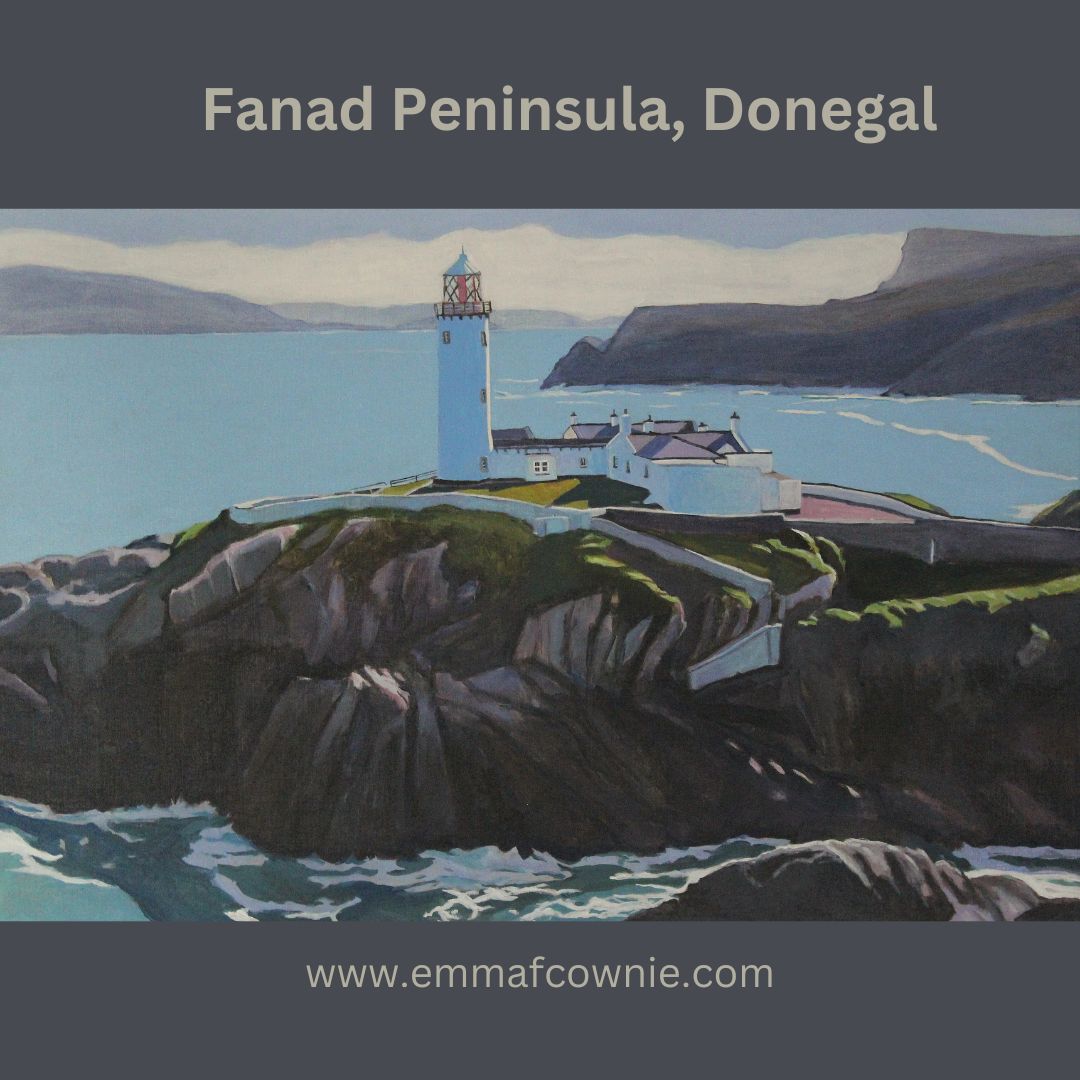
Fanad is a finger of land that lies between Lough Swilly and Mulroy Bay on the north coast of County Donegal, Ireland. It is not that easy to get to and the the survival of the Irish language is testiment that relative isolation.
Lambing season at Fanad Head (Donegal) SOLD
Fanad Lighhouse (Donegal). Is one of the 12 Great lighthouses of Ireland. It was built in 1886 at Fanad Head (although the station was originally established in 1817). The lighthouse, or more acrrately, the harbour light, marks the entrance into Lough Swilly which forms a natural harbour.
Fanad Lighthouse (Donegal) SOLD
I have painted this isolated structure several times before. I have always enjoyed painting the northernly light on Fanad. I have only have painted it in acrylics. That’s not a delibertae choice, more one of circumstance because at times I have had limited space, and I dont want to use oil paints with kittens close at hand.
Over to Fanad Lighthouse (Donegal) _Emma Cownie SOLD
I think acrylics suit the airiness of the subject matter. After a couple of years working out how to use them, I have settled on a technique of light layers of paint that allow the underlying colour to show through. This can give a transulent quality to the colour. This is in contrast to the relatively flat areas of colous I use for the larger areas of colour such as sky or the sea.
My latest painting was an experiment in composition. We used an image from a drone shot done by my artist husband, Seamas (James Henry Johnson).
In this piece, I wanted to create a sense of space from the mountains of the Inishowen Peninsula in the distance. The distant mountains were layered with bluish white until I got the right impression of distance.
I often find myself looking at the tiny Fanad lighthouse far off in the distance when I am at Lisfannon on the Inishowen Penisula. There is a sign comemorating a famous Atlantic storm that happened in 1748. this storm threatened to sink The Greyhound, the ship of one John Newton, a slave trader. John was so frightened that he called out to God for mercy. This moment marked a profound spiritual conversion, and many years later he wrote the words for the hymn “Amazing Grace” one of my favourite hymns, and to also campaign for the abolition of slavery.
There is some confusion how many storms there were . One website claims the terrible tempset happened far away out in the Atlantic because it took John Newton another four weeks after his conversion to sail into Lough Swilly and arrive at Derry/Londonderry. The Amazing Grace.ie site however, makes it clear a second storm happened in Lough swilly itself as it quotes John’s journal ” We saw the island of Tory and the next day anchored in Lough Swilly in Ireland. This was the 8th day of April, just four weeks after the damage we sustained from the sea. When we came into this port, our very last victuals was boiling in the pot; and before we had been there two hours, the wind began to blow with great violence. If we had continued at sea that night in our shattered condition, we must have gone to the bottom. About this time I began to know that there is a God that hears and answers prayer.” It’s got to be said, that John Newton really took his time putting his evangelical beliefs into action because he went back to being a slave trader for another five years before he eventually retired and became a minister in 1757!
The heaving sea at the foot of the massive lighthouse rock intrigued me. The Atlantic Ocean has such a bulk and stregth, even on a relatively fine day, I am not surprised that John Newton was terrified by its strength far away from the Donegal coast. I wondered about the long and difficult process of building this structure all those years ago in a remote location. Yet, this lighthouse has stood the test of time and proudly marks the entrance to Lough Swilly and can be seen from inland and further along the coast.
We are in the midst of lockdown in Wales, the schools are shut and the good news is that the covid numbers are falling. They need to fall a lot further because when the schools and the university students come back they will shoot up again. I had in a mind a longer blog post, but I find that after I have got up, done my yoga/ankle exercises and painted in the morning light, that I am too tired for much else. That post will have to wait a little longer.
So I have decided to show you my most recent work. I have been painting Tenby, which I can only visit in my imagination.Tenby is a harbour town and resort in southwest Wales. It’s known for its 13th-century town walls and its stretches of sandy shoreline, including Castle Beach.
I have been working on a triptych (which is three paintings) but I have only finished two of them, so its a diptych (two)! I will add the third one when I have completed it. I was trying to find unusual angles to paint. As much as I love painting Tenby and its colouful houses and boats, I need a fresh angle to present my brain with a new set of challenges to solve. This first painting, the challenge lay in how to paint the headland off in the distance and balnce it with the very dark shaows in the foreground. In the end I simplified the details and make sure that the tone was cool with warm grey and mauve. I was particularly pleased with the shadows on the beach and the blue house.
Out of the Tenby Shadows
My second painting is a view of the pier or quay from Castle Hill. This is a headland on which the ruins of Tenby Castle overlook the harbour. I liked the fact that this was the “underside” of the view we usually see of the harbour. The pier is a working pier as can be seen from the lobster pots stacked at the far end. It’s also where the Caldey Island boat picks up supplies for the islanders and the abbey every day (so long as the wind is not from the South West or over 20mph). Apparently royal mail has continued to visit throughout the pandemic, so that the monastery shop has been able to continue to operate. The boat that takes visitors to the island leaves from Castle Beach round the corner. The island is usually open from Easter to September for visitors, I don’t know whether that happended this year. A visit to Caldey in the boat was a pretty outdoor affair in ordinary times, so maybe they will start again in the summer, who knows.
Tenby Pier, Wales (Sold)
I will add my third painting when I have completed it.
Update:Here’s the third and final painting of the three.
I have found that my energy is slowly but steadily returning after my operation on my broken leg in March (although painting light is shrinking with the shortening days). I spent much of the spring and early summer sitting in my chair wishing I could go outside into the fresh air or climb the stairs to my attic studio. I painted watercolours instead, and thought a lot about colour and composition. I learnt to simplify my images and edit them with more ruthlessness than I had done before.
Gola Houses (watercolor)
I have attempted to carry these lessons into the compositions of my oil paintings. I suspect that I need to go further. I am always torn between a desire to accurately convey what is probably a well-known location to local people, and the need to create an effective composition. In otherwords I want to create an engaging painting, regardless of whether a viewer has visited Donegal or not.
Blue Door, Gola (oil on canvas) SOLD
Here’s an example of editing my composition. I used several reference photos for this painting of Bád Eddie (Eddie’s Boat) but you will see that I decide to leave out the all the lamp posts. I felt they made the picture look cluttered. I also left out the the skylights on a couple of the houses for the same reason. I did, however, decide to include a couple of series of fence posts on the right side of the painting as they lead the eye down the hill.
One of the reference photos for Bád Eddie at Bunbeg
Bád Eddie, Ireland. (Oil on canvas) SOLD
I have gone further with my editing of the reference image in my most recent painting of Arranmore. This is a painting of a (probably abandoned) white house that I had painted a watercolour of earlier in the year .
The White house, Arranmore, Ireland (watercolour)
A lot of the compositional work is done when composing the reference photograph, but there is often a bit more tinkering to be done to clarify the image further.
The White Bridge, Arranmore, Ireland (100cm x 65cm) (Oil on canvas)
Here you can see that I have again removed most of the telegraph poles, just leaving one further down the road. The fence posts as usual, get to stay. The ones on the right led the eye down the road. The central part of the painting on the right side is too cluttered for my liking too. It’s very confusing for the viewer. I have since discovered that this is because there are too many “tangents“. The word “tangent” usually just indicates that two things are touching, but in art the term describes shapes that touch in a way that is visually annoying or troublesome. This also describes those telegraph poles I removed. It all makes for an image that is easier to “read”.
Tangent Chart – From emptyeasel.com
I also removed a several of the buildings so that there is a clear view over to the tiny island of Inishkeeragh with its solidary summer home. Finally, I also simplied the pair of yellow buildings to the far right. I found the semi-abstract result pleasing and I felt that the lack of detail balanced the detail in mud, rocks and grasses on the near side to the left of the painting. I like to balance detail with areas of flat colour, such as the roof of the house or the sea, as I think that too much detail all over makes the head sore. The human brain doesn’t process images in this way any way. Our eyes/brains will focus on one or two areas and “generalise” other larger areas of colour.
Thus, I hope I have created a succesful painting rather than slavishly copying a photograph.
White Bridge Arranmore, (in situ)
Read more about avoiding confusing tangents in compositions here
From Magheraclogher Beach (Bunbeg) (Private Collection)
I decided to apply the detailed techniques I have used for painting the hilly city of Swansea to the rural homes of the coastal townland of Bunbeg. I am usually drawn to painting old fashioned Irish cottages, as I like their clean lines and simple shapes. This time, I decided to challenge myself by painting modern Irish houses. The homes of this part of Bunbeg are almost all modern homes, although there are one or two old cottages tucked in amongst the two-storey houses. I found the arrangement of houses on the hilly a pleasing one. I was particularly keen on the road that snakes its way down the hill on the far left of the composition. I decided to leave out all the lamp posts as I felt the cluttered the scene. However, the real joy of the composition is rather unexpected (if you have never seen it before, that is) shipwreck on the right-hand side of the painting. Bád Eddie.
Mageraclogher beach, Bunbeg, on the West coast of Donegal, is a vast, beautiful, and usually windswept beach. It is like a natural amphitheater. In its center, fleetingly illuminated by the autumn light, just for a moment is the ruined hulk of a boat.
Bád Eddie, Ireland.
This is a shipwreck, known locally as Bád Eddie, Bád meaning boat in Irish/Gaeilge. I initially thought “Bad Eddie” was a nickname like Paul Newman’s character in the movie The Hustler, “Fast Eddie”. It made me think the wreck had been some sort of errant boat, but no it just means Eddie’s Boat in Irish. This is, after all, Gaoth Dobhair (Gweedore), an Irish speaking area of Ireland.
There are shipwrecks and there are shipwrecks. I am very familiar with images of bones of the Helvetia that have lain submerged on Rhossili Beach on the Gower Peninsula for over 120 years. Bád Eddie, however, is loved in a way that the Helvetia can only dream of. She has starred in a pop video with Bono and Clannad, no less! She has had a film about her life made and broadcast on the TG4 the Irish language channel (see the film below, it is well worth watching), she has her own popular Twitter account too – Bád Eddie @CaraNaMara
Bád Eddie’s Twitter Page
.
Bád Eddie, isn’t her real name. She was actually named Cara Na Mara (Friend of the Sea). Her first career was as a fishing boat and she was originally built in Brittany, France, and bought by local fisherman Eddie Gillespie. In 1977 she needed two planks repaired and she was towed ashore onto Magherclougher beach and somehow got left. The repairs were never done and she has lain here for over 40 years. So this, if there can be such a thing, is a happy shipwreck. No one died when this ship was washed up. No one had to rescue the crew. There are no sad memories, except for Eddie who never fixed his fishing boat.
Bád Eddie in her better days: From Twitter
In fact, Bád Eddie has helped create nothing but good memories. Over the years she became the playground to the local people and families on holiday in Gweedore. She has featured in thousands of family holiday photos and locals include her in their weddings, communions, even christenings. Sadly, the Atlantic Storms have taken their toll on Bád Eddie, and there’s less on her today than when I saw her two winters ago.
Decorated for Christmas: Image Donegal Daily
The locals love her and also recognize that she is a big tourist attraction and they want her preserved to keep that tourism alive. So there is an ambitious plan to create the first permanent sculpture in the sea in Ireland, a stainless steel full-size replica of the boat, incorporating what is left of the structure. I think a sea sculpture is a brilliant idea. There are some amazing sea sculptures in England, “Another Place” by Antony Gormley at Crosby, Near Liverpool in England and “The Scallop” by Maggi Hamblin at Aldeburgh, on the Suffolk coast – both have had their share of controversy (The Scallop has been called “The most controversial piece of Art in Suffolk”) but they have certainly increased tourism to their areas. I don’t imagine the Bád Eddie sea sculpture will cause too much controversy. The difficulty is around getting enough money together to build it. The project has the support of Donegal County Council, but more funding is needed so a gofundme campaign has been set up.
Poll na mbadaí (Harbour of the Boats) Arranmore, Ireland.
Here is my latest Donegal painting. I am delighted that it will be going to its new home in California, USA, very soon.
A narrow lane curves down to a shining white cottage and outbuilding and to the right. This is not a public road but a lane to the house, just around the bend. Here it is bathed in glorious winter light. The low sun creates long dark shadows along the lane. The sheep look up, they are not used to strangers (not like the sheep on the Gower that barely give visitors a second glance). On the horizon, you can make out the tiny but distinctive shapes of Muckish and Errigal mountains . You can just make out a line of fence posts that lead down towards the small natural harbour that gives its name to this place: Poll Na Mbadaí or Poolawaddy. The meaning of Poolawaddy (also spelled Pollawaddy) is often disputed. In irish Poll a Mhadaigh, could mean Poll – the harbour, a Mhadaigh – of dogs or Poll na mbadaí, Poll – the harbour, na mbadaí – of the boats. I suspect that the harbour of the boats is more likely, as it is a natural harbour and pier, but I could be wrong. I only have a basic understanding of Irish but I like to try and read it because place names are very descriptive (as they are in Welsh too) and often poetic. A harbour of dogs is just as possible, after all, there are tiny islands nearby named Calf, Duck and Gull Island.
Arranmore Island map
It feels like it has taken me 7 months to get here. The last painting I finished just before I broke my leg in eraly March was also a painting of this area (see below). It has taken me so long to recover my “painting stamina” and gradually paint larger canvases (although some artists would not consider 80×60 cm “large”). I don’t think I will go any larger for now. I feel exhausted after finishing a large painting these days.
View From Poolawaddy (Private collection) painted in early March 2020
I like to understand what it is that I am painting, to get a sense of its history and the people who live/d there. I might call a building an “outhouse” for example but very often that building was once a family home, a newer bigger one having been built next to it. It matters to me to know that. It helps me make sense of a place. I only know only a little about the History of Arranmore, however, so what I have written here has been taken from articles I have found online (I have included links and a list of websites at the end).
Life on the east side of Arranmore Island, where Pollawaddy is located, is marginally easier than on the west side. This is because Cnoc an Iolair, the highest peak on the island (reputedly once home to golden eagles), provides relative shelter from the prevailing westerly Atlantic winds. This side of the island certainly seems more sheltered, gentler.
Poolawaddy, Arranmore, Ireland (from the other side of the bay). Calf Island is to the right of the bay.
After the Protestation plantation in the 17th century, Arranmore Island, Donegal’s largest island, like other large parts of West Donegal, had been given to the English Lord Conyngham. However, when the terrible potato blight leading to the Great Hunger (“an Gorta Mór”, in Irish) spread during in the mid-1840s he declared the island, which he had never set foot on in his life, as unprofitable and sold it to a Protestant man John Stoupe Charley of Finnaghy, Belfast on 29 June 1849. The new landlord came to live on the island, building a “Big House” (now the Glen Hotel) after 1855 just down the road from Poolawaddy. Very near Poolawaddy, RIC police barracks were built, presumbably built around at the same time to protect the landlord’s property. Interestingly, the RIC left the island after about 40 years and there is still no police station on the island (although the Guards do visit on a regular basis).
Ruins of the RIC barracks: Image from thearranmoreferry.com
Landlord Charley decided to clear as many starving tenants off the land, so he demanded them to present the receipts of their rent payments or face eviction. Of course, few if any had been given written receipts, let alone kept them since most of them could not read or write. The choice they were faced with was either the poor house in Glenties or to emigrate to America in a ‘coffin ship’. Many of these subtenants were evicted in 1847 and 1851. Many who made it into the new world settled on ‘Beaver Island’ (Lake Michigan, USA ). The two islands are twinned. The Árainn Mhór & Beaver Island Memorial, built in 2000, and the sign that Beaver Island is 2,750 miles away, is a memorial to this link. Many of the first islanders who emigrated to Beaver Island were from Poolawaddy. Evictions carried on after John Charley’s death in 1879, when his widow Mary and his brother Walter Charley MP were left to manage his lands. The British government even sent a gunboat, “Goshawk” in 1881 to “assist … the serving of ejectment processes on the tenants in the island of Arranmore”!
Poolawaddy Pier, image from thearranmoreferry.com
The Islanders who left for America emigrated permanently, but seasonal emigration was a more common feature of island life, with many young people working as labourers for farmers in the Lagan, a fertile area in northwest Ulster, and also in Scotland as ” tattiehokers” for the summer. Rósie Rua was one such youngster. She was born in 1879 and was reared on Aranmore Island by her mother and her step-father, the Butcher. In adult life, she gained renown as the best traditional singer in Aranmore and wrote a memoir of her life with the help of Padraig Ua Cnaimhsí. Unfortunately, the memoir seems to be out of print, but I could read some sections of it on google.books.
Róise Rua
In her memoir she describes how at aged nine she was hired out to farmers in the Lagan. Her family home was not far from Poolawaddy and she describes catching the boat to Scotland to work as a farmworker or ” tattiehoker” for the summer. She wrote that “the steamer had dropped anchor off Calf Island, and we saw the boats pulling out from the shore with their passengers. In no time at all, we were all down at Pollawaddy ourselves and one of the small boats brought us out. Lily was the name of the steamer.I was amazed at the size of her…just about a hundred passengers in all boarded the Lily at Calf Island.”
Róise Rya’s Home:Image thearranmoreferry.com
Rósie Rua has a singing festival, Féile Róise Rua held in her name on Arranmore. The first was held in 2019. Sadly the pandemic distrupted the 2020 festival. The festival went online on facebook and you can watch some of the performers here. Fingers crossed the next one can go ahead in 2021! I will leave you will a clip of Jerry Early singing “I’ll Go” (5.55 onwards). Just look at the view out of his window!
Dylan Thomas, the poet, grew up in Swansea and he descbed it as “An ugly, lovely town … crawling, sprawling … by the side of a long and splendid curving shore”.
About 5 years ago I went through a phase of painting a number of intricate paintings of Swansea. I loved the layers of Victorian and Edwardian houses with their high pitched roofs. I went to great effort to walk out onto the quay and the beach to take photos with a zoom lens. The quay is no longer accessible, as part of the walkway has since collapsed.
I recently reworked a couple of these paintings that I still had.
The Old Observatory, Swansea
Over to Bernard Street, Swansea
I was recently commissioned to paint another painting from this series. The commissioned work would be similar, but the composition and the execution of the work would be slightly different. I had mixed feelings about the project because I knew how fiddly these paintings are. These paintings take a great deal of concentration! I use a small brush for all the work on the buildings and they take several days of very focused effort to complete. Still, I hadn’t painted one for many years so I decided to paint one again. Perhaps it’s like a transatlantic flight, something that you can endure once a year but no more often than that. So here it is.
Swansea from the Beach Revisited (2020 commission)
Still, for all my wingeing I can’t help but say that I was really pleased with the final painting. My head hurts from all that focusing on the small houses with their white gables and red chimneys. However, I did like thinking about the different places in the painting as I painted them. The perspective squeezes the buildings together in a way and makes them look closer to each other in a way they are not in real life, by that I mean, on the ground.
Beachfront café when it was 360
On the far right of the painting, on the beach, is what used to be the 360 Café and is now called The Secret. Next to that is the green building know as the Patti Pavilion, the trees behind it belong to the beautiful Victoria Park. They look so close to each other but in reality, the Patti Pavilion is on the other side of the busy Oystermouth Road.
Patti Pavillion and Oystermouth Road
The square building that stretches across the rest of the painting is the Guildhall, which contains the beautiful panels painted by Frank Brangwyn. Rising up behind these buildings is are the parts of Swansea known as Sandfields, Brynmill, and Townhill.
The Brangwyn Hall in Swansea.
Once upon a time, they were villages or rolling farmland, but now they are all merged into the sprawling City of Swansea. As Dylan Thomas aptly described it “The town of windows between hills and the sea.” On rainy days the clouds descend on Townhill and it can no longer see or be seen!
I am now working on a medium-sized much “looser” Donegal landscape painting, before making a start on two more commissions.
You can now buy a print of this painting here. Click on “reproductions” tab to see your options.
To follow in Dylan Thomas’s footsteps you can visit his favourite places around Swansea:-