Donegal is a big mountaneous county in a big country. Imagine my shock when I discover that it’s only the 4th largest in Ireland (after Cork, Galway and Mayo) at 4,860 km2 (1,880 sq miles). It seems even bigger as there is no railway or motorways here, so it takes a long time to travel around all the mountains. One of joys of the county is that it’s relatively empty (the 5th least populated in Ireland) with 32.6 people per km2.
There is also a lot of coastline and the landscape varies from remote mountain bogland, rocky shores to lush rolling farmland in the east. Here are three small paintings I have completed recently that reflect some of this diversity.
The first painting is the furthest north – Malin on the Inishowen Peninsula. This peninsula is the furthest north in Ireland – Malin Head is represented by the red star nearest the top of the map above. It is further north than any part of Northern Ireland! This causes a lot of confusion for my parents who have never been to Ireland despite the fact that my father’s grandparents were from Cork.
The wee House at Malin is a cave, where folklore has it that no matter how many people enter it will hold all. It predates a monastic foundation and Holy Well. The cave and holy well were originally associated with the belief in the sanctity of water and local tradition states that the original foundation was built to exorcise evil from the area. The “Saint” venerated was St. Muirdhealach. He supposedly blessed the well (located in a cavern underneath the large rock directly in front of the ruins of the church).
The second is a view from Arranmore, the largest of the many islands off the coast of Donegal. This is represented by the red star furthest to the left/west on the map above.
And finally Muckish Mountain which lies further inland in West Donegal. I notice Muckish isn’t always included in Tourist maps (like the one bolow which has a red triangle for near by Errigal), yet its distinctive flat backed shape can see seen from Arranmore in the far west and even Carrigans in the far East of Donegal.
In my last post I decribed visiting the abandoned fishing village of An Port tucked away in a remote corner of the Donegal shoreline (read it here).
We were inspired to seek out this very remote spot by American artist Rockwell Kent, who visited and painted the area in the 1920s. I was waiting for a book on the artist to write this post but it only had a couple of sentences about his visit to Ireland so the delay was unwarranted.
Annie McGinley’s House at Port (from the far side of the cove)
Rockwell Kent enjoyed Donegal and had originally intended to stay longer. He stored his larger paintings in Annie McGinley’s family home in Port (see my previous post about Port) but he actually spent most of his time in the neighbouring valley of Glenlough. He rented a old barn (byre) from hearing-impaired farmer Dan Ward. He lived in it with his second wife, Frances, and used it as his studio. The paintings of the views from Glenlough, especially of the bay and the giant sea stacks, are quite remarkable.
Welsh poet Dylan Thomas later stayed in Glenlough in the summer of 1935. His stay didn’t go too well, he found the soliditude difficult to bear and he described himself as “lonely as Christ”. He left without paying his bills (although his editor later paid them).
Glenlough Bay – Rockwell KentWhen the Sunshines, Rockwell Kent
Following in Rockwell Kent (and Dylan Thomas’s) footsteps is easier said than done. For a man who loved to visit and paint inacessible and elemental places in Newfoundland, Alaska, Terra Del Fuego and Greenland, maybe this should not be a surprise; even a century later.
The Road to Port
Glenlough is an anomaly in this modern world. It is a lost valley. It’s located on the lip of a gale-swept edge of north-west Ireland. It’s an inacessible part of a very remote county. No one has lived there for more than 30 years. There is no road in and no road out. There isn’t even a footpath. The local farmers ride the curves of the rough landscape on their quad bikes.
There is a song “The Road to Glenlough” by fiddler, James Byrne, from near by Glencolumbkille, Donegal. The title must be some sort of joke as there is definately no road to Glenlough. I know, I have looked very hard for it. You can find Glenlough Bay on a map. Here. Where that red tag is.
Map of the North of Ireland – the red tag marks Glenlough Bay, Donegal
Map of an Port and Glenlough Bay – its all rock and blanket bogland
Google confidently suggests that route to Glenough Bay is quite straight forward. The straight white dotted line should immediately suggest wild over-confidence on the part of AI. Compare it to the dotted blue line, which is the single track road to An Port. This road/track does not exist.
We decided to (sort of) follow the coastline from Port and climb up the very steep hill to Glenlough. The map only gives you a hint at how truly rough and rugged the terrain is. Its all elevated upland bog with and massive bolders dropped by glaciers thousands of years ago. The first part of our “walk” invovled a scramble up a steep path strewn with rocks (see photo below). I had my walking poles with me and I clambered up this section like a weird four legged beast. I have a lot of pins and screws in my left leg from a bad break I had two years agao, and this section terrified me. I would not have done it without the additional help from the poles.
View of Port Bay from above
We first passed the remains of the village of Port.
With walking Poles: Photo credit: Seamas Johnston
The climb up hill seemed to go on for ever. Up and up. First we followed sheep tracks upwards. The sheep aren’t very interested into getting to Glenlough and so we were on constant lookout for ways upwards in the right sort of direction. The sheep track kept vering off to the left and right. I had never walked somewhere where there was no human path before. I found it quite exhausting looking for a way up. The ground was springey underfoot. It’s bogland. It was mostly dry. It was one of those cimbs where you keep expecting to reach the brow of the hill but there’s just more boggy incline, going up and up!
It’s a long way up hill
Eventually, there were spots where we could pause and take our bearings. The view was something else.
The view from ridge above Port
I haven’t mentioned that it was very windy too. We stayed away from the cliff edge. He sat in the shelter of a dip in the landscape to eat our sandwiches and look at the view towards An Port.
Finally, after a lot of walking when we were thinking of turning back, it appears. Our view of Glenlough Bay. We stand and gawp at it in wonder. It is vast and the colours are vivid. The colour of grass on the stacks is an intense green, the colour of the sea is a cold blue. The sea water is very clear and you can see the massive boulders on the raised beach from up here. It is hard to covey how stunning it is in a photo or a painting. We watched the shadows cast by the clouds pass over the landscape. It was mesmerising. The last time I starred at a landscape in such wonder when was when we visited the incredible Grand Canyon.
Cloud shadows over Glenlough Bay: Photo credit Emma Cownie
I wish we could have got closer but we were already very tired and decided to come back another time to go down to valley of Glenlough itself. I am not sure I am able bodied enough to make it down to the beach (see the video by Unique Ascent below) but we could come back with a drone camera and take photos. I just want to see the buildings where Rockwell Kent and Dylan Thomas stayed all those years ago.
Glen Lough – One of Rockwell Kent’s “Missing” Irish paintingsThe Cottage , Rockwell Kent
Unique Ascent’s video makes the visit to the shore of Glenlough Bay look so easy!
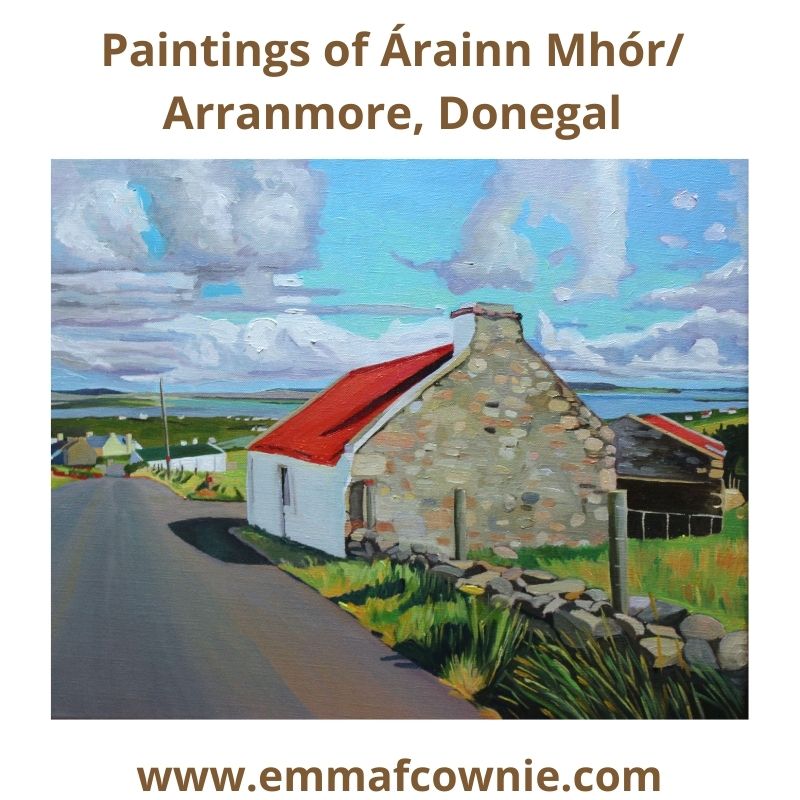
I recently join the Stair Árrain Mhór – Árrain Mhór History Facebook group and was overwhelmed by the positive response I received from the members when I put my most recent post online there. I was asked if I had any more paintings of Arranmore for them to see, so here’s a collection of all my paintings of the Island that I have completed in the last two years.
Where it reads (Private Collection) it means that the painting has been sold. I hope you enjoy looking at them.
A while back I came across a quote on the internet that has stuck in my mind:- “If I knew the world was to end tomorrow, I would still plant an apple tree today.” I was quite struck by this sentiment, especially in the light of current events.
I could not remember who said it. So I did some research. I was intrigued by what I discovered online. I found a number of statements:-
It was originally said by Martin Luther, a 16th century German monk
It was originally said by Martin Luther King Jnr, the 20th century African-American Civil Rights Campaigner.
It wasn’t said by 1) or 2)!
This puts me in mind of one of my favourite internet memes by that teller-of-truth Abe Lincoln…
Just joking!
The apple seed quote apparently originates in Nazi Germany in the 1930s, in the Protestant Confessing Church, which used it to inspire hope and perseverance during its opposition to the Nazi dictatorship.
To be honest, it doesn’t matter who said or when (although there’s a lesson about taking things at face value there) because I like the sentiment. No matter how dreadful things seem, they will pass. Eventually.
Here is my apple seed for this week.
The Road by the Loch, Ireland (80x60cm/ 31.5×23.5″)