The Sperrins or Sperrin Mountains (Irish: Sliabh Speirín) are a mountain range in Northern Ireland. The name Sperrin derives from “Na Speiríní ” meaning “Spurs of Rock” and it is the rocks of the Sperrins and the rolling geography of the area that form the foundation of this distinct landscape. The mountain range, stretching 40 miles along the border of counties Tyrone and Derry, is the largest in Ireland. There are 10 summits above 500 metres with the highest of the range, Sawel Mountain, peaking at 678m (2,224ft).
The landscape is mostly moorland and blanket bog. The Sperrins were designated an Area of Outstanding Natural Beauty in 1968. It’s a sparse rolling landscape. These peaks have been smoothed out by glaciers thousands of years ago. Populated by sheep, bog grass (Eriophorum angustifolium) and farmhouse, old and new.
Some old farm buildings have long-been abandoned by people but are still used for farm equipment and shelter for sheep. So long as there is a tin roof, the walls will last years and years.
I love the sharp oranges of those tin roofs and I will return to them again and again for inspiration. Broadly speaking, in terms of composition I am looking for three dominant colours; green grass/sky and orange tin roofs. You can see how I simplify these main colours in the painting below.
Drone photography has become widespread in our lives. I remember clearly first seeing drone shots of different American cities in episodes of CSI. They were tracking shots of skyscrapper from directly above. As if you were a bird, flying directly above. They were fascinating. Funny, I cant find a clip to illustrate online now. These days they are used in local and national news and documentaries so frequently I dont think we even register that they are drone shots. They have become part of everyday our visual language.
Recently, I have started to explore the use of drone footage (shot by my husband) to extend the possiblilties of compositions I can paint from. So often, I have thought: “If only I was 20 foot high, I’d get a great shot”. So now I can see from 20 foot above, or round the otherside.
I know that many people think that “real” art is plein air sketching, live and I would need to be in a hot airballon to get these views. I admire people who can do this. I can’t. I am not a plein air painter. I am too much of a control freak. I work slowly in the comfort of my studio with all my paints within arms’ reach, exactly where I want them.
This is the first rainbow I have painted. I was pretty nervous about doing it as rainbows are so beautiful and etheral. They are also fleeting. I am reasonably happy with the result although I would be happier if it was more transulent. If I painted another one I would use more acrylic medium to get a more see through effect.
Rainbow over a Sperrins Farm_Emma Cownie
I can also use drone footage and photography if collectors want a commissioned work with drones offering a novel view of their favourite places! It certainly has helped me become more creative with compositions and has benefitted my work greatly.
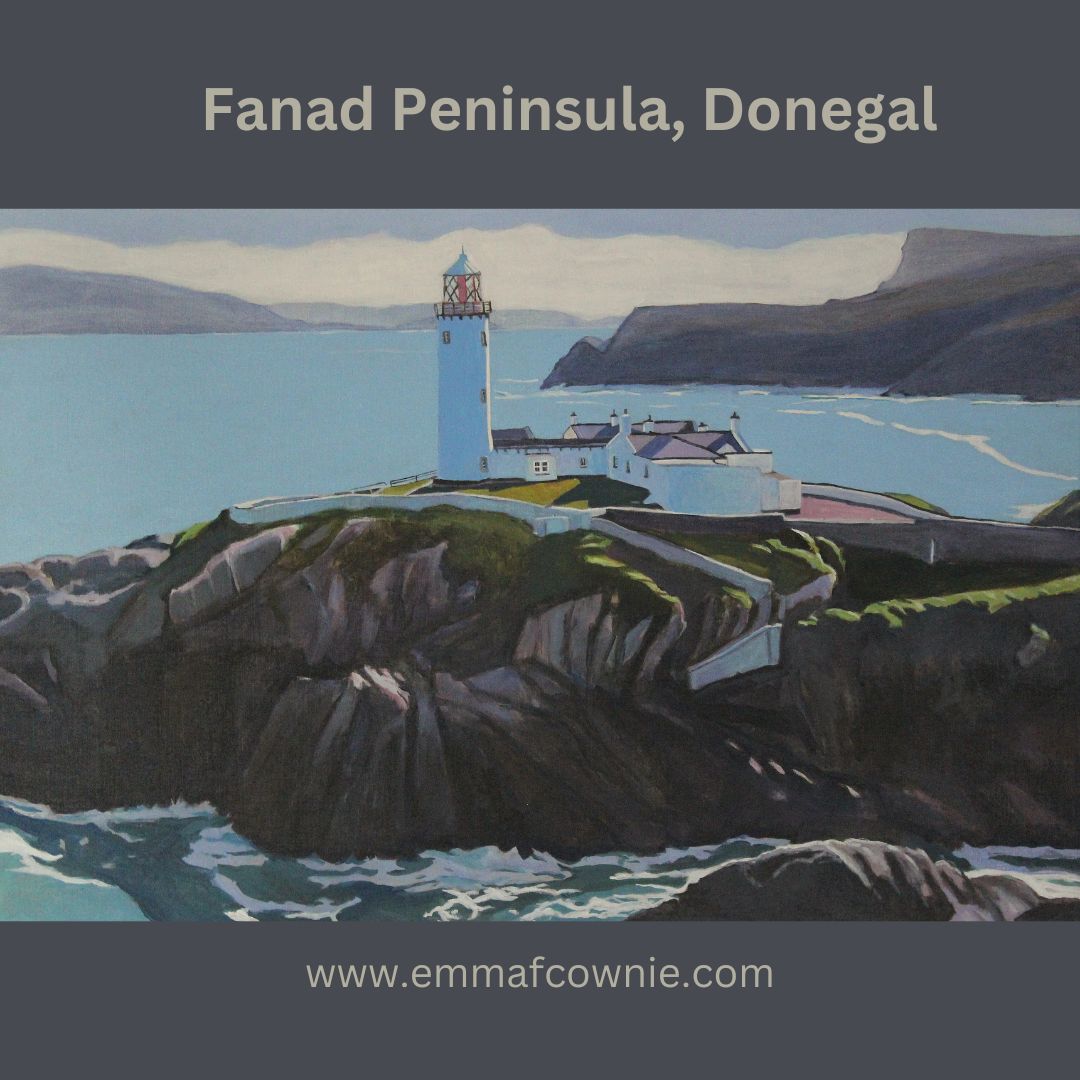
Fanad is a finger of land that lies between Lough Swilly and Mulroy Bay on the north coast of County Donegal, Ireland. It is not that easy to get to and the the survival of the Irish language is testiment that relative isolation.
Lambing season at Fanad Head (Donegal) SOLD
Fanad Lighhouse (Donegal). Is one of the 12 Great lighthouses of Ireland. It was built in 1886 at Fanad Head (although the station was originally established in 1817). The lighthouse, or more acrrately, the harbour light, marks the entrance into Lough Swilly which forms a natural harbour.
Fanad Lighthouse (Donegal) SOLD
I have painted this isolated structure several times before. I have always enjoyed painting the northernly light on Fanad. I have only have painted it in acrylics. That’s not a delibertae choice, more one of circumstance because at times I have had limited space, and I dont want to use oil paints with kittens close at hand.
Over to Fanad Lighthouse (Donegal) _Emma Cownie SOLD
I think acrylics suit the airiness of the subject matter. After a couple of years working out how to use them, I have settled on a technique of light layers of paint that allow the underlying colour to show through. This can give a transulent quality to the colour. This is in contrast to the relatively flat areas of colous I use for the larger areas of colour such as sky or the sea.
My latest painting was an experiment in composition. We used an image from a drone shot done by my artist husband, Seamas (James Henry Johnson).
In this piece, I wanted to create a sense of space from the mountains of the Inishowen Peninsula in the distance. The distant mountains were layered with bluish white until I got the right impression of distance.
I often find myself looking at the tiny Fanad lighthouse far off in the distance when I am at Lisfannon on the Inishowen Penisula. There is a sign comemorating a famous Atlantic storm that happened in 1748. this storm threatened to sink The Greyhound, the ship of one John Newton, a slave trader. John was so frightened that he called out to God for mercy. This moment marked a profound spiritual conversion, and many years later he wrote the words for the hymn “Amazing Grace” one of my favourite hymns, and to also campaign for the abolition of slavery.
There is some confusion how many storms there were . One website claims the terrible tempset happened far away out in the Atlantic because it took John Newton another four weeks after his conversion to sail into Lough Swilly and arrive at Derry/Londonderry. The Amazing Grace.ie site however, makes it clear a second storm happened in Lough swilly itself as it quotes John’s journal ” We saw the island of Tory and the next day anchored in Lough Swilly in Ireland. This was the 8th day of April, just four weeks after the damage we sustained from the sea. When we came into this port, our very last victuals was boiling in the pot; and before we had been there two hours, the wind began to blow with great violence. If we had continued at sea that night in our shattered condition, we must have gone to the bottom. About this time I began to know that there is a God that hears and answers prayer.” It’s got to be said, that John Newton really took his time putting his evangelical beliefs into action because he went back to being a slave trader for another five years before he eventually retired and became a minister in 1757!
The heaving sea at the foot of the massive lighthouse rock intrigued me. The Atlantic Ocean has such a bulk and stregth, even on a relatively fine day, I am not surprised that John Newton was terrified by its strength far away from the Donegal coast. I wondered about the long and difficult process of building this structure all those years ago in a remote location. Yet, this lighthouse has stood the test of time and proudly marks the entrance to Lough Swilly and can be seen from inland and further along the coast.
I am finding our current very mild weather rather confusing, it doesn’t feel very Christmasy at all although it’s very dark here – it doesn’t start getting light until well after 8.30am. I keep having to check what day Christmas day is too.
My biggest pleasure is my two kittens Flossie and Nellie, whom we have had since they were a tiny 8 weeks old. They were teeny with huge personalities. I used to be able to pick them both up in one hand. I couldn’t get over how small they were. They had been dumped with their brother in a remote carpark in South Donegal when they were 5 weeks old. Thankfully a kind person caught them and took them to the Animal Shelter (Donegal Animals in Need).
They were good travellers (it was dreadful weather the day we fetched them from Donegal Town). When we let them out of their cat carrier they ran and played and played and played for four hours! I wasn’t used to small kittens and was quite taken aback by their energy. They were busy little girls and loved playing.
Flossie – Loo roll for scale
Tiny Nellie
Full of Fun and mischief – always making me laugh
They grew fast and ate loads.“Helping” with the PC
Flossie and Nellie in Derry
Weighing in
We have taken our time getting them settled in (and moving them from Donegal to Derry) and taken our time introducing them to our resident cat, Artimus (Artie). I have followed this method before (see the video links at the end of the post) and I know it works. I just have to be patient. They are all indoor cats so I have to be careful that no one gets too upset as they dont have the outdoor world to retreat to. I have been introducing them one at a time on mini- “play dates”. Artie is a very laid back guy but having been a stray before he came to us, he has some “issues” and I also think he’s been grieving for our last cat Hattie.
Artimus
Anyway, it took about three months in all but I think I can say that we are finally getting along. Artie has been playing with the kittens too.
One cat gang now (the kittens are actually half the size of Artie- the camera makes them look bigger than they really are)
Next job is getting along with the dog, Biddy. Fortunately Artie can put in a good word with her.
Artie and Biddy
So here’s to a happy and peaceful Christmas and a healthy New Year to you all. Thank you for to my customers and for all your comments, likes, clicks and support here and across social media.
I have been suffering from writer’s block. I started this post in March this year. I keep writing, rewriting it and then not publishing it. The problem isn’t that I don’t have any thing to say. It is more that I have too much to say and I didn’t know where to start or how to structure what I want to say. It’s not about paint but thread and wool. I have been on a bit of an artist’s journey. It’s been quite a meander; off my usual painting path. I am not sure if it’s a dead end, another fad.
Sewing materials – wool and floss – such lovely colours!
I discovered that here In the north of ireland it doesn’t start to get light here until after 9 am in the deepest winter and painting light often “goes” by 1 or 2pm. There wasn’t going to be a lot of time for painting. So I decided I needed another creative outlet to persue along side the painting to do in the hours of gloomy light and nights, under artifical light. I thought about sewing.
A certain photo haunted me. I had taken it back in Swansea before we moved over to Ireland. I was going through the exhausting process of sorting through my stuff and deciding what I could keep and what should go. I came across this moth-eaten piece of fabric. It was a piece I made in junior school. I took a photo of it. It’s not well made at all but I liked its carefree style and slightly chaotic composition. The moths had made quite a meal of it. .Those elephants once all had eyes. I enjoyed the bold colours It got me thinking. Embroidery/sewing was something creative I could do under artificlal light.
An Early Cownie Tapestry
So I gave up trying to paint under artifical light in the mornings and evenings. Instead I took up sewing and embroidery. I have always liked the vibrant colours of embroidery floss. However, I found that it occupied my thoughts a lot of the time so much so that it was difficult to concentrate on my day time painting. I suppose the issue was that although I enoyed the action of sewing, I didn’t quite know in which direction to go with what I doing with it. It was slow and time-consuming and what I produced was small-scale. I was also torn between learning and practicing different stitches and what to do with them. Quite possibly this is an conundrum at the heart of all creative endeavours.
That delicate balance between skill and expression. If I make something without much skill it will just be crude and amateurish? If I make something that it is skillful – it may well have less personality and expression. And for that matter, as an artist, how do I feel about possibly straying into the world of “craft”? A world that is largely populated by women and with less status than art?
But what’s the difference between Art and Craft anyway? Good question. Like all lazy writers I looked it up on Google: ” Art is described as an unstructured and open-ended form of work; that expresses emotions, feelings, and vision. Craft denotes a form of work, involving the creation of physical objects, by the use of hands and brain. Art relies on artistic merit whereas craft is based on learned skills and technique.” So I was onto something. If I get too skillful at embroidery I am in danger of verring off into the world of craft. That’s worth bearing in mind although there’s little danger of me becoming too skillful.
Intially I lacked confidence, I collected images in a scrap book and on Pinterest and my early pieces aped people whose work I liked. I spent the winter admiring the work of many textile artists – the ones that come to mind right now are Sue Stone, Mandy Pattullo, Ann Smith (Persimonstudioart) as well as Japanese applique artists Mika Harasa and the incredible Ayako Miyawaki.
Stitch Portrait of Seamas
I was like a child in a sweet shop, verring off in first one direction than another. First I tried to copy the style of Sue Stone for a stitch portrait. I discovered that stitching a face is very much like drawing or painting a face, tiny details matter.
Then a bird inspired by the work of Mandy Pattullo and Ann Smith.
Embroidery bird on a cushion
I wasn’t particularly happying copying other people’s style but I had to start somewhere. I couldn’t decide. The choice was bewildering. Was it line, colour, texture that I liked? Yes, yes, yes. I liked it all! I then tried freestyle style stitching in the hope that it would express my personal style. well, no. It got too chaotic. I enjoyed the mechanical action of sewing by hand. I tried dry felting and although my husband liked the chaos, I didn’t.
Freetyle Stitching
Dry Felting – House on Arranmore, Donegal
I wan’t sure if all this was coming from me or was just a mish mash of other people’s work. I needed a greater sense of control over what I was doing. I had to pause. I decided to rein it all in and try simple stitches again although I often prefered the messy underside of the work. Why is that?
The “wrong side” of the sparrow embroidery
I tried to explore the texture of birds feathers a little more.
Embroidery Robin – unfinished
Finally, I came around to a way of working that seemed to be a decent expression of my work in paint. I started getting where I wanted to go. The ancient and humble chain stitch. Turns out that the chain stitch is one the oldest and most widely known stitches in existence. Examples have been found in Egypt on textiles from Tutankhamun’s tomb, dated to the 14th century BC; on embroideries found in Pazyryk tombs dating from 4th-3rd century BC (excavated in southern Siberia but probably originating in China). I enjoyed it’s texture and it’s ability to fill space with colour.
I started with a semiabstract flower design based on a painting I had done many years ago.
Then I decided to try some Irish scenes. that I had painted. These satisfied me the most.
House on Inishbofin – Emma Cownie
Painting and Embroidery “House on Inishbofin” – Emma Cownie
Chain Stitch Embroidery – House on Gola
Me stitching – observed by my loyal helper cat, Tiffany. Embroidery travels well but pointy scissors and planes dont mix. I had my snippers conviscated!.
The work is maddenly slow but strangely therapeutic. There is something very compulsive about filling the space with colourful stitches. I enjoy running my fingers over the stitches. It also mad me think about what could be simplified into an embroidery an what sort of details could and could not be rendered in chain stitches. Getting the right colour thread was difficult at times. I made mistakes – a brown shadow rather than a bluish one. I tried to be accurate but somes I was forced to compromise, sometimes I just got it wong.
So now I have a small collection of tapestries very fond of in an in formal display in my living room. it’s been an interesting journey but I am not sure if its a cul-de-sac or “Grist-to-the-mill” part of a creative process. Maybe the reall problem is that I discovered that it was difficult to sew by hand under artifical light and the embroidery was competing with painting for useable daylight. It was a joy to return to speedy paint when the light improved. So, embroidery has drifted off into a bit of a back-water for the time being although I still have a couple of projects on the go.
You have may well have seen images of County Sligo, Ireland, without necessarily knowing that’s where it is. It’s home to one of the most poplar views on Social Media. Here’s an example:
C:\Users\emmaf\Downloads\2023-11-23 09_51_34-mullaghmore sligo instagram – Google Search.jpg
It’s quite disconcerting to come across a view that you are very familar with but have never visited in person before. It’s sort of like a celebrity view. I experienced a strange sense of fracture when we rounded the corner in the road and saw it. It was impressive sight but our photographs were not half as good as other people’s, presumably taken with zoom lens under different light/weather conditions.
Mullaghmore Head, Sligo
You can see fine views of the magnificent Dartry Mountains from Mallaghmore Beach too.
View of the Dartry Mountains from Mullaghmore, Sligo
View of Ben Bullen from Mullaghmore, Sligo
The ever changing light meant that we ended up exploring the area of Sligo near Benwhiskin (also spelt Benwiskin). It’s like a wonderful witched hat, knocked askew. I have never seen a peak like it! It’s particularly distinctive as the surrounding moutains are flat topped. They reminded me of the Antrim Plateau in Northern Ireland. Like cousins.
Here’s a panning shot of the Dartry Mountains done by Seamas, my husband, and his drone. The distinctive peak of Benwiskin can be seen at the end.
Here are my two paintings of Benwiskin; the first is in acrylics.
It’s noticeable that the light is different from Donegal light, its softer, slightly yellower. The sense of the place is that life isn’t as quite tough as it is in Donegal (I’m thinking of the winter and the gales).
I was delighted to see my two Donegal paintings “Up Bloody Foreland, Donegal” and “The through Road, Donegal” on the walls of the London Irish Centre (Camden, London).
These two oil paintings form part of a “real room” of an Irish family in 1950s Britain installation. The exhibition, which is on during August through to October, pulls together a dynamic collection of prints, photographs, paintings, and writings that weave together the different threads of ‘Home’ for Irish Immigrants to London. This has been organised Tara Griffin, who is Education and Heritage Officer at the London Irish Centre, in conjunction with the Museum of the Home. It looks fascinating and I hope my paintings bought happy reminders of home to visitors to the centre. My work has been described as nostalgic by by some and I am interested in capturing a vanishing Ireland of the not too distant past. I just wish I could have visited in person!
Donegal is a big mountaneous county in a big country. Imagine my shock when I discover that it’s only the 4th largest in Ireland (after Cork, Galway and Mayo) at 4,860 km2 (1,880 sq miles). It seems even bigger as there is no railway or motorways here, so it takes a long time to travel around all the mountains. One of joys of the county is that it’s relatively empty (the 5th least populated in Ireland) with 32.6 people per km2.
There is also a lot of coastline and the landscape varies from remote mountain bogland, rocky shores to lush rolling farmland in the east. Here are three small paintings I have completed recently that reflect some of this diversity.
The first painting is the furthest north – Malin on the Inishowen Peninsula. This peninsula is the furthest north in Ireland – Malin Head is represented by the red star nearest the top of the map above. It is further north than any part of Northern Ireland! This causes a lot of confusion for my parents who have never been to Ireland despite the fact that my father’s grandparents were from Cork.
The wee House at Malin is a cave, where folklore has it that no matter how many people enter it will hold all. It predates a monastic foundation and Holy Well. The cave and holy well were originally associated with the belief in the sanctity of water and local tradition states that the original foundation was built to exorcise evil from the area. The “Saint” venerated was St. Muirdhealach. He supposedly blessed the well (located in a cavern underneath the large rock directly in front of the ruins of the church).
The second is a view from Arranmore, the largest of the many islands off the coast of Donegal. This is represented by the red star furthest to the left/west on the map above.
And finally Muckish Mountain which lies further inland in West Donegal. I notice Muckish isn’t always included in Tourist maps (like the one bolow which has a red triangle for near by Errigal), yet its distinctive flat backed shape can see seen from Arranmore in the far west and even Carrigans in the far East of Donegal.