Posted on 2 Comments

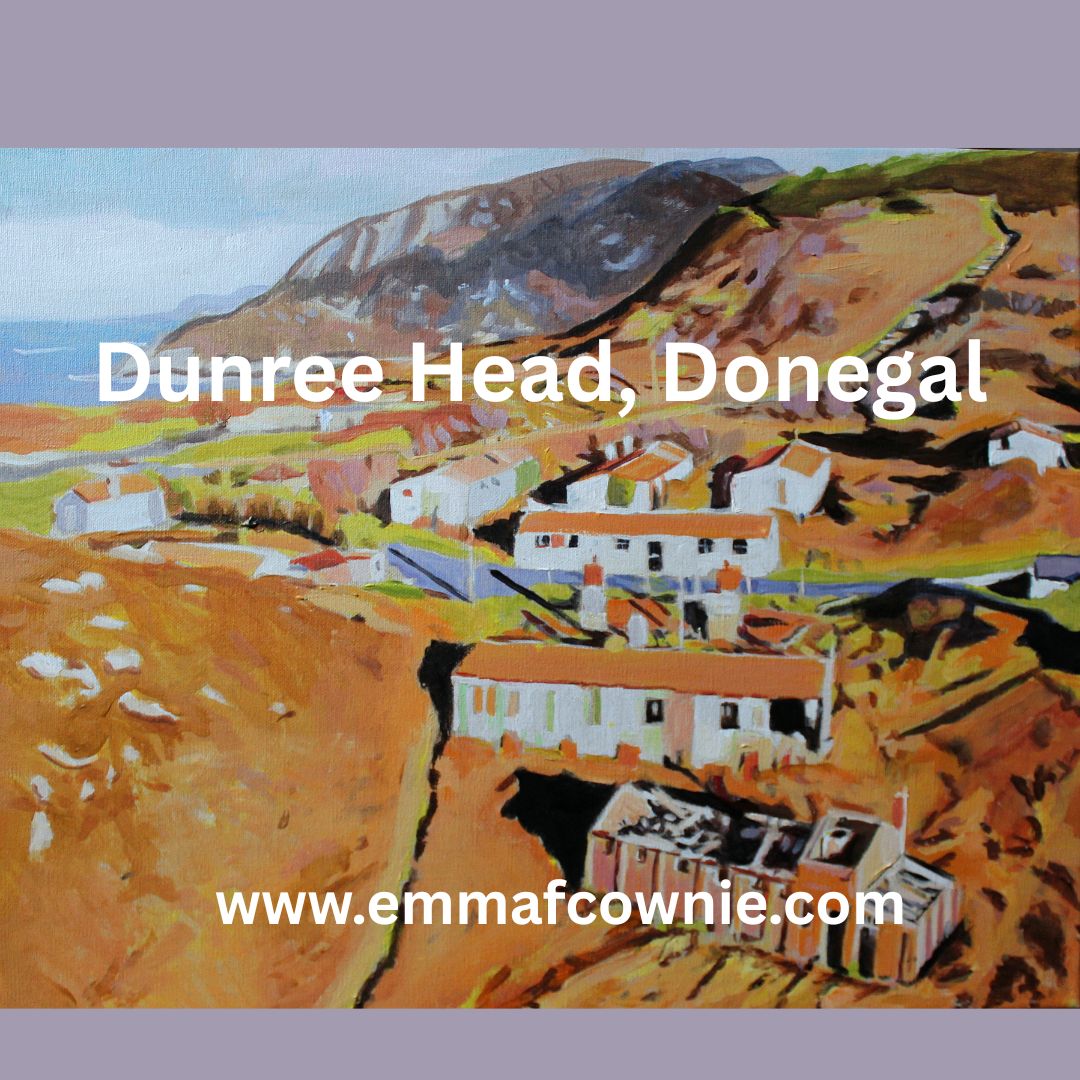
Dunree Head, Donegal

Dunree Head Donegal

 Dun Fhraoigh in Irish means, “Fort of the Heather” – it has been a fort at Dunree for thousands of years, since the Bronze age (over 4000 years ago). When you see the chunk of rock that the “modern” day fort (well Napoleonic era) for has been built on, you understand why.

Its a big chunk of rock! (photo credit: Emma Cownie)

Photo Credi t: The Artillery Club of Ireland
Aeriel View of Dunree Head (Google Maps)

Its location, on the cliffs of Dunree Head, is great for observing and controlling ships moving up and down the majestic Lough Swilly, one of Ireland’s three glacial fjords.

The English built this sturdy fort on the chunk of rock c. 1812-3 with a draw-bridge! The enemy back then, as readers of Jane Austen will know, was the French forces of Napolean Bonaparte. (The story of Jane Austen’s Donegal nieces is worthy of a BBC/RTE mini-series in its own right; linking Kent, Ramelton and Gweedore). The French had attempted landing in Lough Swilly in 1798 with a force of about 8,000 men, which was repelled at sea. The Royal Navy anchored ships in the Lough. There were a lot of big guns here, nine 24-pounders were in 1817.  There was once a Martello-type in the centre of the old fort but it was demolished c. 1900, as it obstructed the field of fire from the new fort on the summit of Dunree Hill.

Although the Irish Free State was created in 1922 and they followed (and still follow) a policy of political neutrality, the British army did not leave Dunree until 1938. This was because Lough Swilly was a “Treaty Port”, and it remained under British military control for defensive purposes.  During the Second World War, it was under control of the Irish Army and it played an integral role in safeguarding Ireland when a number of anti aircraft guns were added to site. The waters off the coast of Donegal are under threat today from Russia’s so-called “shadow fleet”.

I am not particularly interested in military hardware, although I know plenty of people in the world are. I have not been in the military museum. What did take my interest, however, were the barracks. There were brick buildings but also a lot of decaying iron huts that the gunners had lived in. I am nosy and I enjoy seeing how people lived. Although, frustratingly, most of that has gone. There tiny glimpses; brick chimney stacks, the odd rusting bedstead but not a lot.


Army Barracks – Brick and iron. Photo Credit: James Henry Johnston
Dunree Army Huts: Photo credit James Henry Johnston
Dunree Barrack Huts: Photo credit James Henry Johnston

A little further up (a steep) hill from Fort Dunree and the barrack buildings is Dunree Lighthouse. This a puzzling lighthouse. I am used to lighthouses being built atop of great pillars like the one across the Swilly water at Fanad.

The one at Dunree, however, has no tower. It doesnt need one. The light is at ground level. The “ground” however its up high on the cliff way above the Fort. A lantern attached to a house for the Lighthouse Keeper was built, and the light established on 15th January 1876. The light was a non flashing one with a two wick oil burner. Sadly, for the lighthouse keeper, technology did away with his job in 1927 when this light was replaced in December 1927 with an “unwatched acetylene with a carbide generating plant attached to the station”. The light was later converted to electricity in 1969. It must have been a great place to live. 

Lighthouse at Fort Dunree (Donegal)
Lighthouse at Fort Dunree (Donegal) – View from the east. The litchen covered stone wall is testiment to the clean air of Donegal

The lighthouse keeper’s house has a spectacular view across the Lough. Its built of local rubble stone masonry, this building retains its early form and character. Its visual appeal and expression is enhanced by the retention of much of its original fabric including timber sliding sash windows. Both the house and the lantern were built by McClelland & Co. of Derry. The simple outbuilding and boundary walls are very elegant too.

From the outhouse towards the lighthouse


The views at Dunree are spectacular. Lough Swilly is quite majestic, even on an overcast day.  Perhaps, it’s particularly dramatic on a overcast day with the shifting light and colours. You can walk up Dunree Hill and look over towards the Urris Hills and Dunree Bay (Crummies Bay).

There is a regular bus service from Buncrana, a coffee house, museum and public toilet. It might be a good idea to go before they start work on revamping the place!

See more paintings of Inishowen Peninsula here

Read More

https://www.buildingsofireland.ie/buildings-search/building/40901824/dunree-fort-dunree-donegal

https://www.donegallive.ie/news/inishowen/1589360/decision-on-12-5m-fort-dunree-tourism-project-due-early-next-year.html

https://www.govisitdonegal.com/blog/january-2024/between-waves-and-war

Posted on 10 Comments

Spring in the Sperrins

Painting of Spring in Sperrins, N.I

The Sperrins or Sperrin Mountains (Irish: Sliabh Speirín) are a mountain range in Northern Ireland. The name Sperrin derives from “Na Speiríní ” meaning “Spurs of Rock” and it is the rocks of the Sperrins and the rolling geography of the area that form the foundation of this distinct landscape.  The mountain range, stretching 40 miles along the border of counties Tyrone and Derry, is the largest in Ireland. There are 10 summits above 500 metres with the highest of the range, Sawel Mountain, peaking at 678m (2,224ft). 

The landscape is mostly moorland and blanket bog. The Sperrins were designated an Area of Outstanding Natural Beauty in 1968. It’s a sparse rolling landscape. These peaks have been smoothed out by glaciers thousands of years ago. Populated by sheep, bog grass (Eriophorum angustifolium) and farmhouse, old and new.

Some old farm buildings have long-been abandoned by people but are still used for farm equipment and shelter for sheep. So long as there is a tin roof, the walls will last years and years.

painting Upper Dreen_Emma Cownie
Upper Dreen_Emma Cownie (SOLD) Recently,

I love the sharp oranges of those tin roofs and I will return to them again and again for inspiration. Broadly speaking, in terms of composition I am looking for three dominant colours; green grass/sky and orange tin roofs. You can see how I simplify these main colours in the painting below.

Farm in the Sperrins, County Tyrone, Ireland
Farm in the Sperrins, County Tyrone, Ireland _Emma Cownie

Drone photography has become widespread in our lives. I remember clearly first seeing drone shots of different American cities in episodes of CSI. They were tracking shots of skyscrapper from directly above. As if you were a bird, flying directly above. They were fascinating. Funny, I cant find a clip to illustrate online now. These days they are used in local and national news and documentaries so frequently I dont think we even register that they are drone shots. They have become part of everyday our visual language.

Recently, I have started to explore the use of drone footage (shot by my husband) to extend the possiblilties of compositions I can paint from. So often, I have thought: “If only I was 20 foot high, I’d get a great shot”. So now I can see from 20 foot above, or round the otherside.

I know that many people think that “real” art is plein air sketching, live and I would need to be in a hot airballon to get these views. I admire people who can do this. I can’t. I am not a plein air painter. I am too much of a control freak. I work slowly in the comfort of my studio with all my paints within arms’ reach, exactly where I want them.

This is the first rainbow I have painted. I was pretty nervous about doing it as rainbows are so beautiful and etheral. They are also fleeting. I am reasonably happy with the result although I would be happier if it was more transulent. If I painted another one I would use more acrylic medium to get a more see through effect.

Rainbow over a Sperrins Farm_Emma Cownie

I can also use drone footage and photography if collectors want a commissioned work with drones offering a novel view of their favourite places! It certainly has helped me become more creative with compositions and has benefitted my work greatly.

(c) James Henry Johnston 2024

Posted on 9 Comments

Urban Minimal Views of Derry City

Urban Minimal Views of Derry City by Emma Cownie

Urban Minimal

Several years ago I embarked on what I called an “Urban Minimal“project; focusing on the streets of Brynmill, in Swansea, South wales, where we used to live. This work culminated in an exhibition in the Cardiff MadeinRoath festival (read more here).

My original “rules” for urban minimalism composition and painting

  1. No cars
  2. No People
  3. Bright light. There must be shadows – at diagonals if possible.
  4.  Simplified forms – there must be little detail in the final painting. I found this the most challenging “rule” to stick to.
Hollowed Community
Hollowed Community

Urban Minimal in Derry/Londonderry

I am developing this approach with Derry. I like to paint relatively ordinary street scenes without people. The sunlight and the colours give them drama and beauty. Each of the painting is really about light. I am still attempting to simplify forms but this is something I am always failing at.

On the plus side, I think that my colours have become much softer and more subtle. I think this is partly a response to the northern light which is bluer and less golden than that in Swansea. Its is also because I have got better at achieving naturalistic colours. My confidence has also improved. In the past I chose brigher colours to make a painting more exciting.

I have slowly come to the realisation that such excitment is like hidden sugar in my food. Yes, its initially appealling but it can give you a bit of a headache!

I have enjoyed exploring the streets of Derry. I feel I know the place a bit better for painting them.

Its hard to find a car-free Queen Street but early on a Sunday morning it is possible.

Eagle-eyed readers will spot a car in the mid-distance. I thought I’d see whether a car would negatively disturpt the composition. I don’t think it did.

Painting of houses on Castle Street, Derry/Londonderry by Emma Cownie
Castle Street, Derry/Londonderry by Emma Cownie (acrylic on canvas)

Some of my earlier paintings of Derry.

Posted on 1 Comment

Affordable Art in Donegal

Affordable Art

The rain finally stopped yesterday morning and the temperature rose a few degrees. We just had three days of steady rain. The temperatures also went up a bit. I was amused to discover that this “event” made the news. The headline in “The Donegal Daily” an online newspaper read: “Weather- Another Mild Day in Store for Donegal”. This publication is favourite of mine. It is a heart-warming mixture of stories with happy endings (swimmers get into trouble in rip tide but they are all rescued by a passer by and a lifeboat crew), lost dogs, sport stories and local crime cases (often from two years ago).

Anyway, we felt encouraged by the dry (ish) weather to do some light food shopping in Dungloe and then drive to an Affordable Art Fair in Derrybeg, Gweedore. This Art Fair was held at An Gaillearai, which is located at Ionad Aislann, Na Doira Beaga (Derrybeg).

Ionad Aislann, Na Doira Beaga
Entrance to Ionad Aislann, Na Doira Beaga

We have never been to Ionad Aislann before and I was very interested to see what this cultural centre was like. I know that “Ionad” means a centre of some sort in Irish but I didn’t know what the word “Aislann” meant. I tried looking it up on google translate but drew a blank so I thought it might be someone’s name. It was wrong. “Áislann” is a word derived from combining two words from the Irish vocabulary of South West Donegal, Áiseanna (facilities) and Lann (building).

Lots of Praking!
Lots of Parking!

The centre also houses, amongst other things,  a public library and nursery. When I looked it up here I discovered that the building hosted much more than that: a theatre/cinema, sports hall, meeting rooms, local history centre, PC centre, a gym and a tea room! This cultural centre was set up in 1992  expressly to cater for local people as well as for visitors to the area, including the many artists like me who come to live here. It was also meant to help strengthen bonds within the local community via cultural/artistic pursuits and leisure activities.  

Affordable Art Fair Poster


The Gallery is large and airy and there was plenty of room for visitors and artists. Everyone was wearing masks too which was reassuring. 

Inside the Art Fair
Inside the Art Fair

Some of the artists showing include (in no particular order); Ian Gordon, Cathal MacGinley, Peadar McDaid, Heidi Nguyen , Mary Toland, Gay OToole and Nora Duffy. We had the pleasure of meeting and chatting with two of the exhibiting artists, Heidi Nguyen and Gay O’Toole. We met Cathal Mac Fhionnghaile/Cathal MacGinley when we visited Inishbofin last month.   Here is a selection of the work on display. 

Gay O Toole
Gay O Toole
Work of Gay O Toole
Work of Gay O Toole


Heidi Nguyen
Heidi Nguyen
Heidi Nguyen
Heidi Nguyen
Heidi Nguyen
Heidi Nguyen


Cathal Mac Fhionnghaile


Cathal Mac Fhionnghaile


Cathal Mac Fhionnghaile
Cathal Mac Fhionnghaile – we bought the middle one!
Ian Gordon
Ian Gordon
Ian Gordon
Ian Gordon
Maura McGlynn
Maura McGlynn


Nora Duffy
Nora Duffy
Nora Duffy
Nora Duffy
Nora Duffy
Nora Duffy


Mary Toland
Mary Toland
Sarah Lewtas
Sarah LewtasKarol Mac Geirbheith

Karol Mac Geirbheith

Karol Mac Geirbheith

Karol Mac Geirbheith

Karol Mac Geirbheith


Peadar McDaid
Peadar McDaid


Peadar McDaid
Peadar McDaid – we also bought the middle one (top row).


As our house is already over flowing with paintings we generally don’t buy other people’s art (although I have one painting by Welsh landscape artist, Warren Heaton, in the bedroom) but we changed the habit of a lifetime yesterday and bought two small paintings at the art fair. I know that Séamas wanted to buy more. We left the two paintings on the wall with red stickers next to them (hoping that sign of success would encourage more sales) and will go back on Thursday to pick them up.

After so long in lockdown and avoiding people, it was really great to go out somewhere and to meet new people. Ionad Aislann certianly did its job of helping to strengthen the bonds between local community via cultural/artistic pursuits and leisure activities. It was well worth a visit and if you are in area I would highly recommend stopping by.  The Art Fair is on for several more days, from 12 to 5pm until this Thursday 14th October 2021. 


Posted on 12 Comments

Gola Staycation (2021)

Gola Staycation

Caravans tucked away on coastal inlets and islands are not an unsual sight in Donegal.  I am always impressed by their presence as there are no roads for lorries and it must have taken a good deal of effort and ingenuity to get it there. Getting to have a “Staycation” in 2021 amidst all the uncertainty of vaccine rolls out & third (or is it fourth?) waves looks like it will take an equal amount of effort! So instead join me in imagining the view from the static caravan’s wide window across the rugged terrain of Gola Island on this late spring morning.

Painting of caravan on Gola island, Donegal
Gola Staycation (2021) 100×65 cm

Posted on 15 Comments

Still life paintings

Still Life Painting
Private Conversation

This will be a short post as I am nursing a painful left elbow on an ice pack. I developed bursitis on Friday, I am not sure why as I didn’t hit my elbow on anything but too many sun salutations in yoga is my number one suspect.

We have had a lot of really bad weather lately. We seem to be cantering our way through the alphabet of storms: Atiyah, Brendan, Ciara, Dennis, Ellen, Francis etc. This means I have rarely left the house, except to buy food, walk the dogs in our local park or to go to a yoga class, although yoga will be out of bounds until my elbow recovers now.

So, whilst Storm Ciara was blasting her way overhead, a couple of weeks ago, I decided to set up a number of still life compositions to work from. I had painted a number of largish canvases (80x60cm) and felt in wanted to paint something smaller for variety’s sake, and also something that I could complete in a short (gloomy) day.

My past forays into Still Life painting explored paleness/whiteness, and they were largely inspired by the work of Morandi. These were medium-sized paintings. I liked the calmness of the plain backgrounds.

In this short series of paintings, I was more interested in colour. I was particularly inspired by a patterned cloth that my husband, Seamas, had found in a charity shop many years ago. I liked the warmth of the colours.

This was my first painting. I liked the way the colours of the flowers chimed with the fruit on the plate.

Still life with Patterned Cloth

I think my second painting was better probably helped by better light on the day that I painted it.

Still life with patterned cloth #2

Then I decided to focus on the fruit. A tiny slice of it!

#3
A Slice of Lemon (SOLD)

Then finally a more traditional composition with a cup and red cloth. I have noticed before how I am drawn to painting reds in winter.

Blue cup with Lemons

The bright colours in these paintings cheered me up. Having completed this short series I felt ready to return to large canvases and more muted tones.