This is going to be short. I am snatching a few minutes whilst the puppy sleeps.
Long story short; our beloved Biddy, who has been with us for 15 years had to be put to sleep. In our grief we made a truly daft decision and immediately got a puppy AND moved house in winter. My mother said it was compliment to Biddy that we wanted another dog straight away. I think she was being kind, but she does love animals so maybe not.
So enter Effie. Or the “Scruffy One” as my husband called her as we watched her and her sister (our choice of two) cavort around the farmer’s yard with great energy. This was the one my husband picked.
She was covered in mud (poop) and slightly pink from blood. Her litter-mates picked on her. The farmer said ‘I think she will be the kinder dog”. Kind means gentle in this part of County Derry. Yes we picked the underdog.
Effie was born in a barn
So we took home a mucky pup and gave her a shower. She has dealt with the transition to indoor life with three cats very well. We, the humans have found it a tougher transition.
First night in a big basket
There is a lot to learn with collies. They are not like other dogs. They are super smart but also very sensitive. We are exhausted from trying to keep up and understand her. I have been doing a lot od reading. I find Barbara Skyes’ books on Border Collies really helpful. We still haven’t quite finished moving house!
We think Artie has had experience with collies before
She is pretty much house-trained after 3 weeks (probably slow for a collie) but needs to be made to chill out and nap several times in the day or she gets fractious and grumpy at night. Every morning is a new start even if she went to bed sulking with us, and greets us both with a kiss (lick on the ear) and chest (to gently rub).
Nellie and Flossie with Effie
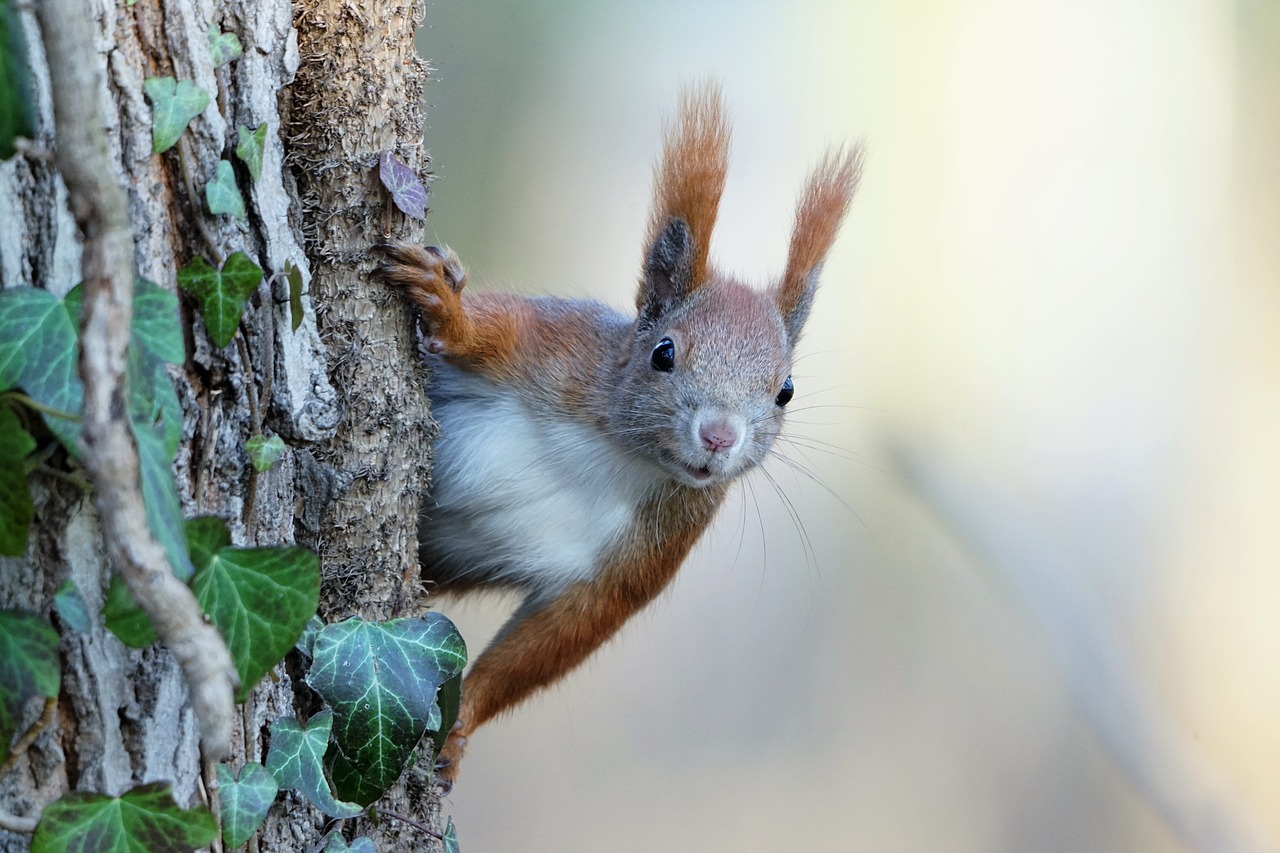
And the red squirrels? We saw two this week. For the first time in my life. They are very rare in Britain. They are more common in Ireland but shy. We saw two on Inch Island when we were out exercising Effie.
My favourite image of her – asleep!
She has to be exercises away from other dogs and grass until we’ll after her second vaccination. We saw them scampering across a lane from a wooded area. They are very different from their grey American cousins. They are smaller, delicate with russet red coats and tuffed ears. When they run their bodies and tails undulate in an elegant way. The second time I saw one I could see it had a white chest. It was fleeting sighting so I don’t gave a photo but I can offer a couple of paintings I did many years ago.
Times up. Effie stirs.
Red Squirrel – oil on canvasRed Squirrel in the Snow -oil on canvasRed Squirrels (from Pixabay)
This is a postscript to my post earlier this month about Malin Head. It was a beautiful sunny day there today. Summer has arrived in Donegal. Who know how long it will last so everyone was out!
I met brothers Harry and Kit (Dr) Lawrence just after they had laboured up the steep hill to Malin Head Tower on their bikes, laughing as they finished.
“We have just finished a thousand km cycle ride from Mizen Head!” Annouced Harry to no one in particular and anyone who could hear.
“Congratulations” we said and I shook their hands (me and some motorcyclist tourists).
The brothers had taken just 8 days to ride from Mizen Head in Cork to Malin Head today. I told them about Sophie Powers who had done it in 4 days with very little sleep. They had had sleep and no back up team. Just two panniers with their spare clothes in. They were not expert cyclists. Kit proudly told me that he’d bought his bike on Gumtree for £100 last month. It was clearly a massive bargain as it did the job very well indeed. They raised over £2000 for the Samaritans. I couldn’t have done that in 80 days never mind 8 days! Well done!
Just arrived at Malin Head
Harry and Kit Lawrence at Malin Head with that bargain bike
The name will be familar to British ears who ever listened to the daily shipping forecast on BBC Radio. It is broadcast late at night just before 1 am and very early (5.20am). Anyone who is a night owl or insominiac will have listened to it. The list of shipping zones and forecasts is not only practical but also poetic and rather mysterious. Following the litany of locations and numbers is very soporistic. Listen to the clip below. The actual broadcast is from 2.46 onwards ZZzzzzzzzzz
Shipping Forcast (1993) – almost always broadcast on the radio, you have to use your imagination!
Many British people may not know where Malin Head it is anymore than than they know the location of German Bight or Viking. To Irish ears, however, it is well-known as the most northerly tip of the island of Ireland and also features on Met Eireann’s, sea area forecast, broadcast on RTE.
UK_shipping_forecast_zones
Malin Head to Mizen Head
People regularly tranverse the length of Ireland from Malin Head, Donegal, to Mizen Head, Cork. It’s a fair stretch. Just under 400 miles (640 km). Some incredible people have cycled it in just over 15 hours. Ordinary mortals take about 4 days.
Amazingly some super-human runners have done it in about the same time – 4 days! I recently listened to a radio interview with the heroic Sophie Power. Sophie is from England and she recently ran the length of Ireland in under 4 days. This is a World Record. She beat the previouis record by three hours. Being a mother, she had to fit it in during her children half-term holiday and didn’t get to pick the day with the nicest weather – just the Tuesday of half-term and so she started off in driving rain! Many years ago I used to run (only piddly 10ks and 5ks) and I would certainly prefer to run in rain than heat.
Incredibly Sophie ran most of the distance without sleep, snatching the odd half an hour on her second and third day. She ended up hallucinating, and with a knee injury that had to be braced. When she finished the race in Cork she had developed heat stroke! That alone shows you how far south Cork is. There’s no way she’d get heat stroke in Donegal! She’s planning to come back and run the Cork Marathon.
Sophie Power at Malin Head
At the Edge of the world
Standing at Malin Head is like standing at the edge of the world. To the north is nothing can be seen but sky and sea. A long way off is Iceland and much. much further away to the north-west is North America. It feels very remote (but surprisngly accessible from Letterkenny and Derry/Londonderry) but to fishermen and sailors, I’m sure it’s not. Scotland is surpisingly close to the north-east. If you have ever flown from England to Belfast on a clear day, you can see the Scottish Isles and the Isle of Man scattered across the Irish Sea, pretty close the Antrim coast. Donegal is just a bit further along.
On the most northerly tip of the island of Ireland, you will find a tower that was built in 1805 during the Napoleonic wars as a lookout tower to defend against any attacks by the French. You can see at the top left hand side of my painting above. Edges of places are places to look out from – for invaders, or for incoming storms. Weather reports that were important to local and international shipping were first recorded at Malin Head in 1870. It was in that year the tower became a signal tower for Lloyds of London. Semaphore was used to connect with ships at sea and the lighthouse on nearby Inishtrahull. In 1902 the first commercial wireless message was sent from Malin Head to the S.S.Lake Ontario by the Marconi Company.
Divers’ magnet
There are the wrecks of many ships lying off the coast in this area. Many of these such as SS Audacious, SS Carthaginian and RMS Justicia date to the time of the First World War, when Ireland was still part of the British Empire.
In 1917 two German mines sankLaurentic and although her crew successfully abandoned ship, but 354 of them died of hypothermia in her lifeboats.Interestingly, Laurentic was carrying about 43 tons of gold bars when she sank. Most of the 3,211 bars were salvaged by 1924; three more bars were found in the 1930s, however 22 gold bars have still not been recovered.
The Great Emergency/Second World War
During the Second World War, Ireland was neutral. The Irish army built lookout posts in places along the coast to prevent any violation of this neutrality. This was important as this part of Donegal is so close to Northern Ireland, which not not neutral and was bombed by the Germans. There is an EIRE 80 sign built of stones during the war so aircraft would know that they were over Ireland (not Northern Ireland). They acted also as a navigational aid for pilots. Eire 79 is at Fanad Head to the west. Eire 81 is at Glengad Head, further along the Inishowen Peninsula, to the east. You can see it on the map below. The SS Athenia, a passenger ship carrying 1,418 people was torpedoed by a German U-boat just hours after war had been declared in 1939 off the coast of Malin Head! Most of the passengers survived but 117 perished.
Tourism Sign at Malin Head
Some scenes from the film Star Wars: The Last Jedi film was shot at Malin Head. I have to admit that I am not a Star Wars fan – I never made it through awhole film. I have to admit that I’m more of a Star Trek fan. Apparently, it is possible to have a tour of the locations used for the film from local tour guides. The road leading up to Bamba’s Crown has been renamed locally from the R242 to the R2D2 in recognition of the Star Wars connection. Also beside the tower, there is a short lovely refreshing walk along the cliffs to Hell’s Hole. The cliffs are massive here and even on a relatively calm day the sea is restless and a bit intimidating It needs to be remembered that this not just a sea here but an Ocean.
Birds Eye View of Malin Head, Donegal- Emma Cownie
You have may well have seen images of County Sligo, Ireland, without necessarily knowing that’s where it is. It’s home to one of the most poplar views on Social Media. Here’s an example:
C:\Users\emmaf\Downloads\2023-11-23 09_51_34-mullaghmore sligo instagram – Google Search.jpg
It’s quite disconcerting to come across a view that you are very familar with but have never visited in person before. It’s sort of like a celebrity view. I experienced a strange sense of fracture when we rounded the corner in the road and saw it. It was impressive sight but our photographs were not half as good as other people’s, presumably taken with zoom lens under different light/weather conditions.
Mullaghmore Head, Sligo
You can see fine views of the magnificent Dartry Mountains from Mallaghmore Beach too.
View of the Dartry Mountains from Mullaghmore, Sligo
View of Ben Bullen from Mullaghmore, Sligo
The ever changing light meant that we ended up exploring the area of Sligo near Benwhiskin (also spelt Benwiskin). It’s like a wonderful witched hat, knocked askew. I have never seen a peak like it! It’s particularly distinctive as the surrounding moutains are flat topped. They reminded me of the Antrim Plateau in Northern Ireland. Like cousins.
Here’s a panning shot of the Dartry Mountains done by Seamas, my husband, and his drone. The distinctive peak of Benwiskin can be seen at the end.
Here are my two paintings of Benwiskin; the first is in acrylics.
It’s noticeable that the light is different from Donegal light, its softer, slightly yellower. The sense of the place is that life isn’t as quite tough as it is in Donegal (I’m thinking of the winter and the gales).
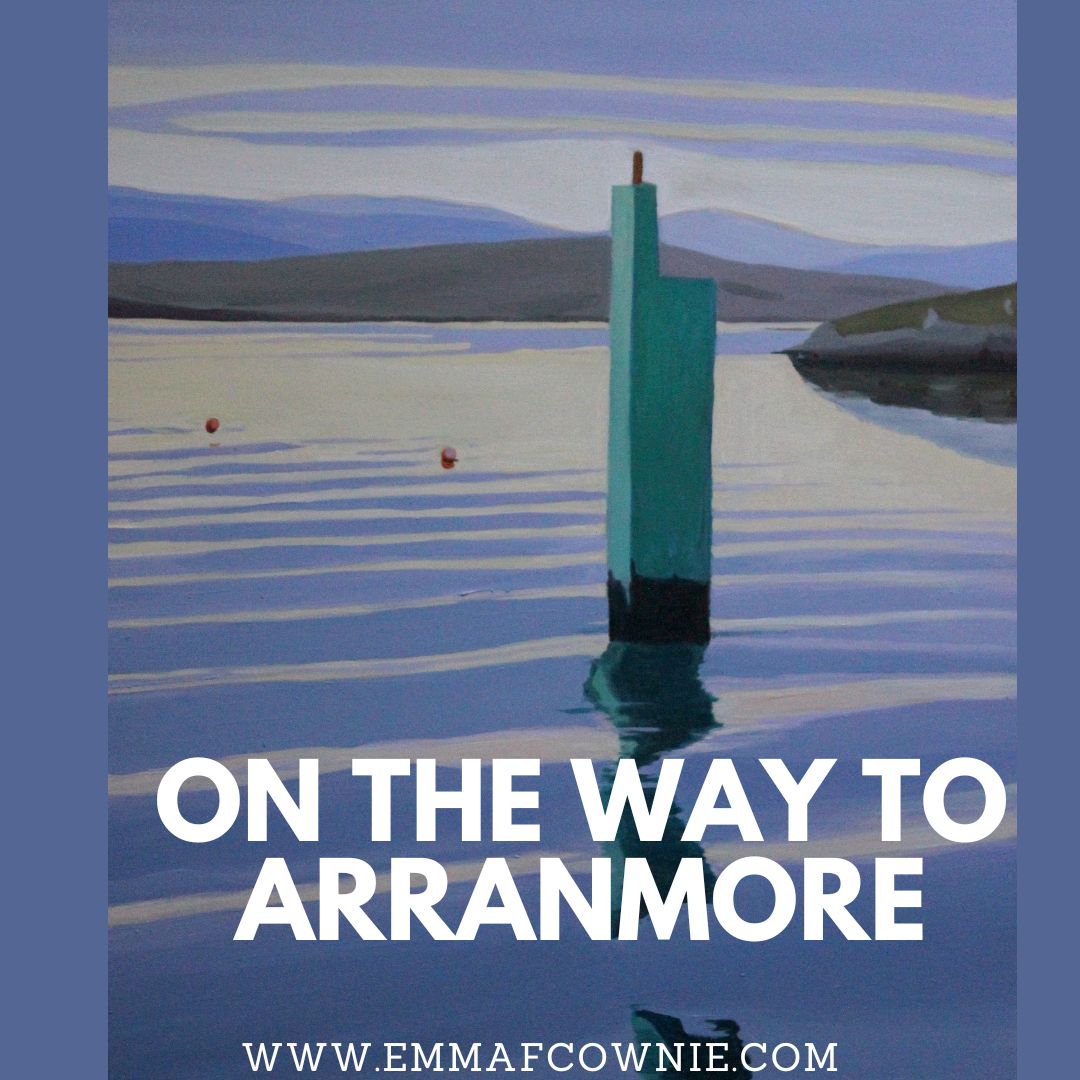
Looking through my recent work, I was surpised to realise that I haven’t painted many paintings of Arranmore Island in the last couple of years despite visiting the islands in the summer. So I have put that right with a series of new paintings.
As always I am entranced by the journey to and from the island. You can read my short History of the Island here
Arranmore is lucky to be served by two ferry companies. There is The Arranmore Ferry (Blue) which is based on the island and Arranmore Ferry (Red) which is not. Yes, I know the names are almost identical, just a small matter of “The”. They both offer a fantastic 15 minute journey from Burtonport (Ailt An Chorráin) to Arranmore Island. On a calm and sunny day the view on the crossing are just heavenly. Sometimes there are dolphins too.
Map of Arranmore and the coast off Burtonport
The ferrys sail through a narrow passage past a scattering of islands on the way to Arranmore.
Rutland Island (Inis Mhic an Doirn) lies between Burtonport and Arranmore, Donegal. William Burton Conyngham (a local landowner for whom Burtonport takes its Anglised form) had warehouses, a street of houses, a post office and a school built c. 1784 to capitalised on a the abundant herring fishing. Unfortunately, the herring disappeared very early in the 1800’s and the station fell into disuse. The island was inhabited until the 1950s. These are the remains of the fish factory and landing stage on Rutland Island.
Opposite is Inishcoo Island with Mount Errigal in the distance peeping out from under the clouds. The jetty in the left hand corner belongs the magnificent Inishcoo House (see painting below)- once a coast guard house, built in the C18th.
Inishcoo House, Ireland (SOLD)
There are several tiny holiday homes dotted across the islands (and cows)
Ferry Home (Arranmore, Donegal) by Emma Cownie SOLD
A you can see the views are quite idyllic. Whether from the ferry or from the island. To be honest, I wish the ferries were like the Circle Line on the London Underground, where you can ride the tube rround and round (it takes and hour and an half apparently, I have never done it) and you could ride them back and forth to the island all day!
Washing Line, Arranmore by Emma Cownie SOLD
Some more recent works….
A Home on Arranmore, West Donegal, Ireland by Emma Cownie
This section is more about how I work, my style and influences.
Q: How do you choose your places to paint? And is there a particular time of year that you favour?
A: Light and colour draw me to a subject. I am looking for a strong composition and clean colours. Usually bright light and strong shadows, so any time of year except for summer. I paint large paintings in the long hours of summer instead. Composition is key to my work. I also like to express the quiet like various American realists like Edward Hopper. I also love Rockwell Kent, a painter who also painted west Donegal.
Q: Do you work en plein air? From sketches? Photographs?
A: I tried painting en plein air in South Wales – I was crippled by feeling self-conscious and frustrated by my lack of control over the conditions. Plein air is also not conducive to my style of painting, and what I am trying to achieve in my work; in the magnification of simplicity, form, light and shadow. I am continually painting layers over a period of time. My creative process starts with taking the photo, editing and then using it for inspiration. I try to recreate the essence of a place I am painting rather than simply reproducing a scene. I am very much influenced by the photography of Henri Cartier-Bresson and how he used composition to create dynamic images.
Henri Cartier-Bresson, County Kerry, Ireland, 1952
Q: You now live in Derry and Donegal. How did that come about?
A: We wanted to have a combination or urban and rural so that we could experience both, so we live 7/8 months of the year in Derry and 4/5 months in Donegal. The Derry/Donegal combo is hard to beat. Derry also opens up another area of east Donegal, Inishowen, as it is only a few miles away from Derry city.
Q: Your work features on a Donal Ryan Spanish version of Strange Flowers [‘Cottage on Bunbeg Harbour’] and Claire Keegan’s Foster [‘The Traditional House. Gola’]. Congratulations. Has that made a difference?
A: It has been great to get recognition from two such brilliant writers. I feel greatly honoured. I knew that when I moved from South Wales to Ireland that I was likely to lose collectors (although I still paint the Gower Peninsula in South Wales and Tenby from time to time) and it would take time to build up an Irish following.
I am hoping these book covers will help with that, plus this feature.
Cover of Claire Keegan’s “Foster”
Q: How did the dreaded Covid affect you and your work?
A: I broke my leg at the start of the pandemic and was awaiting an operation in Morriston Hospital, near Swansea as the country went into lockdown. So whilst most were confined to their houses I was confined to my bedroom for several months and had to do physiotherapy down the phone. I took months to recover and regain my mobility and make it up the steep stairs into my attic studio.
Painting in the studio with my leg up!
Artists live very solitary lives so lockdown wasn’t a massive change to my life, as such. I was frustrated that I couldn’t visit locations to take photos for new paintings so I spent months scouring through the photos I did have. I was surprised at how many photos I had discounted could be made into interesting pictures.
Covid has definitely affected our life here – I feel frustrated that we are living at arms’ length from everyone. It has meant that we have limited where we go and what we do. My husband is asthmatic, so we are very careful. We got vaccinated and boosted and always wear masks indoor but we were still very ill this summer. It knocked us both out for 6 weeks. I don’t want to catch it again because we don’t know what the long term effects will be.
Q: In terms of your palette what colours are essential?
A: It depend where I am painting and whether I am using oils or acrylics. The light in South Wales is more yellowy, in Donegal it is clearer and bluey-white. Our house in Derry is smaller than our Donegal house so I had to learn to paint with acrylics because of the fumes and having pets at close quarters.
Acrylics are very different to oils as you have to build them up in thin layers. They dry fast and are difficult to blend. Oils are more opaque but much slower to dry. I have to think about each medium in a different way and use different colours. With both oil and acrylics I prefer underlying warm colours (oranges, ochres, pinks and mauves) but I have to use different colours to get a similar same effect in each. With oils I would use Naples Yellow, Yellow ochre, Olive Green, Raw and Burnt Umber, Raw Sienna, Van Dyke Brown, Warm Grey, and Cool Grey, Mauve and for the sea and sky Ultramarine and Phthalo Blues.
With acrylics I would use Lemon Yellow, Ivory, Light Ochre, Sap Green, Cerulean Blue and Ultramarine blue, pink and purple, Payne’s grey for darker tones. I use more mixing white and fluid medium in acrylic. I have had to train myself to mix large quantities of “sky” colour and keep in a tub with acrylic. There’s this thing called “colour shift” which means the paint dries lighter. So it’s almost impossible to match wet acrylics to the dry colour you want to achieve. The irony is that I think that although I prefer painting in oils, I think my acrylic paintings might actually be better.
Q: The painting reproduced in the Sunday Independent on 15 January is ‘Down to the Pier, Gola’. Would you say something please about your links with, your relationship with, Donegal in general and Gola in particular.
Down to the Pier, Gola (Donegal, Ireland)
A: I love the Donegal islands – they are a glimpse of a vanishing Ireland. Gola and Inishbofin are wonderful locations, in particular, although the one I most visit and have painted most is Arranmore.
I went to Gola island because of the space as I thought it would suit my “rural minimal” style of painting which proved to be the case. They have very few vehicles and I really enjoy the peace. Isn’t that why we like the coast – with just the sound of the waves and the wind? How the houses were placed, in this vastness lent itself to composition. The islands, more than any other place I have been to, chime most with my style of painting. They have moved my style forward. Also I really like the fact that there are almost no telegraph poles to complicate compositions too.
The way the vernacular houses are arranged, sheltering from upland areas of the island, and close together suggests how people of the past worked together and with the landscape. I think I am attracted to the sense of community. People had to work together in order to survive. A sense of community, interconnectedness, of Irishness, lingers there. It is tangible.
Q: Also re ‘Down to the Pier, Gola’ how quickly does your eye know and choose the perspective and the composition of the piece? And would you say something please about how you went about making this work? Did you begin with a drawing? What colour did you put down first etc.
A: Composition is key. The cinematic-type compositions and dramatic use of light and shade. As I said before I am strongly influenced by the French photograph Henri Cartier Bresson and I often look for a road or fence posts to lead the eye into the painting.
Rule of Thirds – Henri Cartier Bresson
Elements will also be left out or simplified to give the image more punch. Most of the Gola and Inishbofin paintings are painted in my own “rural minimal” style which is the rural manifestation of the “urban minimal” style I developed to paint the city with. This style of painting is influenced by those American realist painters who paint the quiet, the spacious and the still and revere a certain treatment of light and colour such as Edward Hopper as well as by Contemporary Minimalists such Jessica Brilli, (whom I traded paintings with last year). The rules of composition are strong light and shade, use of diagonals and simplified forms. I wanted to explore the interplay of the geometry of shadows and structures – the tension between the 3D buildings and the 2D shadows. I wasn’t sure if this style would work in the countryside until I went to Gola and found it was perfect for evoking the silence and the stillness of these beautiful islands.
Tigh Breslin, Gola – Emma Cownie (SOLD)
“Down to the Pier, Gola” is an oil painting. I sketched the outline of the road and buildings in thin red ochre paint. I painted the white house first. It takes a several layers of paint to create that intensity of the whitewash. I usually use thin layers of paint, but my final layer of white will be thicker. White oil paint takes the longest time to dry, which is why I often start with white. I then added the blue sky and the pink road and distant buildings. I like to work quickly when I paint in oils. I will rub away the paint if I am not happy with a colour. I have learnt to be quite ruthless with rubbing back and starting from the canvas. This way the final piece is lighter and has more coherence. I am wary of over-working the paint.
I use a different approach to painting with acrylics. It is much slower as I usually paint a grayscale (or in earth tones) underpainting to check I have my tonal values right and then I add colour. There is a lot of adjusting of colours and correction that goes on. I will often work on two paintings at a time so that I can add sky, sea and use the same colours and let them dry so I can consider the colours and how they are coming together. Acrylic paintings can take up to a couple of weeks, on and off, to complete.
Q: What do you look for in a painting? And do you have a favourite painting by another artist that means a great deal to you?
A: Often I am drawn to the light – a shaft of sunlight on a window sill or a strong shadow by a house. Often times it will be a particular colour – such as the blue of clear seas of Donegal or the pale fluffy clouds.
Robert Bevan’s “Maples at Cuckfield, Sussex” (painted in 1914) is very special to me as it was a complete surprise when I came across it at Cardiff Museum in 2012. A good painting makes me to go home and paint. I used to feel that way about the Van Gogh’s and Monet.
I just loved the muted colours with the light orange and purples and the semi abstract trees. Bevan had spent time in Paris at Pont Aven in Brittany. He met Cezanne and Renoir was friends with Gauguin. I went back the follow year to see it again and was disappointed to find it wasn’t on display. The museum was kind enough, however, to let me and my husband go down to storage to see it close up.
Q: You have sold many many paintings. Are you sorry to see them go? Has there ever been one that you just did not want to part with?
A: I have had to toughen up a lot about parting with paintings. My sister’s advice was “paint so many you are sick of the sight of them”. It did work but some paintings really are tough to let go of. I really regret selling a painting of a horse “Blaze” and another of a elderly lady carrying her shopping in Swansea town centre, called “Soldiering On”. I have learnt my lesson and I have a handful of paintings that I won’t ever put up for sale – one is of a Gower pony, another is of a cat that used to hang out at the local general store in Swansea.
Soldiering On, Emma Cownie
Q: If you would like me to include your website, instagram, upcoming exhibition etc please give them here.
A: I haven’t exhibited in recent years in galleries by choice and I sell the majority of my work via my website although I have a private art gallery behind my cottage in Donegal which is usually open, by appointment, May – October.
In my last post I decribed visiting the abandoned fishing village of An Port tucked away in a remote corner of the Donegal shoreline (read it here).
We were inspired to seek out this very remote spot by American artist Rockwell Kent, who visited and painted the area in the 1920s. I was waiting for a book on the artist to write this post but it only had a couple of sentences about his visit to Ireland so the delay was unwarranted.
Annie McGinley’s House at Port (from the far side of the cove)
Rockwell Kent enjoyed Donegal and had originally intended to stay longer. He stored his larger paintings in Annie McGinley’s family home in Port (see my previous post about Port) but he actually spent most of his time in the neighbouring valley of Glenlough. He rented a old barn (byre) from hearing-impaired farmer Dan Ward. He lived in it with his second wife, Frances, and used it as his studio. The paintings of the views from Glenlough, especially of the bay and the giant sea stacks, are quite remarkable.
Welsh poet Dylan Thomas later stayed in Glenlough in the summer of 1935. His stay didn’t go too well, he found the soliditude difficult to bear and he described himself as “lonely as Christ”. He left without paying his bills (although his editor later paid them).
Glenlough Bay – Rockwell KentWhen the Sunshines, Rockwell Kent
Following in Rockwell Kent (and Dylan Thomas’s) footsteps is easier said than done. For a man who loved to visit and paint inacessible and elemental places in Newfoundland, Alaska, Terra Del Fuego and Greenland, maybe this should not be a surprise; even a century later.
The Road to Port
Glenlough is an anomaly in this modern world. It is a lost valley. It’s located on the lip of a gale-swept edge of north-west Ireland. It’s an inacessible part of a very remote county. No one has lived there for more than 30 years. There is no road in and no road out. There isn’t even a footpath. The local farmers ride the curves of the rough landscape on their quad bikes.
There is a song “The Road to Glenlough” by fiddler, James Byrne, from near by Glencolumbkille, Donegal. The title must be some sort of joke as there is definately no road to Glenlough. I know, I have looked very hard for it. You can find Glenlough Bay on a map. Here. Where that red tag is.
Map of the North of Ireland – the red tag marks Glenlough Bay, Donegal
Map of an Port and Glenlough Bay – its all rock and blanket bogland
Google confidently suggests that route to Glenough Bay is quite straight forward. The straight white dotted line should immediately suggest wild over-confidence on the part of AI. Compare it to the dotted blue line, which is the single track road to An Port. This road/track does not exist.
We decided to (sort of) follow the coastline from Port and climb up the very steep hill to Glenlough. The map only gives you a hint at how truly rough and rugged the terrain is. Its all elevated upland bog with and massive bolders dropped by glaciers thousands of years ago. The first part of our “walk” invovled a scramble up a steep path strewn with rocks (see photo below). I had my walking poles with me and I clambered up this section like a weird four legged beast. I have a lot of pins and screws in my left leg from a bad break I had two years agao, and this section terrified me. I would not have done it without the additional help from the poles.
View of Port Bay from above
We first passed the remains of the village of Port.
With walking Poles: Photo credit: Seamas Johnston
The climb up hill seemed to go on for ever. Up and up. First we followed sheep tracks upwards. The sheep aren’t very interested into getting to Glenlough and so we were on constant lookout for ways upwards in the right sort of direction. The sheep track kept vering off to the left and right. I had never walked somewhere where there was no human path before. I found it quite exhausting looking for a way up. The ground was springey underfoot. It’s bogland. It was mostly dry. It was one of those cimbs where you keep expecting to reach the brow of the hill but there’s just more boggy incline, going up and up!
It’s a long way up hill
Eventually, there were spots where we could pause and take our bearings. The view was something else.
The view from ridge above Port
I haven’t mentioned that it was very windy too. We stayed away from the cliff edge. He sat in the shelter of a dip in the landscape to eat our sandwiches and look at the view towards An Port.
Finally, after a lot of walking when we were thinking of turning back, it appears. Our view of Glenlough Bay. We stand and gawp at it in wonder. It is vast and the colours are vivid. The colour of grass on the stacks is an intense green, the colour of the sea is a cold blue. The sea water is very clear and you can see the massive boulders on the raised beach from up here. It is hard to covey how stunning it is in a photo or a painting. We watched the shadows cast by the clouds pass over the landscape. It was mesmerising. The last time I starred at a landscape in such wonder when was when we visited the incredible Grand Canyon.
Cloud shadows over Glenlough Bay: Photo credit Emma Cownie
I wish we could have got closer but we were already very tired and decided to come back another time to go down to valley of Glenlough itself. I am not sure I am able bodied enough to make it down to the beach (see the video by Unique Ascent below) but we could come back with a drone camera and take photos. I just want to see the buildings where Rockwell Kent and Dylan Thomas stayed all those years ago.
Glen Lough – One of Rockwell Kent’s “Missing” Irish paintingsThe Cottage , Rockwell Kent
Unique Ascent’s video makes the visit to the shore of Glenlough Bay look so easy!
An Port has loomed large in my imagination for a long time. It’s very remote and quite difficult to get to. To reach it, you have to drive down a very, very long single track road (it’s about three miles but it feels longer) on the way to Glencolmcille. There are plenty of sheep and only a few people.
The Road to Port
At An Port there is a small quay and a tiny deserted fishing village which looks out over a small bay, surrounded by cliffs and truly massive slabs of rocks and sea stacks. Its one of those landscapes that you imagine can be found all along the west coast of Ireland but is actually unique. When I visited Texas in the late 1990s I thought it would all look like Monument Valley, thanks to those John Ford films. I was surpised to find it was pretty flat.
An Port, Donegal – photo credit Emma CownieAn Port: Photo credit Emma Cownie
The village was still inhabited in the 1920s. The hillside is littered with the remains of the stone houses
Remains of houses at An Port: Photo credit Emma Cownie
There is one inhabited house, now an AirBnB property. You can see it on the hill behind me in the photo my husband took of me (below). This was Annie McGinley’s family home.
Me at An Port
I first heard about Port in 2018 from a TV programme about the famous American landscape artist Rockwell Kent and his stay in Donegal the 1920s. Rockwell Kent is probably best known today for his illustrations for Moby Dick.
Moby Dick Illustrated by Rockwell Kent
Unfortunately Kevin Magee’s film (in Irish with subtitles) “Ar Lorg Annie” or “Searching for Annie” is no longer available but you can see a short clip on Youtube here. A friend of Kent’s, Rex Stout, had funded his trip to Ireland. He paid him $300 a month on the condition that he had the choice of two painting when he got back. This is one of them in California, “Prince Charles’ Cove”.
Rockwell Kent and his second wife Frances Lee Higgins (they were on honeymoon) spent several months in the near by valley of Glenlough on a farm belonging to farmer Dan Ward. Kent stored many of his paintings back at Port, in the home of Annie McGinley, who modeled for him. Her she is.
The original “Annie McGinley” now rests in a private collection in New York,
Rockwell Kent returned to Donegal, 32 years later. He had wanted to buy Dan Ward’s farm but it had already sold to another farmer. Instead he sought out ‘this singularly lovely teenage girl with whom I had danced many a jig’ and found her in nearby Crobane, married, midddle-aged and ‘broad-beamed’. She had had 14 children, 12 had lived.
Annie McGinley and Rockwell Kent in 1958
Rockwell went to find Annie’s long abandoned cottage in An Port where in 1926 he had dried his Donegal paintings. It turned out to be the only structure still standing, barely supporting the weight of an overgrown thatched roof, a year or two from dereliction. ‘This house, we thought, we ought to buy and fix and have as a place to come every year …’ but he didn’t.
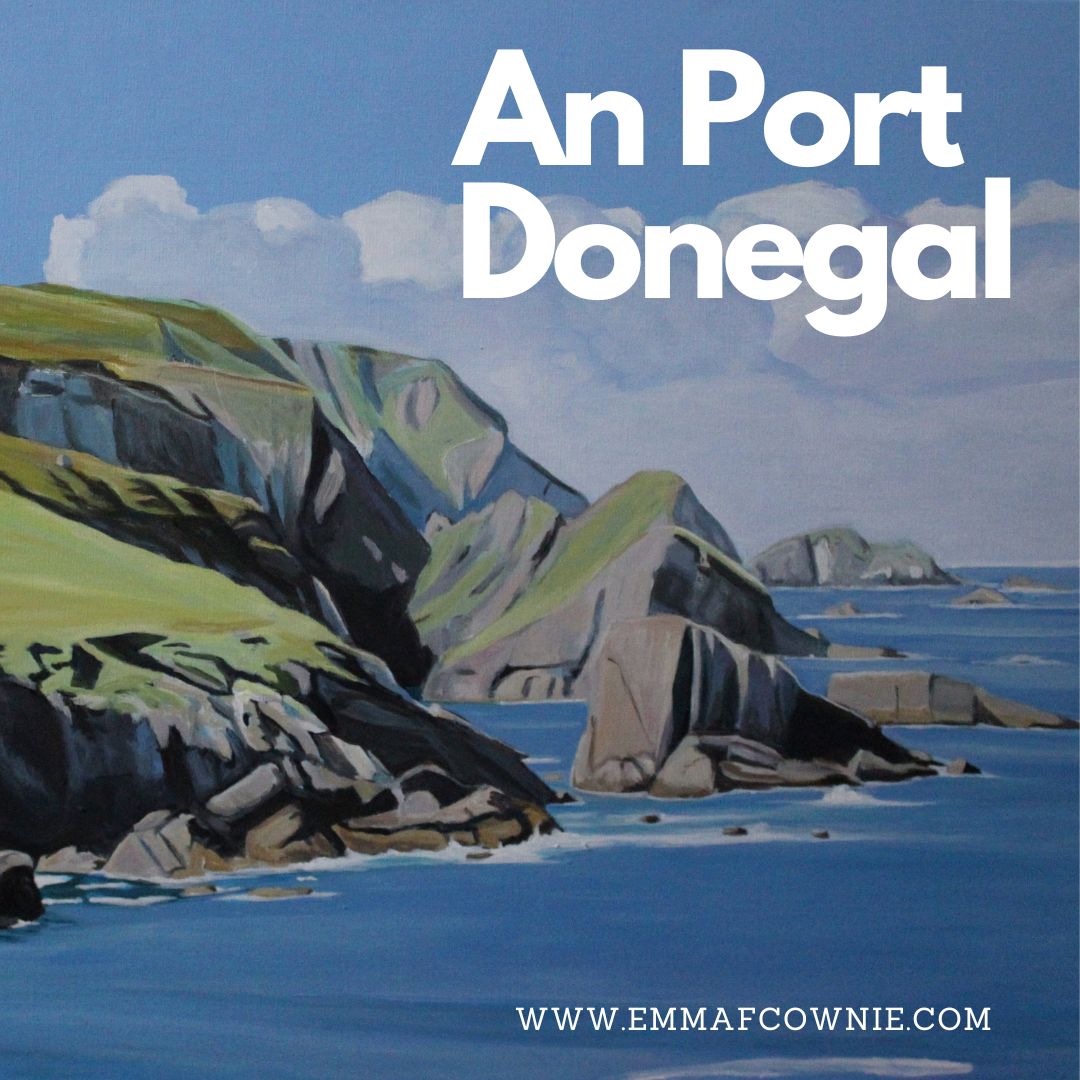
If you look on the left hand side of my painting “An Port” (below), you will see tiny fence posts along top of the cliff. They help give a sense of scale of the huge cliffs and rocks. I can’t remember who first described this landscape it as the “land of giants”but it truly apt.
It is hard to do justice to this incredible landscape but I think that Rockwell Kent’s paintings do. He really capures the majesty and warm colours of Donegal. He also excels at Donegal skies and light. I am really in awe of him.
I wish I could see the original paintings but this is very unlikely. It seems that none of Rockwell Kent’s large paintings stayed in Ireland. Most of them are either in the USA or in Russia. But that’s another story.
The west coast of Ireland is dotted with islands, big and small but also plenty of sea stacks. Perhaps, they were once sea arches, I am not sure. If they were the crown of the arch fell in to create these majestic pillars. They can be seen from miles away. Even on misty days. This one, Tormore (in the painting above and below) is miles away, near a very remote location called Glenlough Bay. There is something exciting and other worldly and timeless about it.
Rossbeg Beach, Donegal (Photo credit:Emma Cownie)
Rossbeg (sometimes spelt Rosbeg) is a tiny townland on the west coast of Donegal, just three miles south-west of Portnua and Nairn. This is the Dawros Peninsula. There is a pier and a scattering of houses, some are modern, but many are old cottages, probably used as holiday lets.
There is a definite shift in the seasons. In summer here, the light seemed to stretch on for eve; well past 11pm. Suddenly the days have started shortening fast. It is now dark before 9pm. It has rained solidly for the last two days. In typical Donegal fashion, the sun has come out and everything is bright and fresh.
Artimus (aka Artie) our Donegal rescue cat has just passed me to go outside in the catio to smell the breeze. He used to be a stray. It’s hard to believe as he’s so beautiful and such a softie. He now enjoys the warmth and comforts of indoor life (especially hiding under the towel rail) but he still enjoys the smells and sounds of rural life outside. We lost three pets in the last year (two cats and a dog) and I am not letting him outside when there’s a busy road at the bottom of the garden. I cant face the heartache, if I dont have to. So Séamas, built a catio. Or the cat veranda as I like to call it. Both of our cats, enjoy it but Artie, especially so but not when it’s cold. He’s been in and out of it four times in the last twenty minutes. I think he wishes it was warmer. He must have found life as a stray really tough!
Artie in the Catio (through the window)
Catio – aka cat veranda
Artie – indoors
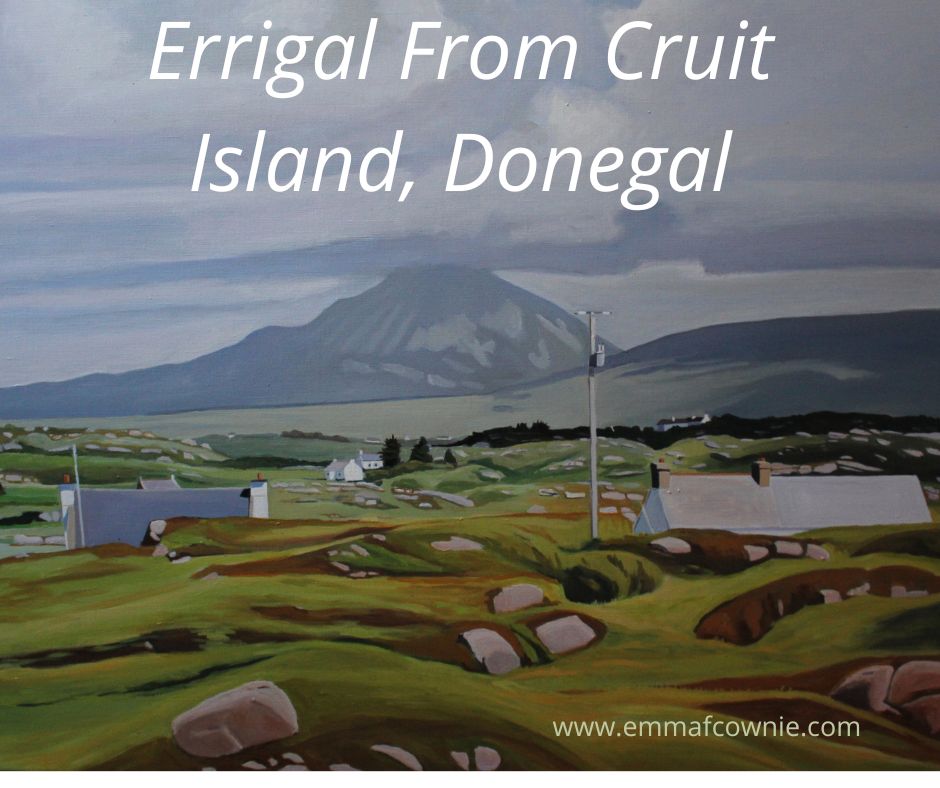
Errigal from Cruit Island, Donegal:-This was one of a pair of large paintings I started before I got ill. It sat in it’s greyscale state for over a month and a half until I recovered enoungh stamina to complete it! Large painting require a lot of strength as you lift your arms/hands above your head, even if you are just moving the canvas. I was very glad to finish it.
Donegal Greyscale #1
I enjoyed painting the rolling landscape; splattered with rocks. I took great pleasure in adjusting the colours in oil paint and “tightening up” the details. The rash of rocks amongst the boglands is quite unique to this part of Donegal. Further south towards, Glencolmcille, there are far fewer bolders and rocks. There the bogland blankets the landscape uninterupted. There are far fewer houses there too. This area of Donegal, the Rosses, however, is dotted with houses old and new. I like that the old houses nestle in the nooks and crannies of the landscape; keeping out of the prevailing westerly winds and showers.
Gentle Artie came from AnimalsinNeedDonegal – They found him a home because long-haired stray cats don’t live long lives outside in Donegal, their long coats are hard to keep fully dry.
Here’s their facebook page here They also have a charity shop in Donegal Town and you can make donations here. You can also follow them on Instagram