Posted on 2 Comments

Dunree Head, Donegal

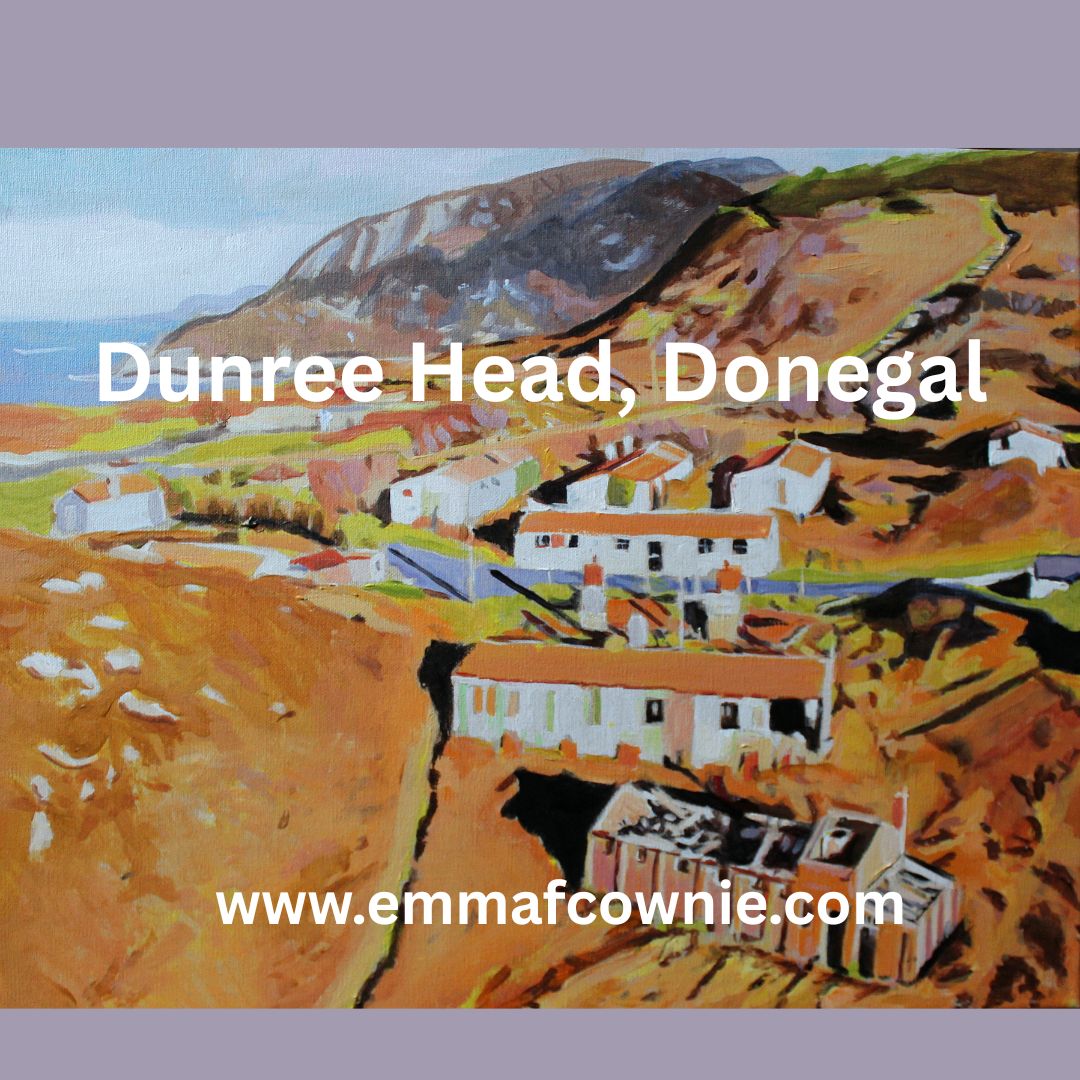
Dunree Head Donegal

 Dun Fhraoigh in Irish means, “Fort of the Heather” – it has been a fort at Dunree for thousands of years, since the Bronze age (over 4000 years ago). When you see the chunk of rock that the “modern” day fort (well Napoleonic era) for has been built on, you understand why.

Its a big chunk of rock! (photo credit: Emma Cownie)

Photo Credi t: The Artillery Club of Ireland
Aeriel View of Dunree Head (Google Maps)

Its location, on the cliffs of Dunree Head, is great for observing and controlling ships moving up and down the majestic Lough Swilly, one of Ireland’s three glacial fjords.

The English built this sturdy fort on the chunk of rock c. 1812-3 with a draw-bridge! The enemy back then, as readers of Jane Austen will know, was the French forces of Napolean Bonaparte. (The story of Jane Austen’s Donegal nieces is worthy of a BBC/RTE mini-series in its own right; linking Kent, Ramelton and Gweedore). The French had attempted landing in Lough Swilly in 1798 with a force of about 8,000 men, which was repelled at sea. The Royal Navy anchored ships in the Lough. There were a lot of big guns here, nine 24-pounders were in 1817.  There was once a Martello-type in the centre of the old fort but it was demolished c. 1900, as it obstructed the field of fire from the new fort on the summit of Dunree Hill.

Although the Irish Free State was created in 1922 and they followed (and still follow) a policy of political neutrality, the British army did not leave Dunree until 1938. This was because Lough Swilly was a “Treaty Port”, and it remained under British military control for defensive purposes.  During the Second World War, it was under control of the Irish Army and it played an integral role in safeguarding Ireland when a number of anti aircraft guns were added to site. The waters off the coast of Donegal are under threat today from Russia’s so-called “shadow fleet”.

I am not particularly interested in military hardware, although I know plenty of people in the world are. I have not been in the military museum. What did take my interest, however, were the barracks. There were brick buildings but also a lot of decaying iron huts that the gunners had lived in. I am nosy and I enjoy seeing how people lived. Although, frustratingly, most of that has gone. There tiny glimpses; brick chimney stacks, the odd rusting bedstead but not a lot.


Army Barracks – Brick and iron. Photo Credit: James Henry Johnston
Dunree Army Huts: Photo credit James Henry Johnston
Dunree Barrack Huts: Photo credit James Henry Johnston

A little further up (a steep) hill from Fort Dunree and the barrack buildings is Dunree Lighthouse. This a puzzling lighthouse. I am used to lighthouses being built atop of great pillars like the one across the Swilly water at Fanad.

The one at Dunree, however, has no tower. It doesnt need one. The light is at ground level. The “ground” however its up high on the cliff way above the Fort. A lantern attached to a house for the Lighthouse Keeper was built, and the light established on 15th January 1876. The light was a non flashing one with a two wick oil burner. Sadly, for the lighthouse keeper, technology did away with his job in 1927 when this light was replaced in December 1927 with an “unwatched acetylene with a carbide generating plant attached to the station”. The light was later converted to electricity in 1969. It must have been a great place to live. 

Lighthouse at Fort Dunree (Donegal)
Lighthouse at Fort Dunree (Donegal) – View from the east. The litchen covered stone wall is testiment to the clean air of Donegal

The lighthouse keeper’s house has a spectacular view across the Lough. Its built of local rubble stone masonry, this building retains its early form and character. Its visual appeal and expression is enhanced by the retention of much of its original fabric including timber sliding sash windows. Both the house and the lantern were built by McClelland & Co. of Derry. The simple outbuilding and boundary walls are very elegant too.

From the outhouse towards the lighthouse


The views at Dunree are spectacular. Lough Swilly is quite majestic, even on an overcast day.  Perhaps, it’s particularly dramatic on a overcast day with the shifting light and colours. You can walk up Dunree Hill and look over towards the Urris Hills and Dunree Bay (Crummies Bay).

There is a regular bus service from Buncrana, a coffee house, museum and public toilet. It might be a good idea to go before they start work on revamping the place!

See more paintings of Inishowen Peninsula here

Read More

https://www.buildingsofireland.ie/buildings-search/building/40901824/dunree-fort-dunree-donegal

https://www.donegallive.ie/news/inishowen/1589360/decision-on-12-5m-fort-dunree-tourism-project-due-early-next-year.html

https://www.govisitdonegal.com/blog/january-2024/between-waves-and-war
Posted on Leave a comment

Cruit Lower, Kincasslagh

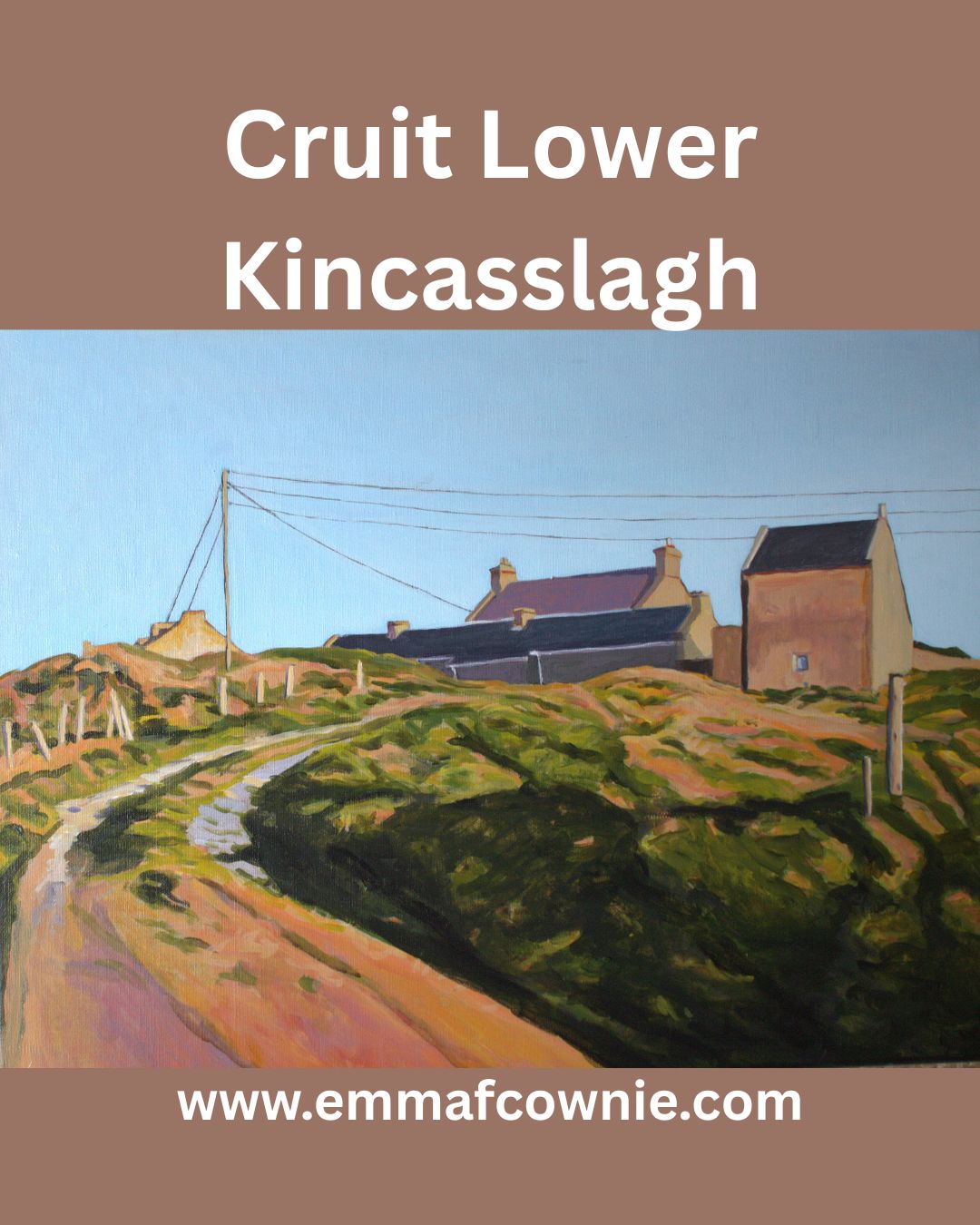
Cruit Lower, Kincasslagh

Summer in Donegal is full of light. Even if its damp summer there is still lots of light. The northly latitude sees to that. It only seems to get properly dark for a couple of hours after midnight and dawn comes impossibly soon. So its great for painting and getting out and about but the light is not so interesting for photography or sketching, especially if, like me, you like lots of strong shadows. So my paintings are usually based on images that are captured in the autumn months. Otherwise, mornings and evening are best for interesting colours and shadows.

Autumn Light on Cruit Island, Donegal _ E,mma Cownie
Autumn Light on Cruit Island, Donegal _ Emma Cownie SOLD

Cruit Island is one of my favourite places in Donegal. It’s rocky and sparsely populated but is accessible by a handy bridge.

Donegal Cottages, Cruit Island _Emma Cownie
Donegal Cottages, Cruit Island _Emma Cownie SOLD
Over Cruit Island by Emma Cownie SOLD

We have driven past the collection of farm buildings at Cruit Lower many times but I only managed to capture an image I liked enough to paint this spring. It was an uncharacteristically warm and sunny run of days this May.

The farm has long fascinated me as you have to drive through it. These through roads through farms are not unusal in rural areas in Ireland (and Wales). Informal tracks through a collection of farm buildings, now divided by tarmac.

Lower Cruit was for sale last year and I had a good look at it online. It was interesting as you can only glimpse some of the buildings from the road. I cant remember how much the asking price was. Getting on for a million Euro, maybe. Way out the reach of a poor artist! You got a lot for that; a collection of beautiful historic buildings (some pre-famine era) and access to a beautiful beach and some really incredible views of the West of Donegal. Here are some of the photos from the website. I dont know who bought it but I really hope they look after the beautiful old buildings.

Cruit Lower From the Air
Cruit Lower with Beach behind
Prefamine house at Cruit Lower
Cruit Lower – the view you cant see from the road!

More information about Cruit Lower

https://www.buildingsofireland.ie/buildings-search/building/40904015/cruit-lower-co-donegal

1901 census information http://donegalgenealogy.com/1901cruitlowr.htm

Kinclasslagh wikipedia

https://www.donegalcottageholidays.com/cruitisland-cruitisland

https://www.booking.com/city/ie/kincaslough.en-gb.html

Posted on 8 Comments

Fanad Peninsula, Donegal

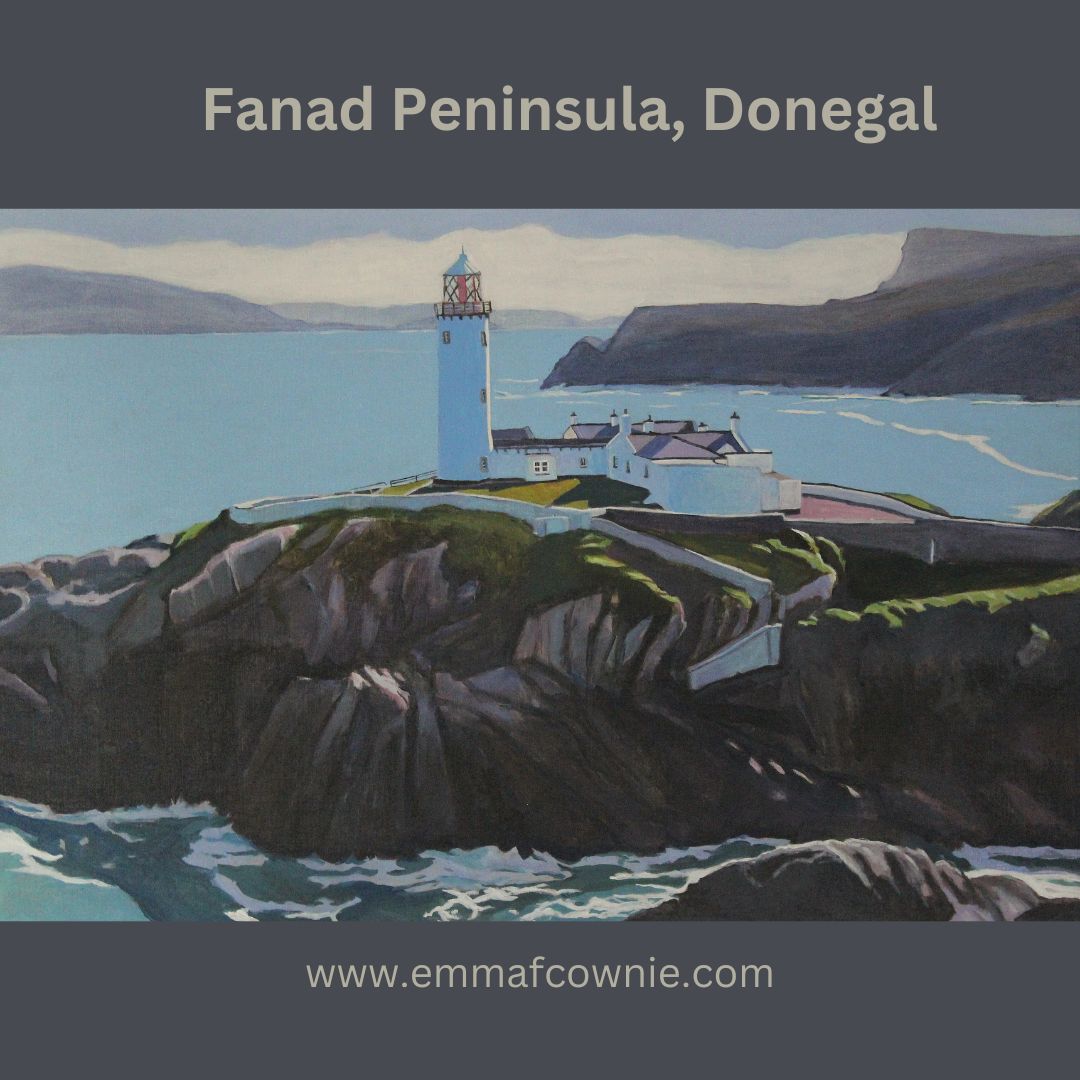
Painting of Fanad Lighthouse by Emma Cownie

Fanad is a finger of land that lies between Lough Swilly and Mulroy Bay on the north coast of County Donegal, Ireland. It is not that easy to get to and the the survival of the Irish language is testiment that relative isolation.

Painting of Lambing season at Fanad Head (Donegal)
Lambing season at Fanad Head (Donegal) SOLD

Fanad Lighhouse (Donegal). Is one of the 12 Great lighthouses of Ireland. It was built in 1886 at Fanad Head (although the station was originally established in 1817). The lighthouse, or more acrrately, the harbour light, marks the entrance into Lough Swilly which forms a natural harbour.

Fanad Lighthouse (Donegal)
Fanad Lighthouse (Donegal) SOLD

I have painted this isolated structure several times before. I have always enjoyed painting the northernly light on Fanad. I have only have painted it in acrylics. That’s not a delibertae choice, more one of circumstance because at times I have had limited space, and I dont want to use oil paints with kittens close at hand.

Over to Fanad Lighhouse (Donegal) _Emma Cownie
Over to Fanad Lighthouse (Donegal) _Emma Cownie SOLD

I think acrylics suit the airiness of the subject matter. After a couple of years working out how to use them, I have settled on a technique of light layers of paint that allow the underlying colour to show through. This can give a transulent quality to the colour. This is in contrast to the relatively flat areas of colous I use for the larger areas of colour such as sky or the sea.

Read more about my use of acrylics here

a painting of Fanad Head and lighthouse
Fanad SOLD

My latest painting was an experiment in composition. We used an image from a drone shot done by my artist husband, Seamas (James Henry Johnson).

In this piece, I wanted to create a sense of space from the mountains of the Inishowen Peninsula in the distance. The distant mountains were layered with bluish white until I got the right impression of distance.

I often find myself looking at the tiny Fanad lighthouse far off in the distance when I am at Lisfannon on the Inishowen Penisula.  There is a sign comemorating a famous Atlantic storm that happened in 1748. this storm threatened to sink The Greyhound, the ship of one John Newton, a slave trader. John was so frightened that he called out to God for mercy. This moment marked a profound spiritual conversion, and many years later he wrote the words for the hymn “Amazing Grace” one of my favourite hymns, and to also campaign for the abolition of slavery.

There is some confusion how many storms there were . One website claims the terrible tempset happened far away out in the Atlantic because it took John Newton another four weeks after his conversion to sail into Lough Swilly and arrive at Derry/Londonderry. The Amazing Grace.ie site however, makes it clear a second storm happened in Lough swilly itself as it quotes John’s journal ” We saw the island of Tory and the next day anchored in Lough Swilly  in Ireland.  This was the 8th day of April, just four weeks after the damage we sustained from the sea.  When we came into this port, our very last victuals was boiling in the pot; and before we had been there two hours, the wind began to blow with great violence.  If we had continued at sea that night in our shattered condition, we must have gone to the bottom.  About this time I began to know that there is a God that hears and answers prayer.” It’s got to be said, that John Newton really took his time putting his evangelical beliefs into action because he went back to being a slave trader for another five years before he eventually retired and became a minister in 1757!

The heaving sea at the foot of the massive lighthouse rock intrigued me. The Atlantic Ocean has such a bulk and stregth, even on a relatively fine day, I am not surprised that John Newton was terrified by its strength far away from the Donegal coast. I wondered about the long and difficult process of building this structure all those years ago in a remote location. Yet, this lighthouse has stood the test of time and proudly marks the entrance to Lough Swilly and can be seen from inland and further along the coast.

Painting of Fanad Lighthouse, donegal by Emma Cownie
The Heaving Sea at the foot of Fanad Lighthouse, Donegal by Emma Cownie

Fand Lighthouse by James Henry Johnston (c) 2024

Turquoise Sea At Fanad Lighthouse

Find out more

Fanad

https://www.ireland.com/en-gb/destinations/regions/fanad-head/

John Newton

http://www.amazinggrace.ie/newton-in-ireland.html

Posted on 6 Comments

On the Way to Arranmore

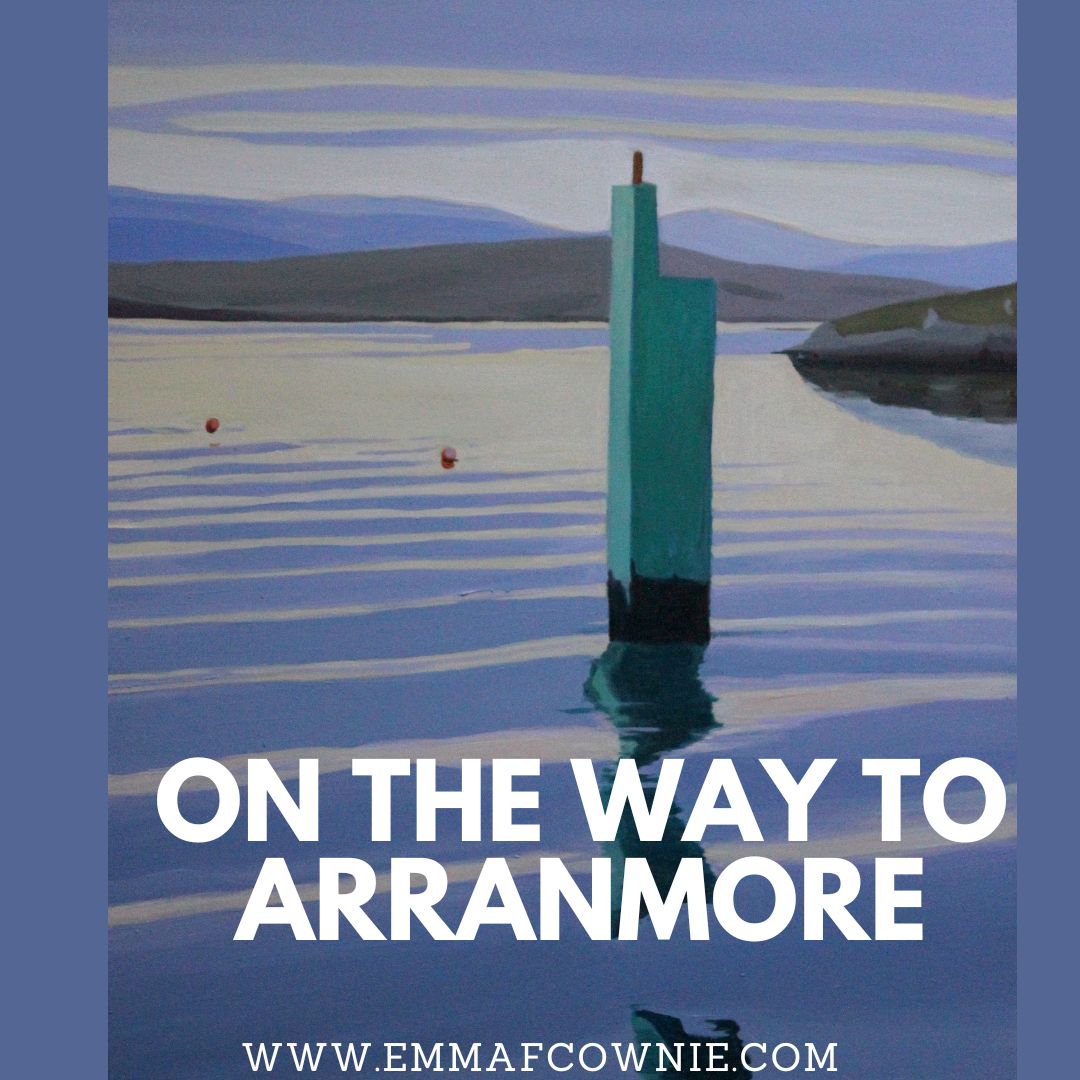
On the Way to Arranmore_Emma Cownie

Looking through my recent work, I was surpised to realise that I haven’t painted many paintings of Arranmore Island in the last couple of years despite visiting the islands in the summer. So I have put that right with a series of new paintings.

As always I am entranced by the journey to and from the island. You can read my short History of the Island here 

Arranmore is lucky to be served by two ferry companies. There is The Arranmore Ferry (Blue) which is based on the island and Arranmore Ferry (Red) which is not. Yes, I know the names are almost identical, just a small matter of “The”. They both offer a fantastic 15 minute journey from Burtonport (Ailt An Chorráin) to Arranmore Island. On a calm and sunny day the view on the crossing are just heavenly. Sometimes there are dolphins too.

Map of Arranmore
Map of Arranmore and the coast off Burtonport

The ferrys sail through a narrow passage past a scattering of islands on the way to Arranmore.

Route of the Arranmore Ferrys
Route of the Arranmore Ferries


painting of On Rutland Island, Donegal - Emma Cownie
On Rutland Island, Donegal – Emma Cownie


Rutland Island (Inis Mhic an Doirn) lies between Burtonport and Arranmore, Donegal. William Burton Conyngham (a local landowner for whom Burtonport takes its Anglised form) had warehouses, a street of houses, a post office and  a school built c. 1784 to capitalised on a the abundant herring fishing.  Unfortunately, the herring disappeared very early in the 1800’s and the station fell into disuse. The island was inhabited until the 1950s. These are the remains of the fish  factory and landing stage on Rutland Island.


Painting of Inishcoo Island, Donegal
House on Inishcoo, Donegal – Emma Cownie

Opposite is Inishcoo Island with Mount Errigal in the distance peeping out from under the clouds. The jetty in the left hand corner belongs the magnificent Inishcoo House (see painting below)- once a coast guard house, built in the C18th.

Inishcoo House, Donegal, ireland by ma Cownie
Inishcoo House, Ireland (SOLD)


There are several tiny holiday homes dotted across the islands (and cows)

Ferry Home (Arranmore, Donegal) by Emma Cownie
Ferry Home (Arranmore, Donegal) by Emma Cownie SOLD


Inishcoo Ireland
Inishcoo cottages Ireland (SOLD)


Inishcoo (To The Fore of Arranmore)
Inishcoo (To The Fore of Arranmore) – Emma Cownie
Blue Freey at Burtonport, Donegal - Photo by Emma Cownie
Blue Ferry off Arranmore, Donegal – Photo by Emma Cownie


A you can see the views are quite idyllic. Whether from the ferry or from the island. To be honest, I wish the ferries were like the Circle Line on the London Underground, where you can ride the tube rround and round (it takes and hour and an half apparently, I have never done it) and you could ride them back and forth to the island all day!

Painting of Washing Line, Arranmore _Emma Cownie
Washing Line, Arranmore by Emma Cownie SOLD
Red Ferry at Arranmore, Donegal - Photo by Emma Cownie

Some more recent works….

A Painting of a cottage of Arranmore, West Donegal, Ireland by Emma Cownie
A Home on Arranmore, West Donegal, Ireland by Emma Cownie

A Short History of Arranmore 

Getting There

The Arranmore Ferry (Blue)

Arranmore Ferry (Red)

Posted on 6 Comments

Boat on Rossbeg Beach, Donegal

Painting of Rossbeg Beach

The west coast of Ireland is dotted with islands, big and small but also plenty of sea stacks. Perhaps, they were once sea arches, I am not sure. If they were the crown of the arch fell in to create these majestic pillars. They can be seen from miles away. Even on misty days. This one, Tormore (in the painting above and below) is miles away, near a very remote location called Glenlough Bay. There is something exciting and other worldly and timeless about  it.

Rossbeg Beach, Donegal
Rossbeg Beach, Donegal (Photo credit:Emma Cownie)

Rossbeg (sometimes spelt Rosbeg) is a tiny townland on the west coast of Donegal, just three miles south-west of Portnua and Nairn. This is the Dawros Peninsula. There is a pier and a scattering of houses, some are modern, but many are old cottages, probably used as holiday lets.

Road above Rossbeg Beach:- Phot Credit Séamas Johnston
Road above Rossbeg Beach:- Photo Credit Séamas Johnston

There is another beach around the corner too.

Rossbeg on the Map
Rossbeg on the Map

Boat on Rossbeg Beach: Photo Credit - Emma Cownie
Boat on Rossbeg Beach: Photo Credit:- Emma Cownie

Rossbeg Beach, Donegal
Rossbeg Beach, Donegal (Tide further in): Photo Credit:Emma Cownie

Rossbeg postcard
https://www.johnhindecollection.com

The beach and the view is just perfect. The water is so very clear that the rocks and seaweed are visible from quite some distance from the shore.

Rossbeg Pier (From Marina.com) note the cows on the baech

Rossbeg Pier (From Marina.com) note the cows on the baech
Rossbeg Pier (From Marina.com) You can see the seaweed from up high too!

Rossbeg Beach:- Photo Credit Séamas Johnston

Boat on Rossbeg Beach, Donegal, painting by Emma Cownie

Boat on Rossbeg Beach, Donegal, painting by Emma Cownie SOLD

SEE DONEGAL PAINTINGS                                             BUY DONEGAL PRINTS 

Posted on 3 Comments

Exciting New Development near Riverside Walk, Dungloe- its quite magical

This is a follow up on a recent blog of mine.

If you are wondering, Kenneth Campbell is a real estate agent/realtor/auctioneer. We bought our cottage from him several years back.  He’s very good at his job and a natural performer!

You can read about my recent visit to this charming installation here  

Kenneth Campbell’s website here  

This was originally published on facebook here https://www.facebook.com/Campbells.ie/videos/336882011887081

Posted on 13 Comments

If you go down to the woods today…

Magicland Dungloe Donegal

It took a while, but I finally worked it out. On sunny days Lidl’s car park in Dungloe is pretty full but the shop is quite empty. Just across the road from is the entrance to the River Walk. I have eyed this entrance many times as I have bundled the shopping into the back of the car.  Mothers with prams and toddlers are often headed this way. Yesterday I finally crossed to road and wandered into a magical woodland. No teddies to be found but a magical woodland with fairies and a giant troll. Here he is.

Troll from Dungloe's River Walk Land of Magic 2022
Troll from Dungloe’s River Walk Land of Magic 2022


The Troll: Photo credit Seamas Johnston
He’s really big! Photo credit Séamas Johnston

From Destination Dungloe on Twitter @DungloeD
Hitching a ride on on the back of a lorry from Northern Ireland last year. – Credit: Destination Dungloe on Twitter @DungloeD


Here’s a selection of images from the walk. It was inventive, funny, engaging and charming in equal measure. I just loved it.

Land of Magic - from Dungloe's River Walk Land of Magic 2022
Land of Magic – from Dungloe’s River Walk Land of Magic 2022

The backstory - from Dungloe's River Walk Land of Magic 2022
The backstory (in Irish)- from Dungloe’s River Walk Land of Magic 2022

The backstory - from Dungloe's River Walk Land of Magic 2022
The backstory – from Dungloe’s River Walk Land of Magic 2022


Some pretty cool houses

Just love those chimneys!

It’s also got a tiny out door privy


On such a sunny day there was plenty of washing hung out to dry

A fine bit of dry stome walling too.


An insect hotel too

Evidence of diverse bunch of fairies live here


I liked the pine cones around the edge


EU notice - from Dungloe's River Walk Land of Magic 2022
EU notice – from Dungloe’s River Walk Land of Magic 2022


I wonder how many sightings of magical creatures have been reported to the Elf-13 office at the EU? A fair few I shouldn’t imagine.

More about the land of Magic

https://www.facebook.com/TheLandOfMagicDungloe/

Find out more about the talented people who made the Land of Magic  https://www.facebook.com/stickyfingersartsnewry/

https://www.newrydemocrat.com/news/2021/09/12/gallery/tri-na-draiochta-represents-a-new-dimension-in-cross-border-collaborations-18350/

Stor the Troll has settled into his new home in Dungloe

Posted on 4 Comments

Back in Donegal

I have decided that perfect is the enemy of good, and I need to give up on the idea that I should write lengthy blogs posts, as I end up writing nothing! So here goes,

Donegal Paintings
Two grey scale paintings

One of the many great things about being back in West Donegal is that I can paint much larger paintings as my art studio is much bigger here than in Derry. So I now have two on the go!

Donegal Greyscale #1

These are both painted in acrylic paint. I find it easier to make adjustment in the value/tones in acrylic before I move onto a layer of oil as a final layer. Acrylic can act as a foundation layer for oil, but not the other way around. I had forgotten how physically tiring painting a large painting is.  My arms are tired!

Donegal Greyscale #2


If you want to know about Greyscaling and why I have adopted this technique since moving to Ireland please see my post “Adventures In Acrylic Paint” 

Posted on 9 Comments

Recent work (of Derry and Donegal)

Recent work - Emma Cownie

We are about to decamp to Donegal for the summer/early autumn. I have mixed feeling about returning to oil paints. It’s been a quite a steep learning curve getting comfortable with acrylic paint but I feel like I finally got there. I am not sure what it will be like to paint in oils again; oh the the joy of easy blending! I am looking forward to being able to paint larger canvases. I will continue my practice of laying down an underpainting in grey-scale paint, regardless.

Here are some of my recent acrylic paintings, mostly of Inishowen Penisula (Donegal)

Kinnagoe Beach - Emma Cownie
Kinnagoe Beach – Emma Cownie

Down to the Rusty Nail, Inishowen_Emma Cownie

a painting of Fanad Head and lighthouse
Fanad (SOLD)

On the Way to Kinnagoe Bay (Drumaweer, Greencastle)
On the Way to Kinnagoe Bay (Drumaweer, Greencastle) (SOLD)

painting of Doagh Strand, donegal_Emma Cownie
Down to Doagh Strand, Donegal

Painting of Lambing season at Fanad Head (Donegal)

Lambing season at Fanad Head (Donegal)

Carrickabraghy Castle, Inishowen

Acrylic painting of Portmór Beach, Malin Head, Donegal
Portmór Beach, Malin Head, Donegal


Also of Derry city – what a great little city.

The Walls of Derry painting by Emma Cownie
The Walls of Derry


The Sperrinspainting Upper Dreen_Emma Cownie

Upper Dreen_Emma Cownie

And finally a few also of my favourite, Gola Island.

painting of house On Gola (Donegal)
Still, On Gola (Donegal)

The Turn in the Road, Gola - Emma Cownie
The Turn in the Road, Gola – Emma Cownie

A Sandy Road Through Gola-Emma Cownie

The weather forecast is for cool weather, so I will be packing some light jumpers. I have found, however, that forecasts are pretty unreliable for Donegal so it could be very pleasant. I am looking forward to the sweet breezes!


Posted on 25 Comments

Studies of Inishbofin

Last Thursday morning Bingo, one of my two cats,  collapsed in the front garden under a hedge and we had to take him on the long drive to the vets to end his suffering. It broke my heart. I had had him for over a decade and loved him dearly. Hattie, his cat companion of the last 6 years, misses him too and she has been outside looking for him. That’s even sader. We are keeping her indoors for now.

Bingo
Bingo


So my concentration hasn’t been great. I have struggled to write anything, although I had almost finished another blog. Every time, I looked at images, trying decide what painting to start next, I am crippled by indecision. So I have been painting instead a series of small studies. Playing with composition, and simplifying images. The idea is to reduce detail to the minimum.

Caravan at Magheraroarty
Caravan at Magheraroarty 24x18cm


Inishbofin #2
Inishbofin #2 24x18cm SOLD


I then moved on to slightly larger canvases. The photographs of the paintings don’t quite capture their colour. Unfortunately, they have a blueish cast to them.

Inishbofin #3

Inishbofin #3  30x24cm

Inishbofin #4
Inishbofin #4  30×24 cm


Inishbofin #5
Inishbofin #5  30 x34cm


Inishbofin #6
Inishbofin #6 30x24cm


Inishbofin # 7
Inishbofin # 7 (SOLD) 30x24cm


Inishbofin #8
Inishbofin #8 30x24cm


I will continue with these and hopefully I will find it within me to paint some much larger versions. In the meantime, we have a large rescue cat we have named Tadhg (pronunced “Tag”) from Burtonport Animal Rescue, in the office. He is named after a famous Irish rugby player,  called Tadhg Furlong, on account of his robust physique.

Tadhg Furlong
Human Tadhg,  the rugby player


Unfortunately, Hattie hissed  at him when she first saw him, so we are introducing them very, very slowly. Swapping scents and feeding them on opposite sides of the same door etc.  Tadhg was a stray and hasn’t had much experience of the indoor life, so he’s getting used to things like doors (they move when you rub up against them, you know) and mirrors (there’s a big black and white cat in window thing in the bedroom next door he’s worried about). He also loves carpets and heating. When he wants a break he sits under the chair in the corner of the room. I hope we can successfully integrate Tadhg into our animal family!

Tadhg liks his basket
Cat Tadhg likes his basket


See all the studies here