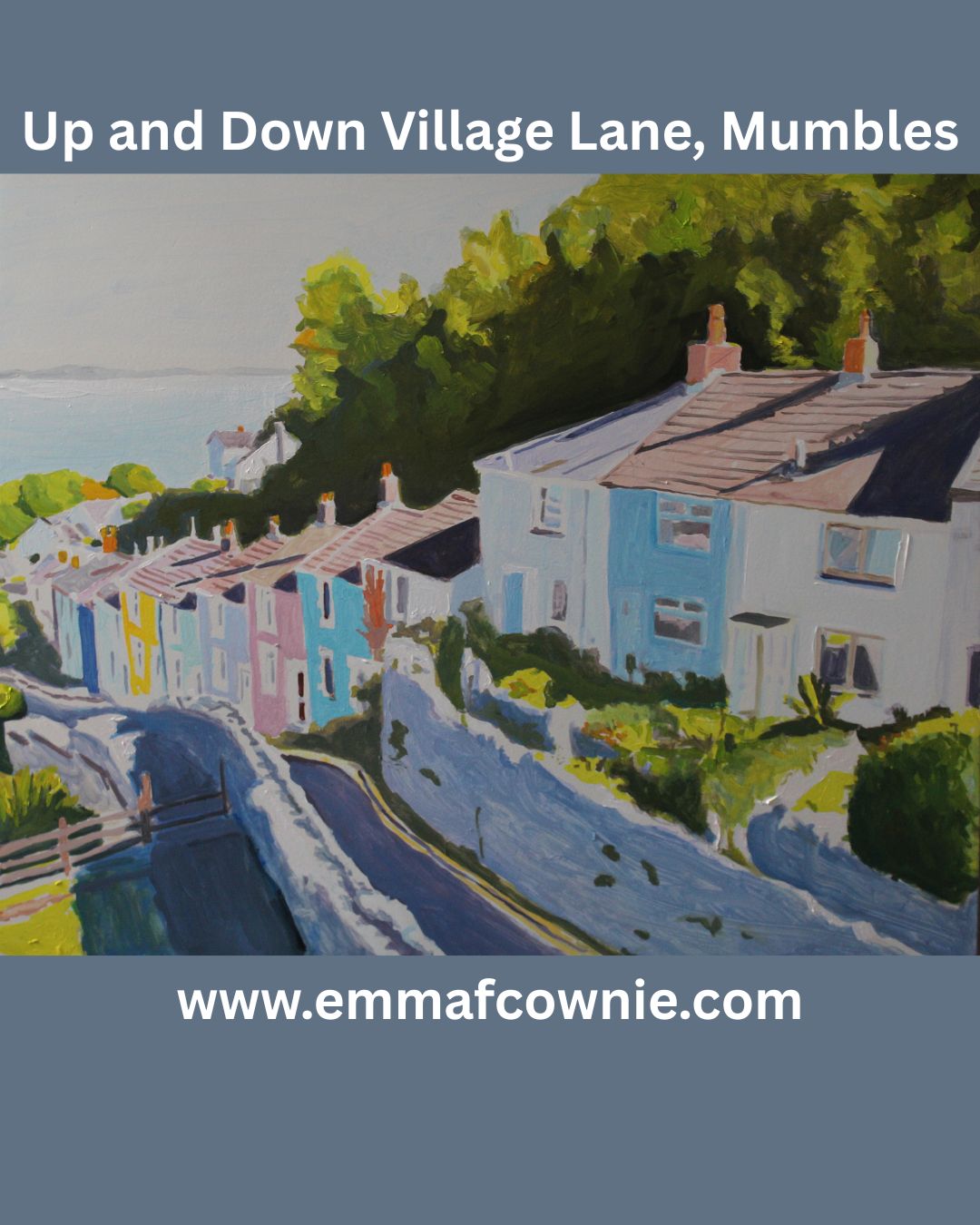
Mumbles is the name commonly given to to coastal village on the western rim of the expansive Swansea Bay. Strictly speaking its the name of the headland that juts out into the Bristol Chanel. Mumbles Head is often the windiest place in the area. Listen out for it on the shipping forcast. Anyway, the place a lot of people think of as “Mumbles” is the largest village on the Gower peninsula.
People have lived in the area longer than most places in Britain – 30,000 years if you are asking. I doubt if the ones living there today are related to the people of the stone age who left behind their flint axe heads, now kept in Swansea Museum. Or possibly even related to the Romans who built a villa or mansio at Oystermouth so they could keep watch over the bay and maybe eat oysters.
It is possible that a few might have ancestors amongst the Normans later built a castle at Oystermouth in the late 12th century. The castle was to keep the local Welsh population in check. Apparently the name Oystermouth is a corruption of the Welsh name for the settlement, Ystumllwynarth. When non-Welsh speaking people started to settle in the area, they heard the Welsh name, but couldn’t say or understand it, but they knew there were oyster beds in the area, so they brains turned it into “Oystermouth”. Even today the people of this area seem dont have a strong Welsh accent. Read more about the different accents in the Swansea region here.
Oyster fishing was once an important industry in Swansea Bay, employing 600 people at its height in the 1860s. However, overfishing, disease and pollution had all but wiped out the oyster population by 1920.
Its a bit confusing. A lot of people use the names Oystermouth and Mumbles interchangeably. The distinction between Oystermouth and Mumbles is blurred. Local buses to the area are labelled Oystermouth, despite the fact that most people in the area would say they live in Mumbles. Strangely, I have never come across anyone who says they live in “The Mumbles”. Its people from further away who say that, I think.
Whilst at Three Crosses
Brooke-Branwhite, Charles (1851 - 1923)
Like pretty much everywhere in Britain, two hundred years ago Oystermouth/Mumbles was a few lanes and a lot of fields. Village lane stretched from the coast up a steep hill.
Maps of Mumbles Village and Oystermouth - 1845 and 1896
Village lane was (and still is) in the centre of the village but a lot of houses have been built in the fields around it. Built “Mumbles” has also extended to all along the headland with a new cutting and road being built at the end of the 19th century. The new road coinsided with the building of “Prettiest Pier on the Bristol Channel” which attracted large crowds on the newly extended railway from Swansea. Village Lane was increasingly out of the way and probably ignored by most visitors.
Southend, Mumbles 1925. Shared from the Swansea History Society Facebook page.
Up Village Lane by Emma Cownie (SOLD)
Village Lane, Mumbles #1 by Emma Cownie
The Victorian Villages c. 1885 - From the Story of Mumbles
Up Village Lane, Mumbles (#1) by Emma Cownie
Modern day visitors who like their cars will find visiting Village Lane a bit of a challenge. It’s one way (down hill, thankfully) and there is no parking at any time of day. Obviously, residents are allowed to drop off their shopping and deliveries but move on sharply. There are several Air B&Bs along here now. Wales Online wrote and article recently trying to make out that some people were unhappy with the short-term rental properties. They didn’t seem that unhappy to me. One anonymous local said “You just miss having more neighbours,” she said, but added that living in the street is “lush” and the people that do live there full-time “cheer each other on” and perhaps most importantly- “offer each other cake”.
Down Village Lane, Mumbles (#3) with Tree by Emma Cownie
It was clear from the article that ordinary people are still keen to live in these 2 bed cottages and they are not cheap!
Angela Benham is renting the orange house on the lane and she said that “The people on Village Lane are outstanding. When I first moved in, I had two bottles of wine, two bunches of flower and seven cards welcoming me to the lane. That made me feel really part of the community. The whole community is lovely here, it’s a great place to live.”
I am not surprised people love it as its wonderfully quiet and the views are stunning. The cake is definitely a bonus!
Village Lane, Mumbles (#2) Yellow House by Emma Cownie
Today is International Women’s Day. As I drove through Mumbles yesterday afternoon I was reminded of two remarkable Swansea women and I was pondered on why we like to focus on very unsual women, rather than remarkable ordinary women. It got me thinking about other notable women of Swansea, past, and present
Here’s my list of five that came to mind:-
First comes the women of privilege:-
1. Thereza Dillwyn Llewelyn (1834 –1926). She was an astronomer and pioneer in scientific photography. She came from a wealthy family and her father was a pioneer photographer, astronomer, a botanist and a Fellow of the Royal Society. She made some pioneeringtelescopic photographs of the moon in 1857/8.
2. Amy Dillwyn (1845-1935) – She was a radical novelist, feminist campaigner, and early female industrialist. Amy was first, a novelist, and a supporter of sexual equality and women’s suffrage. When her brother and father died in the early 1890s she found herself responsible for a workforce of 300 and a spelter business crippled by debt. Impressively, despite losing her home, she decided to run the business herself, which she did successfully. She was a strong supporter of social justice and in 1911 gave her support to 25 striking seamstresses, who worked for Ben Evan’s, a local department store. These dressmakers were demanding a living wage in return for their long hours. Amy called for a boycott of the store and encouraged her friends and family to not shop there. Her eccentric appearance, her habit of smoking cigars and lifestyle make her appealing figure to modern eyes.
Now to some working women.
2. Jessie Ace and Margaret Wright (neé Ace) these two sisters were the daughters of the Lighthouse Keeper, Abraham Ace. In the winter of 1883, these two sisters valiantly rescued two lifeboat crewmen, in the midst of a terrible storm, by tying their shawls together to use as a rope. Margaret supposedly exclaimed: “I will lose my life than let these men drown” as she waded into the icy waters.
4. Iris Gower (1935 – 20 July 2010)- This was the pen name of Iris Richardson a prolific novelist who wrote many historical romances set in this area. I once heard her talk about her writing and was left with the impression of a resilient, hard-working woman with fiery red hair, who was a force of nature. She talked about her early days of writing, about getting up before her 4 children to write, before going to work! I don’t think she ever let up, writing about 35 novels and many articles too.
And finally (as I drove down Mumbles Road and passed her beautiful house on the hill) I was reminded of
5. Bonnie Tyler – who I once saw in Sainsbury’s on Christmas Eve several years ago. She looked very glamorous holding her wire basket in the tea and coffee aisle. I don’t think I have ever looked that glamorous, probably not on a night out and certainly on a trip to he local supermarket. Bonnie was the daughter of a coal-miner and grew up in a council house and left school with no qualifications, but talent and a lot of hard work led to a phenomenally successful musical career. Her two singles “It’s a Heartache” and “Total Eclipse of the Heart” are among the best-selling singles of all time, with sales in excess of six million each.
It’s hard not to focus on exceptional women like these. Often, we end up focusing on unusual people because we know more about them. There are newspaper articles, books, and photographs of them. I cannot find an online image for the “Ben Evans’ Girls” who went on strike in 1911. Those 25 striking seamstresses that Amy Dillwyn supported, would have been just as hard-working as Amy was, but lacking in the advantages her privileged upbringing and family connections had given her.
Ben Evans, Swansea
Interestingly thousands of Swansea people attended a mass demonstration in support of their cause. I could not find out if they had won of lost their cause for a decent wage. Iris Gower’s fictional women, may have been romanticized, but their hard lives were real enough. So here’s to all the women of Swansea (and everywhere else) the world, past and present, famous, infamous and obscure!
I love looking at maps. I have been gazing at the map of coastal path around Gower for days now. The Peninsula juts out westwards into the Bristol Chanel. Its about 17 miles in length and 8 miles width at its widest point. I am planning to walk around its coastline, approximately 38 miles in length, maybe a bit less.
I am, however, going to start with a map of Swansea Bay. People who have never been to Swansea make jokes about the place as if its somewhere to avoid. Quite the opposite. The hilly city sits alongside the sparkling sea and beautiful sandy five-mile beach.
Swansea Bay
I have decided to illustrate this series of post with my paintings and with (mostly) my own photographs. The paintings have been completed in recent years, some as a result of this trek, other are older. The photos are mostly from 2018 but a few are from my 2016 attempt to walk the Gower coast. I started my first attempt at Mumbles in 2016.
The pretty Victorian village of Mumbles sits at the far end of the western arm of Swansea Bay. This is where my journey around the Gower coast begins.
Round Mumbles Bend
Mumbles was originally a fishing village. It did not catch fish but rather, oysters. It was, for a time, a thriving industry. Part of Mumbles is known as Oystermouth and many people often use the two names interchangeably to mean the same place.
The Strange Afternoon (Mumbles & Oystermouth Castle)
Many people often associate South Wales with coal mining, and coal was certainly vital in locating the copper industry in nearby Swansea. It was the need for limestone, however, that changed Mumbles’ fortunes. Limestone was used as a fertilizer, in steel making, pharmaceuticals, and also as a construction aggregate (in other words, gravel).
Tide’s In (Mumbles)
Mumbles was made of limestone and that fact brought the modern world to the front door of this tiny fishing village in 1804 when the Oystermouth railway line was built in order to transport limestone from the quarries of Mumbles to Swansea Docks. This track was the world first passenger line, the Swansea and Mumbles Railway, carrying at first horse-drawn carriages, and later steam locomotives.
Mumbles Pier from Knab Rock
The trains also brought many day trippers for a time. The railway is now long gone, closed in 1960, but there remains a sturdy promenade that runs along the sea front where the trains used to run. Locals and visitors alike still love to walk its length and admire the spectacular view across the sweep of Swansea Bay.
Afternoon Stroll in Mumbles
The promenade runs up to Verdis, a popular ice-cream parlour and thence to the Mumbles Pier. The Victorian pier was built in the last years of the 19th century and was the last stop for the Railway. Here tourists could catch a paddle steamers for a tour along the River Severn and Bristol Channel. The Pier hosts a great cafe (with self-playing piano), an amusement arcade and tiny art gallery.
Mumbles Pier
On the other side of Mumbles Head is Bracelet Bay. Mumbles Head comprises two tidal islands. At low tide those with stout boots can walk out to the islands and look at the much-photographed lighthouse.
Towards Mumbles Lighthouse
The octagonal lighthouse lighthouse was built in 1794 by Swansea architect William Jernegan, who also designed Singleton Abbey which later became part of Swansea University. This was the second attempt to built a lighthouse here. The first one started a few years earlier, designed by someone else, collapsed before it was even finished!
This is where the real Gower coast walk begins! In my next post I puzzle over myriad bus timetables and eventually feel brave enough to leave the car behind! In the meantime here’s a cool video of a drone flying around Mumbles Head. https://youtu.be/MvGQhPzQlKo
I am delighted to say I have been asked by Welsh Coastal Life Magazine to submit some coastal paintings, mostly of the Gower peninsula, to be featured in their magazine. I sent the following images to give a geographical running order, if you like, from Swansea Bay via Mumbles to Gower, to Tenby and up to Morfa Nefyn on the Llyn Peninsula in North Wales.
As a trained Historian as well as being an artist, I feel the need to place my “urban minimal” paintings in context. I think it helps me understand the city around me too. Swansea is a town in which nothing in particular has happened. There was no workers’ rising (Merthyr and Newport), no cross-dressing protests (Rebecca Riots to the west of here) although Emily Phipps and the suffragettes were pretty active here in the years before the First World War. Again and again I come back to Poet Dylan Thomas who grew up here.
“Metroland” or “Metro-land” was the name dreamt up by advertisers for the new commuter belt communities to the north-west of London that was served by the Metropolitan Line. The 1920s and 1930s saw the rapid growth of new houses often in a mock Tudor/rustic style. In Wales, the presence of swathes of brand new Metroland-style houses signalled that the middle classes were as respectable (or “tidy”) and as well off as those in England. This was in stark contrast to the working-class mining communities in the South Wales during the Great Depression. They were experiencing destitution and extreme poverty. The 1930s in the Rhondda Valley was all about soup kitchens and the means test, not faux rustic idylls.
“Hunger March” to London by welsh miners to draw attention to their plight
Not so in the heart of suburban Swansea. Poet Dylan Thomas, was born in an Edwardian house in 1914. His home was in the bosom of Swansea’s version of Metroland; Ffynone, Uplands and parts of Sketty. He grew up in Swansea in the 1920s, well before the Luftwaffe and the town planners destroyed the town centre. He famously wrote that Swansea was “an ugly, lovely town … crawling, sprawling … by the side of a long and splendid curving shore. This sea-town was my world.”
Swansea birthplace and childhood home of Dylan Thomas.
Writing to his friend, Trevor Hughes, in early 1934 he describes himself as “living in Metroland” in the midst of “respectability and subservient to the office clock”. This is quite ironic as Trevor lived in Harrow, outside London which was part of the original “Metro-land” served by the Metropolitan Line.
Young Dylan clearly found the respectability suffocating. Indeed, Dylan Thomas’s antics were not always to the tastes of the people of Swansea. After all, his birth place number 5 Cwmdonkin Drive, was only made into a museum and restored to its former glory in 2005. As a teenager, Dylan acted in several plays at the Swansea Little Theatre which was based in a small church hall in the sea-side village of Mumbles near to Swansea. His alcoholism was already affecting his life as he frequently needed to slip out of rehersals for a quick drink.
The Antelope and the Mermaid Hotel were closest. He later wrote about breaking his tooth playing “cats and dogs” in the Mermaid. Dylan entered wholeheartedly into the game by crawling about on his hands and knees, barking loudly and finally shuffling outside to bite a lamp post and breaking a tooth! However, when the Company producer gave him an ultimatum at a dress rehersal, he left the company.
Mermaid Hotel Mumbles
It was at number 5 Cwmdonkin Drive that he wrote more than 200 poems in his tiny bedroom before he was 20 years old. Later in the same year he wrote to Trevor Hughes about “living in Metroland”, he left Swansea for Fulham, in London. To live with his artist friend Alfred Janes. He had well and truly left Metroland now.
Delighted to say I have just SOLD this oil painting “Mumbles Pier” via Artfinder. “Oil painting of the tide lapping its first waves of late afternoon on to the beach near Mumbles Pier, enticing boaters and their boats into it’s watery delight.”
Delighted to say I have just SOLD this oil painting, “Hilly Mumbles” via Artfinder
“A Naive painting of Mumble, a seaside village near Swansea in South West Wales” . https://www.artfinder.com/product/hilly-mumbles/
“This is an oil painting of an allotment nestled up beside the magnificent ruins of Oystermouth Castle in Mumbles, near Swansea South West Wales. I loved the transition of buildings, light and trees as one looks through the public park in the distance.”
Delighted to say I have SOLD “Tide’s In, Mumbles” via facebook – a reminder that my artwork can be bought direct here on facebook or on twitter as well as on my website http://emmacownie.artweb.com/