Posted on 1 Comment

Gola; The Island that waits patiently for people to return

Gola

I am delighted that Peter Zantingh, a Dutch blogger, wrote this an account of Gola and my work. I have translated it for you to read (well, Google did). You can read the original here.

“In the autumn of 2018, Emma Cownie looked out from the Irish mainland at an island she could not get to. It seemed so close. She could see the rocks off the coast and beyond them, scattered seemingly at random across the rolling land, the whitewashed cottages. Some were abandoned, others clearly still inhabited, or used as summer homes.

Gola Island is one of 365 islands off the Irish coast. It is just two square kilometres in size. No one knows exactly how many people live there, because there are more in the summer than in the winter. Ferryman Sabba only goes up and down between June and September.

But in 2022, there were fifteen people living on Gola, according to official figures.

Emma Cownie is a British artist. She studied medieval history at Cardiff University and taught at a secondary school for a while. On 29 February 2012, she was hit by a car. It was, in retrospect, what prompted her to take up painting full-time. The days in front of the class were exhausting, almost all contact with other people in fact, she was startled by every sudden sound. A few years before the accident her dog had been run over on a busy road.

Painting helped.

In the days after she had stood on the mainland looking at those houses in the distance she painted Spring Light on Gola. It came, she told me, ‘out of a kind of longing for the island’.

In the spring she went again. It was early April, sunny but chilly, a cold wind blowing along the coast. Her husband Séamas was with her, their dog Mitzy too. To get the best view of the island – again there was no ferry – they walked along long stretches of beach and climbed on granite boulders, almost pink in the spring light. From here she could see the houses that had recently been renovated and modernised.

That summer she was finally able to go there. ‘There are hardly any cars’, she told me about it. ‘Just a few tractors, no telephone poles or electricity pylons and only a few other people. Other than that, just birdsong and wind. It’s bliss.’

donegal painting of Gola, West Donegal, Emma Cownie.
Spring Light on Gola (Sold)

*I emailed Emma Cownie last month with a simple question. One of her paintings was used on the cover of one of my favorite books, Foster by Claire Keegan. I wanted to discuss that book in my newsletter, and I would like to show that painting as well. Would that be okay? I would mention her name and link to her website.

She responded the same day, and we got to talking. She said that the painting I had asked about was called Traditional Two Storey House, Gola, and that it was nice to hear from someone from the Netherlands, because although she regularly sees Dutch campers in Donegal, the county in the northwest of Ireland where she lives part of the time, she has never sold work to anyone from the Netherlands.

The title of the painting made me curious. Gola? What was that? That’s how I became fascinated with the island in my own way.

At one time, there were about two hundred people living there, who made a living from fishing and small farms. But after 1930, the population began to decline. Especially in the winter, it was easier to earn money in the cities, especially those of Scotland and England, and fewer and fewer people returned for the summers. In 1966, the island’s school closed; with only nine pupils (there used to be sixty), it no longer had a right to exist. The few families with young children were forced to move to the mainland – and once the last family with children had left, the community was doomed.

I read this last in Gola: The Life and Last Days of an Island Community (1969) by F.H. Aalen and H. Brody, which I ordered for a few euros on boekwinkeltjes.nl or Abebooks. I think I mainly wanted to know what happened when the last ones left. How does a group of people dissolve itself?

Gola: The Life and Last Days of an Island Community (1969) by F.H. Aalen and H. Brody,

Brody, a sociologist who wrote the part about the last days of the community by the two authors, saw a kind of laconic group feeling among those who were still there at the end of the sixties. Everyone wanted to stay, if the rest stayed too. Everyone thought it was okay to go, as long as everyone else went too.

The most intriguing aspect of each islander’s account of his own predicament is his insistence that it all depends on the others. […] The general attitude is one of wait and see – what the others do. But all of the Gola people are waiting on one another in this way, and do not seem to mind the impasse that this conditional planning involves. Of ten islanders who related their plans, nine said they would like to stay, but it depended on the others. One man said he would stay so long as he had a dog with him, and could not see any advantage to life away from the island. Apart from that one man, all stated they would be glad to remain on Gola, but did not really mind leaving.

The authors also contributed to a short documentary for the Irish public broadcaster RTÉ from the same year, which shows how one family, the O’Donnells, leaves the island. They lock the door and walk with their dog, a long-haired collie, to a motor boat in the harbor. They are all wearing black. (Screenshots from the film below)

Five people remained: fisherman Eddie, fisherman Tadhg, postman Nora and her husband John, and ninety-year-old Mary. It would not be long for them either.

What was left behind? The island had no shop, no pub, not even a church. “The islanders worship on the mainland when the weather is good enough to make a safe crossing,” Brody wrote in 1969. Just over thirty houses remained, most in poor condition. The schoolhouse and the post office. Wooden boxes and fishing nets in the harbour, where a statue of the Virgin Mary, housed in a stone shrine, continued to look out. Two pegs on a washing line.

Between 1969 and 2002, Gola was an uninhabited island. In Dances With Waves: around Ireland by Kajak (1998), Brian Wilson (not the Beach Boys guy, another Brian Wilson) writes about the time he went ashore during his nearly two-thousand-mile kayak trip all the way around Ireland. He hoped to find some peace and shelter that day, but he encountered “the eerie atmosphere of a ghost town”. Fishing boats lay rotting in the harbour among the washed-up debris.

But he found something more hopeful in the cottages. They were “abandoned, but not in decay”.

[…] one felt as though, like faithful dogs, they were just waiting for their owners to return. More than that, it was as if the island itself was still waiting. And the people came again. They came back. Somewhere around the turn of the millennium, the first ones crossed. Today, most of the cottages are still uninhabited, but in summer the sounds and movements of people join those of the cormorants, guillemots and gannets.

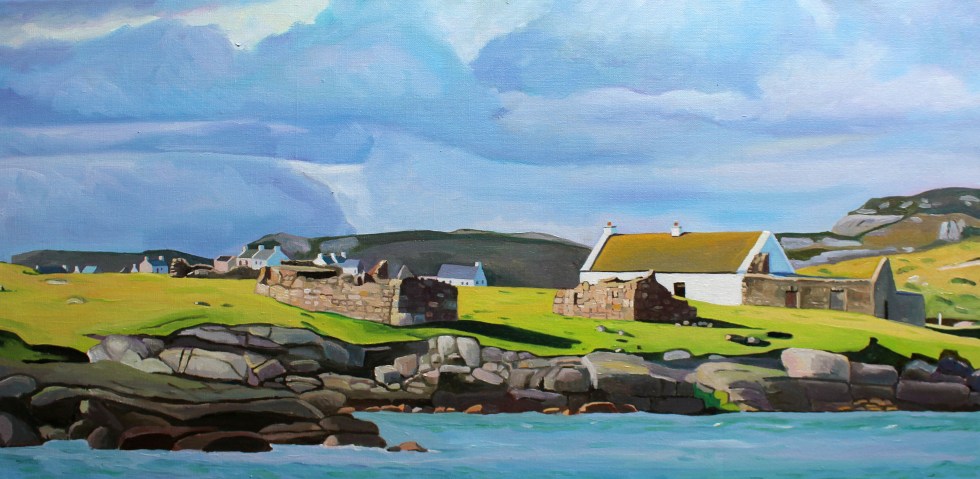
Emma Cownie has made more than 25 paintings of Gola in recent years.

For Traditional Two-storey House, Gola, the painting that made me contact her, she returned to the ‘rules’ she had set for herself a few years earlier. These rules – not coincidentally – coincide with how she wanted to organise her life after the car accident and the difficult time that followed: no cars, no people, bright light.

Furthermore, there must be shadows, preferably diagonal, in simple shapes. The painting must be about the interplay between shadows and man-made constructions, the tension between 3D buildings and 2D shadows.

She also wanted to think longer and better about colour. Not to choose the brightest colour, purely for effect, as she had done before, but to work more subtly. In a new series of works based on the houses on Gola Island, including Traditional Two-storey House, she resisted the urge to make the shadows very dark, the sky pale pink and the grass yellow and bright green. “I tried to keep the shapes and colours as simple as possible without it being a cartoon,” she told me. “I wanted to capture the essence of the place.”

Oil painting of Gola Donegal by Emma Cownie
The Traditional House, (Gola)

She painted the picture in January 2021, during a Covid-19 lockdown in Wales, where she was then living. That summer, she and Séamas moved to Donegal, in the north of Ireland.

It was the following summer, 2022, that she was approached by the prestigious London publishers Faber & Faber: they wanted to use Traditional Two-storey House for the cover of Claire Keegan’s Foster, originally published in 2010.
“I didn’t realise what an honour it was until I got a copy of the book and read it,” she said. “I cried at the end.”

Foster by Claire Keegan, Published by Faber

Is there a writing lesson in this? I don’t know. Maybe that there’s more to everything. Maybe it’s worth following your interests and fascinations without reservation. To notice it – this interests me, this grabs me – and follow that line, see where it takes you.

Posted on 12 Comments

Gola Staycation (2021)

Gola Staycation

Caravans tucked away on coastal inlets and islands are not an unsual sight in Donegal.  I am always impressed by their presence as there are no roads for lorries and it must have taken a good deal of effort and ingenuity to get it there. Getting to have a “Staycation” in 2021 amidst all the uncertainty of vaccine rolls out & third (or is it fourth?) waves looks like it will take an equal amount of effort! So instead join me in imagining the view from the static caravan’s wide window across the rugged terrain of Gola Island on this late spring morning.

Painting of caravan on Gola island, Donegal
Gola Staycation (2021) 100×65 cm

Posted on 23 Comments

Going large! (Scaling up a commission piece)

Commissions are usually pretty interesting because they will challenge me in some way or another. This particular commission’s challenge was about scale. Now, I don’t usually paint large paintings because I just don’t have the space to store many of them. I have a few but I am not keen to paint many more as and I find it difficult to paint in a crowded attic studio, both on a practical level (if you look at my photos carefully you can see its crowded in my studio) and also psychologically (it starts to bug me).  So if a commission requires me to go large I am quite excited by that prospect. Excited and a bit scared.

This commission was based on a relatively modest-sized painting I had recently painted of Gola Island, Donegal. This is 41x33cm, that’s 16 x 13 inches for non-metric people.

Painting of Gola, Donegal

Up from the Pier (Gola)

As you can see from the studio photo, the original fits on the seat of a chair. It is a favourite of mine. I have many favourite paintings, this is my current one.

The commission canvas size was to be 120 x 80cm (47×32 inches). Which is pretty big for my little studio. The canvas I could cope with, but the cardboard box it was arrived in is annoying me as it’s ended up by the railings by the steps to the attic. It’s in my way.

So I pondered the issues with scaling up this painting. The joy of small paintings is that you can hint at all sorts of things with a brushstroke or two and the brain will do the rest of the work. There’s no hiding place when the canvas is over a metre in size.

Painting of Gola, Donegal
Up from the Pier (in-studio)

So the first change in my approach was scale. I printed out my reference photo on a much larger piece of paper. My original photo wasn’t much bigger than 10cm (4 inches) square. Don’t ask me why. I like to print off a lot of images at one time and then ponder which one I want to actually paint. For the commission, the photo was closer to A4 size (7×11 inches) and amazingly, I could see much more detail! So I focused a lot of attention on the buildings and caravan on the horizon. I paint with a small brush get the details of the light on the houses and ruins.

Painting of Gola, Donegal
Sketching out the commission

I generally work from left to right when I am painting so as not to smudge work with my hand and the next part I worked on were the rocks and the grassy verge to the left of the track. The real joy of painting vegetation in Donegal is the many varied greens and yellows. I love picking out the different hues. I have to make sure that my colours match the colours in the reference photo as closely as possible. It sounds daft, but I hold up the paintbrush next to the photo to check I have the right tones.

The grass and bracken in the main part of the painting were carefully reconstructed. Saying that I use much larger brushes than I do for my smaller paintings. I make sure that blocks of yellow ochres and green grass or darker bracken are in the right place. There are both warm and cool greens here. There are splashes and smudges of oranges, pinks, jade and turquoise in there too. I am trying to convey not only colour but the shape of undulating land; where the grass has grown up and in some places, covered completely the old stone walls. The island is covered in lots of wooden fence posts, but I don’t want to paint in all the wires as the eye wouldn’t see them all in that much detail so I pick out just a few of them. I wanted to recreate the spirit of the smaller painting rather than create a new painting so I have to adjust a few patches of grass, on the left-hand side of the painting, so their bluish tones echo the first painting and balance the colours in the whole. The tiny golden yellow flowers that are gathered at the bend in the pinkish track are added.

The sky is painted last. Sometimes I paint skies first, especially if it is a cloudy or stormy sky, but in this case, it’s a blue powdery summer blue and it comes last. It has the effect of bringing the whole painting together.

Painting of Gola, Donegal

The commission next to the study painting of Gola

So the final stage is to sit with the painting and check that it has the same “vibe” as the smaller study painting. I think it has. I regard it as a big beast, but one I like.

I wonder what it would be like to have a massive studio where you could store bigger paintings? Would I paint larger paintings? Well, in the winter when light is short I would still paint smaller works that could be completed relatively quickly, but in the summer months when I have acres of daylight? You bet.

Painting of Gola, Donegal
The artist (*ahem*) with the two paintings
Painting of Gola, Donegal
The Commission piece finished 120x80cm


Posted on 17 Comments

Gola Island – Oileán Ghabhla

Donegal Painting of Gola
Donegal painting of Gola Island
Oileán Ghabhla (Donegal) SOLD

Gola is a Donegal island I painted and thought about long before I set foot on its shores. I have written about it before here. Last month I was fortunate to visit it. The wind had woken me in the night. The early dawn had me awake by 6.30.  I felt so tired and my limbs ached that I drank the last can of caffeinated energy drink that was sitting in our fridge (leftover from the epic drive up north). 

We drove the 40-minute drive from Burtonport to the little harbour at from Magheragallon Pier, Bunbeg.  The final part of our drive was along single-track road across flat grasslands which were home to both a graveyard and a golf course. That sounds grim but there’s plenty of space for both here.

Gweedore from Magheragallon (Machaire Gathlán)
View of Gweedore from Magheragallon (Machaire Gathlán)

It was the most perfect of days. The sun was shining, the sea was sparkling and flat and the sky was a hazy light blue. The sand was very light, but not white. The sea was incredibly clear and on a clear day like this, you could easily see the seabed, giving the sea a beautiful turquoise colour.

Magheragallon Pier
“The Cricket” at Magheragallon Pier (Machaire Gathlán)

The pier is well set up for waiting travelers with benches and a portaloo. We sat on a bench and waited for Sabba the boatman to give to signal to get on board. Seamas, my husband, tells me that Sabba the boatman has been sailing since aged 7. He has a facebook page here where he will post times of sailings and photos.

Fisherman off Gola
Fisherman off Gola

It’s only a 15 minutes crossing. As soon as we set foot on the island, I am struck by the sense of peace here. Most of the sounds you are of nature. Birds singing. Sheep bleating. The wind. That’s it.

Gola
Gola Pier

This is because there are very few motor vehicles here, one or two cars and some tractors.

IMG_2711
A fine red tractor

Gola is in the Donegal Gaeltacht, where many people speak Irish. They are brought up speaking Irish at home and in school. So the signs are in Irish. Some have English translations, but not all did.

In 1911 as many as 169 people lived here but in the 1960s people started leaving as jobs and a better standard of living on the mainland and abroad had a stronger appeal than full-time life on the island. Only a handful of people live here all year round now.

Gola is part of the Gaeltachta - an Irish speaking area of Donegal.
Gola is part of the Gaeltacht

It’s so peaceful. The land is covered vast stretches of long yellow prairie-like grass spotted with rocks and a few sheep and their sturdy lambs. The houses are scattered across the island along tracks.

Boat for Sale on Gola

Some of the houses are modern, others have been renovated and are still lived in during the summer months at least, others are boarded up but many lie ruined, without roofs or reduced to crumbling walls.

Houses on Gola
Houses on Gola
Houses on Gola
Houses on Gola

It was interesting to see the houses on Gola close up after looking across the water at them from Dunmore strand (see painting below). The houses are spaced much further apart than I supposed them to be. I was not satisfied until I had walked all the way to the southern tip of the island, so I could turn and look back at the houses. In this way, I could make sense of what I saw in early spring.

donegal painting of Gola, West Donegal.
Spring Light on Gola

The houses are close but not that close. All of their front doors face southwards, towards the mainland. Mount Errigal and Muckish are off in the distance. I didn’t realise that you could see Muckish this far south. I suppose I have had never been here on such a clear day before.

Gola - View Towards the South West
Gola – View Towards the South West

I tried to take a photo of two camera-shy woolly donkeys in a field. They took exception to my presence and brayed very loudly at me. I got the message and left them in peace. Even the sheep eye you up, they are not used to strangers. They seem to look at you as if they are saying “You are not our farmer, what are you doing here?”.

Donkeys on Gola
Donkeys on Gola – No photos please!
Port an Chruinn
Port an Chruinn
Cottage to Let
Cottage to Let

Gola 2

Houses facing the mainland

On they way back to the boat we pass the infomation centre – an Teach Beag – its a large shed with tables outside. We are hot and I fancy a cup of tea. I try out the one bit of Irish I know on the man behind the counter “Dia duit” (“Hello”) I say. He then says something back to me which I dont understand. That stumps me. Turns out that he just said “Hello” back to me (“Dia is Muire duit”). I need to get a few more phrases/word in Irish under my belt!

This is Paddy Joe, who is 73 years old and still volunteers for the local lifeboat (training and teaching younger volunteers). It is noticeable how fit and active people in Donegal are, especially the men. We talk in English. I love listening to his accent, Irish is his first language. It’s musical. Part Ulster accent, part something else, something almost Scandinavian.  Certainly, of the north. It sort of reminds me of the halting accents of Welsh-speaking farmers in North-Wales, as they seem to trip over their words as they think the right word in English.

Paddy Joe tells a story of going fishing down the Kerry coast and stopping in a pub for a drink. There are Irish speakers there but they do not understand the Irish speakers from Donegal, and the Donegal Irish speakers do not understand them either! I know that its similar in Wales, where Welsh speakers from the North use many different words from those in the West or South.

Some of the few trees on Gola

We decide to catch the 2 o’clock boat back as we have eaten all our sandwiches and the next boat is at 6pm. There is plenty more island to explore on another visit. We haven’t seen the sea arch at Scoilt Ui Dhúgáin, the lake Loch Mhachaire n nGall.

Clear Seas off Gola
Clear Seas off Gola (Bloody Foreland in the distance)

The boat is setting off,  when Sabba spots two girls who came across with us at 11am. He returns to shore to pick them up. They get on the boat looking very relieved. They clearly didn’t fancy waiting until 6pm for the last boat back. The sky is starting to cloud over as we cross and by the time we reach Magheragallon Pier it is overcast.

Donegal painting Gola
A House on Gola SOLD

Read more about Gola Island here