


Please note that this post was written in 2018 and there was a massive rock falls on this section of the Gower coastline in 2019.
I realise now that my Gower Coastal Walk may have been easier if I waited until summer to do it. It was probably because my 2016 attempt ran into the sand that I have become a bit obsessed with getting it done. I also have work-related commitments in May and June that mean that I won’t be able to go walking during the weeks and I may be too tired to do much at the weekend. So what? Well, cold weather and wind is fine – lots of layers and a padded coat with a hood see to that (see illustrative photo to the right).
The mud’s quite different. It can be quite a hazard. My first walks from Limeslade to Brandy Cove, were reasonably mud-free. From Pwll Du onwards, however, mud becomes a frequent peril. It’s just as tiring as sand to walk through but offers the excitement of the possibility of a) slipping and falling on my backside or b) slipping and twisting my ankle. Thankfully, neither of these actually happened. I have taken many photos of my muddy boots. Here’s a selection.


I don’t know why I never see other walkers with mega muddy boots like mine, maybe there are more nimble. Anyway, more of mud and other hazards later.
I’ll start with a lovely mud-free church. St Illytd’s church, Oxwich, is in the most beautiful setting. The first painting I ever sold was of St Illtyd’s Oxwich. Unfortunately, I didn’t keep a decent photo of that painting. St Illtyd’s nestles in the woods by the sea, just short walk from the village of Oxwich. At high tide you can hear the waves just the other side of the graveyard wall. The vicar used to live an rectory even closer to the sea (see Thomas Rothwell’s painting below) but it’s gone now, unfortunately, destroyed by the encroaching tide.

Rothwell, Thomas; “The Old Rectory, Oxwich” (1790)
The very first religious building was built here in the sixth century. St. Illtyd, a native of Brittany, is meant to have built a small cell here. Illtyd is a very significant figure in Celtic Christianity. He is also known as “Illtud Farchog” in Welsh meaning, “Illtud the Knight”.

You may not have heard of this Celtic saint but he was very active on the Gower peninsula and elsewhere in South Wales. Legend connects him to the legendary King Arthur, claiming that he was the King’s cousin and served him as a young soldier. Even if this is not true, it was not unheard of for knights to get up their fighting life for spiritual conflict and enter a monastery. The village of Ilston not far from Oxwich is named after him as well its church. There is also a church dedicated to Sts. Illtyd and Rhydian in the village of Llanrhidian in North Gower. There are churches and schools which bear his name all over South Wales and in his homeland of Brittany.
Illtyd later left Gower and founded a very important monastic school known as “Cor Tewdws”, in Llanilltud Fawr (Llantwit Major) which is further east along the Glamorgan coast. His school is believed to be Britain’s earliest centre of learning. At its height, it had over 1000 pupils and educated many of the great saints of the age, including Saint David, later patron saint of Wales, Gildas the Historian, and Samson of Dol, founder of a monastery on Caldey Island.

The church you see today, however, is not Illtyd’s construction, although the font inside apparently is. Most of this building was rebuilt in the thirteenth century. What is so interesting about the design of the “new” church is the battlemented tower, which looks more suited to a castle that a church. Almost all the churches in Gower have these fortified towers. Many Gower churches, nine to be precise, were owned by a crusading order called the “Knights Hospitallers” but the design has nothing to do with crusading in foreign lands and everything to do with homeland security.

In the 12th and 13th centuries, the Severn Estuary was riddled with pirates. In the 12th century Viking raiders – based in Ireland, the Isle of Man and the Scottish Isles – still ravaged the Irish Sea coasts. Lundy Island, far out in the Channel but within easy reach of the Gower by sea, was a pirate lair during the first half of the 13th century. Raiding vessels could easily send crews ashore to take animals and even people for ransom or slavery. Oxwich church tower, with its battlemented roof, could be used as a look out and as it was built of stone, it they could be used as temporary refuge against robbers long enough for help to arrive.


Oxwich church, then, has a very ancient history and setting which is not as peaceful as it first seems. Its graveyard is also reputed to be haunted by a supernatural beasts known as a “ceffyl dwr” or water horse. The water horse is a horse-like creature, which was apparently been seen walking on its hind legs, and then vanishing down the well c.1894. The first written account of a sighting appeared in Rev. J.D. Davies’s “History of West Gower” where he tells of his elder brother and father seeing the beast one night, after they had been fishing in the bay. In a letter published in the Swansea Evening Post in May 1963, Mr David Lewis George of Cardiff wrote, “I recent years a similar white form was seen gliding over the graves in Oxwich churchyard around midnight by an elderly person of unquestionable integrity “, thus making at least three witnesses who claim to have seen the ghostly apparition of Oxwich churchyard.

We did not see any horse-like creatures on our walk. Once again, I am accompanied by Biddy and Mitzy our dogs and Seamas, my husband. Once we passed the church we are presented with a very long flight of steps cut into the earth.
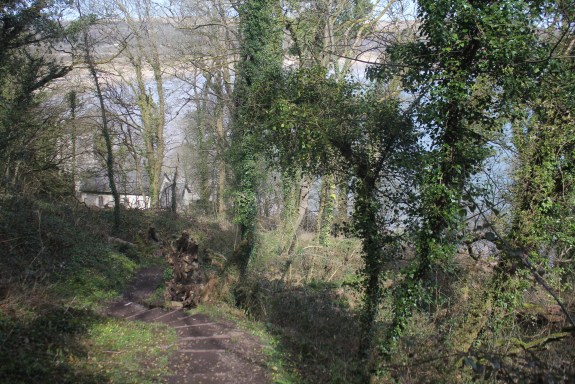
Although tiring to climb, these steps are a godsend to walkers. We follow the path through the wood and then climb a lot of steps back down the hill.

Here among the trees are cliffs. They are not obvious. The trees largely hide them but they are a significant height and there are warning signs. I mentally sniggered at the signs when I first saw them as I thought they were over the top. Turns out they are not. The sun then went in.

Although there are fences along the top of most of the wooded cliffs, not all of them are fenced off. We were passing another family on the path and Biddy, our Collie-cross, walked towards what looked like the continuation of the path downhill. It was no such thing. It was a cliff edge. I don’t know if was my yelling her name at the top of my lungs, or her natural good sense but Biddy, thank God, paused at the edge.

Not all dogs have sense. A friend’s dog was killed when he fell off a cliff in West Wales. Several years ago our dog, Dottie, the wired haired terrier, was killed on the main road near our house in Swansea when she ran away from me. Actually, she was running towards the beach. She had bolted out of the park, disregarding my calls. I tried running after her but she was too quick, I could not catch her and there was no gate on the entrance. She never got to the beach. There was a busy main road was in the way. The incident broke my heart and cast a long shadow. It is still a very painful subject for us.
So, we peered over the edge and thanked God that Biddy had stopped in time. If she had gone over the edge she would have probably been killed. I have watched her behaviour on walks since, and realise now that she probably paused from natural caution. Dottie was never cautious. So with that near miss playing on my mind and later on that night, I kept replaying that moment when I was shouting at her to stop in my head, we carried on along the path.

The path is very muddy. The colour reminds me of chocolate. It is very slippy. This is the sort of place that I worry I will twist my ankle. I don’t; I just get very muddy boots. For a lot of the path it is so thickly wooded the sea is hardly visible. Occasionally there are gaps in the trees and if you were feeling agile and adventurous you could climb down to the rocks by the sea.

Eventually, after a long slippy walk, we leave the trees behind and we have a clear view of Three Cliffs across the bay.

We can also see Devon across the Bristol channel. The headland is rocky. Very rocky.


I read the warning sign with some trepidation. They seem fair warnings. I did see an adder one summer years ago at the top of Tor Bay. He was crossing the path. I just stood back and let him go on his way. He was not interested in us.

Historically, the main hazard around here was to shipping. If you look at the Thomas Rothwell’s 1790 painting of the old rectory again, you can see how rocky Oxwich Bay is along the east side. The headland is even rockier. It not surprising, then, that the coast of Gower has seen something like 250 shipwrecks. Maybe this is due to the high tidal range in the Bristol Channel. More likely it was due to a rocky shoreline and poor weather. Oxwich Bay and Oxwich Point witnessed the floundering and wrecking of something like 15 ships in just under 50 years from 1822-1866. Wreckage from ships that had sunk further along the coast would also be washed upon the sands of the bay.
The path above the headland is relatively easy to walk along here. It is flat and dry.

We stopped for jam sandwiches and biscuits, looking out towards the one-time-home of pirates, Lundy Island. It’s a slither of blue on the horizon.

The sun is long gone and the sky is covered in clouds. There’s a cold wind. I now regret not bringing my woolly hat but take some satisfaction in the fact that I have my warm padded jacket on. Craggy rocks loom above the path to Horton.


The path to Horton is long but reasonably straight forward.


There are a couple of detours around fields. These detours look like they have been here for years.


The final detour involves a long steep climb up a valley called Slade, just by a sandy slither of beach.


By the time we reach Horton the tide is retreating. My parents tell me we came on a family holiday to Horton when I was two years old. I don’t remember it. It must have been a happy holiday because my younger brother came into the world nine months later!


Horton is separated from Port Eynon by a short stretch of sand dunes. Although they are so close they are two very distinct communities. Horton, I suspect is slightly posher than Port Eynon. At its heart are some grand Victorian villas. There are also a series of very beautiful exclusive houses with long zig-zagging steps down to beach. That said a large detached house in Port Eynon can cost as much as £800,000 – £1.1 million (or US $1m -S1.5m). Not exactly cheap.

Yet, it’s all a bit of façade because behind both Horton and Oxwich are a number of vast large parks, full of static caravans. These static caravans cost upwards of £35,995 to buy and you pay site fees of £2-3000 each year on top of that. (that’s about US $50,000 and annual fees of US $3000-4000). These are a bit like American trailer parks but you are not allowed to live in them all year around, they usually close for 4 months over the winter.

The sun is shinning for my next walk from Port Eynon and get up the courage to get on the bus again and even make a connection.


