
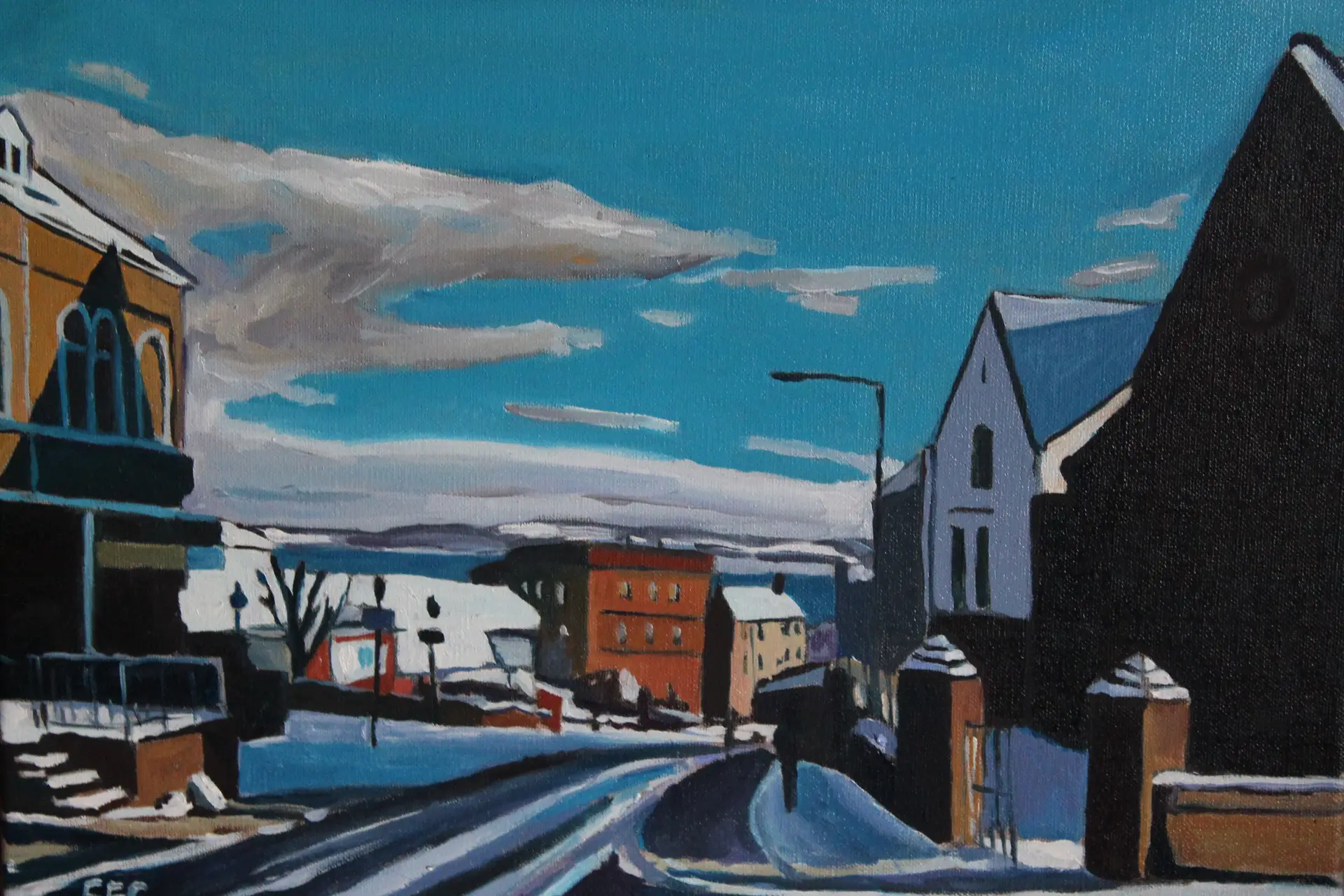
Wishing all everyone a Restful Christmas and a Happy New Year
Thank you for your continued support. I look forward to sharing my new work and thoughts with you all in 2026.

Thank you for your continued support. I look forward to sharing my new work and thoughts with you all in 2026.


Once-upon-a-time I worked full time as a teacher in school of just under 2,000 pupils and I would teach approximately 150 pupils in a day. That’s a lot of faces to put names to every day. I was pretty good at learning all those names too. These days, however, I might only speak to a handful of people in a day; my husband, my neighbour and local shopkeepers. So, when presented with an opportunity to met with and chat with to new people I relish it. Clyne Christmas market gave me a lovely opportunity to talk to all sorts of people.
I am pretty new to running a stall, I did it once about 4 years ago. I really enjoyed it back then but teaching commitments meant that I did not have the energy to keep doing it. That has changed now. I have the energy and the time to pursue this and yesterday I had a stall at the first Clyne Farm Christmas market. I realise that I have a lot to learn.
Clyne Farm sits on top of Clyne Common, high up above Swansea. It has sweeping views towards the sea-side village of Mumbles and across the massive Swansea Bay.
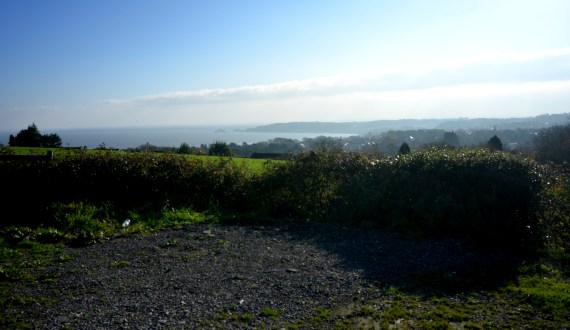
Once upon a time it was a riding stables but in recent times it has transformed itself into an top-class accommodation and activity centre.


Yesterday was their first Christmas Market and we were blessed with sparkling crisp sunshine. The photos above were taken in the first half an hour before it got busy. The crowds ebb and flow. After a quite half an hour, it is quickly jammed with families carrying babies wrapped up to the eyes in jump suits and bobble hats. The little girls are drawn to the “Sparkly Bow” stall further down my aisle. The table covered in glittery objects is exactly the right height to catch a 5-year-old’s attention – at eye-level.
This first onslaught is followed by another wave of families with dogs on leads, and in carried in their arms. There are lots of woolly coated “cockerpoos” (Cocker Spaniels Crossed with Poodles) and some sharp-eyed border collies. They take in everything. Later as people leave for lunch in the other hall, it becomes calmer. People are clutching bags with their purchases. I recognise some people who came around earlier return to buy. It’s in the post-lunch calm that I make most of my sales. I chat with many of the people in the hall. My cards of Mumbles Pier starts a number of conversations about a controversial development of the Pier Head area that the local community (Mumbles Action Group) are currently fighting.

I manage a quick break and visit some of the animals on the farm. I’d met Ted the collie and Flo the goat and her surrogate daughters, the sheep Brillo and Lucy, yesterday.


Along a muddy tack there children’s pony rides on offer. I had to make a special journey along a different muddy path to see Peggy the Pig. She is massive. I give her a pat on her broad back and was surprised that her back was covered in bristles, not wiry hair. Her floppy ears cover her eyes, like nature’s sunshades, but it can’t be easy for her to see. I was told by Sarah who works at Clyne, that Peggy is pretty laid back and is a “morning” pig. She is active in the morning and spends her afternoons sleeping. Someone speculates that she’s a Gloucester Old Spot. I assume that they have only one big spot but looking it up later it seems that they were probably right and she’s an “Old Spot”.

The hall is filled with bright sunshine but by the late afternoon, I’m starting to feel the cold. Although there’s carpet in the hall the concrete floor underneath is cold. I run to my car to fetch my woolly hat. As the afternoon wears on I notice that the tip of my nose is numb! After 5 hours in the hall, my feet are starting to feel like blocks of ice. The girl opposite me is wearing thin daps and ends up sitting on her chair with her feet tucked under her. At four o’clock the sun is low in the sky and someone mentions that there’s Christmas Parade in town at 4pm. That seemed to be the signal for the stall-holders to pack up and within minutes the hall is bustling with activity as the stalls are rapidly dismantled. I drive home with the sun setting over Clyne Common.

What I learnt


I love looking at maps. I have been gazing at the map of coastal path around Gower for days now. The Peninsula juts out westwards into the Bristol Chanel. Its about 17 miles in length and 8 miles width at its widest point. I am planning to walk around its coastline, approximately 38 miles in length, maybe a bit less.
I am, however, going to start with a map of Swansea Bay. People who have never been to Swansea make jokes about the place as if its somewhere to avoid. Quite the opposite. The hilly city sits alongside the sparkling sea and beautiful sandy five-mile beach.

I have decided to illustrate this series of post with my paintings and with (mostly) my own photographs. The paintings have been completed in recent years, some as a result of this trek, other are older. The photos are mostly from 2018 but a few are from my 2016 attempt to walk the Gower coast. I started my first attempt at Mumbles in 2016.

The pretty Victorian village of Mumbles sits at the far end of the western arm of Swansea Bay. This is where my journey around the Gower coast begins.

Mumbles was originally a fishing village. It did not catch fish but rather, oysters. It was, for a time, a thriving industry. Part of Mumbles is known as Oystermouth and many people often use the two names interchangeably to mean the same place.

Many people often associate South Wales with coal mining, and coal was certainly vital in locating the copper industry in nearby Swansea. It was the need for limestone, however, that changed Mumbles’ fortunes. Limestone was used as a fertilizer, in steel making, pharmaceuticals, and also as a construction aggregate (in other words, gravel).

Mumbles was made of limestone and that fact brought the modern world to the front door of this tiny fishing village in 1804 when the Oystermouth railway line was built in order to transport limestone from the quarries of Mumbles to Swansea Docks. This track was the world first passenger line, the Swansea and Mumbles Railway, carrying at first horse-drawn carriages, and later steam locomotives.

The trains also brought many day trippers for a time. The railway is now long gone, closed in 1960, but there remains a sturdy promenade that runs along the sea front where the trains used to run. Locals and visitors alike still love to walk its length and admire the spectacular view across the sweep of Swansea Bay.

The promenade runs up to Verdis, a popular ice-cream parlour and thence to the Mumbles Pier. The Victorian pier was built in the last years of the 19th century and was the last stop for the Railway. Here tourists could catch a paddle steamers for a tour along the River Severn and Bristol Channel. The Pier hosts a great cafe (with self-playing piano), an amusement arcade and tiny art gallery.

On the other side of Mumbles Head is Bracelet Bay. Mumbles Head comprises two tidal islands. At low tide those with stout boots can walk out to the islands and look at the much-photographed lighthouse.


The octagonal lighthouse lighthouse was built in 1794 by Swansea architect William Jernegan, who also designed Singleton Abbey which later became part of Swansea University. This was the second attempt to built a lighthouse here. The first one started a few years earlier, designed by someone else, collapsed before it was even finished!

This is where the real Gower coast walk begins! In my next post I puzzle over myriad bus timetables and eventually feel brave enough to leave the car behind!
In the meantime here’s a cool video of a drone flying around Mumbles Head.
https://youtu.be/MvGQhPzQlKo

UK- See the book on Amazon.co.uk by clicking here.
USA – See the book on Amazon.com by clicking here

I am delighted to say I have been asked by Welsh Coastal Life Magazine to submit some coastal paintings, mostly of the Gower peninsula, to be featured in their magazine. I sent the following images to give a geographical running order, if you like, from Swansea Bay via Mumbles to Gower, to Tenby and up to Morfa Nefyn on the Llyn Peninsula in North Wales.


Delighted to say I have just SOLD this giclee print of “Night Time in the Mumbles” via artgallery.co.uk


Delighted to say I have just SOLD this oil painting, “Hilly Mumbles” via Artfinder
“A Naive painting of Mumble, a seaside village near Swansea in South West Wales” .
https://www.artfinder.com/product/hilly-mumbles/


I am delighted to say I have just SOLD this oil painting “The Allotment by Oystermouth Castle” the next day after uploading onto my Artfinder store!
https://www.artfinder.com/product/the-allotment-by-oystermmouth-castle/
“This is an oil painting of an allotment nestled up beside the magnificent ruins of Oystermouth Castle in Mumbles, near Swansea South West Wales. I loved the transition of buildings, light and trees as one looks through the public park in the distance.”


Delighted to say I have just SOLD “Up Village Lane, Mumbles” via Artfnder, 6 days after uploading it! It is now on it’s way to the USA, a very popular destination for my artwork.
https://www.artfinder.com/product/up-village-lane-mumbles/

A new oil painting as of today, 40 x 40 cm. This oil painting “Up Village Lane, Mumbles” is a naive painting of a rather lovely lane, Village Lane, in Mumbles, near Swansea which crawls up the hill from Swansea Bay.
The lane is a huddle of beautifully coloured cottages, of various pastel shades, which are especially colourful when the sun is out although their assembled ability to cheer the heart on a grey day is always appreciated too.
It is quite difficult to paint the front of Mumbles unless one is on a boat. I photographed this image from further around the arch of Swansea Bay with a telephoto lens.


In a meditative manner, to the music of Eric Satie’s gorgeous “Trois Gymnopedies”, I attempt to describe how working close to nature but in the city is a major influence on my painting, blending with my technique to create my artwork. In fact, place and painting are inseparable. I am greatly influenced by the light and beauty in Wales and around the Swansea area in particular. Most of my paintings inspired by the bountiful beauty that surrounds me, the sounds as well as the images. You might even notice the odd inspiration that made it to be a painting too (as well as the odd painting of my inspirational Swansea). Welcome to my Attic Art Studio and the place and surrounding area that inspires much of my artwork.