Posted on 6 Comments

Above Mussenden Temple

Above Mussenden

There is a unique architectural gem, perched upon the high cliffs above the shores of the north Derry coastline. It is an elegant Roman-style round temple; a beautiful rotunda. It is a wonderful surprise. There is none other in Ireland. It looks out across Lough Foyle to Donegal to the north and on a clear day the Scottish Isles can be seen to the north-east. This remarkable building is Mussenden Temple.

Mussenden Temple from Downhill Strand

It was built by the eccentic and extravagant Earl Bishop of Derry, Frederick Hervey (b.1730-1806). The 18th century is full of mischievious and surprising characters and he’s one of the best. Frederick Hervey was in turns controversial, revolutionary and yet both shocking and popular in his own life time. He came from an aristocratic English family, the 3rd son of an earl with big estates in Suffolk. Having two elder brothers he probably never expected to inherit from his father. He first tried law and then became a vicar hoping for a career in the church. His family connections helped a lot. He became chaplain to the king, George III in 1763, who later called him ‘that wicked prelate’ .

When his eldest brother George became Lord Lieutenant of Ireland in 1766, he managed to wangle the post of Bishop of Cloyne for Frederick and then, shortly afterwards, in 1768, Bishop of Derry, one of the wealthiest Irish sees.

Frederick threw himself into being Bishop of Derry, reportedly visiting every parish in the diocese and embarking on a number of notable building projects in the city of Londonderry including building St Columbs Cathedral’s first spire (it had to be replaced later as it was too heavy) many fine building and the first (wooden) bridge over the River Foyle, earning himself the nickname ‘the Edifying Bishop’.

In 1779 his brother George died and Frederick became the 4th Earl of Bristol, inheriting an income of £20,000 a year. He now even more money. He spent a fortune on building and collecting art.

He was widely travelled and had a fine appreciation of art, especially Greek and Italian. He spent 18 years of his life in Italy and spoke Italian fluently. Frederick was also well-read and he was an expert in flora and fauna and publicised The Giant’s Causeway. The Earl Bishop did extensive research into the origins of the Causeway and promoted his findings to the scientific community and wider world.

He also visited Staffa Island on the Western Isles of Scotland to confirm the links with similar columnar formations. In 1782, he was made a Fellow of the Royal Society for his efforts.

The Earl Bishop was a colourful character and was clearly someone people loved to gossip about. There are many examples of his eccentricity. It is said that he made his clergy run a leapfrog race on Downhill beach to see who would win the best area!

He had an eye for the ladies and was reputed to have had several affairs. Among his mistresses was society beauty Madam Ritz, as well as possibly Emma Hamilton who was also the mistress of Admiral Lord Nelson.

Bramante’s Tempietto, Rome 1502

It was on his tour of Europe that he fell in love with Bramante’s Temple in Rome. He reportedly tried to buy it and have it moved back to Britain but the Pope would not let him. So the Frederick Hervey built his own. Several of them. He built Ballyscullion, near Bellaghy, Co Derry, in 1787 to his own extravagant designs. The façade was inspired by St Peter’s in Rome, and measured 350ft across, with a central rotunda flanked by curved wings and a large pavilion at each end. It sadly, no longer exists.

Ballyscullion House

He also started Ickworth House, in Suffolf in 1795 which was completed by his successors.

Ickworth House, Suffolk, England

His first rotunda, however, was Musseden Temple, built in 1873. It was built as a library on the cliff edge of his estate at Dunbo, County Londonderry, Northern Ireland.  Dunbo derives from the Irish Dún Bó, meaning ‘fort of the cows’. Dunbo was renamed Downhill Demense and an incredible 300,000 trees were planted on the estate; although there is little sign of them today.

A huge castle was built with the assistance of number of architects (Frederick kept firing them) including Michael Shanahan of Cork and Placido Columbani of Milan, who was supervising plumbing and the installation of water closets, a swanky innovation for the time. So we are not entirely sure who designed the rotunda/temple on the cliffs.

Mrs Daniel Mussenden (born Fridiswide Bruce, d.1785)
Unknow French artist c.1780

The temple was dedicated to his lovely young cousin Frideswide Mussenden (neé Bruce) who had recently married the rich banker, Daniel Mussenden, had given birth to a child. The temple was meant to a be delightful retreat for her to escape to and look out at the wonderful view or read some of the many books there. A fire was kept lit at all time to save the books (and her) from the damp Irish weather. Sadly, Frederick’s terrible reputation with women meant that their “friendship” was gossiped about, in the press. The fragile Frideswide was horrified to be written about in the Freeman’sJournal, even if she wasn’t mentioned by name, and it may well have supposedly sent her into a physical decline, dying at the age of tender age of just 22 in 1785.

There is a minature of her in the National Gallery of Ireland painted when she was 17 in 1780, presumably when she had just married Daniel. She has a very sweet and tender face; you can easily imagine her upset at the nasty rumours.

So the library on the cliffs is a poignant place. Built for a young woman who perhaps only used it for a short time before she died. It was always close to the cliff edge, reported 30 foot away when it was built. I think that is an exaggeration, as maps from the early 19th century do not show that much land between the temple and the cliff edge. The cliff has eroded and about 20 years ago the National Trust did extensive work to stablise the cliff and underpin the temple.

OSNI 1831 Downhill
OSNI 1831 Downhill

I am very bad at remembering to take work in progress photos of my work. I often get too caught up in painting the piece. I am also usually very anxious about a painting until I have practically finished it!

This is a painting done with acrylic paints. I work with thin layers of paint, building up the colours and adjusting them, lighter or darker with each new layer. Often I like the painting best when its about a third done – I am confident I know where I am going with it and it still has “potential”.

Work in progress - Mussenden Temple

Here there are still some “problems” to solve, the shadow on the temple needs to be darkened.

Work in Progress 2 - Mussenden Temple
Work in Progress 2 – Mussenden Temple
Above Mussenden Temple_ Painting by Emma Cownie

Frederick Hervey was a fascinating man, who had a long and varied life and I could write a lot more about him.  He was minor celebrity in his day, he travelled widely on the Continent, where he kept company and correspondence with leading philosophers, princes, politicians, scientists, artists, architects and writers—including Voltaire, Goethe, Benjamin Franklin, John Strange, Jeremy Bentham, James Boswell and the Pope. He has been described as “a bad father, and worse husband, a determined deist, [who was] very blasphemous in his conversation”.

Yet he was a generous man who treated the people of Derry well, whether Catholic, Protestant or Non-Conformist (a type of Protestant that was discriminated against by the state at the time). He argued all his life for religious tolerance.


_Earl-Bishop_with_His_Granddaughter_in_Gardens_of_Villa_Borghese_Hugh_Douglas_Hamilton_Circa_1790_National_Gallery_Ireland.
Earl-Bishop with His Granddaughter in Gardens of Villa Borghese c1790 National_Gallery_Ireland.

He believed the answer to the Irish question or the Irish problem of a disaffected Catholic majority is, was not meanness but generosity. Just as God wins our prayers of thanksgiving by His extravagant generosity, so England could learn how to win over Irish Catholics by giving them more, not less. He bankrolled the first Catholic chapel in Derry—Long Tower Church—and personally chose the magnificent Italian marble that adorns the altar.

He undertook public works to relieve poverty, and was a generous patron to the Catholic population of Derry.  

He died in Italy in 1803, trying to recover his art collection that had been conviscated by Napoleon Bonaparte. Hundreds of artists attended his funeral in Rome and he was buried at his ancestral home, Ickworth in Suffolk, where there is an obelisk paid for by public subscription by the Catholics, Presbyterians and Protestants of Derry.

obelisk-memorial-blue-sky-ickworth-suffolk-495470
obelisk memorial, Ickworth House

Find out More  

https://www.nationaltrust.org.uk/visit/northern-ireland/mussenden-temple-and-downhill-demesne

It’s Downhill All the Way

The ‘oral-bishop’: the epicurean theology of Bishop Frederick Hervey, 1730–1803

https://www.earlbishopstrail.com/

https://vipauk.org/enter/muse/ni/i30.html

Click to access EARL-BISHOP-BOOKLET-WR.pdf

Edifying and Eccentric – The Earl Bishop

Posted on 10 Comments

Spring in the Sperrins

Painting of Spring in Sperrins, N.I

The Sperrins or Sperrin Mountains (Irish: Sliabh Speirín) are a mountain range in Northern Ireland. The name Sperrin derives from “Na Speiríní ” meaning “Spurs of Rock” and it is the rocks of the Sperrins and the rolling geography of the area that form the foundation of this distinct landscape.  The mountain range, stretching 40 miles along the border of counties Tyrone and Derry, is the largest in Ireland. There are 10 summits above 500 metres with the highest of the range, Sawel Mountain, peaking at 678m (2,224ft). 

The landscape is mostly moorland and blanket bog. The Sperrins were designated an Area of Outstanding Natural Beauty in 1968. It’s a sparse rolling landscape. These peaks have been smoothed out by glaciers thousands of years ago. Populated by sheep, bog grass (Eriophorum angustifolium) and farmhouse, old and new.

Some old farm buildings have long-been abandoned by people but are still used for farm equipment and shelter for sheep. So long as there is a tin roof, the walls will last years and years.

painting Upper Dreen_Emma Cownie
Upper Dreen_Emma Cownie (SOLD) Recently,

I love the sharp oranges of those tin roofs and I will return to them again and again for inspiration. Broadly speaking, in terms of composition I am looking for three dominant colours; green grass/sky and orange tin roofs. You can see how I simplify these main colours in the painting below.

Farm in the Sperrins, County Tyrone, Ireland
Farm in the Sperrins, County Tyrone, Ireland _Emma Cownie

Drone photography has become widespread in our lives. I remember clearly first seeing drone shots of different American cities in episodes of CSI. They were tracking shots of skyscrapper from directly above. As if you were a bird, flying directly above. They were fascinating. Funny, I cant find a clip to illustrate online now. These days they are used in local and national news and documentaries so frequently I dont think we even register that they are drone shots. They have become part of everyday our visual language.

Recently, I have started to explore the use of drone footage (shot by my husband) to extend the possiblilties of compositions I can paint from. So often, I have thought: “If only I was 20 foot high, I’d get a great shot”. So now I can see from 20 foot above, or round the otherside.

I know that many people think that “real” art is plein air sketching, live and I would need to be in a hot airballon to get these views. I admire people who can do this. I can’t. I am not a plein air painter. I am too much of a control freak. I work slowly in the comfort of my studio with all my paints within arms’ reach, exactly where I want them.

This is the first rainbow I have painted. I was pretty nervous about doing it as rainbows are so beautiful and etheral. They are also fleeting. I am reasonably happy with the result although I would be happier if it was more transulent. If I painted another one I would use more acrylic medium to get a more see through effect.

Rainbow over a Sperrins Farm_Emma Cownie

I can also use drone footage and photography if collectors want a commissioned work with drones offering a novel view of their favourite places! It certainly has helped me become more creative with compositions and has benefitted my work greatly.

(c) James Henry Johnston 2024

Posted on 8 Comments

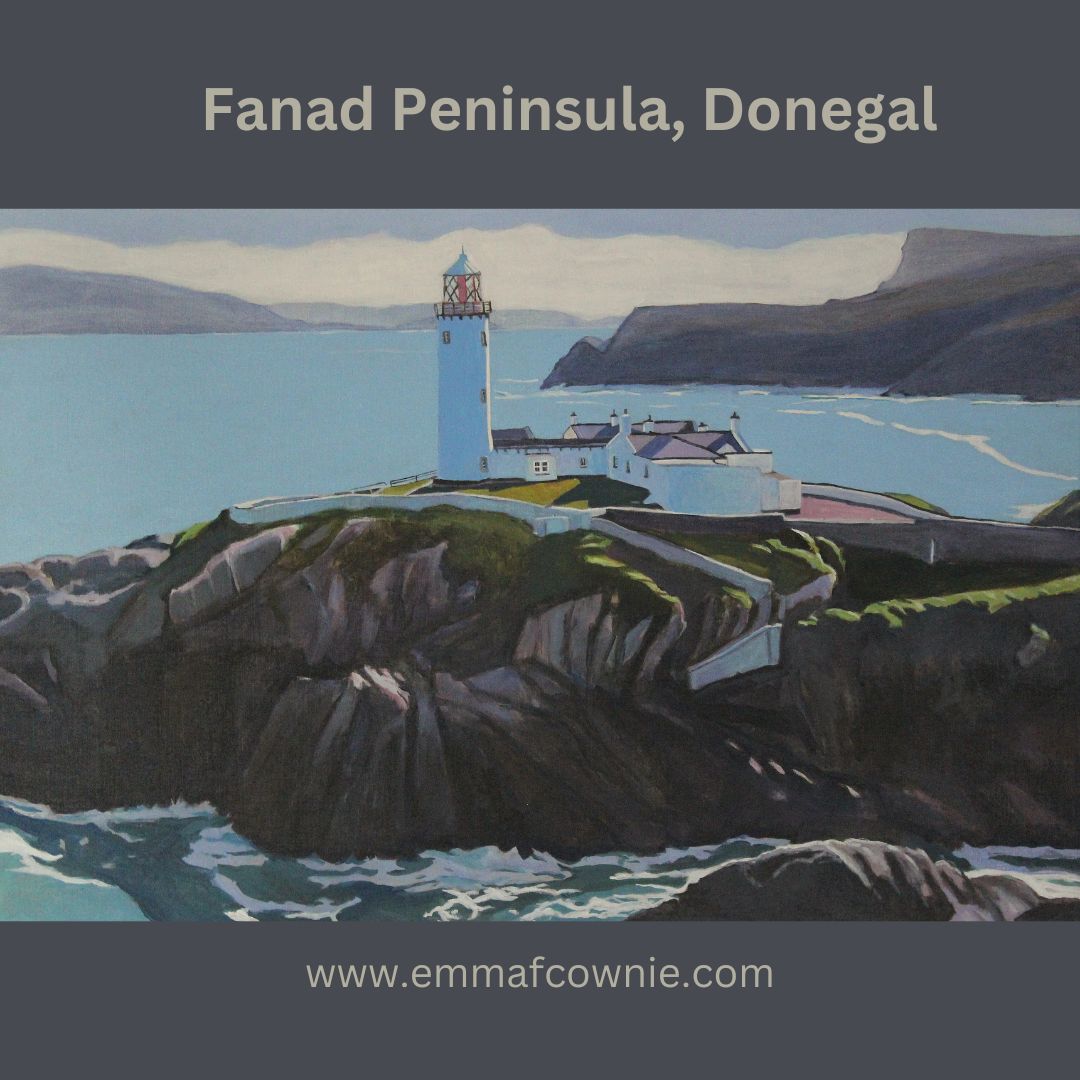
Fanad Peninsula, Donegal

Painting of Fanad Lighthouse by Emma Cownie

Fanad is a finger of land that lies between Lough Swilly and Mulroy Bay on the north coast of County Donegal, Ireland. It is not that easy to get to and the the survival of the Irish language is testiment that relative isolation.

Painting of Lambing season at Fanad Head (Donegal)
Lambing season at Fanad Head (Donegal) SOLD

Fanad Lighhouse (Donegal). Is one of the 12 Great lighthouses of Ireland. It was built in 1886 at Fanad Head (although the station was originally established in 1817). The lighthouse, or more acrrately, the harbour light, marks the entrance into Lough Swilly which forms a natural harbour.

Fanad Lighthouse (Donegal)
Fanad Lighthouse (Donegal) SOLD

I have painted this isolated structure several times before. I have always enjoyed painting the northernly light on Fanad. I have only have painted it in acrylics. That’s not a delibertae choice, more one of circumstance because at times I have had limited space, and I dont want to use oil paints with kittens close at hand.

Over to Fanad Lighhouse (Donegal) _Emma Cownie
Over to Fanad Lighthouse (Donegal) _Emma Cownie SOLD

I think acrylics suit the airiness of the subject matter. After a couple of years working out how to use them, I have settled on a technique of light layers of paint that allow the underlying colour to show through. This can give a transulent quality to the colour. This is in contrast to the relatively flat areas of colous I use for the larger areas of colour such as sky or the sea.

Read more about my use of acrylics here

a painting of Fanad Head and lighthouse
Fanad SOLD

My latest painting was an experiment in composition. We used an image from a drone shot done by my artist husband, Seamas (James Henry Johnson).

In this piece, I wanted to create a sense of space from the mountains of the Inishowen Peninsula in the distance. The distant mountains were layered with bluish white until I got the right impression of distance.

I often find myself looking at the tiny Fanad lighthouse far off in the distance when I am at Lisfannon on the Inishowen Penisula.  There is a sign comemorating a famous Atlantic storm that happened in 1748. this storm threatened to sink The Greyhound, the ship of one John Newton, a slave trader. John was so frightened that he called out to God for mercy. This moment marked a profound spiritual conversion, and many years later he wrote the words for the hymn “Amazing Grace” one of my favourite hymns, and to also campaign for the abolition of slavery.

There is some confusion how many storms there were . One website claims the terrible tempset happened far away out in the Atlantic because it took John Newton another four weeks after his conversion to sail into Lough Swilly and arrive at Derry/Londonderry. The Amazing Grace.ie site however, makes it clear a second storm happened in Lough swilly itself as it quotes John’s journal ” We saw the island of Tory and the next day anchored in Lough Swilly  in Ireland.  This was the 8th day of April, just four weeks after the damage we sustained from the sea.  When we came into this port, our very last victuals was boiling in the pot; and before we had been there two hours, the wind began to blow with great violence.  If we had continued at sea that night in our shattered condition, we must have gone to the bottom.  About this time I began to know that there is a God that hears and answers prayer.” It’s got to be said, that John Newton really took his time putting his evangelical beliefs into action because he went back to being a slave trader for another five years before he eventually retired and became a minister in 1757!

The heaving sea at the foot of the massive lighthouse rock intrigued me. The Atlantic Ocean has such a bulk and stregth, even on a relatively fine day, I am not surprised that John Newton was terrified by its strength far away from the Donegal coast. I wondered about the long and difficult process of building this structure all those years ago in a remote location. Yet, this lighthouse has stood the test of time and proudly marks the entrance to Lough Swilly and can be seen from inland and further along the coast.

Painting of Fanad Lighthouse, donegal by Emma Cownie
The Heaving Sea at the foot of Fanad Lighthouse, Donegal by Emma Cownie

Fand Lighthouse by James Henry Johnston (c) 2024

Turquoise Sea At Fanad Lighthouse

Find out more

Fanad

https://www.ireland.com/en-gb/destinations/regions/fanad-head/

John Newton

http://www.amazinggrace.ie/newton-in-ireland.html

Posted on Leave a comment

My Autumn Newsletter

Painting of ferry at Magheraroarty Pier

Autumn 2023 Page 1

Paintings of Donegal by Emma Cownie

Paintings of Donegal by Emma Cownie

Paintings of Donegal by Emma Cownie

Paintings of Donegal by Emma Cownie

Paintings of Donegal by Emma Cownie

Paintings of Donegal by Emma Cownie

Paintings of Donegal by Emma Cownie
Finally…

Paintings of Donegal by Emma Cownie

Find out more on my website 

Cruit Island in the Autumn light

Posted on 13 Comments

Summer Newsletter

Emma Cownie Newsletter Summer 2022

While many of you are baking in England and dealing with a hosepipe ban, in Donegal it’s cloudy with occasional showers. I thought I would share you my recent newletter. They have ended up being quarterly. It depends of how much news I have and how busy I have been. I always make it strong on the visuals and light on the words! I also make the typeface large for reading on smart phones!

Emma Cownie Newsletter Summer 2022

Emma Cownie Newsletter Summer 2022


Emma Cownie Newsletter Summer 2022


Emma Cownie Newsletter Summer 2022


Read More

More about greyscaling 

Buy Paintings 

Visit our viewing gallery

Commission a landscape painting 

Posted on 12 Comments

“The Quiet Girl” – my painting, the book and the film

The Quiet Girl Curzon Film

No sooner than I arrived in Donegal and made a start on two large paintings than Seamas and I came down with Covid 19.  Apparently the current wave has been mopping up many of the people who  had thus far avoided the horrible virus. I never gave up wearing my mask in shops but I still caught it. Darn! So I have spent most of the last two weeks sleeping and lying in bed trying to do very little, in the hope that my immune system will bounce back and my energy levels will return to normal.

Book Cover - Foster by Claire Keegan
Book Cover – Foster by Claire Keegan


I am also feeling faintly stupid but very delighted  because I only just realised that Claire Keegan’s novella “Foster”, is the basis for the film “The Quiet Girl”.  My oil painting “The Traditional House, Gola”  has been used for the cover of the reprint of “Foster”. Actually, never mind the covid, I nearly fell over when I made the connection.

Oil painting of Gola Donegal by Emma Cownie
My painting – The Traditional House, (Gola)


I must have seen these adverts on TG4 (the Irish language chanel) because I thought of this film by it’s Irish language title  “An Cailín Ciúin” – as just about all the dialogue is in Irish. I didn’t realise that it was the same story as “Foster”.

It’s story about a nine-year-old girl,  Cáit, who is sent to spend the summer with her aunt Eibhlín (Carrie Crowley) and her husband Seán, who live in the Rinn Gaeltacht, County Waterford. The film is directed and written by Colm Bairéad , based on Claire Keegan’s story “Foster”.  It has won a whole pile of International awards, rave reviews and has been breaking box office records in Ireland and UK. I am really excited and greatly honoured to be connected, even in a tenuous way, to such an amazing project!

I am now going back to bed, in the hope that I haven’t over done it.

The Quiet Girl Curzon Film
The Quiet Girl – Curzon Films


More about the film

https://www.theguardian.com/world/2022/jun/12/the-quiet-girl-irish-language-film-box-office-ireland-uk-an-cailin-ciuin

https://en.wikipedia.org/wiki/An_Cail%C3%ADn_Ci%C3%BAin

https://www.theguardian.com/film/2022/may/11/the-quiet-girl-review-beauty-and-pain-in-rural-ireland

https://www.audible.co.uk/pd/Foster-Audiobook/057137350X

Posted on 8 Comments

Shut for a Month

Painting of Port Eynon and Horton from Salt House, Gower
Port Eynon and Horton from Salt House, Gower (A recent commission)


Just a quick notice to say that my shop on this website (www.emmafcownie.com),  and shops on Artfinder.com and  Singulart.com will be closed for a month from today. This is to cope with final packing, tidying up and a million and one things we have to do before leaving Wales as well as the period of self-isolation we have to undergo in Donegal (14 days, possibly less, depending on the results of our PCR tests after day 5).

It’s all exhausting and very nerve racking.

You can still buy my prints on Artmajeur.com. or make an equiry about a commission

Wish us luck!


Posted on 28 Comments

100K!

100K views of www.emmafcownie.com

This week I passed an important blogging milestone. On Tuesday moring I was greeted with the message that my wordpress site had passed 100,000 all-times views!

100,000 views - wow!
Wow!

My husband, Séamas, set up this wordpress site for me over seven years ago. When I took it over full-time in 2015, I had 91 followers, now I have just over 800! Views for my site have steadily been growing but 2020-21 was a bumper year. Stats for my wordpress blog

Breaking my leg last year provoked the most comments by far!

Comments
Comments

I would like to say a great big thank you to every one who visited my website, bought my work, read my blogs and left comments!

It seems that I like animals almost as much as I like Art. Turns out that Wayne  (Barnes) of Tofino Photography is my chattiest follower.  He certainly makes me laugh! He takes wonderful photographs of the incredible wildlife of Western Canada – eagles, bears, wolves, orcas and humming birds! Take a look here.

A Candian bear catching his lunch
A Candian bear catching his lunch: Image  by Wayne Barnes

Thank you to everyone who has visited my website and blog. Whether you have just stopped by to look at my paintings, read my blogs but especially those who “like”, comment and buy my work.  Without you I could not continue to make art.

Painting of view Overlooking Magheroarty
Overlooking Magheroarty

Posted on 12 Comments

Hidden Gems (of St Thomas, Swansea)

Hidden Gems by Emma Cownie

Here is a short series of paintings based on the shadows in a backlane in Swansea.  The photographs I used for these paintings were taken a couple of years ago. I came across them in my folder of printed images and decided I wanted revist my “urban minimal” themes.  The light in St Thomas is quite different to that in Brynmill, where I am at the moment.  I don’t know if its because the sea is closer to this part of Swansea, or because Kilvey Hill  has a particular angle of steepness,  but on a sunny day the light is luminescent.

I particularly wanted to used a glazing medium called liquin, to see if I could add depth to my shadows. I first did an under-painting using red ochre and sepia and then used the medium to add colour to shadows.

Back Lane, St Thomas (2021)

Back Lane, St Thomas (Swansea)(2021)

As I grew in confidence I used more liquin medium to paint the drying washing on the line and shadows on the stone wall.

Hung Out to Dry (St Thomas)_Emma Cownie
Hung Out to Dry (St Thomas, Swansea)

I think the darker shadows were more successful than the lighter ones.

Backlane Basketball painting
Backlane Basketball (Swansea) 2021 

I particularly enjoyed the contrast between the neat house with its clean, fresh drying washing and the apparent ugliness of the rough breeze-block wall in the backlane. This painting is very hard to photograph because of the very light and very dark colours. Some part of it end up too light or too dark! I think I got about right but I am still not happy with the final image. Just a reminder that you need to see a painting in real life to really appreciate it.

Too Dark!

Too Light!

A Soft Breeze (St Thoams, Swansea)
Just right? A Soft Breeze (St Thomas, Swansea) 2021

Read more about my Urban Minimal project

My Painting Project: Urban Minimalism

Posted on 12 Comments

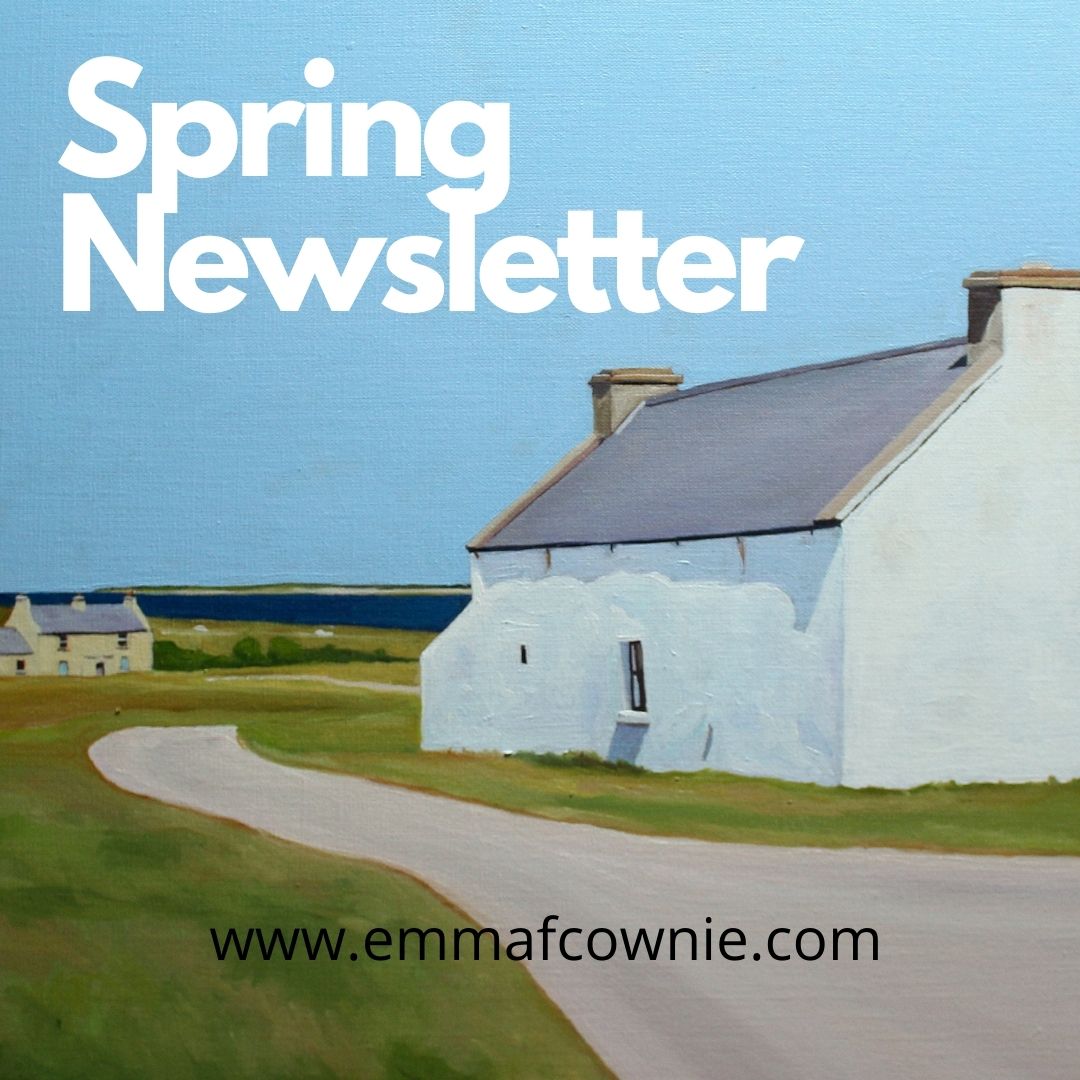
Spring Newsletter 2021

Newsletter Cover

Here’s my spring newsletter which you will see is heavy on the visual and very light on the text!

Spring Newsletter 2021 Page 1
See more Gola paintings 


Spring Newsletter 2021 Page 2
See Large paintings 

Spring Newsletter 2021 Page 2
See  All Recently Sold Work 


See! That was easy to look at. If you wish to get regular (no more than once a month) updates about my work and news about exhibitions sign up here