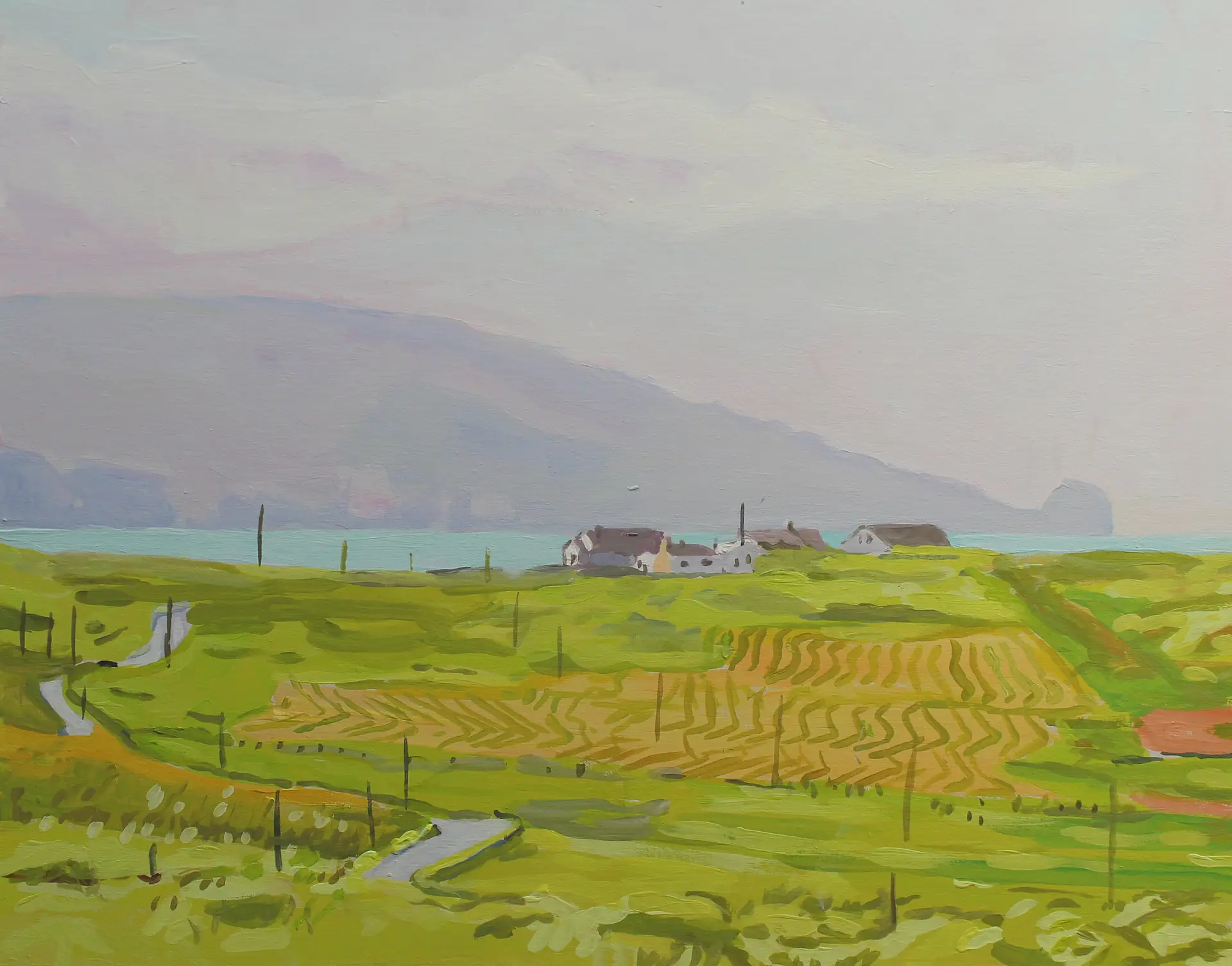
Today is the shortest day of the year. Its very dark up north here. The morning are very dark yet I find it hard to sleep. When the sun appears it illuminates and reveals a verdent but slummering landscape. I am always looking for flashes of red to paint in the deepest winter. In the past it might be a coat, or a door. Today it is a red roof on an old stone cottage. The old houses are disappearing fast here.
This part of Inishowen near Dunaff feels remote. Maybe that’s because we drove through up and through the Urris Hills and Mamore gap to get here. It’s all small long roads like this one. Its tucked away in a north western corner of Inishowen, Malin Head is to the north, close by. I look forward to the days slowing getting longer.
Summer in Donegal is full of light. Even if its damp summer there is still lots of light. The northly latitude sees to that. It only seems to get properly dark for a couple of hours after midnight and dawn comes impossibly soon. So its great for painting and getting out and about but the light is not so interesting for photography or sketching, especially if, like me, you like lots of strong shadows. So my paintings are usually based on images that are captured in the autumn months. Otherwise, mornings and evening are best for interesting colours and shadows.
Autumn Light on Cruit Island, Donegal _ Emma Cownie SOLD
Cruit Island is one of my favourite places in Donegal. It’s rocky and sparsely populated but is accessible by a handy bridge.
Donegal Cottages, Cruit Island _Emma Cownie SOLD
Over Cruit Island by Emma Cownie SOLD
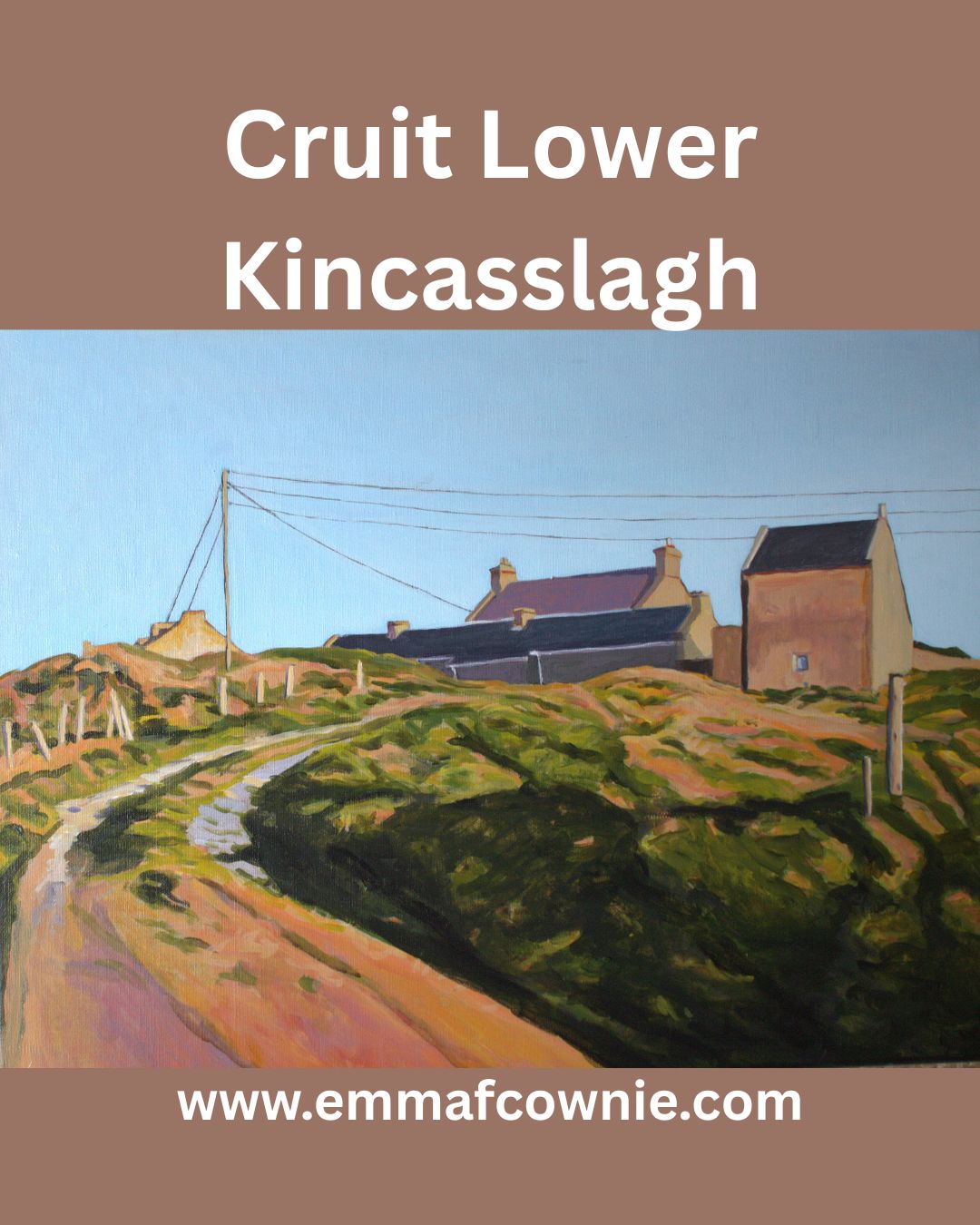
We have driven past the collection of farm buildings at Cruit Lower many times but I only managed to capture an image I liked enough to paint this spring. It was an uncharacteristically warm and sunny run of days this May.
The farm has long fascinated me as you have to drive through it. These through roads through farms are not unusal in rural areas in Ireland (and Wales). Informal tracks through a collection of farm buildings, now divided by tarmac.
Lower Cruit was for sale last year and I had a good look at it online. It was interesting as you can only glimpse some of the buildings from the road. I cant remember how much the asking price was. Getting on for a million Euro, maybe. Way out the reach of a poor artist! You got a lot for that; a collection of beautiful historic buildings (some pre-famine era) and access to a beautiful beach and some really incredible views of the West of Donegal. Here are some of the photos from the website. I dont know who bought it but I really hope they look after the beautiful old buildings.
Cruit Lower From the Air
Cruit Lower with Beach behind
Prefamine house at Cruit Lower
Cruit Lower – the view you cant see from the road!
“Is this a fast painting or a slow one?” My husband asks.
This question gives me pause.
“A fast one” I reply.
Portnoo Colours (Donegal) by Emma Cownie
My paintings usually take days to complete. On average three days. A smaller one quicker. Commissions are still “slow” paintings.
Lately, though I have taken to completing paintings in a single sitting. This may well be several hours, but its a single sitting.
Rocky Ground Bun An Inver by Emma Cownie
The results are more sponanteous-looking. The process feels slightly out of control. Often I think “I have bitten off more than I can chew” here. But I stick with it. Years of painting have taught me to ignore the impulse to give up. To push on, even when when it looks a bit ugly.
There may well be things wrong; colours or details but they dont matter too much. I will alter them if they really bug me. Mostly I dont. The brush strokes are broken and incomplete. In some places they are deliberately rough. The canvas shows through in places. Often I am uncertain if I like the painting when I stop. Its usually a bit of a surprise. I have to fight my perfectionism.
Narin Rise, Donegal by Emma Cownie
I am racing ahead of my thoughts. Ahead of my critical mind that tells me its not good enough and to keep painting. Now I refuse to listen and keep going. It’s intense and exhausting.
Over Cruit Island, Donegal and painting by Emma Cownie
My father died in June this year. He was 92. My heart is broken. He was a lovely, funny and kind man and I miss him terribly.
To Celebrate the New Year I am giving 30% off all work on my website – to get the discount you have to enter a code at the checkout. Where’s the code? Join my email list and it will be sent to you, automatically. The sale ends on 15th January.
View from the Pier (Portnoo)-Emma Cownie SOLD
If you have already joined my mailing list and haven’t had my latest newsletter with the sale code check your SPAM folder.
It’s not until you film yourself painting that you realise just how long a painting takes. I *know* how long they take, usually several days, sometimes longer. Actually seeing the process makes you realise how painstaking and slow the whole process is. Its taken me a while how to work out how to do a timelapse film and its a joy to see the work “fly” along. This is how it feels to me as I am painting (when its going well). Of course, a film can’t capture all the standing back, breaks to change the water, to clean the palette, or just to *look* at the painting. That is a dedicated painting shirt, by the way. There’s a lot of paint on the front of it.
Nellie had been lying on the bed whilst I was painting and came over when I put the palette down. Flossie and Nellie have always taken a great interest in my painting. So much so that I have been reduced to using a small camping stool as they insisted on walking along the back of the chair I used. My water is in a small jam jar with a scew-on lid as Nellie frequently tries to drink the (probably toxic) paint water if I leave it unattended. The palette also has a lid to help keep it damp and keep playful paws away from the paint. They are a large part of the reason I paint in water-based acrylic paints these days instead of oils.
Have you seen this Apple advert? Take a moment to watch it. It makes my blood run cold. Surprisingly the tech bros at Apple thought it was a good idea to show this advert which depicts a tower of creative tools and analog items (like paint, trumpets and record players), being crushed into the form of the iPad. It’s a pretty grim vision of the future. It a good visual metaphor for what is happening to creatives right now.
This year has been the toughest year I have experienced as an artist, for a myriad of reasons, and the art market seems to be struggling generally. Yes there’s war in Ukraine and the Middle East (and elsewhere in the world) and “the Cost of Living Crisis” and terrible cold and wet weather in the British Isles hasn’t helped either.
It seems evident that it’s more difficult getting my work seen. I cant help but think that AI and the “enshitification of the internet” is at least partly responsible. I feel a bit like I am being slowly crushed by the Apple crusher. It’s sapping my creative juices. I don’t quite know what to do about it. Cory Doctorow explains how enshittification works “It’s a three-stage process: first, platforms are good to their users. Then they abuse their users to make things better for their business customers. Finally, they abuse those business customers to claw back all the value for themselves. Then, there is a fourth stage: they die.”
This is probably the reason why I can’t find any useful results on google – lots of top ranking website are full of AI nonsense. It’s also why fewer people are seeing my work on the internet. My posts are pretty much hidden on Facebook, Instagram and invisible on X. Images of my paintings do not show up on Google as much as they did say 3 or even 6 months ago. Many other artists report a similar decline in interest from potential customers.
I have started to visit my local library again in search of real books with in- depth facts. The only decent thing on Google these days is Wikipedia. I find that Youtube playlists are so random as to be useless and a search on Pinterest results in either pins I have seen before (in other words I have already saved them) or one unrelated to the search term I just used. Tech companies are burning up the planet with their massive data centres in the hope that one of them will “win” the AI battle and then charge us all for what used to be better quality and free.
What’s this got to do with you? Everything. Doctorow says that enshittification is coming for all industries. “From Mercedes effectively renting you your accelerator pedal by the month to Internet of Things dishwashers that lock you into proprietary dish soap, enshittification is metastasising into every corner of our lives. Software doesn’t eat the world, it just enshittifies it.” Think about your printer – a new printer is cheap as chips but the ink costs a fortune and you cant use non-proprietary ink and your printer will know, and refuse to work.
Corry Doctorow’s big hope is that “Stein’s Law will take hold: anything that can’t go on forever will eventually stop…if everyone is threatened by enshittification, then everyone has a stake in disenshittification.” Actually, there’s a lot more to it than that. You’ll have to read his articles to find out what USA and EU are planning to do to break the monopolies of the big tech comapnies.
I just hope that independent artists like me survive the process or else everyone will have to console themselves with souless AI-derived art their ipad/smartphone/tablet device instead.
See below for some scary examples of AI “Art”. It’s a nonsense view of Derry if you didn’t know.
“Painting of Derry City by Emma Cownie” – Thanks AI. I can give up now. NOT.
Just in case some of you are saying. It’s Londonderry not Derry. AI is no better at conjuring up a view of Londonderry. Take a look! Although there is a river this time.
“Painting of Londonderry City by Emma Cownie”
How about Three Cliffs Bay? I have painted that many times. Sure AI will do better at ripping me off. Well, no.
Painting of Three Cliff Bay by Emma Cownie – Yes, it looks NOTHING like Three Cliffs Bay
Yes, we can laugh at AI’s efforts and say they look nothing like those places or my paintings but it’s all doing damage. AI can never replace human creativity. AI cannot suffer and struggle like humans. It just produces a wierd pastiche of the thing it is meant to be. It’s expensive rubbish. It’s costing us dearly. Emissions from data centers of the likes of Google, Microsoft, Meta and Apple may be 7.62 times higher than they let on.
We can reverse the enshittification of the internet. Don’t accept those tracking cookies. Try a different search engine. Stay on the website rather than downloading apps (you can use ad blockers on the website you can’t on the app). Don’t buy everything via Amazon if you can buy it in a real life shop.
We can halt the creeping enshittification of every digital device. Put down your phone/tablet and read a book or look at a painting made by a real human being. Join artists’ mailing lists so you can still follow their work no matter what the big platforms do to hide their work.
Oh, did I mention I have a 20% off sale on? Starting Sunday until Monday 14th. You have to join my mailing list for the code 20% code but you can unsubscribe at any time.
Here is the painting that finished me off. Now I look at it after a month, I am not sure why. I just felt like I had run into the sand and needed a change. I had been doing a lot of reading about composition but I suspect it had more to do with taking too long to paint. Acrylic paint often requires several layers to achieve the opacity of oil paint. I was getting bored and tired and I wanted to try something new. A change is a good as a rest.
Toralaydan Island, West Donegal
So I took a month off posting new work on facebook & instagram, to give myself head space. Some artists love being filmed live and showing their “process” – I am not like that. I get very self conscious and often will immediately screw up a painting if I take photos too early in its development. It’s one of the reasons I cannot bear to paint outside “en plein air” – people understandably want to see what you are painting and that makes me feel very self-conscious. I really dont know how people go on TV shows like “Landscape Artist of the Year” and produce really good paintings, or half-way decent paintings at all, in fact. They must have nerves of steel. I don’t. In fact, I know that many of my paintings can go through stages of looking quite rubbish before they (almost always) emerge butterfly-like from the murk and layers. It’s a lovely (and sadly rare) experience when a painting look interesting/beautiful all they way through the process of coming into being.
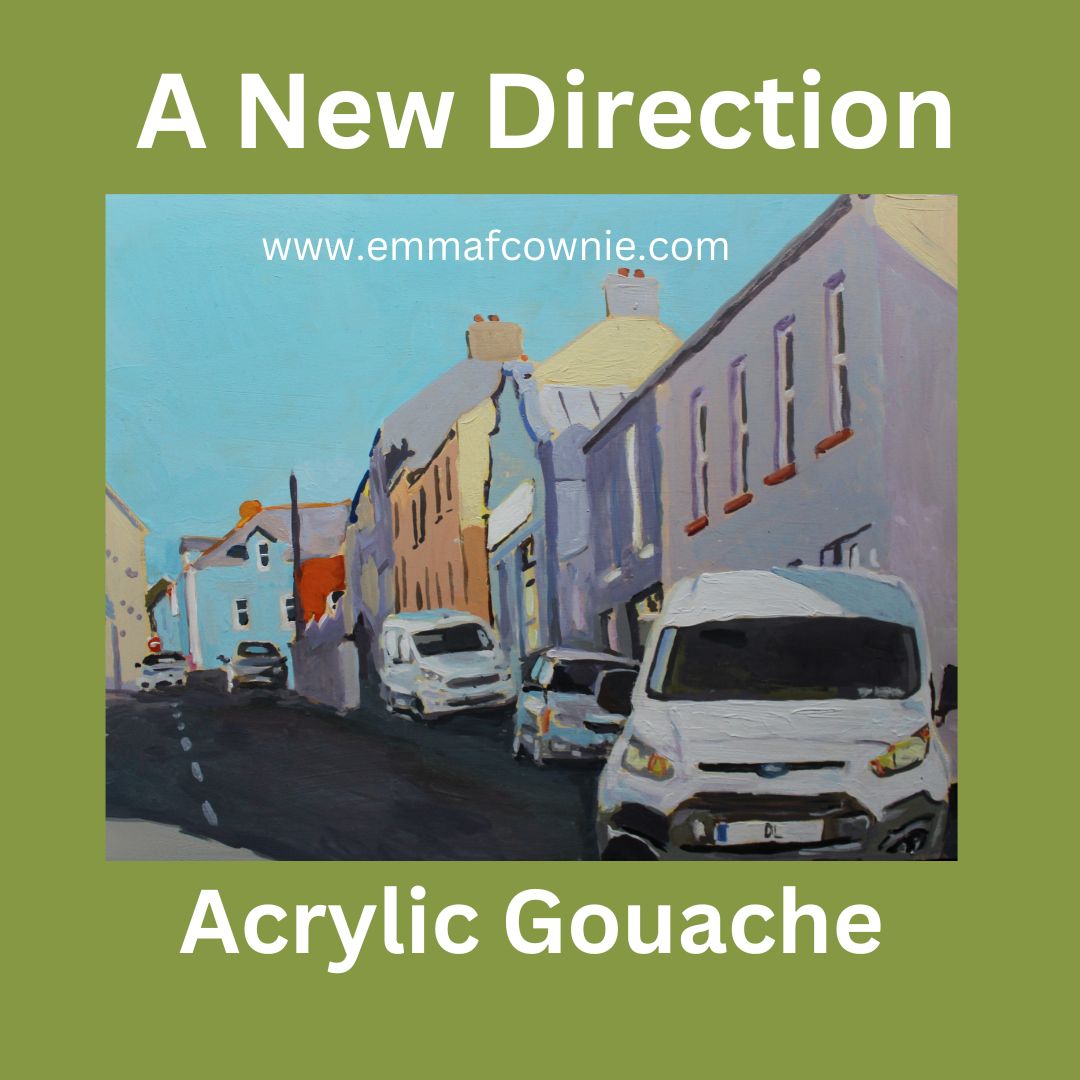
I had bought some tubes of Acrylic Gouache in the spring but had not got around to trying them out. Now I opened that box of paints and gave them my full attention. I had been looking for a water-based paint, to reduce the risk to my pets, especially my young inqusitive cats. I had had oil paint/white-spirit incidents with pets in the past when we had a lot more space and I did not want to take that risk now. I also wanted opaque paint. I had discovered that some American artists, whose work I liked, used Nova acrylics which is pretty opaque but they did not have a UK stockist. I was cautious about importing paints from the US as I once ordered a load of paint from a sale from JerrysArtsarama only to get stung by customs and VAT charges. So any saving I had made in the sale were wiped out! I also considered Golden SO FLAT matte acrylic paint but I am not a great fan of Golden colours. Dont get me wrong, some of their acrylic colours are great (light ultramarine for example) and I know many artists rave about them, but I don’t LOVE them. They were also sold in a jar rather than a tube, and I could just see me absent-mindedly sticking my dirty paint brush in a jar and mucking up the colour. I prefer tubes that I can squeeze a tiny bit of paint out onto my wet palette and keep my colours clean.
Not the set I bought – I wish!
I saw that Jacksons Art stocked Turner Acryl from Japan. I watched a couple of videos comparing different makes of Acrylic Gouache and liked the vibrancy of Turner’s paint. There is not a lot of information about acrylic gouache, unlike regular acrylic (I have several books on the technical aspects of using this acrylic). I keep reading the same thing – its a cross between gouache and acrylic. Gouache is a water-based paint which can be opaque (unlike water colours which are usually transculent) and it can be reactivated with water. Acrylic gouache, however, once dry, sets like acrylic and cannot be reactivated with water. It dries pretty quickly too. It dries to a smooth velvety matt finish too. It is used by illustrators, especially anime.
An example of anime art from Instagram from @happy.artistry
Look at the lovely rich colours!
The colours are lovely but I have a lot to learn. There are so many wonderful rich colours and I can see why these [paints are popular with illustrators. Unlike acrylics or gouache, there is little to no colour shift. It is non-toxic. It does not dry lighter or darker. I am finding this hard to get used too. I am overcautious about laying down darker colours. I have to learn this again and again. I often dont make my paintings dark enough as I am afraid the strong colour of the tarmac road will overwelm the painting. I have to repaint the shadows.
I feel out of control with it at times. Sometimes that is exciting, others just scary.
Winter Morning on Academy Road, Derry – Acrylic Gouache on wood Panel 2024 – An early effort
I painted a load of duff pieces before I started to feel I was getting somewhere with “Ardara”.
Ardara – Acrylic Gouache on Wood Panel 2024 – Another early effort
I felt that a new medium required new subject matter to set it apart from the rural scenes I had focused on since moving to Ireland in 2021. My work had previously described by Niall McMonagle in the Irish Independent as a “Clear bright glimpse of a vanishing Ireland”. I wanted to mix things up and paint a more contemporary version of everyday Irish life.
This meant scenes with cars. The Irish love their cars. I have painted cars in the past but not for a very long time. It was usually at night or in the rain (at night) so you could not really see them properly.
My Pop Art – The Driving Rain (SOLD) Oil on Linen Canvas, 2015
Coming out of Shell, Oil on Linen canvas (SOLD) 2020
It was in 2017 that I decided to pursue “Urban Minimalism” for my “Hollowed community” project for the MadeinRoath festival in Cardiff. For a long time, I have sought out empty scenes with no cars or people. It found it cleansing. The Morris Minor (below) was one of few exception to this. This vintage car was parked around the corner from our home in Brynmill. I used to hear the owner drive past our house on the way to the paper shop every morning.
Urban Minimal style – Morris Minor 2018 Oil on Linen Canvas (SOLD)
Now I decided on a volte face and to seek out street scenes with cars to challenge myself. Car are difficult to paint. I know some people will disagree with me, but in themsleves, they are not intrinsically beautiful, although the light reflected on their surfaces can be. I am more a fan of vintage cars like the Morris Minor and old-style minis (genuinely small cars) and enjoy the colours used by Italian manufacturers such as Fiat 500s. Too many cars in Ireland are black or grey. They don’t make for interesting compositions. Surprisingly, Lorries do. In the right place.
Deliveries on Queen Street, Derry – Acrylic Gouache on wood panel 2024
I wanted to paint with speed. I was bored of spending days or even weeks on a large painting. I wanted to work fast keep things fresh. I tried hard to resist overpainting. I left wobbly lines where possible so as to convey some of the energy of the urban areas.
Derry is a very lively city. I also wanted to explore town/city life on both sides of the border in Donegal and Derry, in Northern Ireland. The building stock is very different depending on which side of the border you are. The number plates maybe different but the cars are pretty similar.
Bogside, Derry – Acrylic Gouache on wood panel 2024
Light and shadows continue to be a theme in my work.
Carn (Donegal) – Acrylic Gouache on wood panel 2024
I have found this both challenging and exciting. I have produced quite a few paintings that didn’t work, especially at the start but I just pushed on. I knew that there would be a lot of wastage at the start. The only way I would get the hang of this medium was by painting a lot. I learn through my hands, mixing the paint and then placing the paint on the board. I have not yet achieved the consistency in my work I am used to with oils and acrylics.
I also had to deal with the fear that people might not like this style of paintings or the subject matter. That’s why I had to stay off social media until I felt like I knew what I was doing (sort of). I have shifted styles and subject matter before. There are themes I have focused on before and I am revisiting them. Others are constant – shadow and light. Strong dynamic compositions are also important.
I used to alternate larger landscapes with smaller people/animal paintings. This way I kept my interest in what I was painting. But I seem to get stuck painting landscapes when I came to Ireland. I am not sure it was good for me as an artist. I need to mix things up to keep them fresh. I don’t know where I am going with this but I feel I need to persue this trail for a while longer. I just have to keep going to see where I end up.
I am delighted that Peter Zantingh, a Dutch blogger, wrote this an account of Gola and my work. I have translated it for you to read (well, Google did). You can read the original here.
“In the autumn of 2018, Emma Cownie looked out from the Irish mainland at an island she could not get to. It seemed so close. She could see the rocks off the coast and beyond them, scattered seemingly at random across the rolling land, the whitewashed cottages. Some were abandoned, others clearly still inhabited, or used as summer homes.
Gola Island is one of 365 islands off the Irish coast. It is just two square kilometres in size. No one knows exactly how many people live there, because there are more in the summer than in the winter. Ferryman Sabba only goes up and down between June and September.
But in 2022, there were fifteen people living on Gola, according to official figures.
Emma Cownie is a British artist. She studied medieval history at Cardiff University and taught at a secondary school for a while. On 29 February 2012, she was hit by a car. It was, in retrospect, what prompted her to take up painting full-time. The days in front of the class were exhausting, almost all contact with other people in fact, she was startled by every sudden sound. A few years before the accident her dog had been run over on a busy road.
Painting helped.
In the days after she had stood on the mainland looking at those houses in the distance she painted Spring Light on Gola. It came, she told me, ‘out of a kind of longing for the island’.
In the spring she went again. It was early April, sunny but chilly, a cold wind blowing along the coast. Her husband Séamas was with her, their dog Mitzy too. To get the best view of the island – again there was no ferry – they walked along long stretches of beach and climbed on granite boulders, almost pink in the spring light. From here she could see the houses that had recently been renovated and modernised.
That summer she was finally able to go there. ‘There are hardly any cars’, she told me about it. ‘Just a few tractors, no telephone poles or electricity pylons and only a few other people. Other than that, just birdsong and wind. It’s bliss.’
Spring Light on Gola (Sold)
*I emailed Emma Cownie last month with a simple question. One of her paintings was used on the cover of one of my favorite books, Foster by Claire Keegan. I wanted to discuss that book in my newsletter, and I would like to show that painting as well. Would that be okay? I would mention her name and link to her website.
She responded the same day, and we got to talking. She said that the painting I had asked about was called Traditional Two Storey House, Gola, and that it was nice to hear from someone from the Netherlands, because although she regularly sees Dutch campers in Donegal, the county in the northwest of Ireland where she lives part of the time, she has never sold work to anyone from the Netherlands.
The title of the painting made me curious. Gola? What was that? That’s how I became fascinated with the island in my own way.
At one time, there were about two hundred people living there, who made a living from fishing and small farms. But after 1930, the population began to decline. Especially in the winter, it was easier to earn money in the cities, especially those of Scotland and England, and fewer and fewer people returned for the summers. In 1966, the island’s school closed; with only nine pupils (there used to be sixty), it no longer had a right to exist. The few families with young children were forced to move to the mainland – and once the last family with children had left, the community was doomed.
I read this last in Gola: The Life and Last Days of an Island Community (1969) by F.H. Aalen and H. Brody, which I ordered for a few euros on boekwinkeltjes.nl or Abebooks. I think I mainly wanted to know what happened when the last ones left. How does a group of people dissolve itself?
Brody, a sociologist who wrote the part about the last days of the community by the two authors, saw a kind of laconic group feeling among those who were still there at the end of the sixties. Everyone wanted to stay, if the rest stayed too. Everyone thought it was okay to go, as long as everyone else went too.
The most intriguing aspect of each islander’s account of his own predicament is his insistence that it all depends on the others. […] The general attitude is one of wait and see – what the others do. But all of the Gola people are waiting on one another in this way, and do not seem to mind the impasse that this conditional planning involves. Of ten islanders who related their plans, nine said they would like to stay, but it depended on the others. One man said he would stay so long as he had a dog with him, and could not see any advantage to life away from the island. Apart from that one man, all stated they would be glad to remain on Gola, but did not really mind leaving.
The authors also contributed to a short documentary for the Irish public broadcaster RTÉ from the same year, which shows how one family, the O’Donnells, leaves the island. They lock the door and walk with their dog, a long-haired collie, to a motor boat in the harbor. They are all wearing black. (Screenshots from the film below)
Five people remained: fisherman Eddie, fisherman Tadhg, postman Nora and her husband John, and ninety-year-old Mary. It would not be long for them either.
What was left behind? The island had no shop, no pub, not even a church. “The islanders worship on the mainland when the weather is good enough to make a safe crossing,” Brody wrote in 1969. Just over thirty houses remained, most in poor condition. The schoolhouse and the post office. Wooden boxes and fishing nets in the harbour, where a statue of the Virgin Mary, housed in a stone shrine, continued to look out. Two pegs on a washing line.
Between 1969 and 2002, Gola was an uninhabited island. In Dances With Waves: around Ireland by Kajak (1998), Brian Wilson (not the Beach Boys guy, another Brian Wilson) writes about the time he went ashore during his nearly two-thousand-mile kayak trip all the way around Ireland. He hoped to find some peace and shelter that day, but he encountered “the eerie atmosphere of a ghost town”. Fishing boats lay rotting in the harbour among the washed-up debris.
But he found something more hopeful in the cottages. They were “abandoned, but not in decay”.
[…] one felt as though, like faithful dogs, they were just waiting for their owners to return. More than that, it was as if the island itself was still waiting. And the people came again. They came back. Somewhere around the turn of the millennium, the first ones crossed. Today, most of the cottages are still uninhabited, but in summer the sounds and movements of people join those of the cormorants, guillemots and gannets.
Emma Cownie has made more than 25 paintings of Gola in recent years.
For Traditional Two-storey House, Gola, the painting that made me contact her, she returned to the ‘rules’ she had set for herself a few years earlier. These rules – not coincidentally – coincide with how she wanted to organise her life after the car accident and the difficult time that followed: no cars, no people, bright light.
Furthermore, there must be shadows, preferably diagonal, in simple shapes. The painting must be about the interplay between shadows and man-made constructions, the tension between 3D buildings and 2D shadows.
She also wanted to think longer and better about colour. Not to choose the brightest colour, purely for effect, as she had done before, but to work more subtly. In a new series of works based on the houses on Gola Island, including Traditional Two-storey House, she resisted the urge to make the shadows very dark, the sky pale pink and the grass yellow and bright green. “I tried to keep the shapes and colours as simple as possible without it being a cartoon,” she told me. “I wanted to capture the essence of the place.”
The Traditional House, (Gola)
She painted the picture in January 2021, during a Covid-19 lockdown in Wales, where she was then living. That summer, she and Séamas moved to Donegal, in the north of Ireland.
It was the following summer, 2022, that she was approached by the prestigious London publishers Faber & Faber: they wanted to use Traditional Two-storey House for the cover of Claire Keegan’s Foster, originally published in 2010. “I didn’t realise what an honour it was until I got a copy of the book and read it,” she said. “I cried at the end.”
Foster by Claire Keegan, Published by Faber
Is there a writing lesson in this? I don’t know. Maybe that there’s more to everything. Maybe it’s worth following your interests and fascinations without reservation. To notice it – this interests me, this grabs me – and follow that line, see where it takes you.
We have been exploring Malin Head a fair bit recently. I really enjoy it’s wildness and dramatic beauty. It’s one of those rare places that is quiet. By quiet, I mean a lack of human busyness. There’s plenty of nature noise like the wind, the hissing of the grasses and leaves as they are blown.This has to be one of the most exposed spots in Ireland.
There is good scattering of robust cottages and relatively few cars. The narrow, winding roads mean that they are not pelting by. Its the quiet and still I hunger for – even when its blowing a gale! The fresh air here is like a refreshing drink of water.
Here are two new Malin Head paintings. The first is “Midsummer at Malin Head” which is a sturdy cottage surrounded by vigorous growths of monbretia. We are a bit early for its distinctive firey orange flowers – the come out from July to September.
The second painting is John’s Cottage, Malin Head (photography with permission of John Gallagher). John was born in the cottage but he now lives with his family (and dog) in a neighbouring cottage a stone’s throw from here.
In the distance are the Urris Hills, also on the Inishowen Peninsula. We spent two days last autumn there, looking for my husband Séamas’s drone crashed on Croaghcarragh (a peak between Urris Hills and Mamore with Mamore Gap in between) after he flew it backward into the mountainside! I spent a longtime waiting for him as various spots on the mountain, looking out towards Dunduff, Clonmany and Malin. The view was magnificent in that direction too. The howling gale that threatened to blow us off the mountain was pretty sobering. Fortunately, the drone was found and it still worked after a night out in the wilds. DJI make pretty tough little drones!