Posted on 1 Comment

Gola; The Island that waits patiently for people to return

Gola

I am delighted that Peter Zantingh, a Dutch blogger, wrote this an account of Gola and my work. I have translated it for you to read (well, Google did). You can read the original here.

“In the autumn of 2018, Emma Cownie looked out from the Irish mainland at an island she could not get to. It seemed so close. She could see the rocks off the coast and beyond them, scattered seemingly at random across the rolling land, the whitewashed cottages. Some were abandoned, others clearly still inhabited, or used as summer homes.

Gola Island is one of 365 islands off the Irish coast. It is just two square kilometres in size. No one knows exactly how many people live there, because there are more in the summer than in the winter. Ferryman Sabba only goes up and down between June and September.

But in 2022, there were fifteen people living on Gola, according to official figures.

Emma Cownie is a British artist. She studied medieval history at Cardiff University and taught at a secondary school for a while. On 29 February 2012, she was hit by a car. It was, in retrospect, what prompted her to take up painting full-time. The days in front of the class were exhausting, almost all contact with other people in fact, she was startled by every sudden sound. A few years before the accident her dog had been run over on a busy road.

Painting helped.

In the days after she had stood on the mainland looking at those houses in the distance she painted Spring Light on Gola. It came, she told me, ‘out of a kind of longing for the island’.

In the spring she went again. It was early April, sunny but chilly, a cold wind blowing along the coast. Her husband Séamas was with her, their dog Mitzy too. To get the best view of the island – again there was no ferry – they walked along long stretches of beach and climbed on granite boulders, almost pink in the spring light. From here she could see the houses that had recently been renovated and modernised.

That summer she was finally able to go there. ‘There are hardly any cars’, she told me about it. ‘Just a few tractors, no telephone poles or electricity pylons and only a few other people. Other than that, just birdsong and wind. It’s bliss.’

donegal painting of Gola, West Donegal, Emma Cownie.
Spring Light on Gola (Sold)

*I emailed Emma Cownie last month with a simple question. One of her paintings was used on the cover of one of my favorite books, Foster by Claire Keegan. I wanted to discuss that book in my newsletter, and I would like to show that painting as well. Would that be okay? I would mention her name and link to her website.

She responded the same day, and we got to talking. She said that the painting I had asked about was called Traditional Two Storey House, Gola, and that it was nice to hear from someone from the Netherlands, because although she regularly sees Dutch campers in Donegal, the county in the northwest of Ireland where she lives part of the time, she has never sold work to anyone from the Netherlands.

The title of the painting made me curious. Gola? What was that? That’s how I became fascinated with the island in my own way.

At one time, there were about two hundred people living there, who made a living from fishing and small farms. But after 1930, the population began to decline. Especially in the winter, it was easier to earn money in the cities, especially those of Scotland and England, and fewer and fewer people returned for the summers. In 1966, the island’s school closed; with only nine pupils (there used to be sixty), it no longer had a right to exist. The few families with young children were forced to move to the mainland – and once the last family with children had left, the community was doomed.

I read this last in Gola: The Life and Last Days of an Island Community (1969) by F.H. Aalen and H. Brody, which I ordered for a few euros on boekwinkeltjes.nl or Abebooks. I think I mainly wanted to know what happened when the last ones left. How does a group of people dissolve itself?

Gola: The Life and Last Days of an Island Community (1969) by F.H. Aalen and H. Brody,

Brody, a sociologist who wrote the part about the last days of the community by the two authors, saw a kind of laconic group feeling among those who were still there at the end of the sixties. Everyone wanted to stay, if the rest stayed too. Everyone thought it was okay to go, as long as everyone else went too.

The most intriguing aspect of each islander’s account of his own predicament is his insistence that it all depends on the others. […] The general attitude is one of wait and see – what the others do. But all of the Gola people are waiting on one another in this way, and do not seem to mind the impasse that this conditional planning involves. Of ten islanders who related their plans, nine said they would like to stay, but it depended on the others. One man said he would stay so long as he had a dog with him, and could not see any advantage to life away from the island. Apart from that one man, all stated they would be glad to remain on Gola, but did not really mind leaving.

The authors also contributed to a short documentary for the Irish public broadcaster RTÉ from the same year, which shows how one family, the O’Donnells, leaves the island. They lock the door and walk with their dog, a long-haired collie, to a motor boat in the harbor. They are all wearing black. (Screenshots from the film below)

Five people remained: fisherman Eddie, fisherman Tadhg, postman Nora and her husband John, and ninety-year-old Mary. It would not be long for them either.

What was left behind? The island had no shop, no pub, not even a church. “The islanders worship on the mainland when the weather is good enough to make a safe crossing,” Brody wrote in 1969. Just over thirty houses remained, most in poor condition. The schoolhouse and the post office. Wooden boxes and fishing nets in the harbour, where a statue of the Virgin Mary, housed in a stone shrine, continued to look out. Two pegs on a washing line.

Between 1969 and 2002, Gola was an uninhabited island. In Dances With Waves: around Ireland by Kajak (1998), Brian Wilson (not the Beach Boys guy, another Brian Wilson) writes about the time he went ashore during his nearly two-thousand-mile kayak trip all the way around Ireland. He hoped to find some peace and shelter that day, but he encountered “the eerie atmosphere of a ghost town”. Fishing boats lay rotting in the harbour among the washed-up debris.

But he found something more hopeful in the cottages. They were “abandoned, but not in decay”.

[…] one felt as though, like faithful dogs, they were just waiting for their owners to return. More than that, it was as if the island itself was still waiting. And the people came again. They came back. Somewhere around the turn of the millennium, the first ones crossed. Today, most of the cottages are still uninhabited, but in summer the sounds and movements of people join those of the cormorants, guillemots and gannets.

Emma Cownie has made more than 25 paintings of Gola in recent years.

For Traditional Two-storey House, Gola, the painting that made me contact her, she returned to the ‘rules’ she had set for herself a few years earlier. These rules – not coincidentally – coincide with how she wanted to organise her life after the car accident and the difficult time that followed: no cars, no people, bright light.

Furthermore, there must be shadows, preferably diagonal, in simple shapes. The painting must be about the interplay between shadows and man-made constructions, the tension between 3D buildings and 2D shadows.

She also wanted to think longer and better about colour. Not to choose the brightest colour, purely for effect, as she had done before, but to work more subtly. In a new series of works based on the houses on Gola Island, including Traditional Two-storey House, she resisted the urge to make the shadows very dark, the sky pale pink and the grass yellow and bright green. “I tried to keep the shapes and colours as simple as possible without it being a cartoon,” she told me. “I wanted to capture the essence of the place.”

Oil painting of Gola Donegal by Emma Cownie
The Traditional House, (Gola)

She painted the picture in January 2021, during a Covid-19 lockdown in Wales, where she was then living. That summer, she and Séamas moved to Donegal, in the north of Ireland.

It was the following summer, 2022, that she was approached by the prestigious London publishers Faber & Faber: they wanted to use Traditional Two-storey House for the cover of Claire Keegan’s Foster, originally published in 2010.
“I didn’t realise what an honour it was until I got a copy of the book and read it,” she said. “I cried at the end.”

Foster by Claire Keegan, Published by Faber

Is there a writing lesson in this? I don’t know. Maybe that there’s more to everything. Maybe it’s worth following your interests and fascinations without reservation. To notice it – this interests me, this grabs me – and follow that line, see where it takes you.

Posted on 7 Comments

Two new Malin Head paintings

Malin Paintings by Emma Cownie

We have been exploring Malin Head a fair bit recently. I really enjoy it’s wildness and dramatic beauty. It’s one of those rare places that is quiet. By quiet, I mean a lack of human busyness. There’s plenty of nature noise like the wind, the hissing of the grasses and leaves as they are blown.This has to be one of the most exposed spots in Ireland.

There is good scattering of robust cottages and relatively few cars. The narrow, winding roads mean that they are not pelting by. Its the quiet and still I hunger for – even when its blowing a gale! The fresh air here is like a refreshing drink of water.

Here are two new Malin Head paintings. The first is “Midsummer at Malin Head” which is a sturdy cottage surrounded by vigorous growths of monbretia. We are a bit early for its distinctive firey orange flowers – the come out from July to September.

The second painting is John’s Cottage, Malin Head (photography with permission of John Gallagher). John was born in the cottage but he now lives with his family (and dog) in a neighbouring cottage a stone’s throw from here.

In the distance are the Urris Hills, also on the Inishowen Peninsula. We spent two days last autumn there, looking for my husband Séamas’s drone crashed on Croaghcarragh (a peak between Urris Hills and Mamore with Mamore Gap in between) after he flew it backward into the mountainside! I spent a longtime waiting for him as various spots on the mountain, looking out towards Dunduff, Clonmany and Malin. The view was magnificent in that direction too. The howling gale that threatened to blow us off the mountain was pretty sobering. Fortunately, the drone was found and it still worked after a night out in the wilds. DJI make pretty tough little drones!

Summer Post-Script

For those who cannot not make it to West Donegal, here’s a brief video of my viewing gallery all set up by Séamas.

Summer 2024

If you are thinking of visiting here’s a google map of our location

More Information on Inishowen

https://www.themountainguide.co.uk/ireland/inishowen

Posted on 6 Comments

Mizen Head to Malin Head in 8 Days

This is a postscript to my post earlier this month about Malin Head. It was a beautiful sunny day there today. Summer has arrived in Donegal. Who know how long it will last so everyone was out!

I met brothers Harry and Kit (Dr) Lawrence just after they had laboured up the steep hill to Malin Head Tower on their bikes, laughing as they finished.

“We have just finished a thousand km cycle ride from Mizen Head!” Annouced Harry to no one in particular and anyone who could hear.

“Congratulations” we said and I shook their hands (me and some motorcyclist tourists).

The brothers had taken just 8 days to ride from Mizen Head in Cork to Malin Head today. I told them about Sophie Powers who had done it in 4 days with very little sleep. They had had sleep and no back up team. Just two panniers with their spare clothes in. They were not expert cyclists. Kit proudly told me that he’d bought his bike on Gumtree for £100 last month. It was clearly a massive bargain as it did the job very well indeed. They raised over £2000 for the Samaritans. I couldn’t have done that in 80 days never mind 8 days! Well done!

Just arrived at Malin Head

Posted on 13 Comments

Summer on Three Cliffs Bay

Three Cliffs Bay in Summer bay Emma Cownie

Three Cliffs Bay never disappointed. It did not matter how many times I saw it. The sight of it always caused me to catch my breath; when I saw it from the road, from the slopes of Cefn Bryn or from Pennard Cliffs.

It is one of the things I miss about living in South Wales. I imagine it in sunshine, although I am pretty sure the Summer in Wales this years has been as poor as it has been in Ireland. It may well improve. Septembers were often best for sunshine. Just as the schools had gone back!

Emma Cownie with Gower painting
Here’s me posing with the painting! – Sunny Morning Haze on Three Cliffs Bay (Gower)

I used to get up early in the morning and drive down to Pennard to walk along the edge of the golf course, past the dog walkers, to see the sea and take photos. This is a new painting (see above).

Once I found an excellent parking spot opposite the corner shop in Pennard, only to find I had forgotten to put the battery in my camera. I wasn’t carrying a spare. So, I had to drive all the way back to Swansea to fetch the battery. The journey seemed to take forever (as I cursed my stupidity all the waythere and back) but when I got back the conditions were still lovely.

It was low tide and you could see the river, the Pennard Pill, at its meandering best. When you first come to Three Cliffs you assume you can easily cross the Pill in your bare feet. You can at the shoreline but it get deeper quite quickly. There are stepping stones further up stream. In boot-wearing weather, its a short walk inland to cross at the stones. My painting (see below) Two Rock, Three Cliffs is near to the stepping stones.

Here is my other new Gower painting.

Read about my 2018 walk along the Gower Coastal Path here

Posted on 5 Comments

At the edge of the world – Malin Head, Donegal.

Star of the BBC Shipping Forecast

The name will be familar to British ears who ever listened to the daily shipping forecast on BBC Radio. It is broadcast late at night just before 1 am and very early (5.20am). Anyone who is a night owl or insominiac will have listened to it. The list of shipping zones and forecasts is not only practical but also poetic and rather mysterious. Following the litany of locations and numbers is very soporistic. Listen to the clip below. The actual broadcast is from 2.46 onwards ZZzzzzzzzzz

Shipping Forcast (1993) – almost always broadcast on the radio, you have to use your imagination!

Many British people may not know where Malin Head it is anymore than than they know the location of German Bight or Viking. To Irish ears, however, it is well-known as the most northerly tip of the island of Ireland and also features on Met Eireann’s, sea area forecast, broadcast on RTE.

800px-UK_shipping_forecast_zones
UK_shipping_forecast_zones

Malin Head to Mizen Head

People regularly tranverse the length of Ireland from Malin Head, Donegal, to Mizen Head, Cork. It’s a fair stretch. Just under 400 miles (640 km). Some incredible people have cycled it in just over 15 hours. Ordinary mortals take about 4 days.

Amazingly some super-human runners have done it in about the same time – 4 days! I recently listened to a radio interview with the heroic Sophie Power. Sophie is from England and she recently ran the length of Ireland in under 4 days. This is a World Record. She beat the previouis record by three hours. Being a mother, she had to fit it in during her children half-term holiday and didn’t get to pick the day with the nicest weather – just the Tuesday of half-term and so she started off in driving rain! Many years ago I used to run (only piddly 10ks and 5ks) and I would certainly prefer to run in rain than heat.

Incredibly Sophie ran most of the distance without sleep, snatching the odd half an hour on her second and third day. She ended up hallucinating, and with a knee injury that had to be braced. When she finished the race in Cork she had developed heat stroke! That alone shows you how far south Cork is. There’s no way she’d get heat stroke in Donegal! She’s planning to come back and run the Cork Marathon.

Sophie Power at Malin Head

At the Edge of the world

Standing at Malin Head is like standing at the edge of the world. To the north is nothing can be seen but sky and sea. A long way off is Iceland and much. much further away to the north-west is North America. It feels very remote (but surprisngly accessible from Letterkenny and Derry/Londonderry) but to fishermen and sailors, I’m sure it’s not. Scotland is surpisingly close to the north-east. If you have ever flown from England to Belfast on a clear day, you can see the Scottish Isles and the Isle of Man scattered across the Irish Sea, pretty close the Antrim coast. Donegal is just a bit further along.

Map of Inishowen, Donegal from c.1790
Painting of Crashing Waves At Malin Head"
Crashing Waves At Malin Head, Inishowen, Donegal – Emma Cownie

Lookout on Malin Head

On the most northerly tip of the island of Ireland, you will find a tower that was built in 1805 during the Napoleonic wars as a lookout tower to defend against any attacks by the French. You can see at the top left hand side of my painting above. Edges of places are places to look out from – for invaders, or for incoming storms. Weather reports that were important to local and international shipping were first recorded at Malin Head in 1870. It was in that year the tower became a signal tower for Lloyds of London. Semaphore was used to connect with ships at sea and the lighthouse on nearby Inishtrahull. In 1902 the first commercial wireless message was sent from Malin Head to the S.S.Lake Ontario by the Marconi Company.


Divers’ magnet

There are the wrecks of many ships lying off the coast in this area. Many of these such as SS Audacious, SS Carthaginian and RMS Justicia date to the time of the First World War, when Ireland was still part of the British Empire.

In 1917 two German mines sank Laurentic and although her crew successfully abandoned ship, but 354 of them died of hypothermia in her lifeboats.Interestingly, Laurentic was carrying about 43 tons of gold bars when she sank. Most of the 3,211 bars were salvaged by 1924; three more bars were found in the 1930s, however 22 gold bars have still not been recovered.

The Great Emergency/Second World War

During the Second World War, Ireland was neutral. The Irish army built lookout posts in places along the coast to prevent any violation of this neutrality. This was important as this part of Donegal is so close to Northern Ireland, which not not neutral and was bombed by the Germans. There is an EIRE 80 sign built of stones during the war so aircraft would know that they were over Ireland (not Northern Ireland). They acted also as a navigational aid for pilots. Eire 79 is at Fanad Head to the west. Eire 81 is at Glengad Head, further along the Inishowen Peninsula, to the east. You can see it on the map below. The SS Athenia, a passenger ship carrying 1,418 people was torpedoed by a German U-boat just hours after war had been declared in 1939 off the coast of Malin Head! Most of the passengers survived but 117 perished.

Tourism Sign at Malin Head

Some scenes from the film Star Wars: The Last Jedi film was shot at Malin Head. I have to admit that I am not a Star Wars fan – I never made it through awhole film. I have to admit that I’m more of a Star Trek fan. Apparently, it is possible to have a tour of the locations used for the film from local tour guides. The road leading up to Bamba’s Crown has been renamed locally from the R242 to the R2D2 in recognition of the Star Wars connection. Also beside the tower, there is a short lovely refreshing walk along the cliffs to Hell’s Hole. The cliffs are massive here and even on a relatively calm day the sea is restless and a bit intimidating It needs to be remembered that this not just a sea here but an Ocean.

Birds Eye View of Malin Head, Donegal- Emma Cownie

Read more

https://www.inishview.com/activity/the-tower

https://www.authenticvacations.com/star-wars-filming-locations-ireland

https://www.odohertyheritage.org/maps

Posted on 19 Comments

How artists (and bloggers) can survive the “google apocalypse”

Google Logo

The Rise of AI

We all want to be seen. I want people to see my work. I also want people to see the process behind that work (have you listened to my recent radio interview yet?) I also want to maybe inspire and/or encourage people to undertake their own creative journey. There are bumps in the road, however. Making a living in the creative industries is difficult and uncertain at the best of times.

I recently wrote about how Generative AI was scraping/stealing artists’ copyrighted without permission or recompense. Its not clear how the rise of AI will change things. It has already been disruptive for many of those in the media industry. The protective tools such as “Glaze” are only short-term fixes, if you can get them to work. But that disruption may also create opportunities for some – its hard to tell.

Many people aren’t very interested in AI but wonder why they can’t get speak to a human in customer services but only an online bot.

Walled Gardens

A Walled Garden – 2013 SOLD

As an artist who sells much of their work directly, I am reliant on the internet to get my work “out there” to as many people as possible. For many years I have used social media sites like Instagram, Facebook, Twitter/X, Pinterest in addition to my own website (with blog) as well as a mailing list. I have posted my work on a handful of online Galleries, Artfinder,in particular. To be honest, I don’t know what works.

I used to assume that everything did a bit of something. Lately its become apparent that some are doing very little indeed. A couple of years ago my instagram posts used to regularly get over a thousand likes, these days I am lucky to get over two hundred. I have pretty much given up on Twitter/X now from lack of engagement. I am wondering whether Facebook is worth the effort too. Since the arrival of TikTok in 2026, the short form video has been given priority by “the algoritim”. Not great news for camera-shy artists, like me.

What is apparent, is that social media sites are like walled gardens, where leaving is discouraged. Posts with external links are downgraded by the site and search algorithims. Facebook and Instagram are both owned by Meta. These walled gardens can and do change their rules for who get seen and who doesn’t.

A rather dated illustration of “Walled gardens”

“Enshitification” (Or – Its all going to Hell in a hardcart)

This is something that what Cory Doctorow calls the “Enshitification” of the internet. He points out that “Once upon a time, Facebook and Twitter showed you stuff from your friends and followers; now you get a torrent of things that the platform’s algorithms think might increase your “engagement”. Doctorow says “First,” he writes, “they are good to their users; then they abuse their users to make things better for their business customers; finally, they abuse those business customers to claw back all the value for themselves.” You do this by offering “free” services (Google, Facebook, Twitter, YouTube, Instagram), or loss-making reduced prices (Amazon). Then once you’ve got them locked in, you turn them into a captive market for your real customers – advertisers and vendors. And once you’ve got them locked in then you’re in a seller’s market – and have a licence to print money.

Twitter/X and Facebook have made it harder and hard to post and see external links to websites and publications. Many users have left the site. Opinions and comments used to be reinforced by reptutable publications. Partly as a result of this policy many online publications that people used to link to in their twitter posts have seen a big drop in traffic.

The Death of Google

The rise of AI is another threat to the stablility of online ecosystem. The death of Google has been predicted for many years now (at least since 2018). Google dominates internet search results so much that for many people it is the internet. These days, however, your Google search is likely to be swamped in link-farms, clickbait, long-form articles with thousands of words that ultimately say nothing, those weird ads about cars/fridges/hots tubs being “practically given away”. In fact, tons and tons of ads.

AI Overviews

In order to try and weed out some of the spammy stuff, Google recently introduced something called AI Overviews. maybe you have noticed it. Maybe not. The tech company unleashed a makeover of its search engine in mid-May that frequently provides AI-generated summaries on top of search results – it used to use Wikipedia for its summary with a list of links below. That was uncontroversial.

Google’s new AI Overviews saves you the effort of clicking on links by using generative AI to provide summaries of the search results. So if you want to know how to make cheese stick on your pizza – it will save you the bother of clicking on a receipe site. Google want to be the search and answer engine. However, when someone asked Google to suggest what to do if cheese is not sticking to pizza, it claimed that its AI suggested adding non-toxic glue to it! This was based on an 11-year-old comment from a forum site called Reddit that has recently done a deal to allow AI to train on content.

AI can’t tell fact from fiction, or from jokes or sarcasm. This is causing big problems for AI – a response to a advise on depression included “Jump of the Golden Gate Bridge”!

AI’s Advice on identifying edible wild mushooms was worryingly vague, emphasising looking for those with solid white flesh — which many potentially deadly puffball mimics also have. It has been said that “pharmaceutical companies aren’t allowed to release drugs that are harmful. Nor are car companies. But so far, tech companies have largely been allowed to do what they like Google is now making “more than a dozen technical improvements” to its artificial intelligence systems!  It is important that Google maintains user trust. Other browsers are available. I have started to use one called Brave, there is also DuckDuckGo, Firefox and Microsoft Edge.

Google Zero – what does it mean for the artist blogger?

Google’s summaries are designed to get people authoritative answers to the information they’re looking for as quickly as possible without having to click through a ranked list of website links. This desire for Google to become a search and answer engine is called “Google Zero” by Nilay Patel, editor-in-chief of the Verge Magazine.; when Google Search simply stops sending traffic outside of its search engine to third-party websites. That possibly means my website, or your blog. Independent review sites have been feeling the effects of the changes.

There’s a review website called House Fresh, who review air purifiers that they have personally tested (instead of recycling PR puff from the manufacturers). Since 2023, they have seen their reviews ripped off by bigger websites and web traffic to their own site decimated. The teething problems of Google Overview may see it being ditched by Google. They have a track record of ditching apps that were’t immediately successful – you can read a long list of them here. Remember Google Street View? Gone. Google Hangout? Not Really. Google My Business? Yes. That’s gone too.

What to do?

So whilst Google Overview maybe gone very soon, AI wont be going anywhere soon. Too much money has been spent on it. The big tech companies are desperate to keep ahead in the innovation race. They are also desperate for web-domination, regardless of the collateral damage. Yes, that maybe your amazing following on Youtube, Facebook, TikTok that gradually loses traction.

Artists may follow the latest advice to make reels, or stories (how many daft videos on Instagram reels have I seen of an artist turning around to “reveal” their latest work) and it may work for a while. All these innovations are designed to please the “algorithim”. Not the audience. Certainly not the artist. The goal posts keep moving. Once it was stories we had to make, then reels. What next? It’s exhausting. It’s a bottomless pit that sucks in a lot of your creative energy. I am an artist and I want to paint. Not perform.

The moral of the story is don’t build your house on someone else’s land. I have known this for sometime. Several years ago, Facebook unexpectedly deleted my Emma Cownie Artist page without warning. I set up a new one (two actually, one also to link to my Instagram account) but the follower numbers have never come close to the numbers or engagement of the original page. The waters closed in pretty easily.

I redoubled my efforts with my own website (with this blog) and a mailing list and my website numbers and views have steadily grown. You have to build an audience.

I looked at a blog I wrote in 2019 when I first started my mailing list and most of the suggestions I included (but not necessarily followed) still look good to me. There is a lot of cross over with my blog on this website but its not identical.

I write high-quality, carefully researched content. I write about my new work, sales and the inspiration behind my paintings i.e. the local history of the the places I paint and the process of painting – including technical stuff to do with colour, composition.

I write about the process of creativity.

I also write about the inspiration provided by other artists. I know its a cliche but I am on a “journey” but I am keen to explain what is informing that journey. Why I paint in a certain way and not another? It’s vital to keep supporters/fans engaged to maintain their relationship with you and your business. It’s all about adding value to their lives.

Apocalypse Now?

Not necessarily. So it seems that the best advice is don’t panic. Keep on keeping on and build those ladders over the walls in the walled gardens into your own garden!

Join my Mailing List Here

Find Out More about Issues discussed in this blog

https://emmafcownie.com/2024/04/07/ai-and-artwhat-you-need-to-know/

https://www.theguardian.com/commentisfree/2023/mar/11/users-advertisers-we-are-all-trapped-in-the-enshittification-of-the-internet

https://www.cjr.org/the_media_today/google_ai_summaries_publishers_fears.php?ref=biztoc.com

https://www.pbs.org/newshour/politics/google-makes-fixes-to-ai-generated-search-summaries-after-outlandish-answers-went-viral

https://theconversation.com/eat-a-rock-a-day-put-glue-on-your-pizza-how-googles-ai-is-losing-touch-with-reality-230953

https://www.theverge.com/2024/5/31/24168605/google-search-api-leak-openai-media-vergecast

https://www.theverge.com/2024/5/30/24168344/google-defends-ai-overviews-search-results

How Google is killing independent sites like ours – https://housefresh.com/david-vs-digital-goliaths/

Posted on 14 Comments

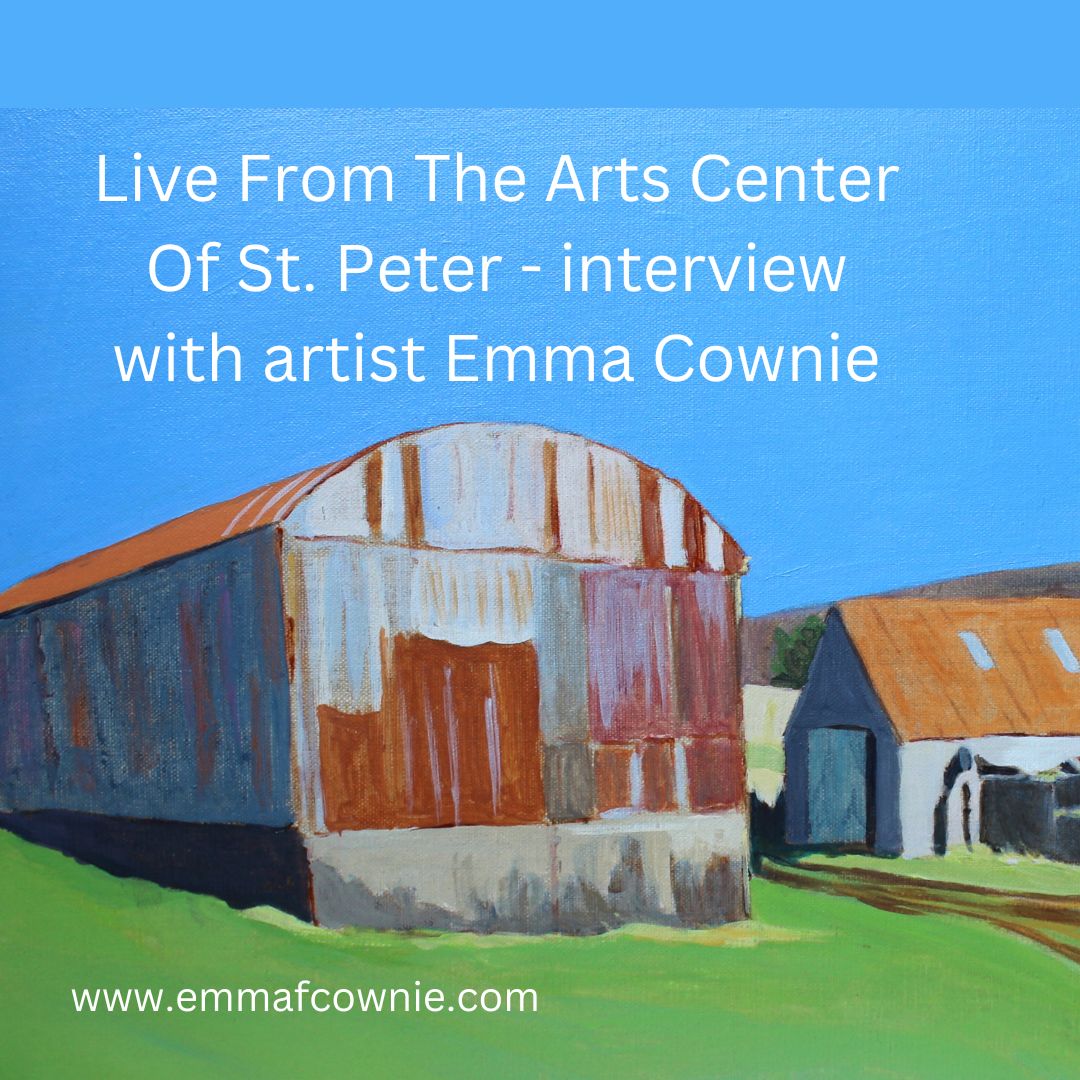
Live From The Arts Center Of St. Peter – interview with artist Emma Cownie

I did this interview back in March this year with artist and magician Michael Callahan and co-host Ann Rosenquist Fee, executive director of the Arts Center, St Pauls, Minnestota, USA. In it I talk about how I came to be an artist, my process, my love of colour and paint brushes!

SEE DONEGAL PAINTINGS                                             BUY DONEGAL PRINTS 

Posted on 6 Comments

Above Mussenden Temple

Above Mussenden

There is a unique architectural gem, perched upon the high cliffs above the shores of the north Derry coastline. It is an elegant Roman-style round temple; a beautiful rotunda. It is a wonderful surprise. There is none other in Ireland. It looks out across Lough Foyle to Donegal to the north and on a clear day the Scottish Isles can be seen to the north-east. This remarkable building is Mussenden Temple.

Mussenden Temple from Downhill Strand

It was built by the eccentic and extravagant Earl Bishop of Derry, Frederick Hervey (b.1730-1806). The 18th century is full of mischievious and surprising characters and he’s one of the best. Frederick Hervey was in turns controversial, revolutionary and yet both shocking and popular in his own life time. He came from an aristocratic English family, the 3rd son of an earl with big estates in Suffolk. Having two elder brothers he probably never expected to inherit from his father. He first tried law and then became a vicar hoping for a career in the church. His family connections helped a lot. He became chaplain to the king, George III in 1763, who later called him ‘that wicked prelate’ .

When his eldest brother George became Lord Lieutenant of Ireland in 1766, he managed to wangle the post of Bishop of Cloyne for Frederick and then, shortly afterwards, in 1768, Bishop of Derry, one of the wealthiest Irish sees.

Frederick threw himself into being Bishop of Derry, reportedly visiting every parish in the diocese and embarking on a number of notable building projects in the city of Londonderry including building St Columbs Cathedral’s first spire (it had to be replaced later as it was too heavy) many fine building and the first (wooden) bridge over the River Foyle, earning himself the nickname ‘the Edifying Bishop’.

In 1779 his brother George died and Frederick became the 4th Earl of Bristol, inheriting an income of £20,000 a year. He now even more money. He spent a fortune on building and collecting art.

He was widely travelled and had a fine appreciation of art, especially Greek and Italian. He spent 18 years of his life in Italy and spoke Italian fluently. Frederick was also well-read and he was an expert in flora and fauna and publicised The Giant’s Causeway. The Earl Bishop did extensive research into the origins of the Causeway and promoted his findings to the scientific community and wider world.

He also visited Staffa Island on the Western Isles of Scotland to confirm the links with similar columnar formations. In 1782, he was made a Fellow of the Royal Society for his efforts.

The Earl Bishop was a colourful character and was clearly someone people loved to gossip about. There are many examples of his eccentricity. It is said that he made his clergy run a leapfrog race on Downhill beach to see who would win the best area!

He had an eye for the ladies and was reputed to have had several affairs. Among his mistresses was society beauty Madam Ritz, as well as possibly Emma Hamilton who was also the mistress of Admiral Lord Nelson.

Bramante’s Tempietto, Rome 1502

It was on his tour of Europe that he fell in love with Bramante’s Temple in Rome. He reportedly tried to buy it and have it moved back to Britain but the Pope would not let him. So the Frederick Hervey built his own. Several of them. He built Ballyscullion, near Bellaghy, Co Derry, in 1787 to his own extravagant designs. The façade was inspired by St Peter’s in Rome, and measured 350ft across, with a central rotunda flanked by curved wings and a large pavilion at each end. It sadly, no longer exists.

Ballyscullion House

He also started Ickworth House, in Suffolf in 1795 which was completed by his successors.

Ickworth House, Suffolk, England

His first rotunda, however, was Musseden Temple, built in 1873. It was built as a library on the cliff edge of his estate at Dunbo, County Londonderry, Northern Ireland.  Dunbo derives from the Irish Dún Bó, meaning ‘fort of the cows’. Dunbo was renamed Downhill Demense and an incredible 300,000 trees were planted on the estate; although there is little sign of them today.

A huge castle was built with the assistance of number of architects (Frederick kept firing them) including Michael Shanahan of Cork and Placido Columbani of Milan, who was supervising plumbing and the installation of water closets, a swanky innovation for the time. So we are not entirely sure who designed the rotunda/temple on the cliffs.

Mrs Daniel Mussenden (born Fridiswide Bruce, d.1785)
Unknow French artist c.1780

The temple was dedicated to his lovely young cousin Frideswide Mussenden (neé Bruce) who had recently married the rich banker, Daniel Mussenden, had given birth to a child. The temple was meant to a be delightful retreat for her to escape to and look out at the wonderful view or read some of the many books there. A fire was kept lit at all time to save the books (and her) from the damp Irish weather. Sadly, Frederick’s terrible reputation with women meant that their “friendship” was gossiped about, in the press. The fragile Frideswide was horrified to be written about in the Freeman’sJournal, even if she wasn’t mentioned by name, and it may well have supposedly sent her into a physical decline, dying at the age of tender age of just 22 in 1785.

There is a minature of her in the National Gallery of Ireland painted when she was 17 in 1780, presumably when she had just married Daniel. She has a very sweet and tender face; you can easily imagine her upset at the nasty rumours.

So the library on the cliffs is a poignant place. Built for a young woman who perhaps only used it for a short time before she died. It was always close to the cliff edge, reported 30 foot away when it was built. I think that is an exaggeration, as maps from the early 19th century do not show that much land between the temple and the cliff edge. The cliff has eroded and about 20 years ago the National Trust did extensive work to stablise the cliff and underpin the temple.

OSNI 1831 Downhill
OSNI 1831 Downhill

I am very bad at remembering to take work in progress photos of my work. I often get too caught up in painting the piece. I am also usually very anxious about a painting until I have practically finished it!

This is a painting done with acrylic paints. I work with thin layers of paint, building up the colours and adjusting them, lighter or darker with each new layer. Often I like the painting best when its about a third done – I am confident I know where I am going with it and it still has “potential”.

Work in progress - Mussenden Temple

Here there are still some “problems” to solve, the shadow on the temple needs to be darkened.

Work in Progress 2 - Mussenden Temple
Work in Progress 2 – Mussenden Temple
Above Mussenden Temple_ Painting by Emma Cownie

Frederick Hervey was a fascinating man, who had a long and varied life and I could write a lot more about him.  He was minor celebrity in his day, he travelled widely on the Continent, where he kept company and correspondence with leading philosophers, princes, politicians, scientists, artists, architects and writers—including Voltaire, Goethe, Benjamin Franklin, John Strange, Jeremy Bentham, James Boswell and the Pope. He has been described as “a bad father, and worse husband, a determined deist, [who was] very blasphemous in his conversation”.

Yet he was a generous man who treated the people of Derry well, whether Catholic, Protestant or Non-Conformist (a type of Protestant that was discriminated against by the state at the time). He argued all his life for religious tolerance.


_Earl-Bishop_with_His_Granddaughter_in_Gardens_of_Villa_Borghese_Hugh_Douglas_Hamilton_Circa_1790_National_Gallery_Ireland.
Earl-Bishop with His Granddaughter in Gardens of Villa Borghese c1790 National_Gallery_Ireland.

He believed the answer to the Irish question or the Irish problem of a disaffected Catholic majority is, was not meanness but generosity. Just as God wins our prayers of thanksgiving by His extravagant generosity, so England could learn how to win over Irish Catholics by giving them more, not less. He bankrolled the first Catholic chapel in Derry—Long Tower Church—and personally chose the magnificent Italian marble that adorns the altar.

He undertook public works to relieve poverty, and was a generous patron to the Catholic population of Derry.  

He died in Italy in 1803, trying to recover his art collection that had been conviscated by Napoleon Bonaparte. Hundreds of artists attended his funeral in Rome and he was buried at his ancestral home, Ickworth in Suffolk, where there is an obelisk paid for by public subscription by the Catholics, Presbyterians and Protestants of Derry.

obelisk-memorial-blue-sky-ickworth-suffolk-495470
obelisk memorial, Ickworth House

Find out More  

https://www.nationaltrust.org.uk/visit/northern-ireland/mussenden-temple-and-downhill-demesne

It’s Downhill All the Way

The ‘oral-bishop’: the epicurean theology of Bishop Frederick Hervey, 1730–1803

https://www.earlbishopstrail.com/

https://vipauk.org/enter/muse/ni/i30.html

Click to access EARL-BISHOP-BOOKLET-WR.pdf

Edifying and Eccentric – The Earl Bishop

Posted on 10 Comments

Spring in the Sperrins

Painting of Spring in Sperrins, N.I

The Sperrins or Sperrin Mountains (Irish: Sliabh Speirín) are a mountain range in Northern Ireland. The name Sperrin derives from “Na Speiríní ” meaning “Spurs of Rock” and it is the rocks of the Sperrins and the rolling geography of the area that form the foundation of this distinct landscape.  The mountain range, stretching 40 miles along the border of counties Tyrone and Derry, is the largest in Ireland. There are 10 summits above 500 metres with the highest of the range, Sawel Mountain, peaking at 678m (2,224ft). 

The landscape is mostly moorland and blanket bog. The Sperrins were designated an Area of Outstanding Natural Beauty in 1968. It’s a sparse rolling landscape. These peaks have been smoothed out by glaciers thousands of years ago. Populated by sheep, bog grass (Eriophorum angustifolium) and farmhouse, old and new.

Some old farm buildings have long-been abandoned by people but are still used for farm equipment and shelter for sheep. So long as there is a tin roof, the walls will last years and years.

painting Upper Dreen_Emma Cownie
Upper Dreen_Emma Cownie (SOLD) Recently,

I love the sharp oranges of those tin roofs and I will return to them again and again for inspiration. Broadly speaking, in terms of composition I am looking for three dominant colours; green grass/sky and orange tin roofs. You can see how I simplify these main colours in the painting below.

Farm in the Sperrins, County Tyrone, Ireland
Farm in the Sperrins, County Tyrone, Ireland _Emma Cownie

Drone photography has become widespread in our lives. I remember clearly first seeing drone shots of different American cities in episodes of CSI. They were tracking shots of skyscrapper from directly above. As if you were a bird, flying directly above. They were fascinating. Funny, I cant find a clip to illustrate online now. These days they are used in local and national news and documentaries so frequently I dont think we even register that they are drone shots. They have become part of everyday our visual language.

Recently, I have started to explore the use of drone footage (shot by my husband) to extend the possiblilties of compositions I can paint from. So often, I have thought: “If only I was 20 foot high, I’d get a great shot”. So now I can see from 20 foot above, or round the otherside.

I know that many people think that “real” art is plein air sketching, live and I would need to be in a hot airballon to get these views. I admire people who can do this. I can’t. I am not a plein air painter. I am too much of a control freak. I work slowly in the comfort of my studio with all my paints within arms’ reach, exactly where I want them.

This is the first rainbow I have painted. I was pretty nervous about doing it as rainbows are so beautiful and etheral. They are also fleeting. I am reasonably happy with the result although I would be happier if it was more transulent. If I painted another one I would use more acrylic medium to get a more see through effect.

Rainbow over a Sperrins Farm_Emma Cownie

I can also use drone footage and photography if collectors want a commissioned work with drones offering a novel view of their favourite places! It certainly has helped me become more creative with compositions and has benefitted my work greatly.

(c) James Henry Johnston 2024

Posted on 3 Comments

Spring Newsletter

Spring Newsletter 2024

Read about my other appearances in the media here 

New Work Spring 2024
See Derry City Paintings Here
New Work 2024

The Causeway Coast and Antrim


A selection of some of my paintings of the area. Please check my website to see my full collection of work

Antrim and Causeway Coast

A Recent Commission

Mumbles View _ Emma Cownie
"Mumbles View" 120cm x40 cm

Paintings of West Donegal, Fanad and Gower, Wales 

Paintings of West Donegal, Fanad and Gower, Wales

Wishing Everyone a Happy and Relaxing Easter/Spring Break!