Posted on 11 Comments

Looking at Paintings in Real Life is Good for you

A long time ago, when I was a student, my favourite place to visit was the National Museum of Wales. The Davies collection in particular. The Davies were two sisters, Gwendoline and Margaret, amassed one of the greatest British art collections of the 20th century and bequeathed it (260 works!) to the National Museum of Wales. That’s Girl Power!

Some of Monet’s paintings at Cardiff National Museum

They had great taste. Those paintings became like my friends. I visited them often and spent a long time looking closely at them. They excited, inspired and comforted me. Even now when I look at reproductions of them online I have a strong reaction to them.

I used to think, this was because I was an artist. I remember peering closely at Monet’s brush strokes and marvelling at how they were laid down. I mean look at this.

A tingle goes down my spine, looking at it. This is what art is meant to do. It’s even better in real life.

Look at Van Gogh’s painting of a rainy day in Auvers. I have never seen better rain (and I have lived in Wales and Ireland – very wet places).

Van Gogh’s painting In its frame

The Mauritshuis Museum in The Hague, is the home of Vermeer’s ‘Girl with the Pearl Earring’. Thew museum recently did some academic research into how visitors responded to artworks. They looked at the neurological mechanisms and emotions underlying the appreciation of perception in art.

Girl with a Pearl Earing

The study used EEG and eye-tracking measurements on 20 participants who followed a set route through the Mauritshuis. Five paintings were included on this route: Girl with a Pearl Earring (Johannes Vermeer), The Violin Player (Gerrit van Honthorst), Self-portrait (Rembrandt van Rijn), The Anatomy Lesson of Dr Nicolaes Tulp, (Rembrandt van Rijn), View of Delft (Johannes Vermeer). They also showed them reproductions of the originals and compared their responses. The EEG results showed that the real paintings created a stronger emotional response compared with the poster versions of the same paintings.

Volunteer in the study looking at “Girl with a Pearl Earing” – Her eye movements are being tracked

“The Girl with a Pearl Earing” created the biggest emotial response. Painting of “The View of Delf” did not score well, and I wondered whether it was because it was a landscape rather than a portrait, not as famous as the “Girl with the Pearl Earing” or people were not familar with the layout of Delf. I have spent a long time looking at historic paintings of London, Swansea and Derry, trying to work out how they relate to the modern day cities. But maybe that’s because I’m pretty geeky. I doubt I had a big emotional response to them, though. Not enough paint!

Screen shot of the results of the study

The EEG results confirm that real paintings (compared to poster versions) also elicited a strong need to approach the paintings. It wasn’t just me wanting to get a close look at the paint! Real art, including the surrounding ambience, lighting, frame also helped evoke an emotional reaction many times more powerful (10x more powerful according to this study) than looking at a poster of a painting.

Some of you will put that in the “No Sh*t, Sherlock” category of scientific “discoveries” – which was my husband’s response when I told him about the study.

I have never seen Vermeer’s painting in real life but my parents have a reproduction in a tiny gold frame. I don’t know if people’s reponses were elicited because its very beautiful, well-composed, very famous, or because its a human face. I suscpect its a combination of all three.

Mona Lisa in the Louvre – I dont remember it looking as big as this when I saw it back in 1988!

Seeing a famous painting isn’t always rewarding. Maybe you too went to the Louvre in Paris to see the Leonardo’s Mona Lisa and were underwhelmed. Its notoriously small and hard to see as it under glass , far away and surounded by tourists.

There have been times I have come across paintings that I didn’t know and looked at them for a long time. I sat in the Tate (in the 1980s way before it became Tate/Tate Modern) with a lot of Rothko paintings and felt incredibly moved. You just cannot convey that with a reproduction.

So I guess this is a round about way to encourage you to go and see art in real life. You will feel better for it. Possibly. I hope you have some sort of emotional response – tears, laughter, anger even. Barnett Newman, Who’s Afraid of Red, Yellow and Blue III, 1967-68 has been slashed three times.

Barnett Newman, Who’s Afraid of Red, Yellow and Blue III, 1967-68. Oil on canvas, 8′ x 18′

We can’t all own Monets and Vermeers (and I don’t think any of us should, they are too important for that) but we can be glad that museums hold them in public collections we can see. I would love to see Picasso’s Guernica in real life. I have had it projected on a class room wall when I have taught lessons about the Spanish Civil War – it is a powerfully brutal work. My board was large no where near the full the size of the painting which is 3.49 meters (11 ft 5 in) tall and 7.76 meters (25 ft 6 in) across. Art stimulates our senses, emotions, and intellect. Guernica was also designed to stimulate our empathy. It is as relevant today as it was when it was painted in 1937.

Picasso’s Guernica, 1937

Cardiff National Museum let me visit the stores to see Robert Bevan’s Maples at Cuckfield in 2013, because my husband put in a request to see it after seeing in the gallery the year before after my car accident. This work inspired me to start painting again. It helped with my recovery from PTSD and burn out.

Seeing paintings in real life really does do you good. Dr. Saundra Dalton-Smith has identified looking at art as a way of getting creative rest, one of seven types of rest all people need. Creative rest involves exposing yourself to sources of awe and inspiration and makes you better able to create and problem solve. Painting pictures is even better for you.

Robert Bevan Maples at Cuckfield, Sussex 1914 National Museum of Wales, Cardiff Photo © National Museum of Wales

Just a reminder that I am offering 20% off all my paintings on my website until 14th October with a code.

Join my mailing list to get the code here.

Shifting Shadows on Three Cliffs Bay (Gower) Context

Read More about the study

https://www.theguardian.com/science/2024/oct/03/real-art-in-museums-stimulates-brain-much-more-than-reprints-study-finds

https://www.mauritshuis.nl/meisje/#Waarom-dit-onderzoek

https://www.theartnewspaper.com/2024/10/03/the-pearly-triangle-neurological-investigation-reveals-secret-of-vermeers-girl-with-a-pearl-earring

Posted on 6 Comments

Above Mussenden Temple

Above Mussenden

There is a unique architectural gem, perched upon the high cliffs above the shores of the north Derry coastline. It is an elegant Roman-style round temple; a beautiful rotunda. It is a wonderful surprise. There is none other in Ireland. It looks out across Lough Foyle to Donegal to the north and on a clear day the Scottish Isles can be seen to the north-east. This remarkable building is Mussenden Temple.

Mussenden Temple from Downhill Strand

It was built by the eccentic and extravagant Earl Bishop of Derry, Frederick Hervey (b.1730-1806). The 18th century is full of mischievious and surprising characters and he’s one of the best. Frederick Hervey was in turns controversial, revolutionary and yet both shocking and popular in his own life time. He came from an aristocratic English family, the 3rd son of an earl with big estates in Suffolk. Having two elder brothers he probably never expected to inherit from his father. He first tried law and then became a vicar hoping for a career in the church. His family connections helped a lot. He became chaplain to the king, George III in 1763, who later called him ‘that wicked prelate’ .

When his eldest brother George became Lord Lieutenant of Ireland in 1766, he managed to wangle the post of Bishop of Cloyne for Frederick and then, shortly afterwards, in 1768, Bishop of Derry, one of the wealthiest Irish sees.

Frederick threw himself into being Bishop of Derry, reportedly visiting every parish in the diocese and embarking on a number of notable building projects in the city of Londonderry including building St Columbs Cathedral’s first spire (it had to be replaced later as it was too heavy) many fine building and the first (wooden) bridge over the River Foyle, earning himself the nickname ‘the Edifying Bishop’.

In 1779 his brother George died and Frederick became the 4th Earl of Bristol, inheriting an income of £20,000 a year. He now even more money. He spent a fortune on building and collecting art.

He was widely travelled and had a fine appreciation of art, especially Greek and Italian. He spent 18 years of his life in Italy and spoke Italian fluently. Frederick was also well-read and he was an expert in flora and fauna and publicised The Giant’s Causeway. The Earl Bishop did extensive research into the origins of the Causeway and promoted his findings to the scientific community and wider world.

He also visited Staffa Island on the Western Isles of Scotland to confirm the links with similar columnar formations. In 1782, he was made a Fellow of the Royal Society for his efforts.

The Earl Bishop was a colourful character and was clearly someone people loved to gossip about. There are many examples of his eccentricity. It is said that he made his clergy run a leapfrog race on Downhill beach to see who would win the best area!

He had an eye for the ladies and was reputed to have had several affairs. Among his mistresses was society beauty Madam Ritz, as well as possibly Emma Hamilton who was also the mistress of Admiral Lord Nelson.

Bramante’s Tempietto, Rome 1502

It was on his tour of Europe that he fell in love with Bramante’s Temple in Rome. He reportedly tried to buy it and have it moved back to Britain but the Pope would not let him. So the Frederick Hervey built his own. Several of them. He built Ballyscullion, near Bellaghy, Co Derry, in 1787 to his own extravagant designs. The façade was inspired by St Peter’s in Rome, and measured 350ft across, with a central rotunda flanked by curved wings and a large pavilion at each end. It sadly, no longer exists.

Ballyscullion House

He also started Ickworth House, in Suffolf in 1795 which was completed by his successors.

Ickworth House, Suffolk, England

His first rotunda, however, was Musseden Temple, built in 1873. It was built as a library on the cliff edge of his estate at Dunbo, County Londonderry, Northern Ireland.  Dunbo derives from the Irish Dún Bó, meaning ‘fort of the cows’. Dunbo was renamed Downhill Demense and an incredible 300,000 trees were planted on the estate; although there is little sign of them today.

A huge castle was built with the assistance of number of architects (Frederick kept firing them) including Michael Shanahan of Cork and Placido Columbani of Milan, who was supervising plumbing and the installation of water closets, a swanky innovation for the time. So we are not entirely sure who designed the rotunda/temple on the cliffs.

Mrs Daniel Mussenden (born Fridiswide Bruce, d.1785)
Unknow French artist c.1780

The temple was dedicated to his lovely young cousin Frideswide Mussenden (neé Bruce) who had recently married the rich banker, Daniel Mussenden, had given birth to a child. The temple was meant to a be delightful retreat for her to escape to and look out at the wonderful view or read some of the many books there. A fire was kept lit at all time to save the books (and her) from the damp Irish weather. Sadly, Frederick’s terrible reputation with women meant that their “friendship” was gossiped about, in the press. The fragile Frideswide was horrified to be written about in the Freeman’sJournal, even if she wasn’t mentioned by name, and it may well have supposedly sent her into a physical decline, dying at the age of tender age of just 22 in 1785.

There is a minature of her in the National Gallery of Ireland painted when she was 17 in 1780, presumably when she had just married Daniel. She has a very sweet and tender face; you can easily imagine her upset at the nasty rumours.

So the library on the cliffs is a poignant place. Built for a young woman who perhaps only used it for a short time before she died. It was always close to the cliff edge, reported 30 foot away when it was built. I think that is an exaggeration, as maps from the early 19th century do not show that much land between the temple and the cliff edge. The cliff has eroded and about 20 years ago the National Trust did extensive work to stablise the cliff and underpin the temple.

OSNI 1831 Downhill
OSNI 1831 Downhill

I am very bad at remembering to take work in progress photos of my work. I often get too caught up in painting the piece. I am also usually very anxious about a painting until I have practically finished it!

This is a painting done with acrylic paints. I work with thin layers of paint, building up the colours and adjusting them, lighter or darker with each new layer. Often I like the painting best when its about a third done – I am confident I know where I am going with it and it still has “potential”.

Work in progress - Mussenden Temple

Here there are still some “problems” to solve, the shadow on the temple needs to be darkened.

Work in Progress 2 - Mussenden Temple
Work in Progress 2 – Mussenden Temple
Above Mussenden Temple_ Painting by Emma Cownie

Frederick Hervey was a fascinating man, who had a long and varied life and I could write a lot more about him.  He was minor celebrity in his day, he travelled widely on the Continent, where he kept company and correspondence with leading philosophers, princes, politicians, scientists, artists, architects and writers—including Voltaire, Goethe, Benjamin Franklin, John Strange, Jeremy Bentham, James Boswell and the Pope. He has been described as “a bad father, and worse husband, a determined deist, [who was] very blasphemous in his conversation”.

Yet he was a generous man who treated the people of Derry well, whether Catholic, Protestant or Non-Conformist (a type of Protestant that was discriminated against by the state at the time). He argued all his life for religious tolerance.


_Earl-Bishop_with_His_Granddaughter_in_Gardens_of_Villa_Borghese_Hugh_Douglas_Hamilton_Circa_1790_National_Gallery_Ireland.
Earl-Bishop with His Granddaughter in Gardens of Villa Borghese c1790 National_Gallery_Ireland.

He believed the answer to the Irish question or the Irish problem of a disaffected Catholic majority is, was not meanness but generosity. Just as God wins our prayers of thanksgiving by His extravagant generosity, so England could learn how to win over Irish Catholics by giving them more, not less. He bankrolled the first Catholic chapel in Derry—Long Tower Church—and personally chose the magnificent Italian marble that adorns the altar.

He undertook public works to relieve poverty, and was a generous patron to the Catholic population of Derry.  

He died in Italy in 1803, trying to recover his art collection that had been conviscated by Napoleon Bonaparte. Hundreds of artists attended his funeral in Rome and he was buried at his ancestral home, Ickworth in Suffolk, where there is an obelisk paid for by public subscription by the Catholics, Presbyterians and Protestants of Derry.

obelisk-memorial-blue-sky-ickworth-suffolk-495470
obelisk memorial, Ickworth House

Find out More  

https://www.nationaltrust.org.uk/visit/northern-ireland/mussenden-temple-and-downhill-demesne

It’s Downhill All the Way

The ‘oral-bishop’: the epicurean theology of Bishop Frederick Hervey, 1730–1803

https://www.earlbishopstrail.com/

https://vipauk.org/enter/muse/ni/i30.html

Click to access EARL-BISHOP-BOOKLET-WR.pdf

Edifying and Eccentric – The Earl Bishop

Posted on 8 Comments

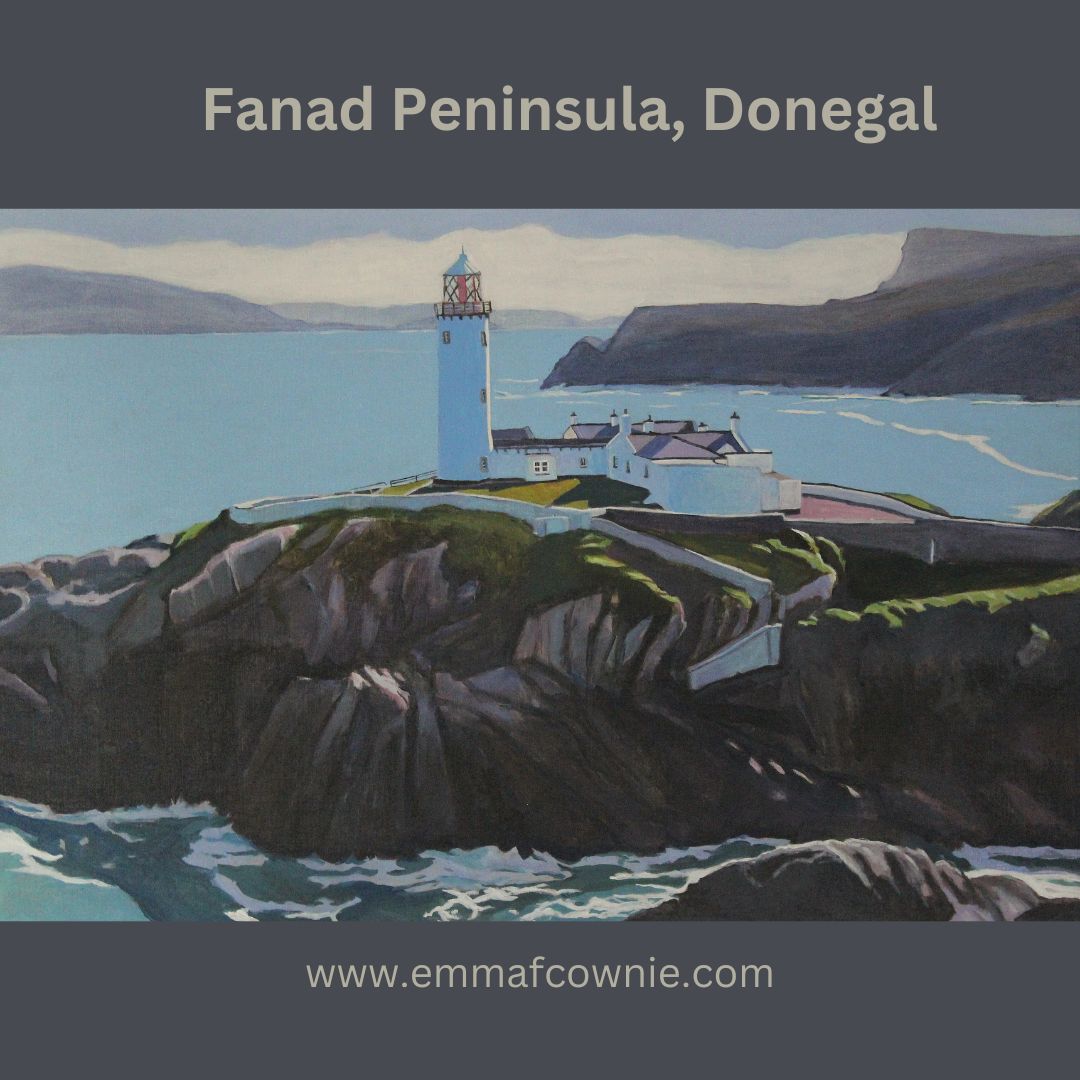
Fanad Peninsula, Donegal

Painting of Fanad Lighthouse by Emma Cownie

Fanad is a finger of land that lies between Lough Swilly and Mulroy Bay on the north coast of County Donegal, Ireland. It is not that easy to get to and the the survival of the Irish language is testiment that relative isolation.

Painting of Lambing season at Fanad Head (Donegal)
Lambing season at Fanad Head (Donegal) SOLD

Fanad Lighhouse (Donegal). Is one of the 12 Great lighthouses of Ireland. It was built in 1886 at Fanad Head (although the station was originally established in 1817). The lighthouse, or more acrrately, the harbour light, marks the entrance into Lough Swilly which forms a natural harbour.

Fanad Lighthouse (Donegal)
Fanad Lighthouse (Donegal) SOLD

I have painted this isolated structure several times before. I have always enjoyed painting the northernly light on Fanad. I have only have painted it in acrylics. That’s not a delibertae choice, more one of circumstance because at times I have had limited space, and I dont want to use oil paints with kittens close at hand.

Over to Fanad Lighhouse (Donegal) _Emma Cownie
Over to Fanad Lighthouse (Donegal) _Emma Cownie SOLD

I think acrylics suit the airiness of the subject matter. After a couple of years working out how to use them, I have settled on a technique of light layers of paint that allow the underlying colour to show through. This can give a transulent quality to the colour. This is in contrast to the relatively flat areas of colous I use for the larger areas of colour such as sky or the sea.

Read more about my use of acrylics here

a painting of Fanad Head and lighthouse
Fanad SOLD

My latest painting was an experiment in composition. We used an image from a drone shot done by my artist husband, Seamas (James Henry Johnson).

In this piece, I wanted to create a sense of space from the mountains of the Inishowen Peninsula in the distance. The distant mountains were layered with bluish white until I got the right impression of distance.

I often find myself looking at the tiny Fanad lighthouse far off in the distance when I am at Lisfannon on the Inishowen Penisula.  There is a sign comemorating a famous Atlantic storm that happened in 1748. this storm threatened to sink The Greyhound, the ship of one John Newton, a slave trader. John was so frightened that he called out to God for mercy. This moment marked a profound spiritual conversion, and many years later he wrote the words for the hymn “Amazing Grace” one of my favourite hymns, and to also campaign for the abolition of slavery.

There is some confusion how many storms there were . One website claims the terrible tempset happened far away out in the Atlantic because it took John Newton another four weeks after his conversion to sail into Lough Swilly and arrive at Derry/Londonderry. The Amazing Grace.ie site however, makes it clear a second storm happened in Lough swilly itself as it quotes John’s journal ” We saw the island of Tory and the next day anchored in Lough Swilly  in Ireland.  This was the 8th day of April, just four weeks after the damage we sustained from the sea.  When we came into this port, our very last victuals was boiling in the pot; and before we had been there two hours, the wind began to blow with great violence.  If we had continued at sea that night in our shattered condition, we must have gone to the bottom.  About this time I began to know that there is a God that hears and answers prayer.” It’s got to be said, that John Newton really took his time putting his evangelical beliefs into action because he went back to being a slave trader for another five years before he eventually retired and became a minister in 1757!

The heaving sea at the foot of the massive lighthouse rock intrigued me. The Atlantic Ocean has such a bulk and stregth, even on a relatively fine day, I am not surprised that John Newton was terrified by its strength far away from the Donegal coast. I wondered about the long and difficult process of building this structure all those years ago in a remote location. Yet, this lighthouse has stood the test of time and proudly marks the entrance to Lough Swilly and can be seen from inland and further along the coast.

Painting of Fanad Lighthouse, donegal by Emma Cownie
The Heaving Sea at the foot of Fanad Lighthouse, Donegal by Emma Cownie

Fand Lighthouse by James Henry Johnston (c) 2024

Turquoise Sea At Fanad Lighthouse

Find out more

Fanad

https://www.ireland.com/en-gb/destinations/regions/fanad-head/

John Newton

http://www.amazinggrace.ie/newton-in-ireland.html

Posted on 29 Comments

Adventures in Acrylic Paint

Acrylic paint by Emma Cownie

You probably think that artists are good at creating paintings/images in all mediums; oil, watercolours acrylic paints. Many probably are, but I am not.  I need to work at it. It’s a bit like being an athlete. You might be great at football but it doesn’t automatically mean you are a great sprinter, tennis player or swimer. Although there are athletes who have successfully switched disciplines, like Usain Bolt, who started his career as a footballer; extra training is needed. I think painting is like that. 

Almost all of my experience up to now has been in working with oil paints but in the last six months I have been working hard at painting in acrylics.  Why? I knew that in our small house in Derry, until we got stairs put into the attic space, that oil paints and with their associated mess and fumes weren’t going to work.

Unfortunately I feel like I have been hitting my head against a brick wall for several months. I have learnt a great deal, using acrylic mediums and varnishes is very technical, but I won’t go into all the detail of what I have learnt. The strange thing is that the finished paintings looked good but the process of creating them was slow and frustrating. Here are some early examples;

Painting of fram buildings in Donegal
Shadow on the Entrance, Bloody Foreland
House in Inishbofin
House on Inishbofin


Stony Wall, Cnoc Fola (Donegal)
Painting of the view above Magheraroarty_Emma Cownie
Above Magheraroarty_Emma Cownie

This last one is my favourite but it took weeks to complete rather than days. I just don’t have the patience to spend that long on one smallish painting.

I also used acrylic paint for underpaintings for my oil painting, which worked better for me. It enabled be to paint faster, but this approach would be no good in Derry where I couldn’t use oil paints.

Boat at the Pier, Gola_Emma Cownie
Boat at the Pier, Gola (Donegal)
From Magheraroarty to Muckish
From Magheraroarty to Muckish (Donegal)


So why was I taking so long to complete these acrylic paintings? Acrylics don’t act like oil paints, that can be a good thing as well as a bad thing. You can correct mistakes easily. Acrylic paint is a relatively recent invention of the 1950s. It’s essentially a plastic. It is amazingly versatile but it’s origins as a polymer  presents a couple of challenges that I have struggled with for some time.  The first issue is that it dries fast. Really fast. I found that it dried on my palette within minutes. I hate wasting paint, so I made my own wet palette, so that the paint on my palette dries within days and not minutes.

It still dried very fast on the board/canvas on which I was painting. That meant that large areas, such as skies, werevery difficult to paint without looking patchy. I learnt to mix up large quantities of paint so that if I needed to, I could repaint a small area of the sky. Otherwise,  the whole sky had to be repainted.

The second big issue I had was somehing called “colour shift”. Acrylic paint dries dark. This is because most makers of acrylic paint use white binder that dries clear, so it looks light when you apply it, but goes dark as it dries. It seems to affect blues and browns particularly badly. I tried painting patches of colour to see who was the worst offender.

Colour Shift
Colour Shift (these are all dry so you cant see the colour shift but my notes tell you what I saw)


Although Windsor & Newton’s paints use clear blinder and have little colour shift, I didn’t particularly like them as a paint. I am not sure why I didn’t like them, possibly I just prefered to colour range of other manufacturers. Anyway, in the end I bought lots of Schminke PrimAcryl paints which also use a clear binder and results in only a small colour shift.

Finally, I decided to experiment with indirect painting. This is a method where by an underpainting in grayscale is done first and light layers of colour are applied as a glazes.

Again, its’s not as speedy as painting in oils (although I have used brown-tonal underpaintings in the past – with oil paintings, see here).

So here are two paintings I painted tonal underpaintings, and then added colour through a series of glazes.

Greyscale study of lambing Season at Fanad Head
Work in Progress - Lambing season at Fanad Head
Work in Progress – Lambing season at Fanad Head

Painting of Lambing season at Fanad Head (Donegal)Lambing season at Fanad Head (Donegal) – Final version

Greyscale study of Fanad LighthouseGreyscale study of Fanad Lighthouse – painted on a blue ground, which I left in the sky area of the painting.

Fanad Lighthouse (Donegal)
Almost done – Fanad Lighthouse (Donegal)
Lighthouse at Fanad Head (Donegal)
Lighthouse at Fanad Head (Donegal) – Final version with lightened sky


This approach seemed to work well for acrylics. Although I am still not as quick as I am in oils, this process enables me to produce paintings with greater depth of colour and more accurate tonal values. It is especially good for getting distant mountains right, something I have struggled with in the past. I am hoping that I have finally got the hang of working with this medium. I think it’s the end of the beginning rather than the beginning of the end. There’s always so much to learn with painting no matter which medium you use!


Some of my resources

Indirect painting and Glazing https://thevirtualinstructor.com/how-to-glaze-acrylics.html

Willaim Kemp’s Art School https://willkempartschool.com/acrylic-tonal-study-using-colour-strings-glazes/

UK stockist of PrimAcryl https://www.jacksonsart.com/schmincke-primacryl-acrylic


Posted on 16 Comments

Some Adventures in Paint

Some Adventure in Paint

I have been experimenting with different supports and media. The Jessica Brilli painting on wood got me curious about how it would be different from painting on canvas.

Jessica Brilli's "Cutlass" - with me holding it
Jessica Brilli’s “Cutlass” – Acrylic painting on wood panel

I could find very little information about the experience of painting on wood panels (but lots of information on how to prepare them). So I realised that I had to use trial and error to find out. I ordered some gessoed wood panels from Cork Art Supplies who delivered them very promptly.

My first effort was this painting. I painted a light ground of red ochre in oil before I laid down the painting. I found that achieving fine detail was much easier than on canvas. However, the colours didn’t behave the way I expected them too. My sky started off too dark. I found it was easy to wipe off the oil paint and repaint it a lighter shade.  I found that white areas also needed a further layer once they had dried to give them the solidity I required. The painting took much longer than I am used to to dry.

A painting of Inishbofin Donegal
A Place to Rest, Inishbofin, Donegal

I have painted in acrylics on canvas before and struggled with the speed with with the paint dries on the palette. I used to find the the paint had gone hard in the 20 minutes since I started painting. It drove me mad. However, after extensive reserach I worked out how to make a wet palette so that I could slow down the drying time of paint on the palette. I decided to use the quick-drying acrylic paint as an underpainting.

The acrylic painting was more of a sketch than a proper painting. The process forced me to simplify my images further and the final layer of oil paint gave the image a greater depth and richness of colour.

Acrylic Painting
Acrylic Underpainting
Boat at the Pier, Gola_Emma Cownie
Boat at the Pier, Gola (Donegal) – Final Painting

Some of the acrylic sketches really challenged me as the paint did not move and work in the way I was used to with oils. The greens and yellows were too transparent and looked messy. It was impossible to lighten colours, like the leading edge of the fence post,  once they had gotten too dark.

painting of GOla, Donegal
Fenced in, Gola – Acrylic Underpainting

The final layer of oil paint, however, enabled me to make my colours much more opaque and to to add much more detail in places, especially on the wire fence.

Fenced In, Gola
Fenced In, Gola

My final painting was a studies in mauves, blues and greys. I had added an additional layer of light grey gesso as a ground before I started painting.

Lighting the Way to Arranmore - Acrylic version
Lighting the Way – Acrylic version
Lighting the Way (to Arranmore) Donegal
Lighting the Way (to Arranmore) Donegal – Final version

I enjoyed experimenting and I ended up painting several painting at the same time, as I waited for paint to dry between layers.  The whole process forced me to confront my short-comings as a painter of acrylics. I did not enjoy that. It made me feel uncomfortable and brought out my “imposter” anxieties. I need to do much more work in this area to develop my skills.

It was also rather time-consuming and probably not a great project to undertake in the winter months, in Donegal, when good light is in very short supply. I am not sure that I would spend so much time on the underpaintings in future, as I liked my first painting the best. Although I would where there are large areas of white. I did enjoy painting on the wood panel and I will continue to experiment with them.

SEE DONEGAL PAINTINGS                                             BUY DONEGAL PRINTS 

Posted on 17 Comments

Summer Newsletter 2021

Here’s my summer newsletter. I am shutting up shop for a  month from 20th June to 20th July. All going well, we will be safely installed and open for business (online at least) in Donegal by mid-July. I am already longing to get back to my painting routine.  I can’t quite  believe that after being ground so long by my broken leg and the pandemic that we will actually move house/studio to another country by then. It’s a huge step!  Fingers crossed it all goes smoothly!

Posted on 28 Comments

100K!

100K views of www.emmafcownie.com

This week I passed an important blogging milestone. On Tuesday moring I was greeted with the message that my wordpress site had passed 100,000 all-times views!

100,000 views - wow!
Wow!

My husband, Séamas, set up this wordpress site for me over seven years ago. When I took it over full-time in 2015, I had 91 followers, now I have just over 800! Views for my site have steadily been growing but 2020-21 was a bumper year. Stats for my wordpress blog

Breaking my leg last year provoked the most comments by far!

Comments
Comments

I would like to say a great big thank you to every one who visited my website, bought my work, read my blogs and left comments!

It seems that I like animals almost as much as I like Art. Turns out that Wayne  (Barnes) of Tofino Photography is my chattiest follower.  He certainly makes me laugh! He takes wonderful photographs of the incredible wildlife of Western Canada – eagles, bears, wolves, orcas and humming birds! Take a look here.

A Candian bear catching his lunch
A Candian bear catching his lunch: Image  by Wayne Barnes

Thank you to everyone who has visited my website and blog. Whether you have just stopped by to look at my paintings, read my blogs but especially those who “like”, comment and buy my work.  Without you I could not continue to make art.

Painting of view Overlooking Magheroarty
Overlooking Magheroarty

Posted on 22 Comments

My top tips & resources for artists

Top tips for Artists_Emma Cownie

I am sometimes asked if I hold workshops or produce intructional videos, and unfortunately, the answer is that I don’t as I am usually busy painting (and blogging). There is so much already available on the internet that I don’t feel I can compete. Others have done it better already!

So I have put together, instead,  a short list of tips and links for any one who is interested to help them develop. Please feel free to comment or suggest your own.  There are no affliate links in this blog. I have included websites and video clips that I have found personally useful.

My Top TEN TIPS

  1. Paint, paint and paint some more. The more you paint, the more your work will improve. Most artists keep a sketch book and sketch and paint in their spare moments. It is important to pratice without worrying too much about the expensive canvas you are painting.  I used to work in oil pastels  on paper  when I was younger but now I try to paint in oils most days.  I have also experimented with water colours and acrylics. It is only by doing and looking that you will develop as an artist


  2.  Look at Art. Decide what you like. Look at the works of many artists. Think about what they are doing and how they do it. You don’t have to copy them but you can be inspired by them.

    Albert Marquet, Fécamp
    Albert Marquet, Fécamp, 1906

    I particularly like pre 1950s artists  (especially post impressionists like Matisse, Marquet, Derain, Bevan, Gilman) for their use of colour and portayal of light.

    The Harbor - Great Spruce Head 1974
    Fairfield Porter The Harbor – Great Spruce Head 1974

    I also like modern American artists such as Edward Hopper Fairfield Porter, Lois Dodd, Peggi Kroll Roberts, Randall Exon, Mitchell Johnson and Jennifer Pochinski.

    Edward Hopper - Hodgkin's House, Cape Ann, Massachusetts
    Edward Hopper – Hodgkin’s House, Cape Ann, Massachusetts

    There are many fascinating interviews with artists on Savy Painter that  are well worth a listen!

    Randall Exon
    Beach House by Randall Exon, 2009

    It is important to see paintings “in the flesh too”.  Van Gogh and Monet need to be seen in real life to appreciate their scale, and how they have used the paint. I once saw a Picasso in Swansea’a Glynn Vivian Museum, and its presence quite blew me away. It was very big. I got a powerful sense of an artist who knew what he wanted to achieve and knew exactly how to do it. If I had just looked at online I would got none of that.  I save  images  of work I like on my  pinterest account.

    Picasso painting Glynn Vivian
    Someone else took a photo of the Picasso and posted it on trip advisor

  3. Paint – buy the best paint you can afford. Try out different brands. A paint may have the same name but look very different depending on the brand. Only buy Artist’s oil paints. The student version are cheaper and inferior. They are fine for underpainting only. They fade. My favourite brands include Lefranc and Bourgeois Extra Fine, Lukas 1862 Finest Artists’ Oil Colour, Sennelier Finest Artist’s Oli Colour, Talens Rembrandt Artists’ Oil Colour, Schmincke Norma Professional Artists’ Oil Colour, Michael Harding Artists’ Oil Colours.  It took me a long time to really understand what colour opacity and the transparency of paint meant in terms of my painting. I am still learning how to use this knowlege.

    Transparency-Oil-Acrylic-em
    Transparency of Oil and Acrylic paint


  4. Canvas – invest in good quality canvas.  I love linen canvas as they are really strong and hard wearing. In my early days,  I painted on cheap cotton canvases that years later would tear easily. It was quite heart breaking to realise that I had wasted my creative energy on an inferior product.

    Loxley Linen canvas (clear gesso)

    I particularly like the natural ones painted with clear gesso. If you buy the white ones, it’s helpful to paint the canvas with a coloured ground before you start painting. Here’s a excellent video on how to do it.

    Cass Art Linen canvases

    They are wonderful to paint on. UK stockists: Great Art, Cass Art, Loxley Arts,  you can also get Loxley Linen canvases at Art Discount and Pegasus Art.


  5. Composition – shapes and how they are arranged,  lines and their direction.

    Henri Cartier-Bresson (1908-2004) Munster, County Kerry, Ireland, 1952
    Henri Cartier-Bresson, County Kerry, Ireland, 1952

    I like looking at how photographers like Henri Cartier-Bresson, Vivian Maier, William Eggleston and Harry Gruyaert used light, colour and composition in their work.

    William Eggleston
    William Eggleston

    “If the arrangement of the big shapes is strong and coherent, it’ll carry the painting. You are 90 percent of the way toward achieving a composition – and consequently a painting – that will work from Mastering Composition“by Ian Roberts

Compositional Guide see here 

Painting of Irish Cottage on Gola, Gweedore
Down to the Pier, Gola by Emma Cownie (Private Collection)

6. Tonal value – The value of a color is how dark or how light that color is. It is easy to see value shifts looking to an image in black and white or in grayscale; it is a little trickier to see it in color.

Tonal values video examples here  

Gray Scale and Value finder
Painting Value Studies with Peggi Kroll-Roberts DVDs
Jana Bouc, Painting Value Studies with Peggi Kroll-Roberts DVDs


Painting of Tenby Harbour
Tonal painting of Tenby Harbour  (Emma Cownie)

7. Colour 

Colour – warmth/coolness of colours and their intensity

Get a Colour Wheel

Colour Wheel


Browns
Brown isn’t on a lot of colour wheels


There is more than way to mix a particular colour. Sometimes its a matter of trial and error. Practice mixing colours and understand why some combinations (the three primary colours for example) result in mud. Mixing “warm” and “cool” colours doesn’t work either. See an explanation here. Remember that brands vary. I have found that  not all “Vandyke Browns” are the the same.

Colour Theory video here 

Van Gogh – used complementary colours in his work to intensify his colours


Some artist restrict their palette, inspired by Anders Zorn

The many shades of the Zorn palette


Notice how the artist holds the brush with paint up against the reference source in this video clip

Compare the paint with the reference

Mixing the exact colour examples here and with acrylic paint here 

Peggi Kroll Roberts – value and colour system 

The Yellow House, Emma Cownie (Private Collection)

8. Simplify, simplify, simplify. Yet don’t forget the details!

Catherine Kehoe
Catherine Kehoe

9. Using Source Material (photographs)  

Don’t be afraid to change what is in the source photos you use, leave out things, simplify forms. Sometimes a really good photo doesn’t make a really good painting. I take photos with the express idea of using them for painting, that means they are not necessarily good photos but they have the information I need.

Peggi Kroll Roberts  – translating from a photo  

Peggi Kroll Roberts, Sharing the Sun

Peggi Kroll Roberts – demonstrates a “high key” painting, where values are kept at a narrow range, in the lighter shades of value.


10. Watch videos and save them – If you want to know how an artist does something, look it up. It might help, it might not. I have found that looking up a technique say “scumbling” is more useful that “how to paint clouds” because I have realised that I have to find my own way of doing something.  I save links on my pinterest account.

Tucson Art Academy Online – lots of short clips 

There is an online gallery/site called Dailypaintworks.com run by Carole and David Marine and daughter Sophie  which runs regular challenges where you can post your paintings along side other artists. They also offer tutorialsArtBytes – Affordable Byte-sized Fine Art Tutorials. Some are free ones as well as modestly priced ones

William Kemp Art Shool offers excellent advice for beginners in oil and acrylics (and a downloaded book on starting acrylics).

How to Paint a Simple Still Life using Oil Paints
How to Paint a Simple Still Life using Oil Paints (Will Kemp)

https://gaborsvagrik.easywebinar.live/registration offers a free webinar


Finally, find your own voice. Forget all of the above points and just create. Don’t copy. By all means steal good ideas. You have to have your own style, like you have a style of hand writing you have a style of painting. Let it develop. Good Luck.

Painting of Early Morning Shadows at Low Tide, Three Cliffs (Gower)
Early Morning Shadows at Low Tide, Three Cliffs (Gower)


Posted on 15 Comments

My Review of 2020

Review of 2020

 We are all glad to see the back of 2020 but I am pausing for a moment to reflect on some of my painting sales over the year. Sadly, my accident and having my leg in a cast meant that I couldn’t get up the steep stairs to my attic studio (or anywhere else) to paint any oil paintings for over three months but things have ticked over during 2020.

I would like to say thank you Rob and David who waited a very long time in the cold with me for the ambulance to come, to the paramedics and firebrigade who got me out of the woods, to NHS staff at Morriston who fixed my very broken leg and looked after me, as well as to the Physical Therapists who gave me lots of advice on exercises over the phone. I still have a way to go! 

I have to say an absolutely massive thank you to my brillant husband, Séamas, who trudged  up and down two flights of stairs with trays of food many times a day (and lost weight doing so) for months. He kept my spirits up when I got frustrated and tearful. It wasn’t that often as I was so glad to be home but it was all hard work for him in the midst of a pandemic! He also kept the show on the road by packing up and arranging the shipping my paintings. He was, and remains, utterly wonderful!

Here’s a selection of some of my sales from 2020

Some of my "people" paintings sold in 2020
Some of my “people” paintings sold in 2020


Some of my paintings of Wales sold in 2020


Some of my paintings of Ireland sold in 2020


A Selection of Commission from 2020
A Selection of Commissions from 2020


My top four personal favourites of 2020


Donegal painting of Owey Island_Emma Cownie
Owey in Late Spring – Top of my personal  favorites of 2020!


Here’s to a happier and healthier 2021 to  everyone! 


Posted on 35 Comments

Watercolour birds

Watercolour painting of a sparrow by Emma Cownie

My left leg and ankle is now at the rehab stage of my recovery (if you would like to know how I ended up with a broken leg you can read about it here). That means I can put partial weight on the leg and I have to do a series of exercises 5 times a day. My ankle is incredibly stiff and my leg is pretty weak from almost 2 months of inaction. When I try to lift my toes, I can feel the plates in my leg. It’s very wierd. It feels a bit like aliens have control of my ankle! The muscles get sore. It’s also very tiring. Actual walking seems a long way off!

In terms of practicality, it means that I am pretty much confined to my bedroom and cannot use my usual oil paints. This is due to the lack of room and the fact that oils are much too messy for a bedroom. So I have dedicated myself to spending this time with my watercolours. I have learnt a lot about the qualities of the different colours and how I can and can’t use them over the past few weeks. I have been frustrated and pleased in equal measure.

In between the exercises, I have been painting birds in watercolours. I have painted many garden birds in oils over the years. I am particularly fond of sparrows. Here’s a selection of my oil paintings to illustrate:-

I have also painted many robins, wrens, blackbirds and a few puffins too!

I have decided that watercolour is a medium that works really well for painting garden birds. It is quite possibly better than oils. Its transparency is particularly well-suited to conveying the lightness of birds. I am experimenting with tight control of the paint versus letting it bleed in parts of the painting. The results of interesting and varied.

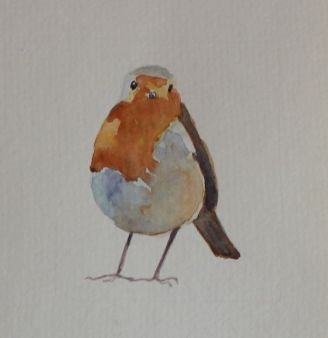
Watercolour painting of robin
Robin #1 (SOLD)

I have been trying out different watercolour papers too. My earliest birds were painted on Etival 300g/m (140 lb) rough texture paper. It was what I happened to have in the cupboard.

Out of curiosity, I tried a different make, Bockingford. Their paper is Acid-Free, and archival quality. I tried two weights. First I tried very heavy 425g/m (200 lb) paper, rough texture. I liked the substantial thickness of this paper, and the paintings turned out well enough but the grain of the paper doesn’t photograph well. I might try scanning them instead, when I am finally up and about.

The second Bockingford paper I tried was a lighter 300 g/m rough texture paper. I think that this suited me best in terms of how the paintings look in photographs.

I have ordered some Bockingford 300 g/m cold press (not) texture paper to try out too. That should be coming early next week. So trying that out will come as a welcome break from my rehab exercises!

Stockists

On this occasion, I ordered my paper from Jacksons Art, as they had an extensive range of watercolour paper and paints on offer.

They also stock the excellent M. Graham watercolour paints. It’s not cheap and so far I have one tube of this paint but I love it more than all my other watercolour paints put together!

In the past I have also used Ken Bromley and Great Art.

Rosemary and Co also make beautiful brushes

Please note that I am not being paid to promote any of these stockists.