We are all glad to see the back of 2020 but I am pausing for a moment to reflect on some of my painting sales over the year. Sadly, my accident and having my leg in a cast meant that I couldn’t get up the steep stairs to my attic studio (or anywhere else) to paint any oil paintings for over three months but things have ticked over during 2020.
I would like to say thank you Rob and David who waited a very long time in the cold with me for the ambulance to come, to the paramedics and firebrigade who got me out of the woods, to NHS staff at Morriston who fixed my very broken leg and looked after me, as well as to the Physical Therapists who gave me lots of advice on exercises over the phone. I still have a way to go!
I have to say an absolutely massive thank you to my brillant husband, Séamas, who trudged up and down two flights of stairs with trays of food many times a day (and lost weight doing so) for months. He kept my spirits up when I got frustrated and tearful. It wasn’t that often as I was so glad to be home but it was all hard work for him in the midst of a pandemic! He also kept the show on the road by packing up and arranging the shipping my paintings. He was, and remains, utterly wonderful!
Here’s a selection of some of my sales from 2020
Some of my “people” paintings sold in 2020
Some of my paintings of Wales sold in 2020
Some of my paintings of Ireland sold in 2020
A Selection of Commissions from 2020
My top four personal favourites of 2020
Owey in Late Spring – Top of my personal favorites of 2020!
Here’s to a happier and healthier 2021 to everyone!
“When a picture isn’t realized, you pitch it in the fire and start another.” (Paul Cezanne)
“Angry Dog” (c. 1938-43) by Edvard Munch – Please burn!
Artists create. Over the years they can create a lot. Not all of it is good.
A while back I read an article about a man who had been left hundreds of paintings by a relative of his, an aunt I think, who was an enthusiastic amateur artist. My recollection of the paintings is that they were bad. Really bad. I mean, I would have struggled to keep one of them (hidden in a dark corner of the house) but he had hundreds of them! Sadly, they weren’t quite bad enough to be added to a collection of the wonderful Museum of Bad Art. Yet, the loving nephew was going to keep and treasure them all! This story has haunted me. As artist Robert Glenn wrote, “There’s enough bad art in the world already and we don’t want to add to it by leaving substandard stuff out and about.”
I just don’t have the room for everything so a cull has been taking place. I have been destroying old paintings of mine that I don’t think are up to the mark. It’s a form of curation. In fact, I believe that destruction and renewal are central to the all creative processes. Writers cut and redraft. I think of the time I wasted reading Harper Lee’s “Go Set a Watchman”, which turned out to the first draft of the much-superior “To Kill a Mockingbird”. Harper Lee was right not to want to publish it. Painting is the same.
An element of destruction and renewal has always been part of my process. If part or all of a painting isn’t working, I would much rather scrub the paint off the canvas and start again than let it dry and attempt to paint over the error. I usually have to work myself up into a minor frenzy to do this. I feel better looking at a scrubbed canvas than one that is “wrong”. Sometimes, I might spend a whole day on a painting that I scrub away and start again the next day (to the dismay of my husband). Usually, this is down to poor light. I don’t often do this, but I think its important to be able to”kill” your work so that better work can come forth. It’s reassuring to know that great artists like David Hockney have also destroyed unsatisfactory work in the process of creation.
Portrait of an Artist (Pool with Two Figures). David Hockney destroyed an earlier version of this painting
Over the years I have stored older, or just less successful paintings away in the attic, behind stacks of other paintings. They fall into two categories a) early work done on cheap canvases. These are easy to destroy with a metal spike. You get what you pay for, I suppose. I actually like some of these paintings, especially the animals and so I have taken a sharp knife to them and carefully cut them from the stretchers.
Saved for another day
I have decided to store these in a large folder the rest will destroyed; and b) work done on linen canvases I don’t think are up the mark. I wont show these to anyone. Again I will cut the canvases from the stretcher to keep the wooden frames to reuse with a fresh canvas. The canvases will be cut up and thrown away. If I had a large garden I’d burn them.
These need to be cut up!
I have tried reusing canvases in the past by sanding them down and painting gesso on them but I am never really happy with the result. I use paint too finely. i like a smooth surface. This is a luxury. In his early days as an impoverished artist, Picasso would often paint over pictures he thought unsuccessful because he didn’t have the money to buy a fresh canvas.
Picasso “Still Life” 1922 – on the front
It is important to conduct the destruction in private so no one can make you feel bad about it. I have found the process quite cleansing. I did not realise that every time I looked around my crowded studio and glimpse the edges of an unsuccessful painting that it brought me down. They reminded me of my failures. That I was a lousy artist. Out comes my imposter syndrome! Ironically, if an artist sells a lot of work, they have little evidence of their successes around them.
Stretchers can be reused
I think that most artists have to come to terms with destroying work that isn’t up to the mark. One of two duff paintings can make all the others look bad. It’s sometimes difficult to decide as many artists develop their style, improve their technique, or just explore new themes so their earlier works can seem at odds with their later stuff. How to decide if it is bad or just different? Lucien Freud is an excellent example of an artist whose style changed significantly throughout his career as he found his own style of painting.
I once went to an exhibition of Cezanne’s early work In Paris and decided, that with the exception of the House of the Hanged Man, most of it should have been burnt. We know that Cezanne burnt his poorer work so it must have been really, really bad! We are best not seeing it.
Don’t put this one of the fire!
Likewise, Vincent Van Gogh should have burnt more. Before he discovered colour and light in the south of France in 1888, he produced a lot of dark and miserable work that no one wanted to buy. Yes, its interesting to see his journey as an artist, but I don’t think the world would have many of these early brown works if he’d burnt them.
Claude Monet was prolific. He painted around 250 “Water Lily” paintings over the last three decades of his life—but originally, there were many more. Before an exhibition of the paintings in 1908, Monet destroyed a group of them with a knife and a paintbrush, disappointed by their quality in comparison to “better” canvases. Time magazine called this a “rage of perfectionism”.
Monet was at this time struggling with his eyesight and was diagnosed with cataracts in 1912. Over the next decade, both his vision decreased progressively as well as his colour perception. Monet had surgery in 1923. He recovered excellent near vision and reasonable distance vision in the affected eye, but he complained bitterly about the world appearing too yellow or sometimes too blue. It took almost two years before he finally told friends that his color vision felt normal. After his surgery, Monet destroyed many canvases, maybe as many as thirty of them. I can only imagine his rage as I saw these substandard works.
Francis Bacon also frequently destroyed work he was not happy with. He worked on the Screaming Pope paintings for about 20 years and some of them turned up as recycled canvas which had been used by an amateur painter, Lewis Todd. When these scraps were discovered the Todd paintings shot up in value. They are still on the lookout for a pope’s screaming head! Below Todd’s paintings (left) Bacon’s scraps (right)
Francis Bacon was not at all thorough about destroying his work. In 2007 a group of damaged Bacon paintings was found in a skip outside the artist’s London studio by electrician Mac Robertson. He sold them.
Georgia O’Keeffe, was another painter, like Monet, who had difficulties with her sight, and who destroyed her own work. Her decision to destroy work was also about keeping her reputation strong. Curation.
She had been diagnosed with macular degeneration in 1964 at the age of 77, and by 1972, her vision had fallen below 20/200 despite attempts at laser treatment, and towards the end of the 1970s she gave up painting altogether. In the 1980s “she wanted to go into storage to destroy some of the paintings that she didn’t think were at her level,” Some allegedly destroyed works have apparently slipped through the cracks.
The one that got away
Red and Green II (1916), one of her first watercolors, is listed in her notebooks as having been destroyed after she showed it once in 1958 at New York’s Downtown Gallery. Yet the work surfaced in a Christie’s New York American Art sale in November 2015.
Some conceptual artists have made a career out of destruction but that’s not what I am talking about here. I am talking about Monet’s “rage of perfection”. It is not vandalism if its your own creation. Sometimes, after a distance of months or even years, you can see your creations clearly. I once only “saw” a painting of mine clearly as it was leaving the room in a collector’s arms. “Ah”, I thought “That’s a lovely painting”. It’s not always the way. Sometimes, I look at a painting from several years ago and wonder “What was I thinking?” I hadn’t been able to see it before then.
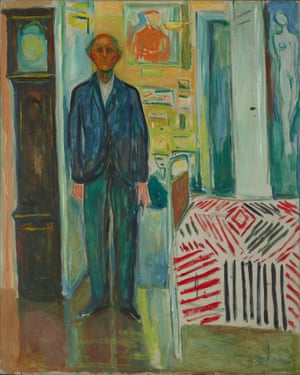
Self-portrait Between the Clock and the Bed
Being able to let go and destroy work is a sign of emotional health. I am not doing so well as many of these paintings were done over a decade ago. I don’t think Edward Munch, who suffered from terrible anxiety exacerbated by excessive drinking, could let go of many of his paintings let alone destroy them.
He was in the position that he did not need to sell his work and he ended up with a collection of almost all his art on the second floor of his house. He even called his paintings his “children”! In Self-portrait Between the Clock and the Bed, which he painted in the years just before his death, Munch seems crowded out by his “children” on the wall behind him. I think they should have been made to leave home!
Anyway, I digress. Artists and writers should be allowed to destroy early work, failures, something that was really only a first draft (Harper Lee), a work in progress or a cry for help (Edvard Munch’s Angry Dog, surely?). It’s not always easy to do. That first novel should stay in the locked drawer and those early paintings and sketches go into the bin. So those paintings of mine in lying in that folder may yet end up on a bonfire!
As a rule, I don’t rework my paintings. Either they work or they don’t. Here’s the exception. This is a large painting (80x100cm) that has hung in my hallway for the past five years. It was for sale on an online gallery a several years ago but for some reason, it was taken off. I am not sure why.
Life in the Uplands (2015)
I didn’t really look at it until this summer when it got moved into our bedroom and I looked at it again. I was talking to my mother and sister on messenger/facetime and they saw it on the wall behind me – “Oh, that’s a nice painting” they both called out. “Oh, no that’s old,” I said as if it was a dress I had smuggled back from the shop. Why wasn’t I proud of it? I thought about it. It was an example of my early work when I was going through a phase of drawing lines around everything. I believed this was in the style of the fauvists like Derain and Matisse.
To be honest, it worked at the time but my painting has changed a lot since 2015 and I wasn’t comfortable with those lines. There was no light. I love painting shadows and light and yet there were none in this painting. Curiously, the omission of the skyline helped give a lightly claustrophobic sense of being in a crowded town. That was its real strength. It was a forerunner of my urban minimal series of paintings of Brynmill which culminated in my “Hollowed Community” Exhibition in Cardiff in 2017 (see examples of this series below)
Top of Rhyddings Park
In light and Dark
Rhyddings House Swansea
Brynmill Primary School
Former Cricketers, Swansea
Former Grocers, King Edward’s Road, Brynmill, Swansea.
Why had I painted this scene on an overcast day? Why had I cropped it in so tight so there was no sky? I really could not remember. I tried to find the view again. I spent some time hanging out of the windows at the back of our house trying to find the same angle. Eventually, I discovered something similar from the attic window.
View from the attic
There were a lot more trees. These are the plane trees line that Bernard Street. This road runs from Brynmill uphill to Gower Road, in the Uplands. The trees branches are cut back to stumps every year to control their growth but they burst forth every summer again (See three of my urban minimal paintings below, which feature the trees of Bernard Street).
Bernard Street, in the Summer, Swansea
Bus Stop (back of Brynmill Launderette)
It wasn’t the only thing that had changed in the last 5 years. Many of the houses had been painted in a different colour. A tin roof towards to centre of the middle (on the right) was now orange with rust. The sunshine also created shadows and changed the colour of many of the roofs.
So I started painting and worked on this when I wasn’t working on commissions. I changed the colour of the chimney pots in the foreground of the painting.
Work in Progress (Summer 2020)
It took some time as I ended up pretty much repainting the whole canvas. The end result was painting with more depth and yet a “lighter” feel. There were still some of those lines but I had reduced them so they did not dominate the painting. I was much happier with this version of Brynmill/Uplands in the sunshine.
Over to Bernard Street, Swansea (2020)
Here are the two paintings side by side so you can see the changes I made.
Life in the Uplands (2015)
Over to Bernard Street, Swansea
My next post will be about the paintings that I decided could not be reworked and what I did with them.
I have been on the Artfinder website since 2013, and during that time I have been fortunate enough to sell an incredible 788 artworks! I am very proud of the 254 5-star reviews that I have collected over the years via Artfinder.
So, I thought that I would share with you some of the customer reviews and messages I received last month from the collectors of my work on Artfinder. They are the icing on the cake for me and my husband Séamas, who has been working incredibly hard packing and shipping my work whilst I am recovering from my broken leg & ankle. I often think that my collectors describe my work better than I can and love reading what they say. I am very happy that my work is appreciated and enjoyed around the world.
After You Are GoneThe Red Roofed House, Ireland
Review by Maureen, I love these beautiful, atmospheric pieces. Emma captures her subjects to perfection. These two pieces are special to me as they remind me of my youth, growing up in an offshore Island in Ireland I look forward to seeing more of Emma’s work.
Winter Shopping
Review by Laurent- “This [“Winter Shopping”] is the third painting from Emma I have bought. As before, everything has been perfect… great communication, delivery in two days.. And it is a beautiful painting!
StormOver Inishbofin
Message: Dear Emma, The painting [“Storm Over Inishbofin, Ireland”] has just arrived safely. It is lovely and I especially like the contrast between the optimistic houses and the darkening sky! Best wishes, Katharine
Between Tides, Tenby
Review by Cameron, Have been viewing Emma’s works & style for a while now so grey happy to finally have 1 of her works hanging in my home [“Between Tides, Tenby”].
Hazy Tenby
Review by Elissa, “Love this painting [“Hazy Tenby”] which was despatched and received within a few days of ordering. Thanks so much, Emma”
Roshin Acres, Ireland
Review By Helen, “We were so pleased to purchase the painting [“Roshin Acres, Irealand”]. It is beautiful and when it arrived it was what we had hoped for when we purchased it. It arrived super quick”.
Perhaps I should have called this post “the invisible people”. I have a bit of a fascination with things and people that often go unnoticed. The unnoticed have now become the invisible. With the coming of the terrible coronavirus crisis, the sight of elderly people on the street is a thing of the past. They are now “self-isolating” for anything up to 12 weeks.
My confinement is more of a challenge than the “lock-down”. My broken leghas me confined to my bedroom and the bathroom. We have too many steep stairs for me to go anywhere else. I just look out the window and take satisfaction in the quietness in the street outside. As an artist, I am used to quite a high degree of isolation. Yet, I know that this level of isolation must be incredibly hard, especially for the elderly or vulnerable if they do not have the internet or can’t work messaging apps. Even if they can, it’s still hard. People need face-to-face interactions with other people, even if it’s only buying groceries at the local shops. I know my father is missing his shopping trips.
Swansea People painting by contemporary artist Emma Cownie
Swansea People painting by contemporary artist Emma Cownie
Swansea People painting by contemporary artist Emma Cownie
I hate how news reports of coronavirus deaths often like to report that a certain number are elderly or “had underlying conditions” as if that somehow means those people don’t matter so much. Every single one of them matters. They are all someone’s loved ones; nan, dad or sister, son. My husband has “an underlying condition” as do my parents, my brother-in-law and many of my friends. They are sheltering indoors, relying on the fit and young to keep the hospitals and shops up and running.
Swansea People painting by contemporary artist Emma Cownie
Swansea People painting by contemporary artist Emma Cownie
So today’s gallery of my people paintings has an added significance for me. This is a reminder of all the vanished; the people you don’t see on the streets. They are still here, at home, maybe, watching TV or listening to the radio. I hope that they are chatting away on skype or messenger or maybe like me they are just peering out their windows.
Walk of Life (Sold)
My “The Walk of Life” painting has added significance for me. When I painted it was struck by the old lady’s determination and how tiny she was in comparison with the younger people around her. I thought the composition captured the variety of life on Swansea, Oxford Street on a summer’s afternoon.
I never thought that I would have my own zimmer frame, but I do. I have to keep the weight off my healing left leg for another 4 weeks so it is vital for getting from my bedroom to the bathroom. It’s a fantastic bit of kit. Light and simple yet sturdy and reliable. Like the lady in the painting, mine has two wheels at the front and I will sometimes carry an object like a book in a bag from one room to another. I have tried holding stuff in my mouth but it just doesn’t work.
I am delighted that the American collector who recently bought this painting is a nurse who works with elderly ladies like this one. He will understand just how liberating a zimmer frame is to the disabled and elderly. During my stay in the hospital, I watched very elderly ladies, who had fallen, broken their hips and had them replaced, push past pain and discomfort slowly but steadily make their way up and down the ward with the help of a frame. Once they proved their mobility they could negotiate their return back home. I have a set of crutches but I like the frame better. So although “The Walk of Life” always was a celebration of the human spirit and determination, but I now know that the old lady is just getting on with her life. She probably doesn’t want applause or pity but she certainly might want to have a good chat.
While the rest of the world is on coronavirus lock-down I am confined to my bedroom with my leg in a very heavy plaster. Moving from the bed to a chair involves a lot of hopping and a zimmer/walker frame. It all takes a lot of effort to achieve simple things that I never gave much thought to before.
I broke my left leg. I have broken both lower bones and dislocated my ankle. Six days ago I had an operation to pin the bones in my ankle. My brother asked if breaking a bone is more painful than a toothache. The answer is definitely yes. I have endured 50 shades of different pain since I went for a walk with our dogs 2 weeks ago in my favourite woods, near Ilston, Gower. It was just about the worst time to break my leg, to be honest.
Ilston River (SOLD)
I had walked about half a mile along the side of the stream. I had bought a new camera with me and my attention was caught by the sunlight on a mossy tree. I decided I would move closer to take a photo. Instead, I stumbled over a muddy stick and as I put my left foot out to steady myself I felt it twist and a sickening snap. I rolled on the wet ground, hoping against hope that I hadn’t done something dreadful but the horrible pain told me that I had. My foot was bent out of shape. Just to think about it makes me feel ill, even now.
As I lay on the ground, I wondered what to do. I tried shouting “Help” a few times but felt silly/useless. What could I do? My husband was in Ireland. Fortunately, I had my mobile phone in my handbag and it was charged with credit so I rang for an ambulance and waited, and waited. The call handler told me not to move. It was cold on the wet mud. I took a photo of my bent leg. I have not looked at it since. I don’t think I can bear to.
Ilston Cwm – Close to where I broke my leg
I assumed that the ambulance would not be too long (I was very wrong on this score) and I started to worry about my two dogs, what would happen to them? I rang my neighbours Rob and Liz and told them what had happened and where I was. Rob said he would come for the dogs. So I waited. I lay and looked up at the sky. Blue patches and white clouds drifted by. It started to rain. Then the sun came out again. I was still lying on the ground. I don’t remember what my dogs were doing but they were nearby. I think Biddy, the collie-cross, tried to present me with a few sticks to throw for her. I clutched my injured leg, it really hurt. I rang my husband. It went to voicemail. “I am lying in Ilston Woods, I think I have broken my leg. I have rung for an ambulance. I have spoken to Liz and Rob. Rob’s coming for the dogs….” I felt bad about leaving him a message when there was nothing he could do.
View From the Bridge 100 x73 cm
After a long time, a family appeared on the track, a couple with their two girls. “Help, I think I have broken my leg”. I think they were surprised by this as they walked towards me very slowly. I told them that I had called for an ambulance and my neighbour was coming. They took my phone number and said they would go down to the road and look out for Rob and/or the ambulance. So they left me and I waited and waited. Company had distracted me from the pain in my leg and being on my own meant being with the pain. I rang my husband again and then Biddy started barking. It was Rob. Thank God.
“How long have you been lying there?”
“45 minutes. The Call handler said to stay where I was”
“That’s stupid advice. She can’t see your situation. You will get hypothermia. We need to get you up” So with great difficulty, Rob helped me up off the wet mud and I hopped in slow agony to a mossy tree, where I first leaned against a trunk and later sat on a low branch. He had brought a heavy hi-vis coat which he put around my shoulders. It was blissfully warm.
I wish I could say that was the end of it. That the ambulance came soon after but they didn’t. We waited and waited and rang the ambulance again. It was difficult explaining where I was to call handlers who were not local. They wanted to know the name of the church at Ilston. Ilston is the tiniest of Gower villages. There are about 10 houses. There is only one church. What did it matter what saint it was dedicated to?
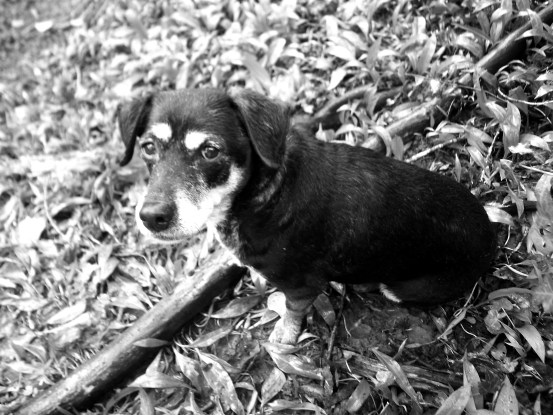
So after another long wait, I asked Rob to walk down to the house opposite the church at Ilston to ask them to ring the ambulance, perhaps they would be able to give better directions. We had often passed the people who live here, they waved in a friendly manner and I was hopeful that they would help. Rob left with my two dogs, Biddy and Mitzy, in tow. I sat and waited. The pain was worse when I did not have any company to distract me. I looked at the mud by my feet. I was dimly aware of a robin on a branch a few feet away from me. And then like a miracle, little Mitzy appeared by my side. She was collarless. I was so glad to see her. She was not leaving me. Good loyal rescue dog to the rescue. I took her photo as a distraction from the pain.
Mitzy the faithful rescue dog, to the rescue.
Rob returned with David (and Biddy on her lead). David is 73 and lives in the house opposite the church. He made several trips along the track, and brought me many very welcome items like a big blanket, gloves, hat and a hot water bottle. I was really thirsty and he also bought a bottle of water but David’s wife had said I could not drink anything, her advice turned out to be right, so I just washed my mouth out with it. He made several trips. The last one in the dark with a torch. He took quite a risk, helping us in the dark. We got excited because the beam of his light reflected in the stream and it looked like two people were coming along the track, but it was just him. It got very dark, The moon came out and a barn owl hooted. We told him to go home, we were worried about him in the cold night air. He reluctantly set off.
I started to think that no one was ever going to come. I was so cold. It would be difficult enough to get me out of here in daylight but in the dark? I kept thinking up with ideas for getting how to get me back to the road; What about a horse? A wheelbarrow? One by one my desperate ideas were politely considered and sensibly dismissed. Rob was a reassuring presence. They will come he said. Then eventually, Rob said, says, “I think I can see lights along the track, more than one!”
At long last, the ambulance service had come. After 5 hours of waiting. Two figures dressed in green, a woman and a man, carrying torches were coming along the path, with David and his brother-in-law leading the way. I was so relieved. Once they were there, I knew they could sort everything out. And they did. Lyndsey the paramedic was lovely and reassuring. She worked under very difficult circumstances. It was dark and very cold. She checked my blood pressure, temperature and although I felt so cold my body temperature was normal (hurray for thermal vests, I say). I was given a small dose of morphine which had me seeing stars and then liquid paracetamol. They called Sketty Fire Brigade to put me on a stretcher to carry me half a mile down the track (and over the church fence) to the waiting ambulance. It was a long journey looking up at the cold frosty stars through the tree branches from that stretcher. It was a full moon. They carried me wordlessly. There was a short snort of laughter when I said “Well Done” after they had hoisted me over the churchyard railing.
Ilston Church Yard
It was a very long night. The journey to Morriston Hospital Hospital seemed slow. Where are we now? I would ask. It was the pain that made it feel that way. We waited outside A&E in the ambulance for quite a while. Lyndsey told me her mother was the first baby born in the NHS and called was Aneira, after the Welsh founder of the NHS Aneurin Bevan. Eventually, I was taken in for my first X-ray. I was visited by a number of doctors who introduced themselves to me by their first names; Jeremy, Mohammed, Chris there were others but I have forgotten them. After a wait, the doctors in A&E manipulated my leg (I was under light anesthetic) and put it in plaster so that the agonizing swelling could start to go down. The leg was X-rayed again. Everything was aligned nicely. Every now and then the average waiting time in A&E was announced on the loudspeaker. It started at 8 hours, later it was 13 hours and then by lunchtime the next day it was down to 2 hours. I lost track of time. I didn’t get much sleep in A&E. It was a fascinating place, very hectic. No wonder there are so many drama series set in Emergency Rooms & Casualty Departments.
Anyway, to cut a very story short I waited a day for a bed in the trauma ward. I then spent another 7 days waiting for the swelling to go down so the ankle could be pinned. I was “nil by mouth” for 4 days in a row but never made it to the operating theatre. Thankfully, on Monday I did, finally. It was probably just as well as the ankle specialist was working that day. The coronavirus emergency meant that the ward was rapidly cleared, as they needed the beds and staff elsewhere. I was sent home on Tuesday via Red Cross Ambulance.
All through this experience, I have been impressed by the kindness and amazing patience of medical staff as well as just how much pressure the NHS is under. The pressure has just intensified ever since. I would like to thank Rob and David in particular, who waited so long in the cold with me, and Liz and David’s wife, and anyone who I came in contact within A&E, Ward A (which then had to move upstairs to become Ward G), the operating theatre and the Red Cross. Thank you xxx
Postscript:- Biddy and Mitzy went home with Rob and slept all the next day. Seamas flew back from Ireland on a plane full of racegoers heading for the Cheltenham Races.
I am winding down the social media for a while because we are leaving the UK to spend some time in our house in Burtonport, Donegal, Ireland. The internet will be available on a very limited basis so I won’t be able to post on here until mid-April. I will be checking my emails but I won’t be posting much, if anything, on Facebook, Twitter & Instagram.
I have mixed feeling about the enforced “break” from social media. On the one hand, I hate the way how it sucks up all your spare time and energy and how FOMO (fear of missing out) has you checking updates. There’s always the fear that if you stop “spinning all the plates” that people will forget about you! However, I am certainly looking forward to reading books, listening to the radio (there’s no TV either) and sketching and painting for fun (not oils but watercolour sketches).
I am very excited/nervous about the whole thing because I am driving there and it’s a long, long way.
Please be aware that any artwork purchased after 25th March will only be shipped after 12th April.
My Top 10 tips for selling art online. I am sometimes asked for advice on how to sell art online. To be honest, I feel like there is so much I don’t know about Art marketing, but I did sell over 200 pieces, originals and prints last year and half of these were direct sales to collectors so something’s working. Marketing and selling art takes an enormous amount of time and effort. At least 50% of my day is spent on marketing. The great thing about it all is that the longer you do it the more followers and fans you will gather. It’s an investment of time – but it cuts both ways. You will spend hours at the keyboard, posting away (sometimes wondering if it’s worthwhile) but you will develop a following. Some of it casual, some of it very loyal and dedicated indeed. You need to remember that it may take months or even years of following an artist’s work and career before a collector buys your work. Your fans are invested their time in your you and your “journey” too so you need to keep them with you.
So here are my top 10 tips (BTW there is no affiliate marketing in this blog post and there’s so much more I could say but I’m sticking to 10 tips for starters).
Your story – Be positive. Nothing succeeds like success. There’s enough depressing news out there and your art is (hopefully) an escape from all that unpleasantness. So it’s important to celebrate all your successes no matter how small; every sale, exhibition, painting-in-progress is a cause for celebration. Don’t ever be tempted to say that you aren’t selling or you hate online galleries. Instead talk about your latest project. Explain WHY you make your art. How does it make you feel?
Celebrate where ever you can
Have your own website – don’t build your house on someone else’s land. There are many different hosting platforms out there. There are some that specialise in hosting artists such as artweb, fasco and artmajeur or the very popular wordpress. They will all charge an annual fee (update: Artmajeur’s free plan now allows unlimited artworks to the site). You need to make sure that your site has ecommerce facilities. That means it doesn’t just function as a gallery but also as a shop where collectors can buy work.
Start blogging – a great way to tell your story is to write a blog. I use WordPress but there are other blogging sites like blogger and many websites will have a blog page integrated into the site. Your blogs don’t have to be great long essays but the important thing is to blog regularly. Some bloggers blog once a day, others once a week. Don’t be an occasional blogger. There’s nothing more frustrating than a blogger who only blogs three times a year. You will lose followers if you are inconsistent. Keep focused. Blog about your art and inspiration or art in general. Why do you make your art? How does it make you feel? Don’t blog about the news, your family, what you had for tea, latest fashions unless it’s directly related to art, and what inspires you. Which brings me to…
Be a regular blogger to build an audience
Social Media – there are lots of outlets, Facebook, Instagram, Twitter, Tumblr, Youtube, etc. You don’t have to do them all (I dropped Tumblr, for example as it was a bridge too far) but make sure whichever platform you choose to be, do it well. To honest no one platform is necessarily better than the others for promoting your work, all of them will do something to help. Don’t post twenty times a day – it will seem like you are spamming people and they will unfollow you. Once or twice a day is enough, maybe three times on twitter. Hashtag your own name too #emmacownie so people can follow your work across the platform. The important thing to remember is that it’s called social media for a reason. You have to be sociable. If someone comments on your post it’s good manners to respond, with a “like” and a “thank you”. It’s important that you support other social media users and follow other artists, photographers of any supporters who like, comment on, and share your posts and return the favour. We all need encouragement. It’s important to encourage others. I have made many good friends out there in the online world. Again. like the blogging try not to mix business and personal stuff on your Art pages/sites – have a separate one for your own family stuff and stick to art-related things on your Art accounts.
Not really material for an artist’s Instagram feed
Pinterest – It’s not just for recipes! It has 250 million users every month, with 25 million users in the US and about 80% are female. It’s not a social media platform but a search engine. It’s well worth joining to get your work seen and develop a following. It also a really good source of information about art marketing. I have learnt a lot about blogging, pinning, marketing, and websites from pins on Pinterest. If you want to see a selection, I have saved my Buying and Selling Art pins here.
My Pinterest page
Canva – is great for creating professional-looking blog covers, Pinterest graphics, and so on. I use it all the time. There’s also Pablo and Visme which does some pretty awesome infographics.
SEO– Use Key Words in your posts so that search engines like Google and Safari can find you. A website that is well optimized for search engines “speaks the same language” as its potential visitor base with keywords for SEO that help connect searchers to your site. I find this a vast subject but there are pins on Pinterest and sites like Moz.com will help you improve your SEO. Make sure that when you post your pictures on your website that you filling all the boxes.
Fill in all the boxes
Newsletters – build a list of email addresses on your website. These are your fans, collectors and interested artists. Some collectors watch your progress for years before they buy. This is how you keep them in touch with what going on with you. Not every one uses social media, especially older collectors but they read their emails. Again send out your newsletter on a regular basis, say, every fortnight or once a month. Mailchimp is a marketing platform that offers a free (if your list is under 2000 names) sign up forms and newsletter service. There are others here
Finally, Online Galleries – there are loads and loads to choose from. There is a very long list of online galleries here. It’s a bewildering choice. Some work better than others. There are massive ones like Saatchionline where it is difficult to be seen and smaller ones like Artbazzar that have less of a budget for advertising, there are others that charge to be on them like Artfinder and Artgallery. Others are still free to be on them such as Singulart, but they charge higher rates of commission. It makes sense to have a presence on several sites. Online galleries can be good for sales if they promote you.
Just remember that putting all your energies into one website or social media site is foolish, as it’s like building your house on someone else’s land. They all change their algorithm, pricing policies, curators, and what might work for you one year may not the next. I’ll give you an example, last year Facebook shut down my Emma Cownie Artist Business page with no explanation. This is not uncommon on Facebook. I tried in vain to find out why it had happened and to get it restored, to no avail. I lost thousands of followers and their contact details. I was devasted. That’s not a story I usually share as it’s not a positive one but let that be a warning not to put all your eggs into one social media basket (thankfully, I hadn’t, but it still hurt).
Facebook locks people out of their Business pages
It’s always sensible to be on several platforms and sites and encourage your followers to follow you on different platforms. You can do within many ways such as an email signature with links to your social media platforms. There’s so much to learn and there are plenty of people out there who will offer tempting online courses on Art Marketing but I prefer to teach myself. I hope that this post will help other artists get seen. I welcome any comments, suggestions from other artists or commentators
Delighted to have Sold this classic “urban folk” painting “Night Jacks” to a collector in Utah in the US via Artfinder !
“The title of this expressionist “urban folk” painting takes it’s title from Hopper’s “Night Hawks” – I have “Britishized” Hopper’s painting which was set in an American diner by using a British alternative or even equivalent the ever present Fish and Chip shop instead as it seemed appropriate. The second part of the title, Jacks, refers to a name we have here in Swansea for people who come from Swansea.”
This is one of my favourite reviews of my work from Gallery OMP in Hereford, England.
“Looking at Emma’s painting you may get a sense of Paul Gauguin’s use of yellow and red, Robert Bevan’s blue green trees with purple, Henri Matisse’s simplification and exaggeration of form and Andre Derain’s bold definition of shape within the landscape. Emma likes the Fauvist simplified forms, use of lines and bold combination of colours. Emma challenges herself not to keep producing paintings in one style or influence, and is reactive to the scenes and feelings she is faced with when in front of a potential subject. She has created at the other end of the light spectrum too, capturing night-time urban, city scenes. There are so many subjects for Emma to apply herself too, as she is located in Swansea with so many different types of landscape close by – woodland, mountain and coast. It’s all about the light for Emma, capturing the excitement of it playing on her subjects. A true case of what’s left out by the artist with a clever use of colour to take the viewer’s mind on a journey into the depths of the image.”
Review – Gallery OMP, Hereford.
Large Limited edition mounted prints are available here