Posted on 37 Comments

Walking the Gower Coast; Limeslade and Langland Bays

Gower Coast without a Car 2016
The Old Leaflet

This was all my sister’s idea. She suggested I walk along the Gower coast and paint the bays and beaches. I had no idea how difficult the logistics of this would be. I had the daft idea that catching buses and walking the coastline would be easy. After all I had a jolly looking-leaflet “Gower Coast and Countryside with out a Car” with a photo of a bus on the front.

Sadly, it turns out that Swansea Council have changed their mind and aren’t that keen for walkers to come and visit this “Area of Outstanding Natural Beauty” (since 1956, you know).

Tourist Info.jpg
Closed

I’d picked up that leaflet two years ago. I had called into the Swansea Tourist Office,  sensibly located next to the bus station. There were two helpful ladies who gave me lots of leaflets where told me where I could get up to date bus timetables.

When I tried to revisit them last week, however, I was horrified to discover that the office was closed. There was no notice about where to get tourist information. Swansea council claims that 11,100 people are employed in tourism in Swansea but they can’t find the money to fund two people and some leaflets in a tourism office!

Bus Info.jpg
Bus Station Info Point

Not to be defeated, I called by the bus station, in the hope of getting up-to-date timetables for Gower bus services. I had to wait several long seconds whilst the youth on the information desk pondered over his suduko puzzle, sighed, and looked up. When I asked about buses round Gower he tore off two A5 sheets of paper for the week-day buses to North Gower and to Rhossili. He then went back to his puzzle. I wasn’t filled with confidence about getting around the coast by public transport.

Tescoes IP
Tescos

I went home to look up on the internet where the office had been moved to.  It hadn’t; it was gone. The tourist information office in Mumbles has been closed too. I emailed the tourism people for help. I was tartly informed that information was moved online and supplemented by a series of “information points” around the city where I could get help. I initially thought that these might be sort if dedicated tourism-related computer terminals. turns out that these “information points” are leaflet racks. I wqs informed by the tourism person that they were “a network of Visitor Information Points (VIPs) across the destination, offering a drop-in facility for visitors with plenty of advice, maps and leaflets at the ready!” I didn’t feel very encouraged by this. So I went back into to town to have a look. The first information point I visited was in the foyer of Tescos. There was no one to speak to here.

IMG_20180328_110321 (2)
Grand Theatre

I then visited the foyer of the Grand Theatre where they had a number of racks filled with leaflets. There were staff there. They were sitting behind a glass screen at a counter. There was a queue of people waiting to buy tickets. When the queue went so did the counter staff. I lost heart. I didn’t think they’d thank me for asking them about buses to Port Eynon and I knew that they’d direct me to the bus station, so I left. Whilst was at the Grand Theatre, I did pick up a leaflet which spoke volumes about Swansea Tourism’s much reduced ambitions for tourism the area.

teaserbox_56937528

Instead of “Gower Coast and Countryside without a car”  it’s  now “Mumbles and the City of Swansea without a car.” Swansea and Gower really need the money that tourism can bring to the local economy but the local council just fail to provide the infrastructure that is needed. I’ll come back to the issue of bus timetables later, as it is something that has kept  me awake at night trying to figure out how to go and get back from places in Gower.

Mumbles to Caswell.JPG
Caswell to Mumbles Head

Limeslade. This is where I decided to started my Gower Coastal Walk in 2018. The “First Cymru” buses from Swansea Bus station run every hour along Oystermouth Road. It is a very good service. As a shy teenager I had a terrible fear of speaking to bus drivers. Not anymore. These days, I gabble at them and give them long questions about the right ticket and the correct time.

IMG_0495
My first bus stop

The bus travels along the seafront road to Mumbles and then snakes its way around the bungalows of Langland. Many cheerful white-haired passengers got on and off the bus with their bus passes. Many of them seemed to know each other and they chatted away to each other and waved at friends out of the window. The sunshine has cheered everyone’s spirits. Finally, at the bottom of Plunch Lane, the sea reappeared and I dismounted.

IMG_0507.JPG
The bus at Limeslade

Here there is a little rocky bay called Limeslade Bay, which is a five minute walk round the corner from Mumbles Pier and Bracelet Bay.

Why is Limeslade called Limeslade? Well, limestone is a big feature of the Gower landscape. From Mumbles to Oxwich, the coast is made entirely of Carbonifeous Limestone that has been faulted and folded. There are many little valleys along the Gower coast called “something-slade” and that’s what “slade” means -in an old English word (“slaed”) meaning a low valley, dingle or an open space between banks or woods. Which might surprise you that a Welsh coastline has so many names of Old English origin rather than Welsh. This reflects that fact that Norman landlords claimed the more fertile southern part of the peninsula and left the wilder, less profitable northern parts to the Welsh.

There are two paths you can take from here. There is the official Coastal path which snakes along above the sea following the many inlets. I have taken this path many times before.

IMG_8870.JPG
The Coastal Path

The second one, sneaks up alongside the left hand side of Fortes ice cream parlour, up a steep muddy track onto the Rams Tor. This is the path I took.

IMG_0510
Forte’s, with the steps to the higher path to the left

It is worth the climb. There is a great view of the lighthouse and the Coastguard station, and if its clear enough, further across Swansea Bay to to Port Talbot and Porthcawl.

IMG_9028.JPG
Mumbles Lighthouse from Rams Tor

This is where the coast feels more like West Wales. The stubby trees and gorse bushes all lean lean to the left thanks to the prevailing westerlies. Once on the headland the walk is quite easy, if not a bit muddy. You pass by a few of the houses that lookout over the sea but as you carry on further along the path, the houses recede, with fields in the way. Quite quickly, Langland Bay comes into view. I love the view of the coast where you can see the bays of Gower off into the distance.

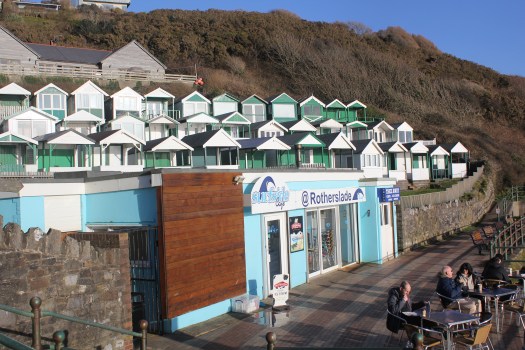
Rotherslade
IMG_3727
Rotherslade

There is a small cove before the main sweep of Langland Bay. This is Rotherhide. Beteen the two bays is Storrs Rock which the French Impressionist painter Alfred Sisley painted in 1897 whilst on staying  at the Osborne Hotel, which overlooked both Langland Bay and Rotherslade Bay, which was also called Lady’s Cove. His stay here must have been very a bitter sweet. He had come come  to marry his partner, so as to legitimize their two children, but both he and his wife were dying of cancer. He painted Storr’s Rock at many times of the day.

IMG_3915.JPG
Storr’s Rock 2018


Storr’s Rock (2018)

Langland 

IMG_0587.JPG
Langland Bay

Langland Bay is very popular with surfers and day trippers but its unusual for modern day sea-side towns, as it has not been hollowed out by holiday lets. That’s because Langland is an expensive place to live and its tiny lanes are often filled with Mercedes and BMWs. Wales’s first millionaires, the Merthyr iron-masters the Crawshays, set the tone in the mid-19th century when they built their massive summer residence here. It was originally known as Llan-y-Llan and looks as if it was ripped intact from the Scottish Highlands. It was later part of the Langland Bay Hotel but is now called Langland Bay Manor and been converted into swanky apartments that wont leave much change from £300K.

langland3.jpg
Old Postcard of Langland
IMG_3750.JPG
Langland Bay 2018

The clean lines of green and white beach huts have become another status symbol. These  striking green and white huts were built in Victorian and Edwardian times. They used to be dolled out to families on a lottery basis, at the very reasonable price of £236 for a three months lease. More recently, however, a cash strapped council decided it would raise money by selling some of the refurnished hut’s leases at a whooping £10,000. You would get to use of your hut for ten years and although the huts can be used every days of the year, you cannot sleep in them in overnight. I don’t know if anyone checks this! None of the huts were in use when I walked past but it was a chilly midweek day in March.

IMG_0003.JPG
Langland from Snaple Point

IMG_9978.JPG

Gower Coastal Path from Langland to Caswell

I continued my walk around the bay and again instead of following the official Coastal Path, I climbed up Newton Cliff which is alongside Langland Golf Club to look across Langland Bay.

IMG_0810
Langland Bay from Newton Cliffs at Sunset

After the climb up Newton Cliff I was starting to get tired. This is when I made a stupid mistake. I left the beaten track. In stead of following the footpath down the hill to rejoin the official coastal path, with its easy tarmacked surface, I decided to try and follow what I thought was a path along the top of cliff along the edge of the golf course. The sun had gone in and it started to spot with rain. This was a disaster, I ended up struggling down paths covered in brambles sleeping-beauty-style, only to eventually admit defeat and retrace my steps. It was a long detour. I ended up asking directions from some rather bemused looking golfers. I could tell one of them wanted to tell me off for being on the golf course but I was apologising so much, he just said “you shouldn’t really be here” and then directed me back to the official path.

By the time I reached Caswell Bay, I was very tired indeed. I had eaten the single banana I’d brought to eat long ago so I queued for minutes in the very crowded “Surfside Cafe” and bought a chocolate ice-cream which revived my spirits considerably. I then waited at the bus stop for the hourly bus back to Swansea.

What I learnt

  1. It hard to write notes on a bus.
  2. Take sandwiches.
  3. Stay on the beaten track – if there’s no post it’s not a path.
  4. Look at the map – put it in your pocket, don’t leave it in your rucksack.
  5. Leave longer than you think
  6. Leave the book on Gower History at home.  It’s heavy.
  7. Don’t believe the weather forecast. It can go from warm sun to wind and rain.
  8. Most importantly, check your camera lens for smudges. Most of the photos I took today were no good (see below).
IMG_0675.JPG
Langland Bay with smudge on the left side of the lens!

What I got right

  1. Coat with hood
  2. Walking boots
  3. Bananas are great
  4. Water bottle – its heavy to start with but you end up drinking most of it.

Next post – Will lots of chocolate biscuits see me through to see the stunning views from Pennard Cliffs?

P.S. Here’s some drone footage of the coast and Langland Bay (BTW The sea isn’t usually this colour)

Posted on 10 Comments

Walking the Gower Coast: Mumbles

Mumbles

I love looking at maps. I have been gazing at the map of coastal path around Gower for days now. The Peninsula juts out westwards into the Bristol Chanel. Its about 17 miles in length and 8 miles width at its widest point. I am planning to walk around its coastline, approximately 38 miles in length, maybe a bit less.

I am, however, going to start with a map of Swansea Bay. People who have never been to Swansea make jokes about the place as if its somewhere to avoid. Quite the opposite. The hilly city sits alongside the sparkling sea and beautiful sandy five-mile beach.

Swansea Bay
Swansea Bay

I have decided to illustrate this series of post with my paintings and with (mostly) my own photographs. The paintings have been completed in recent years, some as a result of this trek, other are older. The photos are mostly from 2018 but a few are from my 2016 attempt to walk the Gower coast. I started my first attempt at Mumbles in 2016.

26907770_1925593071038159_2048231183779527812_n.jpg
Photo Credit: Gower Flight Centre

The pretty Victorian village of Mumbles sits at the far end of the western arm of Swansea Bay. This is where my journey around the Gower coast begins.

Round Mumbles Bend.jpg
Round Mumbles Bend

Mumbles was originally a fishing village. It did not catch fish but rather, oysters. It was, for a time, a thriving industry. Part of Mumbles is known as Oystermouth and many people often use the two names interchangeably to mean the same place.

The Strange Afternoon.jpg
The Strange Afternoon (Mumbles & Oystermouth Castle)

Many people often associate South Wales with coal mining, and coal was certainly vital in locating the copper industry in nearby Swansea. It was the need for limestone, however, that changed Mumbles’ fortunes. Limestone was used as a fertilizer, in steel making, pharmaceuticals, and also as a construction aggregate (in other words, gravel).

Tide's In, Mumbles
Tide’s In (Mumbles)

Mumbles was made of limestone and that fact brought the modern world to the front door of this tiny fishing village in 1804 when the Oystermouth railway line was built in order to transport limestone from the quarries of Mumbles to Swansea Docks. This track was the world first passenger line, the Swansea and Mumbles Railway, carrying at first horse-drawn carriages, and later steam locomotives.

Mumbles Pier From Knab Rock.jpg
Mumbles Pier from Knab Rock

The trains also brought many day trippers for a time. The railway is now long gone, closed in 1960, but there remains a sturdy promenade that runs along the sea front where the trains used to run. Locals and visitors alike still love to walk its length and admire the spectacular view across the sweep of Swansea Bay.

Afternoon Stroll in Mumbles.jpg
Afternoon Stroll in Mumbles

The promenade runs up to Verdis, a popular ice-cream parlour and thence to the Mumbles Pier. The Victorian pier was built in the last years of the 19th century and was the last stop for the Railway. Here tourists could catch a paddle steamers for a tour along the River Severn and Bristol Channel. The Pier hosts a great cafe (with self-playing piano), an amusement arcade and tiny art gallery.

Mumbles Piers.jpg
Mumbles Pier

On the other side of Mumbles Head is Bracelet Bay.  Mumbles Head comprises two tidal islands. At low tide those with stout boots can walk out to the islands and look at the much-photographed lighthouse.

Towards Mumbles Lighthouse (2).JPG
Towards Mumbles Lighthouse


The octagonal lighthouse lighthouse was built in 1794 by Swansea architect William Jernegan, who also designed Singleton Abbey which later became part of Swansea University. This was the second attempt to built a lighthouse here. The first one started a few years earlier, designed by someone else, collapsed before it was even finished!

Clouds Gathering Over Mumbles Head
Gathering Clouds over Mumbles Head

This is where the real Gower coast walk begins! In my next post I puzzle over myriad bus timetables and eventually feel brave enough to leave the car behind!
In the meantime here’s a cool video of a drone flying around Mumbles Head.
https://youtu.be/MvGQhPzQlKo

Paintings of Gower Book

UK- See the book on Amazon.co.uk by clicking here

USA – See the book on Amazon.com by clicking here 

Posted on 21 Comments

Welsh Coastal Magazine

Welsh mag 3

I am delighted to have been featured in April’s edition of Welsh Coastal Magazine as part of their ongoing series “Inspirations” on contemporary artists in Wales. I have included some images but you can read the online version here.

If you would like to buy prints from artmajeur.com click here.

Article clip

Clip #1

Posted on 22 Comments

Walking the Gower Coast. The Rules.

Coloured Sands at Three Cliffs.jpg
Coloured Sands at Three Cliffs Bay

One result of developing PTSD over 5 years ago is that for a long time I had limited energy. I honestly cannot tell whether my energy levels have returned to “normal” levels yet, or ever will. I find that it takes me a couple of days to recover from social events (and no, it’s not a hang-over as I don’t drink alcohol) or from traveling/visiting family or another town. Maybe, everyone my age is like, I don’t know.

I used to have ambitions or even a sort of “bucket list” of things I wanted to get round to doing, some time. I don’t much care for the term “bucket list”. If you haven’t heard about the term “bucket list”, it is a list of all the goals you want to achieve, dreams you want to fulfill and life experiences you desire to experience before you die. Here was mine.

  1. Learn to surf
  2. Learn to Meditate
  3. Walk the coastline of Gower
  4. Run a marathon
  5. Walk the pilgrimage route to Santiago del Compostela
  6. Visit Japan

I did learn to surf and I was very keen for a while, but I was never terribly good at it. I also once went on a 10-day meditation course. There was no talking for 10 days. Strangely, that was the easy part. I was running 20-25 miles on a weekly basis when my life took a swift left turn and everything ground to a halt in 2012. I am still active but I don’t run very far at all these days. I know I won’t be able to run a marathon unless I gave up everything else and just trained, ate and slept. There would be no energy left over for painting and making a living, so that’s out of the window. I cant afford to travel, not at the moment so it’s going to have to be number 3.Walk the coastline of Gower.

Gower-Map-M-1024x516.png

I have a curiosity about exploring the whole coastline of Gower. I know and love certain parts of it very well, such as Three Cliffs Bay. As a painter of the Gower peninsula there are parts that I have visited and painted many times. However, there are also parts I have not visited for years, and a few places I have never visited. I did plan and start to walk the Gower coast in 2016, but it all came to a halt as I tried to cope with the repercussions of being made redundant from my teaching post where I had worked since 1999.

So start again. Here are my rules

  1. Travel in a clockwise direction around the Gower coast
  2. Travel by public transport and by foot.
  3. Walk on sunny days.
  4. Erm, that’s it.

I will document the walk with photos, sketches, and paintings. However, I am nervous about this. The big challenge for me will be in terms of my energy levels. The whole coastline is something like 38 miles long and I know I will have to divide that up into many short walks that will be very tiring for me. I will probably need a week to recover in between walks. I am nervous that I won’t have the determination to finish this, or something will happen to put me off, such as in 2016 when I got part way through in 2016 and gave up. I hate not finishing things.

Worms Head Coast Watch Station.jpg
Coast Watch Station, Rhosilli

It will also be challenging for me mentally. When I was younger, I did many brave things on my own. I traveled around the UK and spoke at Academic conferences, I even traveled to Texas very soon after I passed my driving test and drove a hire car. The PTSD has had the result of reducing my life and what I do, either because I get tired or because I am fearful. PTSD means that my brain goes into anxiety mode very easily. My head will worry about the coming back before I have even left the house.  I will convince myself that none of the buses will arrive and I will be stranded in the wilds of the Gower and have to sleep under a bush. Yes, it all sounds stupid when I type it, but that’s the sort of thing that keeps me awake at 3am in the morning.

So I will have to prepare well, take a load of bus timetables and set off early and challenge the fear. A few weeks ago I panicked and jumped into the sea, thinking I was about to get washed off some rocks. Bizarrely, the evidence has given me confidence. The boots and I survived. It was uncomfortable but the boots dried out on my radiator. So I will make a start this week, even if it takes months to complete the challenge.


Posted on 24 Comments

The ever changing landscape

I am very lucky to live close to the sea. I can never get over my excitement at seeing the sea, even when I live so close to it. I would say that all of the Welsh coast is pretty special. The coast along Pembrokeshire, Ceredigion and the Llyn Peninsula are spectacular however, the Gower peninsula is the coast I visit most often as it’s the easiest to get to for to get to and its paintings of the Gower peninsula that work on most often.

swanseaGower has some incredible coastlines and fabulous beaches. I have always wanted to walk its length but never got my act together to do it. I made plans to do so in 2016 but being made redundant from my teaching job in that year, sort of threw everything out of kilter for me.

The best beaches always involve a bit of a hike but its always worth it. From an artist’s point of view its always different. Whether its high tide, low tide, summer, spring or a blustery winter’s day. What’s the main difference between the seasons? The light. Whether the sun is high or low in the sky, the angle of the rays, the quality of the light. Is it sharp or is it hazy?

Drifting Clouds on Three Cliffs
Floating Clouds over Three Cliffs

I have painted Three Cliffs Bay quite a few times. I am find it interesting to reflect on the different ways I have approached what is in some ways the same subject matter. In winter the sea is a grayed jade the wet sands are pinkish, the dry sand different shades of yellow. The colour of foliage is very muted; the grass on the clifftops is more yellow than green and the bracken is brown. The cliffs are warm grey in direct sunlight, a cooler grey in shadow.


Even on brighter days when the sea has more violet the colours of the cliff tops is more yellow ochre than orange.

Coloured Sands at Three Cliffs
Coloured Sands at Three Cliffs Bay

Three Cliffs Bay at High Tide

Three Cliffs Bay at High TideWhat surprised me when I compare these winter paintings with some that I had done in the summer is that the wet and dry sand is the same ruby/pink/yellow tones, although it seems obvious that it would be now I think about it. What is different, is the sky and the colour of the grass and bracken on the cliffs. The sky is a lighter turquoise and the sea is has more jade and turquoise. The clouds reflections in the surf is still violet. The grass is wonderfully verdant, a sharp green.


This is the oldest painting and it was done in high summer when the grass is a deeper green.

Pobbles and Three Cliffs

Of course, looking through these paintings, I immediately wish I had done some autumn paintings when the bracken is a rusty red. I have painted Rhossili Bay in autumn but not Three Cliff. I can’t think why not. Of course, last autumn I was focusing on my “Hollowed Community Project” and painting houses. I hope that I will be able to come back and paint Three Cliffs again this autumn.


Posted on 16 Comments

Gower Walks (wet feet are optional)

IMG_4453-001.JPG
Fall Bay

The sun is out. So I am out too with my camera. Looking for inspiration for some Gower landscape paintings. We drove down to Rhossili at low tide to look at the rocks. My husband is from Northern Ireland and he was feeling homesick for some monumental rocks like those at Giants’ Causeway. Now, Gower doesn’t have pillars of amazing basalt rock but we do have some pretty grand tors.

The walk from the National Trust car park at Rhossili was certainly bracing. The wind was super cold and strong enough to make me nervous about approaching the cliff edge to take photos. People have fallen to their deaths here. The sheep are all pretty blase about it, though.

IMG_4859.JPG
Blase Sheep in the wind

Behind the bay rises Rhossili Down to a height of 600 feet. It is the remains of an old beach level much eroded later on by the ice sheets of the last but one ice age. The bench of land below, with the Old Rectory in its middle, was caused by earth slumping down from above during a cold phase. Although, it seems like a wild and out of the way place, people have been here for a very, very long time. A Neolithic hand axe – the oldest human artefact found in Wales – was found here and is now on display in The National Museum in Cardiff.

IMG_8295
Worm’s Head

We walked into the wind and past Worms’ Head with its exposed causeway and found a flock of sheep eating turnips scattered amongst the straw-stubbled ground. We walked along cliff tops, and looked over a long dry stone wall inland to the medieval strip farming that still continues in the fields there. This is one of only a few Medieval “Vile” Field systems left in Britain.

IMG_4734.JPG
Sheep on a Medieval Strip Field

The path then splits. You can continue along to top of the cliffs to Mewslade or take a path to the right which dips down to the top of Fall Bay. There is a small collection of wooden boats way above the beach, some are attached to metal rings embedded into the rock. Its a lot easier to make your way down to the beach through this path than it is via a gap in the cliffs at the east end of the beach.

The high parts of Gower are made of the oldest rocks. The downs that loom over Rhossili  and Cefn Bryn are made from Old Red Sandstone.The rest of Gower is made from Carboniferous Limestone. The coastline cuts across a bed of folded of Limestone at an angle of 45 degrees towards the sea, to expose curious diagonal layers of rock.

IMG_8478
Layers of Rock at Fall Bay

IMG_4632-001.JPG

View Towards Mewslade Bay

So here my afternoon takes a slightly wetter turn. I had climbed onto rocks that lay between Fall Bay and Mewslade Bay further along the coast. The sea was crashing around me. I felt quite safe. The rocks were not slippy. I thought the tide was still going out.

Then my husband shouted at me “The Tide’s Coming in” and I looked at my watch. It was exactly 3 o’clock. Low Tide. For some reason, I then decided that the crashing waves were coming a lot closer. I hesitated, the patch of beach I had jumped from onto the rock was submerged in incoming water. I waited. The water just got deeper.

Then, my stupid PTSD head kicked in. It goes for the worst scenario. What if it never retreated? What if was going to get washed away? I was going to get washed away! I was certain. So, I panicked and jumped into the water. It came up to my calves. It was really cold. The bottom half of my jeans were very wet and my walking boots full of water. I sloshed through the sea water and onto dry land. Emergency over, I tried to cover my sense of foolishness by blaming my husband for “frightening me”.

I didn’t drown or even catch cold for having to walk back to the car with wet boots and drive home again. I had a hot bath as soon as I got home but there’s always part of me that believes that you have to suffer (or at least go to great lengths) in the process of creating your art so I find mild exhaustion and hardship rather satisfying. As if deep down I think it will somehow make the paintings better!

IMG_4583-001.JPG
I have cold wet feet, can you tell?

Thurba Head
Thurba Head

Posted on 4 Comments

Llangennith Beach across Rhossili Bay

Painting of Gower, Rhossili Bay_EmmaCownie


Llangennith across the Bay
Llangennith Beach across Rhossili Bay


Rhossili Bay is the most breathtakingly beautiful amongst all the Gower landscapes. The sandy beach is three miles long. This beach regularly features in national newspapers’ lists of top 10 top beaches in the UK, Europe, and even the world. It was voted Wales’ Best Beach 2017 and one of the UK’s Top 10 Beaches for five years running in the TripAdvisor Travellers’ Choice Awards. The wonderful thing about the beach is that it is so massive that it is never the slightest bit crowded. The National Trust car park at Rhossili might be crowded and the lanes from the village of Llangennith to the beach might be jammed with surfers’ vans, but there is always plenty of room on the beach!

It is quite a challenge painting somewhere as well-known and as beautiful as Rhossili Bay. The sheer size of the bay means that the beach and Rhossili Down, the hill that rises up above it, often seems to “shrink” in pictures. The dunes beyond Llangennith Beach are an interesting feature to paint, as well as the hint of Llanelli in the distance, on the shore opposite the peninsula that peeps round the corner of Hillend Burrows. I usually prefer to paint the bay in the late autumn or in winter when the bracken on the Down has turned a fantastic rusty red. The darker greens of high summer are less interesting to me, so my main focus of interest with this painting was the lines of waves on the beach and the changing colour of the sea. I consciously chose a “flatter” more graphic approach to painting the beach and sea in the landscape. As an artist, I am always exploring different ways to approach a painting a scene. Sometimes I use a looser, painterly style, others a more graphic style. I think that element of exploration and challenge keeps me interested in what I am doing and keeps my work “fresh”.

© Emma Cownie 2017


Posted on Leave a comment

A Woodland Reflection

This oil painting is of Ilston Cwm and the bridge, over The Killy Willy, leading to Parkmill. I have painted this bridge in a number of paintings previously sold on Artfinder but this is the first painting from underneath the bridge.

What a spectacular scene there is under bridges as the sun lights the water and this reflects on the underside of the bridge. Here it also illuminates the river bed through which we see an array of autumnal colours through the translucent, rippling water. It is a magical sight and I hope I have caught some of this visual excitement in this painting.

https://www.artfinder.com/product/a-woodland-reflection/

IMG_0729
Woodland Reflection (SOLD)

This painting has now sold but it also available as a limited edition signed and mounted print £45

[wpecpp name=”Woodland Reflections Large Print ” price=”45″ align=”left”]

Posted on Leave a comment

Spring Coloured Woods – a Gower woodland


Delighted to say I have just SOLD “Spring Coloured Woods” via Artfinder.

Now off to live with “The Bridge to Parkmill” in Lancashire – will we see an Ilston Cwm triptych adorning a wall of a home in Lancashire?

053

“This is the last of the summer wine of a substantial series of oil paintings of a woodland area in Gower Pensinsula between Ilston and Parkmill, which the locals call Cannisland Woods.
It is amazingly beautiful at any time of the year but the light is rarely better than in Winter when it is glassy clear and this helps create a riot of colours and hues in this most dank time, in the mulched leave-layered ground, in the trickling everchanging brook of the Killy Willy, in the distant haze behind the barren trees and in the wonderfully green-mossy trees and shiney, slippery brown barks of the twisted trees by the Killy Willy.
This is another “refractionist” (expressionist) style painting which is similar to Sapling Wood and Rainbow Wood in it’s sweeping streaks of colour but much more grand in it’s ambition and luxuriant in i’ts detail.
This will probably be the last of this series of paintings for some time so enjoy.”

Posted on Leave a comment

Sprung Coloured Wood – a Gower painting

Painting of Welsh woods

Delighted to say I have just SOLD this oil painting “Spring Coloured Wood” one day after uploading onto my various online galleries! The artlover will be buying this lovely painting via my “Part Payment” scheme.

If you would like to spread the costs of paying for one of my paintings too please click on this link to find out more details of how to pay for my paintings over a period of months via part payment – the first payment secures the painting for you!

main 065

Large limited edition mounted prints are available here