Posted on 1 Comment

Gola; The Island that waits patiently for people to return

Gola

I am delighted that Peter Zantingh, a Dutch blogger, wrote this an account of Gola and my work. I have translated it for you to read (well, Google did). You can read the original here.

“In the autumn of 2018, Emma Cownie looked out from the Irish mainland at an island she could not get to. It seemed so close. She could see the rocks off the coast and beyond them, scattered seemingly at random across the rolling land, the whitewashed cottages. Some were abandoned, others clearly still inhabited, or used as summer homes.

Gola Island is one of 365 islands off the Irish coast. It is just two square kilometres in size. No one knows exactly how many people live there, because there are more in the summer than in the winter. Ferryman Sabba only goes up and down between June and September.

But in 2022, there were fifteen people living on Gola, according to official figures.

Emma Cownie is a British artist. She studied medieval history at Cardiff University and taught at a secondary school for a while. On 29 February 2012, she was hit by a car. It was, in retrospect, what prompted her to take up painting full-time. The days in front of the class were exhausting, almost all contact with other people in fact, she was startled by every sudden sound. A few years before the accident her dog had been run over on a busy road.

Painting helped.

In the days after she had stood on the mainland looking at those houses in the distance she painted Spring Light on Gola. It came, she told me, ‘out of a kind of longing for the island’.

In the spring she went again. It was early April, sunny but chilly, a cold wind blowing along the coast. Her husband Séamas was with her, their dog Mitzy too. To get the best view of the island – again there was no ferry – they walked along long stretches of beach and climbed on granite boulders, almost pink in the spring light. From here she could see the houses that had recently been renovated and modernised.

That summer she was finally able to go there. ‘There are hardly any cars’, she told me about it. ‘Just a few tractors, no telephone poles or electricity pylons and only a few other people. Other than that, just birdsong and wind. It’s bliss.’

donegal painting of Gola, West Donegal, Emma Cownie.
Spring Light on Gola (Sold)

*I emailed Emma Cownie last month with a simple question. One of her paintings was used on the cover of one of my favorite books, Foster by Claire Keegan. I wanted to discuss that book in my newsletter, and I would like to show that painting as well. Would that be okay? I would mention her name and link to her website.

She responded the same day, and we got to talking. She said that the painting I had asked about was called Traditional Two Storey House, Gola, and that it was nice to hear from someone from the Netherlands, because although she regularly sees Dutch campers in Donegal, the county in the northwest of Ireland where she lives part of the time, she has never sold work to anyone from the Netherlands.

The title of the painting made me curious. Gola? What was that? That’s how I became fascinated with the island in my own way.

At one time, there were about two hundred people living there, who made a living from fishing and small farms. But after 1930, the population began to decline. Especially in the winter, it was easier to earn money in the cities, especially those of Scotland and England, and fewer and fewer people returned for the summers. In 1966, the island’s school closed; with only nine pupils (there used to be sixty), it no longer had a right to exist. The few families with young children were forced to move to the mainland – and once the last family with children had left, the community was doomed.

I read this last in Gola: The Life and Last Days of an Island Community (1969) by F.H. Aalen and H. Brody, which I ordered for a few euros on boekwinkeltjes.nl or Abebooks. I think I mainly wanted to know what happened when the last ones left. How does a group of people dissolve itself?

Gola: The Life and Last Days of an Island Community (1969) by F.H. Aalen and H. Brody,

Brody, a sociologist who wrote the part about the last days of the community by the two authors, saw a kind of laconic group feeling among those who were still there at the end of the sixties. Everyone wanted to stay, if the rest stayed too. Everyone thought it was okay to go, as long as everyone else went too.

The most intriguing aspect of each islander’s account of his own predicament is his insistence that it all depends on the others. […] The general attitude is one of wait and see – what the others do. But all of the Gola people are waiting on one another in this way, and do not seem to mind the impasse that this conditional planning involves. Of ten islanders who related their plans, nine said they would like to stay, but it depended on the others. One man said he would stay so long as he had a dog with him, and could not see any advantage to life away from the island. Apart from that one man, all stated they would be glad to remain on Gola, but did not really mind leaving.

The authors also contributed to a short documentary for the Irish public broadcaster RTÉ from the same year, which shows how one family, the O’Donnells, leaves the island. They lock the door and walk with their dog, a long-haired collie, to a motor boat in the harbor. They are all wearing black. (Screenshots from the film below)

Five people remained: fisherman Eddie, fisherman Tadhg, postman Nora and her husband John, and ninety-year-old Mary. It would not be long for them either.

What was left behind? The island had no shop, no pub, not even a church. “The islanders worship on the mainland when the weather is good enough to make a safe crossing,” Brody wrote in 1969. Just over thirty houses remained, most in poor condition. The schoolhouse and the post office. Wooden boxes and fishing nets in the harbour, where a statue of the Virgin Mary, housed in a stone shrine, continued to look out. Two pegs on a washing line.

Between 1969 and 2002, Gola was an uninhabited island. In Dances With Waves: around Ireland by Kajak (1998), Brian Wilson (not the Beach Boys guy, another Brian Wilson) writes about the time he went ashore during his nearly two-thousand-mile kayak trip all the way around Ireland. He hoped to find some peace and shelter that day, but he encountered “the eerie atmosphere of a ghost town”. Fishing boats lay rotting in the harbour among the washed-up debris.

But he found something more hopeful in the cottages. They were “abandoned, but not in decay”.

[…] one felt as though, like faithful dogs, they were just waiting for their owners to return. More than that, it was as if the island itself was still waiting. And the people came again. They came back. Somewhere around the turn of the millennium, the first ones crossed. Today, most of the cottages are still uninhabited, but in summer the sounds and movements of people join those of the cormorants, guillemots and gannets.

Emma Cownie has made more than 25 paintings of Gola in recent years.

For Traditional Two-storey House, Gola, the painting that made me contact her, she returned to the ‘rules’ she had set for herself a few years earlier. These rules – not coincidentally – coincide with how she wanted to organise her life after the car accident and the difficult time that followed: no cars, no people, bright light.

Furthermore, there must be shadows, preferably diagonal, in simple shapes. The painting must be about the interplay between shadows and man-made constructions, the tension between 3D buildings and 2D shadows.

She also wanted to think longer and better about colour. Not to choose the brightest colour, purely for effect, as she had done before, but to work more subtly. In a new series of works based on the houses on Gola Island, including Traditional Two-storey House, she resisted the urge to make the shadows very dark, the sky pale pink and the grass yellow and bright green. “I tried to keep the shapes and colours as simple as possible without it being a cartoon,” she told me. “I wanted to capture the essence of the place.”

Oil painting of Gola Donegal by Emma Cownie
The Traditional House, (Gola)

She painted the picture in January 2021, during a Covid-19 lockdown in Wales, where she was then living. That summer, she and Séamas moved to Donegal, in the north of Ireland.

It was the following summer, 2022, that she was approached by the prestigious London publishers Faber & Faber: they wanted to use Traditional Two-storey House for the cover of Claire Keegan’s Foster, originally published in 2010.
“I didn’t realise what an honour it was until I got a copy of the book and read it,” she said. “I cried at the end.”

Foster by Claire Keegan, Published by Faber

Is there a writing lesson in this? I don’t know. Maybe that there’s more to everything. Maybe it’s worth following your interests and fascinations without reservation. To notice it – this interests me, this grabs me – and follow that line, see where it takes you.

Posted on 5 Comments

At the edge of the world – Malin Head, Donegal.

Star of the BBC Shipping Forecast

The name will be familar to British ears who ever listened to the daily shipping forecast on BBC Radio. It is broadcast late at night just before 1 am and very early (5.20am). Anyone who is a night owl or insominiac will have listened to it. The list of shipping zones and forecasts is not only practical but also poetic and rather mysterious. Following the litany of locations and numbers is very soporistic. Listen to the clip below. The actual broadcast is from 2.46 onwards ZZzzzzzzzzz

Shipping Forcast (1993) – almost always broadcast on the radio, you have to use your imagination!

Many British people may not know where Malin Head it is anymore than than they know the location of German Bight or Viking. To Irish ears, however, it is well-known as the most northerly tip of the island of Ireland and also features on Met Eireann’s, sea area forecast, broadcast on RTE.

800px-UK_shipping_forecast_zones
UK_shipping_forecast_zones

Malin Head to Mizen Head

People regularly tranverse the length of Ireland from Malin Head, Donegal, to Mizen Head, Cork. It’s a fair stretch. Just under 400 miles (640 km). Some incredible people have cycled it in just over 15 hours. Ordinary mortals take about 4 days.

Amazingly some super-human runners have done it in about the same time – 4 days! I recently listened to a radio interview with the heroic Sophie Power. Sophie is from England and she recently ran the length of Ireland in under 4 days. This is a World Record. She beat the previouis record by three hours. Being a mother, she had to fit it in during her children half-term holiday and didn’t get to pick the day with the nicest weather – just the Tuesday of half-term and so she started off in driving rain! Many years ago I used to run (only piddly 10ks and 5ks) and I would certainly prefer to run in rain than heat.

Incredibly Sophie ran most of the distance without sleep, snatching the odd half an hour on her second and third day. She ended up hallucinating, and with a knee injury that had to be braced. When she finished the race in Cork she had developed heat stroke! That alone shows you how far south Cork is. There’s no way she’d get heat stroke in Donegal! She’s planning to come back and run the Cork Marathon.

Sophie Power at Malin Head

At the Edge of the world

Standing at Malin Head is like standing at the edge of the world. To the north is nothing can be seen but sky and sea. A long way off is Iceland and much. much further away to the north-west is North America. It feels very remote (but surprisngly accessible from Letterkenny and Derry/Londonderry) but to fishermen and sailors, I’m sure it’s not. Scotland is surpisingly close to the north-east. If you have ever flown from England to Belfast on a clear day, you can see the Scottish Isles and the Isle of Man scattered across the Irish Sea, pretty close the Antrim coast. Donegal is just a bit further along.

Map of Inishowen, Donegal from c.1790
Painting of Crashing Waves At Malin Head"
Crashing Waves At Malin Head, Inishowen, Donegal – Emma Cownie

Lookout on Malin Head

On the most northerly tip of the island of Ireland, you will find a tower that was built in 1805 during the Napoleonic wars as a lookout tower to defend against any attacks by the French. You can see at the top left hand side of my painting above. Edges of places are places to look out from – for invaders, or for incoming storms. Weather reports that were important to local and international shipping were first recorded at Malin Head in 1870. It was in that year the tower became a signal tower for Lloyds of London. Semaphore was used to connect with ships at sea and the lighthouse on nearby Inishtrahull. In 1902 the first commercial wireless message was sent from Malin Head to the S.S.Lake Ontario by the Marconi Company.


Divers’ magnet

There are the wrecks of many ships lying off the coast in this area. Many of these such as SS Audacious, SS Carthaginian and RMS Justicia date to the time of the First World War, when Ireland was still part of the British Empire.

In 1917 two German mines sank Laurentic and although her crew successfully abandoned ship, but 354 of them died of hypothermia in her lifeboats.Interestingly, Laurentic was carrying about 43 tons of gold bars when she sank. Most of the 3,211 bars were salvaged by 1924; three more bars were found in the 1930s, however 22 gold bars have still not been recovered.

The Great Emergency/Second World War

During the Second World War, Ireland was neutral. The Irish army built lookout posts in places along the coast to prevent any violation of this neutrality. This was important as this part of Donegal is so close to Northern Ireland, which not not neutral and was bombed by the Germans. There is an EIRE 80 sign built of stones during the war so aircraft would know that they were over Ireland (not Northern Ireland). They acted also as a navigational aid for pilots. Eire 79 is at Fanad Head to the west. Eire 81 is at Glengad Head, further along the Inishowen Peninsula, to the east. You can see it on the map below. The SS Athenia, a passenger ship carrying 1,418 people was torpedoed by a German U-boat just hours after war had been declared in 1939 off the coast of Malin Head! Most of the passengers survived but 117 perished.

Tourism Sign at Malin Head

Some scenes from the film Star Wars: The Last Jedi film was shot at Malin Head. I have to admit that I am not a Star Wars fan – I never made it through awhole film. I have to admit that I’m more of a Star Trek fan. Apparently, it is possible to have a tour of the locations used for the film from local tour guides. The road leading up to Bamba’s Crown has been renamed locally from the R242 to the R2D2 in recognition of the Star Wars connection. Also beside the tower, there is a short lovely refreshing walk along the cliffs to Hell’s Hole. The cliffs are massive here and even on a relatively calm day the sea is restless and a bit intimidating It needs to be remembered that this not just a sea here but an Ocean.

Birds Eye View of Malin Head, Donegal- Emma Cownie

Read more

https://www.inishview.com/activity/the-tower

https://www.authenticvacations.com/star-wars-filming-locations-ireland

https://www.odohertyheritage.org/maps

Posted on 14 Comments

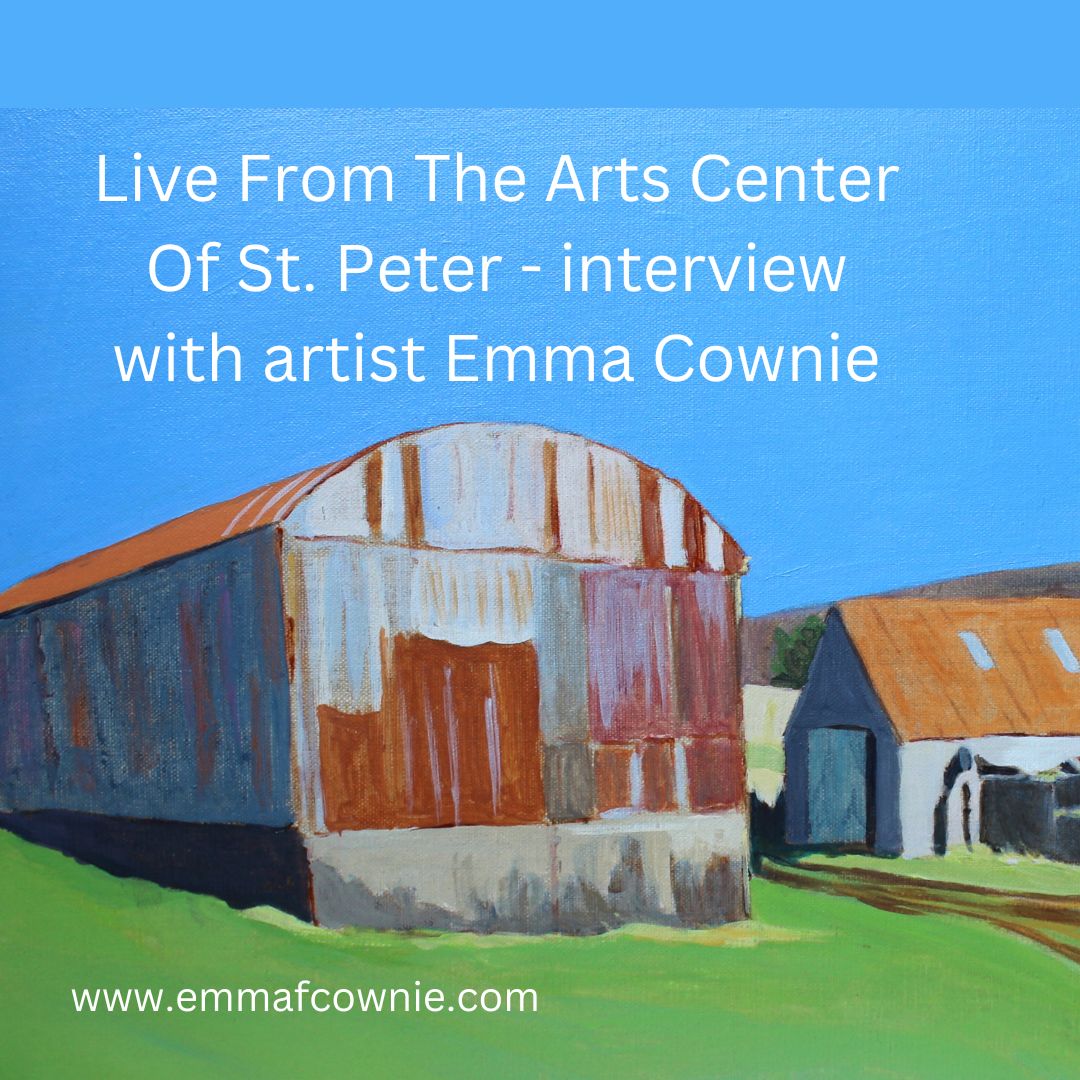
Live From The Arts Center Of St. Peter – interview with artist Emma Cownie

I did this interview back in March this year with artist and magician Michael Callahan and co-host Ann Rosenquist Fee, executive director of the Arts Center, St Pauls, Minnestota, USA. In it I talk about how I came to be an artist, my process, my love of colour and paint brushes!

SEE DONEGAL PAINTINGS                                             BUY DONEGAL PRINTS 

Posted on 10 Comments

Spring in the Sperrins

Painting of Spring in Sperrins, N.I

The Sperrins or Sperrin Mountains (Irish: Sliabh Speirín) are a mountain range in Northern Ireland. The name Sperrin derives from “Na Speiríní ” meaning “Spurs of Rock” and it is the rocks of the Sperrins and the rolling geography of the area that form the foundation of this distinct landscape.  The mountain range, stretching 40 miles along the border of counties Tyrone and Derry, is the largest in Ireland. There are 10 summits above 500 metres with the highest of the range, Sawel Mountain, peaking at 678m (2,224ft). 

The landscape is mostly moorland and blanket bog. The Sperrins were designated an Area of Outstanding Natural Beauty in 1968. It’s a sparse rolling landscape. These peaks have been smoothed out by glaciers thousands of years ago. Populated by sheep, bog grass (Eriophorum angustifolium) and farmhouse, old and new.

Some old farm buildings have long-been abandoned by people but are still used for farm equipment and shelter for sheep. So long as there is a tin roof, the walls will last years and years.

painting Upper Dreen_Emma Cownie
Upper Dreen_Emma Cownie (SOLD) Recently,

I love the sharp oranges of those tin roofs and I will return to them again and again for inspiration. Broadly speaking, in terms of composition I am looking for three dominant colours; green grass/sky and orange tin roofs. You can see how I simplify these main colours in the painting below.

Farm in the Sperrins, County Tyrone, Ireland
Farm in the Sperrins, County Tyrone, Ireland _Emma Cownie

Drone photography has become widespread in our lives. I remember clearly first seeing drone shots of different American cities in episodes of CSI. They were tracking shots of skyscrapper from directly above. As if you were a bird, flying directly above. They were fascinating. Funny, I cant find a clip to illustrate online now. These days they are used in local and national news and documentaries so frequently I dont think we even register that they are drone shots. They have become part of everyday our visual language.

Recently, I have started to explore the use of drone footage (shot by my husband) to extend the possiblilties of compositions I can paint from. So often, I have thought: “If only I was 20 foot high, I’d get a great shot”. So now I can see from 20 foot above, or round the otherside.

I know that many people think that “real” art is plein air sketching, live and I would need to be in a hot airballon to get these views. I admire people who can do this. I can’t. I am not a plein air painter. I am too much of a control freak. I work slowly in the comfort of my studio with all my paints within arms’ reach, exactly where I want them.

This is the first rainbow I have painted. I was pretty nervous about doing it as rainbows are so beautiful and etheral. They are also fleeting. I am reasonably happy with the result although I would be happier if it was more transulent. If I painted another one I would use more acrylic medium to get a more see through effect.

Rainbow over a Sperrins Farm_Emma Cownie

I can also use drone footage and photography if collectors want a commissioned work with drones offering a novel view of their favourite places! It certainly has helped me become more creative with compositions and has benefitted my work greatly.

(c) James Henry Johnston 2024

Posted on 3 Comments

Spring Newsletter

Spring Newsletter 2024

Read about my other appearances in the media here 

New Work Spring 2024
See Derry City Paintings Here
New Work 2024

The Causeway Coast and Antrim


A selection of some of my paintings of the area. Please check my website to see my full collection of work

Antrim and Causeway Coast

A Recent Commission

Mumbles View _ Emma Cownie
"Mumbles View" 120cm x40 cm

Paintings of West Donegal, Fanad and Gower, Wales 

Paintings of West Donegal, Fanad and Gower, Wales

Wishing Everyone a Happy and Relaxing Easter/Spring Break! 

Posted on 8 Comments

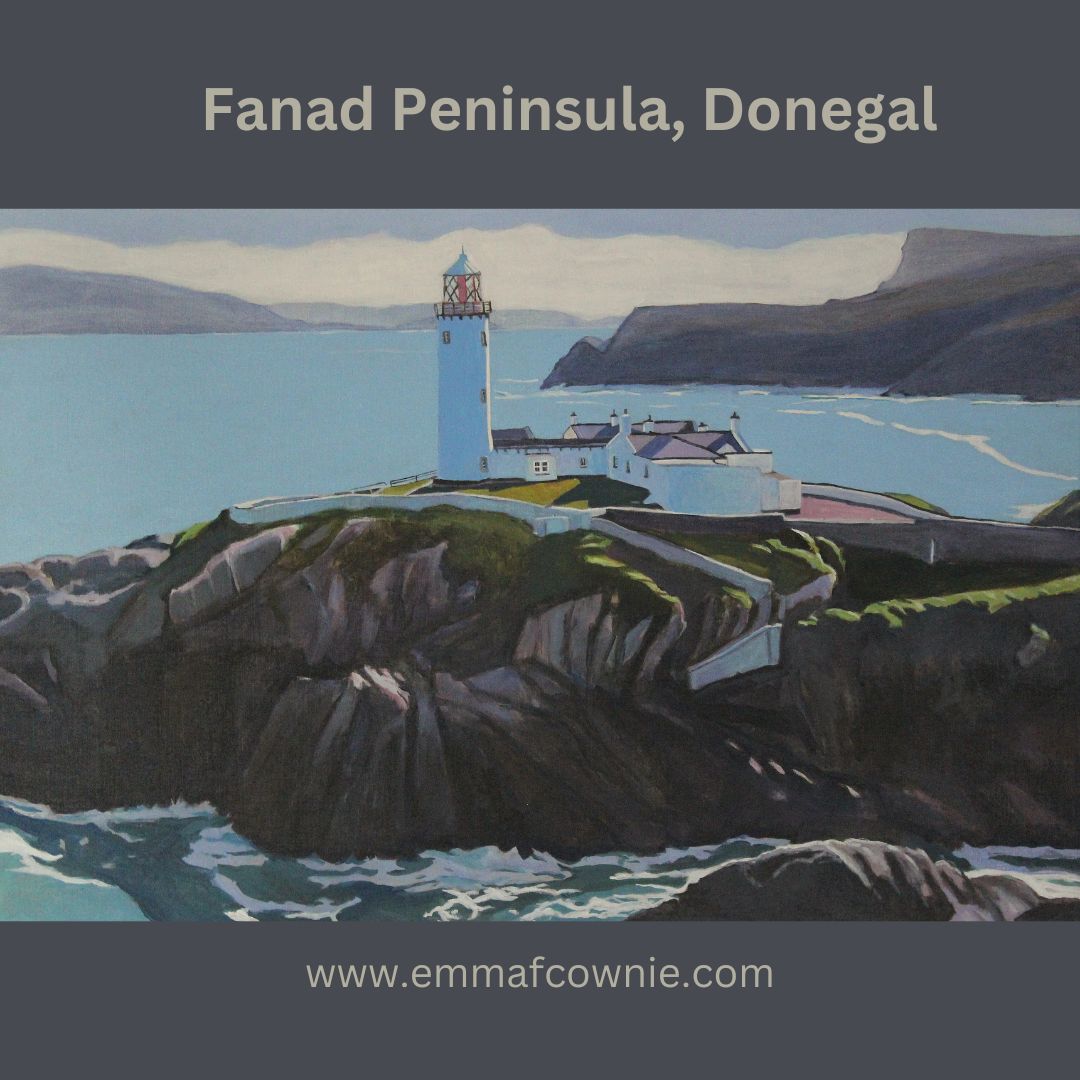
Fanad Peninsula, Donegal

Painting of Fanad Lighthouse by Emma Cownie

Fanad is a finger of land that lies between Lough Swilly and Mulroy Bay on the north coast of County Donegal, Ireland. It is not that easy to get to and the the survival of the Irish language is testiment that relative isolation.

Painting of Lambing season at Fanad Head (Donegal)
Lambing season at Fanad Head (Donegal) SOLD

Fanad Lighhouse (Donegal). Is one of the 12 Great lighthouses of Ireland. It was built in 1886 at Fanad Head (although the station was originally established in 1817). The lighthouse, or more acrrately, the harbour light, marks the entrance into Lough Swilly which forms a natural harbour.

Fanad Lighthouse (Donegal)
Fanad Lighthouse (Donegal) SOLD

I have painted this isolated structure several times before. I have always enjoyed painting the northernly light on Fanad. I have only have painted it in acrylics. That’s not a delibertae choice, more one of circumstance because at times I have had limited space, and I dont want to use oil paints with kittens close at hand.

Over to Fanad Lighhouse (Donegal) _Emma Cownie
Over to Fanad Lighthouse (Donegal) _Emma Cownie SOLD

I think acrylics suit the airiness of the subject matter. After a couple of years working out how to use them, I have settled on a technique of light layers of paint that allow the underlying colour to show through. This can give a transulent quality to the colour. This is in contrast to the relatively flat areas of colous I use for the larger areas of colour such as sky or the sea.

Read more about my use of acrylics here

a painting of Fanad Head and lighthouse
Fanad SOLD

My latest painting was an experiment in composition. We used an image from a drone shot done by my artist husband, Seamas (James Henry Johnson).

In this piece, I wanted to create a sense of space from the mountains of the Inishowen Peninsula in the distance. The distant mountains were layered with bluish white until I got the right impression of distance.

I often find myself looking at the tiny Fanad lighthouse far off in the distance when I am at Lisfannon on the Inishowen Penisula.  There is a sign comemorating a famous Atlantic storm that happened in 1748. this storm threatened to sink The Greyhound, the ship of one John Newton, a slave trader. John was so frightened that he called out to God for mercy. This moment marked a profound spiritual conversion, and many years later he wrote the words for the hymn “Amazing Grace” one of my favourite hymns, and to also campaign for the abolition of slavery.

There is some confusion how many storms there were . One website claims the terrible tempset happened far away out in the Atlantic because it took John Newton another four weeks after his conversion to sail into Lough Swilly and arrive at Derry/Londonderry. The Amazing Grace.ie site however, makes it clear a second storm happened in Lough swilly itself as it quotes John’s journal ” We saw the island of Tory and the next day anchored in Lough Swilly  in Ireland.  This was the 8th day of April, just four weeks after the damage we sustained from the sea.  When we came into this port, our very last victuals was boiling in the pot; and before we had been there two hours, the wind began to blow with great violence.  If we had continued at sea that night in our shattered condition, we must have gone to the bottom.  About this time I began to know that there is a God that hears and answers prayer.” It’s got to be said, that John Newton really took his time putting his evangelical beliefs into action because he went back to being a slave trader for another five years before he eventually retired and became a minister in 1757!

The heaving sea at the foot of the massive lighthouse rock intrigued me. The Atlantic Ocean has such a bulk and stregth, even on a relatively fine day, I am not surprised that John Newton was terrified by its strength far away from the Donegal coast. I wondered about the long and difficult process of building this structure all those years ago in a remote location. Yet, this lighthouse has stood the test of time and proudly marks the entrance to Lough Swilly and can be seen from inland and further along the coast.

Painting of Fanad Lighthouse, donegal by Emma Cownie
The Heaving Sea at the foot of Fanad Lighthouse, Donegal by Emma Cownie

Fand Lighthouse by James Henry Johnston (c) 2024

Turquoise Sea At Fanad Lighthouse

Find out more

Fanad

https://www.ireland.com/en-gb/destinations/regions/fanad-head/

John Newton

http://www.amazinggrace.ie/newton-in-ireland.html

Posted on 7 Comments

London Irish Centre Exhibition

Exhibition at London Irish Centre 2023

I was delighted to see my two Donegal paintings “Up Bloody Foreland, Donegal” and “The through Road, Donegal” on the walls of the London Irish Centre (Camden, London).

These two oil paintings form part of a “real room” of an Irish family in 1950s Britain installation. The exhibition, which is on during August through to October, pulls together a dynamic collection of prints, photographs, paintings, and writings that weave together the different threads of ‘Home’ for Irish Immigrants to London. This has been organised Tara Griffin, who is Education and Heritage Officer at the London Irish Centre, in conjunction with the Museum of the Home. It looks fascinating and I hope my paintings bought happy reminders of home to visitors to the centre. My work has been described as nostalgic by by some and I am interested in capturing a vanishing Ireland of the not too distant past. I just wish I could have visited in person!

Exhibition at London Irish Centre 2023
Up Bloody Foreland: Exhibition at London Irish Centre 2023


Exhibition at London Irish Centre 2023
The Through Road; Exhibition at London Irish Centre 2023


London Irish Centre: website https://londonirishcentre.org/

Posted on 1 Comment

Affordable Art in Donegal

Affordable Art

The rain finally stopped yesterday morning and the temperature rose a few degrees. We just had three days of steady rain. The temperatures also went up a bit. I was amused to discover that this “event” made the news. The headline in “The Donegal Daily” an online newspaper read: “Weather- Another Mild Day in Store for Donegal”. This publication is favourite of mine. It is a heart-warming mixture of stories with happy endings (swimmers get into trouble in rip tide but they are all rescued by a passer by and a lifeboat crew), lost dogs, sport stories and local crime cases (often from two years ago).

Anyway, we felt encouraged by the dry (ish) weather to do some light food shopping in Dungloe and then drive to an Affordable Art Fair in Derrybeg, Gweedore. This Art Fair was held at An Gaillearai, which is located at Ionad Aislann, Na Doira Beaga (Derrybeg).

Ionad Aislann, Na Doira Beaga
Entrance to Ionad Aislann, Na Doira Beaga

We have never been to Ionad Aislann before and I was very interested to see what this cultural centre was like. I know that “Ionad” means a centre of some sort in Irish but I didn’t know what the word “Aislann” meant. I tried looking it up on google translate but drew a blank so I thought it might be someone’s name. It was wrong. “Áislann” is a word derived from combining two words from the Irish vocabulary of South West Donegal, Áiseanna (facilities) and Lann (building).

Lots of Praking!
Lots of Parking!

The centre also houses, amongst other things,  a public library and nursery. When I looked it up here I discovered that the building hosted much more than that: a theatre/cinema, sports hall, meeting rooms, local history centre, PC centre, a gym and a tea room! This cultural centre was set up in 1992  expressly to cater for local people as well as for visitors to the area, including the many artists like me who come to live here. It was also meant to help strengthen bonds within the local community via cultural/artistic pursuits and leisure activities.  

Affordable Art Fair Poster


The Gallery is large and airy and there was plenty of room for visitors and artists. Everyone was wearing masks too which was reassuring. 

Inside the Art Fair
Inside the Art Fair

Some of the artists showing include (in no particular order); Ian Gordon, Cathal MacGinley, Peadar McDaid, Heidi Nguyen , Mary Toland, Gay OToole and Nora Duffy. We had the pleasure of meeting and chatting with two of the exhibiting artists, Heidi Nguyen and Gay O’Toole. We met Cathal Mac Fhionnghaile/Cathal MacGinley when we visited Inishbofin last month.   Here is a selection of the work on display. 

Gay O Toole
Gay O Toole
Work of Gay O Toole
Work of Gay O Toole


Heidi Nguyen
Heidi Nguyen
Heidi Nguyen
Heidi Nguyen
Heidi Nguyen
Heidi Nguyen


Cathal Mac Fhionnghaile


Cathal Mac Fhionnghaile


Cathal Mac Fhionnghaile
Cathal Mac Fhionnghaile – we bought the middle one!
Ian Gordon
Ian Gordon
Ian Gordon
Ian Gordon
Maura McGlynn
Maura McGlynn


Nora Duffy
Nora Duffy
Nora Duffy
Nora Duffy
Nora Duffy
Nora Duffy


Mary Toland
Mary Toland
Sarah Lewtas
Sarah LewtasKarol Mac Geirbheith

Karol Mac Geirbheith

Karol Mac Geirbheith

Karol Mac Geirbheith

Karol Mac Geirbheith


Peadar McDaid
Peadar McDaid


Peadar McDaid
Peadar McDaid – we also bought the middle one (top row).


As our house is already over flowing with paintings we generally don’t buy other people’s art (although I have one painting by Welsh landscape artist, Warren Heaton, in the bedroom) but we changed the habit of a lifetime yesterday and bought two small paintings at the art fair. I know that Séamas wanted to buy more. We left the two paintings on the wall with red stickers next to them (hoping that sign of success would encourage more sales) and will go back on Thursday to pick them up.

After so long in lockdown and avoiding people, it was really great to go out somewhere and to meet new people. Ionad Aislann certianly did its job of helping to strengthen the bonds between local community via cultural/artistic pursuits and leisure activities. It was well worth a visit and if you are in area I would highly recommend stopping by.  The Art Fair is on for several more days, from 12 to 5pm until this Thursday 14th October 2021. 


Posted on 15 Comments

My Review of 2020

Review of 2020

 We are all glad to see the back of 2020 but I am pausing for a moment to reflect on some of my painting sales over the year. Sadly, my accident and having my leg in a cast meant that I couldn’t get up the steep stairs to my attic studio (or anywhere else) to paint any oil paintings for over three months but things have ticked over during 2020.

I would like to say thank you Rob and David who waited a very long time in the cold with me for the ambulance to come, to the paramedics and firebrigade who got me out of the woods, to NHS staff at Morriston who fixed my very broken leg and looked after me, as well as to the Physical Therapists who gave me lots of advice on exercises over the phone. I still have a way to go! 

I have to say an absolutely massive thank you to my brillant husband, Séamas, who trudged  up and down two flights of stairs with trays of food many times a day (and lost weight doing so) for months. He kept my spirits up when I got frustrated and tearful. It wasn’t that often as I was so glad to be home but it was all hard work for him in the midst of a pandemic! He also kept the show on the road by packing up and arranging the shipping my paintings. He was, and remains, utterly wonderful!

Here’s a selection of some of my sales from 2020

Some of my "people" paintings sold in 2020
Some of my “people” paintings sold in 2020


Some of my paintings of Wales sold in 2020


Some of my paintings of Ireland sold in 2020


A Selection of Commission from 2020
A Selection of Commissions from 2020


My top four personal favourites of 2020


Donegal painting of Owey Island_Emma Cownie
Owey in Late Spring – Top of my personal  favorites of 2020!


Here’s to a happier and healthier 2021 to  everyone! 


Posted on 11 Comments

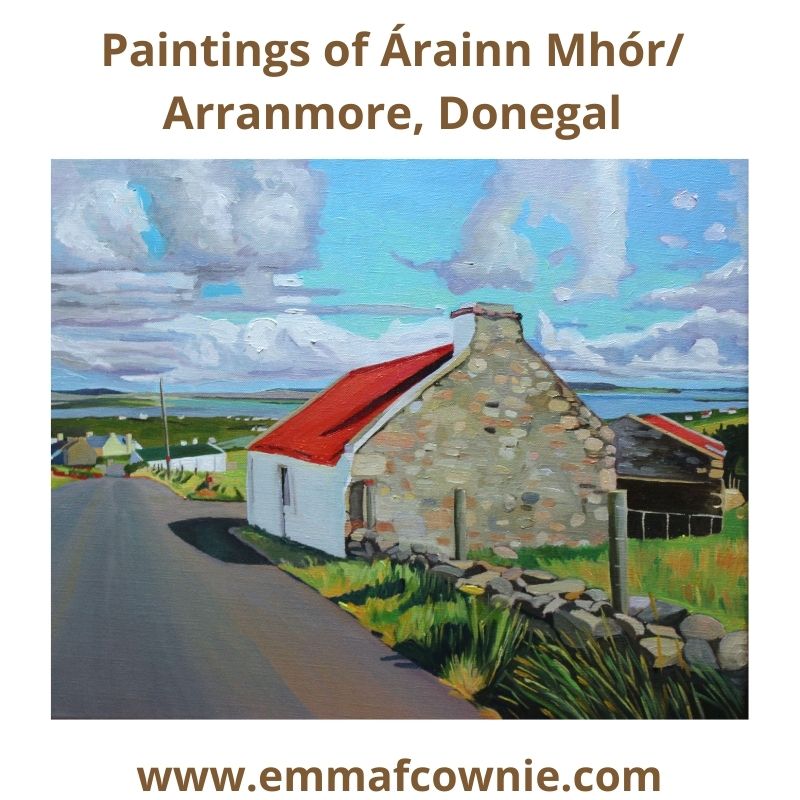
Paintings of Árainn Mhór/Arranmore, Donegal

Arranmore Donegal

I recently join the Stair Árrain Mhór – Árrain Mhór History Facebook group and was overwhelmed by the positive response I received from the members when I put my most recent post online there. I was asked if I had any more paintings of Arranmore for them to see, so here’s a collection of all my paintings of the Island that I have completed in the last two years.

Where it reads (Private Collection) it means that the painting has been sold. I hope you enjoy looking at them.

To see my Donegal paintings for sale click here

Poll na mbadaí (Harbour of the Boats) Arranmore, Ireland.
Poll na mbadaí (Harbour of the Boats) Arranmore, Ireland (Private Collection).


Painting of old cottage on Arranmore, Donegal_Emma Cownie
Brightening Up (Arranmore, Donegal) SOLD


Darkening Clouds On Maghery
Darkening Clouds On Maghery, Ireland (SOLD)


Painting of Arranmore lane, Ireland by Emma Cownie
After the Rain, Arranmore, Ireland (Private Collection)


Landscape Arranmore Ireland
Stone Shed Arranmore Ireland (SOLD)


Landscape painting Donegal
View From Poolawaddy (Private collection) painted in early March 2020


Painting of The Two Tin-Roofed Sheds, Ireland
The Two Tin-Roofed Sheds, Ireland


Red Roofed House Painting
Rusty Roofed House, Arranmore, Ireland


Irish Landscape painting_Emma Cownie
The Two Red Roofed Houses, Ireland (Private Collection)


landscape painting of Arranmore Island_Ireland_Emma Cownie
Down the lane, Arranmore (Private Collection)


Painting of Arranmore, Donegal, Ireland_Emma Cownie
Cloughcor, With Errigal Behind (Ireland) (Private Collection)


Donegal painting
View from Arranmore (Private Collection)

Donegal painting of area around Cloughcor, Arranmore
Around Cloughcor (Arranmore) (Private Collection)


Painting of Donegal Island of Inishkeeragh_EmmaCownie
Over to InishKeeragh (Private Collection)


Donegal landscape painting for sale_EmmaCownie
Gortgar, Arranmore (SOLD)


From Cloughcor To Maghery (Arranmore) (Private Collection)


Painting of Donegal cottage
House by the Wild Red Flowers (Arranmore) (Private Collection)


Painting of Donegal. Arranmore.
Old Courthouse, (Arranmore Island) (Private Collection)


There are also some small watercolours I did when I could not get to my oil paints and easel due to a broken leg/ankle

Watercolour of an old white cottage with a new slate roof, Arranmore, Ireland by Emma Cownie
House on the hill,, Arranmore, Ireland (Sold)

Watercolour of Irish cottage, Donegal
The White house, Arranmore, Ireland

Watercolor of Old White Cottage, Arranmore, Ireland by Emma Cownie
Old White Cottage, Arranmore, Ireland

Watercolour of Arranmore, Ireland
Two Red Roofed Sheds, Arranmore, Ireland


Some of the above paintings are available to buy as prints on artamajeur.com.