Posted on 42 Comments

The Art of Destruction

“When a picture isn’t realized, you pitch it in the fire and start another.” (Paul Cezanne)

http___cdn.cnn.com_cnnnext_dam_assets_181218153453-artists-bad-artworks-edvard-munch-artsy
“Angry Dog” (c. 1938-43) by Edvard Munch – Please burn!

Artists create. Over the years they can create a lot. Not all of it is good.

A while back I read an article about a man who had been left hundreds of paintings by a relative of his, an aunt I think, who was an enthusiastic amateur artist. My recollection of the paintings is that they were bad. Really bad. I mean, I would have struggled to keep one of them (hidden in a dark corner of the house) but he had hundreds of them! Sadly, they weren’t quite bad enough to be added to a collection of the wonderful Museum of Bad Art.  Yet, the loving nephew was going to keep and treasure them all! This story has haunted me. As artist Robert Glenn wrote, “There’s enough bad art in the world already and we don’t want to add to it by leaving substandard stuff out and about.”

I just don’t have the room for everything so a cull has been taking place. I have been destroying old paintings of mine that I don’t think are up to the mark. It’s a form of curation. In fact, I believe that destruction and renewal are central to the all creative processes. Writers cut and redraft. I think of the time I wasted reading Harper Lee’s “Go Set a Watchman”, which turned out to the first draft of the much-superior “To Kill a Mockingbird”. Harper Lee was right not to want to publish it. Painting is the same.

An element of destruction and renewal has always been part of my process. If part or all of a painting isn’t working, I would much rather scrub the paint off the canvas and start again than let it dry and attempt to paint over the error. I usually have to work myself up into a minor frenzy to do this. I feel better looking at a scrubbed canvas than one that is “wrong”. Sometimes, I might spend a whole day on a painting that I scrub away and start again the next day (to the dismay of my husband). Usually, this is down to poor light. I don’t often do this, but I think its important to be able to”kill” your work so that better work can come forth. It’s reassuring to know that great artists like David Hockney have also destroyed unsatisfactory work in the process of creation.

300px-Hockney_Pool_Figures
Portrait of an Artist (Pool with Two Figures). David Hockney destroyed an earlier version of this painting

Over the years I have stored older, or just less successful paintings away in the attic, behind stacks of other paintings. They fall into two categories a) early work done on cheap canvases. These are easy to destroy with a metal spike. You get what you pay for, I suppose. I actually like some of these paintings, especially the animals and so I have taken a sharp knife to them and carefully cut them from the stretchers.

IMG_6950
Saved for another day

I have decided to store these in a large folder the rest will destroyed; and b) work done on linen canvases I don’t think are up the mark. I wont show these to anyone. Again I will cut the canvases from the stretcher to keep the wooden frames to reuse with a fresh canvas. The canvases will be cut up and thrown away. If I had a large garden I’d burn them.

IMG_6949
These need to be cut up!

I have tried reusing canvases in the past by sanding them down and painting gesso on them but I am never really happy with the result. I use paint too finely. i like a smooth surface. This is a luxury. In his early days as an impoverished artist, Picasso would often paint over pictures he thought unsuccessful because he didn’t have the money to buy a fresh canvas.

Picasso "Still Life" 1922
Picasso “Still Life” 1922 – on the front


It is important to conduct the destruction in private so no one can make you feel bad about it. I have found the process quite cleansing. I did not realise that every time I looked around my crowded studio and glimpse the edges of an unsuccessful painting that it brought me down. They reminded me of my failures. That I was a lousy artist. Out comes my imposter syndrome! Ironically, if an artist sells a lot of work, they have little evidence of their successes around them.

IMG_6951
Stretchers can be reused

I think that most artists have to come to terms with destroying work that isn’t up to the mark. One of two duff paintings can make all the others look bad. It’s sometimes difficult to decide as many artists develop their style, improve their technique, or just explore new themes so their earlier works can seem at odds with their later stuff.  How to decide if it is bad or just different? Lucien Freud is an excellent example of an artist whose style changed significantly throughout his career as he found his own style of painting.

I once went to an exhibition of Cezanne’s early work In Paris and decided, that with the exception of the House of the Hanged Man, most of it should have been burnt. We know that Cezanne burnt his poorer work so it must have been really, really bad! We are best not seeing it.

House of the Hanged Man
Don’t put this one of the fire!

Likewise, Vincent Van Gogh should have burnt more. Before he discovered colour and light in the south of France in 1888, he produced a lot of dark and miserable work that no one wanted to buy. Yes, its interesting to see his journey as an artist, but I don’t think the world would have many of these early brown works if he’d burnt them.

Claude Monet was prolific. He painted around 250 “Water Lily” paintings over the last three decades of his life—but originally, there were many more. Before an exhibition of the paintings in 1908, Monet destroyed a group of them with a knife and a paintbrush, disappointed by their quality in comparison to “better” canvases. Time magazine called this a “rage of perfectionism”.

9a2f1d3d004bceaaa839b22e3c81d9ec

Monet was at this time struggling with his eyesight and was diagnosed with cataracts in 1912. Over the next decade, both his vision decreased progressively as well as his colour perception. Monet had surgery in 1923. He recovered excellent near vision and reasonable distance vision in the affected eye, but he complained bitterly about the world appearing too yellow or sometimes too blue. It took almost two years before he finally told friends that his color vision felt normal. After his surgery, Monet destroyed many canvases, maybe as many as thirty of them. I can only imagine his rage as I saw these substandard works.

Francis Bacon also frequently destroyed work he was not happy with. He worked on the Screaming Pope paintings for about 20 years and some of them turned up as recycled canvas which had been used by an amateur painter, Lewis Todd. When these scraps were discovered the Todd paintings shot up in value. They are still on the lookout for a pope’s screaming head! Below Todd’s paintings (left) Bacon’s scraps (right)

Francis Bacon was not at all thorough about destroying his work. In 2007 a group of damaged Bacon paintings was found in a skip outside the artist’s London studio by electrician Mac Robertson. He sold them.

Georgia O’Keeffe, was another painter, like Monet, who had difficulties with her sight, and who destroyed her own work. Her decision to destroy work was also about keeping her reputation strong. Curation. 

She had been diagnosed with macular degeneration in 1964 at the age of 77, and by 1972, her vision had fallen below 20/200 despite attempts at laser treatment, and towards the end of the 1970s she gave up painting altogether. In the 1980s “she wanted to go into storage to destroy some of the paintings that she didn’t think were at her level,”  Some allegedly destroyed works have apparently slipped through the cracks.

okeeffe_red_and_green_ii_1916
The one that got away

Red and Green II (1916), one of her first watercolors, is listed in her notebooks as having been destroyed after she showed it once in 1958 at New York’s Downtown Gallery. Yet the work surfaced in a Christie’s New York American Art sale in November 2015. 


Some conceptual artists have made a career out of destruction but that’s not what I am talking about here. I am talking about Monet’s “rage of perfection”. It is not vandalism if its your own creation. Sometimes, after a distance of months or even years, you can see your creations clearly. I once only “saw” a painting of mine clearly as it was leaving the room in a collector’s arms.  “Ah”, I thought “That’s a lovely painting”. It’s not always the way. Sometimes, I look at a painting from several years ago and wonder “What was I thinking?” I hadn’t been able to see it before then.
1500
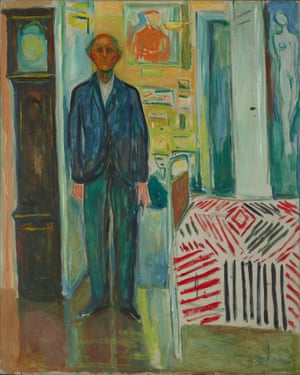
Self-portrait Between the Clock and the Bed

Being able to let go and destroy work is a sign of emotional health. I am not doing so well as many of these paintings were done over a decade ago. I don’t think Edward Munch, who suffered from terrible anxiety exacerbated by excessive drinking, could let go of many of his paintings let alone destroy them.

He was in the position that he did not need to sell his work and he ended up with a collection of almost all his art on the second floor of his house. He even called his paintings his “children”! In Self-portrait Between the Clock and the Bed, which he painted in the years just before his death, Munch seems crowded out by his “children” on the wall behind him. I think they should have been made to leave home!

Anyway, I digress. Artists and writers should be allowed to destroy early work, failures, something that was really only a first draft (Harper Lee), a work in progress or a cry for help (Edvard Munch’s Angry Dog, surely?). It’s not always easy to do. That first novel should stay in the locked drawer and those early paintings and sketches go into the bin. So those paintings of mine in lying in that folder may yet end up on a bonfire! 

Posted on 16 Comments

Tale of two paintings: Reworking a Swansea painting

As a rule, I don’t rework my paintings. Either they work or they don’t. Here’s the exception. This is a large painting (80x100cm) that has hung in my hallway for the past five years. It was for sale on an online gallery a several years ago but for some reason, it was taken off. I am not sure why.

Painting of Swansea by Emma Cownie
Life in the Uplands (2015)

I didn’t really look at it until this summer when it got moved into our bedroom and I looked at it again. I was talking to my mother and sister on messenger/facetime and they saw it on the wall behind me – “Oh, that’s a nice painting” they both called out. “Oh, no that’s old,” I said as if it was a dress I had smuggled back from the shop. Why wasn’t I proud of it? I thought about it. It was an example of my early work when I was going through a phase of drawing lines around everything. I believed this was in the style of the fauvists like Derain and Matisse.

To be honest, it worked at the time but my painting has changed a lot since 2015 and I wasn’t comfortable with those lines. There was no light. I love painting shadows and light and yet there were none in this painting. Curiously, the omission of the skyline helped give a lightly claustrophobic sense of being in a crowded town. That was its real strength. It was a forerunner of my urban minimal series of paintings of Brynmill which culminated in my “Hollowed Community” Exhibition in Cardiff in 2017 (see examples of this series below)

Why had I painted this scene on an overcast day? Why had I cropped it in so tight so there was no sky? I really could not remember. I tried to find the view again. I spent some time hanging out of the windows at the back of our house trying to find the same angle. Eventually, I discovered something similar from the attic window.

View out of my Window
View from the attic

There were a lot more trees. These are the plane trees line that Bernard Street. This road runs from Brynmill uphill to Gower Road, in the Uplands. The trees branches are cut back to stumps every year to control their growth but they burst forth every summer again (See three of my urban minimal paintings below, which feature the trees of Bernard Street).

It wasn’t the only thing that had changed in the last 5 years. Many of the houses had been painted in a different colour. A tin roof towards to centre of the middle (on the right) was now orange with rust. The sunshine also created shadows and changed the colour of many of the roofs.

So I started painting and worked on this when I wasn’t working on commissions. I changed the colour of the chimney pots in the foreground of the painting.

IMG_7037-001
Work in Progress (Summer 2020)

It took some time as I ended up pretty much repainting the whole canvas. The end result was painting with more depth and yet a “lighter” feel. There were still some of those lines but I had reduced them so they did not dominate the painting. I was much happier with this version of Brynmill/Uplands in the sunshine.

Painting of Uplands Swansea by Emma Cownie
Over to Bernard Street, Swansea (2020)

Here are the two paintings side by side so you can see the changes I made.

My next post will be about the paintings that I decided could not be reworked and what I did with them.

Posted on 6 Comments

Our favourite (deceased) female Irish artists Part 2

Following on from my last blog (which covered Sarah Purser, Rose Maynard Barton, Gladys Wynee, Kathleen Fox, Estelle Solomons, Phoebe Donovan, and Norah McGuinness), here’s my second group of my favourite female (deceased) Irish artists. I am covering this group in chronological order, although is overlap, date-wise with my list of artists in part 1. This group of women, although still largely drawn from the “Protestant Ascendancy“, were noticeably less wealthy than many of the artists in part 1.

This is a personal list and you may be shouting at me for leaving out your personal favourite. Tell me who I have missed out.  A lot of the information in this blog is taken from the Catalogue for Irish Women Artists 1870 -1970 Summer Loan Exhibition and Wikipedia.


Grace Henry (1868 – 1953)

image054
Grace Henry

Remember Paul Henry and his beautiful landscapes paintings of the wild west coast? Well, his wife, Grace was an accomplished artist in her own right but her reputation suffered from being overshadowed by her husband’s fame.

Grace Henry was born Emily Grace Mitchell in Aberdeenshire, in Scotland. She was the ninth child of ten of the Rev. John Mitchell and was educated at home, spending time at the family’s home in Piccadilly, where she experienced London society. When her father died the family found themselves in much-reduced circumstances, so Grace left home in 1895 to pursue a career as an artist. Remember, this is the end of the 19th century. That’s a pretty incredible decision for a single woman.

In 1899 she left Scotland for the continent, visiting Holland and Belgium, studying in Brussels and Paris. Whilst in Paris, she met and married Paul Henry in 1903  and moved first to London and then to Ireland. The couple traveled in Achill Island for the first time in 1910 which was intended to be a two-week stay, with the couple going on to live there until 1919. This period spent on the island did place a strain on the Henry’s marriage, as Grace was not as happy living there.

Her work developed while on the island, starting with Whistler- inspired nocturnal scenes with muted colour and simple compositions, becoming stronger as she grew in artistic confidence into the 1920s.

Despite being instrumental in setting up The Society of Dublin Painters in 1920 which provided exhibition space for many female modernist painters, her reputation suffered from her separation (although they never divorced) from her husband Paul, who left out all references to her in his two autobiographies!

Grace continued to travel later in her life, often staying with friends or living in hotels, rather than maintaining a home of her own. She also experienced periods of “melancholy”, probably depression, during these later years, though she continued to exhibit. 

Letitia Marion Hamilton (1878 – 1964)

Originally from Co. Meath, Letitia was one of three sisters. Their father could only afford one dowry, so Letitia and her sister Eva remained unmarried and turned to their artistic careers to help support the household. Letitia studied at the Dublin Metropolitan School of Art where she was taught by William Orpen, continuing her studies at the Slade School of Art in London and with Frank Brangwyn.

She exhibited in Paris, Edinburgh, and Dublin. She was one of the founding members of the Society of Dublin Painters, along with Paul HenryGrace HenryMary Swanzy, and Jack Butler Yeats. In 1948, she won a bronze medal at the Olympic Games art section in London. Who knew you used to be able to paint your way to an Olympic medal?  Letitia Marion Hamilton RHA (1878-1964)

Bunbeg – Letitia Marion Hamilton RHA (1878-1964)

Letitia Marion Hamilton RHA (1878-1964)
Carrycart, Donegal -Letitia Marion Hamilton
Letitia Marion Hamilton RHA (1878-1964)

Lilian Lucy Davidson (1879-1954)

Lilian Lucy Davidson was born in Bray, County Wicklow. She was the sixth of ten children of a clerk of petty session called Edward Davidson. Unfortunately, her mother died when she was ten and it seems that her family was not affluent although it is thought that she had a private education. She went on to attend the Dublin Metropolitan School of Art (DMSA) and was awarded a scholarship and free studentship at the Royal Dublin Society in 1897, the year her father died.

Although not in very buoyant financial circumstances she travelled extensively and did so for most of her life. She painted landscapes in Belgium and Switzerland, besides various parts of Ireland. She was a regular contributor to the Watercolour Society, The Dublin Painters Society and the Munster Fine Art Club, and was part of an interesting circle being friendly with Jack Yeats whom she painted and the circle around the Gate theatre for which she wrote plays under the pseudonym of Ulick Burke. The fact that Davidson’s family was not wealthy may have influenced her choice of poorer people as her subjects, depicting them in a sympathetic manner. I love her fluid style and her treatment of every day life in Ireland. I particularly like “Night at Claddagh”, for the falshes of light from the houses and how the little details such as the woman’s red dress and bare feet suggest so much about her life. 

Lilian Lucy Davidson ARHA (1879-1954) Night at Claddagh (circa 1933)
Lilian Lucy Davidson ARHA (1879-1954)
Night at Claddagh (circa 1933)


Lilian Lucy Davidson ARHA (1879-1954)

Mary Swanzy (1882 – 7 July 1978)

image139
Mary Swanzy

Mary Swanzy was born in Dublin, to a wealthy medical family.  She was educated in Dublin and then sent to a finishing school at the Lycée in Versailles, France, and a day school in Freiburg, Germany. This education meant that Swanzy was fluent in French and German.

Mary trained in several academies in Paris. It seems that Mary was no party animal. Her life in Paris, while agreeable, did not resemble the bohemian myth. Usually, Mary was in bed by 8pm each evening and in the studio by 7.45am each morning, working intensively from the life model.

Her father had hoped she would be a portrait painter, but Mary was disliked portraiture, saying that men tended to want to be painted by men. After the deaths of her parents, Swanzy was financially independent and could travel, spending her time between Dublin and Saint-Tropez during World War I, whilst continuing to paint. She traveled far and wide, to the Balkans, Czechoslovakia, USA, Honolulu, and Samoa. It may well be that the upheavals back in Ireland including the shooting dead of her cousin, Oswald Swanzy, a Detective Inspector with the RIC, prompted Mary to travel abroad.  

Her money also gave her the freedom to explore different artistic styles. She painted in many styles including cubism, futurism, fauvism, and orphism, and she was one of Ireland’s first abstract painters. In the mid-1920s Swanzy settled in Blackheath, London, making regular trips to Dublin and abroad.

To be honest, I agree with the assessment of critics who have described her work as having a “prim, Edwardian feeling” that shows through the veneer of modernism. I think it was painted from the head, not the heart. I much prefer her work that was done in Samoa in the 1920s. Here her work seems relaxed, natural and joyous.


Margaret Clarke (1888-1961) 

H2548-L156932426
Margaret Clarke

Margaret was born in Newry, County Down, Ireland, one of six children of Patrick Crilley. I am guessing from her surname that she was raised a Catholic. She had intended to become a teacher and went to night school to train at technical college but in 1905, she won a scholarship to go to the Dublin Metropolitan School of Art. There she studied under William Orpen, who regarded her as one of his most promising students, she later became his assistant. In 1914, Margaret married her fellow student Harry Clarke, and they had three children.

48
Sketch of Eamon de Valera, 1932

Margaret first exhibited with the RHA in 1913 and would go on to exhibit over 60 artworks in the forty years until 1953, the majority being portraits. Amongst the portrait commissions Clarke received were ones for Dermod O’Brien, President Éamon de Valera, Archbishop McQuaid, and Lennox Robinson. She spent a great deal of time on the Aran Islands with fellow artist Seán Keating and her husband, from which she produced a number of landscapes and smaller studies.

Over her lifetime Clarke won many awards including the Tailteann gold, silver and bronze medals in 1924, and another Tailteann bronze in both 1928 and 1932. Upon the founding of the Irish Exhibition of Living Art in 1943, she was appointed a member of the executive committee.


May Harriet “Mainie” Jellett (1897-1944)

images (1)
Mainie Jellett

Born in Dublin, Mainie was the daughter of a barrister William (who was later also an MP). She studied at the Metropolitan School of Art in Dublin under William Orpen, and then in London under Walter Sickert.


In 1921 she moved to Paris, where she encountered cubism and began an exploration of non-representational art. Her new style, including colour and rhythm was greatly inspired by her stay in France. After 1921 she and artist Evie Hone, her companion and life partner, returned to Dublin but for the next decade she continued to spend part of each year in Paris. In 1923, she exhibited two cubist paintings at the Dublin Painters’ Exhibition.

mainie_jellett-decoration-1923-trivium-art-history-1
Decoration 1923

The response was hostile, with the Irish Times publishing a photograph of one of the paintings and quoting their art critic as saying of them ‘to me they presented an insoluble puzzle’.

Mainie devoted much of her energy—throughs essays and lectures—to trying to overcome conservative attitudes in Ireland, which was then culturally isolated. Her work was also part of the painting event in the art competition at the 1928 Summer Olympics.

Madonna Of Eire
Madonna of Eire

In the 1930s figurative elements reappeared in her painting, and her later work included landscapes and religious subjects. She also made designs for the theatre and ballet. Jellett died young of cancer, but the year before her death, her campaigning on behalf of modern art bore fruit in the founding of the Irish Exhibition of Living Art, of which she was the first chairperson. This was an exhibiting society that became the main venue for avant-garde art in Ireland for many years. Sadly Mainie was not to live a long, dying of cancer at 46, but she had made a significant contribution to Irish Art and Feminism in that short time. 

800px-Jellet_horses
Achill Horses

Nano Reid (1900-1981)

Nano Reid was born in Drogheda, County Louth. She was the eldest of four children of Thomas Reid, a well-to-do publican, and grew up above their pub. Although she started her training to become a nurse, her parents were persuaded by their Catholic parish priest to let her go to the Metropolitan School of Art in Dublin.

In 1927, Nano went to study in Paris and London and after that stayed in Ireland. After returning to Ireland, Reid began to exhibit landscape painting at the RHA. Like other painters of the period, such as Paul Henry, she traveled to the west of Ireland for painting inspiration with her early work showing the landscapes, local people, and fishermen of the area. 

I much prefer her portraits to her landscape work.

In Dublin, Nano shared a house with her friend Patricia Hutchins. There was gossip about the nature of the women’s relationship, but Hutchins went on to marry. After WWII, Nano moved to Fitzwilliam Square, taking in young men as lodgers. She used to go on shared holidays to Connemara with her gay friend, self-taught Belfast artist, Gerard Dillon in the 1940s and 1950s.

In 1950, Reid and Norah McGuinness (see part 1)  were selected to represent Ireland at the Venice Biennale of Art. This was quite remarkable, considering this was the first time the country had shown at the event. The nation’s cultural identity was to be shaped by this event, and international perceptions of the country would be determined by what they chose to show. The reason for their selection was most likely because it was believed these two artists could compete on an international level. 

This second group of female artists ranged from the wealthy and hard-working Mary Swanzy who only had to please herself to Margaret Clarke who started her training at night school, and most of these artists had to teach painting to supplement their income. Their work is diverse in style from figurative to cubism. As a group, they had traveled widely, with Mary Swanzy traveling the widest. Artists like Mainie Jellett embraced very public scorn to promote new ways of painting in the Irish State.

These women were always swimming against the tide. They were independent, working women in an era when women were expected to limit their attention to their homes and families. Taken as a group as a whole, it is probably unsurprising that a significant number were either lesbians or did not marry. Husbands and families did not appeal to Sarah Pursar and Nona Reid and would more than likely impede their ability to paint and to pursue their artistic careers. Only Kathleen Fox and Margaret Clarke were married and had children. Norah McGuiness’s “open marriage” was deeply shocking to contemporary society. Although the support and expertise of men such as J.B. Yeats and William Orphen were pivotal for many of these women, their own organisational skills such as the founding and running the Dublin Painters’ Society and the Irish Exhibition of Living Art, were impressive. They also encouraged and supported many younger artists. Of all these artist, I liked the portraits of Margret Clarke and Letitia Hamiliton’s vigorous landscapes. In the end, it was Lilian Davidson’s lively figurative work that I enjoyed the most.

Yet despite the considerable achievements of these artists, their work still fails to fetch the sort of prices that artists like Jack Yeats, Roderic O’Conor, Paul Henry or Louis leBrocquy command. A list of 25 top-selling Irish artists of the past decade only included only two female painters, Norah McGuiness, and Mary Swanzy.  It is interesting that Mary Swanzy’s cubist work has been promoted by Patrick J Murphy, an author, collector, the former Chairman of the Arts Council of Ireland.

Yet, is hard not to resist the conclusion that the world continues to ignore and downplay female artists. Art UK’s list of 18 “Incredible Irish Artists” only included 6 female artists! The 6 female artists were  “incredible” but many of the male artists that were included on that list were definitely not “incredible”. Ireland Before You Die’s list of the 10 Best and most famous Irish artists includes just 2 female artists. Any modern list of “top” or “hot” artists, Irish or otherwise, is invariably heavily dominated by male artists. It is hard to escape the conclusion that female artists are still swimming against the tide! However, it is significant that auction houses such as Dublin-based Adam’s spent a lot of time, money, and effort putting together a Summer Loan Exhibition of Irish female artists in 2014. All of the paintings were on loan from private collections from both North and South of the border. The catalogue is thoroughly researched,  and includes many more women than I have included on my list. It is important that Adams’s exhibition celebrated and publicized the significant role that women have played in the history of Irish art, a role that has too often been overlooked.

image094
Group of artists at “Young Irish Artists Exhibition 1903”


Read more about Irish Art:-

Catalogue for Irish Women Artists 1870 -1970 Summer Loan Exhibition 

Irish Museum of Modern Art  

https://www.adams.ie/irish-artist-directory/irish-artists-with-surname?ipp=All

https://www.centreculturelirlandais.com/en/agenda/a-history-of-irish-art

https://irishartindex.wordpress.com/

https://www.herstory.ie/photo-essays-2/2020/2/11/invisible-irish-women-artists-from-the-archives-by-catherine-sheridan-at-the-national-gallery-of-ireland


Posted on 22 Comments

Our favourite (deceased) female Irish artists Part 1

After writing about Paul Henry’s work in my last blog, I was embarrassed to realise that I am very ignorant about Irish Art/History, especially female artists. So to remedy this woeful ignorance I set myself the challenge of list of my favourite Female Irish artists, in the spirit of my earlier series of blogs on Our Favourite Female Artists.  I initially thought about a top ten but I failed miserably to limit myself to 10, I came closer to 18 in the end. I am absolutely no good at throwing stuff out, and my list of artists is no exception, so I have organised each selection by the date of birth of the artist.

I will freely admit that my taste is pretty traditional, preferring figurative to abstract art but I do like a lively personal life too (I am rather nosy). I also like and admire the work of long-dead artists, especially those who lived and worked in the period from the 1870s to the end of the Second World War. I think that I feel that I can safely admire their work without accidentally copying it, which always seems to be a danger with living artists. A lot of the information in this blog is taken from the Catalogue for Irish Women Artists 1870 -1970 Summer Loan Exhibition and Wikipedia.

It is a universal truth female artists of the late 19th and early 20th centuries worked under very different circumstance to male artists.  In 1870 women were seen as amateurs in the art world and lacked the opportunities for training, exhibition and sales. They were chaperoned by men and when in 1893 they were eventually let into professional schools such as the RHA school, they were barred from life drawing and anatomy classes (think of those unsuitable naked bodies!). Despite these limitation (or maybe because of them) many Irish female artists traveled abroad to train and returned to Ireland with wider horizons than their male contemporaries.

Djk-gvRWwAA41ke
Female artists from the Dublin Metropolitan School of Art, c. 1910

Visual arts were seen as a ‘genteel hobby’ rather than a genuine vocation for women. Many of the Irish female artists of this period came from well-off, if not always extremely wealthy, origins.  A middle-class Protestant background was more likely to be an encouragement to female artist’s talents, rather than working-class Catholic roots. They also generally remained single and only a few became mothers.

Sarah Purser (1848 – 1943)

Sarah_Purser_by_John_Butler_Yeats
Sarah Purser by J.B. Yeats

The female artists of Ireland tended to come from wealthy (usually Protestant) backgrounds.  Sarah Purser was no different, as she was born into privilege although she made her own fortune through hard work and canny investments. She was the daughter of Benjamin Purser, a prosperous flour miller and brewer. At thirteen she was sent to school in Switzerland where she learned to speak fluent French and began painting.

When in 1873 her father’s business failed and she decided to become a full-time portrait painter. She used her many social connections to gather commissions – she famously commented “I went through the British aristocracy like the measles”.

She was a trail-blazer in many other ways too. From 1911 she held regular social gatherings for Dublin’s intelligentsia at her home, Mespil House. Sarah became wealthy through astute investments, particularly in Guinness, for which several of her male relatives had worked over the years.

In 1924 she founded the Friends of the National Collections of Ireland and was instrumental in setting up the Hugh Lane Gallery. She was also the first woman artist to be elected a full academician of the RHA in 1925. Elizabeth Coxhead remarked, “At thirty she was the oldest and most serious, with no time to waste on cerebral love affairs and agonies of the soul”. I have a sneaky feeling that Sarah was not interested in men, anyway.

W.B.Yeates, Maude Gonne (A Republican and Suffragette) and Michael Davitt (lying in state), She also painted the not-so famous.

Rose Maynard Barton (1856 – 1929)

Rose Barton RWS (1856 - 1929) St Patrick’s Cathedral Watercolour, 27.5 x 18cm
Rose Barton RWS (1856 – 1929) St Patrick’s Cathedral Watercolour, 27.5 x 18cm

Tipperary-born Rose Barton began a long relationship with the Royal Water Colour Society of Ireland in 1872 when she first exhibited with them. Three years later she spent some time in Brussels, taking painting and drawing classes, and in 1878 she exhibited for the first time at the RHA. The following year she sat on the committee of the Irish Fine Art Society.  


Her watercolours, mainly painted in Dublin and London, are distinguished by an emphasis on the almost tangible atmospheric effects of weather conditions. She became known not only through these original works but also through her illustrated books of both cities


Her version of smokey London was very appealing.

She was a great observer of children. The child in white in the painting on the right isn’t a girl, but George, Prince of Wales!

Gladys Wynne (1876 – 1968)

Gladys was the was the fourth daughter of George Robert Wynne, Archdeacon of Aghadoe, Killarney, County Kerry.   She was a watercolor artist, who spent most of her life in Glendalough, County Wicklow, living in Lake Cottage. Landscape was her chosen field and she painted the area throughout her career. It seems that Gladys might have preferred a different life, that of being a wife and a mother as she apparently turned down a proposal of marriage, and regretted having done so. Her work is very chocolate box-ish but I like their gentle character. 

Now to two a female artists who interest me because they were witnesses to, and involved in, the Irish Rising: Kathleen Fox and Estella Solomons.

Kathleen Fox (1880-1963)

Kathleen was the daughter of Captain Henry Charles Fox of the King’s Dragoon Guards. She was from an Irish Catholic upper middle class family with a British Army tradition. She attended the Dublin Metropolitan School of Art, studying under William Orpen. As it was almost impossible to get a female model for the nude in Dublin,William Orphen brought girl models from London. He also allowed his students to talk and smoke in his life-class. 

Whilst in Dublin, Kathleen got to know Constance Gore-Booth (Countess Markievicz) and Willie Pearse (brother of Pádraig). After 1912 She spent 4 years in Europe, returning to Dublin in 1916, and she witnessed and recorded some of the events of the Easter Rising first hand. She sketched at the scene as Countess Markievicz and her 118 fellow rebels were surrendering to British troops outside the Royal College of Surgeons, St. Stephen’s Green. Conscious of the existing political tension, she completed the painting in secret and then sent it to a friend in New York for safekeeping.

The Arrest of Countess Markievicz
The Arrest of Countess Markivicz

Unlike many of our other female artists, Kathleen became a mother, although as she married at the relatively late age of 37, perhaps she had not expected to do so. Whilst in London, Kathleen had met British army Lieutenant Cyril Pym, and married him in 1917. Cyril was killed in action in 1918, and she gave birth to their daughter later that year. In the 1920s she focused  establishing herself as a portrait painter. Her work was shown in London at the New English Art Club, the Society of Women Artists, and the Royal Society of Portrait Painters. She later became known for her paintings of interiors and flowers in the 1940s and 1950s.

Estella Solomons (1882-1968)

Stella-Solomons-Folder1-5_0001croppedEstella’s family, the Solomons, came to Dublin from England in 1824, are one of the oldest continuous lines of Jews in Ireland. Her father, an optician whose practice in 19 Nassau St., Dublin, is mentioned in James Joyce’s Ulysses.

From age 16 she studied Art in Dublin and London. Estella was a committed nationalist who sympathised with anti-Treaty forces during the Easter Rising and Civil War. Her studio in Brunswick Street (now Pearse Street) became a regular rendezvous for Dublin’s artistic and political community, including Arthur Griffith and Horace Plunket. She was a member of Cumann na mBan, an Irish republican women’s paramilitary organisation, and her studio was often raided, leading her to burn portraits of those she harboured, for fear they could be used as evidence against her.

She painted landscapes and portraits, including Jack Yeats, Arthur Griffiths, poet Austin Clarke, James Stephens and George Russell. She later married poet and publisher Seumas O’Sullivan, although her parents opposed the relationship as O’Sullivan was not of the Jewish faith, so they waited until her parents had both died to marry in 1919.

Solomons Donegal Landscape
Estella Solomons – A Donegal Landscape

Joan Jameson (1892 – 1953)

Joan Jameson was the daughter of Sir Richard and Lady Musgrave of Tourin, Cappoquin, Waterford and she studied in Paris at Academie Julian. She was a member of the Society of Dublin Painters (founded in 1920) which provided exhibition space for many of female modernist painters. I like her depiction of life of ordinary people, such as fishermen and farmers but also the daily work of womem, as shown in the painting of two women making the bed (bottom right). 


Norah McGuinness (1901 – 1980)

Norah was a rebel. She rebelled against her Protestant family of coal merchants in Derry by becoming an artist. Norah won a three year scholarship to study at the Metropolitan School of Art in Dublin at the age of 18. Her family did not approve of her choice to study art and become an artist. I think that she is unique in my collection of female artists in that respect. Norah moved to London to study at the Chelsea School of Art. In 1923 she won an RDS medal and the following year exhibited for the first time at the RHA. During these years Norah supported herself by designing sets and costumes for the Abbey and Peacock theatres and illustrated books. Her travels and her quest to gain artistic knowledge had her travel from France to London, to New York and then finally settling in Dublin.

With Nano Reid (see my next blog post) she represented Ireland in the 1950 Venice Biennale. This was the first time Ireland participated in this international exhibition. Each artist showed 12 works and in Italy at least, the response was positive – the Italian President even bought McGuinness’s painting “The Black Church”. You can read more about Norah’s career here

Norah’s personal life was pretty scandalous by any standards. Norah married Geoffrey Taylor also known as Geoffrey Phipps (a poet – known as the “Irish Adonis“), in 1925 but the marriage was dissolved in 1929, because Norah had been having an affair with writer, David Garnett and Geoffrey started an affair with American poet, Laura Riding. Geoffrey ‘behaved like a gentleman’ in allowing Norah to divorce him in an undefended case. Then the Daily Mail splashed on its front page the judge’s summing up, with vituperative condemnation of the scandalous immorality of bohemian writers.

Laura Riding’s 1934 novel “14A”  reads like some crazy bedroom farce, with a ménage à quatre involving writer Robert Graves (“I Claudius” etc), his wife Nancy, Geoffrey and Laura and culminating in both Laura and Robert throwing themselves out of different windows. Laura’s book portrayed Norah as a jealous hysteric and thief. So Norah sued the publisher for libel, and the book was immediately withdrawn from circulation and did not appear in any authorised bibliographical or biographical account until 1976. The Daily Mail was still getting excited about these antics in 2018!

Phoebe Donovan (1902 – 1998)

Phoebe came from a well-off family in Wexford. She began painting as part of a local art group. Donovan grew up on a farm and raised animals and sold eggs to gather the money needed to attend art college. Eventually,  she studied Art in Dublin. Sean Keating taught her portraiture. When the Art school closed for the afternoon, she would “make sure to get locked in so I could keep painting; usually still-lifes.”

Her dedication to art meant she never considered marriage. “Art is a full time job – you just can’t live a normal life,” she explained. “I always painted better when I was lonely. Not just alone. Lonely. I put more into it.” Throughout the 1930s and 40s Donovan was a member of the Society of Dublin Painters.

Phoebe Donovan - Vinegar Hill
Phoebe Donovan – Vinegar Hill

In this selection, Phoebe Donovan’s work is my personal favourite, largely for her painting of Vinegar Hill. I love the sense of airiness and the treatment of the foliage.  This selection of female artists is pretty diverse. Many of them were very determined indiviuals who challenged traditional gender roles by supporting themselves (and their families) through their Art, rather than marrying. Some led quiet lives, others were actively involved in politics. Most of them traveled extensively, and at least one of them was a working mother. For an fascinating personal life and good old front-page scandal, though, you can’t beat Norah McGuinness. Actively rejecting contemporary social conventions, these women independently pursued their own goals as artists, educators and pioneers.


To read more about Irish Art see:-

Catalogue for Irish Women Artists 1870 -1970 Summer Loan Exhibition 

https://www.adams.ie/irish-artist-directory/irish-artists-with-surname?ipp=All

https://www.centreculturelirlandais.com/en/agenda/a-history-of-irish-art

https://irishartindex.wordpress.com/

https://www.herstory.ie/photo-essays-2/2020/2/11/invisible-irish-women-artists-from-the-archives-by-catherine-sheridan-at-the-national-gallery-of-ireland


Posted on 26 Comments

A Better Day: Paul Henry Reimagined

A Better Day by Emma Cownie

I was recently commissioned by a collector to paint a version of a painting by Paul Henry.  This was quite a daunting request. At the moment, my top three favorite (dead) painters of the Donegal landscape are Paul Henry, and William Hubert Craig and Letitia Marion Hamilton.

Born in Belfast, Paul Henry studied art in Belfast and then Paris. He lived in London briefly, and then moved to Achill Island on the West coast of Ireland in 1910, with his artist wife, Grace. They lived here  until 1919 when they moved to Dublin. His paintings depict the West of Ireland landscape in a beautifully spare post-impressionist style.

Paul Henry’s paintings portray the rugged mountains, wind-swept trees, dark boglands and towering clouds of the west coast of Ireland.  His images of  Ireland are genuinely “iconic”. This is because in 1925 he was commissioned by the London Midland and Scottish Railway Company to design a travel poster.

irish-railway-poster-connemara-ireland-by-paul-henry-23-p (1)This poster for Connemara was distributed throughout the world (mostly in North America) to encourage tourists to explore the west of Ireland.  The Irish Times commented in that year: “If thousands of people in Great Britain and America have been led this summer to think over the claims of Ireland as holiday ground it is largely through the lure of Mr Paul Henry’s glowing landscape of a Connemara scene.”

Many people bought reproductions of the poster and more posters followed. 


Many of Paul Henry’s landscape paintings are in public galleries and museums but they also turn up at auction on a regular basis and almost always do “very well”.

The small painting that was auctioned this July, was the one I was commissioned to interpret. This was “Claddagh Village” painted in 1928. I do not know what the painting sold for, but the estimate was for a whopping €40,000 – €60,000

Claddagh Village
Claddagh Village

I had to think quite a bit about this painting and Paul Henry before I started work on my own version. I have never done versions of other artists’ works, although I have seen artists sketching famous paintings in art galleries.  I am the sort of artist who peers very closely at the surface of a painting in a gallery, to try and get a sense of how a painting was made.

I suppose I approached this task in a similar manner. I peered carefully at the impasto brushwork in the photograph of the painting. I looked at how he had laid the colours down. Although the paint was thick in places, in others it was applied thinly and the colour of the canvas/grounding showed through the paint. There was something about Paul Henry’s paintings that bothered me. I could not quite put my finger on it. How can I put it, they were all very blue, even when they had red in them. Indeed, “Claddagh Village” had curious splashes of red on the right-hand side of the painting, and I wasn’t sure what they were meant to represent. Was the hedge on fire? Surely not.

Part of the answer it turns out that Paul Henry was mildly colour bind. So when he used red it was probably squeezed neat from the tube. Greens, warm, cool, or otherwise, are often absent from his paintings. This caused me to pause. Should I copy Paul Henry’s colour scheme or use my own palette of colours? I decided I needed to know more. So I research the subject matter a bit more.


Claddagh was a fishing village in County Galway. It’s thatched cottages were pulled down in the 1930s, but old photographs of the original houses still survive.

These photos gave me a good sense of the chunky shape of these very old houses but not their colours. So I looked for modern photos of Galway thatched cottages for the colour. I finally, found some images of puffy clouds over Connemara and put together a reference sheet for colours and shapes. I decided although I would use Paul Henry’s composition I would not copy his colours, as such, use the reference images in the way I usually paint pictures.

Visual References for Paul Henry
Visual References

Once I had settled these questions in my mind, I put them to mind and painted. My canvas was about the same size (24x30cm) as the one he used (23x30cm). My choice of blue for the sky was very different from the beautiful (almost) duck egg blue Paul Henry used. My cloud was a summer cloud.

My shadows had more blue and mauve in them, that Henry’s which had a lot of grey/brown in them. Interestingly, had I been painting a watercolour version I probably would have copied his choice of colour for the shadows.

I dithered over the russet-coloured bush. I wondered if it had been green in real life or if the painting was done in autumn. In the end, I left it russet. I don’t think I conveyed the thickness of the thatch as well as Henry did. My thatch looks too new.

Right at the end as I painted the grey stone wall, I realised with an oddly blinding clarity that the smudges of red could only be a rain shower! How stupid was I to think that the bush was on fire? The whole painting was about a pair of small rain clouds producing a tiny gust of rain, whereas my version was about a hot sunny day.

Paul Henry’s painting is an infinitely superior painting to mine as it has movement too; in the rain shower, how he has painted the road, the depth of the shadow/reflection on the gable ends of the houses. He handles the paint so confidently. It tells a story, about a sudden shower, whereas mine is about space and empty street. I always thought that Paul Henry was the master of simplifying a scene, I just had not appreciated how effective his use of impasto paint was. I found that very appealing.

Now I understand why artists will make copies of the great masters, because you cannot truly understand how a painting is made until you try and put together your own version.  Looking at the surface of a painting will only get you so far in understanding it. I was not attempting to copy “Claddagh Village”, although that would have been interesting, but reimagine it. As many husband joked, it’s Claddagh village, just on a better day.

a
Claddagh Village – My version
Posted on 10 Comments

A Few Customer Testimonials

I have been on the Artfinder website since 2013, and during that time I have been fortunate enough to sell an incredible 788 artworks! I am very proud of the 254 5-star reviews that I have collected over the years via Artfinder.

Reviews ARTFinder
254 Five Star Reviews!

I also sell directly from this website, Facebook and through my shop on www.emmacownie.artweb.com. You can see some of the work that I have sold recently here.

So, I thought that I would share with you some of the customer reviews and messages I received last month from the collectors of my work on Artfinder.  They are the icing on the cake for me and my husband Séamas, who has been working incredibly hard packing and shipping my work whilst I am recovering from my broken leg & ankle. I often think that my collectors describe my work better than I can and love reading what they say. I am very happy that my work is appreciated and enjoyed around the world. 

After You Are Gone
After You Are Gone
The Red Roofed House, Ireland
 
Review by Maureen, I love these beautiful, atmospheric pieces. Emma captures her subjects to perfection. These two pieces are special to me as they remind me of my youth, growing up in an offshore Island in Ireland I look forward to seeing more of Emma’s work.


Winter Shopping
Winter Shopping

Review by Laurent- “This [“Winter Shopping”] is the third painting from Emma I have bought. As before, everything has been perfect… great communication, delivery in two days.. And it is a beautiful painting!


Donegal landscape painting
StormOver Inishbofin

Message: Dear Emma, The painting [“Storm Over Inishbofin, Ireland”] has just arrived safely. It is lovely and I especially like the contrast between the optimistic houses and the darkening sky! Best wishes, Katharine

Between Tides, Tenby

Review by Cameron, Have been viewing Emma’s works & style for a while now so grey happy to finally have 1 of her works hanging in my home [“Between Tides, Tenby”].

 
Hazy Tenby
Hazy Tenby
 
Review by Elissa, “Love this painting [“Hazy Tenby”] which was despatched and received within a few days of ordering. Thanks so much, Emma”


Roshin Acres, Ireland
 
Review By Helen, “We were so pleased to purchase the painting [“Roshin Acres, Irealand”]. It is beautiful and when it arrived it was what we had hoped for when we purchased it. It arrived super quick”.


Read more of my 5-star reviews on Artfinder here.
 
Please note you will have to give an email address to access the site.
Posted on 28 Comments

Maghery and Crohy Head, Donegal

Blog Cover Maghery

We are all told to stay local in Wales, until July anyway. I am still recovering from the operation to pin my broken leg so all of my journeys are very short, and very slow, anyway. I have been taking more adventurous journeys of the mind to Donegal, and to the little village of Maghery in particular.

It lies just a stone’s throw (4 miles or about a 10-minute drive) down the road from Dungloe (I regard Dungloe as the center of my universe when I am in Donegal because it has supermarkets like Lidls, Aldis, Supervalu, and The Cope).  The Irish name for Maghery Glebe is An Machaire. We know that people lived here over 5000 years ago because they built stone circles, left tombs, a Crannóg, and a stone fort.

Maghery Beach with Arranmore in the distance

We have only ever been to Maghery twice. On both occasions, it was to visit Crohy sea arch. We failed to find the arch, but we did see some very fine sea stacks called Na Bristí on our second visit. We also found found two beautiful beaches, a Napoleonic signal tower, and Second World War look out post and my favouite, and an Éire Sign.


I would like to visit again, but instead, I can only visit online and “in paint”. The drive through the village has inspired my latest series of three paintings. (The first two paintings have gone to collectors in France and the USA). I was drawn to paint the pink and mauve old houses in particular, mixed in with the white stone cottages.

Driving into Maghery
Driving into Maghery SOLD
Pink House Maghery
Pink House Maghery – SOLD
Painting od Donegal Village
Through Maghery, Donegal Ireland

Its only now that I realise the mauve house in my 3rd painting is a very similar colour to the early morning sand on the pristine beach nearby.

IMG_20190331_095237-002

Maghery Beach, with Maghery village and  Napoleonic signal tower


Round the Bend, Maghery (Donegal)
Polite Houses of Maghery- Emma Cownie

People have been looking out at the Atlantic Ocean and the surrounding land from the hills near Maghery for hundreds of years. They haven’t always been admiring the view, either. During the Napoleonic Wars, a signal tower was built on the headland in the years 1804-6.

DSC_1147
Signal Tower at Maghery

This was one of a series of 12 towers built along the Donegal coastline, to watch out for invasion from French forces. We dont have these in Wales, although Wales invaded by a French force in 1797. That’s beacuse it was not built to protect the Irish population from the French, but because the British did not trust the Irish not to welcome the French with open arms. A few years earlier Irishman, Wolfe Tone, had attempted but failed to land a French force near Lough Swilly. The plan had been to throw the British out of Ireland. His landing failed but there was a successful landing of French forces further down the coast in Mayo. A brief declaration of an Irish Republic followed, but the Irish Rebellion ultimately failed, after a series of battles in Wexford culminating, in defeat at Vinegar Hill.

The signal tower is thus a symbol of deep mistrust by the British. This particular tower is well preserved and surrounded by walled farmer’s fields. The men who were garrioned here communicated with neighbouring signal towers by raising and lowering a large rectangular flag, a smaller blue pendant and four black balls in various combinations along a system centred on a tall wooden mast. This must have been very difficult if not impossible in poor weather conditions.

About 200 meters down the road is the Second World War Eire sign. I am not sure why but I was more excited to see this than the tower. Perhaps, because it was tucked away, designed only to be seen from the air. Perhaps also beacuse it is cut into the grass like a prehistoric chalk horse.

Eire 74 sign at Maghery

The letters spell the word Éire, which means “Ireland” in the Irish language. Over 80 of these numbered Éire signs were dotted around the coast of the Republic during the Second World War. I originally thought this was to warn German bombers that they were flying over a neutral country. This was important as neighbouring Northern Ireland, being part of the United Kingdom, was not neutral. I was wrong, the main purpose of these numbered signs was as a navigational aids for the Allied planes. 

Although the Republic were offically neutral they were indirectly involved in the war. In the Spring of 1939, expecting another European War, the British Government had asked the Irish Government to set up a Coastguard Service. The Irish Government agreed to build a series of small concrete huts, known as Look Out Posts (or LOPs) along the coast. There is this one at Crohy and there was another on Arranmore Island near by. The letters Eire (without the accent on the “E”) were written in stone nearby to give aircraft an idea of where they were. The stones were painted white. The numbers (74 in the case of Crohy) were added in 1942 after the Americans entered the war in December of 1941. (Thank you to Séan Bonner for this information).

These huts were pre-built in parts and assembled on site by the army (as the Coastguard Service was under the control of the army). The Irish Government agreed to build the huts and set up the service but on condition that they only would supply radios to the huts in the event of a war. Coast watchers worked around the clock in pairs, reporting every activity observed at sea or in the air by telephone.

As the aircraft would have seen it (Photo Credit:Conor Corbet)

Allied aircraft were allowed to fly over the Republic through the “Donegal Corridor” to airbases in County Fermanagh. These airbases were crucial to provide “cover” for the shipping convoys that came across the Atlantic bringing industrial raw materials and food to Britian. Without fear of air attack, German U-boats would operate as ‘wolf packs’, picking off the ships one by one. All flights were meant to take place at “a good height”. If any aircraft crashed, as at least six did, if they could claim they were on a non-combative mission, they would be repatriated. While it was easy for Allied pilots to make that claim, it was not realistic for Luftwaffe pilots to do so, they tended to be interned. Ireland also helped Britain in secret by setting up an armed air/sea rescue trawler called the Robert Hastie at Killybegs, Donegal, to help any shipping casualties and to supply planes that had run out of fuel.

I didn’t realise it at the time but this is just an updated version of the Napoleonic tower. The ruins above the Eire sign is that of a coast watch station. Coast watchers worked around the clock in pairs, reporting every activity observed at sea or in the air by telephone.

Further along the road is Crohy Head. I think techically is Crohy Head, South. Although there is space to park and a sign announcing its presence, you can sense that the local authority are not all wildly keen to promote this attraction in case people fall down the steep field/cliff face trying to get a good look at it.

IMG_3895
The Sign for Na Bristí

I am sitting here with my pinned leg resting on a chair, and it’s twitching unhappily at the sight of these photos now. My leg does not like to think about rough terrains right now. I can just about manage a slow walk around my local park these days (it’s going to be a long slow build up to full recovery). We must have been mad! I thought so at the time too. Still, my husband Séamas who climbed down to the beach to take some photos whilst I sat on the hill holding onto some yapping dogs. To my shame, there was an artist with his easel painting en plein air at the top of the field. I wonder if he could hearing me hushing the dogs and telling Seamas to hurry up.

Sadly, the light was, in my opinion, in the “wrong direction” and early morning would be a better time of day to catch the sea stacks. The sea arch, was just out of sight around the corner. I think that I will save up and buy a drone to take photographs from higher up without imperilling any of my (or my husbands’) limbs! Or a boat. Things to dream about from my chair.

Here is a marvelous drone photo of Crohy Head.

Crohy Head
Sea Stacks and Sea Arch at Crohy Head (Photo: Gareth Wray)

See Prints of Donegal                               See Donegal paintings

As with all of Ireland, you scratch the surface and discover an ocean of history. These are some of the sites I used for research:-

Information & photos

http://maghery.ie/maghery_history.html – this is an excellent site

https://www.townlands.ie/donegal/boylagh/templecrone/maghery/maghery-glebe

https://www.irishtimes.com/news/environment/ireland-s-napoleonic-era-signal-towers-1.1253929

http://eiremarkings.org/

Local walks

http://magherycoastaladventures.ie/sli_na_rossan.html

http://www.walkingdonegal.net/article/maghery-dungloe-coastal-walk/

Posted on 30 Comments

Back in the studio!

Finally, I managed to scale the steep steps to my attic studio! One step at a time. Holding on the handrails.

Ah, what pleasure it was to be back in the attic. It has a view out the back of the house. It is a great pleasure to look at the wooded parks and hills of West Swansea instead of the unrelenting concrete streets and terrace houses out the front of the house. I have a number of commissions to fulfill but I wanted to “warm up” with some small paintings first as I have been working with watercolours for the past two months. Here’s a selection:-

My first reaction to oil paint was how slow it all is in comparison with watercolours. With watercolours, most of the effort goes into planning and preparation and then the execution of the painting itself is quick. Putting oil paint on the canvas was more laborious that watercolours. I also had to rummage around for looking for the right sort of paintbrushes, a few times. I could not quite lay my hands on what I needed. But,  ah! The paint did what I thought it was going to do. What joy! If I changed my mind about a composition or decided that something did not work I could wipe it off the canvas. It did not reproach me for making a mistake by showing it to the world for ever! Nice!

Anyway, I sat down and started a series of new Donegal paintings. Here they are.

Painting of Donegal Cottage
Wee House on Gola, Donegal (SOLD)

Painting of Storm Clouds Over Inshbofin, Ireland
Storm Over Inshbofin, Ireland (SOLD)

Painting of The Two Tin-Roofed Sheds, Ireland

The Two Tin-Roofed Sheds, Arranmore, Ireland

Painting of house on Gola, Donegal, Ireland
Blue Door, Gola (SOLD)

Landscape Arranmore Ireland

The Old Stone Shed Arranmore Ireland

These paintings are from the past few weeks. I have also worked on two commissions. It has been slow work at times as I often need a lunchtime nap to keep my energy levels up. I do my rehab exercises several times a day which can be very tiring. On a positive note, I finally got to speak to a physiotherapist, Josh, who has been very helpful. He has posted exercises to me and giving me guidance on how much to do.  I can walk upstairs reasonably well, but downstairs one step at a time. When I get tired my ankle gets sore and I limp. I try and avoid that if I can.

What did I learn from watercolours? That I can and should edit and play around with compositions more. I simplified my images as much as I could. I changed the skies or left out an inconvenient house. I found this freeing and I brought an element of this to my oil paintings. For some reason, I have felt to need to be truthful to the real-life locations I painted. I realise now that I don’t have to. I can happily leave out a telegraph pole or a lamp post if it confuses the composition.

What do I miss about watercolours? The tidiness. Clean clothes and hands. The lack of chaos. The speed. The brushes that don’t wear out by the time you have finished a large painting. The lightness. They convey the lightness of birds better than oil colours. Also the convenience, I could pack away all my paper, paints, and brushes in one big bag. I am looking forward to using them outside when I can walk much longer distances!

Emma Cownie Artist
Painting in the studio with my leg up!


Posted on 42 Comments

Am I better yet? Almost.

I feel quite silent at the moment. I don’t have much to say. I think it’s because I am concentrating on my exercises. It has been very tiring. Recovering from a broken leg & ankle is a surprisingly long process. I have been asked a few times if my leg has healed yet. Well, yes it’s not broken anymore but it turns out there’s a bit more to it than that.

I have read that most people are able to normally walk again in three months, although the bones take quite a bit longer to fully heal.  I sort of assumed that once the cast was off, it would not be long before you could walk again. I was given a leaflet by my hospital called “Following a Broken Ankle” in place of actual physical therapy. In this leaflet it was claimed that “some people return to [their sport or activity] within a few days after the cast is removed”. I’d like to meet these miraculous people. It has been 4 weeks since I first started putting weight on my ankle and I am far from “back to normal”. 

My first experience of putting my foot on the ground was very odd. The muscles and tendons had seized up. I was like the rusted tin man. It felt like there were tight belts inside my foot stopping it move. It felt so weird that I initially thought that those were the plates in my foot. I have realized since that this a very daft notion as the plates and pins are in my leg not my foot. It was very uncomfortable putting weight on my leg and foot. My leg was weak as the muscles in my calf and upper leg were smaller and wasted. I had bought a set of resistance bands to exercise with and these were very effective at toning those skinny muscles.  I worked hard at my exercises and needed to sleep a lot.

Most of these exercises were found on the internet. Some more were kindly sent to me by a fellow artist, Nancy, who also broken her leg but gets to go to actual rehab. So here I am 4 weeks later, I can walk short distances but I struggle to climb more than a few stairs at a time.  I have made it down-stairs twice in the last week. I am currently practicing standing on one leg – the recovering leg. That was pretty scary to start with.  The tendons in my ankle are still tight and uncomfortable but my range of motion is improving. I have to concentrate hard when I am walking so that I don’t limp. My husband, Séamas, has helped with the exercises. He has watched how I walk to suggest improvements and encouragement. 

Perhaps in another 2 weeks, I will be more normal. Every day I make progress but it is slow progress. There has been no magical moment when nothing is stiff anymore and everything moves like the other foot. I suspect that day (if it exists) is still months away.

I am very grateful that I can finally stand on my own two feet again. I sometimes just stand up for just for fun, because I can. I am happy that I can carry something as I walk, as I no longer need a crutch. I feel that I will make it up those steep stairs to the attic studio soon, but not this week. Maybe next.

Free at Last
I made it down two flights of stairs to see the dogs!

Posted on 35 Comments

Watercolour birds

Watercolour painting of a sparrow by Emma Cownie

My left leg and ankle is now at the rehab stage of my recovery (if you would like to know how I ended up with a broken leg you can read about it here). That means I can put partial weight on the leg and I have to do a series of exercises 5 times a day. My ankle is incredibly stiff and my leg is pretty weak from almost 2 months of inaction. When I try to lift my toes, I can feel the plates in my leg. It’s very wierd. It feels a bit like aliens have control of my ankle! The muscles get sore. It’s also very tiring. Actual walking seems a long way off!

In terms of practicality, it means that I am pretty much confined to my bedroom and cannot use my usual oil paints. This is due to the lack of room and the fact that oils are much too messy for a bedroom. So I have dedicated myself to spending this time with my watercolours. I have learnt a lot about the qualities of the different colours and how I can and can’t use them over the past few weeks. I have been frustrated and pleased in equal measure.

In between the exercises, I have been painting birds in watercolours. I have painted many garden birds in oils over the years. I am particularly fond of sparrows. Here’s a selection of my oil paintings to illustrate:-

I have also painted many robins, wrens, blackbirds and a few puffins too!

I have decided that watercolour is a medium that works really well for painting garden birds. It is quite possibly better than oils. Its transparency is particularly well-suited to conveying the lightness of birds. I am experimenting with tight control of the paint versus letting it bleed in parts of the painting. The results of interesting and varied.

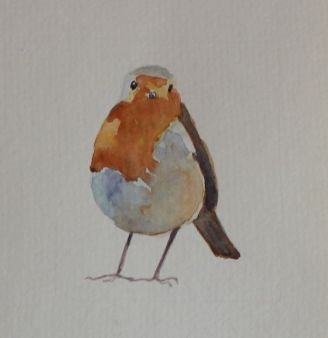
Watercolour painting of robin
Robin #1 (SOLD)

I have been trying out different watercolour papers too. My earliest birds were painted on Etival 300g/m (140 lb) rough texture paper. It was what I happened to have in the cupboard.

Out of curiosity, I tried a different make, Bockingford. Their paper is Acid-Free, and archival quality. I tried two weights. First I tried very heavy 425g/m (200 lb) paper, rough texture. I liked the substantial thickness of this paper, and the paintings turned out well enough but the grain of the paper doesn’t photograph well. I might try scanning them instead, when I am finally up and about.

The second Bockingford paper I tried was a lighter 300 g/m rough texture paper. I think that this suited me best in terms of how the paintings look in photographs.

I have ordered some Bockingford 300 g/m cold press (not) texture paper to try out too. That should be coming early next week. So trying that out will come as a welcome break from my rehab exercises!

Stockists

On this occasion, I ordered my paper from Jacksons Art, as they had an extensive range of watercolour paper and paints on offer.

They also stock the excellent M. Graham watercolour paints. It’s not cheap and so far I have one tube of this paint but I love it more than all my other watercolour paints put together!

In the past I have also used Ken Bromley and Great Art.

Rosemary and Co also make beautiful brushes

Please note that I am not being paid to promote any of these stockists.