Posted on 9 Comments

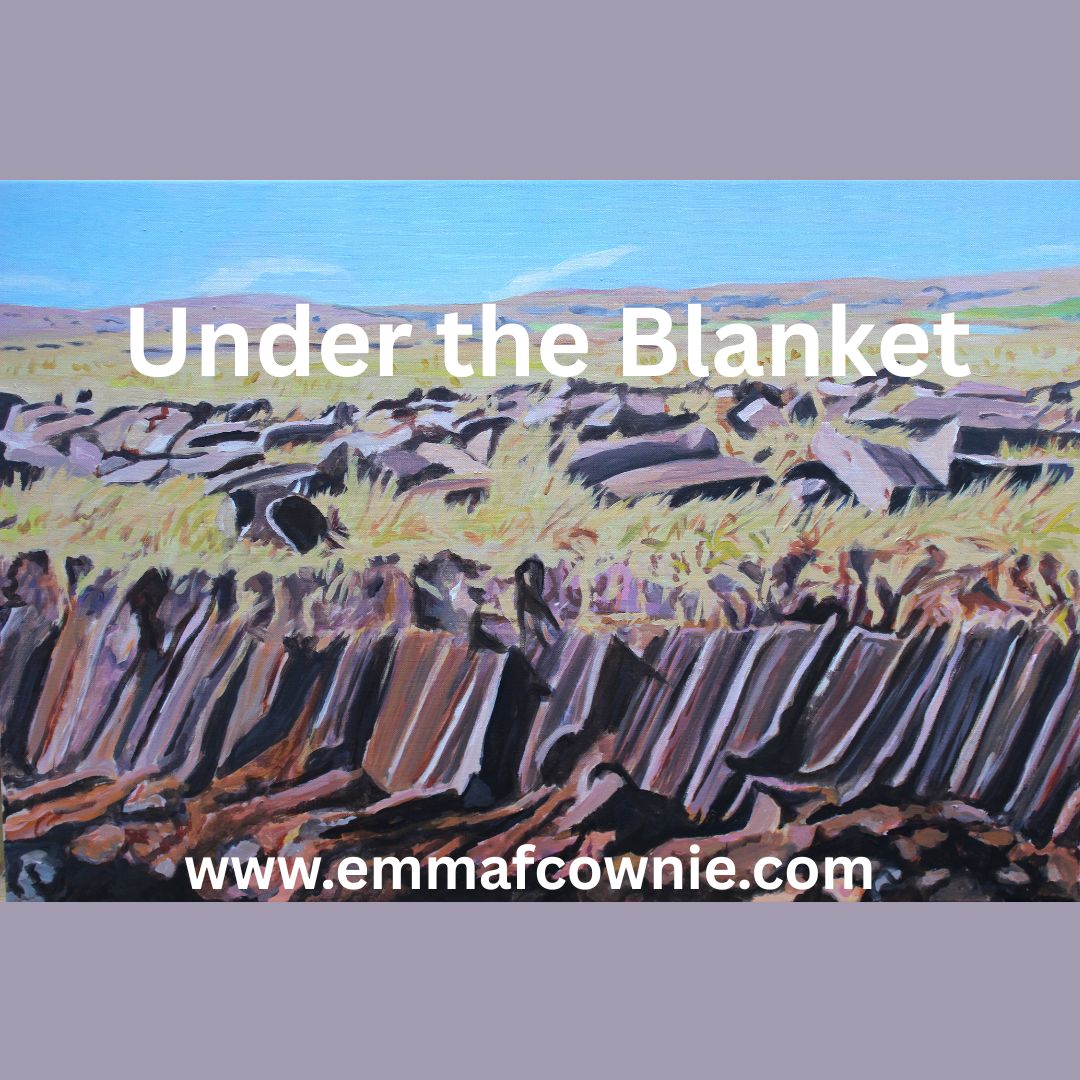
Under the Blanket

Under the Blanket by Emma Cownie

Ireland was once covered in a massive sheet of ice. Then about ten thousand years ago it retreated and trees and grasses sprang up to cover the rocky landscape. Today those trees are long gone. Farmers came and cleared them about 6,000 years ago and the continual rains from the Atlantic soaked and washed the soil reducing the mineral content making it more acidic. Plants like sphagham moss helped keep the land wet. So now West Donegal is covered in something called blanket bog. Blanket bog is a type of peatland found in only a few parts of the world with cool, wet and, usually, oceanic climates. It covers 3% of the world but contains a third of all the carbon in the world.

I love the blanket bog – it covers vast areas. It is a seemingly empty landscape. On an overcast day it has an exhilerating bleakness. On a sunny day, it hints at what a prehistoric Ireland might have looked like (plus a few wolves and lots of red deer). There are few, if any, paths through the bogland. If you venture on the land in summer it is springy underfoot. Most of it is drained with ditches along the road and narrow bog roads leading to “nowhere”.

Blanket bog in West Donegal
Blanket bog in West Donegal (from N252 on the way to Doochary)

For generations people who lived on the boglands drained the land then cut and dried the peat, also called turf, to burn. This was cheap fuel to cook and heat their homes. In a land with no oil or coal, the turf was essential. The landscape across west Donegal is marked with the long scars of peat banks. Cutting it is back-breaking work. In the past the surface of the bog was mostly cut away by hand using the traditional turf spade or sleán. Further South mechanised extraction is apparently the norm, using chain cutter, digger, sausage, hopper and milling machines. In Donegal, however, it is still cut by hand.

The Irish government used to burn turf on an industrial scale, enough to fuel a couple of power stations, up until very recently, 2020 in fact. People with “turbary rights” can cut and burn sod peat on their land for their own domestic uses but they are not meant to sell it. However with fuel poverty, older people in particular, will buy it to use it in winter. A load of turf may cost as little as 200 Euros (about 230 US dollars) and can last months.

The government is trying to discourage this not only because of the enviromental costs but also because of the pollution it causes. It smells delicious but its smoky and very bad for the lungs, especially if you have asthma.

There are moves to encourage the rewetting of the bogs. Targets have been set by the EUand a few pilot schemes in Donegal and a lot more in the Midlands, have been rolled out, Cloncrow Bog Natural Heritage Area is a great example of a rewetted raised bog. However, much more funding is needed from the government to encourage widespread adoption and to help the 4% of the population for whom turf is their main source of heating.

Scars of turf banks line the landscape
Turf drying in the summer sun - Westr Donegal
Turf drying in the summer sun – West Donegal
Turf bagged up
Bags of turf and Errigal
Wildlife growing in the bogland
Wildlife is abdundant in Donegal, if you look down.

The boglands are abundant with wildlife and have been an important part of Irish culture. Bogs were seen as liminal zones – watery places often are. They were seen as places of both life and death—fertile ground for spirits, fairies, and supernatural beings. The bog was also believed to be the gateway to the Otherworld, where fairies, spirits, and even the dead could cross between realms. Many bog bodies and ancient artifacts were likely put there as ritual offerings to appease gods or supernatural forces.

If you want to look at some bog bodies this site has some good photos. I wont post them here, I never really got over looking at the poor soul in the British Museum (Lindow Man) who died in a Cheshire bog. I was fascinated by his face but couldn’t help thinking he could never imagine his mortal remains being looked at by all and sundry over 2000 years later.

One of the most famous mythical figures associated with the bog is Fionn Mac Cumhaill (Finn McCool), the legendary warrior of the Fianna. Some stories say that he and his warriors roamed the boglands, using them as a hiding place during battles.

Red Deer near Burtonport, Donegal

Bogs have also inspired wonderful poetry. This is my favourite-

The One

Green, blue, yellow and red –
God is down in the swamps and marshes
Sensational as April and almost incred-
ible the flowering of our catharsis.
A humble scene in a backward place
Where no one important ever looked
The raving flowers looked up in the face
Of the One and the Endless, the Mind that has baulked
The profoundest of mortals. A primrose, a violet,
A violent wild iris – but mostly anonymous performers
Yet an important occasion as the Muse at her toilet
Prepared to inform the local farmers
That beautiful, beautiful, beautiful God
Was breathing His love by a cut-away bog.

+ Patrick Kavanagh (One of Ireland’s most famous poets, from Monaghan, d.1967)

Cronashallog Bogcut (Arranmore) – a commission by Emma Cownie

And finally…Seamus Heaney’s Poem “Digging” In 1995 Seamus was awarded the Nobel Prize for literature.

Read about Seamus Heaney’s Bog Poems

NOTE: I did not use AI to research and/or write this and I did not use it to “improve” it. I would rather my writing was human and imperfect.

Read More about Boglands

https://www.nature.scot/landscapes-and-habitats/habitat-types/mountains-heaths-and-bogs/blanket-bog

https://theinformedfarmer.com/blog/tech-giants-invest-in-irish-bog-restoration–a–3-million-initiative

https://theconversation.com/peatland-folklore-lent-us-will-o-the-wisps-and-jack-o-lanterns-and-can-inspire-climate-action-today-170202

https://talesofforgottenirishhistory.substack.com/p/the-bog-of-allen?utm_medium=web

Posted on 8 Comments

Timelapse of a Commission (with Nellie)

Timelapse Film of Work on a Commission

It’s not until you film yourself painting that you realise just how long a painting takes. I *know* how long they take, usually several days, sometimes longer. Actually seeing the process makes you realise how painstaking and slow the whole process is. Its taken me a while how to work out how to do a timelapse film and its a joy to see the work “fly” along. This is how it feels to me as I am painting (when its going well). Of course, a film can’t capture all the standing back, breaks to change the water, to clean the palette, or just to *look* at the painting. That is a dedicated painting shirt, by the way. There’s a lot of paint on the front of it.

Nellie had been lying on the bed whilst I was painting and came over when I put the palette down. Flossie and Nellie have always taken a great interest in my painting. So much so that I have been reduced to using a small camping stool as they insisted on walking along the back of the chair I used. My water is in a small jam jar with a scew-on lid as Nellie frequently tries to drink the (probably toxic) paint water if I leave it unattended. The palette also has a lid to help keep it damp and keep playful paws away from the paint. They are a large part of the reason I paint in water-based acrylic paints these days instead of oils.

Flossie and Nellie
Flossie and Nellie (on the wardrobe admiring art)
Posted on 13 Comments

Summer Newsletter

Emma Cownie Newsletter Summer 2022

While many of you are baking in England and dealing with a hosepipe ban, in Donegal it’s cloudy with occasional showers. I thought I would share you my recent newletter. They have ended up being quarterly. It depends of how much news I have and how busy I have been. I always make it strong on the visuals and light on the words! I also make the typeface large for reading on smart phones!

Emma Cownie Newsletter Summer 2022

Emma Cownie Newsletter Summer 2022


Emma Cownie Newsletter Summer 2022


Emma Cownie Newsletter Summer 2022


Read More

More about greyscaling 

Buy Paintings 

Visit our viewing gallery

Commission a landscape painting 

Posted on 18 Comments

Swansea: “The town of windows between hills and the sea”

Swansea: The town of windows between hills and the sea

Dylan Thomas, the poet, grew up in Swansea and he descbed it as “An ugly, lovely town … crawling, sprawling … by the side of a long and splendid curving shore”.

About 5 years ago I went through a phase of painting a number of intricate paintings of Swansea. I loved the layers of Victorian and Edwardian houses with their high pitched roofs.  I went to great effort to walk out onto the quay and the beach to take photos with a zoom lens. The quay is no longer accessible, as part of the walkway has since collapsed.

I recently reworked a couple of these paintings that I still had.

I was recently commissioned to paint another painting from this series. The commissioned work would be similar, but the composition and the execution of the work would be slightly different. I had mixed feelings about the project because I knew how fiddly these paintings are. These paintings take a great deal of concentration!   I use a small brush for all the work on the buildings and they take several days of very focused effort to complete. Still, I hadn’t painted one for many years so I decided to paint one again. Perhaps it’s like a transatlantic flight, something that you can endure once a year but no more often than that. So here it is.

Swansea from the Beach
Swansea from the Beach Revisited (2020 commission)

Still, for all my wingeing I can’t help but say that I was really pleased with the final painting. My head hurts from all that focusing on the small houses with their white gables and red chimneys. However, I did like thinking about the different places in the painting as I painted them. The perspective squeezes the buildings together in a way and makes them look closer to each other in a way they are not in real life, by that I mean, on the ground.

beachfront-cafe-swansea
Beachfront café when it was 360

On the far right of the painting, on the beach, is what used to be the 360 Café and is now called The Secret. Next to that is the green building know as the Patti Pavilion, the trees behind it belong to the beautiful Victoria Park. They look so close to each other but in reality, the Patti Pavilion is on the other side of the busy Oystermouth Road.

Patti_Pavilion,_Victoria_Park,_St._Helen's,_Swansea,_2009
Patti Pavillion and Oystermouth Road

The square building that stretches across the rest of the painting is the Guildhall, which contains the beautiful panels painted by Frank Brangwyn. Rising up behind these buildings is are the parts of Swansea known as Sandfields, Brynmill, and Townhill.

The Brangwyn Hall in Swansea.

Once upon a time, they were villages or rolling farmland, but now they are all merged into the sprawling City of Swansea.  As Dylan Thomas aptly described it “The town of windows between hills and the sea.” On rainy days the clouds descend on Townhill and it can no longer see or be seen!

I am now working on a medium-sized much “looser” Donegal landscape painting, before making a start on two more commissions.


You can now buy a print of this painting here. Click on “reproductions” tab to see your options.


To follow in Dylan Thomas’s footsteps you can visit his favourite places around Swansea:-

https://www.visitwales.com/things-do/culture/cultural-attractions/swansea-and-gower-dylan-thomas-footsteps


Posted on 23 Comments

Going large! (Scaling up a commission piece)

Commissions are usually pretty interesting because they will challenge me in some way or another. This particular commission’s challenge was about scale. Now, I don’t usually paint large paintings because I just don’t have the space to store many of them. I have a few but I am not keen to paint many more as and I find it difficult to paint in a crowded attic studio, both on a practical level (if you look at my photos carefully you can see its crowded in my studio) and also psychologically (it starts to bug me).  So if a commission requires me to go large I am quite excited by that prospect. Excited and a bit scared.

This commission was based on a relatively modest-sized painting I had recently painted of Gola Island, Donegal. This is 41x33cm, that’s 16 x 13 inches for non-metric people.

Painting of Gola, Donegal

Up from the Pier (Gola)

As you can see from the studio photo, the original fits on the seat of a chair. It is a favourite of mine. I have many favourite paintings, this is my current one.

The commission canvas size was to be 120 x 80cm (47×32 inches). Which is pretty big for my little studio. The canvas I could cope with, but the cardboard box it was arrived in is annoying me as it’s ended up by the railings by the steps to the attic. It’s in my way.

So I pondered the issues with scaling up this painting. The joy of small paintings is that you can hint at all sorts of things with a brushstroke or two and the brain will do the rest of the work. There’s no hiding place when the canvas is over a metre in size.

Painting of Gola, Donegal
Up from the Pier (in-studio)

So the first change in my approach was scale. I printed out my reference photo on a much larger piece of paper. My original photo wasn’t much bigger than 10cm (4 inches) square. Don’t ask me why. I like to print off a lot of images at one time and then ponder which one I want to actually paint. For the commission, the photo was closer to A4 size (7×11 inches) and amazingly, I could see much more detail! So I focused a lot of attention on the buildings and caravan on the horizon. I paint with a small brush get the details of the light on the houses and ruins.

Painting of Gola, Donegal
Sketching out the commission

I generally work from left to right when I am painting so as not to smudge work with my hand and the next part I worked on were the rocks and the grassy verge to the left of the track. The real joy of painting vegetation in Donegal is the many varied greens and yellows. I love picking out the different hues. I have to make sure that my colours match the colours in the reference photo as closely as possible. It sounds daft, but I hold up the paintbrush next to the photo to check I have the right tones.

The grass and bracken in the main part of the painting were carefully reconstructed. Saying that I use much larger brushes than I do for my smaller paintings. I make sure that blocks of yellow ochres and green grass or darker bracken are in the right place. There are both warm and cool greens here. There are splashes and smudges of oranges, pinks, jade and turquoise in there too. I am trying to convey not only colour but the shape of undulating land; where the grass has grown up and in some places, covered completely the old stone walls. The island is covered in lots of wooden fence posts, but I don’t want to paint in all the wires as the eye wouldn’t see them all in that much detail so I pick out just a few of them. I wanted to recreate the spirit of the smaller painting rather than create a new painting so I have to adjust a few patches of grass, on the left-hand side of the painting, so their bluish tones echo the first painting and balance the colours in the whole. The tiny golden yellow flowers that are gathered at the bend in the pinkish track are added.

The sky is painted last. Sometimes I paint skies first, especially if it is a cloudy or stormy sky, but in this case, it’s a blue powdery summer blue and it comes last. It has the effect of bringing the whole painting together.

Painting of Gola, Donegal

The commission next to the study painting of Gola

So the final stage is to sit with the painting and check that it has the same “vibe” as the smaller study painting. I think it has. I regard it as a big beast, but one I like.

I wonder what it would be like to have a massive studio where you could store bigger paintings? Would I paint larger paintings? Well, in the winter when light is short I would still paint smaller works that could be completed relatively quickly, but in the summer months when I have acres of daylight? You bet.

Painting of Gola, Donegal
The artist (*ahem*) with the two paintings
Painting of Gola, Donegal
The Commission piece finished 120x80cm


Posted on 4 Comments

How to commission a painting

Custom paintings by Emma Cownie
Selection of Commissioned work by Emma Cownie

How to commission a painting. This for all you collectors, decorators, and art enthusiasts who are intimidated by the thought of commissioning a painting, but thrilled at the prospect of working with an artist on a piece of your own. It’s easy.

Here are my 5 steps.

1. The Brief – send me an outline of what you are looking for in your commission; i.e. size, subject matter, and include as many good quality reference photos as you can.  I can edit or combine images on request. Here’s an example of a project where I did this last year. If its a pet portrait, what sort of background would you like?

2. Size of the Work – This has a bearing on the price. Here are some guidelines. These prices include free packing & shipping. Most canvas sizes can be ordered to suit commission requirements.

60×50 cm – £295      (Approx 19.68 x 23.6 inches – US $380)
70×50 cm – £345     (Approx 19.68 x 27.5 inches – US $445)
80×60 cm – £450     (Approx 31.49 x 23.6 inches – US $582)
100×80 cm – £650   (Approx 39.49 x 31.49 inches – US $840)

3. Logistics – Timescale, is this work a present for a special event? A custom painting can be a unique gift for a loved one. I will need to know special dates well in advance so there is plenty of time for the work to thoroughly dry before it is packed and shipped.

4. Deposit – I will need a deposit usually 25% of the final price, this is to cover the materials and any design work, such as sketches or other mockups.

5. Final review – You will be sent images of the final painting. I finish my work by painting a neutral colour around the edges so the painting is ready to hang. Your work will be shipped and a tracking number provided.

That’s it. Sit back and admire your painting for years to come.

Get in touch to discuss ideas. Email emmafcownie@gmail.com

Commission of a painting of a spaniel
The progress of a painting commission

So to sum it all up…

Custom art work by Emma Cownie
5 steps to a commission

Posted on 25 Comments

Art as Satire

molly-ivins-journalist-quote-satire-is-traditionally-the-weapon-of.jpg
I paint commissions. Most commissions requests are pretty standard, say a beloved dog, a favourite landscape or the owner’s house. Some commissions, however, are different. I recently painted two commissions that quite different from the typical paintings of animals/landscapes. My client sent me two images, both were photographs cut out of the New York Times, with little or no explanation. They were both clearly political in nature. I was given free rein to interpret them as I liked.
Painting of American internment camp on Mexican border
Suffer the Children
I find these commission interesting as these are not my usual subject matter. I *usually* paint landscapes or observational people portraits. However, in painting these images I am forced to look at them carefully and consider the wider implications of what I am observing. I don’t research the image beforehand only afterwards, I just observe.
The first image I painted was of an internment camp. So with “Suffer the Children”, the tents reminded me of  the 1970s medical comedy/satire M*A*S*H which was set during the Korean War. In its early years, M*A*S*H was clearly a commentary on the Vietnam War but later on the Cold War in general. It often questioned, mocked, and grappled with America’s role in the Cold War. It was funny and thought provoking.
I knew that the figures lined up in my source photograph were minors. Teenage boys, I guessed from their size. I didn’t know where they were, but I guessed that they were somewhere in the USA near the Mexican border.
It eventually dawned on me that the white squares on their colourful T-shirts were actually I.D. tags, a bit like those luggage labels evacuees wore during Britain in the Second World War. Turns out that these were teenage boys who had entered the USA illegally. This is, in fact, is a secret internment camp at Tornillo, outside El Paso, Texas. I call it secret because no reporters have been allowed to visit although the New York Times wrote an onion piece on its existence. The photos were presumably taken with a drone.
New York Times
Internment camp at Tornillo, outside El Paso, USA (New York Times photo)
When I painted this image and shared it on social media there were the usual “likes” but little commentary. Few comments. No one said how terrible it was that children were held indefinitely in these camps, in the “free” west. Or that similar “immigration removal centres also exist in the UK, where people, men women and children, are locked up without time limit. Perhaps, they think “immigrants” and then lose interest. Perhaps people missed the satire of the title “Suffer the Children”?
I drew a very different reaction with the second commission. This was a photograph of North Korean leader Kim Jong Un standing on a bridge. I know plenty about the North Korean leader and I think that North Korea must be a dreadful place for its citizens to live in, as they are lied to, starved and any disent is swiftly punished with time in work camps. Also know that that we in the west are told a lot of nonsense about the Korean, such as North Koreans only being allowed a choice of 15 “official hair cuts. It all needs to be taken with a pinch-of-salt.
 I initially thought this image had been photoshopped. The two figures either side of Kim didn’t look real. In fact they sort of reminded me of a Pink Floyd Album cover, “Wish you were Here”. If you are not familiar with it , it shows of two men in suits shaking hands. One of the men is one fire.  As the image was made in 1975, those are real flames. Not photoshopped. Which makes the image especially mesmerising.
Man on fire image from Pink Floyd Album
Pink Floyd “Wish You Were Here”
As I looked athe Kim Jong Un, photograph I realised that two suited men were his security detail. The image was as “real” as the Pink Floyd one, but also just as staged. All photography and images of Kim have to be officially sanctioned. North Koreans can’t draw or paint him unless they are official state artists.
This photograph, then is how Kim wants to be seen. As a relaxed and smiling leader on a modern railway bridge. There are no ordinary North Koreans in sight on the train platform in the distance. If I was a North Korean citizen, the act of making this painting, however, may lead to me and my family spending time in a prison camp, Hence the title “Wish You Were Here” (no question mark) is ironic.
Turns out that this was a new railway bridge in Gwangwon Province and photograph was taken less than a day after Donald Trump called off his planned meeting with Kim. North Korea had said that Kim was still willing to meet Trump “at any time”, so the title is doubly appropriate.
Painting of Kim Jong Un
Wish You Were Here? (Kim Jong Un painting)

Wish You Were Here

When I posted this image on facebook and twitter, hashtagging it #statire, it was met with a storm of outraged comments from people who assumed that it was some sort of endorsement of the North Korean state. I was bemused. I wasn’t expecting this sort of reaction. Is it really very likely that a western artist would paint a fan portrait of a dictator?
There were many outraged comments on how Kim Jong Un killed people in work camps and was an evil man. These came mostly from American and Asian commentators. Interesting, in the light of the fact that Trump’s government imprisons children indefinitely and China also detains muslim uighur people in Xinjiang province. I could go on. Hypocrisy is rife. It’s also interesting, it was only British commentators who got the joke or just commented that it was “bizarre”. I’d be interested to see what sort of reaction I’d get if I painted a portrait of Donald Trump or Putin.
There is a long tradition of satire in Britain and Ireland. Although satire is usually meant to be humorous, its greater purpose is often constructive social criticism, using wit to draw attention to both particular and wider issues in society. Hence Jonathan Swift’s famous ‘A Modest Proposal’ which he published in 1729 in which he suggested that the people of Ireland sell their children as food. This outrageous idea was never meant to be taken as face value. Satire is never meant to be taken at face value yet in this social media era things often are, which is why we are all such suckers for fake news, no matter how outrageous it is.
We can scoff at Trump supporters who believed his lies about Clinton and the pizzagate conspiracy but just yesterday a lot of people on twitter in the UK got worked up about a supposed protest by the far right against the new vegan sausage rolls. These sausage rolls had been introduced by Greggs the Bakers. It’s a long story, but a right wing TV commentator Piers Morgan had started the “controversy” when he called the company out on Twitter calling them ‘PC-ravaged clowns’ writing: “Nobody was waiting for a vegan bloody sausage.”
Tweet1
This tweet appeared in my feed yesterday. So as you can see the tweet was “liked” thousands of times and there were many outraged and puzzled comments about how the far right were pathetic and stupid.
Five hours after the original tweet the person who posted it tweeted, backtracked, presumably after realising he’d got it wrong and another tweet claiming it was a “joke” or “banter”, as he called it.

Tweet 2.png

 The traditional print media put everyone right, eventually.
Newspaper.png
Manchester Evening News
So we all need to slow down and think about what we are looking at. Take a minute to see beyond the surface. I’ll leave you with an quote from Jonathan Swift to ponder.
Amazing-Facebook-Statuses-12534-statusmind.com
If you are interested in a commission, satirical or otherwise, please get in touch here.

Posted on 20 Comments

New York Commission

Commission by Emma Cownie

This is a commission piece I have been working on this week. The brief was to paint this beautiful sunlit New York apartment. I was sent a number of photos to work from, the plates and dishes had to vanish, so the main focus of the work was the light and shadow on the patterned table cloth.

A number of New York water towers could be seen outside. I was quite intrigued by these water towers. I had no idea that they were a feature of the Manhattan skyline. I looked up some more photos of these urban water towers and was quite blown away by how many there are!


Water_Tank_Chelsea_Water_Tanks_AW_Duggal_tb.jpg
NY Water towers

Sadly the water towers are not a big feature of the painting, but you can see two of them quite clearly from window on the right hand side of the painting.

IMG-3492.JPG
Original photograph

I love the clean lines of the shadows cast by the window on the table and the parquet flooring and decided that clarity was essential in the composition. So I played around with the original image using an open source program called Gimp (which is a lot like Photoshop) and simplified the image. I “cleared” the table and removed the sleeping hound on the carpet. The resulting images was far from perfect but gave me a claener image to work from.

Empty Table
After  “Gimping” – an empty table

I further simplified the image by painting a plain rug. I also lighten certain parts of the painting, such as the wall behind the table. In this way I wanted to create a feeling of airiness and light.

New York Apartment, November Light

I also lightened the red chair on the right hand side so that it could seen more easily seen and its beautiful curves more easily appreciated. This way it became an integral part of composition, with the red theme in the buildings on the left window, reddish shadows on the wooden flooring being balanced by the red carpet, chair and red in the painting above it.

The shadows have exciting dynamic to them; with the cool shad

ow across the table cloth contrasting with the hot shadows cutting across the floor. My favourite part of the painting was the slice of sunlight on the table leg.

The client, I am pleased to say, loved it. She was very generous in her praise, saying “it is more truthful, beautiful than real life!”

Want to commission your own unique piece of art? Click here.

Posted on 32 Comments

Anatomy of a commission

Hudson Cropped
Hudson the Poodle

Here’s Hudson the black poodle. He’s a handsome chap. I was asked to paint a picture of him. Pretty straight forward, eh?

Well, the challenge was that the commission required that Hudson was to be portrayed not in this rural idyll but in New York City, waiting outside Malecon coffee shop where his owner popped by every morning for her coffee. Hudson is one of those super cool dogs that will just wait. He does not need to be tied up.


I was provided with a couple of photographs of the said restaurant but there were a couple of issues that needed dealing with. Take a look.

Firstly, there were signs and bicycles in the way of the front of the shop. There was no clear view. So I googled the restaurant in the hope that I might find some more useful photographs online.

Several photos of Malecon restaurants in different locations in NYC. The second problem is that Hudson in the original photos was sitting in grass and I could not see what sort of tail he has and what happens to it when he sits down, whether he tucks it under or not. So I searched for some poodles images. Did he have a long or short tail?

IMG_0780
Hudson sitting on the lawn

So I spent a morning using a photo editing program called Gimp (an open source version of Photoshop) and adding poodle tails, taking out bicycles and playing around with compositions.

I finally decided that I lived the photo with the lit interior best. I thought the lights would make a more interesting image. I had a problem deciding where to place the dog as he was black and would not stand out against the dark background. Initially I placed him to one side in front of the plant container but finally settled on in the foreground so that he was the main focus of the picture.

So I send this final image to the customer to check that she’s happy with the composition and I have the right sort of tail for Hudson before I make a start painting. I also got her to agree to a rectangular canvas, rather than a square one, that way I could fit the dog and all of the shop front in easily.

My final problem is that I added a shadow to the dog to give the picture a more dynamism but there were few, if any shadows in the photos I had. I so searched the internet again for reference images.


So I did a lot of thinking about the likely direction of shadow that the awning would likely cast and the length of the shadow, drawing lines on the image I’d sent to the customer. So once, I decided on these things and also kept in mind the information I had in the original photos I got started. I began with the letters of the restaurant name as I this was the element that I was most concerned to get right. Once I had painted these in, I relaxed and enjoyed the work. As I was using a small canvas (41 x 33 cm) it was easy to turn and paint upside-down, side to side as well as right side up. Overall, allowing for dying times, the work was done over three days.

This is what I painted.

IMG_8829g
Hudson, New York

If you are interested in finding out more about a commission, click here

Posted on 2 Comments

6 Tips for Painting Commissions

6 Tips on Commissions v2

Commissions for Oil Paintings

I am currently working on a commission piece at the moment and have two more in the pipeline. I really enjoy doing commissions for three reasons: Firstly, you’ve “sold” a piece of work before you’ve completed it. Secondly, it’s quite a compliment and boost to the fragile painters’ ego: someone likes your work enough to ask you to paint something especially for them. Finally, it’s a challenge – often you are asked to paint subjects you would not have normally chosen to paint but the results can be very pleasing. Subjects I have painted range from beloved pets (many more dogs than cats), a holiday scene, a family home, a golf course in Australia, a CD cover as well as revisiting subjects that I have painted before which as woodland scenes and Welsh landscapes.

My 6 Tips on Commissions

1. Price – make it clear how much it is likely to cost. I have a page on my website that sets out the sizes and prices. We can negotiate on details such as shipping, packaging (do they want it gift-wrapped, a card with a message included?). Generally, I charge according to how long the work is likely to take and how detailed it is.

2. Deal direct with the collector – I used to do commissions via online galleries but I have found that galleries have interfered with the negotiations too much, and that has discouraged me. Some online galleries even stipulate that if you do a commission through them then the customer retains the copyright to the work. I believe that the artist retains the copyright, whereas the collector has bought for the artwork

3. Turnaround time – make it clear how quickly you can paint the piece (including drying times which can be quite lengthy). It is important not to take on too many projects at the same time. I generally, limit myself to three at any one time.

4. Ideally, secure a deposit before you start working. If nothing else, it helps ensure that the customer is serious about this commission. This gives me peace of mind of knowing that my buyer is serious about commissioning without me being left empty handed.

5. Know your limits. If you are working from a photo, make sure it is of good quality and better still, make sure you have several images of the subject to chose from. The photos need to have been in good light. If the image is not good enough, don’t be afraid to ask for better ones. If none are available, be prepared to turn down the commission. You don’t want to produce a poor quality artwork. No one will be happy with that outcome.

6. Communication – let the customer see the finished painting before it’s dried and communicate about shipping details, when it’s sent, tracking number and check that it’s arrived safely and the customer is satisfied.

© Emma Cownie 2017