We have been in full lockdown since last Friday and the the terrible weather (I write this to the sound of of rain lashing against against the windows) makes it a all a lot tougher to endure. The clocks went back too, so good quality light to paint by has been in short supply. I have, nevertheless, just finished a large scale painting and I am now working on a commission.
The Approaching Storm (On Dunlewy Lough), Ireland – Work in Progress
I wanted to write about how you can “show” your work when you are social distancing. On this wordpress site I am able to show more than one photos of my paintings in the “shop” section. It is useful to take photos of a painting in a studio so you can get a sense of the scale of the painting.
The Approaching Storm (On Dunlewy Lough), Ireland
Here it is. My most recent painting ” The Approaching Storm (On Dunlewy Lough), Ireland” which is 100cm x 80cm (approx 39″x 31″). I will often post a “in the studio” photos of painting to help give a sense of the sense of the painting, but they dont really show the painting at its best. A real life exhibition would be good but its not pratictical (or allowed) at the moment.
The Approaching Storm (On Dunlewy Lough), Ireland – In my attic studio
The next best way of displaying my painting is using an online app which show the work “in situ” in a computer generated room. Online galleries will often provide these sorts of images as part of the membership of the site (e.g. Singulart and Artfinder) but the choice of rooms is limited and often they won’t provide them for smaller works.
Artfinder mock up
Singulart Mock Up
I have spent some time searching online for apps so I could do this myself and have more control of the choice of rooms and colour of the walls. It was difficult to find sites that showed works to scale. There is not much point showing people a mock up that makes your painting look much bigger or smaller than it is in real life. That would be misleading. Unfortunately, most of the good ones were only available for ipads (we dont have one) or on android (too fiddly on a smart phone) and I was looking for a an app that I could use on my PC.
Eventually I came across a site called “Canvy” which has a free plan which allowed the use of 12 “rooms” and unlimited downloads. It was very esay to use. It was a matter of importing images of paintings, typing dimensions (this is very important so images are to scale) and choosing your backgrounds. It is all drag on drop. It seems to automatically add a frame which might be a bit misleading as I dont frame my paintings, but paint around the edges in a neutral colour (usually blue). Very importantly, the final downloaded images do not have watermarks. It has a plugin which links to Etsy.
There is also a paid plan for $15 a month (40% reduction if you signed up to an annual plan) with access to over 200 “rooms”, it offers a 30 day free trial for the full version. Maybe there are better sites out there, I would be interested to hear what other artists use.
Here what a few of the mock-ups look like. Which is your favourite?
The Approaching Storm (On Dunlewy Lough), Ireland on blue wallThe Approaching Storm (On Dunlewy Lough), Ireland on a brick wallThe Approaching Storm (On Dunlewy Lough), Ireland on mustard wall
The great thing is that you can put together a mini exhibition too!
Donegal paintings in situ
After looking at al these photographs, I decided to lighten the clouds at the bottom of the Errigal painting. I felt that the black storm clouds were distracting to eye away from the moutnain and its reflection in the loch.
I am very excited to have my paintings choosen to accompany the acoustic piano version the single, ‘Out Of My Mind’ by the Opacas. Thank you The Opacas for inviting me to collaborate, and to Patrick Boyle in particular who made the beautiful video!
From Magheraclogher Beach (Bunbeg) (Private Collection)
I decided to apply the detailed techniques I have used for painting the hilly city of Swansea to the rural homes of the coastal townland of Bunbeg. I am usually drawn to painting old fashioned Irish cottages, as I like their clean lines and simple shapes. This time, I decided to challenge myself by painting modern Irish houses. The homes of this part of Bunbeg are almost all modern homes, although there are one or two old cottages tucked in amongst the two-storey houses. I found the arrangement of houses on the hilly a pleasing one. I was particularly keen on the road that snakes its way down the hill on the far left of the composition. I decided to leave out all the lamp posts as I felt the cluttered the scene. However, the real joy of the composition is rather unexpected (if you have never seen it before, that is) shipwreck on the right-hand side of the painting. Bád Eddie.
Mageraclogher beach, Bunbeg, on the West coast of Donegal, is a vast, beautiful, and usually windswept beach. It is like a natural amphitheater. In its center, fleetingly illuminated by the autumn light, just for a moment is the ruined hulk of a boat.
Bád Eddie, Ireland.
This is a shipwreck, known locally as Bád Eddie, Bád meaning boat in Irish/Gaeilge. I initially thought “Bad Eddie” was a nickname like Paul Newman’s character in the movie The Hustler, “Fast Eddie”. It made me think the wreck had been some sort of errant boat, but no it just means Eddie’s Boat in Irish. This is, after all, Gaoth Dobhair (Gweedore), an Irish speaking area of Ireland.
There are shipwrecks and there are shipwrecks. I am very familiar with images of bones of the Helvetia that have lain submerged on Rhossili Beach on the Gower Peninsula for over 120 years. Bád Eddie, however, is loved in a way that the Helvetia can only dream of. She has starred in a pop video with Bono and Clannad, no less! She has had a film about her life made and broadcast on the TG4 the Irish language channel (see the film below, it is well worth watching), she has her own popular Twitter account too – Bád Eddie @CaraNaMara
Bád Eddie’s Twitter Page
.
Bád Eddie, isn’t her real name. She was actually named Cara Na Mara (Friend of the Sea). Her first career was as a fishing boat and she was originally built in Brittany, France, and bought by local fisherman Eddie Gillespie. In 1977 she needed two planks repaired and she was towed ashore onto Magherclougher beach and somehow got left. The repairs were never done and she has lain here for over 40 years. So this, if there can be such a thing, is a happy shipwreck. No one died when this ship was washed up. No one had to rescue the crew. There are no sad memories, except for Eddie who never fixed his fishing boat.
Bád Eddie in her better days: From Twitter
In fact, Bád Eddie has helped create nothing but good memories. Over the years she became the playground to the local people and families on holiday in Gweedore. She has featured in thousands of family holiday photos and locals include her in their weddings, communions, even christenings. Sadly, the Atlantic Storms have taken their toll on Bád Eddie, and there’s less on her today than when I saw her two winters ago.
Decorated for Christmas: Image Donegal Daily
The locals love her and also recognize that she is a big tourist attraction and they want her preserved to keep that tourism alive. So there is an ambitious plan to create the first permanent sculpture in the sea in Ireland, a stainless steel full-size replica of the boat, incorporating what is left of the structure. I think a sea sculpture is a brilliant idea. There are some amazing sea sculptures in England, “Another Place” by Antony Gormley at Crosby, Near Liverpool in England and “The Scallop” by Maggi Hamblin at Aldeburgh, on the Suffolk coast – both have had their share of controversy (The Scallop has been called “The most controversial piece of Art in Suffolk”) but they have certainly increased tourism to their areas. I don’t imagine the Bád Eddie sea sculpture will cause too much controversy. The difficulty is around getting enough money together to build it. The project has the support of Donegal County Council, but more funding is needed so a gofundme campaign has been set up.
I recently join the Stair Árrain Mhór – Árrain Mhór History Facebook group and was overwhelmed by the positive response I received from the members when I put my most recent post online there. I was asked if I had any more paintings of Arranmore for them to see, so here’s a collection of all my paintings of the Island that I have completed in the last two years.
Where it reads (Private Collection) it means that the painting has been sold. I hope you enjoy looking at them.
Poll na mbadaí (Harbour of the Boats) Arranmore, Ireland.
Here is my latest Donegal painting. I am delighted that it will be going to its new home in California, USA, very soon.
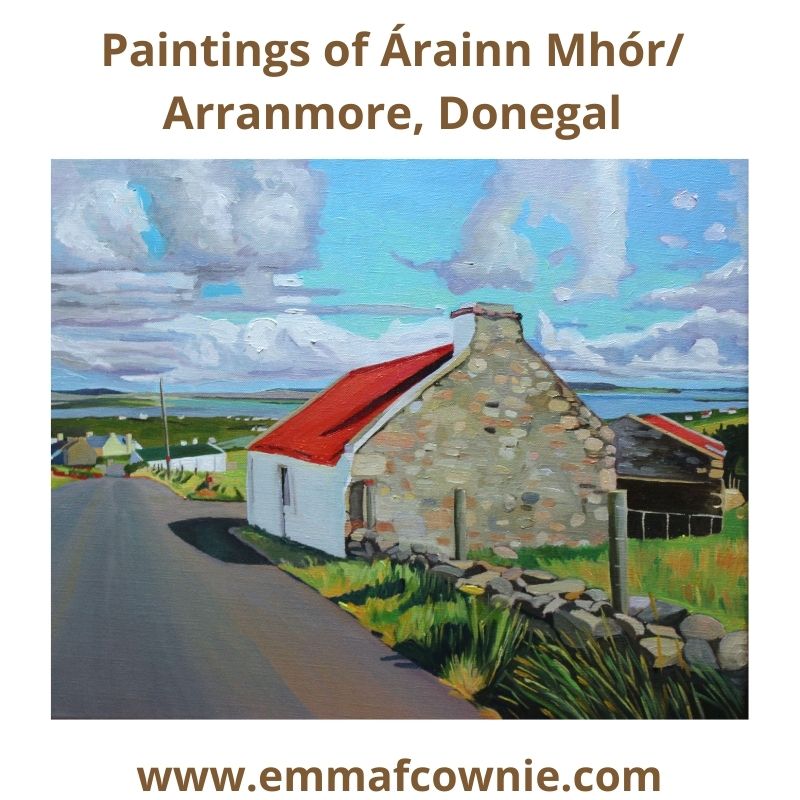
A narrow lane curves down to a shining white cottage and outbuilding and to the right. This is not a public road but a lane to the house, just around the bend. Here it is bathed in glorious winter light. The low sun creates long dark shadows along the lane. The sheep look up, they are not used to strangers (not like the sheep on the Gower that barely give visitors a second glance). On the horizon, you can make out the tiny but distinctive shapes of Muckish and Errigal mountains . You can just make out a line of fence posts that lead down towards the small natural harbour that gives its name to this place: Poll Na Mbadaí or Poolawaddy. The meaning of Poolawaddy (also spelled Pollawaddy) is often disputed. In irish Poll a Mhadaigh, could mean Poll – the harbour, a Mhadaigh – of dogs or Poll na mbadaí, Poll – the harbour, na mbadaí – of the boats. I suspect that the harbour of the boats is more likely, as it is a natural harbour and pier, but I could be wrong. I only have a basic understanding of Irish but I like to try and read it because place names are very descriptive (as they are in Welsh too) and often poetic. A harbour of dogs is just as possible, after all, there are tiny islands nearby named Calf, Duck and Gull Island.
Arranmore Island map
It feels like it has taken me 7 months to get here. The last painting I finished just before I broke my leg in eraly March was also a painting of this area (see below). It has taken me so long to recover my “painting stamina” and gradually paint larger canvases (although some artists would not consider 80×60 cm “large”). I don’t think I will go any larger for now. I feel exhausted after finishing a large painting these days.
View From Poolawaddy (Private collection) painted in early March 2020
I like to understand what it is that I am painting, to get a sense of its history and the people who live/d there. I might call a building an “outhouse” for example but very often that building was once a family home, a newer bigger one having been built next to it. It matters to me to know that. It helps me make sense of a place. I only know only a little about the History of Arranmore, however, so what I have written here has been taken from articles I have found online (I have included links and a list of websites at the end).
Life on the east side of Arranmore Island, where Pollawaddy is located, is marginally easier than on the west side. This is because Cnoc an Iolair, the highest peak on the island (reputedly once home to golden eagles), provides relative shelter from the prevailing westerly Atlantic winds. This side of the island certainly seems more sheltered, gentler.
Poolawaddy, Arranmore, Ireland (from the other side of the bay). Calf Island is to the right of the bay.
After the Protestation plantation in the 17th century, Arranmore Island, Donegal’s largest island, like other large parts of West Donegal, had been given to the English Lord Conyngham. However, when the terrible potato blight leading to the Great Hunger (“an Gorta Mór”, in Irish) spread during in the mid-1840s he declared the island, which he had never set foot on in his life, as unprofitable and sold it to a Protestant man John Stoupe Charley of Finnaghy, Belfast on 29 June 1849. The new landlord came to live on the island, building a “Big House” (now the Glen Hotel) after 1855 just down the road from Poolawaddy. Very near Poolawaddy, RIC police barracks were built, presumbably built around at the same time to protect the landlord’s property. Interestingly, the RIC left the island after about 40 years and there is still no police station on the island (although the Guards do visit on a regular basis).
Ruins of the RIC barracks: Image from thearranmoreferry.com
Landlord Charley decided to clear as many starving tenants off the land, so he demanded them to present the receipts of their rent payments or face eviction. Of course, few if any had been given written receipts, let alone kept them since most of them could not read or write. The choice they were faced with was either the poor house in Glenties or to emigrate to America in a ‘coffin ship’. Many of these subtenants were evicted in 1847 and 1851. Many who made it into the new world settled on ‘Beaver Island’ (Lake Michigan, USA ). The two islands are twinned. The Árainn Mhór & Beaver Island Memorial, built in 2000, and the sign that Beaver Island is 2,750 miles away, is a memorial to this link. Many of the first islanders who emigrated to Beaver Island were from Poolawaddy. Evictions carried on after John Charley’s death in 1879, when his widow Mary and his brother Walter Charley MP were left to manage his lands. The British government even sent a gunboat, “Goshawk” in 1881 to “assist … the serving of ejectment processes on the tenants in the island of Arranmore”!
Poolawaddy Pier, image from thearranmoreferry.com
The Islanders who left for America emigrated permanently, but seasonal emigration was a more common feature of island life, with many young people working as labourers for farmers in the Lagan, a fertile area in northwest Ulster, and also in Scotland as ” tattiehokers” for the summer. Rósie Rua was one such youngster. She was born in 1879 and was reared on Aranmore Island by her mother and her step-father, the Butcher. In adult life, she gained renown as the best traditional singer in Aranmore and wrote a memoir of her life with the help of Padraig Ua Cnaimhsí. Unfortunately, the memoir seems to be out of print, but I could read some sections of it on google.books.
Róise Rua
In her memoir she describes how at aged nine she was hired out to farmers in the Lagan. Her family home was not far from Poolawaddy and she describes catching the boat to Scotland to work as a farmworker or ” tattiehoker” for the summer. She wrote that “the steamer had dropped anchor off Calf Island, and we saw the boats pulling out from the shore with their passengers. In no time at all, we were all down at Pollawaddy ourselves and one of the small boats brought us out. Lily was the name of the steamer.I was amazed at the size of her…just about a hundred passengers in all boarded the Lily at Calf Island.”
Róise Rya’s Home:Image thearranmoreferry.com
Rósie Rua has a singing festival, Féile Róise Rua held in her name on Arranmore. The first was held in 2019. Sadly the pandemic distrupted the 2020 festival. The festival went online on facebook and you can watch some of the performers here. Fingers crossed the next one can go ahead in 2021! I will leave you will a clip of Jerry Early singing “I’ll Go” (5.55 onwards). Just look at the view out of his window!
I was recently commissioned by a collector to paint a version of a painting by Paul Henry. This was quite a daunting request. At the moment, my top three favorite (dead) painters of the Donegal landscape are Paul Henry, and William Hubert Craig and Letitia Marion Hamilton.
Born in Belfast, Paul Henry studied art in Belfast and then Paris. He lived in London briefly, and then moved to Achill Island on the West coast of Ireland in 1910, with his artist wife, Grace. They lived here until 1919 when they moved to Dublin. His paintings depict the West of Ireland landscape in a beautifully spare post-impressionist style.
Paul Henry’s paintings portray the rugged mountains, wind-swept trees, dark boglands and towering clouds of the west coast of Ireland. His images of Ireland are genuinely “iconic”. This is because in 1925 he was commissioned by the London Midland and Scottish Railway Company to design a travel poster.
This poster for Connemara was distributed throughout the world (mostly in North America) to encourage tourists to explore the west of Ireland. The Irish Times commented in that year: “If thousands of people in Great Britain and America have been led this summer to think over the claims of Ireland as holiday ground it is largely through the lure of Mr Paul Henry’s glowing landscape of a Connemara scene.”
Many people bought reproductions of the poster and more posters followed.
This travel poster was produced for the London Midland and Scottish Railway Company c1920s. It shows Mount Errigal in Donegal which is the tallest peak in the Derryveagh Mountains and has been voted as ‘Ireland’s Most Iconic Mountain’ in the past. Some small country cottages at the foot of the mountain by the lough side can be seen in the foreground. Artwork is by Paul Henry (1876-1958), who was famous for his paintings of clouds and rugged Irish landscapes. During the 1920s several of Paul Henry’s works were reproduced as posters or print. These helped to establish the standard scenic view of Ireland in tourist literature and in government publications and this poster is a prime example of his outstanding, unique talent.
Many of Paul Henry’s landscape paintings are in public galleries and museums but they also turn up at auction on a regular basis and almost always do “very well”.
The small painting that was auctioned this July, was the one I was commissioned to interpret. This was “Claddagh Village” painted in 1928. I do not know what the painting sold for, but the estimate was for a whopping €40,000 – €60,000
I had to think quite a bit about this painting and Paul Henry before I started work on my own version. I have never done versions of other artists’ works, although I have seen artists sketching famous paintings in art galleries. I am the sort of artist who peers very closely at the surface of a painting in a gallery, to try and get a sense of how a painting was made.
I suppose I approached this task in a similar manner. I peered carefully at the impasto brushwork in the photograph of the painting. I looked at how he had laid the colours down. Although the paint was thick in places, in others it was applied thinly and the colour of the canvas/grounding showed through the paint. There was something about Paul Henry’s paintings that bothered me. I could not quite put my finger on it. How can I put it, they were all very blue, even when they had red in them. Indeed, “Claddagh Village” had curious splashes of red on the right-hand side of the painting, and I wasn’t sure what they were meant to represent. Was the hedge on fire? Surely not.
Part of the answer it turns out that Paul Henry was mildly colour bind. So when he used red it was probably squeezed neat from the tube. Greens, warm, cool, or otherwise, are often absent from his paintings. This caused me to pause. Should I copy Paul Henry’s colour scheme or use my own palette of colours? I decided I needed to know more. So I research the subject matter a bit more.
Claddagh was a fishing village in County Galway. It’s thatched cottages were pulled down in the 1930s, but old photographs of the original houses still survive.
These photos gave me a good sense of the chunky shape of these very old houses but not their colours. So I looked for modern photos of Galway thatched cottages for the colour. I finally, found some images of puffy clouds over Connemara and put together a reference sheet for colours and shapes. I decided although I would use Paul Henry’s composition I would not copy his colours, as such, use the reference images in the way I usually paint pictures.
Visual References
Once I had settled these questions in my mind, I put them to mind and painted. My canvas was about the same size (24x30cm) as the one he used (23x30cm). My choice of blue for the sky was very different from the beautiful (almost) duck egg blue Paul Henry used. My cloud was a summer cloud.
My shadows had more blue and mauve in them, that Henry’s which had a lot of grey/brown in them. Interestingly, had I been painting a watercolour version I probably would have copied his choice of colour for the shadows.
I dithered over the russet-coloured bush. I wondered if it had been green in real life or if the painting was done in autumn. In the end, I left it russet. I don’t think I conveyed the thickness of the thatch as well as Henry did. My thatch looks too new.
Right at the end as I painted the grey stone wall, I realised with an oddly blinding clarity that the smudges of red could only be a rain shower! How stupid was I to think that the bush was on fire? The whole painting was about a pair of small rain clouds producing a tiny gust of rain, whereas my version was about a hot sunny day.
Paul Henry’s painting is an infinitely superior painting to mine as it has movement too; in the rain shower, how he has painted the road, the depth of the shadow/reflection on the gable ends of the houses. He handles the paint so confidently. It tells a story, about a sudden shower, whereas mine is about space and empty street. I always thought that Paul Henry was the master of simplifying a scene, I just had not appreciated how effective his use of impasto paint was. I found that very appealing.
Claddagh Village, Paul Henry
Now I understand why artists will make copies of the great masters, because you cannot truly understand how a painting is made until you try and put together your own version. Looking at the surface of a painting will only get you so far in understanding it. I was not attempting to copy “Claddagh Village”, although that would have been interesting, but reimagine it. As many husband joked, it’s Claddagh village, just on a better day.
We are all told to stay local in Wales, until July anyway. I am still recovering from the operation to pin my broken leg so all of my journeys are very short, and very slow, anyway. I have been taking more adventurous journeys of the mind to Donegal, and to the little village of Maghery in particular.
It lies just a stone’s throw (4 miles or about a 10-minute drive) down the road from Dungloe (I regard Dungloe as the center of my universe when I am in Donegal because it has supermarkets like Lidls, Aldis, Supervalu, and The Cope). The Irish name for Maghery Glebe is An Machaire. We know that people lived here over 5000 years ago because they built stone circles, left tombs, a Crannóg, and a stone fort.
Maghery Beach with Arranmore in the distance
We have only ever been to Maghery twice. On both occasions, it was to visit Crohy sea arch. We failed to find the arch, but we did see some very fine sea stacks called Na Bristí on our second visit. We also found found two beautiful beaches, a Napoleonic signal tower, and Second World War look out post and my favouite, and an Éire Sign.
I would like to visit again, but instead, I can only visit online and “in paint”. The drive through the village has inspired my latest series of three paintings. (The first two paintings have gone to collectors in France and the USA). I was drawn to paint the pink and mauve old houses in particular, mixed in with the white stone cottages.
Driving into Maghery SOLDPink House Maghery – SOLD
Through Maghery, Donegal Ireland
Its only now that I realise the mauve house in my 3rd painting is a very similar colour to the early morning sand on the pristine beach nearby.
Maghery Beach, with Maghery village and Napoleonic signal tower
People have been looking out at the Atlantic Ocean and the surrounding land from the hills near Maghery for hundreds of years. They haven’t always been admiring the view, either. During the Napoleonic Wars, a signal tower was built on the headland in the years 1804-6.
Signal Tower at Maghery
This was one of a series of 12 towers built along the Donegal coastline, to watch out for invasion from French forces. We dont have these in Wales, although Wales invaded by a French force in 1797. That’s beacuse it was not built to protect the Irish population from the French, but because the British did not trust the Irish not to welcome the French with open arms. A few years earlier Irishman, Wolfe Tone, had attempted but failed to land a French force near Lough Swilly. The plan had been to throw the British out of Ireland. His landing failed but there was a successful landing of French forces further down the coast in Mayo. A brief declaration of an Irish Republic followed, but the Irish Rebellion ultimately failed, after a series of battles in Wexford culminating, in defeat at Vinegar Hill.
The signal tower is thus a symbol of deep mistrust by the British. This particular tower is well preserved and surrounded by walled farmer’s fields. The men who were garrioned here communicated with neighbouring signal towers by raising and lowering a large rectangular flag, a smaller blue pendant and four black balls in various combinations along a system centred on a tall wooden mast. This must have been very difficult if not impossible in poor weather conditions.
About 200 meters down the road is the Second World War Eire sign. I am not sure why but I was more excited to see this than the tower. Perhaps, because it was tucked away, designed only to be seen from the air. Perhaps also beacuse it is cut into the grass like a prehistoric chalk horse.
Eire 74 sign at Maghery
The letters spell the word Éire, which means “Ireland” in the Irish language. Over 80 of these numbered Éire signs were dotted around the coast of the Republic during the Second World War. I originally thought this was to warn German bombers that they were flying over a neutral country. This was important as neighbouring Northern Ireland, being part of the United Kingdom, was not neutral. I was wrong, the main purpose of these numbered signs was as a navigational aids for the Allied planes.
Although the Republic were offically neutral they were indirectly involved in the war. In the Spring of 1939, expecting another European War, the British Government had asked the Irish Government to set up a Coastguard Service. The Irish Government agreed to build a series of small concrete huts, known as Look Out Posts (or LOPs) along the coast. There is this one at Crohy and there was another on Arranmore Island near by. The letters Eire (without the accent on the “E”) were written in stone nearby to give aircraft an idea of where they were. The stones were painted white. The numbers (74 in the case of Crohy) were added in 1942 after the Americans entered the war in December of 1941. (Thank you to Séan Bonner for this information).
These huts were pre-built in parts and assembled on site by the army (as the Coastguard Service was under the control of the army). The Irish Government agreed to build the huts and set up the service but on condition that they only would supply radios to the huts in the event of a war. Coast watchers worked around the clock in pairs, reporting every activity observed at sea or in the air by telephone.
As the aircraft would have seen it (Photo Credit:Conor Corbet)
Allied aircraft were allowed to fly over the Republic through the “Donegal Corridor” to airbases in County Fermanagh. These airbases were crucial to provide “cover” for the shipping convoys that came across the Atlantic bringing industrial raw materials and food to Britian. Without fear of air attack, German U-boats would operate as ‘wolf packs’, picking off the ships one by one. All flights were meant to take place at “a good height”. If any aircraft crashed, as at least six did, if they could claim they were on a non-combative mission, they would be repatriated. While it was easy for Allied pilots to make that claim, it was not realistic for Luftwaffe pilots to do so, they tended to be interned. Ireland also helped Britain in secret by setting up an armed air/sea rescue trawler called the Robert Hastie at Killybegs, Donegal, to help any shipping casualties and to supply planes that had run out of fuel.
I didn’t realise it at the time but this is just an updated version of the Napoleonic tower. The ruins above the Eire sign is that of a coast watch station. Coast watchers worked around the clock in pairs, reporting every activity observed at sea or in the air by telephone.
Further along the road is Crohy Head. I think techically is Crohy Head, South. Although there is space to park and a sign announcing its presence, you can sense that the local authority are not all wildly keen to promote this attraction in case people fall down the steep field/cliff face trying to get a good look at it.
The Sign for Na Bristí
I am sitting here with my pinned leg resting on a chair, and it’s twitching unhappily at the sight of these photos now. My leg does not like to think about rough terrains right now. I can just about manage a slow walk around my local park these days (it’s going to be a long slow build up to full recovery). We must have been mad! I thought so at the time too. Still, my husband Séamas who climbed down to the beach to take some photos whilst I sat on the hill holding onto some yapping dogs. To my shame, there was an artist with his easel painting en plein air at the top of the field. I wonder if he could hearing me hushing the dogs and telling Seamas to hurry up.
Sadly, the light was, in my opinion, in the “wrong direction” and early morning would be a better time of day to catch the sea stacks. The sea arch, was just out of sight around the corner. I think that I will save up and buy a drone to take photographs from higher up without imperilling any of my (or my husbands’) limbs! Or a boat. Things to dream about from my chair.
Here is a marvelous drone photo of Crohy Head.
Sea Stacks and Sea Arch at Crohy Head (Photo: Gareth Wray)
Finally, I managed to scale the steep steps to my attic studio! One step at a time. Holding on the handrails.
Ah, what pleasure it was to be back in the attic. It has a view out the back of the house. It is a great pleasure to look at the wooded parks and hills of West Swansea instead of the unrelenting concrete streets and terrace houses out the front of the house. I have a number of commissions to fulfill but I wanted to “warm up” with some small paintings first as I have been working with watercolours for the past two months. Here’s a selection:-
Table Mountain (Crug Hywel)
My first reaction to oil paint was how slow it all is in comparison with watercolours. With watercolours, most of the effort goes into planning and preparation and then the execution of the painting itself is quick. Putting oil paint on the canvas was more laborious that watercolours. I also had to rummage around for looking for the right sort of paintbrushes, a few times. I could not quite lay my hands on what I needed. But, ah! The paint did what I thought it was going to do. What joy! If I changed my mind about a composition or decided that something did not work I could wipe it off the canvas. It did not reproach me for making a mistake by showing it to the world for ever! Nice!
Anyway, I sat down and started a series of new Donegal paintings. Here they are.
Wee House on Gola, Donegal (SOLD)
Storm Over Inshbofin, Ireland (SOLD)
The Two Tin-Roofed Sheds, Arranmore, Ireland
Blue Door, Gola (SOLD)
The Old Stone Shed Arranmore Ireland
These paintings are from the past few weeks. I have also worked on two commissions. It has been slow work at times as I often need a lunchtime nap to keep my energy levels up. I do my rehab exercises several times a day which can be very tiring. On a positive note, I finally got to speak to a physiotherapist, Josh, who has been very helpful. He has posted exercises to me and giving me guidance on how much to do. I can walk upstairs reasonably well, but downstairs one step at a time. When I get tired my ankle gets sore and I limp. I try and avoid that if I can.
What did I learn from watercolours? That I can and should edit and play around with compositions more. I simplified my images as much as I could. I changed the skies or left out an inconvenient house. I found this freeing and I brought an element of this to my oil paintings. For some reason, I have felt to need to be truthful to the real-life locations I painted. I realise now that I don’t have to. I can happily leave out a telegraph pole or a lamp post if it confuses the composition.
Wren
Watercolour painting of robin
What do I miss about watercolours? The tidiness. Clean clothes and hands. The lack of chaos. The speed. The brushes that don’t wear out by the time you have finished a large painting. The lightness. They convey the lightness of birds better than oil colours. Also the convenience, I could pack away all my paper, paints, and brushes in one big bag. I am looking forward to using them outside when I can walk much longer distances!
Watercolours are not usually my thing but circumstances have changed that, for the time being. When I came out of the hospital after my operation to fix my broken left leg, I knew that I going to off my feet for at least 6 weeks. I also knew that it would probably take another 2 to 3 weeks to be fully mobile again. I had all sorts of vague ideas about oil painting again but when I got home I realised that they were hopelessly impractical. My house is full of steep and narrow stairs, so that meant I was going to pretty much confined to my bedroom.
My husband, Séamas, went to a lot of effort to set up the bedroom ready for me. He dismantled the round kitchen table and reassembled it in the bedroom. He also brought up an armchair and two dining chairs for me to sit on and rest my recovering leg on. The table is not very big so that means that the only sort of paint I can hope to use in this limited space are watercolours.
Organised chaos on the ex-kitchen table
I have a love-hate relationship with watercolours. They are portable and come in cute little boxes but they are the least forgiving of all mediums. If you make a mistake it shows. I used to dabble in them many years ago but I always prefered to use acrylics, oil pastels and oil paints, because with all of those mediums you can scrape back or paint over mistakes. Not so with watercolours. They show you up are the second-rate artist you fear you are!
Cloughcor Cottage Arranmore
In my first efforts with the watercolours I used them in pretty much the same way I always had done.
Whilst I was reasonably happy with the foliage and grass in the picture, I thought the sky was too muddy.
Crug Hywel, Brecon Beacons
I decided I needed some technical help. So I got Séamas to go up to the attic and dig out my tiny Collins Gem book on Watercolour Tips by Ian King. What a marvel this book is!
It has many excellent pointers on mixing watercolour paint, making washes, the translucent nature of some colours, as well as the importance of simplifying the composition.
Four sketches of Table Moutain
So I took these points on board, in particular the importance of simplifying the image. I realised that less is more. It changed what I painted. I was much happier to edit my compositions in a way that I don’t usually in my oil paintings. So I decided to simplify my compositions as much as possible and paint a series of studies of the houses on Gola Island.
I was cautious, however, of unintentionally taking on another artist’s style of painting. I wanted the skills but not the style. I didn’t want to paint like these watercolourists, I wanted to paint my way, but in watercolours. I also wanted to keep the paint as “light” possible to keep the painting looking fresh and airy.
Gola Houses (watercolor)
It might sound odd, but I wasn’t familiar with the properties of the colours in my paint-box. Blue watercolour paints act differently to blue oil paints. I needed to experiment and learn how they were different.
In the end, to help me understand what each colour could do I painted each one on a piece of paper so I could look at it when deciding which color to use. This helped me enormously.
My watercolours
I also struggled with how to paint a “simple” wash for some time. One online artist recommended mixing up a lot of paint so that it was “like tea”. This did not do the trick for me. I was reassured by another artist that washes were actually pretty tricky and some colours were harder to use than others. I found this reassuring. I helped me keep perservering. There’s nothing like someone saying “Oh, but it’s easy” to make you want to give up when it’s not easy!
Eventually, after a conversation with my mother (who was a keen water colourist), I tried a different brush and also several pots of water. One to rinse my brush in, the others to dip my brush into before I put it in the watery paint mix. That seemed to work for me. I felt slightly more in control of the process and my skies were less lumpy.
I have a long way to go but I am lot happier with my paintings and I hope that I can use these skills to paint “en plein air” when my leg is better it is safe to go outside again, whenever that will be. Until then, I will keep practicing!
Post Office at Baile Ailean
I would like to thank Séan Ó Domnhaill for the use of his photographs of the red-roofed Post Office on the Outer Hebrides and the Isle of Lewis.
A while back I came across a quote on the internet that has stuck in my mind:- “If I knew the world was to end tomorrow, I would still plant an apple tree today.” I was quite struck by this sentiment, especially in the light of current events.
I could not remember who said it. So I did some research. I was intrigued by what I discovered online. I found a number of statements:-
It was originally said by Martin Luther, a 16th century German monk
It was originally said by Martin Luther King Jnr, the 20th century African-American Civil Rights Campaigner.
It wasn’t said by 1) or 2)!
This puts me in mind of one of my favourite internet memes by that teller-of-truth Abe Lincoln…
Just joking!
The apple seed quote apparently originates in Nazi Germany in the 1930s, in the Protestant Confessing Church, which used it to inspire hope and perseverance during its opposition to the Nazi dictatorship.
To be honest, it doesn’t matter who said or when (although there’s a lesson about taking things at face value there) because I like the sentiment. No matter how dreadful things seem, they will pass. Eventually.
Here is my apple seed for this week.
The Road by the Loch, Ireland (80x60cm/ 31.5×23.5″)




 This poster for Connemara