Posted on 37 Comments

Walking the Gower Coast; Limeslade and Langland Bays

Gower Coast without a Car 2016
The Old Leaflet

This was all my sister’s idea. She suggested I walk along the Gower coast and paint the bays and beaches. I had no idea how difficult the logistics of this would be. I had the daft idea that catching buses and walking the coastline would be easy. After all I had a jolly looking-leaflet “Gower Coast and Countryside with out a Car” with a photo of a bus on the front.

Sadly, it turns out that Swansea Council have changed their mind and aren’t that keen for walkers to come and visit this “Area of Outstanding Natural Beauty” (since 1956, you know).

Tourist Info.jpg
Closed

I’d picked up that leaflet two years ago. I had called into the Swansea Tourist Office,  sensibly located next to the bus station. There were two helpful ladies who gave me lots of leaflets where told me where I could get up to date bus timetables.

When I tried to revisit them last week, however, I was horrified to discover that the office was closed. There was no notice about where to get tourist information. Swansea council claims that 11,100 people are employed in tourism in Swansea but they can’t find the money to fund two people and some leaflets in a tourism office!

Bus Info.jpg
Bus Station Info Point

Not to be defeated, I called by the bus station, in the hope of getting up-to-date timetables for Gower bus services. I had to wait several long seconds whilst the youth on the information desk pondered over his suduko puzzle, sighed, and looked up. When I asked about buses round Gower he tore off two A5 sheets of paper for the week-day buses to North Gower and to Rhossili. He then went back to his puzzle. I wasn’t filled with confidence about getting around the coast by public transport.

Tescoes IP
Tescos

I went home to look up on the internet where the office had been moved to.  It hadn’t; it was gone. The tourist information office in Mumbles has been closed too. I emailed the tourism people for help. I was tartly informed that information was moved online and supplemented by a series of “information points” around the city where I could get help. I initially thought that these might be sort if dedicated tourism-related computer terminals. turns out that these “information points” are leaflet racks. I wqs informed by the tourism person that they were “a network of Visitor Information Points (VIPs) across the destination, offering a drop-in facility for visitors with plenty of advice, maps and leaflets at the ready!” I didn’t feel very encouraged by this. So I went back into to town to have a look. The first information point I visited was in the foyer of Tescos. There was no one to speak to here.

IMG_20180328_110321 (2)
Grand Theatre

I then visited the foyer of the Grand Theatre where they had a number of racks filled with leaflets. There were staff there. They were sitting behind a glass screen at a counter. There was a queue of people waiting to buy tickets. When the queue went so did the counter staff. I lost heart. I didn’t think they’d thank me for asking them about buses to Port Eynon and I knew that they’d direct me to the bus station, so I left. Whilst was at the Grand Theatre, I did pick up a leaflet which spoke volumes about Swansea Tourism’s much reduced ambitions for tourism the area.

teaserbox_56937528

Instead of “Gower Coast and Countryside without a car”  it’s  now “Mumbles and the City of Swansea without a car.” Swansea and Gower really need the money that tourism can bring to the local economy but the local council just fail to provide the infrastructure that is needed. I’ll come back to the issue of bus timetables later, as it is something that has kept  me awake at night trying to figure out how to go and get back from places in Gower.

Mumbles to Caswell.JPG
Caswell to Mumbles Head

Limeslade. This is where I decided to started my Gower Coastal Walk in 2018. The “First Cymru” buses from Swansea Bus station run every hour along Oystermouth Road. It is a very good service. As a shy teenager I had a terrible fear of speaking to bus drivers. Not anymore. These days, I gabble at them and give them long questions about the right ticket and the correct time.

IMG_0495
My first bus stop

The bus travels along the seafront road to Mumbles and then snakes its way around the bungalows of Langland. Many cheerful white-haired passengers got on and off the bus with their bus passes. Many of them seemed to know each other and they chatted away to each other and waved at friends out of the window. The sunshine has cheered everyone’s spirits. Finally, at the bottom of Plunch Lane, the sea reappeared and I dismounted.

IMG_0507.JPG
The bus at Limeslade

Here there is a little rocky bay called Limeslade Bay, which is a five minute walk round the corner from Mumbles Pier and Bracelet Bay.

Why is Limeslade called Limeslade? Well, limestone is a big feature of the Gower landscape. From Mumbles to Oxwich, the coast is made entirely of Carbonifeous Limestone that has been faulted and folded. There are many little valleys along the Gower coast called “something-slade” and that’s what “slade” means -in an old English word (“slaed”) meaning a low valley, dingle or an open space between banks or woods. Which might surprise you that a Welsh coastline has so many names of Old English origin rather than Welsh. This reflects that fact that Norman landlords claimed the more fertile southern part of the peninsula and left the wilder, less profitable northern parts to the Welsh.

There are two paths you can take from here. There is the official Coastal path which snakes along above the sea following the many inlets. I have taken this path many times before.

IMG_8870.JPG
The Coastal Path

The second one, sneaks up alongside the left hand side of Fortes ice cream parlour, up a steep muddy track onto the Rams Tor. This is the path I took.

IMG_0510
Forte’s, with the steps to the higher path to the left

It is worth the climb. There is a great view of the lighthouse and the Coastguard station, and if its clear enough, further across Swansea Bay to to Port Talbot and Porthcawl.

IMG_9028.JPG
Mumbles Lighthouse from Rams Tor

This is where the coast feels more like West Wales. The stubby trees and gorse bushes all lean lean to the left thanks to the prevailing westerlies. Once on the headland the walk is quite easy, if not a bit muddy. You pass by a few of the houses that lookout over the sea but as you carry on further along the path, the houses recede, with fields in the way. Quite quickly, Langland Bay comes into view. I love the view of the coast where you can see the bays of Gower off into the distance.

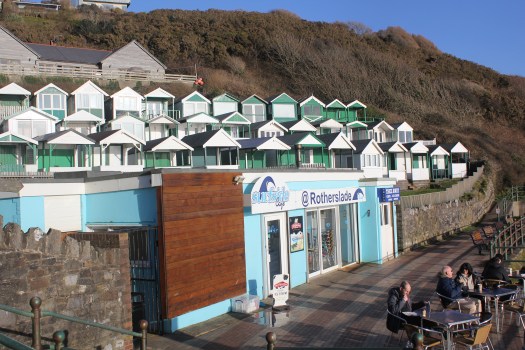
Rotherslade

IMG_3727
Rotherslade

There is a small cove before the main sweep of Langland Bay. This is Rotherhide. Beteen the two bays is Storrs Rock which the French Impressionist painter Alfred Sisley painted in 1897 whilst on staying  at the Osborne Hotel, which overlooked both Langland Bay and Rotherslade Bay, which was also called Lady’s Cove. His stay here must have been very a bitter sweet. He had come come  to marry his partner, so as to legitimize their two children, but both he and his wife were dying of cancer. He painted Storr’s Rock at many times of the day.

IMG_3915.JPG
Storr’s Rock 2018


Storr’s Rock (2018)

Langland 

IMG_0587.JPG
Langland Bay

Langland Bay is very popular with surfers and day trippers but its unusual for modern day sea-side towns, as it has not been hollowed out by holiday lets. That’s because Langland is an expensive place to live and its tiny lanes are often filled with Mercedes and BMWs. Wales’s first millionaires, the Merthyr iron-masters the Crawshays, set the tone in the mid-19th century when they built their massive summer residence here. It was originally known as Llan-y-Llan and looks as if it was ripped intact from the Scottish Highlands. It was later part of the Langland Bay Hotel but is now called Langland Bay Manor and been converted into swanky apartments that wont leave much change from £300K.

langland3.jpg
Old Postcard of Langland
IMG_3750.JPG
Langland Bay 2018

The clean lines of green and white beach huts have become another status symbol. These  striking green and white huts were built in Victorian and Edwardian times. They used to be dolled out to families on a lottery basis, at the very reasonable price of £236 for a three months lease. More recently, however, a cash strapped council decided it would raise money by selling some of the refurnished hut’s leases at a whooping £10,000. You would get to use of your hut for ten years and although the huts can be used every days of the year, you cannot sleep in them in overnight. I don’t know if anyone checks this! None of the huts were in use when I walked past but it was a chilly midweek day in March.

IMG_0003.JPG
Langland from Snaple Point

IMG_9978.JPG

Gower Coastal Path from Langland to Caswell

I continued my walk around the bay and again instead of following the official Coastal Path, I climbed up Newton Cliff which is alongside Langland Golf Club to look across Langland Bay.

IMG_0810
Langland Bay from Newton Cliffs at Sunset

After the climb up Newton Cliff I was starting to get tired. This is when I made a stupid mistake. I left the beaten track. In stead of following the footpath down the hill to rejoin the official coastal path, with its easy tarmacked surface, I decided to try and follow what I thought was a path along the top of cliff along the edge of the golf course. The sun had gone in and it started to spot with rain. This was a disaster, I ended up struggling down paths covered in brambles sleeping-beauty-style, only to eventually admit defeat and retrace my steps. It was a long detour. I ended up asking directions from some rather bemused looking golfers. I could tell one of them wanted to tell me off for being on the golf course but I was apologising so much, he just said “you shouldn’t really be here” and then directed me back to the official path.

By the time I reached Caswell Bay, I was very tired indeed. I had eaten the single banana I’d brought to eat long ago so I queued for minutes in the very crowded “Surfside Cafe” and bought a chocolate ice-cream which revived my spirits considerably. I then waited at the bus stop for the hourly bus back to Swansea.

What I learnt

  1. It hard to write notes on a bus.
  2. Take sandwiches.
  3. Stay on the beaten track – if there’s no post it’s not a path.
  4. Look at the map – put it in your pocket, don’t leave it in your rucksack.
  5. Leave longer than you think
  6. Leave the book on Gower History at home.  It’s heavy.
  7. Don’t believe the weather forecast. It can go from warm sun to wind and rain.
  8. Most importantly, check your camera lens for smudges. Most of the photos I took today were no good (see below).
IMG_0675.JPG
Langland Bay with smudge on the left side of the lens!

What I got right

  1. Coat with hood
  2. Walking boots
  3. Bananas are great
  4. Water bottle – its heavy to start with but you end up drinking most of it.

Next post – Will lots of chocolate biscuits see me through to see the stunning views from Pennard Cliffs?

P.S. Here’s some drone footage of the coast and Langland Bay (BTW The sea isn’t usually this colour)

Posted on 10 Comments

Walking the Gower Coast: Mumbles

Mumbles

I love looking at maps. I have been gazing at the map of coastal path around Gower for days now. The Peninsula juts out westwards into the Bristol Chanel. Its about 17 miles in length and 8 miles width at its widest point. I am planning to walk around its coastline, approximately 38 miles in length, maybe a bit less.

I am, however, going to start with a map of Swansea Bay. People who have never been to Swansea make jokes about the place as if its somewhere to avoid. Quite the opposite. The hilly city sits alongside the sparkling sea and beautiful sandy five-mile beach.

Swansea Bay
Swansea Bay

I have decided to illustrate this series of post with my paintings and with (mostly) my own photographs. The paintings have been completed in recent years, some as a result of this trek, other are older. The photos are mostly from 2018 but a few are from my 2016 attempt to walk the Gower coast. I started my first attempt at Mumbles in 2016.

26907770_1925593071038159_2048231183779527812_n.jpg
Photo Credit: Gower Flight Centre

The pretty Victorian village of Mumbles sits at the far end of the western arm of Swansea Bay. This is where my journey around the Gower coast begins.

Round Mumbles Bend.jpg
Round Mumbles Bend

Mumbles was originally a fishing village. It did not catch fish but rather, oysters. It was, for a time, a thriving industry. Part of Mumbles is known as Oystermouth and many people often use the two names interchangeably to mean the same place.

The Strange Afternoon.jpg
The Strange Afternoon (Mumbles & Oystermouth Castle)

Many people often associate South Wales with coal mining, and coal was certainly vital in locating the copper industry in nearby Swansea. It was the need for limestone, however, that changed Mumbles’ fortunes. Limestone was used as a fertilizer, in steel making, pharmaceuticals, and also as a construction aggregate (in other words, gravel).

Tide's In, Mumbles
Tide’s In (Mumbles)

Mumbles was made of limestone and that fact brought the modern world to the front door of this tiny fishing village in 1804 when the Oystermouth railway line was built in order to transport limestone from the quarries of Mumbles to Swansea Docks. This track was the world first passenger line, the Swansea and Mumbles Railway, carrying at first horse-drawn carriages, and later steam locomotives.

Mumbles Pier From Knab Rock.jpg
Mumbles Pier from Knab Rock

The trains also brought many day trippers for a time. The railway is now long gone, closed in 1960, but there remains a sturdy promenade that runs along the sea front where the trains used to run. Locals and visitors alike still love to walk its length and admire the spectacular view across the sweep of Swansea Bay.

Afternoon Stroll in Mumbles.jpg
Afternoon Stroll in Mumbles

The promenade runs up to Verdis, a popular ice-cream parlour and thence to the Mumbles Pier. The Victorian pier was built in the last years of the 19th century and was the last stop for the Railway. Here tourists could catch a paddle steamers for a tour along the River Severn and Bristol Channel. The Pier hosts a great cafe (with self-playing piano), an amusement arcade and tiny art gallery.

Mumbles Piers.jpg
Mumbles Pier

On the other side of Mumbles Head is Bracelet Bay.  Mumbles Head comprises two tidal islands. At low tide those with stout boots can walk out to the islands and look at the much-photographed lighthouse.

Towards Mumbles Lighthouse (2).JPG
Towards Mumbles Lighthouse


The octagonal lighthouse lighthouse was built in 1794 by Swansea architect William Jernegan, who also designed Singleton Abbey which later became part of Swansea University. This was the second attempt to built a lighthouse here. The first one started a few years earlier, designed by someone else, collapsed before it was even finished!

Clouds Gathering Over Mumbles Head
Gathering Clouds over Mumbles Head

This is where the real Gower coast walk begins! In my next post I puzzle over myriad bus timetables and eventually feel brave enough to leave the car behind!
In the meantime here’s a cool video of a drone flying around Mumbles Head.
https://youtu.be/MvGQhPzQlKo

Paintings of Gower Book

UK- See the book on Amazon.co.uk by clicking here

USA – See the book on Amazon.com by clicking here 

Posted on 21 Comments

Welsh Coastal Magazine

Welsh mag 3

I am delighted to have been featured in April’s edition of Welsh Coastal Magazine as part of their ongoing series “Inspirations” on contemporary artists in Wales. I have included some images but you can read the online version here.

If you would like to buy prints from artmajeur.com click here.

Article clip

Clip #1

Posted on 22 Comments

Walking the Gower Coast. The Rules.

Coloured Sands at Three Cliffs.jpg
Coloured Sands at Three Cliffs Bay

One result of developing PTSD over 5 years ago is that for a long time I had limited energy. I honestly cannot tell whether my energy levels have returned to “normal” levels yet, or ever will. I find that it takes me a couple of days to recover from social events (and no, it’s not a hang-over as I don’t drink alcohol) or from traveling/visiting family or another town. Maybe, everyone my age is like, I don’t know.

I used to have ambitions or even a sort of “bucket list” of things I wanted to get round to doing, some time. I don’t much care for the term “bucket list”. If you haven’t heard about the term “bucket list”, it is a list of all the goals you want to achieve, dreams you want to fulfill and life experiences you desire to experience before you die. Here was mine.

  1. Learn to surf
  2. Learn to Meditate
  3. Walk the coastline of Gower
  4. Run a marathon
  5. Walk the pilgrimage route to Santiago del Compostela
  6. Visit Japan

I did learn to surf and I was very keen for a while, but I was never terribly good at it. I also once went on a 10-day meditation course. There was no talking for 10 days. Strangely, that was the easy part. I was running 20-25 miles on a weekly basis when my life took a swift left turn and everything ground to a halt in 2012. I am still active but I don’t run very far at all these days. I know I won’t be able to run a marathon unless I gave up everything else and just trained, ate and slept. There would be no energy left over for painting and making a living, so that’s out of the window. I cant afford to travel, not at the moment so it’s going to have to be number 3.Walk the coastline of Gower.

Gower-Map-M-1024x516.png

I have a curiosity about exploring the whole coastline of Gower. I know and love certain parts of it very well, such as Three Cliffs Bay. As a painter of the Gower peninsula there are parts that I have visited and painted many times. However, there are also parts I have not visited for years, and a few places I have never visited. I did plan and start to walk the Gower coast in 2016, but it all came to a halt as I tried to cope with the repercussions of being made redundant from my teaching post where I had worked since 1999.

So start again. Here are my rules

  1. Travel in a clockwise direction around the Gower coast
  2. Travel by public transport and by foot.
  3. Walk on sunny days.
  4. Erm, that’s it.

I will document the walk with photos, sketches, and paintings. However, I am nervous about this. The big challenge for me will be in terms of my energy levels. The whole coastline is something like 38 miles long and I know I will have to divide that up into many short walks that will be very tiring for me. I will probably need a week to recover in between walks. I am nervous that I won’t have the determination to finish this, or something will happen to put me off, such as in 2016 when I got part way through in 2016 and gave up. I hate not finishing things.

Worms Head Coast Watch Station.jpg
Coast Watch Station, Rhosilli

It will also be challenging for me mentally. When I was younger, I did many brave things on my own. I traveled around the UK and spoke at Academic conferences, I even traveled to Texas very soon after I passed my driving test and drove a hire car. The PTSD has had the result of reducing my life and what I do, either because I get tired or because I am fearful. PTSD means that my brain goes into anxiety mode very easily. My head will worry about the coming back before I have even left the house.  I will convince myself that none of the buses will arrive and I will be stranded in the wilds of the Gower and have to sleep under a bush. Yes, it all sounds stupid when I type it, but that’s the sort of thing that keeps me awake at 3am in the morning.

So I will have to prepare well, take a load of bus timetables and set off early and challenge the fear. A few weeks ago I panicked and jumped into the sea, thinking I was about to get washed off some rocks. Bizarrely, the evidence has given me confidence. The boots and I survived. It was uncomfortable but the boots dried out on my radiator. So I will make a start this week, even if it takes months to complete the challenge.


Posted on 18 Comments

Waiting for the Tide

Painting of Tenby Harbour

Before I visited Tenby, on the Pembroke coast, I had this vague idea that it was something like Barry Island, on the Glamorgan coast near Cardiff. If you have never heard of Barry Island, it was a Victorian holiday destination for day trippers from Cardiff and the South Wales Valleys. It had a “Pleasure Park” with rides and lots of shops selling rock and candy floss and it also had a Butlins holiday camp but the rides and the holiday camp are long gone now. It has a nice beach but its not as popular as it used to be.

Tenby Painting
On Tenby Harbour Beach

Well, Tenby is nothing like that. It’s tasteful, historic, and enduringly popular.  I love Tenby’s real name. That is it’s Welsh name which is “Dinbych-y-pysgod” meaning fortlet of the fish. It still describes the old town well as as it’s solid town walls still survive as well as its harbour. Its a delightful place to visit with pretty Georgian houses and two large beaches.

Tenby has a special place in my heart because in the midst of my PTSD breakdown and recovery I painted a picture of Tenby harbour.

Painting of Tenby Harbour
Tenby reflections (2013)

I was very emotionally fragile at the time and I really I enjoyed painting the pastel colours of the harbour buildings. I get a lot of pleasure from colour. Other people got pleasure from it too because it was one of the very first paintings I sold as a semi-professional artist. The collector who bought it later told me that she was going to redecorate her lounge to match the painting! I was so touched by this. I had so little confidence at the time that it meant a great deal to me. I also sold many prints this painting. As you can see I did many paintings of Tenby Harbour but I eventually moved on to other subject matters and different challenges. I particularly focused on people portraits closer to home in Swansea and paintings of Gower peninsula, closer to home.

So last month, I decided that Tenby was overdue a visit. I had been watching the weather forecast for weeks. Eventually the forecast was for a day of wall-to-wall sunshine.  The only problem was that it was very cold with a bitter wind. Never mind. I wrapped up well with thermals and two pairs of socks and got up early to catch the 7.50 train from Swansea to Tenby, arriving at 9.30.

I had set off early because I like to catch the morning light with its long shadows. I also wanted to see the harbour at high tide with the boats in the harbour. The only problem was that as soon as arrived at the harbour I could see the the sun was in the “wrong place” and most of the boats had been pulled ashore and covered up! The previous times I had visited Tenby was in the summer, later on in the day.

IMG_8763.JPG
Tenby – sun in “wrong place”

So, I had to wait. So did. I waited in the way I usually do, by moving. I walked and walked. In the end I walked around Tenby for 6  hours, taking photos of the shadows and the people. Despite it being mid winter it was the school mid term break in England (not in wales) and Tenby was full of families, wrapped up, despite the biting wind, and enjoying the sunshine.

I had chips for lunch watched by three beady-eyed seagulls and a chocolate ice-cream. I had to think about that as it was so cold but in the end I gave in had one – it was delicious.  I had intended to catch the 1.40 pm train back to Swansea but i could see that the light was changing and I knew that it was low tide at 4pm so I tried and waited some more. I walked up the habour walked and climbed half way down the steps to take photos of the four or so boats that were in the harbour. It was strange waiting for the tide and light because they eventually changed faster than I thought they would. All of a sudden the tide had retreated far enough for me to walk out into the harbour and take photos of the reflections. Bingo. This was what I was after.

Tenby Harbor
Retreating Tide

And then, almost miraculously the tide revealed the sandbanks on the far side of the harbour, by the end of the harbour wall and I could gingerly climb down some seaweed-covered steps and see the harbour in it’s full glory. I don’t think I took off my fingerless gloves once in Tenby, and I did appreciate the heating on the little train back home. I just made the 4.40 pm train back to Swansea and get home in daylight.

Tenby Harbour at Low Tide

Painting of Tenby Harbour
Waiting for the Tide

My day in Tenby was all about patience and waiting for things beyond my control.  Looking at this, my most recent painting of Tenby harbour I can see how much my work has changed, and hopefully how much I have recovered from those incredibly difficult times back in 2012-13. The painting is much larger and calmer and more confident than any of those I painted before. Large paintings, almost by definition require confidence. The winter tones are less vivid than the summer ones, despite the bright winter sunshine. I will be back for the summer light.

See my coastal paintings for sale here

Posted on 32 Comments

Anatomy of a commission

Hudson Cropped
Hudson the Poodle

Here’s Hudson the black poodle. He’s a handsome chap. I was asked to paint a picture of him. Pretty straight forward, eh?

Well, the challenge was that the commission required that Hudson was to be portrayed not in this rural idyll but in New York City, waiting outside Malecon coffee shop where his owner popped by every morning for her coffee. Hudson is one of those super cool dogs that will just wait. He does not need to be tied up.


I was provided with a couple of photographs of the said restaurant but there were a couple of issues that needed dealing with. Take a look.

Firstly, there were signs and bicycles in the way of the front of the shop. There was no clear view. So I googled the restaurant in the hope that I might find some more useful photographs online.

Several photos of Malecon restaurants in different locations in NYC. The second problem is that Hudson in the original photos was sitting in grass and I could not see what sort of tail he has and what happens to it when he sits down, whether he tucks it under or not. So I searched for some poodles images. Did he have a long or short tail?

IMG_0780
Hudson sitting on the lawn

So I spent a morning using a photo editing program called Gimp (an open source version of Photoshop) and adding poodle tails, taking out bicycles and playing around with compositions.

I finally decided that I lived the photo with the lit interior best. I thought the lights would make a more interesting image. I had a problem deciding where to place the dog as he was black and would not stand out against the dark background. Initially I placed him to one side in front of the plant container but finally settled on in the foreground so that he was the main focus of the picture.

So I send this final image to the customer to check that she’s happy with the composition and I have the right sort of tail for Hudson before I make a start painting. I also got her to agree to a rectangular canvas, rather than a square one, that way I could fit the dog and all of the shop front in easily.

My final problem is that I added a shadow to the dog to give the picture a more dynamism but there were few, if any shadows in the photos I had. I so searched the internet again for reference images.


So I did a lot of thinking about the likely direction of shadow that the awning would likely cast and the length of the shadow, drawing lines on the image I’d sent to the customer. So once, I decided on these things and also kept in mind the information I had in the original photos I got started. I began with the letters of the restaurant name as I this was the element that I was most concerned to get right. Once I had painted these in, I relaxed and enjoyed the work. As I was using a small canvas (41 x 33 cm) it was easy to turn and paint upside-down, side to side as well as right side up. Overall, allowing for dying times, the work was done over three days.

This is what I painted.

IMG_8829g
Hudson, New York

If you are interested in finding out more about a commission, click here

Posted on 11 Comments

International Women’s Day

International Women’s Day is a worldwide event that celebrates women’s achievements – from the political to the social – while calling for gender equality. Its roots can be traced to 1908, when 15,000 women marched through New York City demanding voting rights, better pay and shorter working hours. The first time there was an a “Women’s Day” it was a year later, on February 28, 1909 in New York. March 8 was suggested by the 1910 International Woman’s Conference (attended by more than 100 women from 17 countries) to become an “International Woman’s Day.” In 1911, it was celebrated for the first time in Austria, Denmark, Germany and Switzerland on March 19. In 1913, it was decided to transfer IWD to March 8, and it has been celebrated on that day ever since.

240px-Frauentag_1914_Heraus_mit_dem_Frauenwahlrecht.jpg
Frauen Tag 1914

After women gained the vote in Soviet Russia in 1917, March 8 became a national holiday there. It was also celebrated by the communists in China from 1922, and after founding of the People’s Republic of China in 1949. Mao Zedong declared that ‘women hold up half the sky’ and March 8 was made an official holiday and women were given a half-day off. One can help but wonder that if it had been a international Men’s Day they’d have been given a whole day off! IWD  was finally adopted by the United Nations in 1975.

The original aim – to achieve full gender equality for women the world – has still not been realised. A gender pay gap persists across the globe and women are still not present in equal numbers in business or politics. Figures show that globally, women’s education, health and violence towards women is still worse than that of men.

Cricketers.jpg
Former Cricketers

In Swansea there will be an exhibition of Swansea-based female artists’ work at Cinema & Co. It is meant to show case the work of female artists, myself included. My painting “Former Cricketers” (above) is included. It is from my “Hollowed Community” project which focused on theme of declining community and the lack of sustainability (that means families with children) in areas such as Brynmill in Swansea due to (pretty much) unchecked studentification. The exhibitions will run from March 8th to 20th. There is an opening event on Thursday March 8th 6 pm to 8.30 pm. There will be performances, paintings, films and some “extra surprises”.

cINEMA&cO.JPG


If you want to read more about the “Hollowed Community” project click here.

Posted on 21 Comments

Time to Call it a Night?

I woke up a bit earlier than I usually do this morning. It was just before dawn. The night was no longer inky black but had a bluish tinge to it. The light has been changing ever since. Now it is mauve. It will lighten until the light is pinkish, then finally white. Throughout the course of the winter I have been used to waking in the dark and waiting for the sun to rise. No so much recently. The days are lengthening noticeably. Instead  of night arriving unexpected at 4 o’clock it now holds off about tea time. This gradual lengthening of the day has a natural rhythm and logic.

The sudden arrival of British Summer Time (BST) or Daylight Saving Time (DST) when the clocks are turned forward an hour in late March does not. It feels like we are catapulted into the summer with more light than we know what to do with. I find it odd that I am sad at the arrival of BST because all that extra daylight means I can paint for longer. I should be happy. I am happy but the abrupt lengthening of the day feels  wrong. The “loss” of an hour is also tiring. It’s much worse in the autumn. Instead of easing into winter we are hurled into the darkness. Others feel this way too.

The EU is debating this right now. There have been calls for the European Commission to launch a “full evaluation” of the current system and come up with new plans, if necessary. In Europe, currently, EU law sets a common date in spring and autumn on which clocks must be put forward and back by one hour in all 28 member states. Supporters of the DST say it saves energy and reduces traffic accidents but critics argue it can cause long-term health problems and studies have generally failed to show significant energy savings associated with the shift.

Blue Hour on Uplands

They hate it in Finland. More than 70,000 Fins (out of 5.5 million) signed a petition asking the state to give up the practice. French MEP Karima Delli argued that moving clocks forward to summer time left people tired and led to increased accidents”Studies that show an increase in road accidents or sleep trouble during the time change must be taken seriously”, the French MEP said, adding that estimated energy savings were “not conclusive”. Belgian lawmaker Hilde Vautmans, however, said that changing daylight saving could mean either losing an hour of daylight every day for seven months in summer or sending children to school in the dark for five months over winter.

Night Walks
Night Walks

I was surprised that the USA also uses DST. I assumed that with so many time zones, nine, that they would not have wanted the added complication of DST.  It was introduced during the Second World War and most mainland states areas still have DST except Arizona (although the Navajo have DST on tribal lands). Many studies have been done in the US that show the negative effects of the biannual shift to DST. Losing that hour’s sleep in spring affects health; strokes and heart attacks are more likely, there are more traffic accidents and it affects relationships, tiredness causes more arguments.

Night on Oakwood Road

Interestingly, one big country has tried life without DST. In 2011 Russia   (who have on less than 11 time zones in their massive country) first tried clocks on year-round summer time but that proved unpopular then in 2014 switched to permanent winter time or “standard time”. Russian MPs said permanent summer time had created stress and health problems, especially in northern Russia where mornings would remain darker for longer during the harsh winter months. However, I have yet to discover whether the return to permanent “winter time” is popular with the Russian people.

So if I want to avoid this biannual lurch forward and back in the day, I can move to Russia, Arizona or one of the other 70 countries that don’t bother with it including Japan, India, and China.

Night Falls on Uplands

Posted on 22 Comments

Gower Woodland Walks

The-ford-at-ilston.jpg
The Ford at Ilston    Limited edition signed mounted print £45

[wpecpp name=”Ford at Ilston Large Print ” price=”45″ align=”left”]

It’s still winter here in on the Gower peninsula, Wales. However, the days are starting to get noticeably longer. Instead of night arriving at 4pm, now on a clear day it doesn’t go dark until 5.30-ish.  There are more sunny days now too. It’s still very cold, but sunny. Spring is round the corner. Nature has taken note. Tiny snow drops gather in little crowds along the river bank where we often walk in the woods near the ancient Ilston village in Gower. I can also see sturdy green shoots pushing their way up through the mud. Hundreds of them. There is lots of mud as it has been a very wet winter. The path is inaccessible unless you are wearing Wellington Boots (“Wellies”).

The stream is full and rushes across the Ford at Ilson. You have to be very early to catch the sunlight on the water here. For most of the day it is in shadow. I really like painting the woodlands in spring.  Before the leaves have comes out there is still lots of light on the ground and reflecting on the water. Even when the bright green leaves pop out there is still plenty of light in the early morning light. Every time I visit the woods the light is different. The plants and flowers change. The blossoms will go through nature’s spectrum: white, yellow, blue and white again. The snow drops will be replaced by clumps of small yellow daffodils and primroses, then by the violet bluebells and finally by a thick carpet of white wild garlic. They each make a fantastic and hurried show before the foliage of the beech trees casts heavy shadows throughout the woods in May.

A Bridge in Ilston Cwm
Bridge at Ilston Cwm    Limited edition signed mounted print £45

[wpecpp name=”Bridge at Ilston Large Print ” price=”45″ align=”left”]

For a fantastic map of Gower click here.

If you are interested in seeing more, prints of my Gower Woodland landscape paintings can be found here  or double click on any of the images in the gallery below.

[foogallery id=”7692″]


Posted on 29 Comments

Frank Brangwyn and Brangwyn Hall

You cannot miss Frank Brangwyn’s name in Brynmill, Swansea as there’s a huge hall that takes his name. These past two weeks or so I have worked as an invigilator for Swansea University. One of the venues used for exams is this beautiful hall. The murals that adorn the massive walls are stunning.

Frank Brangwn was born in Bruges, Belgium (Welsh father, English mother) in 1867. His father was a church architect and craftsman. Frank was largely self-taught but that did not stop him from becoming a painter, water colourist, engraver, illustrator and progressive designer.  In his youth, Brangwyn had joined Royal Navy Volunteers and travelled extensively including Russia and South Africa.

DSC_1857
Frank Brangwyn

He was an astonishingly proflic artist. As well as paintings and drawings, he produced designs for stained glass, furniture, ceramics, table glassware, buildings and interiors. He was also a lithographer and woodcutter and was a book illustrator. It has been estimated that during his lifetime Brangwyn produced over 12,000 works. His mural commissions would cover over 22,000 sq ft (2,000 m2) of canvas, he painted over 1,000 oils, over 660 mixed media works (watercolours, gouache), over 500 etchings, about 400 wood engravings and woodcuts, 280 lithographs, 40 architectural and interior designs, 230 designs for items of furniture and 20 stained glass panels and windows.


Known as the British Empire Panels Brangwyn spent a total of 7 years producing 16 large works that cover 3,000 sq ft (280 m2). When you see the size of the murals you can understand why they took 7 years to complete.

In 1928 the House of Lords was commissioned  Brangwyn to produce a series celebrating the beauty of the British Empire and the Dominions to fill the Royal Gallery.  Lord Iveagh tried to secure Brangwyn full artistic freedom to design and paint the commission his way. Unfotunately, Lord Iveagh died in 1927.  After 5 years of work the panels were displayed in the Royal Gallery for approvial by the Lords, but the peers refused to accept them because they were “too colourful and lively” for the place. It was worse than that. Some of them mocked his work in the national press. Lord Crawford, a Tory Peer, wrote in a “The Daily News” that the painting would be more suited to a night club than the House of Lords: “Just imagine five feet long bananas and grinning black monkeys looming over them!”

East Indies.jpg
One of the Panels that Lord Crawford criticised

It has been suggested that, this was rejection was part of a increasing restriction on artiostic expression that accompanying the birth of totalitarian movements across Europe. Fortuantely for the people of Wales and Swansea in partricular 1934 the panels were purchased by Swansea Council in 1934 and were housed in the Brangwyn Hall, Swansea. 

_76424653_brangwyn2
Brangywn Hall, inside

The House of Lords’ loss is Swansea’s gain. These panels are absolutely astonishing. They are massive, colorful and packed to the gills with detail. Apparently, the height of the Hall’s ceiling had to be increased slightly to accommodate the tallest of the panels. They dominate the very large hall and the photographs fail the capture the huge scale of the panels. The are a true feast for the eyes.

The Glynn Vivian Gallery and Brangwyn Hall has on display quite a few of Brangwyn’s beautiful preparatory cartoons. He was a brillant draughtsman.


Interestingly Frank Barngwyn used modern technology to aid him; photography. The squaring up technique is one that artists have used for centuries, and is still used today by many (including me). If you look closely at the murals you can see the feint pencil lines of the grids he used. (Brangwyn photographs courtesy of Paul Cava Fine Art https://paulcava.com/frank-brangwyn)

The animals and people are incredible but the foilage of each country has also been painstakingly researched. I initally thought that the mass of green were sort of generic foliage but when I looked athe panel for England I was blown away when I realised that I recognised every type of leaf and flower; oak leaves, horsechestnuts, sunflowers, pears, apples, foxgoves, irises, blueblues. This is true for all the panels.

England.jpg
The England Panel

I particularly enjoyed the details at the bottpom of the panels as they were at eye level. There were lots of tortoises, rabbits, bugs, butterfies and reptiles. The only thing thatappeared to be missiong were fish and aquautic mammals!  In the 1930s, before colour television and nature programs (and the nearest zoo in Bristol) this riot of creatures must have been quite a relevation for the people of Swansea.

Frank Brangwyn’s evident enthusiasm for the British empire was somewhat out-of-step with the increasingly introspective times of the inter-war years. Interestingly, his treatment of the different and diverse peoples of the British Empire was powerful and energetic. There are plenty of impressive female breasts but the women are strong and vital figures, not overtly sexualised. Perhaps, his celebration of empire makes for uncomfortable viewing in a post-empire world. Yet, the men and women of the Empire are depicted with dignity and sympathy, and the accent throughout is on the people, animals and plants of the conquered countries rather than on the activities of the conquerors.

Sadly, the rejection of the Panels by the Lords devasted Frank Brangwyn and it caused lasting depression in him. He became increasingly pessimistic and a hypochondriac and began disposing of his possessions during the 1930s. This is so sad as these murals are so wonderful!

DSC_1930-001.JPG
Was this grinning monkey Lord Crawford objected to?

Brangwyn, Frank, 1867-1956; British Empire Panel (14) Australia
Australia

Brangwyn, Frank, 1867-1956; British Empire Panel (9) Burma

Burma

East Africa.jpg
East Africa

Siam.jpg
Siam

197c83c5848e5d5c3cab6c81c46eb352.jpg


1779d445befd5b63c367e28075af0930.jpg

1779d445befd5b63c367e28075af0930.jpg