I am delighted and honoured to have been interviewed by Aaron S (@aaronsehmar on Instagram) for his Flying Fruit Bowl podcast. If you haven’t come across his podcast and website check it out – he’s a thoughtful and insightful interviewer who is a very talented photographer in his own right. He’s interviewed a diverse range of talented artists. There is a lots to discover. It’s like a breath of fresh air.
Fanad is a finger of land that lies between Lough Swilly and Mulroy Bay on the north coast of County Donegal, Ireland. It is not that easy to get to and the the survival of the Irish language is testiment that relative isolation.
Lambing season at Fanad Head (Donegal) SOLD
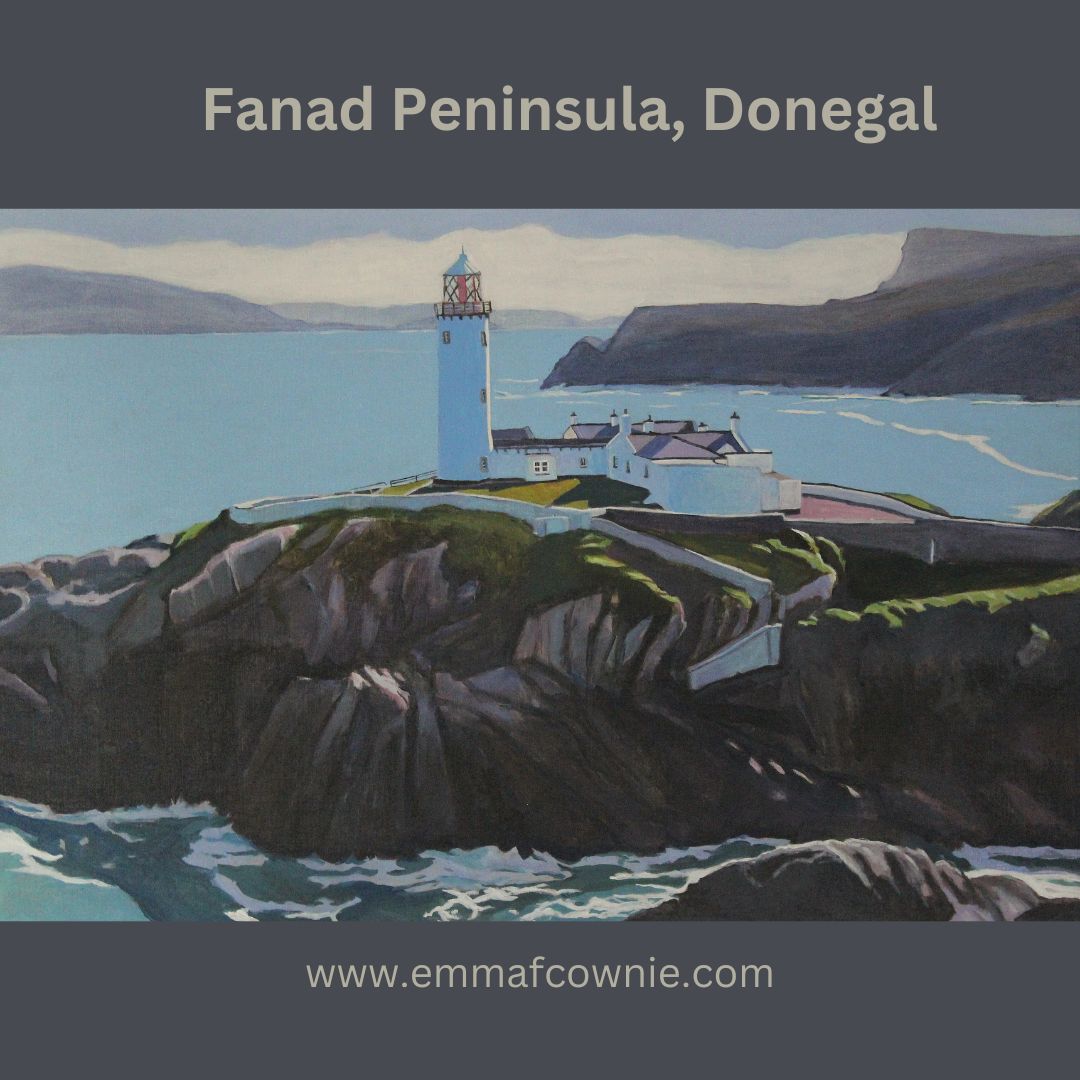
Fanad Lighhouse (Donegal). Is one of the 12 Great lighthouses of Ireland. It was built in 1886 at Fanad Head (although the station was originally established in 1817). The lighthouse, or more acrrately, the harbour light, marks the entrance into Lough Swilly which forms a natural harbour.
Fanad Lighthouse (Donegal) SOLD
I have painted this isolated structure several times before. I have always enjoyed painting the northernly light on Fanad. I have only have painted it in acrylics. That’s not a delibertae choice, more one of circumstance because at times I have had limited space, and I dont want to use oil paints with kittens close at hand.
Over to Fanad Lighthouse (Donegal) _Emma Cownie SOLD
I think acrylics suit the airiness of the subject matter. After a couple of years working out how to use them, I have settled on a technique of light layers of paint that allow the underlying colour to show through. This can give a transulent quality to the colour. This is in contrast to the relatively flat areas of colous I use for the larger areas of colour such as sky or the sea.
My latest painting was an experiment in composition. We used an image from a drone shot done by my artist husband, Seamas (James Henry Johnson).
In this piece, I wanted to create a sense of space from the mountains of the Inishowen Peninsula in the distance. The distant mountains were layered with bluish white until I got the right impression of distance.
I often find myself looking at the tiny Fanad lighthouse far off in the distance when I am at Lisfannon on the Inishowen Penisula. There is a sign comemorating a famous Atlantic storm that happened in 1748. this storm threatened to sink The Greyhound, the ship of one John Newton, a slave trader. John was so frightened that he called out to God for mercy. This moment marked a profound spiritual conversion, and many years later he wrote the words for the hymn “Amazing Grace” one of my favourite hymns, and to also campaign for the abolition of slavery.
There is some confusion how many storms there were . One website claims the terrible tempset happened far away out in the Atlantic because it took John Newton another four weeks after his conversion to sail into Lough Swilly and arrive at Derry/Londonderry. The Amazing Grace.ie site however, makes it clear a second storm happened in Lough swilly itself as it quotes John’s journal ” We saw the island of Tory and the next day anchored in Lough Swilly in Ireland. This was the 8th day of April, just four weeks after the damage we sustained from the sea. When we came into this port, our very last victuals was boiling in the pot; and before we had been there two hours, the wind began to blow with great violence. If we had continued at sea that night in our shattered condition, we must have gone to the bottom. About this time I began to know that there is a God that hears and answers prayer.” It’s got to be said, that John Newton really took his time putting his evangelical beliefs into action because he went back to being a slave trader for another five years before he eventually retired and became a minister in 1757!
The heaving sea at the foot of the massive lighthouse rock intrigued me. The Atlantic Ocean has such a bulk and stregth, even on a relatively fine day, I am not surprised that John Newton was terrified by its strength far away from the Donegal coast. I wondered about the long and difficult process of building this structure all those years ago in a remote location. Yet, this lighthouse has stood the test of time and proudly marks the entrance to Lough Swilly and can be seen from inland and further along the coast.
Several years ago I embarked on what I called an “Urban Minimal“project; focusing on the streets of Brynmill, in Swansea, South wales, where we used to live. This work culminated in an exhibition in the Cardiff MadeinRoath festival (read more here).
My original “rules” for urban minimalism composition and painting
No cars
No People
Bright light. There must be shadows – at diagonals if possible.
Simplified forms – there must be little detail in the final painting. I found this the most challenging “rule” to stick to.
I am developing this approach with Derry. I like to paint relatively ordinary street scenes without people. The sunlight and the colours give them drama and beauty. Each of the painting is really about light. I am still attempting to simplify forms but this is something I am always failing at.
On the plus side, I think that my colours have become much softer and more subtle. I think this is partly a response to the northern light which is bluer and less golden than that in Swansea. Its is also because I have got better at achieving naturalistic colours. My confidence has also improved. In the past I chose brigher colours to make a painting more exciting.
I have slowly come to the realisation that such excitment is like hidden sugar in my food. Yes, its initially appealling but it can give you a bit of a headache!
I have enjoyed exploring the streets of Derry. I feel I know the place a bit better for painting them.
Eagle-eyed readers will spot a car in the mid-distance. I thought I’d see whether a car would negatively disturpt the composition. I don’t think it did.
Castle Street, Derry/Londonderry by Emma Cownie (acrylic on canvas)
I was delighted to see my two Donegal paintings “Up Bloody Foreland, Donegal” and “The through Road, Donegal” on the walls of the London Irish Centre (Camden, London).
These two oil paintings form part of a “real room” of an Irish family in 1950s Britain installation. The exhibition, which is on during August through to October, pulls together a dynamic collection of prints, photographs, paintings, and writings that weave together the different threads of ‘Home’ for Irish Immigrants to London. This has been organised Tara Griffin, who is Education and Heritage Officer at the London Irish Centre, in conjunction with the Museum of the Home. It looks fascinating and I hope my paintings bought happy reminders of home to visitors to the centre. My work has been described as nostalgic by by some and I am interested in capturing a vanishing Ireland of the not too distant past. I just wish I could have visited in person!
Some places cannot be found on google maps. Sometimes you have to get out an old fashioned paper map and look for yourself. I have a small collection of Ordnance Survey “Discovery Series” maps of North-West Ireland. I spend a lot of time looking at them and familarizing myself with an unfamilar landscape. Up until last year, I spent more than half of my life in Wales, and I have so much to learn about Irish Geography and History. My favourite map is number 1. Where I am right now.
I have noticed that there are a lot of “Tramore” beaches in Donegal, – its probaly not that surprising that it means “Big Beach” in Irish. There’s a Tramore beach opposite Dunmore Strand at the north end of the peninsula they build Donegal Airport on. Just to the north of the long beach that lies to the west of the runway, there’s a tiny island that can be reached at low tide. It’s called Oileán na Marbh, Isle of the Dead. I was intrigued. So we went to visit yesterday, on a blustery day.
It is a poignant island on the edge of the land; it is in a windswept and wild place. In accessible at high tide. Both beautiful and very sad. For it was on this island that over 500 stillborn and unbaptised babies were buried between the time of the Great Famine in the 1840s, and 1912. For centuries, until 2007, it was taught by the Catholic Church (and also by the Anglican Church) that unbaptised babies did not go to heaven when they died, but to a place called “Limbo”, and therefore could not be buried in consecrated church land. In other communities it was common to bury these unbaptised mites on the outside of churchyard walls, or in even farmer’s fields. In this part of Donegal, however, this island, served as the final resting place; in limbo between the watery world and the mainland. It was also where the local community buried the bodies of sailors that would sometimes get washed up on their shores.
Today, it is a popular spot for wild swimmers and campers. And yes, in case you are wondering, the sea really is that incredible shade of blue. In the distance you can see the islands of Gola (to the right) and Inisfree Lower, and behind that, Owey (to the left). A truly liminal space on the margins of the physical and spiritual world.
Oilean Na Marbh, Donegal _ photo credit James Henry Johnston
Oilean na Marbh, Donegal _ photo credit James Henry Johnston
Oilean Na Marbh, Donegal _ photo credit James Henry Johnston
Bloody Foreland is one of my favourite locations in Donegal. It is one of the wildest, windiest and most beautiful places I have been. The light is sharp and clear. You feel healthier for breathing the air here.
House on Cnoc Fola
The wind is always blowing. It is very remote and feels a bit like the edge of the known-world.
A derelict house, Bloody Foreland
The name Bloody Foreland (Cnoc Fola in Irish means Hill of Blood) does not to refer to some past battle that took place here in mythic times, but intense red hue of the rocks at sunset. The Irish language dominates here.
Folklore records that Balor, the one-eyed supernatural warlord was eventually slain by his grandson Lugh Lámh Fhada on the slopes of Cnoc Fola. Indeed, some say that the tide of blood which flowed from Balor’s evil eye stained the hillside and gave it its name.
Bloody Foreland, Donegal
I particularly like the incredible stone walls, made of massive granite boulders, that snake across the hills here. They date from the 1890s. They suggest to me a landscape where stones were plentiful and labour cheap. It is also the sort of place where writers come to get away from the modern world and think about writing. Dylan Thomas, travelled to An Port, further south to write poetry, but left without paying his bills.
Old Farm Buildings, Bloddy Foreland
Bloody Foreland, also makes a refreshing contrast to the slopes of Brinlack and Derrybeg, round the corner, which are heavily peppered with larger modern houses and bungalows from the era of “Bungalow Bliss“.
Houses on Bloody Foreland, Donegal
This is the first time that I have been able to paint Ireland whilst in Ireland. Previously, I have worked from my photos back in Wales. Now I think that being surrounded by these colours all the time is affecting my work in a different way.
I am experimenting a little with less detail and letting my under painting show through more – to give a greater sense of the roughness of the landscape here. I am feeling my way. I don’t know how my paintings will develop in the future, but not knowing is a sort of freedom from painting the same thing in the same sort of way.
Here’s a photo-story about our move to Ireland. The photos are all by Séamas Johnston, my husband. He is also the architect of the move, the new studios and our new life. He’s been amazing. It’s great to see all his hard work finally come together.
Packing the Car, Swansea (before much stuff was packed)
Endless Packing! It felt never ending.
Lateral Flow Test – one line means no covid. We discover that our tonsils are not that dangley bit at the back of your throat. We also did a PCR test but there are no photos of that.
Irvine Moving Solutions – they are moving our stuff – we saw their van coming off the Belfast ferry at Birkenhead!
Stena Line Ferry Terminal at Birkenhead, Liverpool. It was a long wait to get on.
The otherside of the Irish Sea. Early Morning Belfast from the ferry
How everything has grown at Meadow Cottage!
The studio window
Séamas reflected in the studio windows
Hattie doing “Cat Patrol with her eyes” on a new view
I love the view from the studio. I cant wait until my stuff arrives from storage and I can get back to painting.
Just to warn you. I have access to wifi this weekend (on a 3 day trial) but we decided to use a different company for our internet but they can’t install it for another 10 days so my responses will be delayed. My business remains closed until the middle of this month (July 2021).
Caravans tucked away on coastal inlets and islands are not an unsual sight in Donegal. I am always impressed by their presence as there are no roads for lorries and it must have taken a good deal of effort and ingenuity to get it there. Getting to have a “Staycation” in 2021 amidst all the uncertainty of vaccine rolls out & third (or is it fourth?) waves looks like it will take an equal amount of effort! So instead join me in imagining the view from the static caravan’s wide window across the rugged terrain of Gola Island on this late spring morning.
Failures are always a challenge. When I used to be a Secondary school teacher, I always learned more about teaching when I faced a difficult class than a nice docile one. They made me go away and think about what I was doing and how I could do it better. Painting is no different.
I have been thinking about the composition of larger paintings. When I used to think about painting a scene I used to think in terms of “that’s a small painting, it won’t “stretch” to a larger canvas”, or “That’s a mountain, definately, therefore, it’s subject suitable for a large canvas”. I am parodying myself somewhat but generally, I have this feeling that small birds belong on small canvases and big landscapes belong on larger ones.
My thinking was challenged by a commission I did in the summer where a client asked for a very large version (120 x 90cm) of a relatively small painting (41 x 33 cm). So I scaled up and despite my anxiety, it worked. This was important as my confidence had been dented by a previous large landscape painting that hadn’t work out for me.
Small and Big Versions
It got me thinking about composition. I understood the basics and had looked of compositional grids in Artbooks as a teenager and thought I’d internalized them. I realized that I had got sloppy. I’ll explain.
A Beginners Guide to Composition
I am not going to do an information dump about theories of composition here (I have added links to some good blogs on the subject below) but the “rule of thirds” is one that springs to mind here. The idea that you should look for naturally occurring in divisions of thirds in a scene and try and locate points of interest at the intersection of the “Golden section”.
Rule of Thirds
The Golden Section
I had been influenced by ideas of composition from photography and the work of artist-turned photographer, Henri Cartier-Bresson,in particular.
Rule of Thirds – Henri Cartier Bresson
I liked his use of diagonals in particular, and this has influenced my paintings of urban scenes.
When I came to Donegal I was so blown away by the vast overarching skies and majestic landscapes. I got very excited by everything I saw. I tried to capture everything. The houses, the mountains, the sea, and the sky. Most of the time it worked.
Swirling Clouds Round Errigal
Donegal Painting
From Ferry Coll
From Cruit Island
Wild Wind Across Dunfanaghy
Shored up near Muckish
Further Up Shore
You can probably look through these paintings and tick off the composition approaches I instinctively used; the diagonal, the pyramid, the rule of thirds and so on. They all worked.
Then, it really pains me to admit it. I lost it. I got carried away and overreached myself and painted this big beast.
Sailing By Edernish
What was I thinking? There is far too much sky in this painting. Worse than that, it was a large canvas. There are things I like about the painting, the light on the island in the bottom half of the painting, but the sky was just too vast. It pained me that I had such a large reminder of my errors of judgment. I don’t mind screwing up every now and then but I hate waste and that was an expensive canvas. It’s no coincidence that I am planning a blog post on reusing stretcher bars to stretch my own canvases.
My confidence was dented. It put me off large paintings for quite some time. It wasn’t until I did the commission I mentioned earlier, that I got thinking about what had gone wrong. I realized that I had to rigorously apply the same rule of composition to large canvases as I instinctively did to my small ones. So I tried an experiment, I took a successful composition of a medium size painting and did a much larger version of it. This composition was based on a compound curve.
Over to the Rosses 60x40xmView From Arranmore, Ireland 92x73cm
It wasn’t a copy of the smaller painting. It wasn’t meant to be, although it was meant to encapsulate the same feel of the smaller work, with some adjustments. I have included some more detail, changed the tree, and added a shadow and a ditch in the bottom third of the painting. I think it worked.
I have since done another small oil sketch of another composition before I scale it up. It’s another diagonal composition. Although, the larger version will not be “portrait” format but my usual “landscape” orientation.
I will add the larger version later in the week. So you will have to wait to see if that composition works as well as this smaller one. Watch this space!