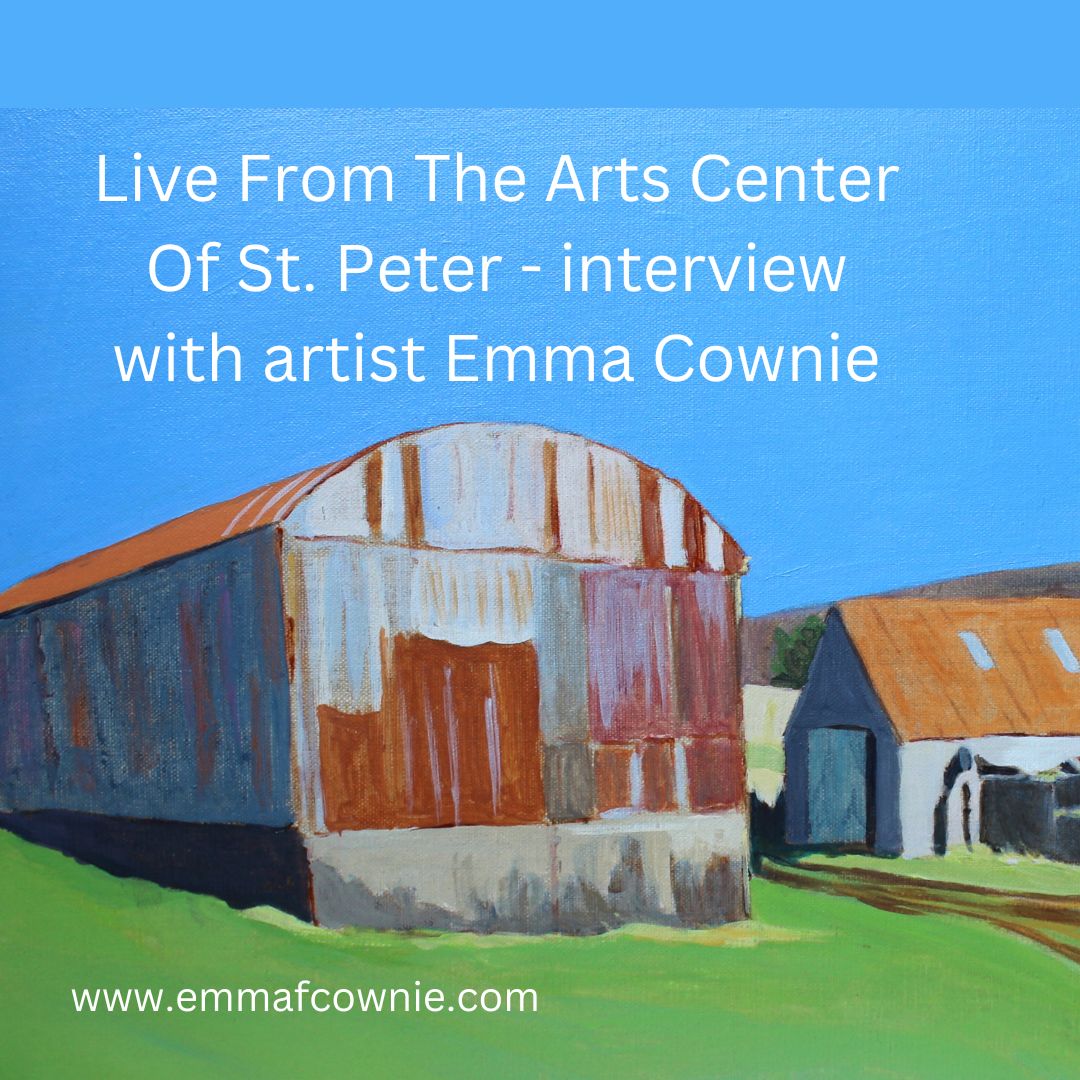
I did this interview back in March this year with artist and magician Michael Callahan and co-host Ann Rosenquist Fee, executive director of the Arts Center, St Pauls, Minnestota, USA. In it I talk about how I came to be an artist, my process, my love of colour and paint brushes!
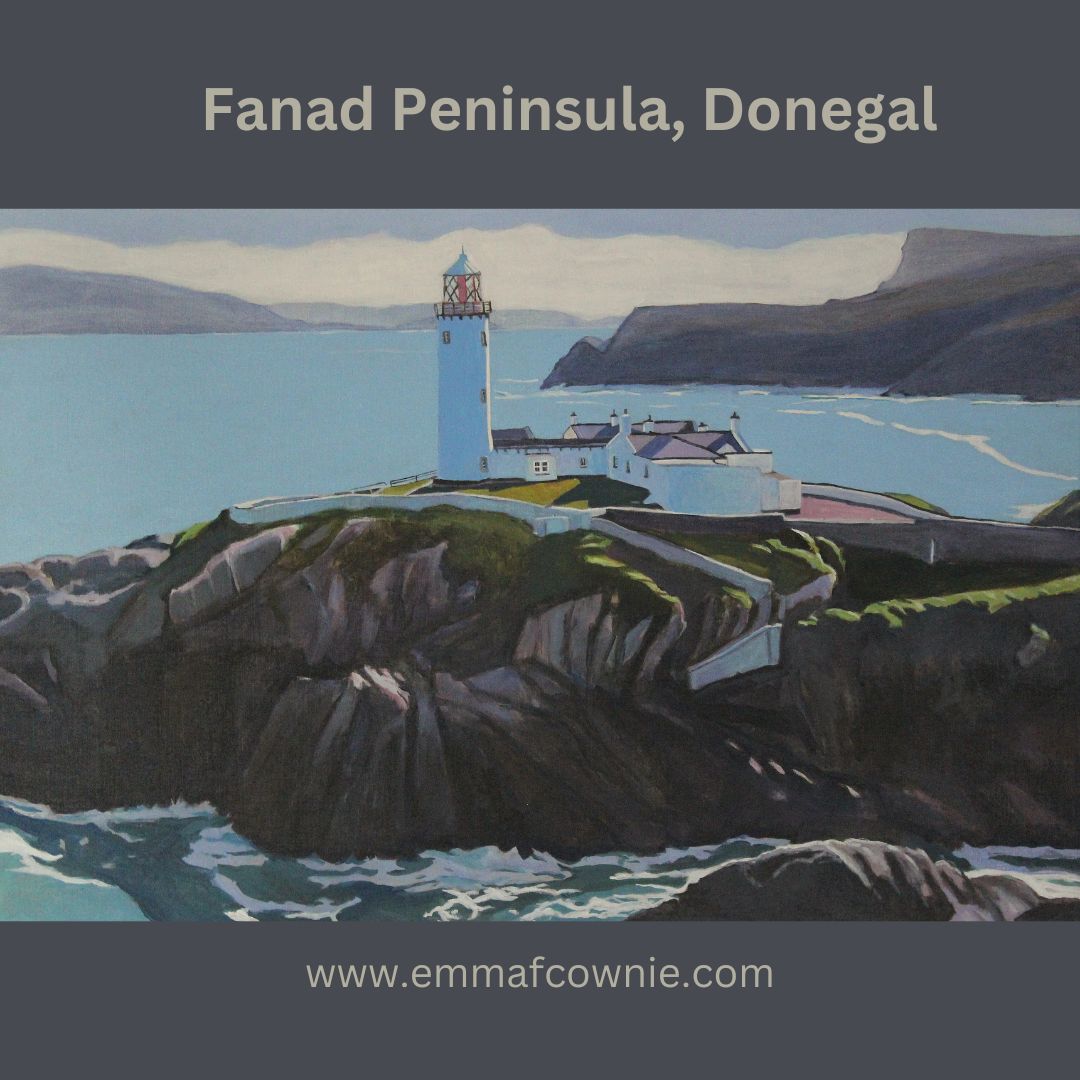
Fanad is a finger of land that lies between Lough Swilly and Mulroy Bay on the north coast of County Donegal, Ireland. It is not that easy to get to and the the survival of the Irish language is testiment that relative isolation.
Lambing season at Fanad Head (Donegal) SOLD
Fanad Lighhouse (Donegal). Is one of the 12 Great lighthouses of Ireland. It was built in 1886 at Fanad Head (although the station was originally established in 1817). The lighthouse, or more acrrately, the harbour light, marks the entrance into Lough Swilly which forms a natural harbour.
Fanad Lighthouse (Donegal) SOLD
I have painted this isolated structure several times before. I have always enjoyed painting the northernly light on Fanad. I have only have painted it in acrylics. That’s not a delibertae choice, more one of circumstance because at times I have had limited space, and I dont want to use oil paints with kittens close at hand.
Over to Fanad Lighthouse (Donegal) _Emma Cownie SOLD
I think acrylics suit the airiness of the subject matter. After a couple of years working out how to use them, I have settled on a technique of light layers of paint that allow the underlying colour to show through. This can give a transulent quality to the colour. This is in contrast to the relatively flat areas of colous I use for the larger areas of colour such as sky or the sea.
My latest painting was an experiment in composition. We used an image from a drone shot done by my artist husband, Seamas (James Henry Johnson).
In this piece, I wanted to create a sense of space from the mountains of the Inishowen Peninsula in the distance. The distant mountains were layered with bluish white until I got the right impression of distance.
I often find myself looking at the tiny Fanad lighthouse far off in the distance when I am at Lisfannon on the Inishowen Penisula. There is a sign comemorating a famous Atlantic storm that happened in 1748. this storm threatened to sink The Greyhound, the ship of one John Newton, a slave trader. John was so frightened that he called out to God for mercy. This moment marked a profound spiritual conversion, and many years later he wrote the words for the hymn “Amazing Grace” one of my favourite hymns, and to also campaign for the abolition of slavery.
There is some confusion how many storms there were . One website claims the terrible tempset happened far away out in the Atlantic because it took John Newton another four weeks after his conversion to sail into Lough Swilly and arrive at Derry/Londonderry. The Amazing Grace.ie site however, makes it clear a second storm happened in Lough swilly itself as it quotes John’s journal ” We saw the island of Tory and the next day anchored in Lough Swilly in Ireland. This was the 8th day of April, just four weeks after the damage we sustained from the sea. When we came into this port, our very last victuals was boiling in the pot; and before we had been there two hours, the wind began to blow with great violence. If we had continued at sea that night in our shattered condition, we must have gone to the bottom. About this time I began to know that there is a God that hears and answers prayer.” It’s got to be said, that John Newton really took his time putting his evangelical beliefs into action because he went back to being a slave trader for another five years before he eventually retired and became a minister in 1757!
The heaving sea at the foot of the massive lighthouse rock intrigued me. The Atlantic Ocean has such a bulk and stregth, even on a relatively fine day, I am not surprised that John Newton was terrified by its strength far away from the Donegal coast. I wondered about the long and difficult process of building this structure all those years ago in a remote location. Yet, this lighthouse has stood the test of time and proudly marks the entrance to Lough Swilly and can be seen from inland and further along the coast.
This section is more about how I work, my style and influences.
Q: How do you choose your places to paint? And is there a particular time of year that you favour?
A: Light and colour draw me to a subject. I am looking for a strong composition and clean colours. Usually bright light and strong shadows, so any time of year except for summer. I paint large paintings in the long hours of summer instead. Composition is key to my work. I also like to express the quiet like various American realists like Edward Hopper. I also love Rockwell Kent, a painter who also painted west Donegal.
Q: Do you work en plein air? From sketches? Photographs?
A: I tried painting en plein air in South Wales – I was crippled by feeling self-conscious and frustrated by my lack of control over the conditions. Plein air is also not conducive to my style of painting, and what I am trying to achieve in my work; in the magnification of simplicity, form, light and shadow. I am continually painting layers over a period of time. My creative process starts with taking the photo, editing and then using it for inspiration. I try to recreate the essence of a place I am painting rather than simply reproducing a scene. I am very much influenced by the photography of Henri Cartier-Bresson and how he used composition to create dynamic images.
Henri Cartier-Bresson, County Kerry, Ireland, 1952
Q: You now live in Derry and Donegal. How did that come about?
A: We wanted to have a combination or urban and rural so that we could experience both, so we live 7/8 months of the year in Derry and 4/5 months in Donegal. The Derry/Donegal combo is hard to beat. Derry also opens up another area of east Donegal, Inishowen, as it is only a few miles away from Derry city.
Q: Your work features on a Donal Ryan Spanish version of Strange Flowers [‘Cottage on Bunbeg Harbour’] and Claire Keegan’s Foster [‘The Traditional House. Gola’]. Congratulations. Has that made a difference?
A: It has been great to get recognition from two such brilliant writers. I feel greatly honoured. I knew that when I moved from South Wales to Ireland that I was likely to lose collectors (although I still paint the Gower Peninsula in South Wales and Tenby from time to time) and it would take time to build up an Irish following.
I am hoping these book covers will help with that, plus this feature.
Cover of Claire Keegan’s “Foster”
Q: How did the dreaded Covid affect you and your work?
A: I broke my leg at the start of the pandemic and was awaiting an operation in Morriston Hospital, near Swansea as the country went into lockdown. So whilst most were confined to their houses I was confined to my bedroom for several months and had to do physiotherapy down the phone. I took months to recover and regain my mobility and make it up the steep stairs into my attic studio.
Painting in the studio with my leg up!
Artists live very solitary lives so lockdown wasn’t a massive change to my life, as such. I was frustrated that I couldn’t visit locations to take photos for new paintings so I spent months scouring through the photos I did have. I was surprised at how many photos I had discounted could be made into interesting pictures.
Covid has definitely affected our life here – I feel frustrated that we are living at arms’ length from everyone. It has meant that we have limited where we go and what we do. My husband is asthmatic, so we are very careful. We got vaccinated and boosted and always wear masks indoor but we were still very ill this summer. It knocked us both out for 6 weeks. I don’t want to catch it again because we don’t know what the long term effects will be.
Q: In terms of your palette what colours are essential?
A: It depend where I am painting and whether I am using oils or acrylics. The light in South Wales is more yellowy, in Donegal it is clearer and bluey-white. Our house in Derry is smaller than our Donegal house so I had to learn to paint with acrylics because of the fumes and having pets at close quarters.
Acrylics are very different to oils as you have to build them up in thin layers. They dry fast and are difficult to blend. Oils are more opaque but much slower to dry. I have to think about each medium in a different way and use different colours. With both oil and acrylics I prefer underlying warm colours (oranges, ochres, pinks and mauves) but I have to use different colours to get a similar same effect in each. With oils I would use Naples Yellow, Yellow ochre, Olive Green, Raw and Burnt Umber, Raw Sienna, Van Dyke Brown, Warm Grey, and Cool Grey, Mauve and for the sea and sky Ultramarine and Phthalo Blues.
With acrylics I would use Lemon Yellow, Ivory, Light Ochre, Sap Green, Cerulean Blue and Ultramarine blue, pink and purple, Payne’s grey for darker tones. I use more mixing white and fluid medium in acrylic. I have had to train myself to mix large quantities of “sky” colour and keep in a tub with acrylic. There’s this thing called “colour shift” which means the paint dries lighter. So it’s almost impossible to match wet acrylics to the dry colour you want to achieve. The irony is that I think that although I prefer painting in oils, I think my acrylic paintings might actually be better.
Q: The painting reproduced in the Sunday Independent on 15 January is ‘Down to the Pier, Gola’. Would you say something please about your links with, your relationship with, Donegal in general and Gola in particular.
Down to the Pier, Gola (Donegal, Ireland)
A: I love the Donegal islands – they are a glimpse of a vanishing Ireland. Gola and Inishbofin are wonderful locations, in particular, although the one I most visit and have painted most is Arranmore.
I went to Gola island because of the space as I thought it would suit my “rural minimal” style of painting which proved to be the case. They have very few vehicles and I really enjoy the peace. Isn’t that why we like the coast – with just the sound of the waves and the wind? How the houses were placed, in this vastness lent itself to composition. The islands, more than any other place I have been to, chime most with my style of painting. They have moved my style forward. Also I really like the fact that there are almost no telegraph poles to complicate compositions too.
The way the vernacular houses are arranged, sheltering from upland areas of the island, and close together suggests how people of the past worked together and with the landscape. I think I am attracted to the sense of community. People had to work together in order to survive. A sense of community, interconnectedness, of Irishness, lingers there. It is tangible.
Q: Also re ‘Down to the Pier, Gola’ how quickly does your eye know and choose the perspective and the composition of the piece? And would you say something please about how you went about making this work? Did you begin with a drawing? What colour did you put down first etc.
A: Composition is key. The cinematic-type compositions and dramatic use of light and shade. As I said before I am strongly influenced by the French photograph Henri Cartier Bresson and I often look for a road or fence posts to lead the eye into the painting.
Rule of Thirds – Henri Cartier Bresson
Elements will also be left out or simplified to give the image more punch. Most of the Gola and Inishbofin paintings are painted in my own “rural minimal” style which is the rural manifestation of the “urban minimal” style I developed to paint the city with. This style of painting is influenced by those American realist painters who paint the quiet, the spacious and the still and revere a certain treatment of light and colour such as Edward Hopper as well as by Contemporary Minimalists such Jessica Brilli, (whom I traded paintings with last year). The rules of composition are strong light and shade, use of diagonals and simplified forms. I wanted to explore the interplay of the geometry of shadows and structures – the tension between the 3D buildings and the 2D shadows. I wasn’t sure if this style would work in the countryside until I went to Gola and found it was perfect for evoking the silence and the stillness of these beautiful islands.
Tigh Breslin, Gola – Emma Cownie (SOLD)
“Down to the Pier, Gola” is an oil painting. I sketched the outline of the road and buildings in thin red ochre paint. I painted the white house first. It takes a several layers of paint to create that intensity of the whitewash. I usually use thin layers of paint, but my final layer of white will be thicker. White oil paint takes the longest time to dry, which is why I often start with white. I then added the blue sky and the pink road and distant buildings. I like to work quickly when I paint in oils. I will rub away the paint if I am not happy with a colour. I have learnt to be quite ruthless with rubbing back and starting from the canvas. This way the final piece is lighter and has more coherence. I am wary of over-working the paint.
I use a different approach to painting with acrylics. It is much slower as I usually paint a grayscale (or in earth tones) underpainting to check I have my tonal values right and then I add colour. There is a lot of adjusting of colours and correction that goes on. I will often work on two paintings at a time so that I can add sky, sea and use the same colours and let them dry so I can consider the colours and how they are coming together. Acrylic paintings can take up to a couple of weeks, on and off, to complete.
Q: What do you look for in a painting? And do you have a favourite painting by another artist that means a great deal to you?
A: Often I am drawn to the light – a shaft of sunlight on a window sill or a strong shadow by a house. Often times it will be a particular colour – such as the blue of clear seas of Donegal or the pale fluffy clouds.
Robert Bevan’s “Maples at Cuckfield, Sussex” (painted in 1914) is very special to me as it was a complete surprise when I came across it at Cardiff Museum in 2012. A good painting makes me to go home and paint. I used to feel that way about the Van Gogh’s and Monet.
I just loved the muted colours with the light orange and purples and the semi abstract trees. Bevan had spent time in Paris at Pont Aven in Brittany. He met Cezanne and Renoir was friends with Gauguin. I went back the follow year to see it again and was disappointed to find it wasn’t on display. The museum was kind enough, however, to let me and my husband go down to storage to see it close up.
Q: You have sold many many paintings. Are you sorry to see them go? Has there ever been one that you just did not want to part with?
A: I have had to toughen up a lot about parting with paintings. My sister’s advice was “paint so many you are sick of the sight of them”. It did work but some paintings really are tough to let go of. I really regret selling a painting of a horse “Blaze” and another of a elderly lady carrying her shopping in Swansea town centre, called “Soldiering On”. I have learnt my lesson and I have a handful of paintings that I won’t ever put up for sale – one is of a Gower pony, another is of a cat that used to hang out at the local general store in Swansea.
Soldiering On, Emma Cownie
Q: If you would like me to include your website, instagram, upcoming exhibition etc please give them here.
A: I haven’t exhibited in recent years in galleries by choice and I sell the majority of my work via my website although I have a private art gallery behind my cottage in Donegal which is usually open, by appointment, May – October.
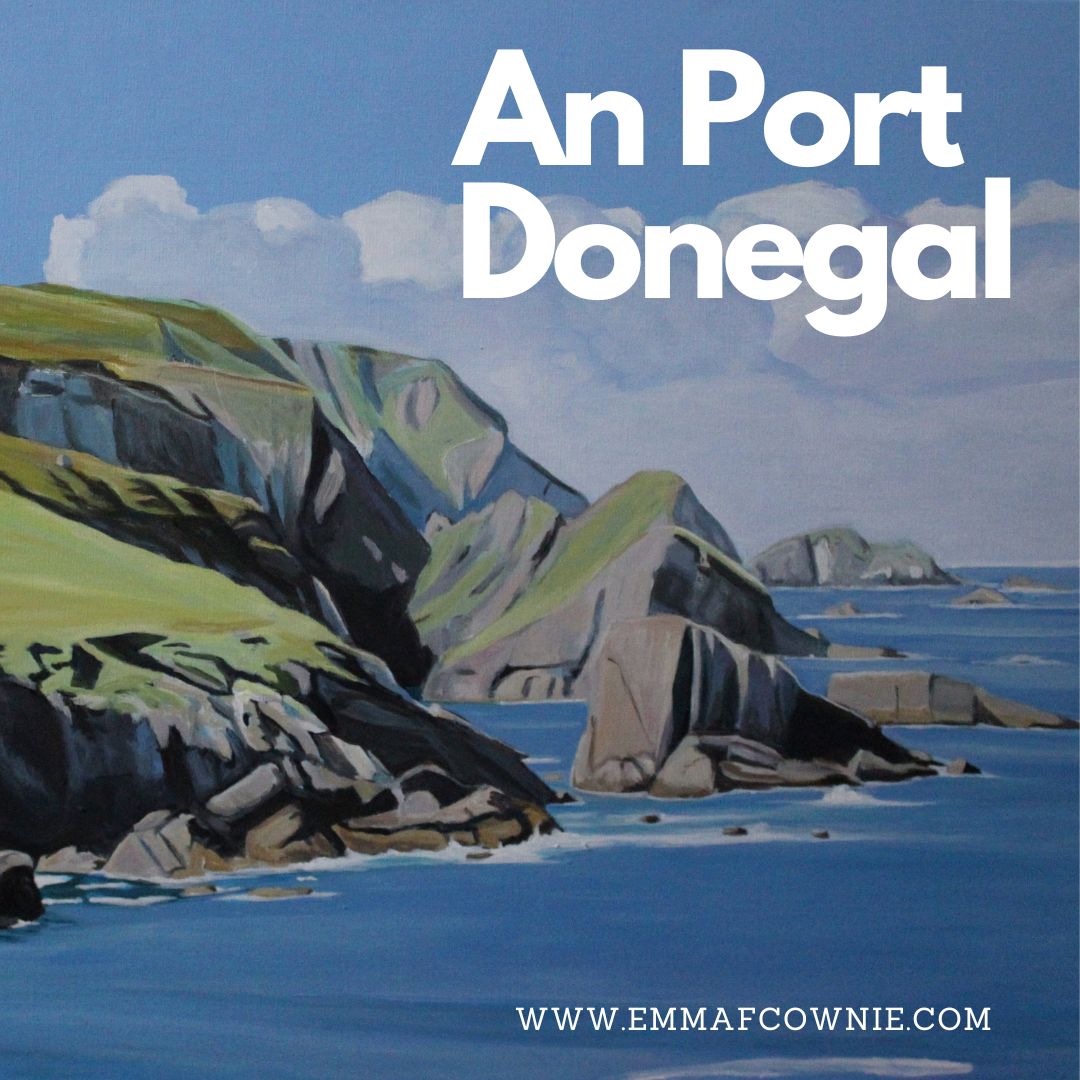
An Port has loomed large in my imagination for a long time. It’s very remote and quite difficult to get to. To reach it, you have to drive down a very, very long single track road (it’s about three miles but it feels longer) on the way to Glencolmcille. There are plenty of sheep and only a few people.
The Road to Port
At An Port there is a small quay and a tiny deserted fishing village which looks out over a small bay, surrounded by cliffs and truly massive slabs of rocks and sea stacks. Its one of those landscapes that you imagine can be found all along the west coast of Ireland but is actually unique. When I visited Texas in the late 1990s I thought it would all look like Monument Valley, thanks to those John Ford films. I was surpised to find it was pretty flat.
An Port, Donegal – photo credit Emma CownieAn Port: Photo credit Emma Cownie
The village was still inhabited in the 1920s. The hillside is littered with the remains of the stone houses
Remains of houses at An Port: Photo credit Emma Cownie
There is one inhabited house, now an AirBnB property. You can see it on the hill behind me in the photo my husband took of me (below). This was Annie McGinley’s family home.
Me at An Port
I first heard about Port in 2018 from a TV programme about the famous American landscape artist Rockwell Kent and his stay in Donegal the 1920s. Rockwell Kent is probably best known today for his illustrations for Moby Dick.
Moby Dick Illustrated by Rockwell Kent
Unfortunately Kevin Magee’s film (in Irish with subtitles) “Ar Lorg Annie” or “Searching for Annie” is no longer available but you can see a short clip on Youtube here. A friend of Kent’s, Rex Stout, had funded his trip to Ireland. He paid him $300 a month on the condition that he had the choice of two painting when he got back. This is one of them in California, “Prince Charles’ Cove”.
Rockwell Kent and his second wife Frances Lee Higgins (they were on honeymoon) spent several months in the near by valley of Glenlough on a farm belonging to farmer Dan Ward. Kent stored many of his paintings back at Port, in the home of Annie McGinley, who modeled for him. Her she is.
The original “Annie McGinley” now rests in a private collection in New York,
Rockwell Kent returned to Donegal, 32 years later. He had wanted to buy Dan Ward’s farm but it had already sold to another farmer. Instead he sought out ‘this singularly lovely teenage girl with whom I had danced many a jig’ and found her in nearby Crobane, married, midddle-aged and ‘broad-beamed’. She had had 14 children, 12 had lived.
Annie McGinley and Rockwell Kent in 1958
Rockwell went to find Annie’s long abandoned cottage in An Port where in 1926 he had dried his Donegal paintings. It turned out to be the only structure still standing, barely supporting the weight of an overgrown thatched roof, a year or two from dereliction. ‘This house, we thought, we ought to buy and fix and have as a place to come every year …’ but he didn’t.
If you look on the left hand side of my painting “An Port” (below), you will see tiny fence posts along top of the cliff. They help give a sense of scale of the huge cliffs and rocks. I can’t remember who first described this landscape it as the “land of giants”but it truly apt.
It is hard to do justice to this incredible landscape but I think that Rockwell Kent’s paintings do. He really capures the majesty and warm colours of Donegal. He also excels at Donegal skies and light. I am really in awe of him.
I wish I could see the original paintings but this is very unlikely. It seems that none of Rockwell Kent’s large paintings stayed in Ireland. Most of them are either in the USA or in Russia. But that’s another story.
Our visit to the island of Inishbofin last month was one of those rare “perfect” days in life. The weather was warm and sunny with enough of a sea breeze to blow away any viruses. We have been looking and admiring from afar the tiny, remote island of Inishbofin, off the coast of Donegal, for quite a while now.
Location of Inishbofin, Donegal
Inishbofin, Donegal
It is 3km/2miles from the pier at Machaire Uí Rabhartaigh / Magheraroarty but that didn’t stop me painting the shoreline of the island a couple of years ago. I also wrote about the island (here) long before I ever got the chance to visit it.
Across to Inishbofin SOLD
Storm Over Inishbofin SOLD
Emma Cownie
It is very easy to confuse the Donegal island with the more southerly Inishbofin near Galway on the internet as google likes to show you maps and ferry pages for the Galway island, even if you type in “Ferry times inishbofin, Donegal”. I think this must because a regular ferry service in Donegal was only started this summer by Harry Coll and his brother, Owenie. Harry has recently retired from his life as a fisherman in Killybegs, Donegal, and decided to buy a boat called Saoirse na Mara II ( which translates, I think, as “Freedom of the Sea II”) in order to run a daily ferry service to the island. As far as I can tell, they have not received any government funding to help them in their venture.
Inishbofin Ferry
You will notice that the flyer for the ferry is in Irish and English. This is an Irish speaking area of Ireland, the Gaelteacht. This was the first place I heard Irish spoken this year, in fact. Inishbofin is an Irish-speaking community and it was a real pleasure to hear people speaking Irish/Gaeilge, although I could only pick out the odd word as I only have a very basic understanding of the language. We were told by the islanders that “Inishbofin” is actually pronouced “Inish-bofin-yeay”. You can here that pronunciation in this Irish-language video here.
The name Inis Bó Finne means “island of the white cow” in English. The white cow, Glas Gaibhnenn, was owned by a blacksmith on the mainland but was stolen by Balor, the mythical one-eyed King of neighbouring Tory Island and hidden on Insishbofin. This wasn’t any old cow, it was a magical cow. It had huge teats that never ran dry which produced an unending supply of milk. Obviously, such production required a great deal of fuel and in no time the cow ate all the grass on the island and had to move on elsewhere. The island is tiny, a mere 2km long and 1km wide or about half a square mile/300 acres so I could well believe that the Bó Finne ate all the grass pretty quickly. Yet, although it looks tiny from the mainland yet it doesn’t feel that tiny when you are on the island.
Saoirse na Mara II at the Magheroarty Pier (Inishbofin is in the distance)
The first inhabitants are believed to have been of Scandinavian origin, who arrived at the time of the Viking raids on Ireland’s coast in the C9th and C10th. Their descendants are thought to have been exterminated by Cromwellian soldiers in the mid-C17th. I wondered whether they had all been killed as I noticed that all the islanders had blue eyes, possibly suggestive of Scandinavian genes. Subsequently the island was settled by mainlanders from Donegal escaping oppression, poverty and famine. We met one islander who jokingly said his family had “recently” moved to the island, in the 1840s.
Map of Inishbofin
It is said that the islands potatoes, like those of neighbouring Tory Island were unaffected by the potato blight which destroyed the main food source of Ireland’s peasantry in the mid-C19th. The blight, and other factors (such as criminal mismanagement of resources by the British Government) led to An Gorta Mór or “The Great Hunger“; starvation and famine fever which led to over a million deaths and mass emigration.
Approaching Inishbofin
As recently as the 1960s, a population of roughly 120 islanders enjoyed a tranquil, if tough, existence, fishing and farming. Nowadays, only a few islanders spend all year on the island, farming on a part-time basis. Many of the houses on the island have been renovated, mostly for use as holiday homes. From March to October many of the former inhabitants return to fish for lobster, crab and Atlantic salmon, or to gather shellfish and pick edible seaweeds such as cairrigin (carrageen) and creathnach (dulse) from the rocks. Other families move back for the school holiday in the summer months. The new ferry service has made visiting the island even easier for families and day trippers.
Irish moss or carrageen moss (Irish carraigín, “little rock” from wikipedia
The morning we visited the island there were lots of people waiting at the Magheraroarty Pier for the ferry and the Coll brothers made several trips to bring them all over to the island. The trip only took ten minutes and the sea was smooth. Stepping off the ferry we were transported to a tranquil and calm world. All the time I was on the island I saw one car and heard only birdsong and the wind. It was bliss.
The Pier at Inishbofin
Inishbofiners working on a roof
Drying in the sun
Muckish Mountain on the Horizon
The island has two halves connected by a narrow, sandy col. There are two villages on the island, one near the harbour of An Clachan (Cloghan), and the other a short distance away at An Garradh Ban, also known as East Town.
The southern half of the island is fertile and was cultivated in the past in the traditional “clachan and rundale” manner, involving communal usage of scarce arable soil and cattle pasture. The ancient field boundaries are still in place, though the fields have now reverted to grassland, providing essential habitat for geese and especially corncrakes – flourishing here, unlike in the rest of the country.
Corncrake
Aerial View of Inishbofin (from BoffinFerryDonegal.com facebook page)
The islanders are very friendly and several people stopped to chat to us to tell us about the island. They have a reputation for speaking to visitors (preferably in Irish Gaelic, but in English too) and like telling stories about the island and its history. One of the islanders, Daniel, mentioned the mystery of the missing millionaire. In 1933 Arthur Kingsley Porter, a professor of Fine Arts at Harvard University, bought Glenveagh Castle in the heart of the Derryveagh Mountains and made it his home. He also built a house on Inishbofin which he used for weekend breaks with his wife. On the morning of 8th July 1933 Kingsley Porter disappeared after going for a walk the morning after a massive storm, and was never seen again.
Arthur Kingsley Porter
Conspiracy theories abound. Had he accidentally fallen from a cliff or had he taken his own life? Had Arthur been murdered? Or had he faked his own death and re-emerged with a new identity on mainland Europe? All of these are a possibility, as Arthur was gay at a time when it was illegal and regarded as deeply shameful (50 states criminalized same-sex sexual activity until 1962). To make things worse, Harvard, Arthur’s employer was running an anti-gay campaign. The college held a secret court to expose and expel gay students and faculty. Two students, accused of being gay, had already died by suicide. Arthur was fearful his homosexuality would be revealed and there would be a scandal. So here we have a possible motive for suicide.
Lucy and Arthur
At the inquest – the first to be held in Ireland without a body – his widow, Lucy, told of her frantic six-hour search with local fishermen. “I think my husband must have slipped off the cliffs, fallen into the sea and been carried away,” she said. Some of the islanders thought that his wife might have done away with him. Yet at the same time there were rumours of a boat that had been seen near the island at the time of his disappearance. If anyone had the money to start a new life in a new country it was Arthur, and Arthur knew Paris with its gay nightlife well as he had studied there as a student in 1923. I suspect however, that if he had started a new life in Paris, he would have eventually been recognised by one of the many American emigrées who also lived there.
Boats on Inishbofin
Anchorage on Inishboffin is too exposed to leave boats afloat and so they are pulled up onto the foreshore.
Inishbofin has witnessed a number of maritime tragedies. In 1929 an island fishing boat was cut in half by a steamer in thick fog off Bloody Foreland, and all but one man drowned. Another boat was swamped in 1931 in the “keelie”, the sound between Inishboffin and InishDooey. During the Second World War, in December 1940, a Dutch ship by the name of Stolwiik broke down after leaving a covoy in a westerly gale. The Arranmore lifeboat made truly heroic rescue of the crew. Read more about it here.
The old phone box – once the island’s only phone
The island has a stunning coastline and a view that include Mount Errigal, the Seven Sisters and seascapes stretching from Cnoc Fola to Tory Island.
I will end with some a film and some paintings of Inishbofin by the very talented artist Cathal McGinley. His paintings were on exhibition in the parish hall on the island – my photos aren’t great but I hope you get a sense of the intense colours and energy of the paintings. Cathal chatted to us outside his beautiful cottage for over an hour and kindly gave us a cup of tea and a bag of carrigeen.
It was quite a shock getting off the ferry at the busy pier at Magheroarty after the incredible peace of the island. We will be back.
The journey only takes 10 minures (weather permitting)
To book the ferry from Magheroarty Pier to Inishboffin Island:
– Telephone Harry on 087 4345892
– Text – Whatsapp – Viber message to 087 4345892
– Email on: boffinferrydonegal@gmail.com
– Social media (facebook / Instagram) www.boffinferrydonegal.com
We are all glad to see the back of 2020 but I am pausing for a moment to reflect on some of my painting sales over the year. Sadly, my accident and having my leg in a cast meant that I couldn’t get up the steep stairs to my attic studio (or anywhere else) to paint any oil paintings for over three months but things have ticked over during 2020.
I would like to say thank you Rob and David who waited a very long time in the cold with me for the ambulance to come, to the paramedics and firebrigade who got me out of the woods, to NHS staff at Morriston who fixed my very broken leg and looked after me, as well as to the Physical Therapists who gave me lots of advice on exercises over the phone. I still have a way to go!
I have to say an absolutely massive thank you to my brillant husband, Séamas, who trudged up and down two flights of stairs with trays of food many times a day (and lost weight doing so) for months. He kept my spirits up when I got frustrated and tearful. It wasn’t that often as I was so glad to be home but it was all hard work for him in the midst of a pandemic! He also kept the show on the road by packing up and arranging the shipping my paintings. He was, and remains, utterly wonderful!
Here’s a selection of some of my sales from 2020
Some of my “people” paintings sold in 2020
Some of my paintings of Wales sold in 2020
Some of my paintings of Ireland sold in 2020
A Selection of Commissions from 2020
My top four personal favourites of 2020
Owey in Late Spring – Top of my personal favorites of 2020!
Here’s to a happier and healthier 2021 to everyone!