We have been living with a lot of uncertainty since summer last year. This is why I have found it difficult to write regularly. Last summer, Biddy, our aged Collie-cross was so frail I didn’t come to Donegal with her. I didn’t think the long bumpy car journeys would be fair on her. The vets are an hour away. She was pts in November last year. It was an honour to look after her in her final days and I still miss her. I will write about Effie in a separate post, soon.
Artie the cat and Biddy 2023
Biddy in 2019 (Look I have found a stick for you to throw!)
It is with a heavy heart that I say that we are planning to leave Donegal. It’s a difficult place to live without family near by. It’s a stunning place and the recent sunshine has really highlighted that. It is possibly the most beautiful landscape I have ever seen and I will be very sad to leave. I am not entirely sure where we are going. I will let you know when we know.
In the meantime, I have painted a series of small paintings of Arranmore Island.
Gortgar,Arranmore (Donegal)Children at Play – Arranmore Island by Emma CownieArranmore Huddle (Donegal) Inishkeeragh View, Arranmore (Donegal)The Quiet Road, Arranmore (Donegal)
We have been exploring Malin Head a fair bit recently. I really enjoy it’s wildness and dramatic beauty. It’s one of those rare places that is quiet. By quiet, I mean a lack of human busyness. There’s plenty of nature noise like the wind, the hissing of the grasses and leaves as they are blown.This has to be one of the most exposed spots in Ireland.
There is good scattering of robust cottages and relatively few cars. The narrow, winding roads mean that they are not pelting by. Its the quiet and still I hunger for – even when its blowing a gale! The fresh air here is like a refreshing drink of water.
Here are two new Malin Head paintings. The first is “Midsummer at Malin Head” which is a sturdy cottage surrounded by vigorous growths of monbretia. We are a bit early for its distinctive firey orange flowers – the come out from July to September.
The second painting is John’s Cottage, Malin Head (photography with permission of John Gallagher). John was born in the cottage but he now lives with his family (and dog) in a neighbouring cottage a stone’s throw from here.
In the distance are the Urris Hills, also on the Inishowen Peninsula. We spent two days last autumn there, looking for my husband Séamas’s drone crashed on Croaghcarragh (a peak between Urris Hills and Mamore with Mamore Gap in between) after he flew it backward into the mountainside! I spent a longtime waiting for him as various spots on the mountain, looking out towards Dunduff, Clonmany and Malin. The view was magnificent in that direction too. The howling gale that threatened to blow us off the mountain was pretty sobering. Fortunately, the drone was found and it still worked after a night out in the wilds. DJI make pretty tough little drones!
The name will be familar to British ears who ever listened to the daily shipping forecast on BBC Radio. It is broadcast late at night just before 1 am and very early (5.20am). Anyone who is a night owl or insominiac will have listened to it. The list of shipping zones and forecasts is not only practical but also poetic and rather mysterious. Following the litany of locations and numbers is very soporistic. Listen to the clip below. The actual broadcast is from 2.46 onwards ZZzzzzzzzzz
Shipping Forcast (1993) – almost always broadcast on the radio, you have to use your imagination!
Many British people may not know where Malin Head it is anymore than than they know the location of German Bight or Viking. To Irish ears, however, it is well-known as the most northerly tip of the island of Ireland and also features on Met Eireann’s, sea area forecast, broadcast on RTE.
UK_shipping_forecast_zones
Malin Head to Mizen Head
People regularly tranverse the length of Ireland from Malin Head, Donegal, to Mizen Head, Cork. It’s a fair stretch. Just under 400 miles (640 km). Some incredible people have cycled it in just over 15 hours. Ordinary mortals take about 4 days.
Amazingly some super-human runners have done it in about the same time – 4 days! I recently listened to a radio interview with the heroic Sophie Power. Sophie is from England and she recently ran the length of Ireland in under 4 days. This is a World Record. She beat the previouis record by three hours. Being a mother, she had to fit it in during her children half-term holiday and didn’t get to pick the day with the nicest weather – just the Tuesday of half-term and so she started off in driving rain! Many years ago I used to run (only piddly 10ks and 5ks) and I would certainly prefer to run in rain than heat.
Incredibly Sophie ran most of the distance without sleep, snatching the odd half an hour on her second and third day. She ended up hallucinating, and with a knee injury that had to be braced. When she finished the race in Cork she had developed heat stroke! That alone shows you how far south Cork is. There’s no way she’d get heat stroke in Donegal! She’s planning to come back and run the Cork Marathon.
Sophie Power at Malin Head
At the Edge of the world
Standing at Malin Head is like standing at the edge of the world. To the north is nothing can be seen but sky and sea. A long way off is Iceland and much. much further away to the north-west is North America. It feels very remote (but surprisngly accessible from Letterkenny and Derry/Londonderry) but to fishermen and sailors, I’m sure it’s not. Scotland is surpisingly close to the north-east. If you have ever flown from England to Belfast on a clear day, you can see the Scottish Isles and the Isle of Man scattered across the Irish Sea, pretty close the Antrim coast. Donegal is just a bit further along.
On the most northerly tip of the island of Ireland, you will find a tower that was built in 1805 during the Napoleonic wars as a lookout tower to defend against any attacks by the French. You can see at the top left hand side of my painting above. Edges of places are places to look out from – for invaders, or for incoming storms. Weather reports that were important to local and international shipping were first recorded at Malin Head in 1870. It was in that year the tower became a signal tower for Lloyds of London. Semaphore was used to connect with ships at sea and the lighthouse on nearby Inishtrahull. In 1902 the first commercial wireless message was sent from Malin Head to the S.S.Lake Ontario by the Marconi Company.
Divers’ magnet
There are the wrecks of many ships lying off the coast in this area. Many of these such as SS Audacious, SS Carthaginian and RMS Justicia date to the time of the First World War, when Ireland was still part of the British Empire.
In 1917 two German mines sankLaurentic and although her crew successfully abandoned ship, but 354 of them died of hypothermia in her lifeboats.Interestingly, Laurentic was carrying about 43 tons of gold bars when she sank. Most of the 3,211 bars were salvaged by 1924; three more bars were found in the 1930s, however 22 gold bars have still not been recovered.
The Great Emergency/Second World War
During the Second World War, Ireland was neutral. The Irish army built lookout posts in places along the coast to prevent any violation of this neutrality. This was important as this part of Donegal is so close to Northern Ireland, which not not neutral and was bombed by the Germans. There is an EIRE 80 sign built of stones during the war so aircraft would know that they were over Ireland (not Northern Ireland). They acted also as a navigational aid for pilots. Eire 79 is at Fanad Head to the west. Eire 81 is at Glengad Head, further along the Inishowen Peninsula, to the east. You can see it on the map below. The SS Athenia, a passenger ship carrying 1,418 people was torpedoed by a German U-boat just hours after war had been declared in 1939 off the coast of Malin Head! Most of the passengers survived but 117 perished.
Tourism Sign at Malin Head
Some scenes from the film Star Wars: The Last Jedi film was shot at Malin Head. I have to admit that I am not a Star Wars fan – I never made it through awhole film. I have to admit that I’m more of a Star Trek fan. Apparently, it is possible to have a tour of the locations used for the film from local tour guides. The road leading up to Bamba’s Crown has been renamed locally from the R242 to the R2D2 in recognition of the Star Wars connection. Also beside the tower, there is a short lovely refreshing walk along the cliffs to Hell’s Hole. The cliffs are massive here and even on a relatively calm day the sea is restless and a bit intimidating It needs to be remembered that this not just a sea here but an Ocean.
Birds Eye View of Malin Head, Donegal- Emma Cownie
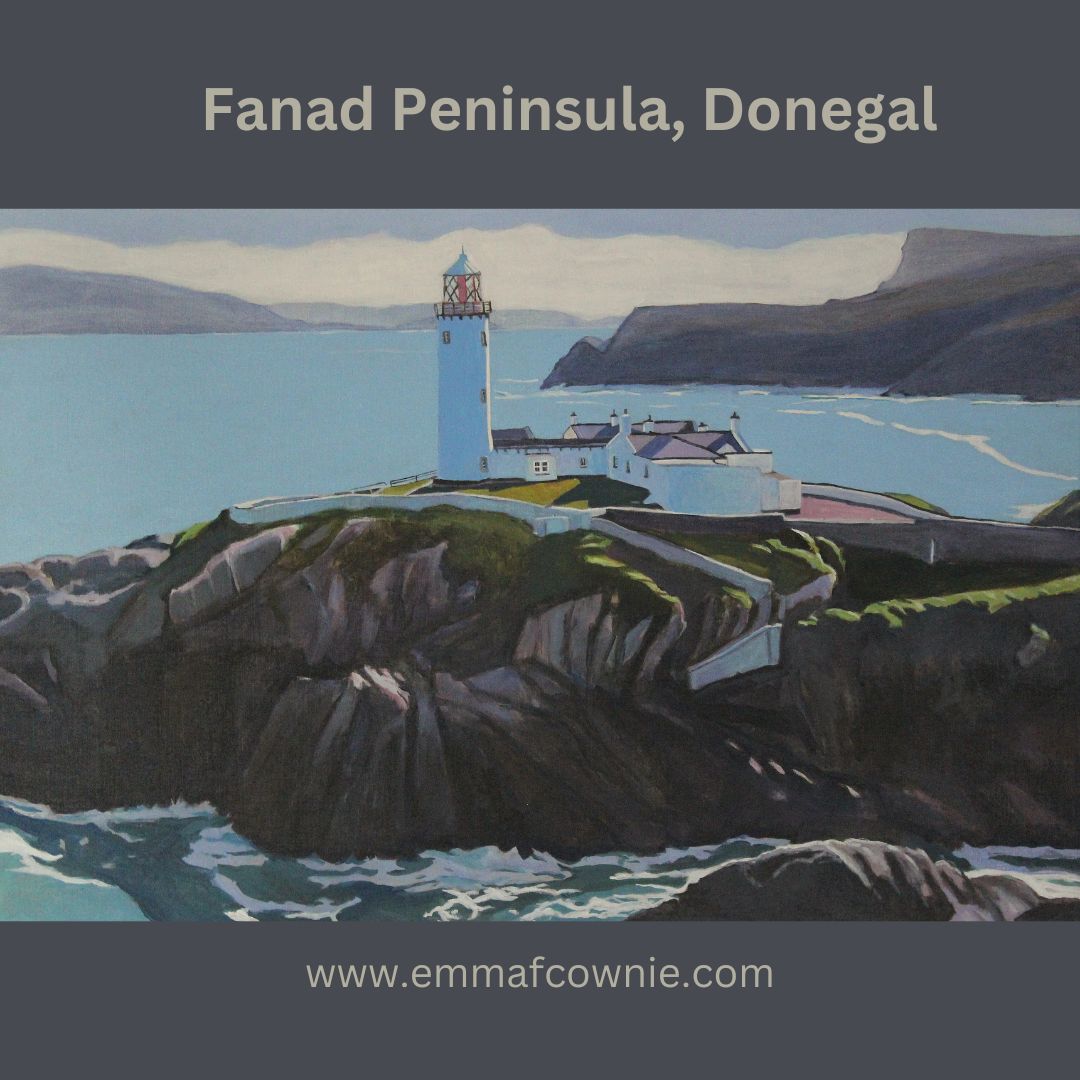
Fanad is a finger of land that lies between Lough Swilly and Mulroy Bay on the north coast of County Donegal, Ireland. It is not that easy to get to and the the survival of the Irish language is testiment that relative isolation.
Lambing season at Fanad Head (Donegal) SOLD
Fanad Lighhouse (Donegal). Is one of the 12 Great lighthouses of Ireland. It was built in 1886 at Fanad Head (although the station was originally established in 1817). The lighthouse, or more acrrately, the harbour light, marks the entrance into Lough Swilly which forms a natural harbour.
Fanad Lighthouse (Donegal) SOLD
I have painted this isolated structure several times before. I have always enjoyed painting the northernly light on Fanad. I have only have painted it in acrylics. That’s not a delibertae choice, more one of circumstance because at times I have had limited space, and I dont want to use oil paints with kittens close at hand.
Over to Fanad Lighthouse (Donegal) _Emma Cownie SOLD
I think acrylics suit the airiness of the subject matter. After a couple of years working out how to use them, I have settled on a technique of light layers of paint that allow the underlying colour to show through. This can give a transulent quality to the colour. This is in contrast to the relatively flat areas of colous I use for the larger areas of colour such as sky or the sea.
My latest painting was an experiment in composition. We used an image from a drone shot done by my artist husband, Seamas (James Henry Johnson).
In this piece, I wanted to create a sense of space from the mountains of the Inishowen Peninsula in the distance. The distant mountains were layered with bluish white until I got the right impression of distance.
I often find myself looking at the tiny Fanad lighthouse far off in the distance when I am at Lisfannon on the Inishowen Penisula. There is a sign comemorating a famous Atlantic storm that happened in 1748. this storm threatened to sink The Greyhound, the ship of one John Newton, a slave trader. John was so frightened that he called out to God for mercy. This moment marked a profound spiritual conversion, and many years later he wrote the words for the hymn “Amazing Grace” one of my favourite hymns, and to also campaign for the abolition of slavery.
There is some confusion how many storms there were . One website claims the terrible tempset happened far away out in the Atlantic because it took John Newton another four weeks after his conversion to sail into Lough Swilly and arrive at Derry/Londonderry. The Amazing Grace.ie site however, makes it clear a second storm happened in Lough swilly itself as it quotes John’s journal ” We saw the island of Tory and the next day anchored in Lough Swilly in Ireland. This was the 8th day of April, just four weeks after the damage we sustained from the sea. When we came into this port, our very last victuals was boiling in the pot; and before we had been there two hours, the wind began to blow with great violence. If we had continued at sea that night in our shattered condition, we must have gone to the bottom. About this time I began to know that there is a God that hears and answers prayer.” It’s got to be said, that John Newton really took his time putting his evangelical beliefs into action because he went back to being a slave trader for another five years before he eventually retired and became a minister in 1757!
The heaving sea at the foot of the massive lighthouse rock intrigued me. The Atlantic Ocean has such a bulk and stregth, even on a relatively fine day, I am not surprised that John Newton was terrified by its strength far away from the Donegal coast. I wondered about the long and difficult process of building this structure all those years ago in a remote location. Yet, this lighthouse has stood the test of time and proudly marks the entrance to Lough Swilly and can be seen from inland and further along the coast.
I have been experimenting with different supports and media. The Jessica Brilli painting on wood got me curious about how it would be different from painting on canvas.
Jessica Brilli’s “Cutlass” – Acrylic painting on wood panel
I could find very little information about the experience of painting on wood panels (but lots of information on how to prepare them). So I realised that I had to use trial and error to find out. I ordered some gessoed wood panels from Cork Art Supplies who delivered them very promptly.
My first effort was this painting. I painted a light ground of red ochre in oil before I laid down the painting. I found that achieving fine detail was much easier than on canvas. However, the colours didn’t behave the way I expected them too. My sky started off too dark. I found it was easy to wipe off the oil paint and repaint it a lighter shade. I found that white areas also needed a further layer once they had dried to give them the solidity I required. The painting took much longer than I am used to to dry.
A Place to Rest, Inishbofin, Donegal
I have painted in acrylics on canvas before and struggled with the speed with with the paint dries on the palette. I used to find the the paint had gone hard in the 20 minutes since I started painting. It drove me mad. However, after extensive reserach I worked out how to make a wet palette so that I could slow down the drying time of paint on the palette. I decided to use the quick-drying acrylic paint as an underpainting.
The acrylic painting was more of a sketch than a proper painting. The process forced me to simplify my images further and the final layer of oil paint gave the image a greater depth and richness of colour.
Acrylic Underpainting
Boat at the Pier, Gola (Donegal) – Final Painting
Some of the acrylic sketches really challenged me as the paint did not move and work in the way I was used to with oils. The greens and yellows were too transparent and looked messy. It was impossible to lighten colours, like the leading edge of the fence post, once they had gotten too dark.
Fenced in, Gola – Acrylic Underpainting
The final layer of oil paint, however, enabled me to make my colours much more opaque and to to add much more detail in places, especially on the wire fence.
Fenced In, Gola
My final painting was a studies in mauves, blues and greys. I had added an additional layer of light grey gesso as a ground before I started painting.
Lighting the Way – Acrylic version
Lighting the Way (to Arranmore) Donegal – Final version
I enjoyed experimenting and I ended up painting several painting at the same time, as I waited for paint to dry between layers. The whole process forced me to confront my short-comings as a painter of acrylics. I did not enjoy that. It made me feel uncomfortable and brought out my “imposter” anxieties. I need to do much more work in this area to develop my skills.
It was also rather time-consuming and probably not a great project to undertake in the winter months, in Donegal, when good light is in very short supply. I am not sure that I would spend so much time on the underpaintings in future, as I liked my first painting the best. Although I would where there are large areas of white. I did enjoy painting on the wood panel and I will continue to experiment with them.
I was delighted to give permission to Eugene Vesey, poet and author, to use my artwork on the back of his book “Opposite Worlds”. In the story, the main character Frank spends his honeymoon with Mary on Gola island.
Someone told me that once we got to Ireland, “it will be like being on holiday everyday!” Hmmm, I have had some pretty eventful holidays in the past. Funny how the disasters are more memorable that the sunny easy holidays. Let me see. Here are three that come to mind; we once got flooded in a campsite in Yorkshire, had a sleepless night holding on to the tent during a gale at a campsite in the South of France, and finally we drove a tempermental campervan around Ireland a decade ago. It only started some of the time. A helpful Polish guy got it started very early in the morning so we could catch the ferry in Wexford.
Knockfola, Donegal
So far, this “holiday-everyday-life” is proving to be pretty good (that’s a English understatement, by the way). There were quite a few “bumps” to start with, however. A lot of things seem to go wrong at the same time. At first we could not get into the studio, as the door lock was jammed, then one of our dogs, little Mitzy had a stroke (the vets was over an hour’s drive away), Bingo the cat got lost and finally the toilet flooded and we couldn’t use it for several days.
The studio makers sent someone all the way from County Tyrone to replace the lock so we could get in! The vets kept Mitzy in over the weekend and thank to a pile of drugs and lots of basket-rest, she has recovered well. Her balance isn’t great and her head is at a permanent tilt but she chase after the ball again and is still telling us what to do.
Mitzy (with Séamas and Biddy)
Ann Marie at Burtonport Animal Rescue put out a notice on their facebook page, asking people to look out for Bingo, and it was shared many times. She gave us useful advice and support too.
They do great work and need donations to keep up that great work. You can donate via this link.
Thankfully, Bingo came home late at night, after the traffic had died down. The flooding toilet issue is more complicated, has been solved for the time being but will need some more work in future. Don’t ask me to explain it.
This is my one and only summer drees
We had a heatwave with unprecedent temperatures of 30 degrees celsius soon after we arrived. This was very unexpected and I had thrown out a lot of my clothes during the move and I only had one summer dress. Fortunately, I did have bathers so we could go for a swim in the sweathering heat. That was fantastic. The water was crystal clear and surprisingly warm (or not as cold as I thought it would be).
Swimming at Cruit Island, Donegal
As for painting. That was bit more difficult. I was not able to paint for two months as I was either helping un/packing up the house, paints were packed away or I was just too exhausted to do anything. I knew it was going take a while to find my painting groove again as I needed to recover my energy levels and adjust to a new location. I am very fussy about arranging my paints and the position of my easel and it took a while sort things out to my satisfaction. It took longer than I thought but I am getting there now.
The Old House at Marameelan
What do I love about Donegal? The way it looks and sounds. Everytime we take a trip into the nearest town of Dungloe, to post a painting or to do our food shopping, I marvel at the views. At night, when I awake, I listen to the slience. I find it so relaxing. I had had enough of the noise of city life. Donegal is so beautiful too. There is so much abundant nature on our door step, quite literally under our feet. The length of the west coast of Ireland is called the Wild Atlantic Way, and it really is wild in every sense.
A carpet of Flowers at Gweedore
Red deer, seen on land only 5 minutes walk from the cottage (photo by Séamas Johnston)
The weather is very mercurial. I thought I was used to rainy weather, living in Swansea in Wales, but this is something else. I may awake to thunder and downpours, but by lunchtime the sun is shining and the sky is full of fluffy clouds. Sometimes it may rain, the sun will come out and then it rains again, all in the space of ten minutes. Today, we are in the midst of a gale, that no one has seen fit to name, with 50 mile-per-hour winds. Standing outside in the buffeting winds is surprisingly envigorating. I think its the negative ions.
Donegal Clouds
It may be grey all all day or the sun might come out in a bit. Passing a window, I might be struck by the beauty of the clouds. Sometimes I point them out to Seamas, or take a photo. Often just drink them in. I hope I never stop marvelling at them.
Come and Visit
In my Viewing Gallery
We are now in a position to receive visitors to our private gallery, at the rear of Meadow Cottage, on a appointment only basis. We ask that social distancing is observed and that masks are worn inside the gallery.
Please call either our mobile no.s +44 782757 4904 or
+353 87963 5699 or landline +353 74 959 1593 to book a viewing.
Bloody Foreland is one of my favourite locations in Donegal. It is one of the wildest, windiest and most beautiful places I have been. The light is sharp and clear. You feel healthier for breathing the air here.
House on Cnoc Fola
The wind is always blowing. It is very remote and feels a bit like the edge of the known-world.
A derelict house, Bloody Foreland
The name Bloody Foreland (Cnoc Fola in Irish means Hill of Blood) does not to refer to some past battle that took place here in mythic times, but intense red hue of the rocks at sunset. The Irish language dominates here.
Folklore records that Balor, the one-eyed supernatural warlord was eventually slain by his grandson Lugh Lámh Fhada on the slopes of Cnoc Fola. Indeed, some say that the tide of blood which flowed from Balor’s evil eye stained the hillside and gave it its name.
Bloody Foreland, Donegal
I particularly like the incredible stone walls, made of massive granite boulders, that snake across the hills here. They date from the 1890s. They suggest to me a landscape where stones were plentiful and labour cheap. It is also the sort of place where writers come to get away from the modern world and think about writing. Dylan Thomas, travelled to An Port, further south to write poetry, but left without paying his bills.
Old Farm Buildings, Bloddy Foreland
Bloody Foreland, also makes a refreshing contrast to the slopes of Brinlack and Derrybeg, round the corner, which are heavily peppered with larger modern houses and bungalows from the era of “Bungalow Bliss“.
Houses on Bloody Foreland, Donegal
This is the first time that I have been able to paint Ireland whilst in Ireland. Previously, I have worked from my photos back in Wales. Now I think that being surrounded by these colours all the time is affecting my work in a different way.
I am experimenting a little with less detail and letting my under painting show through more – to give a greater sense of the roughness of the landscape here. I am feeling my way. I don’t know how my paintings will develop in the future, but not knowing is a sort of freedom from painting the same thing in the same sort of way.
Caravans tucked away on coastal inlets and islands are not an unsual sight in Donegal. I am always impressed by their presence as there are no roads for lorries and it must have taken a good deal of effort and ingenuity to get it there. Getting to have a “Staycation” in 2021 amidst all the uncertainty of vaccine rolls out & third (or is it fourth?) waves looks like it will take an equal amount of effort! So instead join me in imagining the view from the static caravan’s wide window across the rugged terrain of Gola Island on this late spring morning.