

This is my latest Gower landscape painting.
I am taking a break from landscape painting for a few weeks. I feel the need for a change in direction; so I am revisiting an old muse – the urban but in a new medium. It’s both thrilling and scary.
This is my latest Gower landscape painting.
I am taking a break from landscape painting for a few weeks. I feel the need for a change in direction; so I am revisiting an old muse – the urban but in a new medium. It’s both thrilling and scary.

Three Cliffs Bay never disappointed. It did not matter how many times I saw it. The sight of it always caused me to catch my breath; when I saw it from the road, from the slopes of Cefn Bryn or from Pennard Cliffs.
It is one of the things I miss about living in South Wales. I imagine it in sunshine, although I am pretty sure the Summer in Wales this years has been as poor as it has been in Ireland. It may well improve. Septembers were often best for sunshine. Just as the schools had gone back!

I used to get up early in the morning and drive down to Pennard to walk along the edge of the golf course, past the dog walkers, to see the sea and take photos. This is a new painting (see above).
Once I found an excellent parking spot opposite the corner shop in Pennard, only to find I had forgotten to put the battery in my camera. I wasn’t carrying a spare. So, I had to drive all the way back to Swansea to fetch the battery. The journey seemed to take forever (as I cursed my stupidity all the waythere and back) but when I got back the conditions were still lovely.
It was low tide and you could see the river, the Pennard Pill, at its meandering best. When you first come to Three Cliffs you assume you can easily cross the Pill in your bare feet. You can at the shoreline but it get deeper quite quickly. There are stepping stones further up stream. In boot-wearing weather, its a short walk inland to cross at the stones. My painting (see below) Two Rock, Three Cliffs is near to the stepping stones.
Here is my other new Gower painting.
Read about my 2018 walk along the Gower Coastal Path here

On Thursday afternoon I went on my first proper “Walk” with a capital W since I broke my leg and ankle last spring (read about my horrible adventure here). It’s not that I haven’t visited parts of the coast since March 2020. I took numerous short strolls along flat grassy parts of Gower (Mumbles, Oxwich and Pennard) last autumn before we were launched into the never ending autumn/winter lockdowns. Thursday was the first time I really challenged myself and ventured along tracks that I would not have thought twice about walking along before. We left the dogs at home to give our full concentration to walking (and not tripping up).
Life recovering from a broken leg and ankle is all about surfaces and angles. A lot of my walks involve looking at the ground. I make myself stop when I want to look at the scenery. Rough ground can be challenging for my ankle. Going down hill is a lot harder than going up. I often think of my ankle as being like my sewing machine foot when I try and make it sew thick fabrics! Unfortunately, my sewing machine foot has been known to fall off. I am not sure if that’s a reminder to take care or its just not a great analogy.

My ankle doesn’t just have to contend with up and down movement but side to side movement too. I have done a lot of practicing standing on my left leg and on my toes. My muscles are 90% there but not quite what they once were. I have been told that I have to keep doing the exercises until the left leg/ankle is as good as the right one.

Cefn Bryn at our backs and the “cottages” of Penmaen.
Anyway, Thursday was election day. Something I had completely forgotten. I usually get out and vote first in the morning but I had been waiting in for a delivery of paint and it had slipped my mind. That is until, we arrived as Penmaen and saw the “Polling Station” sign in the car park. “Oh, no!” I wailed. “The suffragettes will be spinning in their graves. I have to vote!” “Perhaps, you could vote here?” my husband, Séamas, suggested hopefully. “No it doesn’t work like that, you have to vote in your own area with a piece of paper and a pencil. It’s not that hi-tech, yet”. “Oh” he said.

We usually launch ourselves down an uneven track towards the coast but Séamas was worried that the uneven gravel would be too much for me. I agreed.

So I thought about it, and came up with an alternative route. We turn off the the right and along a wide grassy path across some fields. This was a nice gentle stroll. I paused and admired the view. Behind us was Cefn Bryn and the cottages that line the main road. They are hardly visible from the road, partially hidden by stone walls and trees. From here you could see that these houses all have very large windows from which to see the magnificent views. I wondered how many of them are holiday homes and how many are lived in all year around.
The waters of Oxwich Bay sparkled off in the distance. The tide was in.

Once we walked across the field I faced my first challenge as the path dropped away down hill. Gower really isn’t accessible to the disabled, is it? I thought to myself. That’s why you only see the really elderly at Rhossili where they have a massive car park and wide tarmac paths.
 I shuffled cautiously down this part of the track (we just came from up there)
Our solution was for Séamas to walk right up in front of me so I could rest my hand on his shoulder for extra balance if I needed it. That worked surpingly well. I found that so long as I went really slowly, and I mean REALLY slowly, shuffling really, I was fine. We finally reached the coastal path and turned left.


Here the path enveloped in Nicholston Woods. Stretches of the path had bluebells scattered amongst the trees.

The next section seemed to plunge off into the distance and I almost lost my nerve. As I said, down hill is a lot harder than up hill for me. “We could shuffle down on our bums, if its too difficult?” I suggested. “No, it will be fine if we go slowly” said Séamas. So we did our slow shuffle again, with Séamas in front: “I can fall onto you I said”. Thankfully I didn’t need to. There are no photos of this part except the last bit where I got more confident again as it was uphill.


At the top there is a beautiful old wooden gate where you can pause and take in the view of Great Tor. Adders (Britain’s only poisonous snake) have been seen along this part of the path already this year. I saw one once many years ago near here. It wasn’t interested in us, it just moved away quickly. We didn’t see any today.

The next part of the track was easy but lengthy and I could feel myself tiring a little. I was cautious about over doing it and not being able to get back to the car. PTSD makes me conjure up the worst scenarios in mind at a moments’ notice. I briefly, I imagine the amubulance and emergency services having to rescue me all over again and me having to explain why I thought a coastal walk was a good idea. Time to rest and stop thinking daft thoughts. Séamas is with me. I am not alone. I have not broken my leg again. We find a bench and look at the view and listened to the birds singing.

And up!

Now I know I should be sensible and just turn back and go home but I really want to see Three Cliffs. It’s been so long. I have learnt that if I want to go far with this leg/ankle the trick is to go slow and steady. Speeding off does it no good at all and it start to hurt. So we carried on. A little more slowly.


Finally. This is the view I came for! I sat down and rest and looked across the bay. We watched the cloud shadows as they moved across the land. It was wonderful.

Finally, we decided to return back to the car. I decided to face the uneven track. As its uphill, it might be OK and it was.


I had to stop and rest several times, but I made it! I was disappointed to discover that I had walked less than 2 miles. I felt like a much bigger adventure than that! It was an important step to restoring my confidence again.
When we get home I staggered off to the local polling station to vote. All covid measures were in place. All the doors were open, there were big circles on the ground to tell people where to stand in socially distanced queue. Fat chance! As usual, there was me and the election people and no one else. The majority (60%) of people in my area don’t care about the suffragettes and don’t bother voting. The masked-returning officier was behind a screen, she did not touch my polling card. I went into the polling booth to cast my vote but found the usual pencil on a string was missing. This threw me. The returning officer had a collection of pencils on her table. I dug around in my bag for a pen. I noticed that one of the candidates lives in Penmaen. I wonder if we passed their house today. So at least one of those houses is lived in all year around. I cast my votes and folded up the three sheets of paper and pushed them into the large black metal box. The suffragettes can rest easy.
I waited to see if my leg and ankle would hurt afterwards. They weren’t too bad although both legs ached a bit from unaccustomed walking and that kept we awake in the early hours until I took a painkiller. I was too tired to paint. I am still feeling very tired three days later, but I think I will be back to normal tomorrow.


My leg and ankle are recovering from my accident this spring and although I can walk a faster than I used to, I still cannot walk long distances which means that a lot of my favourite Gower walks are off limits to me. I find staying indoor too much isn’t good for my mental health (especially during the Pandemic) and it is vital to get out and see different places nearby. Fresh air is good for the soul, the mind and more importantly it blows away the virus!
This blog is about a very short road trip around parts of the Penrice estate down to Oxwich Bay we did this week. My husband drove and I took the photographs. Penrice Castle was built by the Mansel Talbots. They were one of the most powerful families in South Wales and certainly one of its biggest resident landowners and MPs for Glamorgan in the Victorian era. The “new” Castle at Penrice was built by Thomas Mansel Talbot in the 1770s, as an alternative residence to the rambling old house at Margam. Thomas, who had travelled to Euope and considered himself a man of great taste had a neo-classical villa built. He also had the land around the house landscaped and a park laid out to improve the romantic scenery that had first attracted him to the place. His son, Christopher Rice Mansel Talbot, who was born at Penrice in 1803, modernised the old Aberavon Port and renamed it (modestly) Port Talbot as an industrial hub for South Wales. The house at Margam was also pulled down and a new mansion was built there between 1827 and 1830 near the ruins of the old abbey.
I will the road trip start with a map. All road trips need a map. There is an excellent map of Gower at Mapsta here. Our trip starts at the top left hand side of the map where a lane turns a sharp left from the A4118 road down a narrow single track lane. A word of warning if you fancy this road trip. This is not a trip for a large vehicle. Most of the lanes are single track and are very narrow. We spent most of it praying that we did not meet any thing coming the other way, and we drive a tiny Kia, as it would have possibly meant a ggod deal of reversing! Thankfully we didn’t.

.


We saw people. There were not too many but enough to watch. There was even a small wedding party having their photos taken on the beach off in the distance. It was heartening to see people managing to commit to a future together come what may! It must have been next to impossible planning their day as we have had a national lockdown, a local lockdowns and a mini-firebreak and there are rumours of another lockdown after Christmas.


On the way back home, we continue anti-clockwise on our loop back up a steep hill to the main road past Underhill Cottage. It was originally the Head Gamekeeper’s cottage. It has a lovely, sunny position overlooking the beautiful Oxwich Marsh and the sea with Nicholaston Woods behind. These days it is a holiday cottage. It is possibly one of the few sorts of holidays you could be confident of not getting cancelled these days (if you live locally, that is).


Buy my book “Footnotes: An Artist’s Walk around the Gower Coast” here
Read More
Mansel family and Port Talbot https://www.walesonline.co.uk/news/wales-news/port-talbot-history-origin-name-18664821
Penrice Castle
Penrice – castle
https://www.parksandgardens.org/places/penrice-castle
Holiday Cottages on Penrice Estate. There are 16 holiday cottages on the estate
http://penricecastle.co.uk/gower-self-catering-holiday-cottages-wales/

Rhossili Bay is a vast beach. The beach is 3 miles long. Photos do not do it justice.

A number of landsmarks are frequently photographed (and painted) along this great expanse – Worms Head the tidal island that stretches along at the Southern end of the bay, the old rectory that looks out from the middle of the shelf above the beach and in the midst of the sand, the Wreck of the Heletiva. If you look very closely at the photo above you might just be able to make it out.
Need help? It’s the group of shark-like fins that are poking out of an impossibly small pool in the midst of the sand. The Helvetia sank into the sand over 130 years ago and only her stubs of her wood ribs remain.

From on top of the Rhossili cliffs, it looks tiny. I have only been down onto the beach to visit it once. It’s usually surrounded by people photographing it.
A quick online search will turn up many, many images of this wreck close up; some with shadows, others with reflections, lots with beautiful sunsets, and a few stunners with starry skies. I don’t know how they arrange it when more than one photographer wants to take a photo at sunset?

She is surprisingly small. These remains must be just the “nose” of her bow. I am very taken with how organic she is. She is made of greenish rotting wood. Presumably being underwater for long parts of the day means that she is only rotting very slowly. Up close, the rotted bow looks dragon-like. The iron nails that protrude from the wood are like the teeth of the beast. The rust from the iron colours the wood orangey-red. Red and green, the colours of Wales.

I wanted to find out more about this ship. What did she look like before she sank? Did anyone die? Why was she called Helvetia?
I discovered that The Helvetia had been a Norwegian barque, which is a kind of sailing ship. She had been built in 1855 and registered at the port of Bremerhaven (in modern-day Germany). She had sailed from New Brunswick, on the East coast of Canada in late October 1887. Although the sea around the Gower coast seems tame in comparison with the wild North Atlantic off Donegal, the coastline has seen the demise of many ships over the centuries. The Helvetia was caught in bad weather and hit the dangerous sandbank of Helwick Sands. She was then swept around Worm’s Head and into Rhossili Bay. Her captain decided to drop anchor but the galeforce wind meant her anchor was ripped free from the sand and she was wrecked on the sands of Rhossili beach. Fortunately, no lives were lost.

During the following weeks, her cargo of timber was collected from the beach and gathered for auction sale. The wreck itself was sold to a local man, who intended to strip the precious copper keel from the vessel but before he got the chance, the Helvetia sank into the sand. Local legend says that he had to settle for salvaging the ship’s deck boards!
I tried to find a photo of the Helvetia before she sank and I discovered that there are many ships that have born that name in the past and in also in the present day. Here are some examples.

This got me wondering why Helvetia was such a popular name for ships. What did it mean anyway? So I did a bit of research and found out that Helvetia was the personification of Switzerland, like Britannia, is for Britain, Marianne for the French Republic, or Erin is for Ireland. So why were Norwegians naming their ship Helvetia? It seems I was totally on the wrong track here.
I did some research and I found that Hel is also an Old Norse word. It has several meaning. It could mean “Hel” who in Norse mythology was a goddess who ruled the underworld, Helheim, or Hel. Hel-Víti thus means “Hell-torment”. That would be a great name for a Viking ship, I think. Hel, however, also means luck which is possibly a better name for a ship, especially as sailors are incredibly superstitious people. If you made your living on the changeable sea you’d be very superstitious too. On a tangent, it was apparently customary among Vikings to say “hell og lykke” (luck and happiness) when they met. This is supposedly were English speakers get the greeting “hello” from.
Anyway, I had assumed that there was a rule that only one ship at a time could bear a particular name – like the Ark Royal, but it could be reused again and again. No so. There were many other ships in the C19th with the name Helvetia – more than one of these ships were passenger ships that took people who wanted to emigrate to the USA, another Norwegian ship, SS Helvetia spent much of the 1870s & 1880 steaming across the Atlantic from Liverpool to New York. Conditions must have been poor as there was a cholera outbreak on one of these voyages in 1866 and the ship was forced to return to Liverpool.

I found another Norwegian ship called Helvetia, operating across the Atlantic in this period. On the “Noway Heritage” website this ship is described as a Bark (Barque) like the Rhossili ship. This ship was also built in Bremerhaven, but in 1858 not 1855, and was wrecked in 1888, not 1887. I don’t know if this is the same ship as the Rhossili wreck. Quite possibly. There is an online passenger list for the Bark Helvetia from her 1861 voyage from Germany to New York here, and you can see the names of the framers and skilled-labourers who were looking for a new life in the United States. According to the “Norway Heritage” website, the Bark Helvetia also sailed to Quebec, in Canada, on a regular basis. She also sailed to Swansea twice in 1866. This Canadian link makes me think that it is the same ship. She regularly sailed from Norway taking hundreds of passengers presumably looking for a new life in Canada in the 1860s (you can see the passenger list here). Incredibly, between 1825 and 1925, more than 800,000 Norwegians immigrated to North America—that’s about one-third of Norway’s population! Most of them immigrated to the US, and lesser numbers immigrating to Canada. Hunger and poverty pushed them to leave their homes. The voyage must have been grim beyond belief. In 1861 a ship called the Helvetia, possibly not the Rhossili ship, is recorded as carrying 344 passengers in steerage from Drammen (Haagensen) but by the time they arrived in Canada, there had been five deaths. Looking at the other ships that arrived in Canada in that summer, smallpox, and measles were also rife on board the crowded ships. Deaths were not uncommon.

Later on in the 1870s the Helvetia sailed from London and then Truro, in Cornwall. I am guessing that she took English passengers to North America and brought timber back to Europe. This intrigued me. Distant relatives of mine left Scotland in the 1860s and started a new life in the States, setting up a successful business selling furs in snowy Des Moines, Iowa. Perhaps they traveled on a ship like the Helvetia? Interestingly, many Norwegians settled in Iowa too.
For a sea-faring nation, Britain has preserved precious few sailing ships from the past. The Helvetia (and her many namesakes) deserves to be remembered as one of the thousands of ships that played a role in the mass migration of peoples from Western Europe to North America in the 19th century. She may have met her end on in the sands of a Welsh beach, but she had been a workhorse of the North Atlantic and it was very fortunate that her final cargo was timber and not people. It seems very fitting that this Scandinavian ship lies on the sands of Rhossili Bay. As behind her off to in the distance another dragon, the Wurm, or Worms Head stretches across the horizon. Wurm is a Viking word. It means “dragon”.

The Wreck Of The Helvetia, Rhossili, Gower
Footnote October 2022

https://www.coflein.gov.uk/en/site/273914/details/helvetia
http://www.gowershipwrecks.co.uk/2009/11/gower-shipwreck-helvetia.html
https://www.walesonline.co.uk/news/wales-news/story-behind-helvetia-rhossili-beach-14968494
also

Here’s a footnote to Sunday’s post about waiting for gaps in the clouds. The sun was peeping over the top of the three peaks, illuminating the edges beautifully. I particularly liked the way the sea and the river, Pennard Pill, merge here. It’s not clear where saltwater and freshwater meet.


I used to like painting landscapes and cityscapes with clear blue skies. I waited for the bright sunny days of early summer to walk around, taking photos and looking for inspiration. Thus, my series of urban minimal paintings of Swansea, made the town look a bit like a Mediterranean location!
What a joke. It rains a lot in Wales. It has rained incessantly for the past two days. Since my extended visits to Donegal, however, I have become increasing inspired by cloudscapes and the silvery light along the Atlantic coast. With my “new eyes” I have started waiting cloudy days in Wales to go out looking for inspiration. Not overcast days, but days with patches of blue sky and sunshine.
I drove down to Pennard, with the idea that I wanted to paint Pennard Pill, the river that follows into the sea at Three Cliffs Bay. The BBC forecast claimed that it would be sunshine and clouds all morning. When I looked at the Mumbles and Caswell Bay webcam, one showed sun and the other was overcast. I set off, anyway. I would go for a walk, regardless. On my way there the sun came and went. As I drove past Mumbles head, I could see it swathed in a light misty cloud. I wondered whether there would be anything to see when I got to Pennard.
Thankfully, the sun was shinning at Pennard as I made down the path that runs alongside the golf club. The tide was coming in and I could just see Great Tor in the distance, through the peaks of dunes. When got close enough for a clear view the sun promptly went in! I looked up at the sky and looked for blue patches. There were quite a few. So I carried on towards Pennard Castle, which is situated on the top the of the high dunes, further inland. I hoped the sun would reappear by the time I got to Pennard Castle. I tried to work out which way the clouds were traveling. Usually, they move from Oxwich Bay towards Three Cliffs. Today they were going the other way. The sun came out a few times on my walk. Just as I was climbing up the sandy path the castle I came out and lit everything up like a technicolor Hollywood film!

The sun promptly went in again. I stood in the ruins of the castle and waited. I thought about the fairies who had supposedly destroyed the castle with a sandstorm when the lord of the castle had refused to invite them to his wedding party. Eventually, the sun broke through and lit part of the valley below.

I watched the light move across the valley and the colours burst into life.

I then decided to walk back towards the sea and see if I could photograph the three peaks that give the bay its name. The clouds rolled in.

I would have gone home at this point, as there was a cold wind and it was almost lunchtime but I could see bright light off in the distance. It was on the far side of the Bristol channel. I could see a ship on the horizon lit by this light.

How wide was this stretch of water? Miles. How long would it take for that shaft of sunlight to make its way over to the Gower coast? A while. So I waited. I am not very good at standing still so I walked around a bit, watching the dog walkers and small family groups vanish from the landscape.
The clumps of large mushrooms spotted about the grassy parts of the dunes, made me think of the fairies again.


I climbed dunes, trying to decide good locations for photos for when that shaft of sunshine arrived. It was definitely coming my way. A new set of walkers was arriving on the beach. They were all optimists too!

Hunger was starting to make itself known. I slouched down against a dune. Patience. Patience. What was the point of giving up now when I had waited so long? Impatience comes from wanting to be somewhere else. I needed to be here now. I thought of a line I heard Van Morrison sing at his 2015 Live 70th Birthday Concert at Cypress Avenue, Belfast “It has always been now” (52 mins into the clip). He’s a genius. He captures the joy of being truly present in the moment. Just as I was saying that to myself when the sun arrived and the technicolor lights were on!

That doesn’t quite capture it. Here let me show you. My view of the world.

That’s more like it.
Now I could go home and eat lunch. Paint and listen to Van Morrison.

I managed to make it down to Rhossili Bay this week. It has been raining on and off for weeks. I have been painting in my attic studio listening to the rain thundering down and I have got quite tired of that sound. So when I was greeted by clear skies I decided, on a whim, to drive down to Rhossili to see the autumn colours.
Rhossili has a wonderful windy wildness to it. It’s unlike the rest of the Gower Peninsula. The trees all lean heavily away from sea and the prevailing westerly wind. As I drove into the village I was caught up in a sheep-jam. A herd of sheep was being moved from one field to another. They were packed into the little road and had stopped the traffic (it was three cars actually). I watched the mob of sheep as they swirled in front of my car and past me. They were Welsh Mountain sheep; only a few had horns. Their creamy fleeces were spotted with brightly coloured red and purple “smit” marks. These are marks painted by their farmers that denote ownership. One moment they were packed around me and the next they had moved on.
There was space in the church car park so I parked and put my donation in a slot in the wall. This car park is closer to Rhossili Beach. If I had wanted to walk to Worms Head itself the National Trust Car park with its facilities (loo block and shop) would have been better. From here I walked down a stepped concreted path down towards the beach. It seems strange but I have never walked on this particular path before. I don’t know why. I have always walked parallel to the beach along the cliffs paths (one on the top of the downs and one in front of the rectory). I wrote about the coastal path in several blog posts and in my book, Footnotes: An Artist’s Journey Around the Gower Coast.

So I followed the path downhill and got a different view of the Worm. The bracken had died back to a wonderful russet colour (one that I associate with wales) and the sea was a beautiful turquoise blue. The tide was out and the tidal island, the Worm (Wurm) rose up above the waves on the horizon. I looked at how the light caught the back of the Dragon and remembered how arduous walking across it was.

The walk down to the sea was quite steep but easy. The final descent was down a ramp of gravel. The vast beach was surprisingly populated for a term-time day in the week.

Of course, I could not pass up the opportunity to visit the remains of the Helvetia on Rhossili Beach. The Helvetia was a Norwegian ship bound for Canada that was wrecked in south-easterly gale on Rhossili Bay over 130 years ago on 1st November 1887. In the Instagram age, given its picturesque location, its not surprising that it has been photographed and shared countless times.

I walk across the beach to bottom of the vast 200-foot cliffs, looking at the colours and light. There are seagulls scattered across the beach and when I turn back I can see the Rhossili Downs and the Od Rectory reflected in the outgoing tide.

On the far edge of the beach, I was surprised to discover the remains of another shipwreck in the sand. A bit of online research and I discover that this is Vennerne, apparently, it is known locally as the Vernani, and it was dashed to pieces under the Rhossili cliffs in 1894.

Another Wreck on Rhossili Bay
There is quite a strong breeze. When the clouds roll in it starts to feel cold. The clouds create a softer light. The grays and purples dominate. I am glad I have my woolly scarf on and start to make my way back to my car. The path hill is pretty steep and the climb warms me up.

The next day, I am tired from walking across the sand but it doesn’t matter as its raining again.
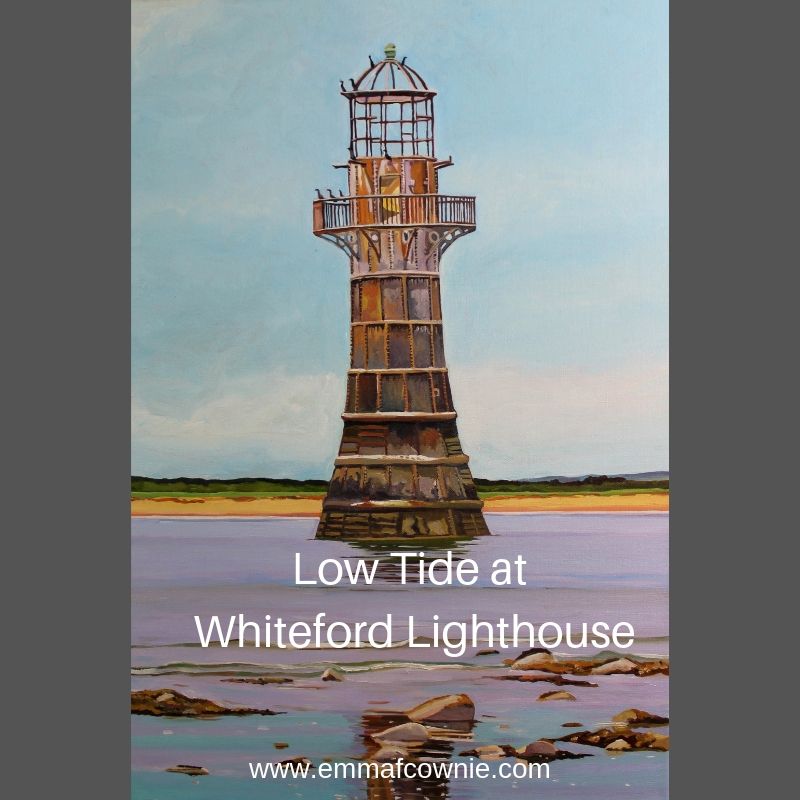
It was a long walk to the lighthouse at Whiteford Point on the northern tip of the Gower Peninsula. The last time I walked here, I just looked at the lighthouse from the beach. This time I wanted to get up close. We had left it late and the tide had already turned when we got here. The last stretch to the lighthouse is across lots of slippery, small rocks were surprisingly difficult to walk across. It took a good 20 minutes to make our way across them.


I was accompanied by Seamas, myy husband, and our loyal dogs, Biddy and Mitzy, who were not keen on the rocks but will follow Seamas anywhere.
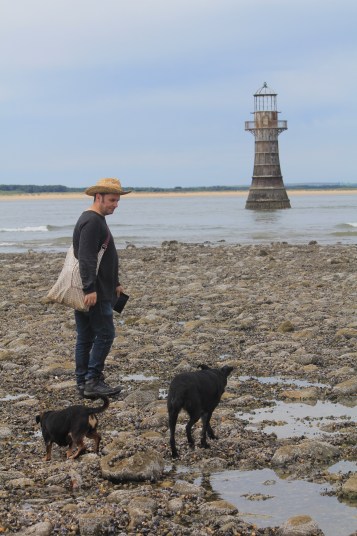
The iron victorian lighthouse had cormorants perched on it when I got there (ahead of the others) but a motor boat came past and they all flew off!

Here’s my painting. I love the colour of the rusted iron of the massive thing and the sea-life that clings to the lower half. It was a hazy day so the sky is bluish and the sea has a slight mauve tinge to it. The waves are gentle but advancing.

The lighthouse looks quite forlorn in the sand. It has no rock to perch on, just the sea bed. The cormorants, don’t care. They like their iron perch!

I am delighted to announce the publication of my latest book “Footnotes, An Artist’s Journey Around the Gower Coast” which is based on my walks and blogs of 2018.

Many years ago I turned my Ph.D. on Medieval History into an academic book. That was jammed packed with footnotes and had almost no pictures (except for the front cover) but it did have some maps hand-drawn by me. I felt quite odd when that was published. I suffered terribly from imposture syndrome, then as now, and it almost felt like someone else had written it when I looked at the words on the book. Don’t get me wrong, I had written every last bit of it, the text, the footnotes, the index but it didn’t feel like it had much of “me” in it, except maybe in my dedications. I think my parents and Seamas, who was my boyfriend back then, appreciated being thanked for their support.
This book is quite different. Ironically, despite the name, the only “footnote” in it is the title. It’s a bit of a joke, I guess! This book has a lot more of “me” in it. Yes, there still some local history and stories about Gower, but its mostly about the walk and dealing with my anxieties.
I had spent weeks editing it and sort of ran out of steam when I reached the part where I had to upload it to the Kindle website. Thankfully, my husband, Seamas, came to rescue and was midwife to the whole venture. He did the final editing and proof-reading and it uploaded to the website. Which sort of sums up our relationship, he’s always there to help me over the “humps”, not just as a cheerleader but as technical support and he also provides so much inspiration. So thank you, Seamas.
I also want to thank my parents who have always supported whatever I have done. My mother is a fervent “liker” on Facebook. Their house has many of my paintings hanging on their walls, which is a compliment in its self as superfluous objects are either returned to the donor or end up in the local Charity shops. I also want to thank supporters on Instagram who tell me that they have downloaded from Kindle or bought the physical book.
I hope that people enjoy it as much for the walks and stories about Gower, as for my paintings!
UK- See the book on Amazon.co.uk by clicking here.
USA – See the book on Amazon.com by clicking here


