The name will be familar to British ears who ever listened to the daily shipping forecast on BBC Radio. It is broadcast late at night just before 1 am and very early (5.20am). Anyone who is a night owl or insominiac will have listened to it. The list of shipping zones and forecasts is not only practical but also poetic and rather mysterious. Following the litany of locations and numbers is very soporistic. Listen to the clip below. The actual broadcast is from 2.46 onwards ZZzzzzzzzzz
Shipping Forcast (1993) – almost always broadcast on the radio, you have to use your imagination!
Many British people may not know where Malin Head it is anymore than than they know the location of German Bight or Viking. To Irish ears, however, it is well-known as the most northerly tip of the island of Ireland and also features on Met Eireann’s, sea area forecast, broadcast on RTE.
UK_shipping_forecast_zones
Malin Head to Mizen Head
People regularly tranverse the length of Ireland from Malin Head, Donegal, to Mizen Head, Cork. It’s a fair stretch. Just under 400 miles (640 km). Some incredible people have cycled it in just over 15 hours. Ordinary mortals take about 4 days.
Amazingly some super-human runners have done it in about the same time – 4 days! I recently listened to a radio interview with the heroic Sophie Power. Sophie is from England and she recently ran the length of Ireland in under 4 days. This is a World Record. She beat the previouis record by three hours. Being a mother, she had to fit it in during her children half-term holiday and didn’t get to pick the day with the nicest weather – just the Tuesday of half-term and so she started off in driving rain! Many years ago I used to run (only piddly 10ks and 5ks) and I would certainly prefer to run in rain than heat.
Incredibly Sophie ran most of the distance without sleep, snatching the odd half an hour on her second and third day. She ended up hallucinating, and with a knee injury that had to be braced. When she finished the race in Cork she had developed heat stroke! That alone shows you how far south Cork is. There’s no way she’d get heat stroke in Donegal! She’s planning to come back and run the Cork Marathon.
Sophie Power at Malin Head
At the Edge of the world
Standing at Malin Head is like standing at the edge of the world. To the north is nothing can be seen but sky and sea. A long way off is Iceland and much. much further away to the north-west is North America. It feels very remote (but surprisngly accessible from Letterkenny and Derry/Londonderry) but to fishermen and sailors, I’m sure it’s not. Scotland is surpisingly close to the north-east. If you have ever flown from England to Belfast on a clear day, you can see the Scottish Isles and the Isle of Man scattered across the Irish Sea, pretty close the Antrim coast. Donegal is just a bit further along.
On the most northerly tip of the island of Ireland, you will find a tower that was built in 1805 during the Napoleonic wars as a lookout tower to defend against any attacks by the French. You can see at the top left hand side of my painting above. Edges of places are places to look out from – for invaders, or for incoming storms. Weather reports that were important to local and international shipping were first recorded at Malin Head in 1870. It was in that year the tower became a signal tower for Lloyds of London. Semaphore was used to connect with ships at sea and the lighthouse on nearby Inishtrahull. In 1902 the first commercial wireless message was sent from Malin Head to the S.S.Lake Ontario by the Marconi Company.
Divers’ magnet
There are the wrecks of many ships lying off the coast in this area. Many of these such as SS Audacious, SS Carthaginian and RMS Justicia date to the time of the First World War, when Ireland was still part of the British Empire.
In 1917 two German mines sankLaurentic and although her crew successfully abandoned ship, but 354 of them died of hypothermia in her lifeboats.Interestingly, Laurentic was carrying about 43 tons of gold bars when she sank. Most of the 3,211 bars were salvaged by 1924; three more bars were found in the 1930s, however 22 gold bars have still not been recovered.
The Great Emergency/Second World War
During the Second World War, Ireland was neutral. The Irish army built lookout posts in places along the coast to prevent any violation of this neutrality. This was important as this part of Donegal is so close to Northern Ireland, which not not neutral and was bombed by the Germans. There is an EIRE 80 sign built of stones during the war so aircraft would know that they were over Ireland (not Northern Ireland). They acted also as a navigational aid for pilots. Eire 79 is at Fanad Head to the west. Eire 81 is at Glengad Head, further along the Inishowen Peninsula, to the east. You can see it on the map below. The SS Athenia, a passenger ship carrying 1,418 people was torpedoed by a German U-boat just hours after war had been declared in 1939 off the coast of Malin Head! Most of the passengers survived but 117 perished.
Tourism Sign at Malin Head
Some scenes from the film Star Wars: The Last Jedi film was shot at Malin Head. I have to admit that I am not a Star Wars fan – I never made it through awhole film. I have to admit that I’m more of a Star Trek fan. Apparently, it is possible to have a tour of the locations used for the film from local tour guides. The road leading up to Bamba’s Crown has been renamed locally from the R242 to the R2D2 in recognition of the Star Wars connection. Also beside the tower, there is a short lovely refreshing walk along the cliffs to Hell’s Hole. The cliffs are massive here and even on a relatively calm day the sea is restless and a bit intimidating It needs to be remembered that this not just a sea here but an Ocean.
Birds Eye View of Malin Head, Donegal- Emma Cownie
I did this interview back in March this year with artist and magician Michael Callahan and co-host Ann Rosenquist Fee, executive director of the Arts Center, St Pauls, Minnestota, USA. In it I talk about how I came to be an artist, my process, my love of colour and paint brushes!
There is a unique architectural gem, perched upon the high cliffs above the shores of the north Derry coastline. It is an elegant Roman-style round temple; a beautiful rotunda. It is a wonderful surprise. There is none other in Ireland. It looks out across Lough Foyle to Donegal to the north and on a clear day the Scottish Isles can be seen to the north-east. This remarkable building is Mussenden Temple.
Mussenden Temple from Downhill Strand
It was built by the eccentic and extravagant Earl Bishop of Derry, Frederick Hervey (b.1730-1806). The 18th century is full of mischievious and surprising characters and he’s one of the best. Frederick Hervey was in turns controversial, revolutionary and yet both shocking and popular in his own life time. He came from an aristocratic English family, the 3rd son of an earl with big estates in Suffolk. Having two elder brothers he probably never expected to inherit from his father. He first tried law and then became a vicar hoping for a career in the church. His family connections helped a lot. He became chaplain to the king, George III in 1763, who later called him ‘that wicked prelate’ .
When his eldest brother George became Lord Lieutenant of Ireland in 1766, he managed to wangle the post of Bishop of Cloyne for Frederick and then, shortly afterwards, in 1768, Bishop of Derry, one of the wealthiest Irish sees.
Frederick threw himself into being Bishop of Derry, reportedly visiting every parish in the diocese and embarking on a number of notable building projects in the city of Londonderry including building St Columbs Cathedral’s first spire (it had to be replaced later as it was too heavy) many fine building and the first (wooden) bridge over the River Foyle, earning himself the nickname ‘the Edifying Bishop’.
In 1779 his brother George died and Frederick became the 4th Earl of Bristol, inheriting an income of £20,000 a year. He now even more money. He spent a fortune on building and collecting art.
He was widely travelled and had a fine appreciation of art, especially Greek and Italian. He spent 18 years of his life in Italy and spoke Italian fluently. Frederick was also well-read and he was an expert in flora and fauna and publicised The Giant’s Causeway. The Earl Bishop did extensive research into the origins of the Causeway and promoted his findings to the scientific community and wider world.
He also visited Staffa Island on the Western Isles of Scotland to confirm the links with similar columnar formations. In 1782, he was made a Fellow of the Royal Society for his efforts.
The Earl Bishop was a colourful character and was clearly someone people loved to gossip about. There are many examples of his eccentricity. It is said that he made his clergy run a leapfrog race on Downhill beach to see who would win the best area!
He had an eye for the ladies and was reputed to have had several affairs. Among his mistresses was society beauty Madam Ritz, as well as possibly Emma Hamilton who was also the mistress of Admiral Lord Nelson.
Bramante’s Tempietto, Rome 1502
It was on his tour of Europe that he fell in love with Bramante’s Temple in Rome. He reportedly tried to buy it and have it moved back to Britain but the Pope would not let him. So the Frederick Hervey built his own. Several of them. He built Ballyscullion, near Bellaghy, Co Derry, in 1787 to his own extravagant designs. The façade was inspired by St Peter’s in Rome, and measured 350ft across, with a central rotunda flanked by curved wings and a large pavilion at each end. It sadly, no longer exists.
Ballyscullion House
He also started Ickworth House, in Suffolf in 1795 which was completed by his successors.
Ickworth House, Suffolk, England
His first rotunda, however, was Musseden Temple, built in 1873. It was built as a library on the cliff edge of his estate at Dunbo, County Londonderry, Northern Ireland. Dunbo derives from the Irish Dún Bó, meaning ‘fort of the cows’. Dunbo was renamed Downhill Demense and an incredible 300,000 trees were planted on the estate; although there is little sign of them today.
A huge castle was built with the assistance of number of architects (Frederick kept firing them) including Michael Shanahan of Cork and Placido Columbani of Milan, who was supervising plumbing and the installation of water closets, a swanky innovation for the time. So we are not entirely sure who designed the rotunda/temple on the cliffs.
Mrs Daniel Mussenden (born Fridiswide Bruce, d.1785) Unknow French artist c.1780
The temple was dedicated to his lovely young cousin Frideswide Mussenden (neé Bruce) who had recently married the rich banker, Daniel Mussenden, had given birth to a child. The temple was meant to a be delightful retreat for her to escape to and look out at the wonderful view or read some of the many books there. A fire was kept lit at all time to save the books (and her) from the damp Irish weather. Sadly, Frederick’s terrible reputation with women meant that their “friendship” was gossiped about, in the press. The fragile Frideswide was horrified to be written about in the Freeman’sJournal, even if she wasn’t mentioned by name, and it may well have supposedly sent her into a physical decline, dying at the age of tender age of just 22 in 1785.
There is a minature of her in the National Gallery of Ireland painted when she was 17 in 1780, presumably when she had just married Daniel. She has a very sweet and tender face; you can easily imagine her upset at the nasty rumours.
So the library on the cliffs is a poignant place. Built for a young woman who perhaps only used it for a short time before she died. It was always close to the cliff edge, reported 30 foot away when it was built. I think that is an exaggeration, as maps from the early 19th century do not show that much land between the temple and the cliff edge. The cliff has eroded and about 20 years ago the National Trust did extensive work to stablise the cliff and underpin the temple.
OSNI 1831 Downhill
I am very bad at remembering to take work in progress photos of my work. I often get too caught up in painting the piece. I am also usually very anxious about a painting until I have practically finished it!
This is a painting done with acrylic paints. I work with thin layers of paint, building up the colours and adjusting them, lighter or darker with each new layer. Often I like the painting best when its about a third done – I am confident I know where I am going with it and it still has “potential”.
Here there are still some “problems” to solve, the shadow on the temple needs to be darkened.
Frederick Hervey was a fascinating man, who had a long and varied life and I could write a lot more about him. He was minor celebrity in his day, he travelled widely on the Continent, where he kept company and correspondence with leading philosophers, princes, politicians, scientists, artists, architects and writers—including Voltaire, Goethe, Benjamin Franklin, John Strange, Jeremy Bentham, James Boswell and the Pope. He has been described as “a bad father, and worse husband, a determined deist, [who was] very blasphemous in his conversation”.
Yet he was a generous man who treated the people of Derry well, whether Catholic, Protestant or Non-Conformist (a type of Protestant that was discriminated against by the state at the time). He argued all his life for religious tolerance.
Earl-Bishop with His Granddaughter in Gardens of Villa Borghese c1790 National_Gallery_Ireland.
He believed the answer to the Irish question or the Irish problem of a disaffected Catholic majority is, was not meanness but generosity. Just as God wins our prayers of thanksgiving by His extravagant generosity, so England could learn how to win over Irish Catholics by giving them more, not less. He bankrolled the first Catholic chapel in Derry—Long Tower Church—and personally chose the magnificent Italian marble that adorns the altar.
He undertook public works to relieve poverty, and was a generous patron to the Catholic population of Derry.
He died in Italy in 1803, trying to recover his art collection that had been conviscated by Napoleon Bonaparte. Hundreds of artists attended his funeral in Rome and he was buried at his ancestral home, Ickworth in Suffolk, where there is an obelisk paid for by public subscription by the Catholics, Presbyterians and Protestants of Derry.
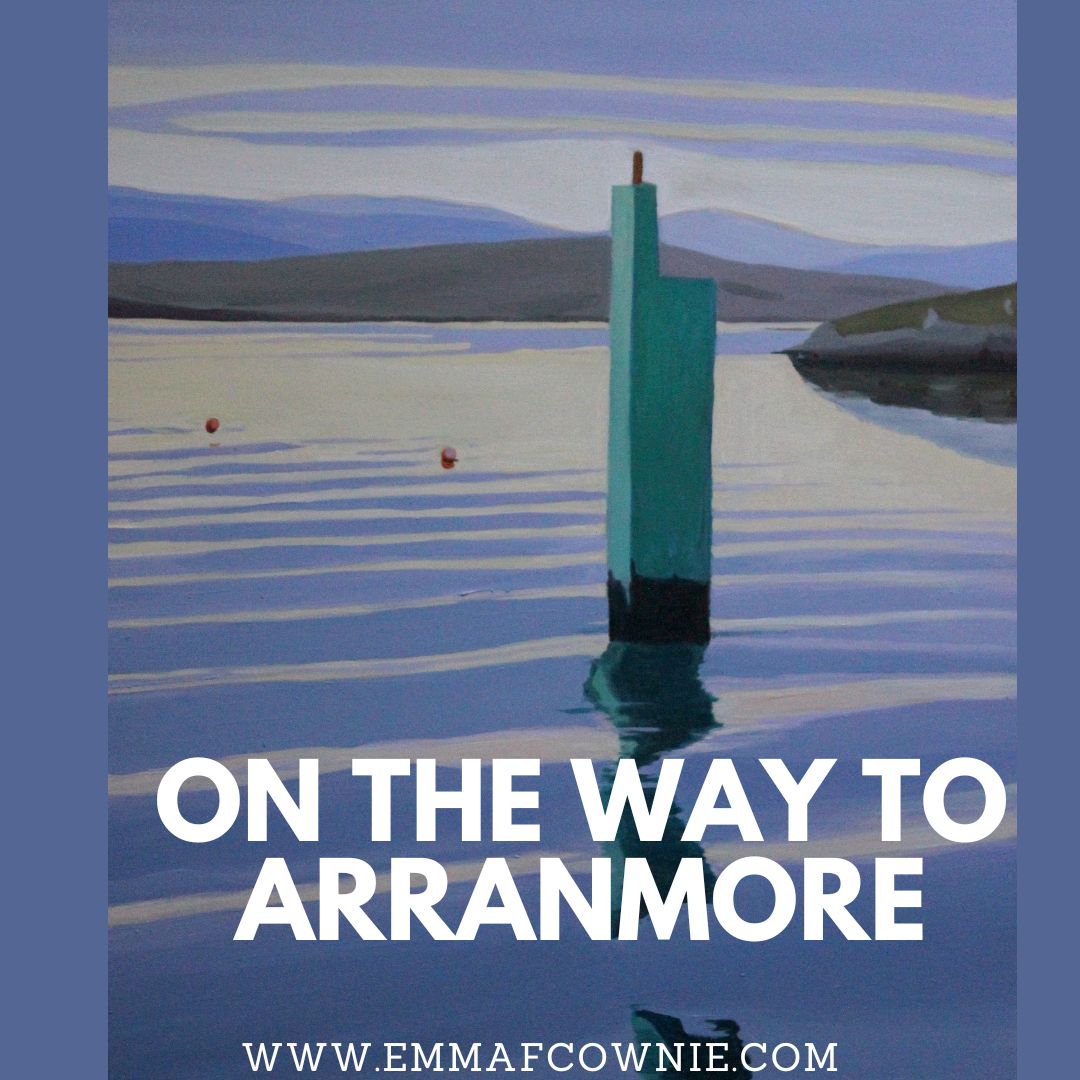
Looking through my recent work, I was surpised to realise that I haven’t painted many paintings of Arranmore Island in the last couple of years despite visiting the islands in the summer. So I have put that right with a series of new paintings.
As always I am entranced by the journey to and from the island. You can read my short History of the Island here
Arranmore is lucky to be served by two ferry companies. There is The Arranmore Ferry (Blue) which is based on the island and Arranmore Ferry (Red) which is not. Yes, I know the names are almost identical, just a small matter of “The”. They both offer a fantastic 15 minute journey from Burtonport (Ailt An Chorráin) to Arranmore Island. On a calm and sunny day the view on the crossing are just heavenly. Sometimes there are dolphins too.
Map of Arranmore and the coast off Burtonport
The ferrys sail through a narrow passage past a scattering of islands on the way to Arranmore.
Rutland Island (Inis Mhic an Doirn) lies between Burtonport and Arranmore, Donegal. William Burton Conyngham (a local landowner for whom Burtonport takes its Anglised form) had warehouses, a street of houses, a post office and a school built c. 1784 to capitalised on a the abundant herring fishing. Unfortunately, the herring disappeared very early in the 1800’s and the station fell into disuse. The island was inhabited until the 1950s. These are the remains of the fish factory and landing stage on Rutland Island.
Opposite is Inishcoo Island with Mount Errigal in the distance peeping out from under the clouds. The jetty in the left hand corner belongs the magnificent Inishcoo House (see painting below)- once a coast guard house, built in the C18th.
Inishcoo House, Ireland (SOLD)
There are several tiny holiday homes dotted across the islands (and cows)
Ferry Home (Arranmore, Donegal) by Emma Cownie SOLD
A you can see the views are quite idyllic. Whether from the ferry or from the island. To be honest, I wish the ferries were like the Circle Line on the London Underground, where you can ride the tube rround and round (it takes and hour and an half apparently, I have never done it) and you could ride them back and forth to the island all day!
Washing Line, Arranmore by Emma Cownie SOLD
Some more recent works….
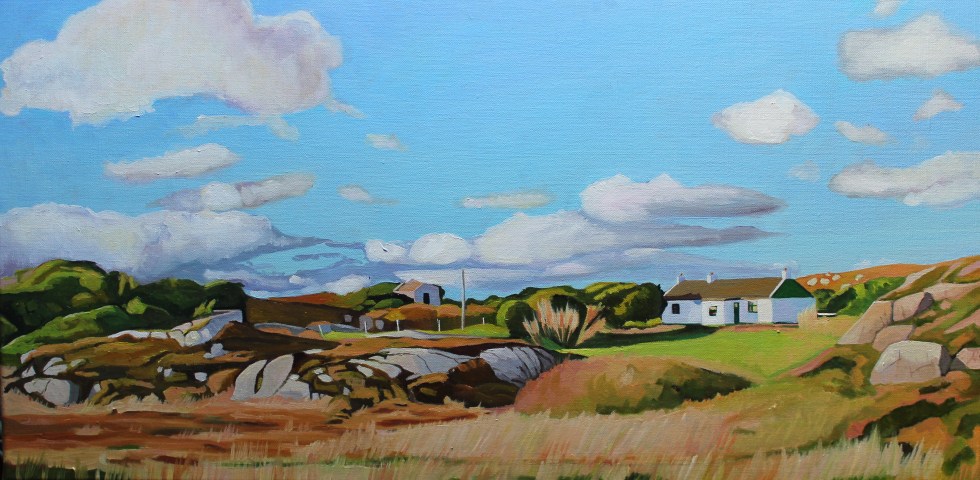
A Home on Arranmore, West Donegal, Ireland by Emma Cownie
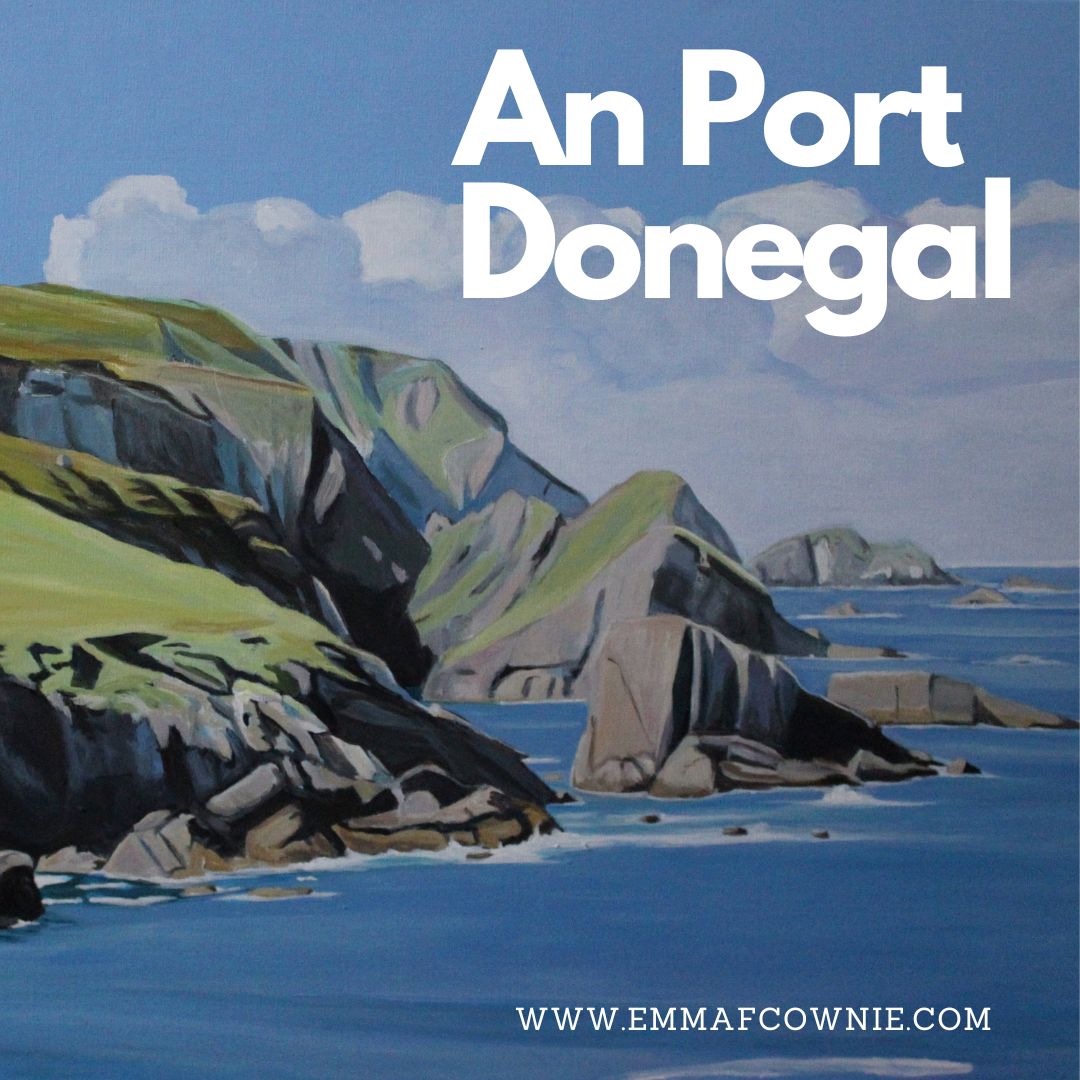
An Port has loomed large in my imagination for a long time. It’s very remote and quite difficult to get to. To reach it, you have to drive down a very, very long single track road (it’s about three miles but it feels longer) on the way to Glencolmcille. There are plenty of sheep and only a few people.
The Road to Port
At An Port there is a small quay and a tiny deserted fishing village which looks out over a small bay, surrounded by cliffs and truly massive slabs of rocks and sea stacks. Its one of those landscapes that you imagine can be found all along the west coast of Ireland but is actually unique. When I visited Texas in the late 1990s I thought it would all look like Monument Valley, thanks to those John Ford films. I was surpised to find it was pretty flat.
An Port, Donegal – photo credit Emma CownieAn Port: Photo credit Emma Cownie
The village was still inhabited in the 1920s. The hillside is littered with the remains of the stone houses
Remains of houses at An Port: Photo credit Emma Cownie
There is one inhabited house, now an AirBnB property. You can see it on the hill behind me in the photo my husband took of me (below). This was Annie McGinley’s family home.
Me at An Port
I first heard about Port in 2018 from a TV programme about the famous American landscape artist Rockwell Kent and his stay in Donegal the 1920s. Rockwell Kent is probably best known today for his illustrations for Moby Dick.
Moby Dick Illustrated by Rockwell Kent
Unfortunately Kevin Magee’s film (in Irish with subtitles) “Ar Lorg Annie” or “Searching for Annie” is no longer available but you can see a short clip on Youtube here. A friend of Kent’s, Rex Stout, had funded his trip to Ireland. He paid him $300 a month on the condition that he had the choice of two painting when he got back. This is one of them in California, “Prince Charles’ Cove”.
Rockwell Kent and his second wife Frances Lee Higgins (they were on honeymoon) spent several months in the near by valley of Glenlough on a farm belonging to farmer Dan Ward. Kent stored many of his paintings back at Port, in the home of Annie McGinley, who modeled for him. Her she is.
The original “Annie McGinley” now rests in a private collection in New York,
Rockwell Kent returned to Donegal, 32 years later. He had wanted to buy Dan Ward’s farm but it had already sold to another farmer. Instead he sought out ‘this singularly lovely teenage girl with whom I had danced many a jig’ and found her in nearby Crobane, married, midddle-aged and ‘broad-beamed’. She had had 14 children, 12 had lived.
Annie McGinley and Rockwell Kent in 1958
Rockwell went to find Annie’s long abandoned cottage in An Port where in 1926 he had dried his Donegal paintings. It turned out to be the only structure still standing, barely supporting the weight of an overgrown thatched roof, a year or two from dereliction. ‘This house, we thought, we ought to buy and fix and have as a place to come every year …’ but he didn’t.
If you look on the left hand side of my painting “An Port” (below), you will see tiny fence posts along top of the cliff. They help give a sense of scale of the huge cliffs and rocks. I can’t remember who first described this landscape it as the “land of giants”but it truly apt.
It is hard to do justice to this incredible landscape but I think that Rockwell Kent’s paintings do. He really capures the majesty and warm colours of Donegal. He also excels at Donegal skies and light. I am really in awe of him.
I wish I could see the original paintings but this is very unlikely. It seems that none of Rockwell Kent’s large paintings stayed in Ireland. Most of them are either in the USA or in Russia. But that’s another story.
Autumn brings incredible colours to the west coast of Ireland. As the grass and bracken die off, they turn a fantastic shade of orange and pink. The pink granite rocks that litter the landscape accentuate the warm colours. They have provided me with much inspiration for my landscape paintings of Donegal, Ireland.
This series of paintings has been inspired by the Old Railway Walk which starts near Burtonport, near Dungloe in Donegal. There are no railways in Donegal anymore. There used to be. The line to Burtonport was built in 1903 as a joint venture by the British government and the Londonderry & Loch Swilly RailwayCompany to attempt to alleviate poverty in north West Donegal.
Steam trains at Burtonport, Donegal
The trains used to carry fish from the port at Burtonport in Donegal to Derry, in the neighboring county. It also carried many seasonal workers to and from Derry and Scotland. After 1922 the line crossed from one country into another; from the Irish Free State into Northern Ireland.
Railways in 1906: Credit: Donegal Daily.comGweedore train station (Mount Errigal in the distance)
In the 1940s, however, the Irish government decided to close down the railways in Donegal. I have never really found a clear explanation for why this happened but I am going to assume that the cost of running the line was an important factor. There were also concerns about the safety of the line.
Owencarrow Viaduct, Donegal
In January 1925 disaster had occurred on the at theOwencarrow Viaductwhen winds of up to 120mph blew carriages of the train off the viaduct causing it to partially collapse. Four poor souls lost their lives.
Owencarrow Viaduct
After the Second World War, the Irish government presumably decided it would cost too much to continue the maintenance of the line and it was closed in 1947. The Burtonport-Gweedore section closed in 1940. There is a great graphic on the Donegal Daily hereillustrating the shrinkage and disappearance of the railways. Donegal became a very remote part of Ireland, with no railways and no (still) motorways. Communication with the area improved in 1986, however, whenDonegal airportstarted operations.
It seems that for half a century nothing much happened on the old railway line. In 2009, however, there was a heavy snowfall, and some of the old railway line was cleared to access water mains that needed repairing. The remaining section was later cleared and gradually developed as a walkway with the support of the local community. A massive effort has gone into creating this beautiful and peaceful walk.
The Burtonport Old Railway Walk
Here are some of my paintings inspired by my husband Seamas’s photographs of the railway walk.
There are many features of the old railway remaining which you can view along the way such as stations, gatehouses, accommodation crossings, lots of pillars, cuttings, embankments, a bridge and rusty gates. There are also lots of shelters for walkers to hide from passing showers to use.
dav
Photo credit: James (Seamas) Henry Johnston
Youtube video- Siúlóid an tSean Bhóthar Iarainn—The Old Railway Walk by Ralph Schulz.
Find out more about the Railway Walk by clicking on the links below:-
Getting here: From Letterkenny and Dungloe – SITI Rural Transport – Tel 0749741644. From Dublin – Bus Eireann@ www .buseireann .ie From Scotland & Northern lreland – Doherty Travel (00353) 749521867
The ferry to Tory Island runs all year round. In the summer months (June onwards) there are extra sailings. We had decided to get an early boat as Seamas, my husband said the weather forecast was for sunshine in the morning, cloudy around midday and then sunshine in the afternoon. I think we are learning to take weather forecasts for Donegal with a pinch of salt. Some forecasts for “cloudy” days translate into blue skies with a few clouds, others into a damp drizzle. We were optimistic but when we arrived at Magheroarty Pier it was overcast. Once we had parked in the generously sized car park, we had to hurry to get the boat. Magheroarty Pier is tidal, so sailings have to leave on time, time and tide wait for no man, etc.
Car at Magheroarty (Muckish Mountain in distance)
We were not quite the last people on the boat but all the downstairs seat were full so we stood on the top deck, me leaning against the body of the ship and Seamas found a large metal box to sit on, the dogs sat close to him. We could feel the movement of the boat as soon as the ferry left the shelter of the harbor at Magherorarty and at times we had to hang onto a metal grill that housed a lifeboat ring.
Queen of Aran – Ferry to Tory
Two men who were standing nearby to us were talking to each other in Irish. Tory Island is probably the strongest Irish-speaking area in the country. It sounded a bit like a Scandinavian language at times – a third Irish speaker stood to one side, listening. They each looked very different from each other in appearance, one was very blonde, one was dark-haired and the third had white hair. The dark-haired man had freckles and light eyes. It is a “look” I have seen a lot in Donegal, Seamas says it’s common in County Derry too.
Map of Tory Island
The trip took just under an hour. The motion of the boat made me feel quite ill by the time we reached firm land. I think being on the top deck made me feel the motion of the baot more than if I have been on the lower deck. It took me at least 30 minutes to shake the feeling of a dodgy stomach. Someone, later asked if we had felt ill on the crossing, and laughed when I said I had. It’s not unknown.
One of the tors of Tory Island
Tory Island lies 8 miles off the coast of Donegal. The origin of the name of Tory Island (Oileán Thoraí in Irish), isn’t universally agreed on. Yes, the word Tory may come from from the Middle Irish word tóraidhe; modern Irish tóraí; meaning a robber or bandit. Ever wondered why one of the oldest British political parties, the Conservatives, are also known as the “Tories”? The term was originally a term of abuse and meant “an Irish rebel”. The insult goes back to the era of Oliver Cromwell’s brutal campaign in Ireland when a band of Irish guerilla fighters was known as Tories.
Another explanation for the name, however, is that it may mean the “island of Tors”. The shape of the island from a distance is a tower, and its northern coastline is peppered with massive tors. This seems just as likely. I suspect that people, however, prefer the story of the name meaning Pirate Island instead of the Island of Tors as it’s more exciting. The remote location of the island has meant that the islanders have had (and continue) to rely on their ingenuity and resourcefulness.
An Baile Thiar
They have lived on the margins of the so-called “civilized world” and kept to their own rules and customs, which were not necessarily those of the mainland. Famously they refused had fallen behind with their rents and rates and a British gunboat, HMS Wasp, was sent in 1884 to forcibly collect the arrears and evict the tenants. Luckily for Tory, it hit a reef near the island and sank rapidly (not so good for the 52 who died). The locals put this stroke of fortune to the power of their cursing stone! This event is one of many Donegal stories about the spooky powers of Tory Island. You can read more in the National Folklore Collection UCD Digitization Project.
One custom that marks Tory as different from Ireland is that they have a king. It’s not a hereditary position, rather one chosen by consensus as a leftover from the days of Gaelic chieftains. Patsy Dan was asked to become king by the children of the previous king Padraig Og Rodgers in the 1990s.
King of Tory (from Wikipedia)
He was a talented musician and painter and acted as a very successful ambassador for the island. At a young age, he had befriended English artist Derek Hill, who regularly painted on Tory and he helped set up a gallery on Tory, where island artists sell their work. He was clearly an energetic man, as was known for personally greeting all the visitors to the island as the ferry arrived from the mainland. He apparently made a point of shaking hands with visitors and saying “Welcome to my island.”
Sadly, Patsy Dan Rodger, died last year and now rests in the churchyard. I saw his grave decorated a wooden cross and with stones around it. I did not take a photo because it felt like it would be an intrusion on the island’s grief. The island is without a king for the time being.
The island itself is a strange mix of very old and modern. People have lived here for over 4500 years. There are a few old cars and vans driving back from the harbour after picking up stuff at the pier.
Tory feels a long way from the mainland, although you can see the coast of mainland Donegal when the weather is clear. It is less than 2 miles long and only half a mile wide. My overwhelming first impression (once the cars and vans had driven off) and we had walked out of the tiny West Town (An Baile Thiar) was of birdsong.
Sparrows, larks and other moorland birds just singing their hearts out. The landscape is full of bold little brown birds, pipits and larks. Some of them even come near to you and sing, possibly as a challenge. We walked along a single tracked road eastward towards the other settlement or “clachan” on the island. We passed a Second World War torpedo that had been painted bright red and erected by the side of the road.
Tory Island (mainland Donegal in the distance)
I marveled at the ground on Tory. To the south of the road, it seemed to be a dried bog and the north it was very stony ground, reminding me of a hardcore carpark. How had anyone, let alone over 200 (at one point it rose to 400) islanders managed to eek a living from such a tough terrain? I have looked at the small stony fields in Galway and thought how tough life must have been for the farmers, but this was much worse. The potato was a versatile crop and remarkably the blight that brought the Great Hunger to mainland Donegal, did not reach the island. Of course, the Tory islanders did not live from farming alone, they were also fishermen and brewers of poitin whiskey.
There was a group of German tourists ahead of us (they all seemed to be wearing blue jackets for some reason). They veered off the road to the left towards what looks like a dip in the earth. We followed them, so see what they have gone to look at and discover that is a massive hole with a cave down to the sea. I would not have guessed this was here from the road.
Cave to the sea
We carried on up to the northern edge of the island. What a view! I am not good with heights as the best of times and I felt quite ill looking over the edge. I lay down on the grass to take photos. The reddish cliffs and cream coloured sea stacks were stunning.
Tory Island Sea StackTory Island
We spent a lot of time walking along the cliffs and back again, taking in the views.
North Coast of Tory Island
There were sea birds flying and squawking. Lots of gulls and razorbills and one lone puffin to be seen. The birds of Tory are the highlight of the visit for me.
We then find the weather has closed in on us. We could see the mist and cloud descending on the lighthouse to the west of us, at the other end of the island. I’d foolishly hoped it would stay on that side of the island!
On the island, weather changes from moment to moment. I am reminded of the sign outside Derek Hill‘s house warning that “Winter weather can happen at any time in Donegal”. Yes, it can.
Mainland Donegal has vanished in a cloud of rain. We get increasingly damp, but not quite soaked through. There’s no shelter anywhere. No trees. No bus shelters (what an utterly daft idea, here). We have a lively discussion about the conditions (I keep thinking of that weather forecast of sunshine in the afternoon) and I optimistically suggest that it will pass soon enough. I am encouraged by the fact that the group of German visitors (off in the distance) haven’t given up and are scaling the heights of Ardil Iril, and are looking over the cliff. So we carry on and by the time we reach Port an Duin, which has a small concrete pier, the rain has halted.
Old winding gear at Port an Duin
We sit down on some rocks and eat our sandwiches and crisps. The dogs get some too and a drink of water from their bowl that I am carrying. The weather brightens up considerably as we climb up to the highest part of Tory. This is Dun Bhaloir (Balor’s Fort), which is an early Iron Age Fort, which is covered in piles of massive rocks, which were part of the defenses. Balor apparently was a fearsome cyclops warlord who could kill a man dead with a single glance of his evil eye!
On Dun Bhaloir, Tory
From here we can get a view of the rest of the island snaking off to the west. It has brightened up now and we take off our coats. The dogs are getting hot and panting.
Tory Island From Dun Bhaloir
There’s a discussion about the return time of the ferry as Seamas’s smartphone has died (and I don’t have one). We’d asked about the times when we got off the ferry but after the long walk we aren’t sure of what we were told, was it 2.30 or 3.30? We could see the ferry heading back to the mainland at 1.30 so I reason that it will be at least 2 hours before it returns. However, we would easily be able to see it returning so we would just need to keep an eye out for it. So we started plodding back to An Baile Thiar and the pier. We were all very tired now. So we start the walk back to the harbour in An Baile Thiar.
Bench on ToryHome maintenance on Tory
We made it back to An Che (the pier) and could see the approaching ferry in plenty of time. I got some extra water for the dogs from a tap in the parish hall. This time we got seats on the ferry so I don’t feel queasy on the journey back. The German tourists are also on the ferry.
As we were coming towards Magharoarty harbor, three dolphins surprise us all appearing in the sea alongside the ferry. I saw a flash of strong blue-grey bodies and then the three of them arching in and out the water behind the ferry. All the passengers on the boat were very excited (as was I). These are my first wild Donegal dolphins. I spend a long time looking at my photos afterward, reliving the experience. I wish the photos were better.
Three dolphins from a distanceCloser Up: Donegal Dolphin
I left with an impression that Tory wasn’t like the other Donegal islands. It felt a lot further away from the mainland for a start. Life was (and probably still is) tough here. When the rain covered the island we might as well have been a thousand miles from the mainland. I know that is true of all islands to some extent, but you really felt it here. We visited in summer, I can hardly imagine what it is like in the winter, surrounded by the raging Atlantic Ocean. I didn’t get to speak to anyone, beyond a “hello” but the islanders are very clearly very independent and resilent. Looking over my little guide book to Tory I realise that there was lots more to see on the island, that we didn’t have the time or energy to see, namely the lighthouse on the west end of the island, Derek Hill’s painting hut, the Art Gallery, or the round tower or the curious T-shaped “Tau” Cross.Next time, I visit, I will bring more sandwiches and a hat in case it rains again.
I love painting the coast, particularly if it’s rocky. Owey Island, lies just a short distance off Cruit Island near Kincasslagh in west County Donegal. Strictly speaking there have been no permanent residents since the 1970s. [Photos from http://www.welovedonegal.com/islands-owey.html]
There is no electricity or mains water, yet plenty of people visit and many visit during the summer months. If you want to visit, there is a ferry service run by Dan the Ferryman.
View of Ireland From Owey Island (Ian Miller)
The name Owey, in Irish Gaelic “uaigh”, means cave. The island is a cavers, kayakers and rock climbers’ paradise.
The island is encircled by massive rock stacks and it also has an underground lake. As I am cave-phobic this video is the closest I will ever get to it!
I am fascinated by rock stacks and Donegal has plenty of them. I like to think of how these massive structures have gradually been eroded by wind and waves over thousands of years, forming first sea arches and then stacks.
I also love the colour of the rocks and the wild Atlantic Ocean. The ocean is incredible shades of blues, greens and mauves, mixed in with browns and frothing surf. Although I feel I am getting better at representing the layers of Donegal sky and clouds, but capturing the movement of the seas is still frustrating me.
Over to Owey Island (SOLD)
If you to find out more about Owey Island see Ian Miller’s Unique Ascent’s website for detailed descriptions and incredible videos.
Just thought I’d add a post script about the “Holy Jaysus Wall”. I think if you look at photo of it you will understand the name. It makes me feel ill just looking at it!
Holy Jesus Wall
SONY DSC
Irish climber and alpinist John McCune, climbed it in 2014.
Here’s a fascinating film clip from the 1970s about Owey Island’s postman, Neil McGonagle, who used to visit the dwindling population on Owey Island by small boat four times a week to maintain the island’s contact with the outside world.