I have tried several times this year to write more about developments in AI (and Art) but I keep giving up because I keep getting sucked down “rabbit holes” and I find it hard to see the wood for the trees. OK here goes – I dislike and distrust AI. It’s overhyped. The visual stuff looks horrible. It’s dangerous. Unregulated it is going to cause a lot of damage in our societies/brains/education/communities/environment. I think that is the nub of it. We are told that our glorious AI-powered future is imminent, yet what we’ve actually got is unprofitable, unsustainable generative AI that has an unassailable problem of spitting out incorrect information. Its an expensive dead end.
If you would like to read a more articulate assessment of the current state of (digital) economy I can recommend Ed Zitron article on the Rot Economy – its in a slightly different league to the Cory Doctorow’s Enshitification explanation of why platforms like Facebook, Instagram, Pinterest and Youtube used to be good to use but are now annoying and almost impossible to use. Can you find the video you just watched on Youtube? Me neither. I have struggled with WordPress ever since it “updated” itself to include all sorts of AI features I will never use. My Windows 11 PC isnt much better. It forever flips a “news” screen in front on my eyes in the midst of me doing something else, like typing a blog
Ed says “Things are being made linearly worse in the pursuit of growth in every aspect of our digital lives, and it’s because everything must grow, at all costs, at all times, unrelentingly … Our digital lives are actively abusive and hostile, riddled with subtle and overt cons. Our apps are ever-changing, adapting not to our needs or conditions, but to the demands of investors and internal stakeholders that have reduced who we are and what we do to an ever-growing selection of manipulatable metrics.” I was delighted (and not surprised) that 95% per cent of the more than 10,000 people in the UK who had their say over how music, novels, films and other works should be protected from copyright infringements by tech companies called for copyright to be strengthened and a requirement for licensing in all cases or no change to copyright law. AI companies have no right to our work.
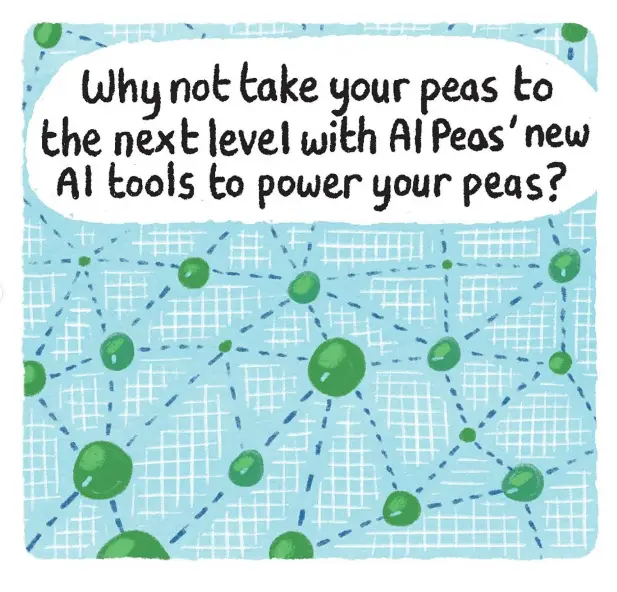
I have decided to give up on writing about AI and so instead I will you with the best commentry on this current state of madness I have come across: AI Peas by Stephen Collins.
I am delighted and honoured to have been interviewed by Aaron S (@aaronsehmar on Instagram) for his Flying Fruit Bowl podcast. If you haven’t come across his podcast and website check it out – he’s a thoughtful and insightful interviewer who is a very talented photographer in his own right. He’s interviewed a diverse range of talented artists. There is a lots to discover. It’s like a breath of fresh air.
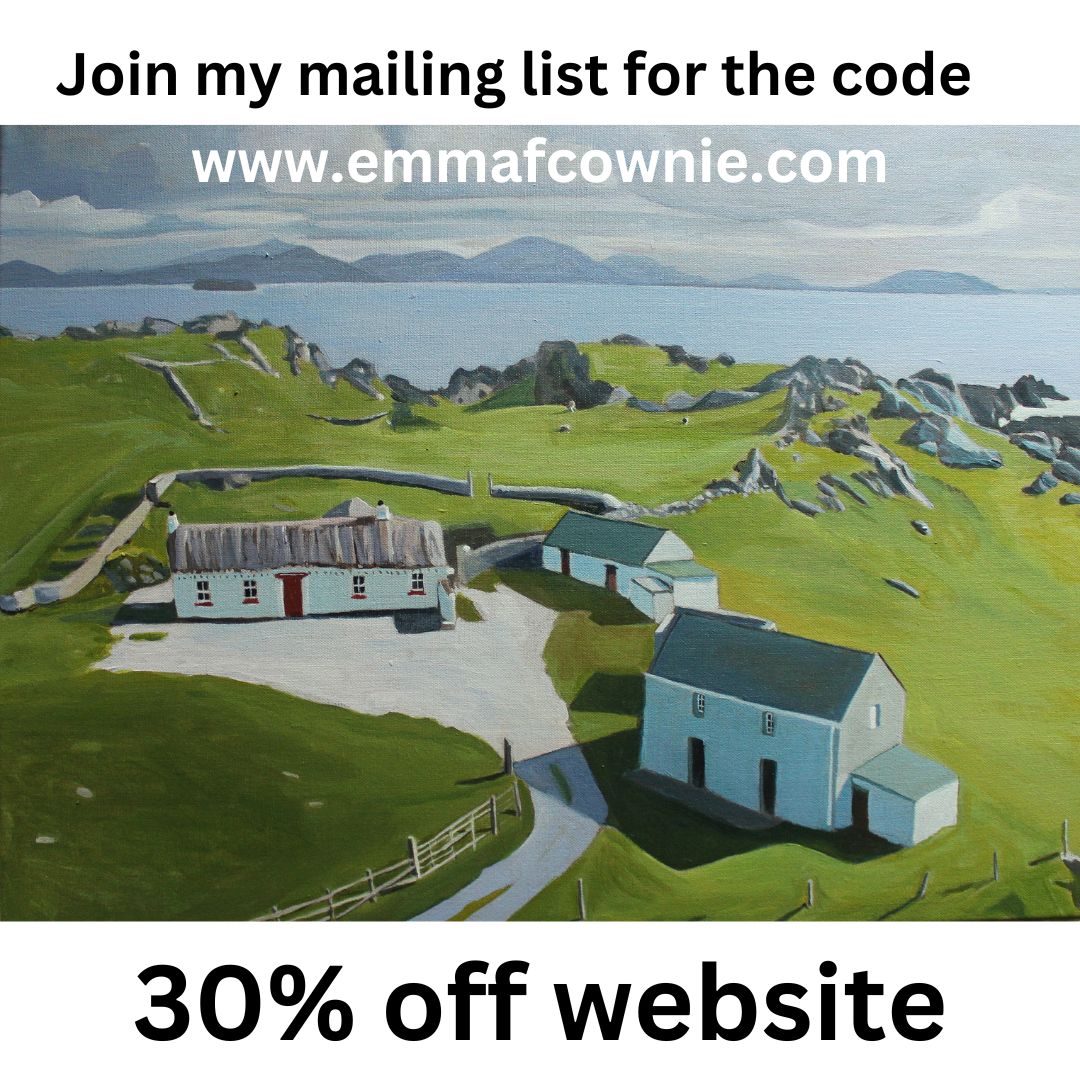
To Celebrate the New Year I am giving 30% off all work on my website – to get the discount you have to enter a code at the checkout. Where’s the code? Join my email list and it will be sent to you, automatically. The sale ends on 15th January.
View from the Pier (Portnoo)-Emma Cownie SOLD
If you have already joined my mailing list and haven’t had my latest newsletter with the sale code check your SPAM folder.
We all want to be seen. I want people to see my work. I also want people to see the process behind that work (have you listened to my recent radio interview yet?) I also want to maybe inspire and/or encourage people to undertake their own creative journey. There are bumps in the road, however. Making a living in the creative industries is difficult and uncertain at the best of times.
I recently wrote about how Generative AI was scraping/stealing artists’ copyrighted without permission or recompense. Its not clear how the rise of AI will change things. It has already been disruptive for many of those in the media industry. The protective tools such as “Glaze” are only short-term fixes, if you can get them to work. But that disruption may also create opportunities for some – its hard to tell.
Many people aren’t very interested in AI but wonder why they can’t get speak to a human in customer services but only an online bot.
As an artist who sells much of their work directly, I am reliant on the internet to get my work “out there” to as many people as possible. For many years I have used social media sites like Instagram, Facebook, Twitter/X, Pinterest in addition to my own website (with blog) as well as a mailing list. I have posted my work on a handful of online Galleries, Artfinder,in particular. To be honest, I don’t know what works.
I used to assume that everything did a bit of something. Lately its become apparent that some are doing very little indeed. A couple of years ago my instagram posts used to regularly get over a thousand likes, these days I am lucky to get over two hundred. I have pretty much given up on Twitter/X now from lack of engagement. I am wondering whether Facebook is worth the effort too. Since the arrival of TikTok in 2026, the short form video has been given priority by “the algoritim”. Not great news for camera-shy artists, like me.
What is apparent, is that social media sites are like walled gardens, where leaving is discouraged. Posts with external links are downgraded by the site and search algorithims. Facebook and Instagram are both owned by Meta. These walled gardens can and do change their rules for who get seen and who doesn’t.
A rather dated illustration of “Walled gardens”
“Enshitification” (Or – Its all going to Hell in a hardcart)
This is something that what Cory Doctorow calls the “Enshitification” of the internet. He points out that “Once upon a time, Facebook and Twitter showed you stuff from your friends and followers; now you get a torrent of things that the platform’s algorithms think might increase your “engagement”. Doctorow says “First,” he writes, “they are good to their users; then they abuse their users to make things better for their business customers; finally, they abuse those business customers to claw back all the value for themselves.” You do this by offering “free” services (Google, Facebook, Twitter, YouTube, Instagram), or loss-making reduced prices (Amazon). Then once you’ve got them locked in, you turn them into a captive market for your real customers – advertisers and vendors. And once you’ve got them locked in then you’re in a seller’s market – and have a licence to print money.
Twitter/X and Facebook have made it harder and hard to post and see external links to websites and publications. Many users have left the site. Opinions and comments used to be reinforced by reptutable publications. Partly as a result of this policy many online publications that people used to link to in their twitter posts have seen a big drop in traffic.
The Death of Google
The rise of AI is another threat to the stablility of online ecosystem. The death of Google has been predicted for many years now (at least since 2018). Google dominates internet search results so much that for many people it is the internet. These days, however, your Google search is likely to be swamped in link-farms, clickbait, long-form articles with thousands of words that ultimately say nothing, those weird ads about cars/fridges/hots tubs being “practically given away”. In fact, tons and tons of ads.
AI Overviews
In order to try and weed out some of the spammy stuff, Google recently introduced something called AI Overviews. maybe you have noticed it. Maybe not. The tech company unleashed a makeover of its search engine in mid-May that frequently provides AI-generated summaries on top of search results – it used to use Wikipedia for its summary with a list of links below. That was uncontroversial.
Google’s new AI Overviews saves you the effort of clicking on links by using generative AI to provide summaries of the search results. So if you want to know how to make cheese stick on your pizza – it will save you the bother of clicking on a receipe site. Google want to be the search and answer engine. However, when someone asked Google to suggest what to do if cheese is not sticking to pizza, it claimed that its AI suggested adding non-toxic glue to it! This was based on an 11-year-old comment from a forum site called Reddit that has recently done a deal to allow AI to train on content.
AI can’t tell fact from fiction, or from jokes or sarcasm. This is causing big problems for AI – a response to a advise on depression included “Jump of the Golden Gate Bridge”!
AI’s Advice on identifying edible wild mushooms was worryingly vague, emphasising looking for those with solid white flesh — which many potentially deadly puffball mimics also have. It has been said that “pharmaceutical companies aren’t allowed to release drugs that are harmful. Nor are car companies. But so far, tech companies have largely been allowed to do what they like Google is now making “more than a dozen technical improvements” to its artificial intelligence systems! It is important that Google maintains user trust. Other browsers are available. I have started to use one called Brave, there is also DuckDuckGo, Firefox and Microsoft Edge.
Google Zero – what does it mean for the artist blogger?
Google’s summaries are designed to get people authoritative answers to the information they’re looking for as quickly as possible without having to click through a ranked list of website links. This desire for Google to become a search and answer engine is called “Google Zero” by Nilay Patel, editor-in-chief of the Verge Magazine.; when Google Search simply stops sending traffic outside of its search engine to third-party websites. That possibly means my website, or your blog. Independent review sites have been feeling the effects of the changes.
There’s a review website called House Fresh, who review air purifiers that they have personally tested (instead of recycling PR puff from the manufacturers). Since 2023, they have seen their reviews ripped off by bigger websites and web traffic to their own site decimated. The teething problems of Google Overview may see it being ditched by Google. They have a track record of ditching apps that were’t immediately successful – you can read a long list of them here. Remember Google Street View? Gone. Google Hangout? Not Really. Google My Business? Yes. That’s gone too.
What to do?
So whilst Google Overview maybe gone very soon, AI wont be going anywhere soon. Too much money has been spent on it. The big tech companies are desperate to keep ahead in the innovation race. They are also desperate for web-domination, regardless of the collateral damage. Yes, that maybe your amazing following on Youtube, Facebook, TikTok that gradually loses traction.
Artists may follow the latest advice to make reels, or stories (how many daft videos on Instagram reels have I seen of an artist turning around to “reveal” their latest work) and it may work for a while. All these innovations are designed to please the “algorithim”. Not the audience. Certainly not the artist. The goal posts keep moving. Once it was stories we had to make, then reels. What next? It’s exhausting. It’s a bottomless pit that sucks in a lot of your creative energy. I am an artist and I want to paint. Not perform.
The moral of the story is don’t build your house on someone else’s land. I have known this for sometime. Several years ago, Facebook unexpectedly deleted my Emma Cownie Artist page without warning. I set up a new one (two actually, one also to link to my Instagram account) but the follower numbers have never come close to the numbers or engagement of the original page. The waters closed in pretty easily.
I redoubled my efforts with my own website (with this blog) and a mailing list and my website numbers and views have steadily grown. You have to build an audience.
I looked at a blog I wrote in 2019 when I first started my mailing list and most of the suggestions I included (but not necessarily followed) still look good to me. There is a lot of cross over with my blog on this website but its not identical.
I write high-quality, carefully researched content. I write about my new work, sales and the inspiration behind my paintings i.e. the local history of the the places I paint and the process of painting – including technical stuff to do with colour, composition.
I write about the process of creativity.
I also write about the inspiration provided by other artists. I know its a cliche but I am on a “journey” but I am keen to explain what is informing that journey. Why I paint in a certain way and not another? It’s vital to keep supporters/fans engaged to maintain their relationship with you and your business. It’s all about adding value to their lives.
Apocalypse Now?
Not necessarily. So it seems that the best advice is don’t panic. Keep on keeping on and build those ladders over the walls in the walled gardens into your own garden!
The rain finally stopped yesterday morning and the temperature rose a few degrees. We just had three days of steady rain. The temperatures also went up a bit. I was amused to discover that this “event” made the news. The headline in “The Donegal Daily” an online newspaper read: “Weather- Another Mild Day in Store for Donegal”. This publication is favourite of mine. It is a heart-warming mixture of stories with happy endings (swimmers get into trouble in rip tide but they are all rescued by a passer by and a lifeboat crew), lost dogs, sport stories and local crime cases (often from two years ago).
Anyway, we felt encouraged by the dry (ish) weather to do some light food shopping in Dungloe and then drive to an Affordable Art Fair in Derrybeg, Gweedore. This Art Fair was held at An Gaillearai, which is located at Ionad Aislann, Na Doira Beaga (Derrybeg).
Entrance to Ionad Aislann, Na Doira Beaga
We have never been to Ionad Aislann before and I was very interested to see what this cultural centre was like. I know that “Ionad” means a centre of some sort in Irish but I didn’t know what the word “Aislann” meant. I tried looking it up on google translate but drew a blank so I thought it might be someone’s name. It was wrong. “Áislann” is a word derived from combining two words from the Irish vocabulary of South West Donegal, Áiseanna (facilities) and Lann (building).
Lots of Parking!
The centre also houses, amongst other things, a public library and nursery. When I looked it up here I discovered that the building hosted much more than that: a theatre/cinema, sports hall, meeting rooms, local history centre, PC centre, a gym and a tea room! This cultural centre was set up in 1992 expressly to cater for local people as well as for visitors to the area, including the many artists like me who come to live here. It was also meant to help strengthen bonds within the local community via cultural/artistic pursuits and leisure activities.
Affordable Art Fair Poster
The Gallery is large and airy and there was plenty of room for visitors and artists. Everyone was wearing masks too which was reassuring.
Inside the Art Fair
Some of the artists showing include (in no particular order); Ian Gordon, Cathal MacGinley, Peadar McDaid, Heidi Nguyen , Mary Toland, Gay OToole and Nora Duffy. We had the pleasure of meeting and chatting with two of the exhibiting artists, Heidi Nguyen and Gay O’Toole. We met Cathal Mac Fhionnghaile/Cathal MacGinley when we visited Inishbofin last month. Here is a selection of the work on display.
Gay O TooleWork of Gay O Toole
Heidi NguyenHeidi NguyenHeidi Nguyen
Cathal Mac Fhionnghaile
Cathal Mac Fhionnghaile
Cathal Mac Fhionnghaile – we bought the middle one!Ian GordonIan GordonMaura McGlynn
Nora DuffyNora DuffyNora Duffy
Mary TolandSarah Lewtas
Karol Mac Geirbheith
Karol Mac Geirbheith
Karol Mac Geirbheith
Peadar McDaid
Peadar McDaid – we also bought the middle one (top row).
As our house is already over flowing with paintings we generally don’t buy other people’s art (although I have one painting by Welsh landscape artist, Warren Heaton, in the bedroom) but we changed the habit of a lifetime yesterday and bought two small paintings at the art fair. I know that Séamas wanted to buy more. We left the two paintings on the wall with red stickers next to them (hoping that sign of success would encourage more sales) and will go back on Thursday to pick them up.
After so long in lockdown and avoiding people, it was really great to go out somewhere and to meet new people. Ionad Aislann certianly did its job of helping to strengthen the bonds between local community via cultural/artistic pursuits and leisure activities. It was well worth a visit and if you are in area I would highly recommend stopping by. The Art Fair is on for several more days, from 12 to 5pm until this Thursday 14th October 2021.
Here’s my summer newsletter. I am shutting up shop for a month from 20th June to 20th July. All going well, we will be safely installed and open for business (online at least) in Donegal by mid-July. I am already longing to get back to my painting routine. I can’t quite believe that after being ground so long by my broken leg and the pandemic that we will actually move house/studio to another country by then. It’s a huge step! Fingers crossed it all goes smoothly!
I was delighted to be asked to do an interview with Toby Buckley for the Net Gallery about selling art and marketing. It was published recently on the “Artist N Virtual” section of their site. I thought I would post it here too:-
With successive lockdowns resulting in the closure and cancellation of many of the galleries, markets, festivals and art fairs that artists rely on to make a living, 2020 and 2021 have seen many artists trying their hands at online sales for the first time. To help anyone taking a jump into the online marketplace, we spoke to Swansea- and Donegal-based artist, Emma Cownie, to get some expert advice.
Emma’s distinctive oil paintings have featured in exhibitions around the UK and are even available from lifestyle giants John Lewis, but she doesn’t rely on these outlets to get her work out there. Spending “at least 50%” of her day marketing, Emma mastered the art of online art sales long before lockdown, selling over 200 pieces, originals and prints (many of which went directly to collectors) in 2018 alone.
TNG: How did you come to settle on your current sales methods?
Emma Cownie (EC): My original sales methods came from the idea of being a “creative entrepreneur” which meant involving collectors and followers in the creation of my work. I did this mainly via blogs which described the creative process, from initial thoughts, going to actual locations, images created, then the painting process, right through to descriptions of the art when placed online. This allowed followers of my work to have an emotional stake in my work, to be part of its creation.
I have retained collectors from this formative period. It has always been important to bring followers with me on a creative journey, so that they are part of the process, buying one’s work, encouraging me as an artist via comments, likes and support. They are part of the process… Art is not created in a vacuum, and shouldn’t be sold in one either. This is especially true when the places I paint, as landscape paintings, have personal attachment to followers and collectors also. In fact, they often purchase work of places close to their heart. I like to blog about work and my inspirations even today. Art can be remote sometimes so I feel it should instead gather people in.
TNG: How can an artist make the most of social media to boost their sales?
EC: Social media is essential to boosting sales, to the uploading of new work and to the celebration of new sales. It keeps collectors and followers up to date on your artistic journey and lets them share in your success and development. An artist’s promotion is often done by people on social media who like your work. It is important to engage with other artists too, supporting each other via shares, comments and likes.
Most sales are a product of a network of social interactions with supporters and it is important to keep busy online. The more one interacts, the more one’s work seems to become visible which in turn helps sales… I also use social media to engage with followers about my work and it’s creation, and this helps too.
TNG: What is the first thing you’d recommend to someone who is trying to get their online art sales off the ground?
EC: Be yourself. By that I mean, collectors are looking for original work, art they have not seen before. They are not looking for derivative work. Novelty and originality are strong selling points. So it is important to develop a style of painting that is distinctively your own.
TNG: You have written that positivity is a key factor in selling art online. Why do you think celebrating success is so important in online sales?
EC: When I post an image of a painting when it has sold, it invariably gets more likes and comments than when posted originally. Collectors and fans like to know an artist is succeeding. Collectors like reassurance about your qualities as an artist and that they are buying a quality piece that will keep its inherent value (obviously the value may also increase through time). They also like to see an artist developing and to be part of that journey in some way. Buying their work makes them intrinsic to that development.
Sales also confirm a collector’s taste in spotting talent, that it is just not them who sees an artist’s talent.
The Glynn Vivian, Swansea
TNG: What should an artist include in their bio to make themselves appeal more to potential buyers?
EC: Collectors like to know if an artist has exhibited in “brick and mortar” galleries too and whether you have work in private collections around the world. I have found that a bio should contain pertinent personal information too. In my case, I started painting in a more concentrated manner following a car crash and painting helped me through the post-traumatic consequences of the crash. Painting helps me in my daily life. Some find this inspiring and it helps them understand where I am coming from.
I also mention my own inspirations and how they shape my work and my style of painting. This also gives them insight into where I am coming from in terms of art history.
TNG: How important are high-quality artwork images, and how would you recommend creating these?
EC: It is essential to upload high-quality artwork images. It is important that the images are as accurate as possible in representing the work. Collectors are relying on this when purchasing art online and remotely… I usually photograph on a greyish, overcast day too.
I get frustrated by artists who clearly have used a flash on their camera to photograph work as it can be seen in the bleaching out of the colours on one side of the painting… If you’re not using natural light, then artificially light a painting from both sides simultaneously. If an artist does not take their work seriously enough to photograph properly it sends out a negative message to collectors.
TNG: What’s more important when pricing works – a wide range of prices to appeal to all wallets or a consistent price that emphasises the value of the work?
EC: Both. My first slogan was ‘Quality Art At Affordable Prices’ which had a range of prices from £30 to £900. As my work has sold over the last 8 years, my prices have incrementally risen. My most expensive painting is £2500, as I still want more people to feel that they can buy art, that it is not an elitist activity, everyone can and should own art as it is so uplifting and adds such value to one’s life. It is a gift that keeps giving.
I would offer a range of prices based on size of canvas used but have enough small, reasonably priced paintings to get sales going and to boost confidence. It is a great feeling selling art. It motivates you to do the same again.
It is important that prices rise in line with sales, however, and work should be priced accordingly. Make incremental changes every time you sell and prices will keep going up but not in a way that discourages sales.
Art by Emma Cownie
The two artworks below, Suburban Cottage and With a Road Running Through It, were created using a minimal style that Emma has been developing over the last 4 years. We asked Emma to tell us a bit more about each piece.
Suburban Cottage – “This is an urban minimal oil painting of Sketty, a middle class suburb of Swansea in Wales. “Urban Minimal” was a deliberate attempt to simplify my paintings in a style similar to the American Minimalists. Much of my work has been influenced by American realists and minimalists. Urban minimalist paintings were painted in accordance with my ‘rules’ for composition and painting:
No cars
No People
Bright light. There must be shadows – at diagonals if possible.
Simplified forms – there must be little detail in the final painting. I found this the most challenging ‘rule’ to stick to.
“I wanted to explore the interplay of the geometry of shadows and man-made structures – the tension between the 3D buildings and the 2D shadows, the simplified blocks of colour.”
With a Road Running Through It – “I painted a series of paintings of cottages on the island of Goal, off the coast of Donegal, Ireland. I tried to paint in a style similar to that of ‘urban minimal’. These ‘rural minimal’ pieces pared paintings down to the basics. Minimal texture, simple but interesting compositions, strong light and shadows, all intended to create a sense of the still, the quiet, a moment in life that is both now and eternal.”
Article by Toby Buckley.
To learn more about Emma Cownie and her work, be sure to check out her website: https://emmafcownie.com. You can read more of her advice about online art sales in her article on Medium.
This week I passed an important blogging milestone. On Tuesday moring I was greeted with the message that my wordpress site had passed 100,000 all-times views!
Wow!
My husband, Séamas, set up this wordpress site for me over seven years ago. When I took it over full-time in 2015, I had 91 followers, now I have just over 800! Views for my site have steadily been growing but 2020-21 was a bumper year.
Breaking my leg last year provoked the most comments by far!
Comments
I would like to say a great big thank you to every one who visited my website, bought my work, read my blogs and left comments!
It seems that I like animals almost as much as I like Art. Turns out that Wayne (Barnes) of Tofino Photography is my chattiest follower. He certainly makes me laugh! He takes wonderful photographs of the incredible wildlife of Western Canada – eagles, bears, wolves, orcas and humming birds! Take a look here.
A Candian bear catching his lunch: Image by Wayne Barnes
Thank you to everyone who has visited my website and blog. Whether you have just stopped by to look at my paintings, read my blogs but especially those who “like”, comment and buy my work. Without you I could not continue to make art.
We are all glad to see the back of 2020 but I am pausing for a moment to reflect on some of my painting sales over the year. Sadly, my accident and having my leg in a cast meant that I couldn’t get up the steep stairs to my attic studio (or anywhere else) to paint any oil paintings for over three months but things have ticked over during 2020.
I would like to say thank you Rob and David who waited a very long time in the cold with me for the ambulance to come, to the paramedics and firebrigade who got me out of the woods, to NHS staff at Morriston who fixed my very broken leg and looked after me, as well as to the Physical Therapists who gave me lots of advice on exercises over the phone. I still have a way to go!
I have to say an absolutely massive thank you to my brillant husband, Séamas, who trudged up and down two flights of stairs with trays of food many times a day (and lost weight doing so) for months. He kept my spirits up when I got frustrated and tearful. It wasn’t that often as I was so glad to be home but it was all hard work for him in the midst of a pandemic! He also kept the show on the road by packing up and arranging the shipping my paintings. He was, and remains, utterly wonderful!
Here’s a selection of some of my sales from 2020
Some of my “people” paintings sold in 2020
Some of my paintings of Wales sold in 2020
Some of my paintings of Ireland sold in 2020
A Selection of Commissions from 2020
My top four personal favourites of 2020
Owey in Late Spring – Top of my personal favorites of 2020!
Here’s to a happier and healthier 2021 to everyone!