Posted on 28 Comments

The Cottages of Donegal

Cottages of Donegal, Ireland
Donegal painting of Owey Island
Owey in Late Spring

I love the Donegal islands for their peace and quiet. Oh, the relative absence of cars, the abundance of nature but I particularly love their houses. You may have noticed that I painted quite a few of them, lately; lovely long strings of houses.

Donegal Painting of Inishbofin
Across to Inishbofin SOLD

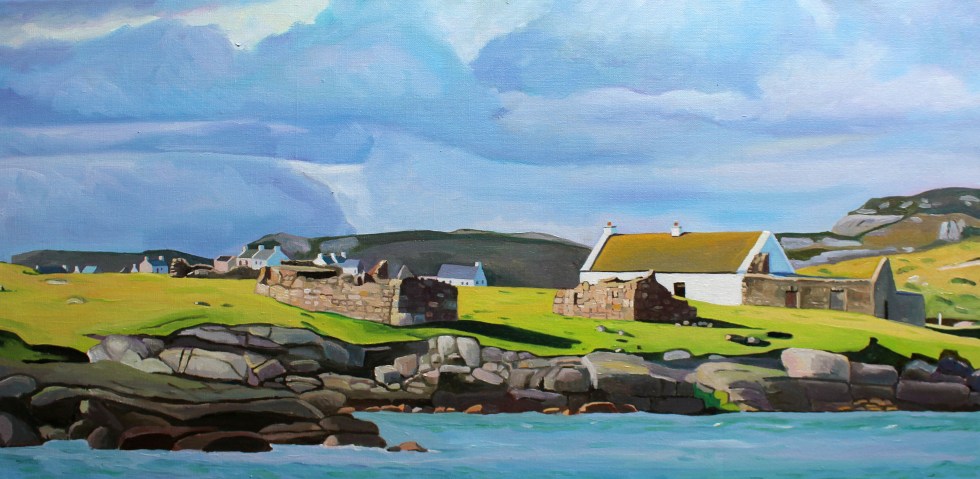
I love their simple clean lines. I enjoy the old-style aesthetic. In Donegal, houses were whitewashed and woodwork was painted red. You still see a few houses like this. Sometimes you might see one with a thatched roof. Usually, their thatch has been replaced with tiled roofs.

Traditional Donegal House
Traditional Donegal House (with a thatched roof)

When is a house a cottage? When it’s small and old and hand-built by its inhabitant, I suppose. In England, the term cottage originates from the Anglo-Saxon term for the peasant or “cottar”, in Irish the word for these houses is “teachin” or “teach beag” which means small house. You can watch a short film on how to say “teach” in Irish here, you may think that word looks like an English word, but it’s pronounced very differently in Irish.

Cottages literally grew out of the landscape that surrounded them. It stands to reason that in the past homes were built from local materials. If the stones and wood had to be carried by donkey or man-power it wasn’t likely to come from very far away. Stone would predominantly be used in coastal and rocky areas, muddy clay in the midlands and even turf in boggy areas.

media_200599
Photographs of a Gweedore cottage by James Glass

Cottages came in different sizes; from the tiny laborer’s cottage or Bothán Scóir (a one-roomed house with mud floors and often not even a window); the byre dwelling (a slightly larger cottage that was shared with the animals) to the thatched mansions – two-storey thatched farmhouses that were often extended from single-storey cottages as the occupants become wealthier.

In Donegal  “direct entry” houses were typical, where the front door open directly into the room with the fireplace. The most popular form of cottage is that with the living area at the center with the hearth fireplace and a bedroom on either end.

The fireplace or hearth usually formed of stone and located at the center of the house with a bedroom behind it to further absorb the heat. Most families lived in a single room. 

Traditional large fireplace (Kerrytown< Donegal)
Traditional large fireplace (Kerrytown, Donegal)
Interior of cottage with family. Aran Islands, Co. Galway, c. 1900
 
Note the bed by the fire

In rural Ireland, they did not usually own the land it stood on.  This is why landlords could evict tenants for non-payment of rent (usually, if they wanted to replace people with more profitable sheep), even those the occupants had built those houses themselves. In the case of  John George Adair of Gleanveagh, he had the houses pulled down after the tenants were thrown out! This was common eviction practice.  Anyone who has seen the excellent film Black 47 will know that this practice, could and did, lead to the death of old and frail tenants  in winter. 

Painting of Donegal, Arranmore
Over to the Rosses (Donegal, Ireland) SOLD

Houses were designed through necessity.  The general rule was that the front door of the cottage faced south, to shelter the house from the prevailing westerly winds. Windows were small in order to retain heat in the winter and to keep cool in the summer. Ground floor windows usually faced to the south, not on the gable ends.

Meadow Cottage
Meadow Cottage – note the first-floor window in the gable end

There were often small windows on the first floor of the gable walls where there were loft accommodations. The walls of a cottage were typically about 600mm thick to support the roof and beams, this led to the attractive deep window reveals found in most cottages.

IMG_2439
Cottage with outhouse (Gweedore)

You may have noticed that many old Irish houses are not one single unified block, but are made up of several extensions, a kitchen at the back, an extra room to the side. Homes were enlarged when money was available. Often this money was earnt far away from home as hardship forced family members to look for seasonal work far away in Derry, Tyrone or even in Scotland.

Donegal painting house Gola
A House on Gola SOLD

Modern houses in Donegal, like modern houses in most places, are comfortable, spacious with plenty of windows. Older people, here as elsewhere, I suspect prefer bungalows for their lack of stairs.

New Houses, Letterkenny, Donegal

Yet, there is still a space for the old style.  On Cruit Island there is a holiday village of new-build holiday homes in the “old” style.

They are single story with thatched roofs but they are large, comfortable, and furnished with wooden rocking chairs, and folksy bedspreads. They also have a beach a stone’s throw away. Obviously, there are real old houses you can stay in on Cruit Island too.

Donegal painting of thatched cottage, Ireland
Donegal thatched cottage #2 SOLD

I sometimes wonder if I am painting a “fake” version of Ireland. I am giving the impression that all of Donegal is covered in little quaint white houses? It isn’t, but they are there. Especially in the Rosses and on the islands. Not all of the houses are quaint in  North-West Ireland; the “bungalow blight” that affects parts of Donegal has been commented on by others.  I suppose I am drawn to the clean lines of the old houses.

Painting of Irish Cottage in Donegal
On the Way to Arranmore (SOLD)

This is a theme I have explored in a different context, previously. A couple of years ago I explored the “Hollowed Community” of Brynmill and painted the Edwardian terraces that surround my home in Swansea. I was also interested in a lost community. The old way of life (pre-internet) that is fast vanishing, where your neighbors lived next to you for years, not for weeks or just the summer months. 

Donegal painting of Owey Island
Owey Island (SOLD)

SEE DONEGAL PAINTINGS                                             BUY DONEGAL PRINTS 


To find out more about the history of the Irish cottage see the links below

http://www.askaboutireland.ie/reading-room/history-heritage/folklore-of-ireland/folklore-in-ireland/vernacular-architecture/The%20Irish%20Cottage/

https://www.irishamericanmom.com/the-thatched-cottage-as-a-symbol-of-ireland/

Why do irish cottages have so few windows? 

https://www.nihe.gov.uk/Documents/Community/traditional_buildings

https://cottageology.com/irish-cottage-history/

 Places you can visit

http://www.glenfolkvillage.com/

https://www.museum.ie/en-IE/Museums/Country-Life/Exhibitions/Hearth-and-Home

Doagh Famine Village

Join my Mailing List

Posted on 20 Comments

Arranmore Island, Donegal

Donegal paintings for sale

I have been back in Wales for three days now and the big difference from Donegal is the temperature and light. It is much warmer in Wales. Last week I was wearing a jumper – here I am in a T-shirt. In Wales, last night it was very dark by 10 pm. In Donegal, however, the light seemed unending. I struggled to sleep, despite being very tired, because although the sunset was after 10pm, it didn’t seem to get properly dark until after well after 11pm. Then it started to get light pretty soon after 4am!

I would sometimes wake in the early hours and look at the dark as a novelty. That’s something I’ve never done in Wales. Yet, I got used to this abundance of light. I made me feel active. With no television to slump in front of, I would find myself doing things after tea, such as the evening I found myself sanding a table at 9pm. I got used to life without news on the radio, although I did listen to some podcasts I had downloaded before I left Wales.

The day we visited Arranmore Island was a sunny Saturday. No jumper, just a shirt. There are two ferry companies that operate from Burtonport Harbour, the Red, and the Blue. They run all year round. In the summer months, they put on extra sailings. We plan to catch the 12.30 ferry, which is the Red Ferry. That’s the favourite colour of Seamas, my husband’s, beloved football team, Liverpool, so he’s happy. The ferry is very busy. It’s delayed by 10 minutes as the last car fills the boat to capacity. There are lots of teenagers and families on board. We stand by the rails as all the seats are taken.

Donegal landscape
Arranmore Red Ferry and an Oystercatcher

The journey to Arranmore is always a treat. The ferry is speedy.  It takes not much more than 15 minutes to complete the three-mile journey. I love looking at the islands (and their houses) that lie alongside the route.

Ednernish and Rutland Islands

Rutland Island is one of the largest of these and lies to the west. There are some very beautiful modern houses on Rutland, alongside ruins which date from the 18th century. These were part of the planned settlement built by William Burton Conyngham. He also owned Arranmore Island.  In my painting “From Ferry Coll” (below) you can see the remains of the fish landing and processing complex on the left side of the painting. There was also once a post office, houses, and a school-house here.

Donegal painting of landscape
From Ferry Coll (SOLD)

On the eastern side, lies the islands of Edernish, Inishchoo, and Eighter.  Here there are old cottages tucked in amongst the rocks. There is sparkling sunshine, but once we leave the shelter of the islands, the sea becomes quite choppy.

Painting of Irish Cottage in Donegal
On the Way to Arranmore (SOLD)

When we arrive at Arranmore harbour there are lots of friends and families waiting for the ferry. There is a lot of waving and photos taking whilst we wait for the cars to drive off the ferry. Then the people can get off the ferry. There are lots of hugs, laughter, and chatter as the passengers finally get off the ferry. It’s a delightful scene.

Arranmore is well worth visiting. It is the second-largest Irish island (the largest is Achill, in County Mayo, if you want to know). It is seven square miles in size and it is dominated by an imposing hill called Cnoc an Iolair (“Hill of the Eagle”, 750 feet) which can be seen from most of the coast of Gweedore ad the Rosses. It has both sandy beaches along the south coast (three of them) and imposing sea cliffs (120 meters) along the west and north side of the island. Many of the islanders are native Irish speakers.

Many islanders used to support themselves through fishing, wild salmon in particular, but in 2006 the EU banned salmon fishing. This has caused a great deal of hardship and anger. It has also meant that many of the young people have been forced to move away in search of work, so the population of the island is dwindling and aging. You can watch a beautiful short film, “A Foot of Turf” about island life here.

Fortunately, the island has recently undergone huge technological advancement and has become the recipient of Ireland’s very first offshore digital hub. In celebration they wrote an open letter to American and Australia, hoping to entice new businesses to the island. Sadly, the story went viral and got distorted in the process. British tabloids, in particular, decided to reframe the story as the island being desperate for immigrants, “begging US citizens to move there” and decided to be offended that they “forgot” to invite British people, writing headlines like: “Anyone but the English”. This caused a great deal of distress on the island as this wasn’t what was intended at all. The letter was meant to appeal to American businesses to help boost the economy by giving islanders jobs – and visit the island.

So we are visiting the island. First, we made our way eastwards, towards the lifeboat station. We then backtracked and walk up the road past The Glen Hotel, which was the island’s first hotel in 1928. It was once the home of John Stoupe Charley, a Protestant from Antrim, who bought the island in 1855. 

View Above the Glen Hotel, Arranmore

It was a long hilly road with a beautiful view across to the mainland. There were many old cottages and outbuildings here. The road was generally quiet but we were periodically passed by several cars. I like to take note of where cars are from, in Ireland registration plates in include letters to denote the county of registration. There were many with “DL” Donegal plates, but also plenty with “D” Dublin and Northern Ireland plates. Although I’d seen plenty of German and Dutch vehicles driving along the Wild Atlantic Way (past our house) there were none on this stretch of Arranmore road.

Painting of Donegal, Arranmore
Over to the Rosses (Donegal, Ireland) (SOLD)

It’s considered good manners in Donegal (and elsewhere, of course) for the driver and pedestrian to acknowledge each other when the car has to slow to pass and the pedestrian has to clamber into the grassy verge. In Donegal, the driver will lift the index finger of his right hand. The pedestrian will similarly lift his or her finger but not necessarily raising the hand to do so. Smiles will be exchanged too. Nothing to exuberant, but friendly. It’s rare that this doesn’t happen, sadly it does on occasion and then it is followed by a short discussion between Seamas and myself about the drivers of particular makes of cars and/or people from NI/Dublin/hirecars.

Artist in Donegal, Ireland
Me on Arranmore Island, Donegal

We get so far and decide to retrace our tracks and walk in a big loop along the west side of the island, which provides us with sweeping views across to Burtonport and Dungloe.  If you look carefully in the photo below you will be able to see the old courthouse to the right. This was built at Fal an Ghabhann (Fallagowan) around 1855.

View Across Arranmore, Donegal.

Painting of Donegal. Arranmore.
Old Courthouse, (Arranmore Island) SOLD

Eventually, the road wound downhill. We could hear the sound of singing on the wind. A choir singing? We eventually came to a large white Community Hall, the doors were open and inside were lots of young people singing in Irish. These were some of the hundreds of teenagers who come to the island as part of a summer scheme to learn and improve on their Irish language skills.

Donegal painting for sale
Gortgar, Arranmore

As if to reinforce this, a tall teenage boy passes us and greets us in Irish. Seamas manages a greeting but then tells me that the lad had used a different form of words to the one he’d learned over 30 years ago. It seems that the Irish language is very similar to the Welsh, in that it has many regional variations in terms of accent, pronunciation, and words used.

Painting of Donegal, Landscape
House By The Red Wildflowers (SOLD)

We finally made it back to the harbour and had two delicious cheese paninis in the sandwich shop.

Blue Ferry to Arranmore Donegal, Ireland
Here comes the Blue Ferry!

The journey back to Burtonport harbour on the Red ferry was very enjoyable, with the passengers still in a buoyant holiday mood, waving at the passengers on the Blue ferry as we passed. A holiday maker’s car alarm kept going off. His embarrassment levels pretty much matched that of his children’s amusement.

I kept a lookout for dolphins or seals but saw none. Only sea birds. An American told me that he’s seen Minke Whales in Clew Bay recently. We had seen dolphin on the way back from Tory island. He had a theory that there was a bumper crop of fish 8 miles out at sea, which was where the wildlife were. Usually, the waters around Burtonport would have plenty of seals and dolphins. That’s something to look forward to seeing another time.

For more on Arranmore and other Donegal islands in general doub;e click on the link

Posted on 25 Comments

Those Uncertain Roots – Retracing the Past in Gweedore

Painting of Donegal Errigal
Donegal painting, a beach on a sunny day.
Dunmore Strand (with Mount Errigal in the distance- SOLD

I have written before about how my husband, Seamas, is a bit obsessed by Donegal’s highest peak, Errigal,  and how loves to tell me that you can see Errigal from different places such as the beach, the airport, the house, the top of the garden and so on. His father helped run a boxing club named after the Donegal peak too. Actually, after spending the week getting sucked down the rabbit hole that is “family history” research, I have decided this love of Errigal is in his genes.

Painting of Donegal and Errigal
Over to Kinclassagh SOLD

If you have ever attempted to trace your family tree you will know how absorbing and frustrating it can be. There are many dead ends, but there are also many highs. Tracing families in Ireland can be difficult as a lot of 19th-century census records were destroyed, however, the 1901 and 1911 censuses are online (http://www.census.nationalarchives.ie/)  and free to search.

Furthermore an excellent site www.irishgenealoy.ie gives you access to images of birth, marriage, death records. I think I found this a more startling insight into Irish History than all my years teaching 18th & 19th century British History at High School. The course title was something like “The History of Wales and England 1785-1914”. In fact, we covered relatively little about the History of Wales (except for the Chartists and the Rebecca Riots), but quite a lot about the History of Ireland. I learned that you cannot begin to understand the History of England without knowing about the history of Ireland.

We tracked Seamas’s great-grandmother’s family, the Colls, to an area of Donegal known as Gweedore. They lived in a townland called Meenderrygamph (Min Doire Dhamh in Irish) which is on the edge of a mountain not far from the Clady River, and the modern-day Gweedore Court Hotel. Maybe they would have been able to look up and see Errigal as they worked their land. This was very marginal land and life was very tough indeed. The Coll’s land in Meenderrygamph was on the edge of peatlands. The grazing was rough. Their family had worked it for generations and but it was not theirs. It was rented.

Donegal painting of Mount Errigal, Ireland
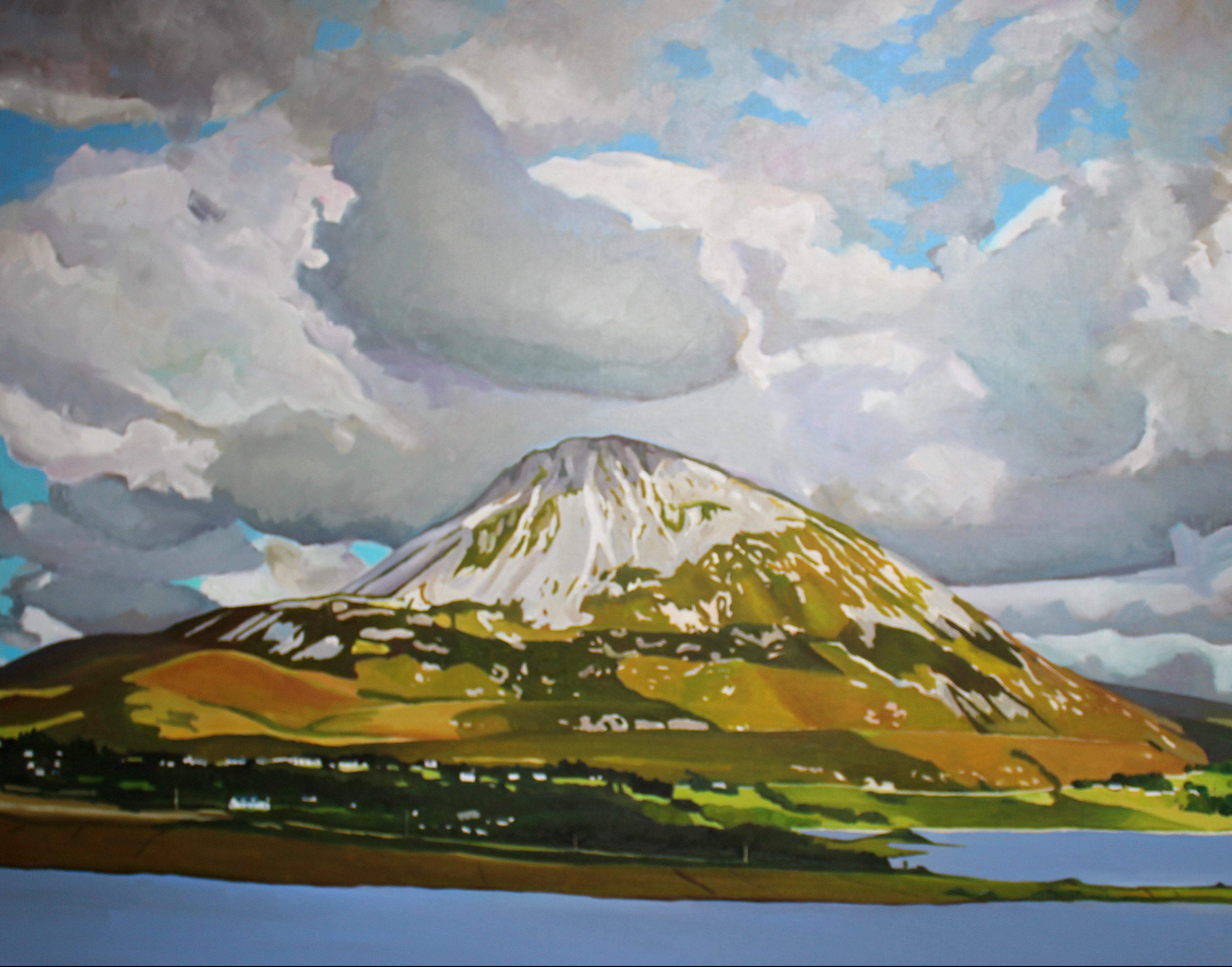
Passing Clouds on Errigal (SOLD)

This was typical of 19th-century Ireland. The ordinary Irish people, who were mostly Catholics, did not own the land they farmed. It was rented from Protestant landlords, who made it virtually impossible for Catholics to own land. Few, if any Catholics in Gweedore, had the right to vote. Up until the 19th century, the population of the area remained low and the lack of roads in the area meant that landlords, agents, and the police generally did not interfere in tenants’ lives. It is evident that this wasn’t from lack of trying. Around 1834 local people had beaten up “two revenue police parties” who had been collecting tithes for the (Protestant) church. The police gave up and left Gweedore.

Without interference from Landlords, the people were able to graze the whole area, and the land was divided up by a system known as “rundale.”  This was an ancient form of land division that, despite its faults, allowed everyone access to the best land, water and common grazing – it’s not dissimilar to the open-field system of farming used in Medieval England. This was a sustainable system of farming that worked well on marginal land that was very difficult to farm.

That all changed, however, when Lord George Hill (1801 -1879) bought up large areas of land in Gweedore in 1838 and started “modernising” things. Some of these changes may look like encouraging developments to modern eyes. The first road into Gweedore was constructed in 1834 when the Board of Works constructed a road from Dunlewey to the Gweedore River and Lord George Hill further improved the roads on his estate, he built a Hotel for visitors to the area. Lord Hill also built the port of Bunbeg in the late 1830s to encourage fishing. He also built a grain store on the quay, opened a shop and a bakery and encouraged women to knit socks for sale. Lord Hill, however, made sure that no one else opened up in opposition to him. Margaret Sweeney was evicted for trying to set up a bakery without permission.

Lord Hill’s land reforms were certainly not welcomed by the people in Gweedore. Lord Hill outlawed the building of any further new houses, any subdivision of land, or the sale of land. He had the area surveyed during 1841-1843, and then began to allot new consolidated larger holdings to each tenant. Under these circumstances, providing land for sons was impossible and the only option for them was emigration.

James Glass of Gweedore people phot
Photo by James Glass of Gweedore people

There were partial crop failures in 1831, 1837, 1854 and 1856, and complete crop failure in the years of “the great famine” (1846-48). Surprisingly, there was not a great loss of population in the Gweedore area compared with other parts of Ireland. This was probably partially due to the efforts of the landlord, and also to the availability of edible seaweed. Lord George Hill tried to help his tenants; he wrote begging letters to the Society of Friends (the Quakers), the Irish Peasantry Improvement Society of London and the Baptist Society. He sold grain below cost and sooner than directed, contrary to government policy, although he was recompensed generously by the government for grinding Indian Corn.

Lord George Hill believed the famine was a judgment by God on the people for their morals and farming practices! He actually said “The Irish people have profited much by the Famine, the lesson was severe; but so were they rooted in old prejudices and old ways, that no teacher could have induced them to make the changes which this Visitation of Divine Providence has brought about, both in their habits of life and in their mode of agriculture.” He saw the famine as justification for phase two of his reforms. Sheep.

The Scottish Blackface, like several other breeds of sheep, was brought to Ireland by Lord Hill (and other landlords) as a way to make up for lost revenue during the famine. This made life very hard for the farmers of Meenderrygamph. The farmers were deprived of their mountain grazing. If their animals wandered onto unfenced land (that had previously been common land) their animals were impounded and the farmers were saddled with massive fines of £2 or more. Things were so bad that John and Daniel Coll had had to apply for poor relief.

Not everyone took this lying down, of course. In December 1856, around forty Irish tenant farmers raided the house of a Scottish shepherd and ordered him to leave the country. More raids followed. Hundreds of sheep were killed (or went missing). Hundred were found dead on the land near Meenderrygamph. This was known as the Gweedore Sheep War.

We know that a Thomas Coll had been arrested for the perpetration of “outrages” and was in jail in 1858 but we don’t know if he was one of the Colls from Meenderrygamph. By the following summer, numerous arrests had been made, new taxes put in place (to pay for the police), and the police presence expanded. By summer 1858 the Gweedore Sheep War was effectively over. The Irish farmers had lost, the sheep remained.

People of Gweedore as photographed by James Glass 19th century
People of Gweedore as photographed by James Glass

The Colls in Meenderrygamph were much reduced in number. In the 1850s there were 6 families bearing the surname farming the land there. By the end of the century, there were only three Coll families, two of whom were sons of Daniel Coll, possibly the late Denis Coll had been his son too, we don’t know. Where had the others gone? Many Gweedore families started to emigrate to America and Australia in the 1860s, perhaps this is where they went too.

The Land War of 1879 to 1882 saw the issue of rents take a deadly turn. Lord George Hill had died in 1879 and his son, Captain Arthur Hill, took over the Gweedore estate. This coincided with the rise of discontent over “landlordism” in Ireland and through a judicial review some rents were reduced on the Gweedore property and 10,000 acres of mountain grazing was given back to the tenants by the Land Commission which sat at Bunbeg. However, Father McFadden, the chairman of the National Land League, an organisation founded in 1882 to oppose “landlordism,” this was not enough and he organised a boycott on the payment of rent. In return, Captain Hill began to evict tenants.

Family Evicted from Hill estate in 1880s
Gweedore Priest
“Fighting” Father James McFadden

Father McFadden, known as the “fighting priest of Gweedore” was put in prison 6 months in 1888 for organizing a boycott and the non-payment of rents. Things got worse in February 1889 when, having finished mass at Derrybeg, Detective Inspector Martin turned up to arrest him again for encouraging resistance to local evictions. The locals quickly acted to defend the priest but in the melee, Inspector Martin ended up dead on the steps of the Priest’s house, some claimed that he’d hit his head on a curb, others that he’s been beaten to death. It was a shocking death. The priest and 40 of his parishioners were charged with murder. Incredibly, the murder charge was dropped and Father McFadden pled guilty to obstruction of justice. The parishioners were charged with manslaughter and given long sentences. McFadden’s was banned from involvement in any further political activities by his bishop and he was transferred to another Donegal parish.

A generation later, life was still very hard for people in Gweedore. It was, over this period, one of the poorest parts of Ireland. Many left, some temporarily for work in Scotland or permanently in America and Australia. Seamas’s great-grandmother Rose Coll had to leave home as a teenager to find work possibly as a servant in a farm near St Johnston. She spoke Irish and English but could not read or write. Looking through records of the area, this seemed to be unusual for people of her generation. Most young people could read by the end of the 19th century. She could not, nor could her two brothers. Healthcare was also a luxury they could not afford. When Rose’s father had died a decade or so earlier in 1888, the registrar’s record noted that he had suffered from some sort of “debility” for two years. The precise cause of the illness was unknown as the family had not been able to afford a medical attendant in all that time. Possibly when her father died, Rose and her brothers were kept home to help with the farm.

Modern day Meenderrygamph
Modern-day Meenderrygamph, Gweedore

So, family history ends up raising more questions than answers but it really makes you appreciate how much we take for granted in life today, the ability to read and write and reliable access to food, healthcare and to a good pair of shoes. To illustrate, I’ll leave you with some incredible photos of Gweedore in the 1870s and 1880s taken by Derry photographer James Glass.  

If anyone reading this knows of the Coll family from Meenderrygamph and can help us fill in some details my husband and  I would greatly appreciate it?

Posted on 11 Comments

Dunmore Strand, Donegal

Painting of Donegal landscape beach,

I have been ill this week so this is a short post.

In last week’s post, Seamas, my husband and I were standing on rocks looking out towards Gola island in Donegal. This week we are looking back inland to Dunmore Strand, and beyond to Mount Errigal.

Donegal painting, a beach on a sunny day.
Dunmore Strand (with Mount Errigal in the distance)

As soon as I saw this scene I knew I wanted to paint it. I loved the dark shadow under the protruding lip of the undulating dunes.  It gave the impression that the grasses were merely a thick blanket laid across the top of the sand.


Scattered along the beach and in the water, were granite rocks. These were so large that they were more like massive boulders. They were a beautiful pinkish colour close up. The sand was also very slightly pinkish but closer to the shoreline it was almost white. Lines of seaweed marked the rising and falling tide.


The tiny white houses gave a sense of sense scale of the dunes. They reminded me a little of boats on the surface of a heaving sea; humans eeking out an existence on the edge of nature. The ocean itself was calm and benign. It was as clear as glass at the shoreline and further out was a beautiful turquoise. It is not always this smooth creature, in autumn, I have seen it roaring and thrashing the shoreline like a wild beast.


Mount Errigal dominates this part of West Donegal, known as Gweedore. The mountain looks close but it’s an optical illusion, it’s actually about 10 miles away to the east. The top of Mount Errigal was swathed in clouds. The mountain always seems to have clouds around its shoulders, or totally smothering it. I had to wait for about 3/4 of an hour for the mists to part for a clear view of the peak. The clouds near to me were dirtier rain-filled clouds that were building and threatening to release their burden on the land somewhere nearby.


Another wonderful thing about this beautiful beach is that on this chilly April afternoon is that there was not another soul there. The only people we saw were the postman in his van on the way down the long lane to the beach.


My next post will peer “through a glass darkly” at Seamas’s Donegal family history (it is very dark in places) and the History of Gweedore along with the controversial issue of modernizing landlords.

Posted on 19 Comments

Donegal Islands: Gola

Paintings of Donegal, Gola, by emma Cownie

My husband, Seamas, loves islands.  He’s not alone, many people dream of living on or even owning their own private island.  I just love looking at them and painting them.  Which is handy, as the coastline of West Donegal is completely smothered with them.  Looking out from the coast of Donegal, one of the longest in the country at more than  800 miles, is a bit like looking at the night sky and trying to name as many of the brightest stars as you can. Seamas seems to know most of their names without having to look at a map.

Map of West Donegal
The larger Islands of the Coast of West Donegal

Around the coastline of the island of Ireland, there are 365 small islands, and a good number of those lie off the coast of Donegal. Wikipedia has individual pages for 20 of them, but there are many more than that. I can’t find an exact number. Many islands near the coast are little more than rocks big enough for some seaweed to cling to the edges of, visible only at low tide.  Maybe these are just baby islands, islets. How big does a piece of land surrounded by water have to be to be an island, I wonder? If it’s big enough for some grass and a cow it must definitely be an island. There are quite a lot of those near Burtonport.  The cows are well known for swimming between the island in search of better grass. I  kid you not, it’s common off the coast of Inishcoo – click here for more evidence. I think the association between cows and island grazing is an ancient one as several islands take their names from cows, such as inishbofin (Inis Bó Finne) means island of the white cow and Calf island near Aran Island.

There are also about 100 sea stacks.  Are these thin, vertical towers of rocks jutting out of the sea proper islands, I wonder? Slighter bigger and desolate are The Stags, or Stag Rocks, also known as The Three Sons of O’Gorra (Na Trí Mic Ó gCorra) which lie someway to the north of Owey island.  Legend says that they were three pagan swimmers who were turned to stone by St. Colmcille the 6th Century missionary, also known as Columba.

Stag Rocks, Donegal
The Stags

Then there are islands that have (or used to have) people living on them. Arranmore is pretty big (8 square miles) and is home to a sizeable community of  about 500 people full-time residents. Some islands are easy to get to, such as Cruit, which has road bridge to the mainland, and Arranmore and Tory which have a daily ferry. There are others that have only summer ferry such as Gola and Owey Islands.

There are a lot of islands with no ferry but can be reached relatively easily by boat or kayak such as Inishsirrer, Inishmeane, Edernish, Rutland, Eighter, Inishillintry, Inishinny, and Bo, Go and Allagh, Inishmeane, Inishdooey, Insihbeg, Inishfree Lower but are close-ish to the mainland, and  others that are pretty remote, even to people with their own boats such as Umfin, Tororragaun and Raithlin O’Birne and then finally there are the very remote ones are Stags Rocks mentioned above and Roan Inish. Some like Arranmore and Tory are inhabited all year round, others like Owey and Gola are mostly home to people during the summer months.

Painting of Donegal
From Cruit Island

I love the descriptive names of the islands thus Cruit (An Chruit)  means harp-shaped, Owey (Uaigh) means cave as there’s one under the island, Island Roy (Oileán Ruaidh) means Red Island, Inisheeney (Inis éanaigh), bird island and Tory Island, (Toraigh) means High Tower and when you see photos of the island you understand why that is a good description of the island.

Donegal island
Tory Island from the mainland

I have driven across the little bridge to long Cruit Island and I have boldly reversed my car onto the ferry to Arranmore and back again. I have spent a fair bit of time standing on the shore looking across the water at islands, Owey is a good example of this.

Donegal painting
Owey Island
Painting of Donegal Island, Owey
Over to Owey

My latest subject for this mainland-based island-gazing is Gola. Its name sounds vaguely sporting, forever muddled in my mind with football and trainers probably because I used to have a pair of Gola gazelle trainers back in the 1990s. The island has nothing to do with trainers or goals. The name Gola, or Gabhla in Irish, means “forked”. If you look at a map of the island the name makes sense. The fork is the split in the west face of the island.

Gola, West Donegal
Map of Gola Island

We set off on a sparkling afternoon in early April. The sun is out but it’s cold, with a chilly wind. I’d wear my big wooly hat in the car but the bobble on top is too big and it hits the headlining. So I drive without it on. In order to get to a good look at Gola, we drove past Donegal’s tiny airport at Carrickfinn, along a long single track road. There’s a lovely view of Mount Errigal off in the distance. 

Donegal airport

Mount Errigal
Errigal from Carrickfinn

The track then rises and winds its way past a series of isolated houses, both and old and modern. The road is a bit threadbare in places, in good condition in others.

We follow the road until we reach a fine modern house overlooking what I’d call a beach, but this sort of long stretch of curving sand is known as a strand in Ireland. I think this is Dunmore Strand (An Tra Bhan). We climb out the car (I leave my window open in my excitement), with hat and gloves on and various cameras slung around our necks and stuffed in jacket pockets. The tide is out so that I don’t realize that the long stretch of dunes reaching to the north of me, is actually part of a tidal island, Inishinny.

Towards Bunbeg
Dunmore Strand

The blond sand is strewn with majestic pink granite boulders and rocks. The clear sea is a most beautiful violet and turquoise. I have never seen anything quite like it. We spent a lot of time staring at the water, trying to fix its colour in our memories. The seaweed resting in between cracks in the rocks is a fantastic livid green.

IMG_1061
Woolly hat back on, taking photos of Gweedore and Bloody Foreland

Beyond the dunes is in the distance to the east is Gweedore and the village of Bunbeg and Magheraclogher beach. The terrain is peppered with lots of little white houses, most of them modern. In the opposite direction to the east is a very different landscape.

Gola West Donegal
View towards Gola

We have to walk along the sheltered beach and climb across a series of massive rocks to get a better look at the island. The island of Gola seems tantalizingly close, it’s only about half a mile. We can see the ruins of many houses, but also many painted white and with good roofs.

Donegal Island, Gola
Houses on the south side of Gola Island

Seamas was very excited to see the island, as there is a possibility that his Donegal Coll forebears may have lived on the island. However, although we know his paternal grandmother originally from the Gaeltacht (Irish speaking area) somewhere in Gweedore, we cannot track her down in the records. There are lots of possibilities but no certainties.

Gola, is a small, very rocky and rather exposed-looking island. Mind you, I was looking at it from across the water, and it is consistently described as “beautiful” by visitors. The silvery quality of the light on the white-washed building nearest the shore certainly caught my eye. I tried to convey the quality of the light in my first painting of the island.

donegal painting of Gola, West Donegal.
Spring Light on Gola (80x40cm)

We then clamber across another set of massive pink granite rocks to the headland nearest the island. It is more exposed here. You can get a better look at the houses. I am fascinated by the ribbon of little white-washed houses that look out towards the mainland. They look they were positioned with the prevailing wind (blocked by the hill to the west of them) and company in mind. There is a larger modern house set back from the old cottages.

I wonder whether that belongs to one of the few full-time residents that live on the island. My second painting of Gola, I think give you a sense of just how rocky the island is. The hills and fields are peppered with boulders, rocks and stone walls. The coastline along the south side of the island is a rampart of geometric rocks. No wonder the little harbour is tucked in on the sheltered eastern side of the island.  

Donegal painting of Gola
Oileán Ghabhla (80x 40cm)SOLD

The island is pretty small. It covers about one square mile (500 acres). Although it seems quite flat in comparison with Aranmore, it is “mildly hilly” on its west side, rising to 238 feet at Cnoc an Choillín and 212 feet at An Mhaol Mhór. These hills provided vital shelter for the houses that stretch along the east side. (Images taken from Google Streetview).

On the other side of the island is as statuesque sea-arch.

Donegal Sea Arch
Sea Arch, Gola Island, Donegal

Gola was once inhabited by a surprisingly large community of over 200 souls. I looked across at this barren-looking land and wondered how on earth they could grow enough food to survive. Mind you, the land is not as bleak as the tiny fields of west Galway, full of stones. Yet survive they did, thrive even. Vegetables could be grown on the land fertilised with seaweed and turf could be cut from the bog to heat the homes. Many of islanders were fishermen and they would also travel to Scotland for seasonal to work each summer to supplement what they could grow on their small farms. Surprisingly, up until 1920s, the island population continued to grow, but it declined after 1930 and then became deserted in the late 1960s

Yet, the island was never completely abandoned. Families would come and spend summer months here. Although most of the buildings on the island are derelict, many have been renovated by Gola families as holiday homes.  The island now has mains electricity and water supply and a small number of people live on the island all year round.

Being an island the sea sustained island life but it also curtailed it. Bad weather could cut the island off from the mainland, especially in winter. The coast of Donegal frequently faces some very severe weather from the prevailing westerlies and the heaving Atlantic Ocean. Gola was immortalised in the sad lament “Baidin Fheilmidh” (Feilim’s little boat), a song about a Feilim’s bat which sets off for Gola and then Tory but was crushed against Tory island, sinking with poor Feilim in it. There are various versions of this song you can listen online including one by Sinead O’Connor but I think I like this paired back version best, which also has the lyrics in Irish & an English translation here.

There is a ferry service that runs from Bunbeg from June to September. Sabba, the ferryman, also runs facebook page under the name “Gola Ferry Service” and it it is a good idea to check before planning a visit.

Ferry to Gola Donegal
Gola Ferry Service Facebook Page

We were too early in the year, sadly,  to visit by boat. I am pretty sure that Seamas and I will be making a trip to Gola island in July when we are planning to be back in Donegal. We returned home to Burtonport for tea and biscuits to warm up in front of the fire.

IMG_1119
Seamas and Mitzy in front of Gola Island.

Posted on 20 Comments

Home from Home

Painting of Irish Landscape
Painting of Donegal, Ireland
Over to Kincasslagh SOLD

I am winding down the social media for a while because we are leaving the UK to spend some time in our house in Burtonport, Donegal, Ireland. The internet will be available on a very limited basis so I won’t be able to post on here until mid-April. I will be checking my emails but I won’t be posting much, if anything, on Facebook, Twitter & Instagram.

I have mixed feeling about the enforced “break” from social media. On the one hand, I hate the way how it sucks up all your spare time and energy and how FOMO (fear of missing out) has you checking updates. There’s always the fear that if you stop “spinning all the plates” that people will forget about you! However, I am certainly looking forward to reading books, listening to the radio (there’s no TV either) and sketching and painting for fun (not oils but watercolour sketches).

I am very excited/nervous about the whole thing because I am driving there and it’s a long, long way.

Please be aware that any artwork purchased after 25th March will only be shipped after 12th April.

IMG_20181103_100343971_HDR
My home in Donegal
Posted on 31 Comments

Behind every cloud …

Donegal painting
“May the friendships you make, Be those which endure, And all of your grey clouds, Be small ones for sure” – Extract from an Irish Blessing “Behind every cloud is another cloud” – Judy Garland   I have had an ambivalent relationship with clouds. I prefer bright sunshine. I In fact I have obsessively looked for bright sunshine and shadows to paint.  I have found the relationship between objects and their shadows exciting.
Oil painting of light and shadows on a Swansea steet.
Up Sketty
  This can be difficult in Wales where we can get days or even weeks of overcast or wet days. So when the sun is out I go mad, rush all over the place taking reference photos to paint later in my studio.  I have been guilty of often portraying Swansea only in its best light.  Someone once said I made Swansea look like a Mediterranean country.   Don’t get me wrong, on a sunny day it’s beautiful place and I have painted dark and rainy scenes too (see below) but not the rain clouds as I prefered painting bright blues skies.
Painting of car in a rainy night street
The Driving Rain (SOLD)
Oil Painting of gas station in the rain
That Petrol Emotion (SOLD)
I have never really been happy with how I painted clouds. They never quite came off the way I wanted them to. The paintings looked fine but I had not enjoyed the process of painting them. For a long time I could not quite put my finger on what it was that I was finding dissatisfying about the experience.
Oil painting of Mumbles Head, Swansea
Clouds Gathering Over Mumbles Head
So I did a bit of research and read up on something called “scumbling” and watched a video on youtube demonstrating the technique. This is a way of applying paint with a dry brush to painted canvas. This way a broken layer of paint is added allowing the colour underneath to show through.  J.M.W. Turner was the king of scumbling. Think of that painting of his “Rain, Steam and Speed” where the steam train is emerging out of the clouds of rain and steam. This is my humble effort at scumbling.
Old painting of clouds in West Wales
A Change in the Weather
I was quite pleased with it but it did not pass the “praise test” with my husband, Seamas. He’s my most valued audience and source of feedback. It’s not that he didn’t like the painting, he just didn’t say anything at all about it. So I decided this technique wasn’t quite working for me. I watched a few more videos on Youtube where artists knocked off beautiful clouds in a matter of minutes. This just seem to make things worse. I swirled the paint around on the canvas and it all just felt “lumpy” to me.  I scrubbed the canvas. Humph. I decided Youtube videos were great for tips on mending jeans or adjusting security lights but not for painting techniques. I had to find my own way. Or truth be told, I forgot about it for a while. Finally, I think I have started to make a break-through. It came from being in another country, Ireland, where the skies are full of constantly changing clouds. This was something quite different to the light of Wales. To start with I tried to painting bright sunshine, as I do in Wales.
Irish Cottage, Arranmore, Donegal, Ireland
On The Way To Arranmore
Round the Rosses
Round the Rosses (SOLD)
I like the light in these painting a lot. Then I was tempted by the landscape to explore the changing skies too. You can’t paint Mount Errigal without a swath of clouds around its shoulders.
Under the Shadow of Errigal
Under the Shadow of Errigal (SOLD)
I started to get sucked into the drama of the Donegal skies. I slowly discovered the key, for me anyway, is very thin layers of paint. After all, clouds are just water vapour. They are made of tiny fine particles of water. They are not solid things and this was where I had been going wrong, making them solid things. They are not. Ironically, this is what exactly what the Youtube videos were showing me but I needed to find my own way of doing it. I didn’t like painting a layer of opaque blue and then adding cloud on top. I prefered a number of very thin layers of paint.  The natural colour of the linen canvas I use, actually helped contribute to the colour of the “dirty” rain clouds.
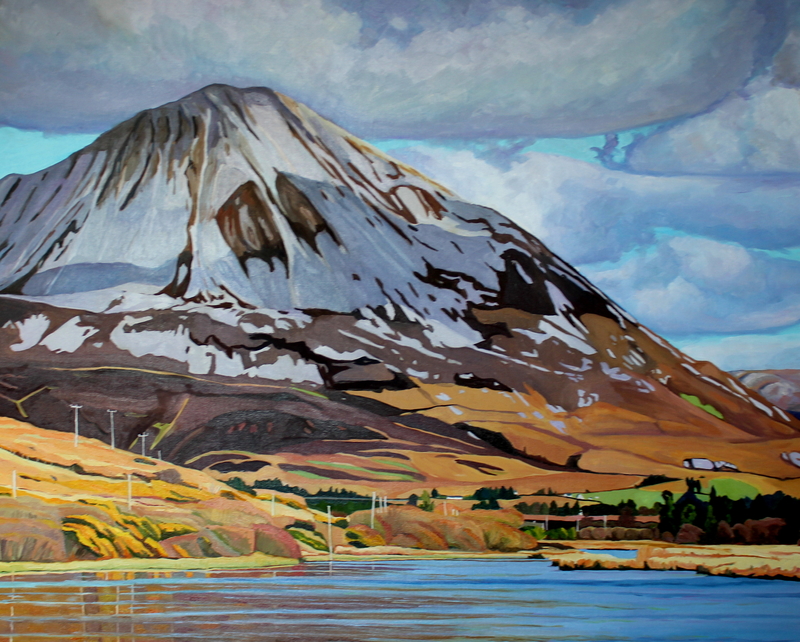
Mount Errigal from Ballymanus Beach, Donegal
Mount Errigal from Ballymanus Beach, Donegal (SOLD)
So my clouds got thinner and finer.
Painting of Owey Island, West Donegal, Ireland.
Over to Owey Island, West Donegal, Ireland
So that a puff of wind would move them along. Or light luminate them.
Painting of view from Burtonport to Arranmore, Donegal, Ireland,
From Ferry Coll
So, I have started painting “overcast” pictures where the light is slivery rather than golden. I can be a challenge because the light affects all the colours, the greens are flater and duller and I am using yellow ochre and naples yellow far more than I do painting sunny Welsh landscapes.
Oil painting of Dunfanaghy and Muckish, Donegal
Across to Dunfanaghy (SOLD)
Painting of Arranmore, Donegal. Finally, my favourite recent painting is the one I did of Muckish mountain. I loved the massive rounded clouds that seemed to be echoing the humped shape of the mountain.
Painting of Muckish, Donegal.
Shored up near Muckish
I have only started feeling confident painting clouds and I think I have some way yet to go. Fortunately, I won’t be short of clouds to paint in Wales and Ireland.    
Posted on 24 Comments

Round the Rosses

Landscape painting of the Rosses, West Donegal, Ireland
Round the Rosses (SOLD)

The Rosses (in Gaelic, Na Rosa) is a region in the west of County Donegal, Ireland. The name comes from “Ros”, the Irish word for headland. It is a curiously rocky place. Not rocky, in the sense that national parks in the American west, like Utah and Arizona, are made of 100% rock, but rather the bedrock is covered with a thin layer of earth, with slabs of rocks and boulders poking through. It’s a barren but beautiful landscape, studded with a myriad of lakes and inlets of the sea.

Aerial View of the Rosses
Aerial View of the Rosses, from the aeroplane (with Mount Errigal in the background).

It may feel like the edge of the known world but this area has been inhabited “since time immemorial” according to Wikipedia. Coastal places like the Rosses, in Donegal, looked out onto a massive highway – the sea. Missionary Celtic saints were busy in this area in the 6th century AD. These saints relished a challenge and liked to travelled up and down the Celtic waterways to spread Christianity to nearby Scotland. In the 1990s it was fashionable to argue that these Irish monks  had in fact, “saved civilisation” by copying the books being destroyed elsewhere by Germanic invaders, eventually bringing them back to the places from which the books had come. Part of this movement included women like St. Crona or St. Crone (Cróine) , a female religious of royal blood. She found a monastery in Termon near Dungloe. She was a cousin of the the better known St. Columba (St. Columcille in Irish) one of the Twelve Apostles of Ireland, who founded the monastic settlement at Iona.

Much later (about a thousand years or so) in the 16th century, a number of ships from the Spanish Armada sank off or landed off its coast. Some 24 to 26 Spanish Armada ships are believed to have foundered off the Irish coast in 1588 while returning from a failed invasion of England by King Philip II. This is not just local myth as the wrecks of two Spanish ships were discovered by archaeologists in shallow water near Burtonport, Donegal, in 2008/9.

Donegal Wreck
Donegal Wreck

What happened to the survivors of these wreck is unclear. We know that as many as 9,000 Spanish soldiers and sailors lost their lives off the Atlantic coast of Ireland, either through drowning or were killed by English troops or Irish chieftains after they were washed ashore. However, not all died. Some Irish who were sympathetic to the Spaniards sheltered them and some kept them on as soldiers. Local legend, credits black-haired locals as being descents of these men, but they are possibly the descents of much earlier people who came from the Iberian peninsula after the end of the last ice age.

I found this area both beautiful fascinating. Donegal manages to combine a sense of isolation with company, should you want it.  This area is littered with houses, old and modern. Many homes are built on the rocks, or have massive rocks in their gardens. People have had to work around the boulders and outcrops.The prevalence of pines dotted across the landscape gives the area a Scots or Canadian feel to it; Caledonian in fact.

Cruit Island

Cruit Island

Although in many senses there is plenty of space, houses seem to huddle together in clusters, isolated but within sight of others. A lot of them (the newer ones, anyway) face out towards the Atlantic Ocean. It seems that in many cases old cramped cottages have been replaced by larger modern buildings. Many tiny cottages, or abandoned derelict buildings are overshadowed by bigger ones. The smaller cottages ended up as holiday homes for visitors. Most of the houses are painted white, but with some older stone cottages and out-houses are left “au naturel”.

On one of the few sunny afternoons we had, we raced round taking photographs of the houses on the rocks. Each bend in the narrow road revealed different vistas. It was hard to decide which one I liked the best. Not only did these houses look out to the sea, behind them were hills and mountains. My painting “Round the Rosses” captures a typical cluster of old and new homes perched on the top of rocky landscape. The light from the afternoon sun glints in the windows of the large house, that faces out to the ocean. The older, smaller buildings look to the east; away from the force of rain and storms and towards the rising sun.

Oil painting of West Donegal Landscape
Round the Rosses (SOLD)

Round the Rosses (SOLD)


Posted on 13 Comments

Donegal

Mount Errigal from Ballymanus Beach, Donegal

The night before last, I woke up in the dead of night, not sure if I was in Ireland or Wales.  It’s now five days since we returned from our week in Donegal, in the Republic of Ireland.

It’s taken that long to recover my energy levels. I hadn’t fully recovered from the virus that keeps coming back, and it was adrenaline that powered me round the place. I don’t get out much, to be honest, and everything was exciting to me; the airport in Cardiff  (on 4 hours sleep), the flight over Wales, looking down at our house, even the long wait in Dublin Airport for the connecting flight to Donegal was interesting. I hadn’t been to Dublin for years (and by years, I actually mean a couple of decades) and it had changed beyond recognition. I enjoyed watching how things are organised and how they connect (when I am not in charge of them, that is).

The final flight into Donegal airport was stunning. Most of Ireland is a patchwork of small green fields until just before you reach the approach to Carrickfinn Airport. Then the fields melt away to be replaced by an expanse of mountains and rusty red boglands.

Donegal is at the north-western corner of the Republic of Ireland. Facing out towards everything the Atlantic has to throw at it. It is very big, very beautiful and very empty. More people live in the city of Swansea (241,300), than in the whole of Donegal (158,755). Swansea is 380 km² and Donegal is 4,861 km². No wonder Swansea feels very crowded.

View across the sea to Owey Island
Owey Island from Cruit Island

The stunning landscape is immediately apparent, but what took a little longer to dawn on me was just how really friendly and well-mannered people are. People wave and say hello when you pass them in the street, when crossing a road cars pause and stop to let you cross, when driving, its a battle of “who’s the politest” at junctions. When people stop for a chat, they chat for 20 minutes or even more.

DSC_0014.JPG
A straight road

I love driving around Donegal because the roads were pretty empty. I am not a fast driver, and wiggly roads without crash barriers are certainly not on my list of favourite things. Add a drop down a steep hill, and you have me driving at a snails’ pace. So what a joy it is to crawl along these hairy roads with no one behind my car. In fact, at Horn Head, I was getting nervous about sheer drops and bends so I pulled over and left my car to walk the last few  bends to the viewing point. No cars passed us, either the way up or on the way down. It was a joy.

flock-of-seagullsI think I was happiest walking along the wind-swept beaches looking at the sea. The wind was always blowing. We quickly developed “Donegal-hair”, from the wind. My husband’s hair started to look that guy from the 1980s band Flock of Seagulls. On some beaches, the sand was almost white. I loved the Atlantic Ocean. It was a strong dark blue, but where the waves lifted, green showed through. The sea was so clear that the shallows, were green too.


DSC_0982
Ballymanus Beach

One of my favourite beaches was Ballymanus, which is just round the corner from Carrickfinn Aiport. From the rocks you can see Mount Errigal, the highest peak in Donegal. It’s a curious dome-shaped mountain and looks like it should have been a volcano, but I don’t think that it was. In this painting I tried to capture the deep blue of the Atlantic and the ever-changing cloudscape. The colours of Donegal are very different to South Wales. There are more purples and greys and the light is cooler, less golden. Painting this picture has helped “embed” Donegal for me. It will be in my dreams for a while longer, I think.

Landscape painting in Oil of Mount Errigal, Donegal, Ireland
Mount Errigal from Ballymanus Beach, Donegal (SOLD)