Posted on 11 Comments

Looking at Paintings in Real Life is Good for you

A long time ago, when I was a student, my favourite place to visit was the National Museum of Wales. The Davies collection in particular. The Davies were two sisters, Gwendoline and Margaret, amassed one of the greatest British art collections of the 20th century and bequeathed it (260 works!) to the National Museum of Wales. That’s Girl Power!

Some of Monet’s paintings at Cardiff National Museum

They had great taste. Those paintings became like my friends. I visited them often and spent a long time looking closely at them. They excited, inspired and comforted me. Even now when I look at reproductions of them online I have a strong reaction to them.

I used to think, this was because I was an artist. I remember peering closely at Monet’s brush strokes and marvelling at how they were laid down. I mean look at this.

A tingle goes down my spine, looking at it. This is what art is meant to do. It’s even better in real life.

Look at Van Gogh’s painting of a rainy day in Auvers. I have never seen better rain (and I have lived in Wales and Ireland – very wet places).

Van Gogh’s painting In its frame

The Mauritshuis Museum in The Hague, is the home of Vermeer’s ‘Girl with the Pearl Earring’. Thew museum recently did some academic research into how visitors responded to artworks. They looked at the neurological mechanisms and emotions underlying the appreciation of perception in art.

Girl with a Pearl Earing

The study used EEG and eye-tracking measurements on 20 participants who followed a set route through the Mauritshuis. Five paintings were included on this route: Girl with a Pearl Earring (Johannes Vermeer), The Violin Player (Gerrit van Honthorst), Self-portrait (Rembrandt van Rijn), The Anatomy Lesson of Dr Nicolaes Tulp, (Rembrandt van Rijn), View of Delft (Johannes Vermeer). They also showed them reproductions of the originals and compared their responses. The EEG results showed that the real paintings created a stronger emotional response compared with the poster versions of the same paintings.

Volunteer in the study looking at “Girl with a Pearl Earing” – Her eye movements are being tracked

“The Girl with a Pearl Earing” created the biggest emotial response. Painting of “The View of Delf” did not score well, and I wondered whether it was because it was a landscape rather than a portrait, not as famous as the “Girl with the Pearl Earing” or people were not familar with the layout of Delf. I have spent a long time looking at historic paintings of London, Swansea and Derry, trying to work out how they relate to the modern day cities. But maybe that’s because I’m pretty geeky. I doubt I had a big emotional response to them, though. Not enough paint!

Screen shot of the results of the study

The EEG results confirm that real paintings (compared to poster versions) also elicited a strong need to approach the paintings. It wasn’t just me wanting to get a close look at the paint! Real art, including the surrounding ambience, lighting, frame also helped evoke an emotional reaction many times more powerful (10x more powerful according to this study) than looking at a poster of a painting.

Some of you will put that in the “No Sh*t, Sherlock” category of scientific “discoveries” – which was my husband’s response when I told him about the study.

I have never seen Vermeer’s painting in real life but my parents have a reproduction in a tiny gold frame. I don’t know if people’s reponses were elicited because its very beautiful, well-composed, very famous, or because its a human face. I suscpect its a combination of all three.

Mona Lisa in the Louvre – I dont remember it looking as big as this when I saw it back in 1988!

Seeing a famous painting isn’t always rewarding. Maybe you too went to the Louvre in Paris to see the Leonardo’s Mona Lisa and were underwhelmed. Its notoriously small and hard to see as it under glass , far away and surounded by tourists.

There have been times I have come across paintings that I didn’t know and looked at them for a long time. I sat in the Tate (in the 1980s way before it became Tate/Tate Modern) with a lot of Rothko paintings and felt incredibly moved. You just cannot convey that with a reproduction.

So I guess this is a round about way to encourage you to go and see art in real life. You will feel better for it. Possibly. I hope you have some sort of emotional response – tears, laughter, anger even. Barnett Newman, Who’s Afraid of Red, Yellow and Blue III, 1967-68 has been slashed three times.

Barnett Newman, Who’s Afraid of Red, Yellow and Blue III, 1967-68. Oil on canvas, 8′ x 18′

We can’t all own Monets and Vermeers (and I don’t think any of us should, they are too important for that) but we can be glad that museums hold them in public collections we can see. I would love to see Picasso’s Guernica in real life. I have had it projected on a class room wall when I have taught lessons about the Spanish Civil War – it is a powerfully brutal work. My board was large no where near the full the size of the painting which is 3.49 meters (11 ft 5 in) tall and 7.76 meters (25 ft 6 in) across. Art stimulates our senses, emotions, and intellect. Guernica was also designed to stimulate our empathy. It is as relevant today as it was when it was painted in 1937.

Picasso’s Guernica, 1937

Cardiff National Museum let me visit the stores to see Robert Bevan’s Maples at Cuckfield in 2013, because my husband put in a request to see it after seeing in the gallery the year before after my car accident. This work inspired me to start painting again. It helped with my recovery from PTSD and burn out.

Seeing paintings in real life really does do you good. Dr. Saundra Dalton-Smith has identified looking at art as a way of getting creative rest, one of seven types of rest all people need. Creative rest involves exposing yourself to sources of awe and inspiration and makes you better able to create and problem solve. Painting pictures is even better for you.

Robert Bevan Maples at Cuckfield, Sussex 1914 National Museum of Wales, Cardiff Photo © National Museum of Wales

Just a reminder that I am offering 20% off all my paintings on my website until 14th October with a code.

Join my mailing list to get the code here.

Shifting Shadows on Three Cliffs Bay (Gower) Context

Read More about the study

https://www.theguardian.com/science/2024/oct/03/real-art-in-museums-stimulates-brain-much-more-than-reprints-study-finds

https://www.mauritshuis.nl/meisje/#Waarom-dit-onderzoek
https://www.theartnewspaper.com/2024/10/03/the-pearly-triangle-neurological-investigation-reveals-secret-of-vermeers-girl-with-a-pearl-earring

Posted on 16 Comments

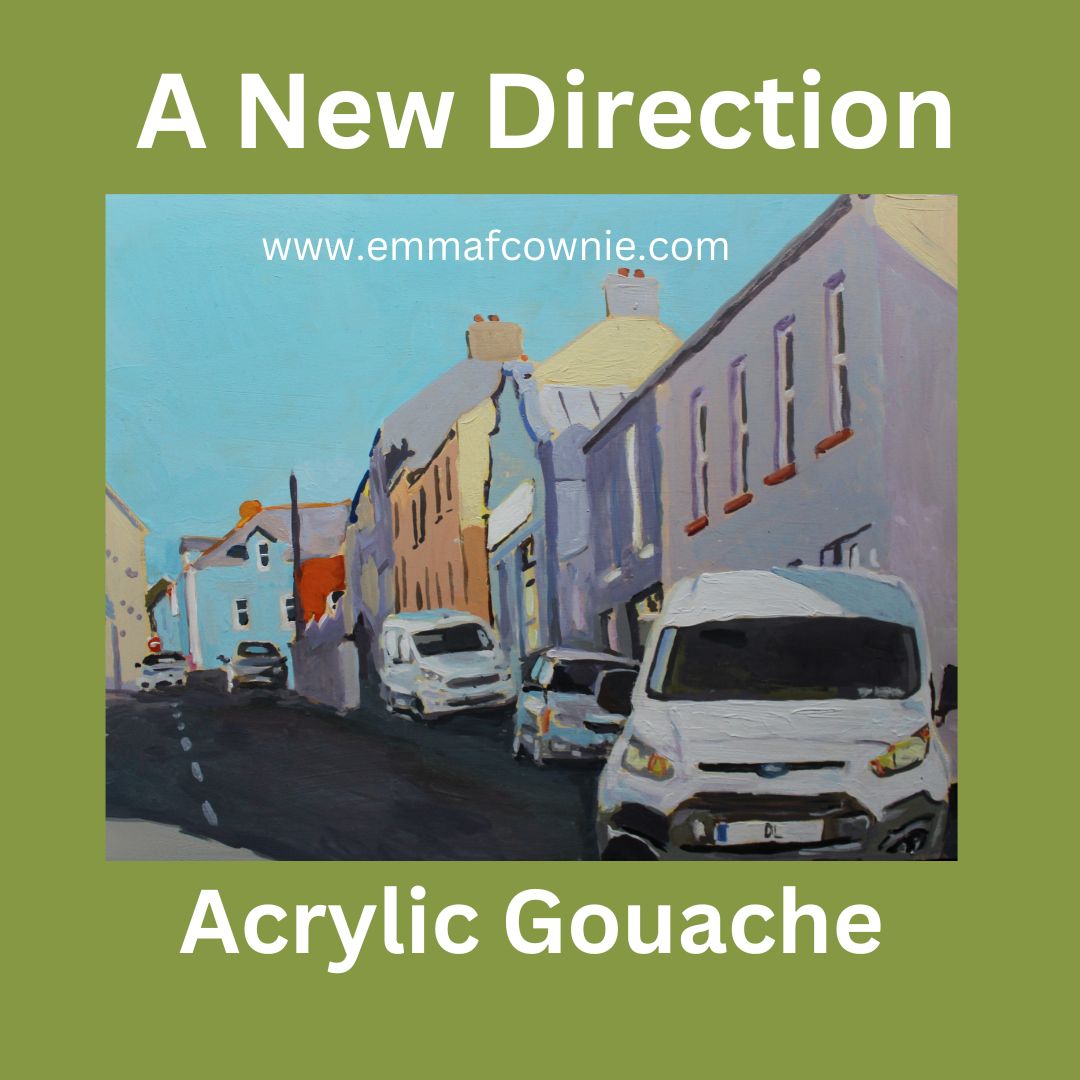
A New Direction: Acrylic Gouache

New Direction - Acrylic Gouache by Emma Cownie

Here is the painting that finished me off. Now I look at it after a month, I am not sure why. I just felt like I had run into the sand and needed a change. I had been doing a lot of reading about composition but I suspect it had more to do with taking too long to paint. Acrylic paint often requires several layers to achieve the opacity of oil paint. I was getting bored and tired and I wanted to try something new. A change is a good as a rest.

Toralaydan Island, West Donegal

So I took a month off posting new work on facebook & instagram, to give myself head space. Some artists love being filmed live and showing their “process” – I am not like that. I get very self conscious and often will immediately screw up a painting if I take photos too early in its development. It’s one of the reasons I cannot bear to paint outside “en plein air” – people understandably want to see what you are painting and that makes me feel very self-conscious. I really dont know how people go on TV shows like “Landscape Artist of the Year” and produce really good paintings, or half-way decent paintings at all, in fact. They must have nerves of steel. I don’t. In fact, I know that many of my paintings can go through stages of looking quite rubbish before they (almost always) emerge butterfly-like from the murk and layers. It’s a lovely (and sadly rare) experience when a painting look interesting/beautiful all they way through the process of coming into being.

I had bought some tubes of Acrylic Gouache in the spring but had not got around to trying them out. Now I opened that box of paints and gave them my full attention. I had been looking for a water-based paint, to reduce the risk to my pets, especially my young inqusitive cats. I had had oil paint/white-spirit incidents with pets in the past when we had a lot more space and I did not want to take that risk now. I also wanted opaque paint. I had discovered that some American artists, whose work I liked, used Nova acrylics which is pretty opaque but they did not have a UK stockist. I was cautious about importing paints from the US as I once ordered a load of paint from a sale from JerrysArtsarama only to get stung by customs and VAT charges. So any saving I had made in the sale were wiped out! I also considered Golden SO FLAT matte acrylic paint but I am not a great fan of Golden colours. Dont get me wrong, some of their acrylic colours are great (light ultramarine for example) and I know many artists rave about them, but I don’t LOVE them. They were also sold in a jar rather than a tube, and I could just see me absent-mindedly sticking my dirty paint brush in a jar and mucking up the colour. I prefer tubes that I can squeeze a tiny bit of paint out onto my wet palette and keep my colours clean.

Not the set I bought – I wish!

I saw that Jacksons Art stocked Turner Acryl from Japan. I watched a couple of videos comparing different makes of Acrylic Gouache and liked the vibrancy of Turner’s paint. There is not a lot of information about acrylic gouache, unlike regular acrylic (I have several books on the technical aspects of using this acrylic). I keep reading the same thing – its a cross between gouache and acrylic. Gouache is a water-based paint which can be opaque (unlike water colours which are usually transculent) and it can be reactivated with water. Acrylic gouache, however, once dry, sets like acrylic and cannot be reactivated with water. It dries pretty quickly too. It dries to a smooth velvety matt finish too. It is used by illustrators, especially anime.

An example of anime art from Instagram from @happy.artistry
Look at the lovely rich colours!

The colours are lovely but I have a lot to learn. There are so many wonderful rich colours and I can see why these [paints are popular with illustrators. Unlike acrylics or gouache, there is little to no colour shift. It is non-toxic. It does not dry lighter or darker. I am finding this hard to get used too. I am overcautious about laying down darker colours. I have to learn this again and again. I often dont make my paintings dark enough as I am afraid the strong colour of the tarmac road will overwelm the painting. I have to repaint the shadows.

I feel out of control with it at times. Sometimes that is exciting, others just scary.

Winter Morning on Academy Road, Derry – Acrylic Gouache on wood Panel 2024 – An early effort

I painted a load of duff pieces before I started to feel I was getting somewhere with “Ardara”.

Ardara – Acrylic Gouache on Wood Panel 2024 – Another early effort

I felt that a new medium required new subject matter to set it apart from the rural scenes I had focused on since moving to Ireland in 2021. My work had previously described by Niall McMonagle in the Irish Independent as a “Clear bright glimpse of a vanishing Ireland”. I wanted to mix things up and paint a more contemporary version of everyday Irish life.

This meant scenes with cars. The Irish love their cars. I have painted cars in the past but not for a very long time. It was usually at night or in the rain (at night) so you could not really see them properly.

Painting of car in a rainy night street
My Pop Art – The Driving Rain (SOLD) Oil on Linen Canvas, 2015
Coming out of Shell
Coming out of Shell, Oil on Linen canvas (SOLD) 2020

It was in 2017 that I decided to pursue “Urban Minimalism” for my “Hollowed community” project for the MadeinRoath festival in Cardiff. For a long time, I have sought out empty scenes with no cars or people. It found it cleansing. The Morris Minor (below) was one of few exception to this. This vintage car was parked around the corner from our home in Brynmill. I used to hear the owner drive past our house on the way to the paper shop every morning.

Urban Minimal style – Morris Minor 2018 Oil on Linen Canvas (SOLD)

Now I decided on a volte face and to seek out street scenes with cars to challenge myself. Car are difficult to paint. I know some people will disagree with me, but in themsleves, they are not intrinsically beautiful, although the light reflected on their surfaces can be. I am more a fan of vintage cars like the Morris Minor and old-style minis (genuinely small cars) and enjoy the colours used by Italian manufacturers such as Fiat 500s. Too many cars in Ireland are black or grey. They don’t make for interesting compositions. Surprisingly, Lorries do. In the right place.

Painting of cars on Bridge Street, Carndonagh, Donegal
Deliveries on Queen Street, Derry – Acrylic Gouache on wood panel 2024

I wanted to paint with speed. I was bored of spending days or even weeks on a large painting. I wanted to work fast keep things fresh. I tried hard to resist overpainting. I left wobbly lines where possible so as to convey some of the energy of the urban areas.

Derry is a very lively city. I also wanted to explore town/city life on both sides of the border in Donegal and Derry, in Northern Ireland. The building stock is very different depending on which side of the border you are. The number plates maybe different but the cars are pretty similar.

Bogside, Derry – Acrylic Gouache on wood panel 2024

Light and shadows continue to be a theme in my work.

Carn (Donegal) – Acrylic Gouache on wood panel 2024

I have found this both challenging and exciting. I have produced quite a few paintings that didn’t work, especially at the start but I just pushed on. I knew that there would be a lot of wastage at the start. The only way I would get the hang of this medium was by painting a lot. I learn through my hands, mixing the paint and then placing the paint on the board. I have not yet achieved the consistency in my work I am used to with oils and acrylics.

I also had to deal with the fear that people might not like this style of paintings or the subject matter. That’s why I had to stay off social media until I felt like I knew what I was doing (sort of). I have shifted styles and subject matter before. There are themes I have focused on before and I am revisiting them. Others are constant – shadow and light. Strong dynamic compositions are also important.

I used to alternate larger landscapes with smaller people/animal paintings. This way I kept my interest in what I was painting. But I seem to get stuck painting landscapes when I came to Ireland. I am not sure it was good for me as an artist. I need to mix things up to keep them fresh. I don’t know where I am going with this but I feel I need to persue this trail for a while longer. I just have to keep going to see where I end up.

About Acrylic Gouache and Stockists

Also direct from Japan Japan Art Supplies – no customs duties for orders under £135. They provide an excellent service with tracking information.

Posted on 1 Comment

Gola; The Island that waits patiently for people to return

Gola

I am delighted that Peter Zantingh, a Dutch blogger, wrote this an account of Gola and my work. I have translated it for you to read (well, Google did). You can read the original here.

“In the autumn of 2018, Emma Cownie looked out from the Irish mainland at an island she could not get to. It seemed so close. She could see the rocks off the coast and beyond them, scattered seemingly at random across the rolling land, the whitewashed cottages. Some were abandoned, others clearly still inhabited, or used as summer homes.

Gola Island is one of 365 islands off the Irish coast. It is just two square kilometres in size. No one knows exactly how many people live there, because there are more in the summer than in the winter. Ferryman Sabba only goes up and down between June and September.

But in 2022, there were fifteen people living on Gola, according to official figures.

Emma Cownie is a British artist. She studied medieval history at Cardiff University and taught at a secondary school for a while. On 29 February 2012, she was hit by a car. It was, in retrospect, what prompted her to take up painting full-time. The days in front of the class were exhausting, almost all contact with other people in fact, she was startled by every sudden sound. A few years before the accident her dog had been run over on a busy road.

Painting helped.

In the days after she had stood on the mainland looking at those houses in the distance she painted Spring Light on Gola. It came, she told me, ‘out of a kind of longing for the island’.

In the spring she went again. It was early April, sunny but chilly, a cold wind blowing along the coast. Her husband Séamas was with her, their dog Mitzy too. To get the best view of the island – again there was no ferry – they walked along long stretches of beach and climbed on granite boulders, almost pink in the spring light. From here she could see the houses that had recently been renovated and modernised.

That summer she was finally able to go there. ‘There are hardly any cars’, she told me about it. ‘Just a few tractors, no telephone poles or electricity pylons and only a few other people. Other than that, just birdsong and wind. It’s bliss.’

donegal painting of Gola, West Donegal, Emma Cownie.
Spring Light on Gola (Sold)

*I emailed Emma Cownie last month with a simple question. One of her paintings was used on the cover of one of my favorite books, Foster by Claire Keegan. I wanted to discuss that book in my newsletter, and I would like to show that painting as well. Would that be okay? I would mention her name and link to her website.

She responded the same day, and we got to talking. She said that the painting I had asked about was called Traditional Two Storey House, Gola, and that it was nice to hear from someone from the Netherlands, because although she regularly sees Dutch campers in Donegal, the county in the northwest of Ireland where she lives part of the time, she has never sold work to anyone from the Netherlands.

The title of the painting made me curious. Gola? What was that? That’s how I became fascinated with the island in my own way.

At one time, there were about two hundred people living there, who made a living from fishing and small farms. But after 1930, the population began to decline. Especially in the winter, it was easier to earn money in the cities, especially those of Scotland and England, and fewer and fewer people returned for the summers. In 1966, the island’s school closed; with only nine pupils (there used to be sixty), it no longer had a right to exist. The few families with young children were forced to move to the mainland – and once the last family with children had left, the community was doomed.

I read this last in Gola: The Life and Last Days of an Island Community (1969) by F.H. Aalen and H. Brody, which I ordered for a few euros on boekwinkeltjes.nl or Abebooks. I think I mainly wanted to know what happened when the last ones left. How does a group of people dissolve itself?

Gola: The Life and Last Days of an Island Community (1969) by F.H. Aalen and H. Brody,

Brody, a sociologist who wrote the part about the last days of the community by the two authors, saw a kind of laconic group feeling among those who were still there at the end of the sixties. Everyone wanted to stay, if the rest stayed too. Everyone thought it was okay to go, as long as everyone else went too.

The most intriguing aspect of each islander’s account of his own predicament is his insistence that it all depends on the others. […] The general attitude is one of wait and see – what the others do. But all of the Gola people are waiting on one another in this way, and do not seem to mind the impasse that this conditional planning involves. Of ten islanders who related their plans, nine said they would like to stay, but it depended on the others. One man said he would stay so long as he had a dog with him, and could not see any advantage to life away from the island. Apart from that one man, all stated they would be glad to remain on Gola, but did not really mind leaving.

The authors also contributed to a short documentary for the Irish public broadcaster RTÉ from the same year, which shows how one family, the O’Donnells, leaves the island. They lock the door and walk with their dog, a long-haired collie, to a motor boat in the harbor. They are all wearing black. (Screenshots from the film below)

Five people remained: fisherman Eddie, fisherman Tadhg, postman Nora and her husband John, and ninety-year-old Mary. It would not be long for them either.

What was left behind? The island had no shop, no pub, not even a church. “The islanders worship on the mainland when the weather is good enough to make a safe crossing,” Brody wrote in 1969. Just over thirty houses remained, most in poor condition. The schoolhouse and the post office. Wooden boxes and fishing nets in the harbour, where a statue of the Virgin Mary, housed in a stone shrine, continued to look out. Two pegs on a washing line.

Between 1969 and 2002, Gola was an uninhabited island. In Dances With Waves: around Ireland by Kajak (1998), Brian Wilson (not the Beach Boys guy, another Brian Wilson) writes about the time he went ashore during his nearly two-thousand-mile kayak trip all the way around Ireland. He hoped to find some peace and shelter that day, but he encountered “the eerie atmosphere of a ghost town”. Fishing boats lay rotting in the harbour among the washed-up debris.

But he found something more hopeful in the cottages. They were “abandoned, but not in decay”.

[…] one felt as though, like faithful dogs, they were just waiting for their owners to return. More than that, it was as if the island itself was still waiting. And the people came again. They came back. Somewhere around the turn of the millennium, the first ones crossed. Today, most of the cottages are still uninhabited, but in summer the sounds and movements of people join those of the cormorants, guillemots and gannets.

Emma Cownie has made more than 25 paintings of Gola in recent years.

For Traditional Two-storey House, Gola, the painting that made me contact her, she returned to the ‘rules’ she had set for herself a few years earlier. These rules – not coincidentally – coincide with how she wanted to organise her life after the car accident and the difficult time that followed: no cars, no people, bright light.

Furthermore, there must be shadows, preferably diagonal, in simple shapes. The painting must be about the interplay between shadows and man-made constructions, the tension between 3D buildings and 2D shadows.

She also wanted to think longer and better about colour. Not to choose the brightest colour, purely for effect, as she had done before, but to work more subtly. In a new series of works based on the houses on Gola Island, including Traditional Two-storey House, she resisted the urge to make the shadows very dark, the sky pale pink and the grass yellow and bright green. “I tried to keep the shapes and colours as simple as possible without it being a cartoon,” she told me. “I wanted to capture the essence of the place.”

Oil painting of Gola Donegal by Emma Cownie
The Traditional House, (Gola)

She painted the picture in January 2021, during a Covid-19 lockdown in Wales, where she was then living. That summer, she and Séamas moved to Donegal, in the north of Ireland.

It was the following summer, 2022, that she was approached by the prestigious London publishers Faber & Faber: they wanted to use Traditional Two-storey House for the cover of Claire Keegan’s Foster, originally published in 2010.
“I didn’t realise what an honour it was until I got a copy of the book and read it,” she said. “I cried at the end.”

Foster by Claire Keegan, Published by Faber

Is there a writing lesson in this? I don’t know. Maybe that there’s more to everything. Maybe it’s worth following your interests and fascinations without reservation. To notice it – this interests me, this grabs me – and follow that line, see where it takes you.

Posted on 13 Comments

Summer on Three Cliffs Bay

Three Cliffs Bay in Summer bay Emma Cownie

Three Cliffs Bay never disappointed. It did not matter how many times I saw it. The sight of it always caused me to catch my breath; when I saw it from the road, from the slopes of Cefn Bryn or from Pennard Cliffs.

It is one of the things I miss about living in South Wales. I imagine it in sunshine, although I am pretty sure the Summer in Wales this years has been as poor as it has been in Ireland. It may well improve. Septembers were often best for sunshine. Just as the schools had gone back!

Emma Cownie with Gower painting
Here’s me posing with the painting! – Sunny Morning Haze on Three Cliffs Bay (Gower)

I used to get up early in the morning and drive down to Pennard to walk along the edge of the golf course, past the dog walkers, to see the sea and take photos. This is a new painting (see above).

Once I found an excellent parking spot opposite the corner shop in Pennard, only to find I had forgotten to put the battery in my camera. I wasn’t carrying a spare. So, I had to drive all the way back to Swansea to fetch the battery. The journey seemed to take forever (as I cursed my stupidity all the waythere and back) but when I got back the conditions were still lovely.

It was low tide and you could see the river, the Pennard Pill, at its meandering best. When you first come to Three Cliffs you assume you can easily cross the Pill in your bare feet. You can at the shoreline but it get deeper quite quickly. There are stepping stones further up stream. In boot-wearing weather, its a short walk inland to cross at the stones. My painting (see below) Two Rock, Three Cliffs is near to the stepping stones.

Here is my other new Gower painting.

Read about my 2018 walk along the Gower Coastal Path here

Posted on 20 Comments

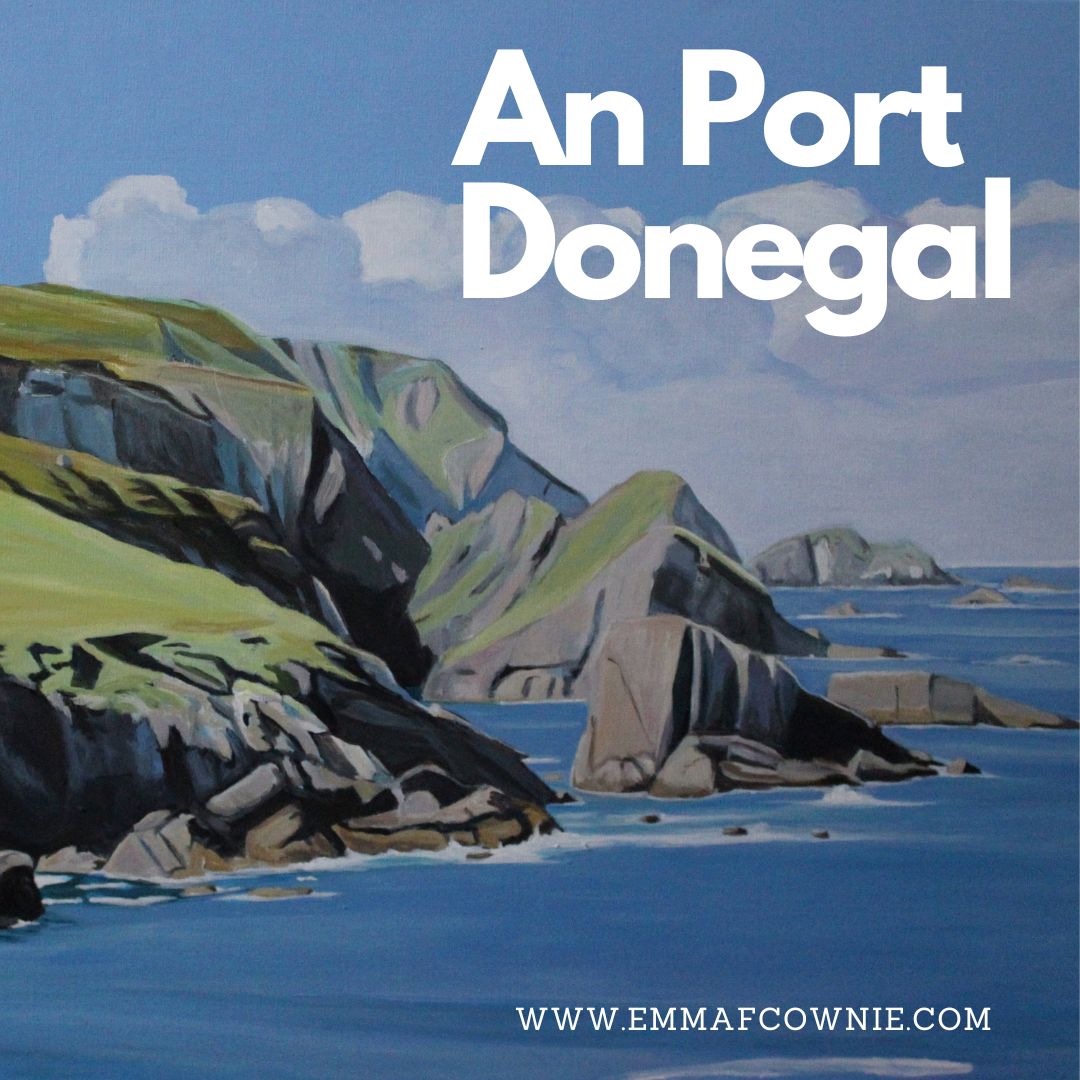
An Port (Donegal)

Painting of An Port, Donegal

An Port has loomed large in my imagination for a long time. It’s very remote and quite difficult to get to. To reach it, you have to drive down a very, very long single track road (it’s about three miles but it feels longer) on the way to Glencolmcille. There are plenty of sheep and only a few people.

The Road to Port
The Road to Port

At An Port there is a small quay and a tiny deserted fishing village which looks out over a small bay, surrounded by cliffs and truly massive slabs of rocks and sea stacks. Its one of those landscapes that you imagine can be found all along the west coast of Ireland but is actually unique. When I visited Texas in the late 1990s I thought it would all look like Monument Valley, thanks to those John Ford films. I was surpised to find it was pretty flat.

An Port, Donegal - pphoto creditEmma Cownie
An Port, Donegal – photo credit Emma Cownie
An Port: Photo credit Emma Cownie

The village was still inhabited in the 1920s. The hillside is littered with the remains of the stone houses

Remains of houses at An Port: Photo credit Emma Cownie

There is one inhabited house, now an AirBnB property. You can see it on the hill behind me in the photo my husband took of me (below). This was Annie McGinley’s family home.

Me at An Port
Me at An Port

I first heard about Port in 2018 from a TV programme about the famous American landscape artist Rockwell Kent and his stay in Donegal the 1920s. Rockwell Kent is probably best known today for his illustrations for Moby Dick.

Moby Dick Illustrated by Rockwell Kent

Unfortunately Kevin Magee’s film (in Irish with subtitles)    “Ar Lorg Annie” or “Searching for Annie” is no longer available but you can see a short clip on Youtube here. A friend of Kent’s,  Rex Stout, had funded his trip to Ireland. He paid him $300 a month on the condition that he had the choice of two painting when he got back. This is one of them in California,  “Prince Charles’ Cove”.

https://donegalnews.com/2018/04/58113/

Rockwell Kent and his second wife Frances Lee Higgins (they were on honeymoon) spent several months in the near by valley of Glenlough on a farm belonging to farmer Dan Ward. Kent stored many of his paintings back at Port, in the home of Annie McGinley, who modeled for him. Her she is.

"Annie McGinley" now rests in a private collection in New York
The original “Annie McGinley” now rests in a private collection in New York,

Rockwell Kent returned to Donegal, 32 years later. He had wanted to buy Dan Ward’s farm but it had already sold to another farmer. Instead he sought out ‘this singularly lovely teenage girl with whom I had danced many a jig’ and found her in nearby Crobane, married, midddle-aged and ‘broad-beamed’. She had had 14 children, 12 had lived.

Annie McGinley 1958
Annie McGinley and Rockwell Kent in 1958

Rockwell went to find Annie’s long abandoned cottage in An Port where in 1926 he had dried his Donegal paintings. It turned out to be the only structure still standing, barely supporting the weight of an overgrown thatched roof, a year or two from dereliction. ‘This house, we thought, we ought to buy and fix and have as a place to come every year …’ but he didn’t.

Painting of fishing boat at Port Donegal
Fishing Boat at Port Donegal-Emma Cownie

If you look on the left hand side of my painting “An Port” (below), you will see tiny fence posts along top of the cliff. They help give a sense of scale of the huge cliffs and rocks. I can’t remember who first described this landscape it as the “land of giants”but it truly apt.

painting of An Port, Donegal
An Port, Donegal_Emma Cownie

It is hard to do justice to this incredible landscape but I think that Rockwell Kent’s paintings do. He really capures the majesty and warm colours of Donegal. He also excels at Donegal skies and light. I am really in awe of him.

 https://www.wikiart.org/en/rockwell-kent/sturrall-donegal-ireland-1927

Rockwell Kent – “Sturral”  https://www.wikiart.org/en/rockwell-kent/sturrall-donegal-ireland-1927
 

I wish I could see the original paintings but this is very unlikely. It seems that none of Rockwell Kent’s large paintings stayed in Ireland. Most of them are either in the USA or in Russia. But that’s another story.

Read about my visit to Glenlough here

SEE DONEGAL PAINTINGS                                             BUY DONEGAL PRINTS 


I have added a few links about the artist Rockwell Kent below.

Rockwell Kent and Donegal

http://in8motivation.com/tag/rockwell-kent/

https://www.gleanncholmcille.ie/rockwell_kent.htm 

https://www.bbc.com/news/uk-northern-ireland-44534911

Click to access The-Missing-Irish-Kent-paintings.pdf

Irish paintings of American artist Rockwell Kent in new documentary Ar Lorg Annie on TG4

The Girl in the Blue Dress

https://www.sullivangoss.com/artists/rockwell-kent-1882-1971 Includes a chronology of his life (but doesn’t mention his Irish trip)

Christy Gillespie The Road to Glenlough  – A massive book on the History of Glenough Valley

Stay there/near by 

https://www.bizireland.com/port-donegal-cottage-087-253-3166

There is the amazing Cropod too which got rave reviews in the Irish TImes more than once  – https://www.irishtimes.com/life-style/travel/2022/09/01/cabin-fever-12-get-away-from-it-all-cabins-to-retreat-to-this-autumn/

How to Get there

http://www.welovedonegal.com/port-ghost-village.html

Climb the stacks (if you are brave enough – not me!)

https://uniqueascent.ie/  There are some excellent guides to the seastacks of Donegal on this site.

Posted on 2 Comments

Passive Smoking

Oil painting of people in Swansea town centre
Passive Smoking

This, like a number of my recent and forthcoming works, will not be available to buy for the foreseeable future as they will be exhibited first but I am posting details of them to keep collectors and artlovers up to date with my recent work, inspirations, and directions.

This painting is a new painting is heavily influenced by North American artists in its colouring and in its subject matter, namely the frisson that comes from human interaction, in the most apparently mundane settings.
I loved this scene, as the man seems ill at ease and not sure whether to leave or remain. He may even feel guilty that he is kinda in ear shot of the couple’s conversation and may appear to be eavesdropping. He was there first and then the couple joined him, to eagerly gossip and have a quick cigarette break. They seem so comfortable in each other’s company compared to the man who seems very ill at ease, aggrieved at having to endure their smoking and the drifting grey-white fumes.

Buy here

Posted on Leave a comment

The Time In Between


Oil painting of woman waiting for the bus.
Time in Between – SOLD

The title refers to the time before one activity, after another activity has ceased. A limbo period filled with change checking in her purse, as she waits for her bus to arrive.

The composition is, as with many of my works, influenced the diagonal compositions as used by Henri Carter Bresson. The colouring is influenced by American artists such as Hopper and Eric Bowman. I have deliberately tried to imbue this portrait with pathos, elevating a mundane act into something semi sacred, as the light is Cathedral-like as it shines through the high glass panels of Swansea Bus Station onto her chunky cable knit cardigan.

Posted on Leave a comment

Enchanted Wood

022
Enchanted Wood (SOLD)


This is a painting of a most enchanted wood, halfway between Ilston and the Gower Inn in the Parkmill area of Gower peninsula in Wales. These woody areas, as many artlovers will have realised by now, are a constant source of inspiration for much of my refractionist and post-refractionist work. This pine wood lies on one side of a bridge with ancient woodland on the other, the contrast between the knarled, mossy twisted ancient branches of the ancient wood across the bridge in clear contrast to the straight, textured, orderly pine trees this side of the bridge. In fact, crossing this bridge gives one a heightened sense of having moved from one region or realm to another, adds to the feeling of having been transported somewhere different.


This is the inspiration for this painting, this feeling as we view the clear late October light falling across this woodland path. I tried to catch the fact that the path is covered in layers of pine needles, mulched to make the most soft and slightly bouncy carpet of needles. It is these needles, layers heaped and heaped on each other that softens the light and gives it texture, catches the light in its soft grasp, making it almost fluffy. The carpet of pine needles fall to create a complete deadening of noise in this wood which is quite a beautiful affect, this complete silence. This adds to the wood’s sense of enchantment. The silence makes this almost a world apart, a secret quiet place to escape to and roam and explore and enjoy as a child. It is a great escape to somewhere unusual and oddly mystical. Enchanted even…

The painting has sold but you can buy a large limited edition mounted print here

Posted on 1 Comment

Windswept Inspiration

287b

Every weekend my husband and I explore and almost mine the beauty of Gower peninsula with its amazing variety of beaches, woods, hills and valleys for inspiration for my next paintings. Increasingly I have used this peninsula to keep my artistic juices flowing. It is almost as if we are harvesting the beauty of Gower in some way and using it to create art before sharing this bounty with art lovers throughout the world.

Different paintings of Gower adorn walls in the homes of art lovers on various continents. Our weekend walks are not just for our aesthetic enrichment but for others too it would seem. What a joy to share the beauty of this stunning peninsula designated Britain’s first Area of Outstanding Beauty.

Posted on Leave a comment

A MEDITATION ON ART, PAINTING AND PLACE.

Umbellifers

In a meditative manner, to the music of Eric Satie’s gorgeous “Trois Gymnopedies”, I attempt to describe how working close to nature but in the city is a major influence on my painting, blending with my technique to create my artwork. In fact, place and painting are inseparable. I am greatly influenced by the light and beauty in Wales and around the Swansea area in particular. Most of my paintings inspired by the bountiful beauty that surrounds me, the sounds as well as the images. You might even notice the odd inspiration that made it to be a painting too (as well as the odd painting of my inspirational Swansea). Welcome to my Attic Art Studio and the place and surrounding area that inspires much of my artwork.