I used to like painting landscapes and cityscapes with clear blue skies. I waited for the bright sunny days of early summer to walk around, taking photos and looking for inspiration. Thus, my series of urban minimal paintingsof Swansea, made the town look a bit like a Mediterranean location!
What a joke. It rains a lot in Wales. It has rained incessantly for the past two days. Since my extended visits to Donegal, however, I have become increasing inspired by cloudscapes and the silvery light along the Atlantic coast. With my “new eyes” I have started waiting cloudy days in Wales to go out looking for inspiration. Not overcast days, but days with patches of blue sky and sunshine.
I drove down to Pennard, with the idea that I wanted to paint Pennard Pill, the river that follows into the sea at Three Cliffs Bay. The BBC forecast claimed that it would be sunshine and clouds all morning. When I looked at the Mumbles and Caswell Bay webcam, one showed sun and the other was overcast. I set off, anyway. I would go for a walk, regardless. On my way there the sun came and went. As I drove past Mumbles head, I could see it swathed in a light misty cloud. I wondered whether there would be anything to see when I got to Pennard.
Thankfully, the sun was shinning at Pennard as I made down the path that runs alongside the golf club. The tide was coming in and I could just see Great Tor in the distance, through the peaks of dunes. When got close enough for a clear view the sun promptly went in! I looked up at the sky and looked for blue patches. There were quite a few. So I carried on towards Pennard Castle, which is situated on the top the of the high dunes, further inland. I hoped the sun would reappear by the time I got to Pennard Castle. I tried to work out which way the clouds were traveling. Usually, they move from Oxwich Bay towards Three Cliffs. Today they were going the other way. The sun came out a few times on my walk. Just as I was climbing up the sandy path the castle I came out and lit everything up like a technicolor Hollywood film!
Pennard Castle
The sun promptly went in again. I stood in the ruins of the castle and waited. I thought about the fairies who had supposedly destroyed the castle with a sandstorm when the lord of the castle had refused to invite them to his wedding party. Eventually, the sun broke through and lit part of the valley below.
Pennard Pill
I watched the light move across the valley and the colours burst into life.
Pennard Pill in sunshine
I then decided to walk back towards the sea and see if I could photograph the three peaks that give the bay its name. The clouds rolled in.
Clouds over Pennard Golf Course
I would have gone home at this point, as there was a cold wind and it was almost lunchtime but I could see bright light off in the distance. It was on the far side of the Bristol channel. I could see a ship on the horizon lit by this light.
Ship on the Bristol Channel
How wide was this stretch of water? Miles. How long would it take for that shaft of sunlight to make its way over to the Gower coast? A while. So I waited. I am not very good at standing still so I walked around a bit, watching the dog walkers and small family groups vanish from the landscape.
The clumps of large mushrooms spotted about the grassy parts of the dunes, made me think of the fairies again.
I climbed dunes, trying to decide good locations for photos for when that shaft of sunshine arrived. It was definitely coming my way. A new set of walkers was arriving on the beach. They were all optimists too!
Cloudy Three Cliffs Bay
Hunger was starting to make itself known. I slouched down against a dune. Patience. Patience. What was the point of giving up now when I had waited so long? Impatience comes from wanting to be somewhere else. I needed to be here now. I thought of a line I heard Van Morrison sing at his 2015 Live 70th Birthday Concert at Cypress Avenue, Belfast “It has always been now” (52 mins into the clip). He’s a genius. He captures the joy of being truly present in the moment. Just as I was saying that to myself when the sun arrived and the technicolor lights were on!
The three peaks
That doesn’t quite capture it. Here let me show you. My view of the world.
A Gap in the Clouds (SOLD)
That’s more like it.
Now I could go home and eat lunch. Paint and listen to Van Morrison.
I managed to make it down to Rhossili Bay this week. It has been raining on and off for weeks. I have been painting in my attic studio listening to the rain thundering down and I have got quite tired of that sound. So when I was greeted by clear skies I decided, on a whim, to drive down to Rhossili to see the autumn colours.
Rhossili has a wonderful windy wildness to it. It’s unlike the rest of the Gower Peninsula. The trees all lean heavily away from sea and the prevailing westerly wind. As I drove into the village I was caught up in a sheep-jam. A herd of sheep was being moved from one field to another. They were packed into the little road and had stopped the traffic (it was three cars actually). I watched the mob of sheep as they swirled in front of my car and past me. They were Welsh Mountain sheep; only a few had horns. Their creamy fleeces were spotted with brightly coloured red and purple “smit” marks. These are marks painted by their farmers that denote ownership. One moment they were packed around me and the next they had moved on.
There was space in the church car park so I parked and put my donation in a slot in the wall. This car park is closer to Rhossili Beach. If I had wanted to walk to Worms Head itself the National Trust Car park with its facilities (loo block and shop) would have been better. From here I walked down a stepped concreted path down towards the beach. It seems strange but I have never walked on this particular path before. I don’t know why. I have always walked parallel to the beach along the cliffs paths (one on the top of the downs and one in front of the rectory). I wrote about the coastal path in several blog posts and in my book, Footnotes: An Artist’s Journey Around the Gower Coast.
Rhossili Bay (View From the Path)
So I followed the path downhill and got a different view of the Worm. The bracken had died back to a wonderful russet colour (one that I associate with wales) and the sea was a beautiful turquoise blue. The tide was out and the tidal island, the Worm (Wurm) rose up above the waves on the horizon. I looked at how the light caught the back of the Dragon and remembered how arduous walking across it was.
Over to Worms Head SOLD
The walk down to the sea was quite steep but easy. The final descent was down a ramp of gravel. The vast beach was surprisingly populated for a term-time day in the week.
Worms Head Rhossili
Of course, I could not pass up the opportunity to visit the remains of the Helvetia on Rhossili Beach. The Helvetia was a Norwegian ship bound for Canada that was wrecked in south-easterly gale on Rhossili Bay over 130 years ago on 1st November 1887. In the Instagram age, given its picturesque location, its not surprising that it has been photographed and shared countless times.
The Wreck Of The Helvetia, Rhossili, Gower SOLD
I walk across the beach to bottom of the vast 200-foot cliffs, looking at the colours and light. There are seagulls scattered across the beach and when I turn back I can see the Rhossili Downs and the Od Rectory reflected in the outgoing tide.
Rhossili Reflection
On the far edge of the beach, I was surprised to discover the remains of another shipwreck in the sand. A bit of online research and I discover that this is Vennerne, apparently, it is known locally as the Vernani, and it was dashed to pieces under the Rhossili cliffs in 1894.
Another Wreck on Rhossili Bay
There is quite a strong breeze. When the clouds roll in it starts to feel cold. The clouds create a softer light. The grays and purples dominate. I am glad I have my woolly scarf on and start to make my way back to my car. The path hill is pretty steep and the climb warms me up.
Cloudy Worms Head
The next day, I am tired from walking across the sand but it doesn’t matter as its raining again.
Commissions are usually pretty interesting because they will challenge me in some way or another. This particular commission’s challenge was about scale. Now, I don’t usually paint large paintings because I just don’t have the space to store many of them. I have a few but I am not keen to paint many more as and I find it difficult to paint in a crowded attic studio, both on a practical level (if you look at my photos carefully you can see its crowded in my studio) and also psychologically (it starts to bug me). So if a commission requires me to go large I am quite excited by that prospect. Excited and a bit scared.
This commission was based on a relatively modest-sized painting I had recently painted of Gola Island, Donegal. This is 41x33cm, that’s 16 x 13 inches for non-metric people.
Up from the Pier (Gola)
As you can see from the studio photo, the original fits on the seat of a chair. It is a favourite of mine. I have many favourite paintings, this is my current one.
The commission canvas size was to be 120 x 80cm (47×32 inches). Which is pretty big for my little studio. The canvas I could cope with, but the cardboard box it was arrived in is annoying me as it’s ended up by the railings by the steps to the attic. It’s in my way.
So I pondered the issues with scaling up this painting. The joy of small paintings is that you can hint at all sorts of things with a brushstroke or two and the brain will do the rest of the work. There’s no hiding place when the canvas is over a metre in size.
Up from the Pier (in-studio)
So the first change in my approach was scale. I printed out my reference photo on a much larger piece of paper. My original photo wasn’t much bigger than 10cm (4 inches) square. Don’t ask me why. I like to print off a lot of images at one time and then ponder which one I want to actually paint. For the commission, the photo was closer to A4 size (7×11 inches) and amazingly, I could see much more detail! So I focused a lot of attention on the buildings and caravan on the horizon. I paint with a small brush get the details of the light on the houses and ruins.
Sketching out the commission
I generally work from left to right when I am painting so as not to smudge work with my hand and the next part I worked on were the rocks and the grassy verge to the left of the track. The real joy of painting vegetation in Donegal is the many varied greens and yellows. I love picking out the different hues. I have to make sure that my colours match the colours in the reference photo as closely as possible. It sounds daft, but I hold up the paintbrush next to the photo to check I have the right tones.
The grass and bracken in the main part of the painting were carefully reconstructed. Saying that I use much larger brushes than I do for my smaller paintings. I make sure that blocks of yellow ochres and green grass or darker bracken are in the right place. There are both warm and cool greens here. There are splashes and smudges of oranges, pinks, jade and turquoise in there too. I am trying to convey not only colour but the shape of undulating land; where the grass has grown up and in some places, covered completely the old stone walls. The island is covered in lots of wooden fence posts, but I don’t want to paint in all the wires as the eye wouldn’t see them all in that much detail so I pick out just a few of them. I wanted to recreate the spirit of the smaller painting rather than create a new painting so I have to adjust a few patches of grass, on the left-hand side of the painting, so their bluish tones echo the first painting and balance the colours in the whole. The tiny golden yellow flowers that are gathered at the bend in the pinkish track are added.
The sky is painted last. Sometimes I paint skies first, especially if it is a cloudy or stormy sky, but in this case, it’s a blue powdery summer blue and it comes last. It has the effect of bringing the whole painting together.
The commission next to the study painting of Gola
So the final stage is to sit with the painting and check that it has the same “vibe” as the smaller study painting. I think it has. I regard it as a big beast, but one I like.
I wonder what it would be like to have a massive studio where you could store bigger paintings? Would I paint larger paintings? Well, in the winter when light is short I would still paint smaller works that could be completed relatively quickly, but in the summer months when I have acres of daylight? You bet.
The artist (*ahem*) with the two paintingsThe Commission piece finished 120x80cm
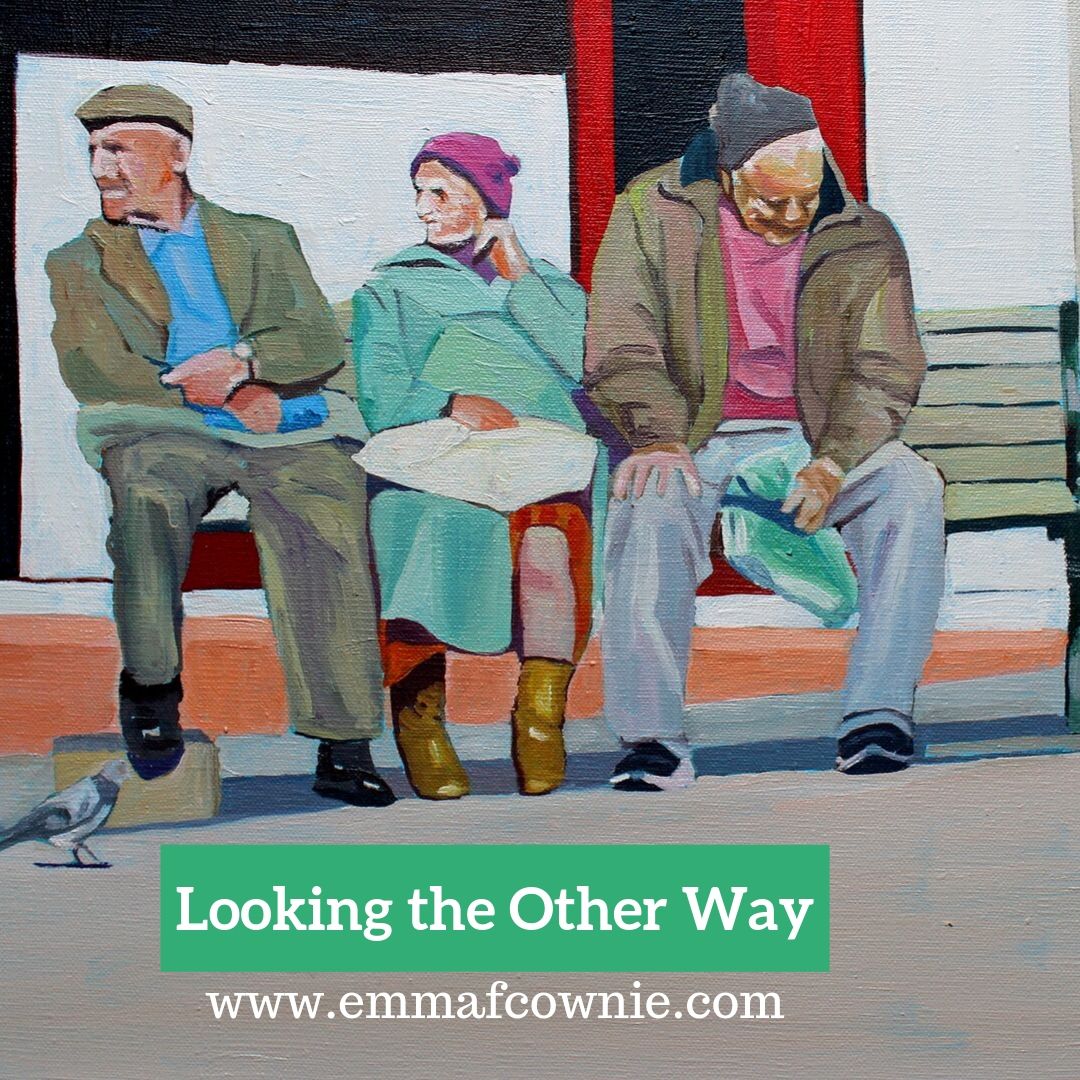
I needed to paint this picture. I have painted a lot of landscapes lately and I was missing the challenge of the human form. Or rather painting light on their clothes and faces. I was spending the week with my parents who live near Stroud. My favourite day for street photography is on Saturdays when there is a farmers’ marketand there are lots of people and dogs. Ilike painting dogs in particular. These three friends were enjoying the autumn sunshine on a bench in Stroud. I liked how they sat close together. Are they related or just friends? The two on the left have a similar style. Perhaps they are married? The street is very steep and although the bench is level, its always as if gravity has pulled the three of them to one end of the bench.
I loved the colours of the woman’s green mac and purple hats and how they worked so well with the men’s pink and blue tee shirts. They seemed to sit in a comfortable silence a lot of the time. The pigeons were not important. They were just hanging around. People often eat here as a baker’s shop is near by. The pigeon in the foreground was in the process of stepping forward, and she is forever preserved as if she only has one leg. When I lived in London, a couple of decades ago, I often saw pigeons with toes and feet missing. They were presumably eaten away by a sort of pigeon leprosy, so I always delight in seeing a pigeon with healthy feet. The man in the pink top looks down, is he looking at a pigeon or just lost in thought. Later on, I spotted this trio walking around the town, the lady in the green mac still in the centre of the trio. On another visit later in the week, the man in the flat cap was sitting on the same bench on his own.
My career as a student activist was a decidely inglorious one. I was a lazy student when it came to protests and demonstrations. I think I may have gone on maybe three or four demos in all my time as a student. Some of them were protests about against introduction of student fees and a later one was against the building of the Cardiff Barrage. I caught a bad chill after getting soaked at one demo in London and was ill in bed for a week. Sadly, I never had the courage/organisational ability to make my own poster or banner. That takes thought and effort. So I’d end up holding a boring printed poster made by some radical left-wing organisation that didn’t quite sum up my sentiments. So I am always very interested in what people put on their home made posters. I wrote a some blog posts about Art and Protest in Art of the Protest(also in Germany & China) quite a while ago, but this is about a homemade protest.
On Friday there was the global Climate Strike to protest about the climate crisis. I had no thought of going along until I heard the day before that adults were asked to attend too. There were hundreds of people of all ages in the centre of Swansea. The fact that it was a hot sunny day in late September, just seemed to illustrate what is going wrong with the climate. Extinction Rebellionhad a big presence, many of its supporters were carrying homemade drums (made from plastic washing up bowls and dustbins). They have a clever logo which is a clever play on the “X” in Exctintion and an hour glass, implying that we are running out of time.
There is an Extinction Rebellion sticker is at the bottom of the poster
I know a Swansea artist, who has given up painting to direct all her energies into working for this environmental group that believes in non-violent protest. They divide opinion, even amongst environmentalists, who say that their activities may be cause the government to increase anti-protest legislation rather than focusing on tackling climate crisis. Yet, they were only one of many organisations that came to their protest. There were people from political parties, trade unions, the Quakers, the Wildlife Trust, as well just ordinary people. One of the student organisers, who was one of the stewarts, worked with Swansea Trades Council. He said they’d been planning this protest for months and he was delighted at the numbers who had turned up.
Here are a selection of the wonderful homemade posters. I particularly liked the ones made by children. They had clearly spent a lot of time designing and making them.
Made on a pillowcase
Beautifully made banners
Teenagers’s posters tended to be simpler with clear and heart-felt statements
Small but beautiful!Just in case you wanted to criticse her for missing school…
The rally then morphed into a march that wound its way through the busy shopping streets of Swansea.
3-D!
Stopped some traffic…and ended up outside the guildhall where anyone in the crowd was invited to step to say a few words. So they did. Young and old.
Although it wasn’t planned the march ended up inside the Guildhall inside the Council chambers. I think the protesters just asked to be let in and the security guards let them. This was later reported in the local newspapers as the protest “occupying” the council chambers and the police removing them. It was hardly, that. It was a bunch of well-behaved kids, and a few adults. Some of the adults and kids said a few words including part of a speech by climate activitst Greta Thunberg. Although we probably had all had heard her say those words before, they were still moving. We all then filed out, chanting and druming all the way. There were some police near by, chatting to each other, in their van. It was very benign. You can watch a clip of it on the BBC website here. It was much more fun than my student day protests!
So it seems that protests and posters are like a good party. They need a fair bit of preparation. You hope people will turn up. Finally, you probably enjoy other people’s far more than your own!
The ferry to Tory Island runs all year round. In the summer months (June onwards) there are extra sailings. We had decided to get an early boat as Seamas, my husband said the weather forecast was for sunshine in the morning, cloudy around midday and then sunshine in the afternoon. I think we are learning to take weather forecasts for Donegal with a pinch of salt. Some forecasts for “cloudy” days translate into blue skies with a few clouds, others into a damp drizzle. We were optimistic but when we arrived at Magheroarty Pier it was overcast. Once we had parked in the generously sized car park, we had to hurry to get the boat. Magheroarty Pier is tidal, so sailings have to leave on time, time and tide wait for no man, etc.
Car at Magheroarty (Muckish Mountain in distance)
We were not quite the last people on the boat but all the downstairs seat were full so we stood on the top deck, me leaning against the body of the ship and Seamas found a large metal box to sit on, the dogs sat close to him. We could feel the movement of the boat as soon as the ferry left the shelter of the harbor at Magherorarty and at times we had to hang onto a metal grill that housed a lifeboat ring.
Queen of Aran – Ferry to Tory
Two men who were standing nearby to us were talking to each other in Irish. Tory Island is probably the strongest Irish-speaking area in the country. It sounded a bit like a Scandinavian language at times – a third Irish speaker stood to one side, listening. They each looked very different from each other in appearance, one was very blonde, one was dark-haired and the third had white hair. The dark-haired man had freckles and light eyes. It is a “look” I have seen a lot in Donegal, Seamas says it’s common in County Derry too.
Map of Tory Island
The trip took just under an hour. The motion of the boat made me feel quite ill by the time we reached firm land. I think being on the top deck made me feel the motion of the baot more than if I have been on the lower deck. It took me at least 30 minutes to shake the feeling of a dodgy stomach. Someone, later asked if we had felt ill on the crossing, and laughed when I said I had. It’s not unknown.
One of the tors of Tory Island
Tory Island lies 8 miles off the coast of Donegal. The origin of the name of Tory Island (Oileán Thoraí in Irish), isn’t universally agreed on. Yes, the word Tory may come from from the Middle Irish word tóraidhe; modern Irish tóraí; meaning a robber or bandit. Ever wondered why one of the oldest British political parties, the Conservatives, are also known as the “Tories”? The term was originally a term of abuse and meant “an Irish rebel”. The insult goes back to the era of Oliver Cromwell’s brutal campaign in Ireland when a band of Irish guerilla fighters was known as Tories.
Another explanation for the name, however, is that it may mean the “island of Tors”. The shape of the island from a distance is a tower, and its northern coastline is peppered with massive tors. This seems just as likely. I suspect that people, however, prefer the story of the name meaning Pirate Island instead of the Island of Tors as it’s more exciting. The remote location of the island has meant that the islanders have had (and continue) to rely on their ingenuity and resourcefulness.
An Baile Thiar
They have lived on the margins of the so-called “civilized world” and kept to their own rules and customs, which were not necessarily those of the mainland. Famously they refused had fallen behind with their rents and rates and a British gunboat, HMS Wasp, was sent in 1884 to forcibly collect the arrears and evict the tenants. Luckily for Tory, it hit a reef near the island and sank rapidly (not so good for the 52 who died). The locals put this stroke of fortune to the power of their cursing stone! This event is one of many Donegal stories about the spooky powers of Tory Island. You can read more in the National Folklore Collection UCD Digitization Project.
One custom that marks Tory as different from Ireland is that they have a king. It’s not a hereditary position, rather one chosen by consensus as a leftover from the days of Gaelic chieftains. Patsy Dan was asked to become king by the children of the previous king Padraig Og Rodgers in the 1990s.
King of Tory (from Wikipedia)
He was a talented musician and painter and acted as a very successful ambassador for the island. At a young age, he had befriended English artist Derek Hill, who regularly painted on Tory and he helped set up a gallery on Tory, where island artists sell their work. He was clearly an energetic man, as was known for personally greeting all the visitors to the island as the ferry arrived from the mainland. He apparently made a point of shaking hands with visitors and saying “Welcome to my island.”
Sadly, Patsy Dan Rodger, died last year and now rests in the churchyard. I saw his grave decorated a wooden cross and with stones around it. I did not take a photo because it felt like it would be an intrusion on the island’s grief. The island is without a king for the time being.
The island itself is a strange mix of very old and modern. People have lived here for over 4500 years. There are a few old cars and vans driving back from the harbour after picking up stuff at the pier.
Tory feels a long way from the mainland, although you can see the coast of mainland Donegal when the weather is clear. It is less than 2 miles long and only half a mile wide. My overwhelming first impression (once the cars and vans had driven off) and we had walked out of the tiny West Town (An Baile Thiar) was of birdsong.
Sparrows, larks and other moorland birds just singing their hearts out. The landscape is full of bold little brown birds, pipits and larks. Some of them even come near to you and sing, possibly as a challenge. We walked along a single tracked road eastward towards the other settlement or “clachan” on the island. We passed a Second World War torpedo that had been painted bright red and erected by the side of the road.
Tory Island (mainland Donegal in the distance)
I marveled at the ground on Tory. To the south of the road, it seemed to be a dried bog and the north it was very stony ground, reminding me of a hardcore carpark. How had anyone, let alone over 200 (at one point it rose to 400) islanders managed to eek a living from such a tough terrain? I have looked at the small stony fields in Galway and thought how tough life must have been for the farmers, but this was much worse. The potato was a versatile crop and remarkably the blight that brought the Great Hunger to mainland Donegal, did not reach the island. Of course, the Tory islanders did not live from farming alone, they were also fishermen and brewers of poitin whiskey.
There was a group of German tourists ahead of us (they all seemed to be wearing blue jackets for some reason). They veered off the road to the left towards what looks like a dip in the earth. We followed them, so see what they have gone to look at and discover that is a massive hole with a cave down to the sea. I would not have guessed this was here from the road.
Cave to the sea
We carried on up to the northern edge of the island. What a view! I am not good with heights as the best of times and I felt quite ill looking over the edge. I lay down on the grass to take photos. The reddish cliffs and cream coloured sea stacks were stunning.
Tory Island Sea StackTory Island
We spent a lot of time walking along the cliffs and back again, taking in the views.
North Coast of Tory Island
There were sea birds flying and squawking. Lots of gulls and razorbills and one lone puffin to be seen. The birds of Tory are the highlight of the visit for me.
We then find the weather has closed in on us. We could see the mist and cloud descending on the lighthouse to the west of us, at the other end of the island. I’d foolishly hoped it would stay on that side of the island!
On the island, weather changes from moment to moment. I am reminded of the sign outside Derek Hill‘s house warning that “Winter weather can happen at any time in Donegal”. Yes, it can.
Mainland Donegal has vanished in a cloud of rain. We get increasingly damp, but not quite soaked through. There’s no shelter anywhere. No trees. No bus shelters (what an utterly daft idea, here). We have a lively discussion about the conditions (I keep thinking of that weather forecast of sunshine in the afternoon) and I optimistically suggest that it will pass soon enough. I am encouraged by the fact that the group of German visitors (off in the distance) haven’t given up and are scaling the heights of Ardil Iril, and are looking over the cliff. So we carry on and by the time we reach Port an Duin, which has a small concrete pier, the rain has halted.
Old winding gear at Port an Duin
We sit down on some rocks and eat our sandwiches and crisps. The dogs get some too and a drink of water from their bowl that I am carrying. The weather brightens up considerably as we climb up to the highest part of Tory. This is Dun Bhaloir (Balor’s Fort), which is an early Iron Age Fort, which is covered in piles of massive rocks, which were part of the defenses. Balor apparently was a fearsome cyclops warlord who could kill a man dead with a single glance of his evil eye!
On Dun Bhaloir, Tory
From here we can get a view of the rest of the island snaking off to the west. It has brightened up now and we take off our coats. The dogs are getting hot and panting.
Tory Island From Dun Bhaloir
There’s a discussion about the return time of the ferry as Seamas’s smartphone has died (and I don’t have one). We’d asked about the times when we got off the ferry but after the long walk we aren’t sure of what we were told, was it 2.30 or 3.30? We could see the ferry heading back to the mainland at 1.30 so I reason that it will be at least 2 hours before it returns. However, we would easily be able to see it returning so we would just need to keep an eye out for it. So we started plodding back to An Baile Thiar and the pier. We were all very tired now. So we start the walk back to the harbour in An Baile Thiar.
Bench on ToryHome maintenance on Tory
We made it back to An Che (the pier) and could see the approaching ferry in plenty of time. I got some extra water for the dogs from a tap in the parish hall. This time we got seats on the ferry so I don’t feel queasy on the journey back. The German tourists are also on the ferry.
As we were coming towards Magharoarty harbor, three dolphins surprise us all appearing in the sea alongside the ferry. I saw a flash of strong blue-grey bodies and then the three of them arching in and out the water behind the ferry. All the passengers on the boat were very excited (as was I). These are my first wild Donegal dolphins. I spend a long time looking at my photos afterward, reliving the experience. I wish the photos were better.
Three dolphins from a distanceCloser Up: Donegal Dolphin
I left with an impression that Tory wasn’t like the other Donegal islands. It felt a lot further away from the mainland for a start. Life was (and probably still is) tough here. When the rain covered the island we might as well have been a thousand miles from the mainland. I know that is true of all islands to some extent, but you really felt it here. We visited in summer, I can hardly imagine what it is like in the winter, surrounded by the raging Atlantic Ocean. I didn’t get to speak to anyone, beyond a “hello” but the islanders are very clearly very independent and resilent. Looking over my little guide book to Tory I realise that there was lots more to see on the island, that we didn’t have the time or energy to see, namely the lighthouse on the west end of the island, Derek Hill’s painting hut, the Art Gallery, or the round tower or the curious T-shaped “Tau” Cross.Next time, I visit, I will bring more sandwiches and a hat in case it rains again.
On a grey overcast day, when the clouds seemed always about to descend on us, we drove to a smart red Georgian house by Lough Gartan, near a place called Churchill (Irish: Mín an Lábáin). This is Glebe House.
Glebe House, Donegal
It had been the home of the English-born artist Derek Hill, who died in 2000. He had bought this massive estate in the 1940s for the bargain price of £1000. There was a sign in the car park, I wish I had taken a photo of it now, which pointed out the guests who were planning to explore the extensive grounds to be well-prepared as “Winter weather can happen at any time of the year in Donegal”.
Lough Gartan, near Glebe House
We had a tour around the house. There were about 10 of us in our group. What a house! It was a riot of colour and packed with fascinating objects and artworks. I loved the design and feel of the house.
William Morris Tiles, Glebe House
If was an interior designer, I’d use it as a source of inspiration. I spent a lot of time, thinking, I’d love a chesterfield sofa like that, or the patchwork quilt is to die for! It was beautiful, artistic and decidedly a home too.
Morning Room, Glebe HouseThe Dining Room, Glebe House
We were, unfortunately, hurried around the house and asked not to take photographs (I took a few before this message got through to me). The explanation given for this was there were plenty of good photos on the website. It wasn’t about flashlight damaging the artifacts, as no one was using flash photography. I suspect, however, it was so that they could speed us around the house as quickly as possible. I went to the website, afterward expecting a feast of photographs, but was disappointed by the limited number of images. There was nothing wrong with the photos, it’s just that there were not enough of them. There were so many fascinating objects and paintings in the house that weren’t properly documented on the website.
Dining Room, OPW, Official websiteDrawing Room, OPW, from the official websiteCecil Beaton’s Portrait of Greta Garbo
At the end of the tour my head was buzzing with the names of so many artists, whose works hung on the walls of the house (Picasso, Victor Passmore, Francis Bacon, James Dixon, Edward Landseer) and stories about the rich and famous friends of Derek Hill’s who came to visit, including Hollywood star Great Garbo who only ate slice apples. Actually, little is known about her 1967 visit and that gap was filled by writer Frank McGuinness’s play “Greta Garbo Came to Donegal“.
Derek Hill came from a very wealthy family and (based on this tour) never seemed to struggle much in life – there were famous friends and artists aplenty. The house was richly decorated in William Morris prints, wallpaper, and carpets. I really liked the richness of the colours of his house but was disappointed that were not given more time to take it all in. Sadly, there isn’t a photograph of his richly wallpapered bathroom on the site.
Photos OPW from Glebe Gallery website.
I wondered if he was gay on the basis of his taste for lavish decorations and he didn’t have any girlfriends, or wives, just female friends – the snakeskin slippers under the bed, the flashy cravat collection also gave me a strong hint in that direction. Maybe there was a hidden struggle in Derek Hill’s life, after all. Homosexuality was illegal for much of his life in the UK and Ireland (it was decriminalized in the late 1960s and early 1990s respectively), and general social acceptance is a relatively recent phenomenon. There were creative men who risked prosecution, such as Francis Bacon and Cecil Beaton, by persuing sexual/and romantic relationships, but it was emotionally difficult for them and their lives were often fraught with guilt and shame. Others, like Hill, probably avoided the complications by becoming what was known as “confirmed batchelors.“
His jacket hanging in his wardrobe was very poignant as it still held the shape of his body, 19 years after his death. It reminded me of Dylan Thomas’s suit that hangs in the Dylan Thomas Centre in Swansea, in Wales. Derek Hill made his living from painting portraits of rich and important people. None of those paintings were here. His portraits of Donegal people are excellent. They were the best paintings in the house by far. The portrait of his head gardener (Below) caught the wiriness and strength of his physique well.
OPW From the Derek Hill Collection
There is a great little coffee shop in a courtyard near the house. Its walls were also covered in original paintings, some by Derek Hill, others by the artists from Tory Island that he befriended and encouraged on his regular summer visit to the island.
Inside the Glebe House Coffee ShopOutside the Glebe House Coffee Shop
With more research that I discover that there was a lot of “emptiness and disappointment” for Derek Hill. The British artistic establishment and critics dismissed Hill’s landscapes as out of date because they were too representational. Welsh artist Kyffin William’s work was dismissed on similar grounds. British galleries refused to buy his portraits, although the best of them (see below) are powerful works.
It is clear that Derek Hill loved Ireland and Donegal and its people, in particular. In 1981, Derek Hill donated Glebe House, its contents and the gardens to the people of Ireland. His studio and guesthouse were transformed into the Glebe Gallery displaying items from the Derek Hill Collection. He moved into a small cottage on the estate for the remaining 19 years of his life. It is clear that Ireland loved him back. In 1998 he was granted honorary Irish citizenship. in 1998, President McAleese told him that he had become “more Irish than the Irish”.
Donegal has lots of breathtaking scenery. I love the coast and the old white houses and a lot of my recent paintings have been concerned with depicting a more intimate impression of Donegal. I don’t like to get into a rut, and I will switch subject matter to challenge myself and keep my work “fresh”.
Painting mountains is one way of doing that for me. I have painted three pictures of the Derryveagh mountains since October 2018. They are based on a series of photographs we took on a trip to Horn Head. For an excellent interactive map of the area click here
Horn Head, Donegal
I had been worried about driving along precipitous cliff tops and we had parked up and walked up to Horn Head. The view was great but the overcast conditions did not make for particularly good photographs. We climbed up part of the spongey hill. I call it spongey because every time I put my put on something that wasn’t a rock, it sort of sank into the heather or boggy grass. It was very unsettling. So I leap from rock to rock. From here we took in the strong breeze and could see across to Dunfanghy.
There were also sweeping views across back towards Falcaragh and Bloody Foreland (Cnoc Fola in Irish). What a great name that is, it refers to the colour of the headland, not to some gruesome incident of the past. The light was in the “wrong” direction for decent photos but the view was lovely.
On the way back down to Dunfanaghy, the sun broke through the clouds off in the distance, we stopped and Seamas took some pictures. These are the photos the three paintings are based on.
These paintings are quite a commitment, in terms of effort and resources as they are physically large (for me, anyway) and mentally demanding. I usually like to paint bright and quite detailed landscapes. These paintings, in contrast, were an exercise in subtly and knowing when and where to include more or less details.
Across to Dunfanaghy SOLD
With all of them, I begin with the sky and work my way down the canvas. As with a lot of my work, I use the paint quite thinly and I find this helps keep the clouds feeling “light”. They are just layers of water vapor, after all. The linen canvas I use is primed with a clear primer so it is brown rather than white in colour. I find this brown works well as a base for dirty looking rain clouds!
My first two paintings I initially painted the distant mountains a range of graduating purples until I stood back and realised that they had to be lightened a lot. I spent a lot of time holding up my paint covered brush next to my reference photograph to compare the shades. I learned that the mountains had a lot of warm grey in them.
Wild Wind Over Dunfanaghy SOLD
The greens of the mid area and the foreground were much easier to gauge although I still visually checked that my tones were correct by holding the paint next to the reference image. The many walls and varying tones of the fields required a great deal of concentration. This was the most detailed part of the painting. I wanted the viewer to look into the distance rather than be distracted by detailed grass in the foreground. So the grass in the foreground is quite flat with only the odd change in colour to hint at roughness.
By the time I had painted the third, most recent, painting in the series, I had learned from experience to keep the colour of the mountains light. The falling rain over the far mountain meant that most of the tones of the grass and bogland were much more muted than in the earlier paintings. There was a lot of greys and purples in the grass and gorse.
Each of the three paintings, although they are of a similar view, each has quite a different feel to it. They remind me how on some days you can stand and watch the light and colours change second by second in Donegal as the clouds move and showers sweep in from the west. The last one does that the most. I think my next challenge will be to paint a mountain scene without any houses at all, just sky and mountain and resist the urge to add detail!
The title of this post comes from a 2005 albumby American musician, Robert Rich.
The inspiration for this album comes from mundane everyday experiences that culture usually overlooks, such as footsteps, casual voices and other ordinary sounds. Although I am sort of “New Wave” (that’s sooo old now, you’ll probably have to look it up) in my musical tastes, I have a sneaky liking for experimental music, if its “live”. I like how it encourages you to pay attention to all the sounds around you, instead of tuning them out with your thoughts. Its sort of mediative. The ordinary appeals to me.
The other day I finished one of my paintings, placed on the other side of my studio to inspect and found myself quite-spell bound by it. I could not stop starring at it. This is not always the way I am with my finished work. More often when I have been excited about a painting, finishing it is a bit of an anti-climax. Maybe, it wasn’t quite what I thought it was going to be. All I can see are the errors. The solutions that weren’t quite right, or not as good as they could have been.
So what was this painting that had me transfixed? You’ll probably laugh when you see it. It was a little painting of two blue tits on a branch. Not a spectacular painting, in any sense, I know. I realised, however, that what had me transfixed were the details. This is really geeky stuff. A shadow under one of the bluetits fell onto the branch below in a really pleasing way. It’s hard to show it here.
Two Blue Tits (detail)Two Bluetits
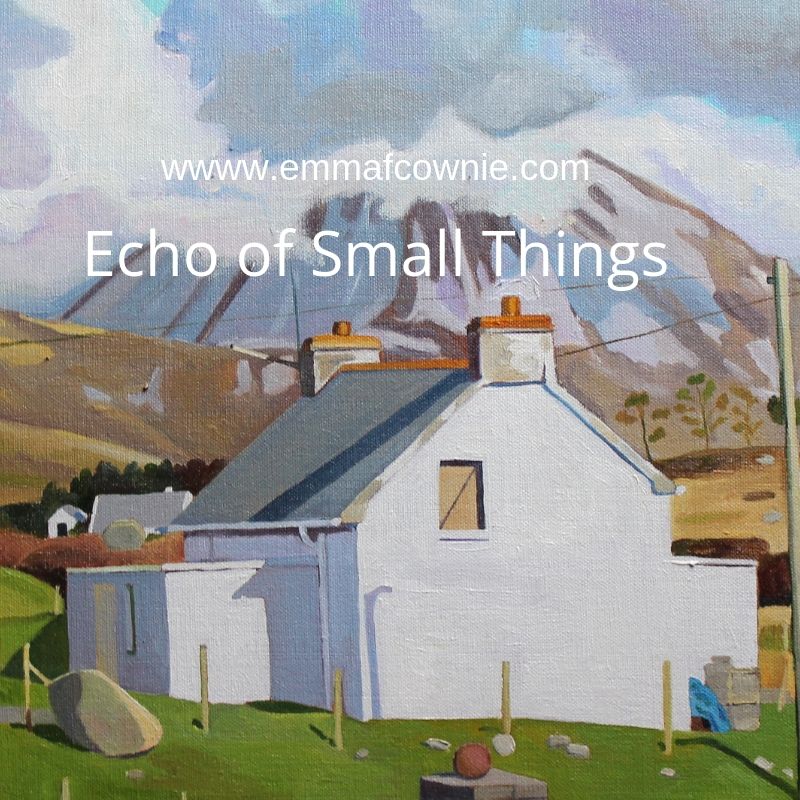
This is my most recent painting below. I choose to paint this because I liked the juxtaposition of the mountain behind the semi-derelict house.
Near Dunmore Strand
I didn’t realise at first that the gable end window is boarded up. It could be mistaken for a blind. Maybe it is a roller-blind pulled down.
Detail (work in progress)
I think the back door is also boarded up. These things are not immediately apparent. There is a large boulder to the left of the house. There is also a pile of building bricks and a tarpaulin in the yard to the right-hand side and old rope in the drive. This is a house at the start or midway through renovations. The details I really relished painting were the shadows of the chimney, roof and the telegraph wire that dissects the window at neat diagonal. It’s only by paying attention to these details that the Donegal light can be properly conveyed.
I have always had a fascination for the ordinary details that are easily overlooked. I want to convey what a scene looked like at that moment. If you were really paying attention. Yet, I am not a painter who works in the hyper-realist style. I am not skillful or patient enough for that. I often cringe when I see my paintings close up because I think some of my brushwork is crude. Yet, “perfect” representation can seem dead and unlife-like.
I think in the errors, the gaps, our brains fill in the gaps the image can come alive. I like that my paintings aren’t just copies of what I can see but an interpretation; the colours brightened, edges sharpened or softened, some details omitted to make for a simpler composition. Deciding what to leave out or simplify is as important as what you decide to include. Rather like Robert Rich’s “Echo of Small things”
I love the Donegal islands for their peace and quiet. Oh, the relative absence of cars, the abundance of nature but I particularly love their houses. You may have noticed that I painted quite a few of them, lately; lovely long strings of houses.
Across to Inishbofin SOLD
I love their simple clean lines. I enjoy the old-style aesthetic. In Donegal, houses were whitewashed and woodwork was painted red. You still see a few houses like this. Sometimes you might see one with a thatched roof. Usually, their thatch has been replaced with tiled roofs.
Traditional Donegal House (with a thatched roof)
When is a house a cottage? When it’s small and old and hand-built by its inhabitant, I suppose. In England, the term cottage originates from the Anglo-Saxon term for the peasant or “cottar”, in Irish the word for these houses is “teachin” or “teach beag” which means small house. You can watch a short film on how to say “teach” in Irish here, you may think that word looks like an English word, but it’s pronounced very differently in Irish.
Cottages literally grew out of the landscape that surrounded them. It stands to reason that in the past homes were built from local materials. If the stones and wood had to be carried by donkey or man-power it wasn’t likely to come from very far away. Stone would predominantly be used in coastal and rocky areas, muddy clay in the midlands and even turf in boggy areas.
Cottages came in different sizes; from the tiny laborer’s cottage or Bothán Scóir (a one-roomed house with mud floors and often not even a window); the byre dwelling (a slightly larger cottage that was shared with the animals) to the thatched mansions – two-storey thatched farmhouses that were often extended from single-storey cottages as the occupants become wealthier.
In Donegal “direct entry” houses were typical, where the front door open directly into the room with the fireplace. The most popular form of cottage is that with the living area at the center with the hearth fireplace and a bedroom on either end.
The fireplace or hearth usually formed of stone and located at the center of the house with a bedroom behind it to further absorb the heat. Most families lived in a single room.
Traditional large fireplace (Kerrytown, Donegal)
Interior of cottage with family. Aran Islands, Co. Galway, c. 1900
Note the bed by the fire
In rural Ireland, they did not usually own the land it stood on. This is why landlords could evict tenants for non-payment of rent (usually, if they wanted to replace people with more profitable sheep), even those the occupants had built those houses themselves. In the case of John George Adair of Gleanveagh, he had the houses pulled down after the tenants were thrown out! This was common eviction practice. Anyone who has seen the excellent film Black 47 will know that this practice, could and did, lead to the death of old and frail tenants in winter.
Over to the Rosses (Donegal, Ireland) SOLD
Houses were designed through necessity. The general rule was that the front door of the cottage faced south, to shelter the house from the prevailing westerly winds. Windows were small in order to retain heat in the winter and to keep cool in the summer. Ground floor windows usually faced to the south, not on the gable ends.
Meadow Cottage – note the first-floor window in the gable end
There were often small windows on the first floor of the gable walls where there were loft accommodations. The walls of a cottage were typically about 600mm thick to support the roof and beams, this led to the attractive deep window reveals found in most cottages.
Cottage with outhouse (Gweedore)
You may have noticed that many old Irish houses are not one single unified block, but are made up of several extensions, a kitchen at the back, an extra room to the side. Homes were enlarged when money was available. Often this money was earnt far away from home as hardship forced family members to look for seasonal work far away in Derry, Tyrone or even in Scotland.
A House on Gola SOLD
Modern houses in Donegal, like modern houses in most places, are comfortable, spacious with plenty of windows. Older people, here as elsewhere, I suspect prefer bungalows for their lack of stairs.
New Houses, Letterkenny, Donegal
Yet, there is still a space for the old style. On Cruit Island there is a holiday village of new-build holiday homes in the “old” style.
They are single story with thatched roofs but they are large, comfortable, and furnished with wooden rocking chairs, and folksy bedspreads. They also have a beach a stone’s throw away. Obviously, there are real old houses you can stay in on Cruit Island too.
Donegal thatched cottage #2 SOLD
I sometimes wonder if I am painting a “fake” version of Ireland. I am giving the impression that all of Donegal is covered in little quaint white houses? It isn’t, but they are there. Especially in the Rosses and on the islands. Not all of the houses are quaint in North-West Ireland; the “bungalow blight” that affects parts of Donegal has been commented on by others. I suppose I am drawn to the clean lines of the old houses.
On the Way to Arranmore (SOLD)
This is a theme I have explored in a different context, previously. A couple of years ago I explored the “Hollowed Community” of Brynmill and painted the Edwardian terraces that surround my home in Swansea. I was also interested in a lost community. The old way of life (pre-internet) that is fast vanishing, where your neighbors lived next to you for years, not for weeks or just the summer months.
We are back in South Wales and have been getting out and about taking photos, especially with a drone. This will help enhance composition in my landscape paintings of the Gower Peninsula.
It was freezing cold but the birds were very busy. There is a sign near by asking people not to feed the birds but the locals take no notice (note the bird feeder). I am glad because I loved watching the birds, especially the tiny coaltits. My camera work isn’t much good but at least you know its real and AI generated slop.