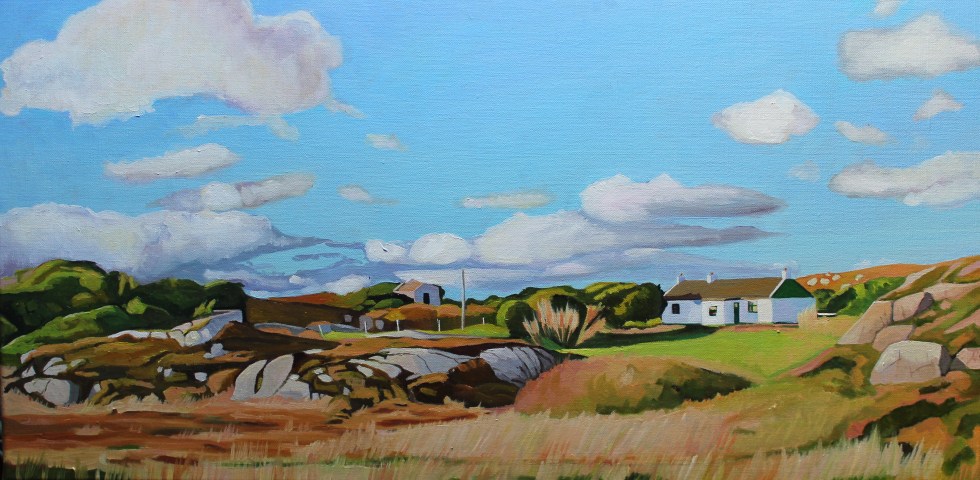
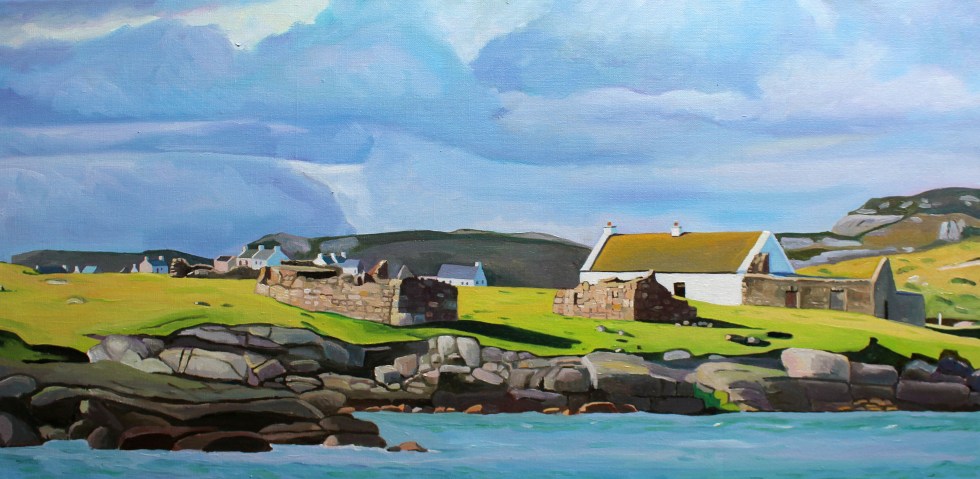
A year’s a long time in art. When I look back at my paintings from early 2019, it feels like I made them much longer ago than that! This selection of “popular” (most likes/biggest reach) is based on my Instagram account, there are many more images that I shared on Facebook, that were also popular but are not included here. The work in progress photos are often very popular, sometimes they are more popular than the final painting!
The most popular nine posts/paintings are all of Donegal, Ireland, paintings.
A selection of some of my most popular Donegal paintings from 2019
Here are my most popular posts/paintings of landscapes, people and animals of Gower, Wales and Stroud, England.
Some more of my most popular paintings from 2019
Finally, a selection of commissioned work. I particularly enjoyed painting the beautiful Maine Coon cats, especially as pet portraits are usually of the canine variety!
Selection of Commissioned work from 2019
My personal favorite from 2019 is this one. There is something about the neatness of the houses on the island that I relish in this painting.
Owey in Spring
Of course, the irony is that one of my most popular posts of 2019 on social media was not a painting but a photograph that my husband took on the spur of the moment of us in woolly hats (and my new Donegal jumper) on Christmas Day!
Seamas and me!
Here’s wishing everyone a Happy, Healthy and Prosperous 2020!
This post has been prompted by the response & comments I got on Instagram when I posted a photo of a painting I had reworked.
Park Fish Bar 2015 version
I came across this early painting when I was sorting through my crowded attic studio. I had forgotten I had it. It took a while to work out how long ago I painted it. It was 4 years ago! It was part of a series of night-time paintings of Brynmill, Swansea, I did in the course of winter of 2015-6. I later went on to develop a series of daytime paintings in the summer of 2017, which formed by the “Hollowed Community” exhibition as part of the Made in Roath, Cardiff, Arts Festival of that year.
I looked at my painting with my 2019 eyes. Sometimes a period of separation enables you to see the painting the way others do. Often this is a happy experience. Not in this case. I liked the light and the shadows but I thought it was a little untamed. The red brick pub opposite the chip shop, The Ryddings pretty much worked. The sky, however, was a bit too messy for me. I don’t usually rework my paintings but this one was bugging me. I nearly worked beautifully, but it didn’t. So I set about to repainting parts of it. Some window sills also needed straightening. The double yellow lines at the bottom of the painting certainly did. The sky then needed “flattening” to create a calmer and tighter painting. After I had done this, I felt a lot happier with the painting. It still has some of the exuberance of the original but it was more disciplined. It has more presence.
Park Fish Bar 2019 Version
(SOLD)
This chip shop has a long history; much longer than I realised. The Park Fish Bar used to have a sign out the front that says it’s Wales’s oldest chip shop (I’ll have to check it see if it’s still there the next time I pass it). It think it said “Since 1977” When I posted a photo of the reworked painting on Instagram Matt (@seamatt79) wrote that it had been a fishmonger or fish shop called “Park View Fisheries” since 1918. Apparently, they sold fish during the day and cooked the fish with chips in the evening. That’s a century of fish and chips in Brynmill. I don’t think there was a centenary celebration last year, which is a shame.
Matt said that he was there in the 1990s the Waterloo Place-side window was replaced (window on the far left of the white building in the painting). An old man who lived in Trafalgar Place came by and told the story of how he helped put the window in as a young boy when during World War Two a German bomb “landed on the corner of Marlborough Road and blew out all the glass”. The corner of Malborough Road is just to the left of the painting. A lot has happened since I painted the original in 2015. Jeff who ran the chip ship since the 1980s had retired and the shop has had two different managers since then.
I was also asked on Instagram by James Potter, another Swansea artist, what the original painting looked like. There are some things you just can’t explain properly on Instagram, so here it is on my WordPress blog!
Happy Christmas to all my fellow bloggers, followers, and readers alike!
Autumn brings incredible colours to the west coast of Ireland. As the grass and bracken die off, they turn a fantastic shade of orange and pink. The pink granite rocks that litter the landscape accentuate the warm colours. They have provided me with much inspiration for my landscape paintings of Donegal, Ireland.
This series of paintings has been inspired by the Old Railway Walk which starts near Burtonport, near Dungloe in Donegal. There are no railways in Donegal anymore. There used to be. The line to Burtonport was built in 1903 as a joint venture by the British government and the Londonderry & Loch Swilly RailwayCompany to attempt to alleviate poverty in north West Donegal.
Steam trains at Burtonport, Donegal
The trains used to carry fish from the port at Burtonport in Donegal to Derry, in the neighboring county. It also carried many seasonal workers to and from Derry and Scotland. After 1922 the line crossed from one country into another; from the Irish Free State into Northern Ireland.
Railways in 1906: Credit: Donegal Daily.com Gweedore train station (Mount Errigal in the distance)
In the 1940s, however, the Irish government decided to close down the railways in Donegal. I have never really found a clear explanation for why this happened but I am going to assume that the cost of running the line was an important factor. There were also concerns about the safety of the line.
Owencarrow Viaduct, Donegal
In January 1925 disaster had occurred on the at theOwencarrow Viaductwhen winds of up to 120mph blew carriages of the train off the viaduct causing it to partially collapse. Four poor souls lost their lives.
Owencarrow Viaduct
After the Second World War, the Irish government presumably decided it would cost too much to continue the maintenance of the line and it was closed in 1947. The Burtonport-Gweedore section closed in 1940. There is a great graphic on the Donegal Daily hereillustrating the shrinkage and disappearance of the railways. Donegal became a very remote part of Ireland, with no railways and no (still) motorways. Communication with the area improved in 1986, however, whenDonegal airportstarted operations.
It seems that for half a century nothing much happened on the old railway line. In 2009, however, there was a heavy snowfall, and some of the old railway line was cleared to access water mains that needed repairing. The remaining section was later cleared and gradually developed as a walkway with the support of the local community. A massive effort has gone into creating this beautiful and peaceful walk.
The Burtonport Old Railway Walk
Here are some of my paintings inspired by my husband Seamas’s photographs of the railway walk.
There are many features of the old railway remaining which you can view along the way such as stations, gatehouses, accommodation crossings, lots of pillars, cuttings, embankments, a bridge and rusty gates. There are also lots of shelters for walkers to hide from passing showers to use.
dav
Photo credit: James (Seamas) Henry Johnston
Youtube video- Siúlóid an tSean Bhóthar Iarainn—The Old Railway Walk by Ralph Schulz.
Find out more about the Railway Walk by clicking on the links below:-
Getting here: From Letterkenny and Dungloe – SITI Rural Transport – Tel 0749741644. From Dublin – Bus Eireann@ www .buseireann .ie From Scotland & Northern lreland – Doherty Travel (00353) 749521867
The Opening night of an “Open” exhibition is an affair full of nervous energy! This is because 90% of people in the room are artists who are all relieved/happy to have their work included in the exhbition in the first place and secondly have come to see where their painting/s have ended up? Are they in a corner? Can they be seen?
Open Exhibition is where the organisers invite or “call” for artists to submit their work (for a small fee). The best works are then selected to be included in the exhibition. There are massive national exhibitions (like the BP Portrait Prize) that are so massive that they have a preliminary round where digital photos are first sent for consideration. The Glynn Vivian, does it the old fashioned way by requiring artists to bring their paintings to gallery for submission. You can submit up to two works each. As, it’s only open to artists living in the Swansea area, it’s not too onerous to drop in the paintings.
All artists fear rejection. We are sensitive souls. So to have to face the prospect of being rejected (one or two paintings) isn’t pleasant. Inclusion isn’t automatic, even if your work has been included before (I was in 2017), especially as the people doing the choosing (or “curating”) change every year. This year’s curators were Richard Billingham and Durre Shahwar. Richard is a photographer and filmer maker who was nominated for the Turner Prize in 2001. Shahwar is a writer, editor, and creative facilitator. Thankfully they chose both of the works I submitted.
I had deliberately decided to arrive an hour into the Opening party as I remember it being very crowded to last time I came in 2017. It was still very crowded at 3pm and the numbers only really thinned out after 4pm. There were 245 pieces in the exhibition. The two rooms in the gallery were filled to the brim with paintings (and artists). were overwhelmingly 2D art. Paintings, sketches and prints, but there were films and sculptures too.
Crowded Glynn Vivian Open
Of course, the first thing I did was try and find my paintings. They were in the second room. I was initially surprised to see that they were not together but had been arranged separately as part of themed groups of colours. I thought that the arrangement worked well. It’s a funny feeling seeing your paintings in amongst lots of other paintings. It’s like a familiar face amongst a crowd of strangers.
There’s no way I can get a photo of both paintings, I thought. Actually, for a long time, I could not get a photo of each painting as the gallery was so crowded.
Spring Light on Gola (top centre)Spring Light on Gola (top centre)
For some reason, people stood in front of my second painting, Autumn in the Rosses for the longest time. Different groups of people too. So I had to wait quite a while to get a photo of it and even then I had a person’s shadow on it!
Spot my painting?Autumn in the Rosses (top left)
It wasn’t just me trying to get a photo of my work. These artists were very excited about being in the exhibition. Their joy was a delight to see.
“Textile Bouquet” by Eleanor Anne Owens
There was so much to look at in the exhibition. There was such a variety of work too. Here are just a few that caught my eye. The most affecting work were the two bird sculptures by Mike Hill. One was made of fishing tackle detritus and the other was in the shape of a cormorant smothered in tar. In fact, the tar-bird was so affecting that I had to fight back the tears. There were quite a few works that touched up the climate emergency and waste but these two, in my opinion, were the most powerful ones.
What are we Doing? What Have We Done? No.1 and No2.What are we Doing? What Have we Done? No.1 and No2.Dafydd Williams “A Coded Reverie”Steve Pleydell “Margot”Amanda Puleston “Doolin, Ireland” – It’s knitted art!
I particularly liked the animal/nature themed wall.
I also really liked Myles Lawrence Mansfield ” Rejections/Acceptance Machine”. I liked it even more when it was explained to me that it moved when you turned to handle! I always like things that do something. Thinking about it now, it may well have been a comment on the life of an artist!
Myles Lawrence Mansfield ” Rejections/ Acceptance Machine”
I had to pleasure of meeting fellow artist Wendy Sheridan in real life (after many online interactions via social media). She very kindly took my photo!
Me at the Glynn Vivian
I would highly recommend visiting the Glynn Vivian to see all the works in the Open Exhibition. It’s on until 23rd February (closed on Mondays) and is free!
The landscapes of Donegal, Ireland have provided me with so much inspiration for my art I thought I’d share some background about our house just outside Burtonport. My husband, Seamas, has spent far more time and effort than me on Meadow Cottage. Thus, this blog post is a bit of a photo-essay as I have been absent for about half of these events. I have stayed behind at home in Wales, feeding our pets and keeping the Art business ticking over.
1. I thought I’d start with the Estate Agent’s photos. In Ireland, estate agents are called auctioneers, in the US I think they are known as realtors. Kenneth Campbell’s aerial photos are great, and doesn’t the yellow gorse look pretty? I changed my mind about gorse, later. What attracted me to the house (other than its location near Donegal airport, as well as walking distance from Burtonport, the ferry to Arranmore Island, a garage shop and Dungloe a short drive away) was the fact that unlike many Donegal homes, it had two rooms upstairs. Why do I care about an upstairs? Well, firstly I have only ever lived in a house with stairs and secondly and more importantly the light is better to paint by. Especially if it comes from a north-facing skylight. That will provide steady cool light. There was no north-facing sky-light only south-facing, but that could be easily changed
In our first spring visit, we concentrated on essentials for the cottages. Thankfully the previous owners were very generous in including a lot of furniture with the cottage so we just had to think about buying things like pots and pans and bedding. We started to explore the area. There was a large area behind the rocks which was overgrown with gorse and brambles. We made some inquiries about getting someone in to do the garden, but they didn’t quite come to anything.
2. Summer visit. Everything had grown. A lot. The grass was now waist-high! The brambly bit of the garden at the back now looking like something out of a sleeping-beauty nightmare.
We looked around at the gardens around us and saw a lot of neat lawns and hedges. Oh dear, we were the neighbourhood scruffs. We had a lot of work to do here. We had brought an electric grass-strimmer with us. It wasn’t much good. There was just too much grass. Even after Seamas had cut it was still a foot deep! Steep learning curve! We bought a petrol strimmer and Seamas studied it carefully. He would be back!
Mizty in the grass (after a trim)
In the mean-time, we hacked away at the biggest interlopers in the garden. There were a couple of fir trees that had spread their seedling all over the grass and were also sprouting up through parts of the drive. They were also blocking the view of drivers pulling out of the side road onto the road to Dungloe. They had to go. I hacked down one with a hand saw and Seamas and I cut down the larger one together (you can see it behind him in the photo below).
Seamas cutting things down
We painted things like fences, walls window sills and the gate.
We can see clearly now…
The cutting things down then extended (rather belated in our stay) to cutting back the gorse. There had been gorse fires in the spring that had been extensive and destroyed one family’s holiday cottage. It had been an important source of income for them. So I wanted to get rid of the gorse near the cottage. It had grown so much that it came up to the back windows of the cottage. We hired a skip and started to fill it. It was hard work. I am not used to it. Still, we got stuck in.
The encroaching gorse
It’s springy stuff. I jumped up and down on it a lot.
We filled it up and when the skip was collected by Paddy Sharkey, he managed to jam a fair bit more in the skip and jump on it.
It was back-breaking stuff. What you needed, Paddy said was a “man with a digger”. We got the number of the man-with-a-digger, and a lot more besides, Tom Ham, and he called round to look at our rocks and gorse. Yes, he could do something with it, in about 6 weeks time. So we left for Wales, with plans.
3. Seamas came back in the to autumn to report back on some improvements he’d arranged to be done whilst we were away. Pauric Neely had put clear glass put in the front door to let light into the hallway.
New front door
Seamas painted the back of the house and got the hang of the petrol strimmer.
4. Seamas’s winter visit. Part 1- More changes: – a new north-facing skylight put in by Paddy Campbell. Yeay. Light to paint by!
New glass in the back door – so we can see the jungle outside!
Best of all, Tom had removed the gorse by the back of the house. It was gone!
Just lovely pink rock!Thank you, digger!
That was great. The brambles were still lurking behind the rock. That was the next stage of the project. It was somewhat fortuitous then, that Seamas’s flight was canceled. He actually went to the airport and waited for his flight. He watched the two-engine plane starting the approach to its landing but very strong cross-winds prevented it from landing. So it returned to Dublin!
Part 2: – Seamas decided to stay another week for the next stage in the work. This was clearing the land behind the rocks and preparing the foundations to put in a couple of wooden clad cabins to act as an art studio and an art gallery. This was a lot of work.
We can see the fabulous pink granite rocksThere’s a lot of rock
Finally, the brambles are gone.
There’s a lot of land here!
The path by the house is finally clear
Seamas has achieved a massive amount over the last year. He’s so happy when he’s in Donegal. He loves our cottage. He is never happier than when he’s working on it. There’s a lot more to do. He has more plans that he’s hatched with Tom, that I am looking forward to happening. I think that when I am back in the spring that I will be planting a lot of grass seed! I am looking forward to my second year and hoping to spend much more time here.
I would like to thank Kenneth Campbell, Pauric Neely, Paddy Sharkey, Paddy Campbell, Lucy of the Parlour Shop, who drove up from Killybegs on a Sunday evening (with her mum) to deliver a table and last but definitely not least, Tom Ham, for all their excellent work.
Update: June 2020 we had a portacabin art studio (designed by Séamas and Stephen Primrose) and built by H.E. Haslett Co. Ltd of County Tyrone delivered. It looks great. If you are wondering, the giant window which is positioned to for the northern light, is round the other side.
Portacabin Art Studio
As you can see the garden has GROWN! I hope the insects and wildlife are all enjoying the overgrown garden. My broken leg and the pandemic prevented a another visit (and a lot of gardening) in 2020.
I am really looking forward to using this studio later this year (all going well with vaccinations, fingers crossed)!
Inside the cards, they read “Season’s Greetings.” They can be bought in packs of 5 of one design or in a selection pack of 6 cards. [maxbutton id=”7″ url=”https://emmacownie.artweb.com/greeting-cards-christmas” text=”Buy Greeting Cards” ]
If you are looking for a special gift or home decoration I also have also a mini-collection of winter-themed / Christmas bird paintings for sale. Most of them are 24×30 cm (9.4 x 11.8 inches). Double click on the names below the images to find out more.
I love looking at maps and finding out the names of places. This is particularly true of the islands that litter the coast of West Donegal near the Rosses. I am always asking my husband, what island is that? He’s usually pretty good at knowing the names (I check on a paper map later). In the summer I spotted a house on a tiny slip of an island to the south of Arranmore. Can you see it in this photograph below?
View from Arranmore
Closer. See it now?
Inishkeeragh
I thought it was just one lone house (was that another house at the other end of the island, maybe?). What glorious solitude! What must it be like to stay on that island all with the spray of the sea so close looking at big Arranmore? This is my painting of the island. I was curious about the feint outlines of ruined houses I could see either side of the restored summer house. I wondered about them and their families.
Over to Inishkeeragh (SOLD)Map of Inishkeeragh (Google)
This is Iniskeeragh. Ireland (like Wales) is rich in descriptive place names. They usually describe are named after features of the landscape, such as hills, rocks, valleys, lakes, islands, and harbours. In Irish, its name is “Inis Caorach” which means “Sheep or Ewe Island”. So either sheep were kept on the island (it seems pretty small for that) or its a shape reminded people of a ewe, which might be more likely?
Inishkeeragh (Google)
After some research (online and in books) back home I discovered that the island had at least 12 families living there permanently, it also had a schoolhouse. I find this incredible for such a small, lowing lying island. It’s 650m x 300m (2132ft x 984ft) in size. I tried to work that out in football pitches. It’s the equivalent to 40 football pitches, so maybe its not as tiny as I think. It is very low. It’s no higher than 11 feet above sea level. Yet you can read their names in the 1901 census here. The family names of the farming families are familiar Donegal ones: Gallagher, Boyle, Sweeney, Rodgers, O’Donnell and a sole Bonner, Grace (35) who was listed in the census as a knitter, she was one of only 2 knitters on the island.
Ruins on Inishkeeragh:- Photo credit Roger Curry
These Donegal islands may seem remote to modern eyes, but they played their part in the culture and history of modern Ireland. Gola Island, Gweedore, may well have served as the model for Robert Louis Stevenson’s Treasure Island. Two men from Gola, Patrick McGinley and Charles Duggan, were aboard the Asgard, the yacht that brought arms into Howth in north county Dublin in 1914, in preparation for the Easter Rising of 1916. Tiny Inishkeeargh also had its connection with the wider world. Writer and political activist Peadar O’Donnell (1893-1986) was a for a time teacher’s assistant at the school on the island and he set his second novel, The Islanders, here. Peadar went on to become one of Ireland’s foremost radicals of the 20th-century.
School House:- Photo credit Roger Curry
Life was tough on the island. Roise Rua described her work on the island kelp-making as “tedious and exhausting”. The tenants had to pay rent of £50: £26 for the use of the land and £24 for the use of the seashore – making kelp, picking winkles or shellfish, dulse and the like.” Sadly, like many other Donegal island communities, such as Owey and Gola, the people of Inishkeeragh was forced to relocate to the mainland in the 1950s.
Inishkeeragh Village:- Photo credit Roger Curry
Sea levels played a big part as at least twice in the twentieth century an exceptionally high tide coinciding with a bad gale forced the islands to take refuge in the two houses that had lofts. They apparently spent hours “in terror, fearing the overloaded floors would collapse.” A storm in 1953 washed away the pier and the government of the day would not pay for it to be repaired. This meant that subsequent storms swept through the houses and within 5 years all the families were forced to leave the island.
Inishkeeragh – Photo Credit: Roger Curry
There was a reunion of Inishkeeragh families and their descendants in 2015 on the island. Internationally renowned Country singer, Daniel O’Donnell, was part of the celebrations (his mother was born on nearby, Owey Island).
Daniel O’Donnell and the Inishkeeragh Reunion
You can see the photos of the day on their facebook page here. You can visit the island with Arranmore Charters, be sure to book beforehand.
Addition sources for Inishkeeragh (Inis Caorachin) came from:
I had been trying to finish it but the weather and the light were so bad here in Wales over the weekend, I had to leave it until Monday. I struggle to see greens in poor light and as the grass at the bottom of the painting was so important to the success of the image, I decided to wait until I could see it.
It was a year ago that I painted my first painting of Donegal. Here it is. It is a small one.
Old School, Owey Island
It’s quite a modest painting. You could say that I started off tentatively. I was feeling my way. The light in Donegal is very clear and the scenery is beautiful. That’s an overused word in this age of social media, but it is beautiful.
My husband, Seamas (he likes counting things) tells me that I have painted over 50 Donegal paintings (including 3 commissions). That pretty much averages out at one a week. I am pleased to say that I have already sold over half of them.
I discovered that I had to use a different palette from the one that I use in Wales. The greens and yellows were more yellow ochre than lemon yellow and the sea was more turquoise (but not quite as turquoise as I first painted) thanks to the clear water.
On The Way To Arranmore
From Ferry Coll SOLD
Over to Owey Island, West Donegal, Ireland
I loved the rocky landscape of the Rosses. It was a landscape like no other I’d seen before. Someone has said to me that it’s quite alien, like a moonscape in places. I love the granite rocks. We have a massive one behind our cottage in Donegal. I feel very affectionate towards it. It’s a protective presence, especially when it’s windy.
Over to Tullyillion
Of course, when you are in a different country to the one you were brought up in, everything seems fascinating. I have loved painting both the modern Donegal houses as well as the old cottages.
From Cruit Island
Over to the Rosses
House by the Wild Red Flowers (Arranmore)
I will freely admit I am quite obsessed by landscape spotted with old cottages on the Donegal islands, on Arranmore and Gola in particular.
Spring Light on Gola
Across to Inishbofin
This Beauty That will Pass
A House on Gola
Up From the Pier (Gola)
Oileán Ghabhla (Donegal)
Around Cloughcor (Arranmore)
Cottage on Inishcoo
On Eighter Island
The Red Roofed House, Arranmore (Private Collection)
I haven’t really got to grips with the mountains of Donegal. What I mean is that I need to visit them a lot more, walk up them and get to know them better. So far I have just admired the “Seven Sisters”, including Mount Errigal and Muckish from a distance.
Across to Dunfanaghy
Mount Errigal from Ballymanus Beach, Donegal
Over to Kinclassagh
The Pig’s Back (Muckish) Donegal
Swirling Clouds Round Errigal
Of course, the real joy of Donegal is the clouds. The changes skies. I am used to it raining, (I have lived in Wales for over 25 years) but the light is different by the North Atlantic Ocean. It is often more slivery, and more changeable.
From Magheraclogher Beach (Bunbeg)
Near Dunmore Strand
Rain over Dunfanaghy
Two Cottages
I think about Donegal every day when I am in Wales. My husband will place his current favourite Donegal paintings in the bedroom and in the lounge so he can look at them whilst we still have them.
Here’s my most recent painting Donegal painting. I am currently working on a painting of Arranmore Island, unfortunately, it rained so much here yesterday, the light went and I have yet to finish it.
Back Road to Burtonport
Here’s a footnote to Sunday’s post about waiting for gaps in the clouds. The sun was peeping over the top of the three peaks, illuminating the edges beautifully. I particularly liked the way the sea and the river, Pennard Pill, merge here. It’s not clear where saltwater and freshwater meet.
We are back in South Wales and have been getting out and about taking photos, especially with a drone. This will help enhance composition in my landscape paintings of the Gower Peninsula.
It was freezing cold but the birds were very busy. There is a sign near by asking people not to feed the birds but the locals take no notice (note the bird feeder). I am glad because I loved watching the birds, especially the tiny coaltits. My camera work isn’t much good but at least you know its real and AI generated slop.