Summer in Donegal is full of light. Even if its damp summer there is still lots of light. The northly latitude sees to that. It only seems to get properly dark for a couple of hours after midnight and dawn comes impossibly soon. So its great for painting and getting out and about but the light is not so interesting for photography or sketching, especially if, like me, you like lots of strong shadows. So my paintings are usually based on images that are captured in the autumn months. Otherwise, mornings and evening are best for interesting colours and shadows.
Autumn Light on Cruit Island, Donegal _ Emma Cownie SOLD
Cruit Island is one of my favourite places in Donegal. It’s rocky and sparsely populated but is accessible by a handy bridge.
Donegal Cottages, Cruit Island _Emma Cownie SOLD
Over Cruit Island by Emma Cownie SOLD
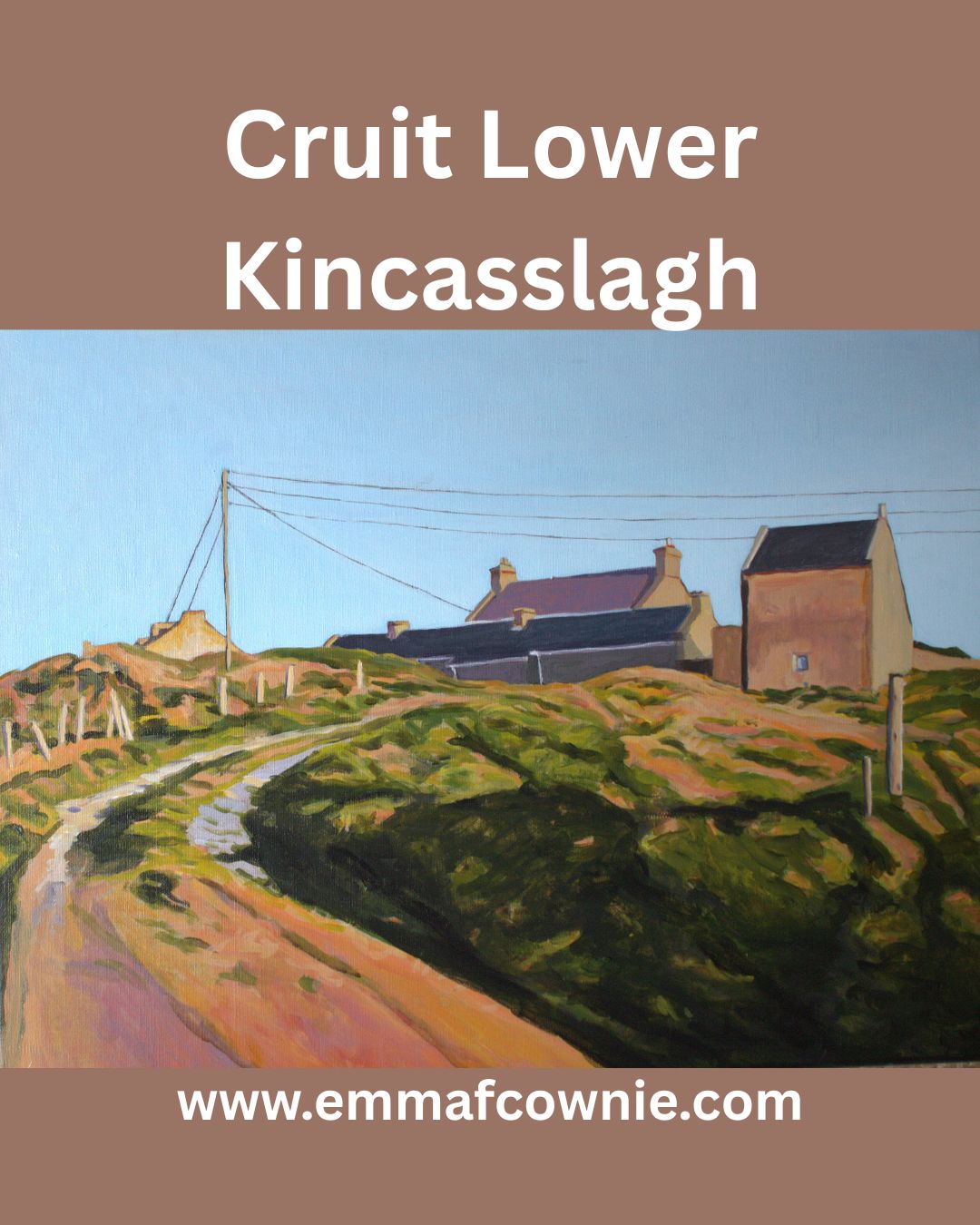
We have driven past the collection of farm buildings at Cruit Lower many times but I only managed to capture an image I liked enough to paint this spring. It was an uncharacteristically warm and sunny run of days this May.
The farm has long fascinated me as you have to drive through it. These through roads through farms are not unusal in rural areas in Ireland (and Wales). Informal tracks through a collection of farm buildings, now divided by tarmac.
Lower Cruit was for sale last year and I had a good look at it online. It was interesting as you can only glimpse some of the buildings from the road. I cant remember how much the asking price was. Getting on for a million Euro, maybe. Way out the reach of a poor artist! You got a lot for that; a collection of beautiful historic buildings (some pre-famine era) and access to a beautiful beach and some really incredible views of the West of Donegal. Here are some of the photos from the website. I dont know who bought it but I really hope they look after the beautiful old buildings.
Cruit Lower From the Air
Cruit Lower with Beach behind
Prefamine house at Cruit Lower
Cruit Lower – the view you cant see from the road!
A long time ago, when I was a student, my favourite place to visit was the National Museum of Wales. The Davies collection in particular. The Davies were two sisters, Gwendoline and Margaret, amassed one of the greatest British art collections of the 20th century and bequeathed it (260 works!) to the National Museum of Wales. That’s Girl Power!
They had great taste. Those paintings became like my friends. I visited them often and spent a long time looking closely at them. They excited, inspired and comforted me. Even now when I look at reproductions of them online I have a strong reaction to them.
I used to think, this was because I was an artist. I remember peering closely at Monet’s brush strokes and marvelling at how they were laid down. I mean look at this.
The Mauritshuis Museum in The Hague, is the home of Vermeer’s ‘Girl with the Pearl Earring’. Thew museum recently did some academic research into how visitors responded to artworks. They looked at the neurological mechanisms and emotions underlying the appreciation of perception in art.
The study used EEG and eye-tracking measurements on 20 participants who followed a set route through the Mauritshuis. Five paintings were included on this route: Girl with a Pearl Earring (Johannes Vermeer), The Violin Player (Gerrit van Honthorst), Self-portrait (Rembrandt van Rijn), The Anatomy Lesson of Dr Nicolaes Tulp, (Rembrandt van Rijn), View of Delft (Johannes Vermeer). They also showed them reproductions of the originals and compared their responses. The EEG results showed that the real paintings created a stronger emotional response compared with the poster versions of the same paintings.
Volunteer in the study looking at “Girl with a Pearl Earing” – Her eye movements are being tracked
“The Girl with a Pearl Earing” created the biggest emotial response. Painting of “The View of Delf” did not score well, and I wondered whether it was because it was a landscape rather than a portrait, not as famous as the “Girl with the Pearl Earing” or people were not familar with the layout of Delf. I have spent a long time looking at historic paintings of London, Swansea and Derry, trying to work out how they relate to the modern day cities. But maybe that’s because I’m pretty geeky. I doubt I had a big emotional response to them, though. Not enough paint!
The EEG results confirm that real paintings (compared to poster versions) also elicited a strong need to approach the paintings. It wasn’t just me wanting to get a close look at the paint! Real art, including the surrounding ambience, lighting, frame also helped evoke an emotional reaction many times more powerful (10x more powerful according to this study) than looking at a poster of a painting.
Some of you will put that in the “No Sh*t, Sherlock” category of scientific “discoveries” – which was my husband’s response when I told him about the study.
I have never seen Vermeer’s painting in real life but my parents have a reproduction in a tiny gold frame. I don’t know if people’s reponses were elicited because its very beautiful, well-composed, very famous, or because its a human face. I suscpect its a combination of all three.
Mona Lisa in the Louvre – I dont remember it looking as big as this when I saw it back in 1988!
Seeing a famous painting isn’t always rewarding. Maybe you too went to the Louvre in Paris to see the Leonardo’s Mona Lisa and were underwhelmed. Its notoriously small and hard to see as it under glass , far away and surounded by tourists.
There have been times I have come across paintings that I didn’t know and looked at them for a long time. I sat in the Tate (in the 1980s way before it became Tate/Tate Modern) with a lot of Rothko paintings and felt incredibly moved. You just cannot convey that with a reproduction.
So I guess this is a round about way to encourage you to go and see art in real life. You will feel better for it. Possibly. I hope you have some sort of emotional response – tears, laughter, anger even. Barnett Newman, Who’s Afraid of Red, Yellow and Blue III, 1967-68 has been slashed three times.
Barnett Newman, Who’s Afraid of Red, Yellow and Blue III, 1967-68. Oil on canvas, 8′ x 18′
We can’t all own Monets and Vermeers (and I don’t think any of us should, they are too important for that) but we can be glad that museums hold them in public collections we can see. I would love to see Picasso’s Guernica in real life. I have had it projected on a class room wall when I have taught lessons about the Spanish Civil War – it is a powerfully brutal work. My board was large no where near the full the size of the painting which is 3.49 meters (11 ft 5 in) tall and 7.76 meters (25 ft 6 in) across. Art stimulates our senses, emotions, and intellect. Guernica was also designed to stimulate our empathy. It is as relevant today as it was when it was painted in 1937.
Cardiff National Museum let me visit the stores to see Robert Bevan’s Maples at Cuckfield in 2013, because my husband put in a request to see it after seeing in the gallery the year before after my car accident. This work inspired me to start painting again. It helped with my recovery from PTSD and burn out.
Seeing paintings in real life really does do you good. Dr. Saundra Dalton-Smith has identified looking at art as a way of getting creative rest, one of seven types of rest all people need. Creative rest involves exposing yourself to sources of awe and inspiration and makes you better able to create and problem solve. Painting pictures is even better for you.
Fanad is a finger of land that lies between Lough Swilly and Mulroy Bay on the north coast of County Donegal, Ireland. It is not that easy to get to and the the survival of the Irish language is testiment that relative isolation.
Lambing season at Fanad Head (Donegal) SOLD
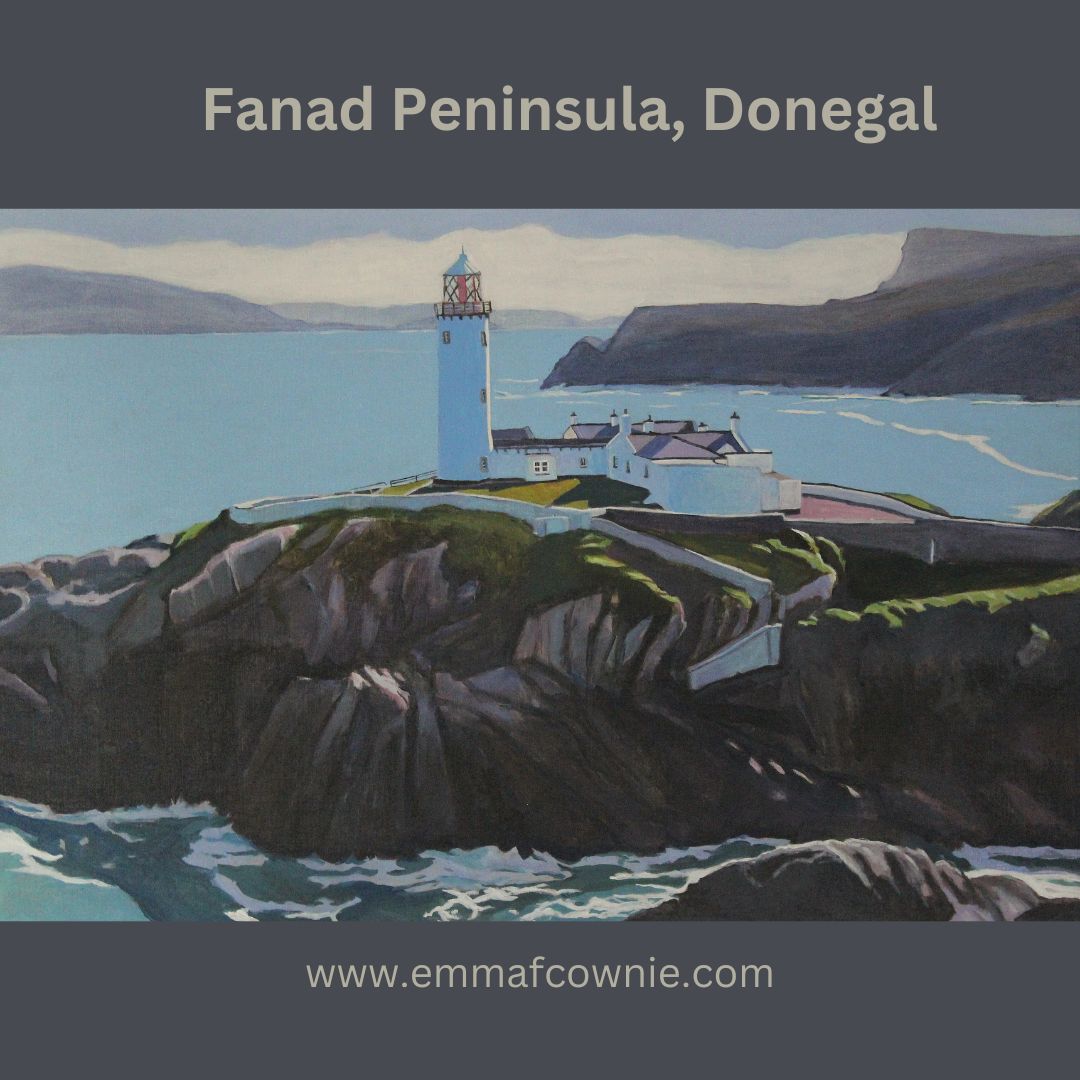
Fanad Lighhouse (Donegal). Is one of the 12 Great lighthouses of Ireland. It was built in 1886 at Fanad Head (although the station was originally established in 1817). The lighthouse, or more acrrately, the harbour light, marks the entrance into Lough Swilly which forms a natural harbour.
Fanad Lighthouse (Donegal) SOLD
I have painted this isolated structure several times before. I have always enjoyed painting the northernly light on Fanad. I have only have painted it in acrylics. That’s not a delibertae choice, more one of circumstance because at times I have had limited space, and I dont want to use oil paints with kittens close at hand.
Over to Fanad Lighthouse (Donegal) _Emma Cownie SOLD
I think acrylics suit the airiness of the subject matter. After a couple of years working out how to use them, I have settled on a technique of light layers of paint that allow the underlying colour to show through. This can give a transulent quality to the colour. This is in contrast to the relatively flat areas of colous I use for the larger areas of colour such as sky or the sea.
My latest painting was an experiment in composition. We used an image from a drone shot done by my artist husband, Seamas (James Henry Johnson).
In this piece, I wanted to create a sense of space from the mountains of the Inishowen Peninsula in the distance. The distant mountains were layered with bluish white until I got the right impression of distance.
I often find myself looking at the tiny Fanad lighthouse far off in the distance when I am at Lisfannon on the Inishowen Penisula. There is a sign comemorating a famous Atlantic storm that happened in 1748. this storm threatened to sink The Greyhound, the ship of one John Newton, a slave trader. John was so frightened that he called out to God for mercy. This moment marked a profound spiritual conversion, and many years later he wrote the words for the hymn “Amazing Grace” one of my favourite hymns, and to also campaign for the abolition of slavery.
There is some confusion how many storms there were . One website claims the terrible tempset happened far away out in the Atlantic because it took John Newton another four weeks after his conversion to sail into Lough Swilly and arrive at Derry/Londonderry. The Amazing Grace.ie site however, makes it clear a second storm happened in Lough swilly itself as it quotes John’s journal ” We saw the island of Tory and the next day anchored in Lough Swilly in Ireland. This was the 8th day of April, just four weeks after the damage we sustained from the sea. When we came into this port, our very last victuals was boiling in the pot; and before we had been there two hours, the wind began to blow with great violence. If we had continued at sea that night in our shattered condition, we must have gone to the bottom. About this time I began to know that there is a God that hears and answers prayer.” It’s got to be said, that John Newton really took his time putting his evangelical beliefs into action because he went back to being a slave trader for another five years before he eventually retired and became a minister in 1757!
The heaving sea at the foot of the massive lighthouse rock intrigued me. The Atlantic Ocean has such a bulk and stregth, even on a relatively fine day, I am not surprised that John Newton was terrified by its strength far away from the Donegal coast. I wondered about the long and difficult process of building this structure all those years ago in a remote location. Yet, this lighthouse has stood the test of time and proudly marks the entrance to Lough Swilly and can be seen from inland and further along the coast.
I have been on the Artfinder website since 2013, and during that time I have been fortunate enough to sell an incredible 788 artworks! I am very proud of the 254 5-star reviews that I have collected over the years via Artfinder.
So, I thought that I would share with you some of the customer reviews and messages I received last month from the collectors of my work on Artfinder. They are the icing on the cake for me and my husband Séamas, who has been working incredibly hard packing and shipping my work whilst I am recovering from my broken leg & ankle. I often think that my collectors describe my work better than I can and love reading what they say. I am very happy that my work is appreciated and enjoyed around the world.
After You Are Gone
The Red Roofed House, Ireland
Review by Maureen, I love these beautiful, atmospheric pieces. Emma captures her subjects to perfection. These two pieces are special to me as they remind me of my youth, growing up in an offshore Island in Ireland I look forward to seeing more of Emma’s work.
Winter Shopping
Review by Laurent- “This [“Winter Shopping”] is the third painting from Emma I have bought. As before, everything has been perfect… great communication, delivery in two days.. And it is a beautiful painting!
StormOver Inishbofin
Message: Dear Emma, The painting [“Storm Over Inishbofin, Ireland”] has just arrived safely. It is lovely and I especially like the contrast between the optimistic houses and the darkening sky! Best wishes, Katharine
Between Tides, Tenby
Review by Cameron, Have been viewing Emma’s works & style for a while now so grey happy to finally have 1 of her works hanging in my home [“Between Tides, Tenby”].
Hazy Tenby
Review by Elissa, “Love this painting [“Hazy Tenby”] which was despatched and received within a few days of ordering. Thanks so much, Emma”
Roshin Acres, Ireland
Review By Helen, “We were so pleased to purchase the painting [“Roshin Acres, Irealand”]. It is beautiful and when it arrived it was what we had hoped for when we purchased it. It arrived super quick”.
Inside the cards, they read “Season’s Greetings.” They can be bought in packs of 5 of one design or in a selection pack of 6 cards. [maxbutton id=”7″ url=”https://emmacownie.artweb.com/greeting-cards-christmas” text=”Buy Greeting Cards” ]
If you are looking for a special gift or home decoration I also have also a mini-collection of winter-themed / Christmas bird paintings for sale. Most of them are 24×30 cm (9.4 x 11.8 inches). Double click on the names below the images to find out more.
Me at Work (with Mitzy)
This blog is made up of 5 photos/images that represent the stages that go into the process of creation of a woodland painting. The first photo is the most joyous. Wandering around the woods (read more about this very special place here), taking photos and marveling at the light. On this day the light was perfect. I was delighted by the way it illuminated the leaves, the moss, and the grass. I was also excited by the fact the woods and stream were flooded with light in a way I had not quite seen before. The time of year and the time of day all affect conditions. No two days are the same. Enjoying the sunshine was the easy part.
Work in Progress #1
Now for the hard work. My woodland paintings are different from my other paintings. I paint them in a different way. They are more of a semi-abstract construction and less organic than my paintings of clouds, coasts or people. I can’t exactly explain how I ended up doing this, I think it was when I was in my fauvist/refractionistphase. It sort of like constructing a giant puzzle and my head usually aches afterward! So I sketch out the basic position of the trees, stream and the main shadows.
Painting is a lot of problem-solving. I have to decide which order to paint different sections of the canvas. Some parts I want to dry and then go back and add detail. So I start by flipping the canvas “upside down” and painting in the light blues and mauves of the sky. I also need to convince myself that this painting will work so I paint in the tree trunks to “anchor” the painting. I look at the painting in a small mirror – this is a way of allowing me to see it in reverse, and trick my brain into seeing it like other people do (rather than what’s in my head). That’s day one of painting.
Work in Progress #2
On my second and third day of painting, I spend a lot of time thinking about colour and how to mix the right shades. Getting the different greens right is vital, from the fresh yellow greens to the very dark hues. The hazy trees in the middle distance are difficult to gauge as mixing green with purple makes a dreadful sludge on my palette and nothing like the colour I want. I am anxious about the dark green on the opposite river bank on the left hand of the painting. I worry about getting it right. I have to be able to represent the damp dark greens effectively, without drawing too much attention to them. I mark in the darkest part of the bank and leave them for the next day. It is slow work.
Work in Progress #3
On the final day of painting, I pick up speed and tackle the far river bank. I attack the most interesting part by painting in the light on the leaves and the purple shadows at the top of the bank. The purple shadow then blends into the green and by the time I have finished with the bank I am pleased with it. The part of the painting that frightened me the most makes me the happiest. Ironically, no will notice probably it. That’s how exactly it should be.
“Path by the Stream”
The final stage of the painting is solving the showed foliage in the lower centre of the painting. This I simply into blocks of colour. I want to focus of the painting to be the hazy light at the top part of the painting and I don’t want to draw the eye to the foreground at the bottom of the canvas. In my mind, I struggle with this process. There is alot of indecision. The literal part of my head wants to paint it “as it is” but my artist’s head is trying to reduce the colours into blocks. To help in this process, I move my reference photo onto a chair so my myopic vision can no longer see the details. I push on and eventually, the canvas is covered.
I then will leave the room to make a cup of tea and return with the express purpose of “surprising” the painting. This way I can see it with fresh eyes from the other side of my studio and decide if I am happy with it. I am.
From further away
I am delighted to report that I sold “Path By the Stream” to one of my most valued collectors, who has bought many of my works, in beautiful Kent, England.
I have started my next woodland painting, if you want to follow its progress like & follow me on Facebook.
My Top 10 tips for selling art online. I am sometimes asked for advice on how to sell art online. To be honest, I feel like there is so much I don’t know about Art marketing, but I did sell over 200 pieces, originals and prints last year and half of these were direct sales to collectors so something’s working. Marketing and selling art takes an enormous amount of time and effort. At least 50% of my day is spent on marketing. The great thing about it all is that the longer you do it the more followers and fans you will gather. It’s an investment of time – but it cuts both ways. You will spend hours at the keyboard, posting away (sometimes wondering if it’s worthwhile) but you will develop a following. Some of it casual, some of it very loyal and dedicated indeed. You need to remember that it may take months or even years of following an artist’s work and career before a collector buys your work. Your fans are invested their time in your you and your “journey” too so you need to keep them with you.
So here are my top 10 tips (BTW there is no affiliate marketing in this blog post and there’s so much more I could say but I’m sticking to 10 tips for starters).
Your story – Be positive. Nothing succeeds like success. There’s enough depressing news out there and your art is (hopefully) an escape from all that unpleasantness. So it’s important to celebrate all your successes no matter how small; every sale, exhibition, painting-in-progress is a cause for celebration. Don’t ever be tempted to say that you aren’t selling or you hate online galleries. Instead talk about your latest project. Explain WHY you make your art. How does it make you feel?
Celebrate where ever you can
Have your own website – don’t build your house on someone else’s land. There are many different hosting platforms out there. There are some that specialise in hosting artists such as artweb, fasco and artmajeur or the very popular wordpress. They will all charge an annual fee (update: Artmajeur’s free plan now allows unlimited artworks to the site). You need to make sure that your site has ecommerce facilities. That means it doesn’t just function as a gallery but also as a shop where collectors can buy work.
Start blogging – a great way to tell your story is to write a blog. I use WordPress but there are other blogging sites like blogger and many websites will have a blog page integrated into the site. Your blogs don’t have to be great long essays but the important thing is to blog regularly. Some bloggers blog once a day, others once a week. Don’t be an occasional blogger. There’s nothing more frustrating than a blogger who only blogs three times a year. You will lose followers if you are inconsistent. Keep focused. Blog about your art and inspiration or art in general. Why do you make your art? How does it make you feel? Don’t blog about the news, your family, what you had for tea, latest fashions unless it’s directly related to art, and what inspires you. Which brings me to…
Be a regular blogger to build an audience
Social Media – there are lots of outlets, Facebook, Instagram, Twitter, Tumblr, Youtube, etc. You don’t have to do them all (I dropped Tumblr, for example as it was a bridge too far) but make sure whichever platform you choose to be, do it well. To honest no one platform is necessarily better than the others for promoting your work, all of them will do something to help. Don’t post twenty times a day – it will seem like you are spamming people and they will unfollow you. Once or twice a day is enough, maybe three times on twitter. Hashtag your own name too #emmacownie so people can follow your work across the platform. The important thing to remember is that it’s called social media for a reason. You have to be sociable. If someone comments on your post it’s good manners to respond, with a “like” and a “thank you”. It’s important that you support other social media users and follow other artists, photographers of any supporters who like, comment on, and share your posts and return the favour. We all need encouragement. It’s important to encourage others. I have made many good friends out there in the online world. Again. like the blogging try not to mix business and personal stuff on your Art pages/sites – have a separate one for your own family stuff and stick to art-related things on your Art accounts.
Not really material for an artist’s Instagram feed
Pinterest – It’s not just for recipes! It has 250 million users every month, with 25 million users in the US and about 80% are female. It’s not a social media platform but a search engine. It’s well worth joining to get your work seen and develop a following. It also a really good source of information about art marketing. I have learnt a lot about blogging, pinning, marketing, and websites from pins on Pinterest. If you want to see a selection, I have saved my Buying and Selling Art pins here.
My Pinterest page
Canva – is great for creating professional-looking blog covers, Pinterest graphics, and so on. I use it all the time. There’s also Pablo and Visme which does some pretty awesome infographics.
SEO– Use Key Words in your posts so that search engines like Google and Safari can find you. A website that is well optimized for search engines “speaks the same language” as its potential visitor base with keywords for SEO that help connect searchers to your site. I find this a vast subject but there are pins on Pinterest and sites like Moz.com will help you improve your SEO. Make sure that when you post your pictures on your website that you filling all the boxes.
Fill in all the boxes
Newsletters – build a list of email addresses on your website. These are your fans, collectors and interested artists. Some collectors watch your progress for years before they buy. This is how you keep them in touch with what going on with you. Not every one uses social media, especially older collectors but they read their emails. Again send out your newsletter on a regular basis, say, every fortnight or once a month. Mailchimp is a marketing platform that offers a free (if your list is under 2000 names) sign up forms and newsletter service. There are others here
Finally, Online Galleries – there are loads and loads to choose from. There is a very long list of online galleries here. It’s a bewildering choice. Some work better than others. There are massive ones like Saatchionline where it is difficult to be seen and smaller ones like Artbazzar that have less of a budget for advertising, there are others that charge to be on them like Artfinder and Artgallery. Others are still free to be on them such as Singulart, but they charge higher rates of commission. It makes sense to have a presence on several sites. Online galleries can be good for sales if they promote you.
Just remember that putting all your energies into one website or social media site is foolish, as it’s like building your house on someone else’s land. They all change their algorithm, pricing policies, curators, and what might work for you one year may not the next. I’ll give you an example, last year Facebook shut down my Emma Cownie Artist Business page with no explanation. This is not uncommon on Facebook. I tried in vain to find out why it had happened and to get it restored, to no avail. I lost thousands of followers and their contact details. I was devasted. That’s not a story I usually share as it’s not a positive one but let that be a warning not to put all your eggs into one social media basket (thankfully, I hadn’t, but it still hurt).
Facebook locks people out of their Business pages
It’s always sensible to be on several platforms and sites and encourage your followers to follow you on different platforms. You can do within many ways such as an email signature with links to your social media platforms. There’s so much to learn and there are plenty of people out there who will offer tempting online courses on Art Marketing but I prefer to teach myself. I hope that this post will help other artists get seen. I welcome any comments, suggestions from other artists or commentators
Here’s part two of my review of 2018, all the paintings, prints and sketches I have sold via www.Artfinder.com or direct via my own website at www. emmacownie.artweb.com. Quite a few were commissions.
It’s funny to notice the colours I favour in my paintings. When I put together a collage of all the paintings and prints I’d sold in 2019 there some surprises. The greens, yellow ochres and blues are to expected as I paint a lot of coast and woods. The reds and oranges, however, are a little more unexpected as I have this idea that I hardly ever use red in my paintings, unlike my husband who says it’s his favourite colour in his work. The oranges don’t just appear in my urban painting where you’d expect brickwork, but also in the russets of the winter bracken on the Welsh mountains.
It’s not all the works sold as I haven’t included the last two months yet. Watch out on facebook/instagram for an update there. Once, again thank you to all my collectors, supporters, fans, commentators and family who keep me going.





 Work in Progress #1
Now for the hard work. My woodland paintings are different from my other paintings. I paint them in a different way. They are more of a semi-abstract construction and less organic than my paintings of clouds, coasts or people. I can’t exactly explain how I ended up doing this, I think it was when I was in my fauvist/
Work in Progress #1
Now for the hard work. My woodland paintings are different from my other paintings. I paint them in a different way. They are more of a semi-abstract construction and less organic than my paintings of clouds, coasts or people. I can’t exactly explain how I ended up doing this, I think it was when I was in my fauvist/ Work in Progress #2
On my second and third day of painting, I spend a lot of time thinking about colour and how to mix the right shades. Getting the different greens right is vital, from the fresh yellow greens to the very dark hues. The hazy trees in the middle distance are difficult to gauge as mixing green with purple makes a dreadful sludge on my palette and nothing like the colour I want. I am anxious about the dark green on the opposite river bank on the left hand of the painting. I worry about getting it right. I have to be able to represent the damp dark greens effectively, without drawing too much attention to them. I mark in the darkest part of the bank and leave them for the next day. It is slow work.
Work in Progress #2
On my second and third day of painting, I spend a lot of time thinking about colour and how to mix the right shades. Getting the different greens right is vital, from the fresh yellow greens to the very dark hues. The hazy trees in the middle distance are difficult to gauge as mixing green with purple makes a dreadful sludge on my palette and nothing like the colour I want. I am anxious about the dark green on the opposite river bank on the left hand of the painting. I worry about getting it right. I have to be able to represent the damp dark greens effectively, without drawing too much attention to them. I mark in the darkest part of the bank and leave them for the next day. It is slow work.

 “Path by the Stream”
The final stage of the painting is solving the showed foliage in the lower centre of the painting. This I simply into blocks of colour. I want to focus of the painting to be the hazy light at the top part of the painting and I don’t want to draw the eye to the foreground at the bottom of the canvas. In my mind, I struggle with this process. There is alot of indecision. The literal part of my head wants to paint it “as it is” but my artist’s head is trying to reduce the colours into blocks. To help in this process, I move my reference photo onto a chair so my myopic vision can no longer see the details. I push on and eventually, the canvas is covered.
I then will leave the room to make a cup of tea and return with the express purpose of “surprising” the painting. This way I can see it with fresh eyes from the other side of my studio and decide if I am happy with it. I am.
“Path by the Stream”
The final stage of the painting is solving the showed foliage in the lower centre of the painting. This I simply into blocks of colour. I want to focus of the painting to be the hazy light at the top part of the painting and I don’t want to draw the eye to the foreground at the bottom of the canvas. In my mind, I struggle with this process. There is alot of indecision. The literal part of my head wants to paint it “as it is” but my artist’s head is trying to reduce the colours into blocks. To help in this process, I move my reference photo onto a chair so my myopic vision can no longer see the details. I push on and eventually, the canvas is covered.
I then will leave the room to make a cup of tea and return with the express purpose of “surprising” the painting. This way I can see it with fresh eyes from the other side of my studio and decide if I am happy with it. I am.


