


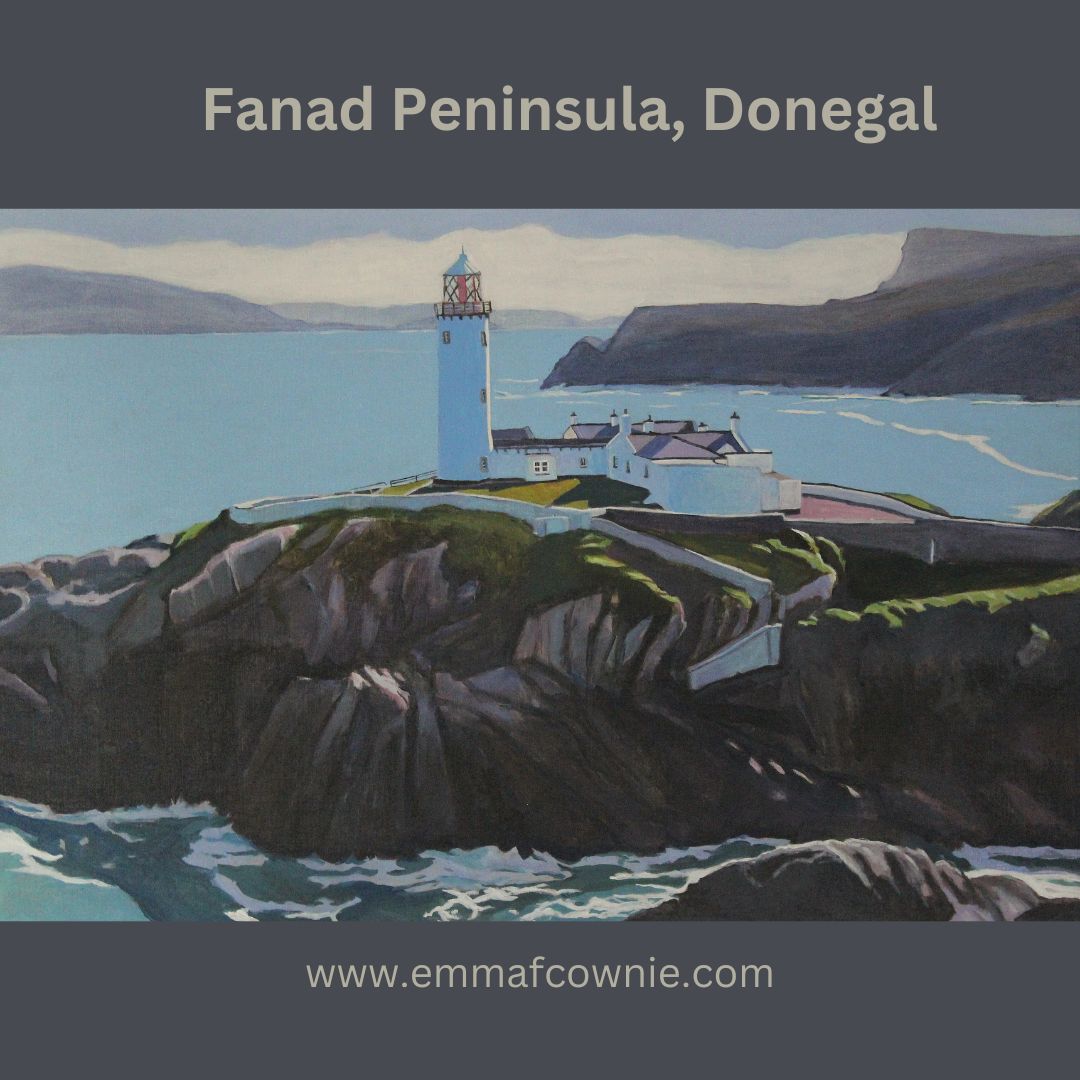
Fanad is a finger of land that lies between Lough Swilly and Mulroy Bay on the north coast of County Donegal, Ireland. It is not that easy to get to and the the survival of the Irish language is testiment that relative isolation.

Fanad Lighhouse (Donegal). Is one of the 12 Great lighthouses of Ireland. It was built in 1886 at Fanad Head (although the station was originally established in 1817). The lighthouse, or more acrrately, the harbour light, marks the entrance into Lough Swilly which forms a natural harbour.

I have painted this isolated structure several times before. I have always enjoyed painting the northernly light on Fanad. I have only have painted it in acrylics. That’s not a delibertae choice, more one of circumstance because at times I have had limited space, and I dont want to use oil paints with kittens close at hand.

I think acrylics suit the airiness of the subject matter. After a couple of years working out how to use them, I have settled on a technique of light layers of paint that allow the underlying colour to show through. This can give a transulent quality to the colour. This is in contrast to the relatively flat areas of colous I use for the larger areas of colour such as sky or the sea.
Read more about my use of acrylics here

My latest painting was an experiment in composition. We used an image from a drone shot done by my artist husband, Seamas (James Henry Johnson).
In this piece, I wanted to create a sense of space from the mountains of the Inishowen Peninsula in the distance. The distant mountains were layered with bluish white until I got the right impression of distance.
I often find myself looking at the tiny Fanad lighthouse far off in the distance when I am at Lisfannon on the Inishowen Penisula. There is a sign comemorating a famous Atlantic storm that happened in 1748. this storm threatened to sink The Greyhound, the ship of one John Newton, a slave trader. John was so frightened that he called out to God for mercy. This moment marked a profound spiritual conversion, and many years later he wrote the words for the hymn “Amazing Grace” one of my favourite hymns, and to also campaign for the abolition of slavery.
There is some confusion how many storms there were . One website claims the terrible tempset happened far away out in the Atlantic because it took John Newton another four weeks after his conversion to sail into Lough Swilly and arrive at Derry/Londonderry. The Amazing Grace.ie site however, makes it clear a second storm happened in Lough swilly itself as it quotes John’s journal ” We saw the island of Tory and the next day anchored in Lough Swilly in Ireland. This was the 8th day of April, just four weeks after the damage we sustained from the sea. When we came into this port, our very last victuals was boiling in the pot; and before we had been there two hours, the wind began to blow with great violence. If we had continued at sea that night in our shattered condition, we must have gone to the bottom. About this time I began to know that there is a God that hears and answers prayer.” It’s got to be said, that John Newton really took his time putting his evangelical beliefs into action because he went back to being a slave trader for another five years before he eventually retired and became a minister in 1757!
The heaving sea at the foot of the massive lighthouse rock intrigued me. The Atlantic Ocean has such a bulk and stregth, even on a relatively fine day, I am not surprised that John Newton was terrified by its strength far away from the Donegal coast. I wondered about the long and difficult process of building this structure all those years ago in a remote location. Yet, this lighthouse has stood the test of time and proudly marks the entrance to Lough Swilly and can be seen from inland and further along the coast.


Find out more
Fanad
https://www.ireland.com/en-gb/destinations/regions/fanad-head/
John Newton
http://www.amazinggrace.ie/newton-in-ireland.html

Urban Minimal
Several years ago I embarked on what I called an “Urban Minimal“project; focusing on the streets of Brynmill, in Swansea, South wales, where we used to live. This work culminated in an exhibition in the Cardiff MadeinRoath festival (read more here).
My original “rules” for urban minimalism composition and painting

Urban Minimal in Derry/Londonderry
I am developing this approach with Derry. I like to paint relatively ordinary street scenes without people. The sunlight and the colours give them drama and beauty. Each of the painting is really about light. I am still attempting to simplify forms but this is something I am always failing at.
On the plus side, I think that my colours have become much softer and more subtle. I think this is partly a response to the northern light which is bluer and less golden than that in Swansea. Its is also because I have got better at achieving naturalistic colours. My confidence has also improved. In the past I chose brigher colours to make a painting more exciting.
I have slowly come to the realisation that such excitment is like hidden sugar in my food. Yes, its initially appealling but it can give you a bit of a headache!
I have enjoyed exploring the streets of Derry. I feel I know the place a bit better for painting them.
Its hard to find a car-free Queen Street but early on a Sunday morning it is possible.
Eagle-eyed readers will spot a car in the mid-distance. I thought I’d see whether a car would negatively disturpt the composition. I don’t think it did.

Some of my earlier paintings of Derry.


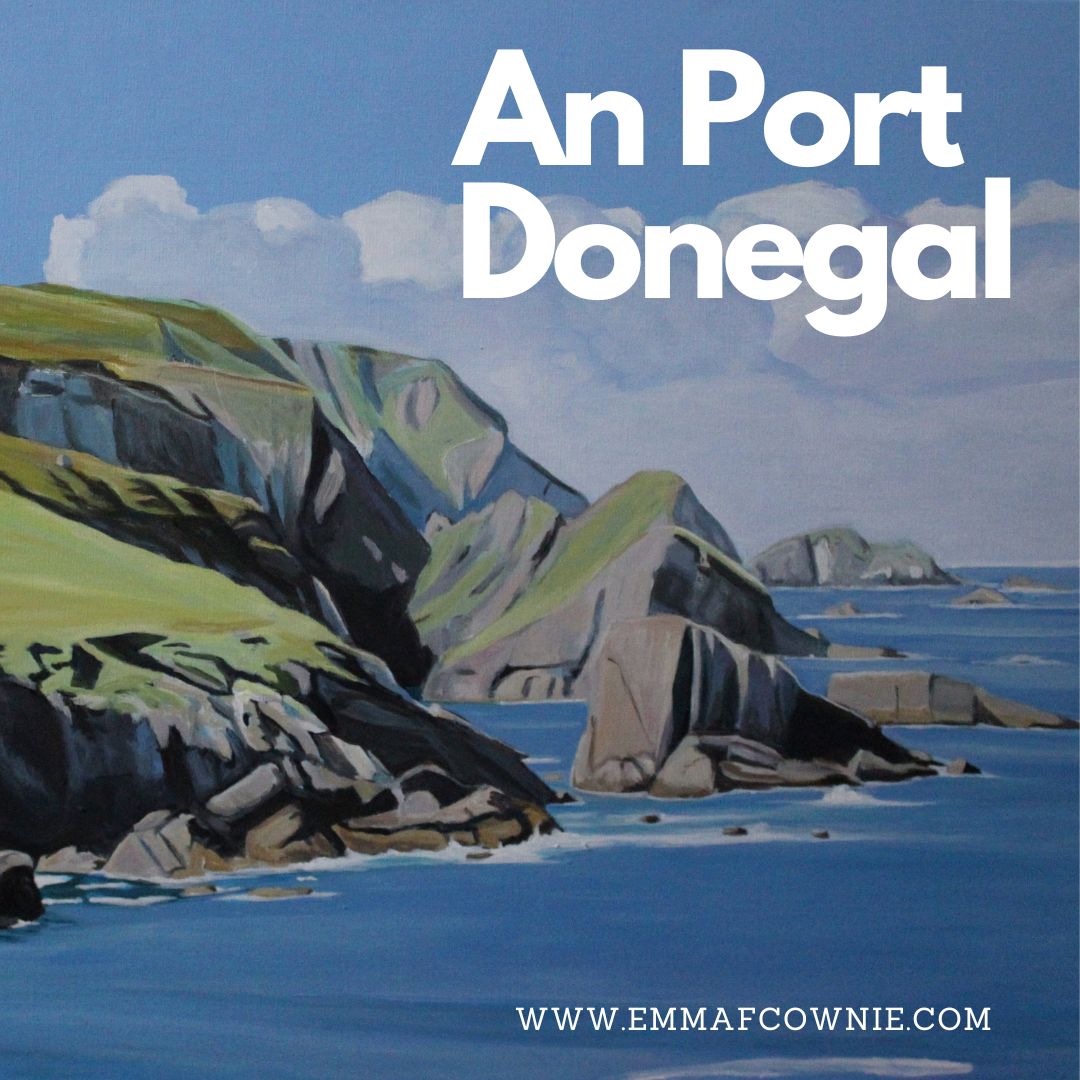
An Port has loomed large in my imagination for a long time. It’s very remote and quite difficult to get to. To reach it, you have to drive down a very, very long single track road (it’s about three miles but it feels longer) on the way to Glencolmcille. There are plenty of sheep and only a few people.

At An Port there is a small quay and a tiny deserted fishing village which looks out over a small bay, surrounded by cliffs and truly massive slabs of rocks and sea stacks. Its one of those landscapes that you imagine can be found all along the west coast of Ireland but is actually unique. When I visited Texas in the late 1990s I thought it would all look like Monument Valley, thanks to those John Ford films. I was surpised to find it was pretty flat.


The village was still inhabited in the 1920s. The hillside is littered with the remains of the stone houses


There is one inhabited house, now an AirBnB property. You can see it on the hill behind me in the photo my husband took of me (below). This was Annie McGinley’s family home.

I first heard about Port in 2018 from a TV programme about the famous American landscape artist Rockwell Kent and his stay in Donegal the 1920s. Rockwell Kent is probably best known today for his illustrations for Moby Dick.

Unfortunately Kevin Magee’s film (in Irish with subtitles) “Ar Lorg Annie” or “Searching for Annie” is no longer available but you can see a short clip on Youtube here. A friend of Kent’s, Rex Stout, had funded his trip to Ireland. He paid him $300 a month on the condition that he had the choice of two painting when he got back. This is one of them in California, “Prince Charles’ Cove”.

Rockwell Kent and his second wife Frances Lee Higgins (they were on honeymoon) spent several months in the near by valley of Glenlough on a farm belonging to farmer Dan Ward. Kent stored many of his paintings back at Port, in the home of Annie McGinley, who modeled for him. Her she is.

Rockwell Kent returned to Donegal, 32 years later. He had wanted to buy Dan Ward’s farm but it had already sold to another farmer. Instead he sought out ‘this singularly lovely teenage girl with whom I had danced many a jig’ and found her in nearby Crobane, married, midddle-aged and ‘broad-beamed’. She had had 14 children, 12 had lived.

Rockwell went to find Annie’s long abandoned cottage in An Port where in 1926 he had dried his Donegal paintings. It turned out to be the only structure still standing, barely supporting the weight of an overgrown thatched roof, a year or two from dereliction. ‘This house, we thought, we ought to buy and fix and have as a place to come every year …’ but he didn’t.

If you look on the left hand side of my painting “An Port” (below), you will see tiny fence posts along top of the cliff. They help give a sense of scale of the huge cliffs and rocks. I can’t remember who first described this landscape it as the “land of giants”but it truly apt.

It is hard to do justice to this incredible landscape but I think that Rockwell Kent’s paintings do. He really capures the majesty and warm colours of Donegal. He also excels at Donegal skies and light. I am really in awe of him.

I wish I could see the original paintings but this is very unlikely. It seems that none of Rockwell Kent’s large paintings stayed in Ireland. Most of them are either in the USA or in Russia. But that’s another story.
I have added a few links about the artist Rockwell Kent below.
Rockwell Kent and Donegal
http://in8motivation.com/tag/rockwell-kent/
https://www.gleanncholmcille.ie/rockwell_kent.htm
https://www.bbc.com/news/uk-northern-ireland-44534911
Click to access The-Missing-Irish-Kent-paintings.pdf
Irish paintings of American artist Rockwell Kent in new documentary Ar Lorg Annie on TG4
The Girl in the Blue Dress
https://www.sullivangoss.com/artists/rockwell-kent-1882-1971 Includes a chronology of his life (but doesn’t mention his Irish trip)
Christy Gillespie The Road to Glenlough – A massive book on the History of Glenough Valley
Stay there/near by
https://www.bizireland.com/port-donegal-cottage-087-253-3166
There is the amazing Cropod too which got rave reviews in the Irish TImes more than once – https://www.irishtimes.com/life-style/travel/2022/09/01/cabin-fever-12-get-away-from-it-all-cabins-to-retreat-to-this-autumn/
How to Get there
http://www.welovedonegal.com/port-ghost-village.html
Climb the stacks (if you are brave enough – not me!)
https://uniqueascent.ie/ There are some excellent guides to the seastacks of Donegal on this site.


We visited Ramelton several times in this summer. It is a fascinating and historic town tucked away in the north-eastern corner of Donegal. Ramelton, (Irish: Ráth Mealtain) is also known as Rathmelton, this caused me great confusion when map reading. Yes, we have a sat nav but I am an old-fashioned girl and I like the immediacy of the map book. I thought Ramelton and Rathmelton were two different places. It is also not too far from another village called Rathmullan. I got very confused. We also didn’t know how to say the name properly to ask directions; we put the emphasis on the first syllable “RAMelton” but it’s said “RamELton”, if you look at the Irish Ráth Mealtain (bearing in mind you don’t say “th”s in Irish) it makes more sense.


Ramelton is a pretty and interesting place to visit. We entered from the north end, over the narrow stone bridge that crosses the flat, slow-flowing River Lennon. There are many fine Georgian-era houses to look at. The Mall runs along the south side of the river from the Bridge to Gamble’s Square. We enjoyed a very pleasant walk along the Mall towards the old buildings that form the Quays.


Further to the east lie the the Quays and the old warehouses, once commercial buildings, some of which are quite neglected, once formed the historic commercial centre of the town.

The town was founded in the early 1600s as a plantation settlement, on the site of an O’Donnell Castle by William Stewart of Ayrshire. Stewart was professional soldier (in otherwords, a mercenary) who had fought for kings of Sweden and Denmark before coming to Ireland for James I (VI of Scotland). He built and gave his name to fortications at Fort Stewart and Newtownstewart. In 1623 he was made a baronet and granted the castle of Ramelton, becoming the biggest landowner in the town. He also gained valuable fishing rights on Lough Swilly.

The word plantation has a special meaning in Ireland. This may cause confusion for some North American readers. In the South States of the USA the term is used to mean a large farm. In Ulster, the northern most province of Ireland, however, the plantation was the mass conviscation of land from the native Catholic Irish by the crown mainly under King James, from c.1609 onwards, and continued under Oliver Cromwell. The conviscated land was “settled” or colonised by Scots Protestants, like William Stewart’s followers. In this sense Ramelton, was a town planned and “planted” by Scots and English settlers.

Ramelton was built where the River Lennon flows into Lough Swilly. We approached the town from the north, over the narrow stone bridge. Unlike many other Irish towns, who seem to turn their backs to their rivers, Ramelton is focused on the River Lennon. In fact, the town is dominated by the wide flat river, with a good part of the old town being built along its shore.
Map of Ramelton, donegal 
The location of the river helped the town develop into an important port and a prosperous centre for industry, trade and local government. In the 18th and 19th centuries Ramelton became the biggest linen bleaching town in County Donegal. Linen was a booming industry in Ulster. By the 1720s flax growing and linen weaving replaced food crops as the staples of Ulster agriculture. In the 18th century the domestic linen industry had expanded so rapidly that annual exports of linen cloth increased 40-fold! The peak period of flax cultivation was the decade of the 1860s (when there was a “cotton famine” in England) during which more than 200,000 acres were grown across Ireland. In the second half of the C19th Ulster produced at least ninety per cent of the national crop. Boats from all over the world docked in Ramelton to trade their wares in return for the Irish linen.

The flax for the linen was grown locally and then treated at the tanyard. Some of the linen was fed into voracious shirt-making industry based in nearby Derry City. The booming trade in linen for the export market helped provide much of the money needed to knock down old plantation houses and replace them with impressive new town houses. These spread westward and eventually grew into a riverside promenade lined by trees, known as The Mall.
Unfortunately, for Ramelton, there was a decline in the linen industry in the 1840s due to competition from Belfast. Although Belfast became firmly established as the linen capital of the world, the bulk of the raw material, however, was no longer produced in Ulster but imported from Belgium and Russian the majority of its production was destined for export too.

In the 1850s the town decline began in earnest as as the port began to silt up although a steam boat would leave from Ramelton to Derry and on to the emigrant ships that left from Derry. Later a new railway line was built in Letterkenny in the early years of the 20th century. This all contributed to the decline in industry in Ramelton. Its role as a centre for local government also ended with the abolition of the Grand Jury system in 1898.


The town is home to McDaid’s, a soft drinks manufacturer, whose drinks are sold throughout Donegal and further afield. Its most famous drink is the Football Special which was originally produced to celebrate the successes of Swilly Rovers Football Club.


We ambled passed the end of the Quays and then looped around and then past some very derelict buildings in sore need need of rescue, to walk back up Castle Street past the old centre of the town. The space which once formed the very centre of the town, is completely given over to a large tee-juntion and cars. Ramelton was also once a “Market Town” with a market cross, which signified the right to hold a market granted by the monarch, or local barony. In Ireland, market crosses were often located in a space, mid-way between church and castle. this was once the case at Ramelton but the market cross itself is long gone.


Open for Business, Ramelton (Donegal) – Emma Cownie
Postcards, drawings and numerous photographs from the 19th century show how prosperous and picturesque the setting of the town was. The town retained its importance as a rural business and market centre into the twentieth century.


At the beginning of the twentieth century, Ramelton had seven churches which is pretty impressive for such a small town. It was known as ‘The Holy City’ due to the religious diversity found in the town. These days there are just three churches. Crime writer Paul Charles, used this diversity as a backdrop for one of his Inspector Starrett detective novels “Dust of Death”. which is based in Ramelton. I read this book, hoping to find out more about the town but apart from the odd mention of the Conway’s Bar and Bridge Bar, there was little background information.

We passed a very modest old end terrace cottage on Bridge Street in Ramelton, Donegal. We didn’t realise it at the time buy this the house where Patsy Gallacher (1891–1953) (also spelt Gallagher), Celtic legend, known as “the Mighty Atom” lived as a child. Patsy’s family were desperately poor, he had been born in the workhouse, and later they moved to Scotland.


On the north side of the river, Bridge End was developed around the large mill sites and bleaching green which is County Donegal’s largest surviving industrial heritage site associated with the linen trade. Although we passed Bridge End on the way into the town, we didn’t cross back over the river to visit this area. If I had known about the mills and bleaching green, I would have made the effort to see it. Next time we certainly will.

Find Out More
Most of the information about the History of Ramelton was taken from “Ramelton Action Plan for Donegal County Council” here .
More about Ramelton here and Rathmelton here (yes, it’s the same place but there are two entries)
Look up individual buildings here
Read more about the Irish Linen Industry
https://en.wikipedia.org/wiki/Irish_linen
https://www.culturenorthernireland.org/features/heritage/shirt-industry
Chapter on Flax in Ireland here
https://theculturetrip.com/europe/ireland/articles/a-history-of-irish-linen-in-1-minute/
Find out about the people who used to live in this parish in 1901 and 1911 census information here
http://www.welovedonegal.com/ramelton.html
Read more about Football Special here

I have been experimenting with different supports and media. The Jessica Brilli painting on wood got me curious about how it would be different from painting on canvas.

I could find very little information about the experience of painting on wood panels (but lots of information on how to prepare them). So I realised that I had to use trial and error to find out. I ordered some gessoed wood panels from Cork Art Supplies who delivered them very promptly.
My first effort was this painting. I painted a light ground of red ochre in oil before I laid down the painting. I found that achieving fine detail was much easier than on canvas. However, the colours didn’t behave the way I expected them too. My sky started off too dark. I found it was easy to wipe off the oil paint and repaint it a lighter shade. I found that white areas also needed a further layer once they had dried to give them the solidity I required. The painting took much longer than I am used to to dry.

I have painted in acrylics on canvas before and struggled with the speed with with the paint dries on the palette. I used to find the the paint had gone hard in the 20 minutes since I started painting. It drove me mad. However, after extensive reserach I worked out how to make a wet palette so that I could slow down the drying time of paint on the palette. I decided to use the quick-drying acrylic paint as an underpainting.
The acrylic painting was more of a sketch than a proper painting. The process forced me to simplify my images further and the final layer of oil paint gave the image a greater depth and richness of colour.


Some of the acrylic sketches really challenged me as the paint did not move and work in the way I was used to with oils. The greens and yellows were too transparent and looked messy. It was impossible to lighten colours, like the leading edge of the fence post, once they had gotten too dark.

The final layer of oil paint, however, enabled me to make my colours much more opaque and to to add much more detail in places, especially on the wire fence.

My final painting was a studies in mauves, blues and greys. I had added an additional layer of light grey gesso as a ground before I started painting.


I enjoyed experimenting and I ended up painting several painting at the same time, as I waited for paint to dry between layers. The whole process forced me to confront my short-comings as a painter of acrylics. I did not enjoy that. It made me feel uncomfortable and brought out my “imposter” anxieties. I need to do much more work in this area to develop my skills.
It was also rather time-consuming and probably not a great project to undertake in the winter months, in Donegal, when good light is in very short supply. I am not sure that I would spend so much time on the underpaintings in future, as I liked my first painting the best. Although I would where there are large areas of white. I did enjoy painting on the wood panel and I will continue to experiment with them.


Last Thursday morning Bingo, one of my two cats, collapsed in the front garden under a hedge and we had to take him on the long drive to the vets to end his suffering. It broke my heart. I had had him for over a decade and loved him dearly. Hattie, his cat companion of the last 6 years, misses him too and she has been outside looking for him. That’s even sader. We are keeping her indoors for now.

So my concentration hasn’t been great. I have struggled to write anything, although I had almost finished another blog. Every time, I looked at images, trying decide what painting to start next, I am crippled by indecision. So I have been painting instead a series of small studies. Playing with composition, and simplifying images. The idea is to reduce detail to the minimum.


I then moved on to slightly larger canvases. The photographs of the paintings don’t quite capture their colour. Unfortunately, they have a blueish cast to them.

Inishbofin #3 30x24cm


I will continue with these and hopefully I will find it within me to paint some much larger versions. In the meantime, we have a large rescue cat we have named Tadhg (pronunced “Tag”) from Burtonport Animal Rescue, in the office. He is named after a famous Irish rugby player, called Tadhg Furlong, on account of his robust physique.

Unfortunately, Hattie hissed at him when she first saw him, so we are introducing them very, very slowly. Swapping scents and feeding them on opposite sides of the same door etc. Tadhg was a stray and hasn’t had much experience of the indoor life, so he’s getting used to things like doors (they move when you rub up against them, you know) and mirrors (there’s a big black and white cat in window thing in the bedroom next door he’s worried about). He also loves carpets and heating. When he wants a break he sits under the chair in the corner of the room. I hope we can successfully integrate Tadhg into our animal family!

See all the studies here

The rain finally stopped yesterday morning and the temperature rose a few degrees. We just had three days of steady rain. The temperatures also went up a bit. I was amused to discover that this “event” made the news. The headline in “The Donegal Daily” an online newspaper read: “Weather- Another Mild Day in Store for Donegal”. This publication is favourite of mine. It is a heart-warming mixture of stories with happy endings (swimmers get into trouble in rip tide but they are all rescued by a passer by and a lifeboat crew), lost dogs, sport stories and local crime cases (often from two years ago).
Anyway, we felt encouraged by the dry (ish) weather to do some light food shopping in Dungloe and then drive to an Affordable Art Fair in Derrybeg, Gweedore. This Art Fair was held at An Gaillearai, which is located at Ionad Aislann, Na Doira Beaga (Derrybeg).

We have never been to Ionad Aislann before and I was very interested to see what this cultural centre was like. I know that “Ionad” means a centre of some sort in Irish but I didn’t know what the word “Aislann” meant. I tried looking it up on google translate but drew a blank so I thought it might be someone’s name. It was wrong. “Áislann” is a word derived from combining two words from the Irish vocabulary of South West Donegal, Áiseanna (facilities) and Lann (building).

The centre also houses, amongst other things, a public library and nursery. When I looked it up here I discovered that the building hosted much more than that: a theatre/cinema, sports hall, meeting rooms, local history centre, PC centre, a gym and a tea room! This cultural centre was set up in 1992 expressly to cater for local people as well as for visitors to the area, including the many artists like me who come to live here. It was also meant to help strengthen bonds within the local community via cultural/artistic pursuits and leisure activities.

The Gallery is large and airy and there was plenty of room for visitors and artists. Everyone was wearing masks too which was reassuring.

Some of the artists showing include (in no particular order); Ian Gordon, Cathal MacGinley, Peadar McDaid, Heidi Nguyen , Mary Toland, Gay OToole and Nora Duffy. We had the pleasure of meeting and chatting with two of the exhibiting artists, Heidi Nguyen and Gay O’Toole. We met Cathal Mac Fhionnghaile/Cathal MacGinley when we visited Inishbofin last month. Here is a selection of the work on display.


Karol Mac Geirbheith

Karol Mac Geirbheith


As our house is already over flowing with paintings we generally don’t buy other people’s art (although I have one painting by Welsh landscape artist, Warren Heaton, in the bedroom) but we changed the habit of a lifetime yesterday and bought two small paintings at the art fair. I know that Séamas wanted to buy more. We left the two paintings on the wall with red stickers next to them (hoping that sign of success would encourage more sales) and will go back on Thursday to pick them up.
After so long in lockdown and avoiding people, it was really great to go out somewhere and to meet new people. Ionad Aislann certianly did its job of helping to strengthen the bonds between local community via cultural/artistic pursuits and leisure activities. It was well worth a visit and if you are in area I would highly recommend stopping by. The Art Fair is on for several more days, from 12 to 5pm until this Thursday 14th October 2021.


