Posted on 1 Comment

Gola; The Island that waits patiently for people to return

Gola

I am delighted that Peter Zantingh, a Dutch blogger, wrote this an account of Gola and my work. I have translated it for you to read (well, Google did). You can read the original here.

“In the autumn of 2018, Emma Cownie looked out from the Irish mainland at an island she could not get to. It seemed so close. She could see the rocks off the coast and beyond them, scattered seemingly at random across the rolling land, the whitewashed cottages. Some were abandoned, others clearly still inhabited, or used as summer homes.

Gola Island is one of 365 islands off the Irish coast. It is just two square kilometres in size. No one knows exactly how many people live there, because there are more in the summer than in the winter. Ferryman Sabba only goes up and down between June and September.

But in 2022, there were fifteen people living on Gola, according to official figures.

Emma Cownie is a British artist. She studied medieval history at Cardiff University and taught at a secondary school for a while. On 29 February 2012, she was hit by a car. It was, in retrospect, what prompted her to take up painting full-time. The days in front of the class were exhausting, almost all contact with other people in fact, she was startled by every sudden sound. A few years before the accident her dog had been run over on a busy road.

Painting helped.

In the days after she had stood on the mainland looking at those houses in the distance she painted Spring Light on Gola. It came, she told me, ‘out of a kind of longing for the island’.

In the spring she went again. It was early April, sunny but chilly, a cold wind blowing along the coast. Her husband Séamas was with her, their dog Mitzy too. To get the best view of the island – again there was no ferry – they walked along long stretches of beach and climbed on granite boulders, almost pink in the spring light. From here she could see the houses that had recently been renovated and modernised.

That summer she was finally able to go there. ‘There are hardly any cars’, she told me about it. ‘Just a few tractors, no telephone poles or electricity pylons and only a few other people. Other than that, just birdsong and wind. It’s bliss.’

donegal painting of Gola, West Donegal, Emma Cownie.
Spring Light on Gola (Sold)

*I emailed Emma Cownie last month with a simple question. One of her paintings was used on the cover of one of my favorite books, Foster by Claire Keegan. I wanted to discuss that book in my newsletter, and I would like to show that painting as well. Would that be okay? I would mention her name and link to her website.

She responded the same day, and we got to talking. She said that the painting I had asked about was called Traditional Two Storey House, Gola, and that it was nice to hear from someone from the Netherlands, because although she regularly sees Dutch campers in Donegal, the county in the northwest of Ireland where she lives part of the time, she has never sold work to anyone from the Netherlands.

The title of the painting made me curious. Gola? What was that? That’s how I became fascinated with the island in my own way.

At one time, there were about two hundred people living there, who made a living from fishing and small farms. But after 1930, the population began to decline. Especially in the winter, it was easier to earn money in the cities, especially those of Scotland and England, and fewer and fewer people returned for the summers. In 1966, the island’s school closed; with only nine pupils (there used to be sixty), it no longer had a right to exist. The few families with young children were forced to move to the mainland – and once the last family with children had left, the community was doomed.

I read this last in Gola: The Life and Last Days of an Island Community (1969) by F.H. Aalen and H. Brody, which I ordered for a few euros on boekwinkeltjes.nl or Abebooks. I think I mainly wanted to know what happened when the last ones left. How does a group of people dissolve itself?

Gola: The Life and Last Days of an Island Community (1969) by F.H. Aalen and H. Brody,

Brody, a sociologist who wrote the part about the last days of the community by the two authors, saw a kind of laconic group feeling among those who were still there at the end of the sixties. Everyone wanted to stay, if the rest stayed too. Everyone thought it was okay to go, as long as everyone else went too.

The most intriguing aspect of each islander’s account of his own predicament is his insistence that it all depends on the others. […] The general attitude is one of wait and see – what the others do. But all of the Gola people are waiting on one another in this way, and do not seem to mind the impasse that this conditional planning involves. Of ten islanders who related their plans, nine said they would like to stay, but it depended on the others. One man said he would stay so long as he had a dog with him, and could not see any advantage to life away from the island. Apart from that one man, all stated they would be glad to remain on Gola, but did not really mind leaving.

The authors also contributed to a short documentary for the Irish public broadcaster RTÉ from the same year, which shows how one family, the O’Donnells, leaves the island. They lock the door and walk with their dog, a long-haired collie, to a motor boat in the harbor. They are all wearing black. (Screenshots from the film below)

Five people remained: fisherman Eddie, fisherman Tadhg, postman Nora and her husband John, and ninety-year-old Mary. It would not be long for them either.

What was left behind? The island had no shop, no pub, not even a church. “The islanders worship on the mainland when the weather is good enough to make a safe crossing,” Brody wrote in 1969. Just over thirty houses remained, most in poor condition. The schoolhouse and the post office. Wooden boxes and fishing nets in the harbour, where a statue of the Virgin Mary, housed in a stone shrine, continued to look out. Two pegs on a washing line.

Between 1969 and 2002, Gola was an uninhabited island. In Dances With Waves: around Ireland by Kajak (1998), Brian Wilson (not the Beach Boys guy, another Brian Wilson) writes about the time he went ashore during his nearly two-thousand-mile kayak trip all the way around Ireland. He hoped to find some peace and shelter that day, but he encountered “the eerie atmosphere of a ghost town”. Fishing boats lay rotting in the harbour among the washed-up debris.

But he found something more hopeful in the cottages. They were “abandoned, but not in decay”.

[…] one felt as though, like faithful dogs, they were just waiting for their owners to return. More than that, it was as if the island itself was still waiting. And the people came again. They came back. Somewhere around the turn of the millennium, the first ones crossed. Today, most of the cottages are still uninhabited, but in summer the sounds and movements of people join those of the cormorants, guillemots and gannets.

Emma Cownie has made more than 25 paintings of Gola in recent years.

For Traditional Two-storey House, Gola, the painting that made me contact her, she returned to the ‘rules’ she had set for herself a few years earlier. These rules – not coincidentally – coincide with how she wanted to organise her life after the car accident and the difficult time that followed: no cars, no people, bright light.

Furthermore, there must be shadows, preferably diagonal, in simple shapes. The painting must be about the interplay between shadows and man-made constructions, the tension between 3D buildings and 2D shadows.

She also wanted to think longer and better about colour. Not to choose the brightest colour, purely for effect, as she had done before, but to work more subtly. In a new series of works based on the houses on Gola Island, including Traditional Two-storey House, she resisted the urge to make the shadows very dark, the sky pale pink and the grass yellow and bright green. “I tried to keep the shapes and colours as simple as possible without it being a cartoon,” she told me. “I wanted to capture the essence of the place.”

Oil painting of Gola Donegal by Emma Cownie
The Traditional House, (Gola)

She painted the picture in January 2021, during a Covid-19 lockdown in Wales, where she was then living. That summer, she and Séamas moved to Donegal, in the north of Ireland.

It was the following summer, 2022, that she was approached by the prestigious London publishers Faber & Faber: they wanted to use Traditional Two-storey House for the cover of Claire Keegan’s Foster, originally published in 2010.
“I didn’t realise what an honour it was until I got a copy of the book and read it,” she said. “I cried at the end.”

Foster by Claire Keegan, Published by Faber

Is there a writing lesson in this? I don’t know. Maybe that there’s more to everything. Maybe it’s worth following your interests and fascinations without reservation. To notice it – this interests me, this grabs me – and follow that line, see where it takes you.

Posted on 10 Comments

Spring in the Sperrins

Painting of Spring in Sperrins, N.I

The Sperrins or Sperrin Mountains (Irish: Sliabh Speirín) are a mountain range in Northern Ireland. The name Sperrin derives from “Na Speiríní ” meaning “Spurs of Rock” and it is the rocks of the Sperrins and the rolling geography of the area that form the foundation of this distinct landscape.  The mountain range, stretching 40 miles along the border of counties Tyrone and Derry, is the largest in Ireland. There are 10 summits above 500 metres with the highest of the range, Sawel Mountain, peaking at 678m (2,224ft). 

The landscape is mostly moorland and blanket bog. The Sperrins were designated an Area of Outstanding Natural Beauty in 1968. It’s a sparse rolling landscape. These peaks have been smoothed out by glaciers thousands of years ago. Populated by sheep, bog grass (Eriophorum angustifolium) and farmhouse, old and new.

Some old farm buildings have long-been abandoned by people but are still used for farm equipment and shelter for sheep. So long as there is a tin roof, the walls will last years and years.

painting Upper Dreen_Emma Cownie
Upper Dreen_Emma Cownie (SOLD) Recently,

I love the sharp oranges of those tin roofs and I will return to them again and again for inspiration. Broadly speaking, in terms of composition I am looking for three dominant colours; green grass/sky and orange tin roofs. You can see how I simplify these main colours in the painting below.

Farm in the Sperrins, County Tyrone, Ireland
Farm in the Sperrins, County Tyrone, Ireland _Emma Cownie

Drone photography has become widespread in our lives. I remember clearly first seeing drone shots of different American cities in episodes of CSI. They were tracking shots of skyscrapper from directly above. As if you were a bird, flying directly above. They were fascinating. Funny, I cant find a clip to illustrate online now. These days they are used in local and national news and documentaries so frequently I dont think we even register that they are drone shots. They have become part of everyday our visual language.

Recently, I have started to explore the use of drone footage (shot by my husband) to extend the possiblilties of compositions I can paint from. So often, I have thought: “If only I was 20 foot high, I’d get a great shot”. So now I can see from 20 foot above, or round the otherside.

I know that many people think that “real” art is plein air sketching, live and I would need to be in a hot airballon to get these views. I admire people who can do this. I can’t. I am not a plein air painter. I am too much of a control freak. I work slowly in the comfort of my studio with all my paints within arms’ reach, exactly where I want them.

This is the first rainbow I have painted. I was pretty nervous about doing it as rainbows are so beautiful and etheral. They are also fleeting. I am reasonably happy with the result although I would be happier if it was more transulent. If I painted another one I would use more acrylic medium to get a more see through effect.

Rainbow over a Sperrins Farm_Emma Cownie

I can also use drone footage and photography if collectors want a commissioned work with drones offering a novel view of their favourite places! It certainly has helped me become more creative with compositions and has benefitted my work greatly.

(c) James Henry Johnston 2024

Posted on 6 Comments

Boat on Rossbeg Beach, Donegal

Painting of Rossbeg Beach

The west coast of Ireland is dotted with islands, big and small but also plenty of sea stacks. Perhaps, they were once sea arches, I am not sure. If they were the crown of the arch fell in to create these majestic pillars. They can be seen from miles away. Even on misty days. This one, Tormore (in the painting above and below) is miles away, near a very remote location called Glenlough Bay. There is something exciting and other worldly and timeless about  it.

Rossbeg Beach, Donegal
Rossbeg Beach, Donegal (Photo credit:Emma Cownie)

Rossbeg (sometimes spelt Rosbeg) is a tiny townland on the west coast of Donegal, just three miles south-west of Portnua and Nairn. This is the Dawros Peninsula. There is a pier and a scattering of houses, some are modern, but many are old cottages, probably used as holiday lets.

Road above Rossbeg Beach:- Phot Credit Séamas Johnston
Road above Rossbeg Beach:- Photo Credit Séamas Johnston

There is another beach around the corner too.

Rossbeg on the Map
Rossbeg on the Map

Boat on Rossbeg Beach: Photo Credit - Emma Cownie
Boat on Rossbeg Beach: Photo Credit:- Emma Cownie

Rossbeg Beach, Donegal
Rossbeg Beach, Donegal (Tide further in): Photo Credit:Emma Cownie

Rossbeg postcard
https://www.johnhindecollection.com

The beach and the view is just perfect. The water is so very clear that the rocks and seaweed are visible from quite some distance from the shore.

Rossbeg Pier (From Marina.com) note the cows on the baech

Rossbeg Pier (From Marina.com) note the cows on the baech
Rossbeg Pier (From Marina.com) You can see the seaweed from up high too!

Rossbeg Beach:- Photo Credit Séamas Johnston

Boat on Rossbeg Beach, Donegal, painting by Emma Cownie

Boat on Rossbeg Beach, Donegal, painting by Emma Cownie SOLD

SEE DONEGAL PAINTINGS                                             BUY DONEGAL PRINTS 

Posted on 9 Comments

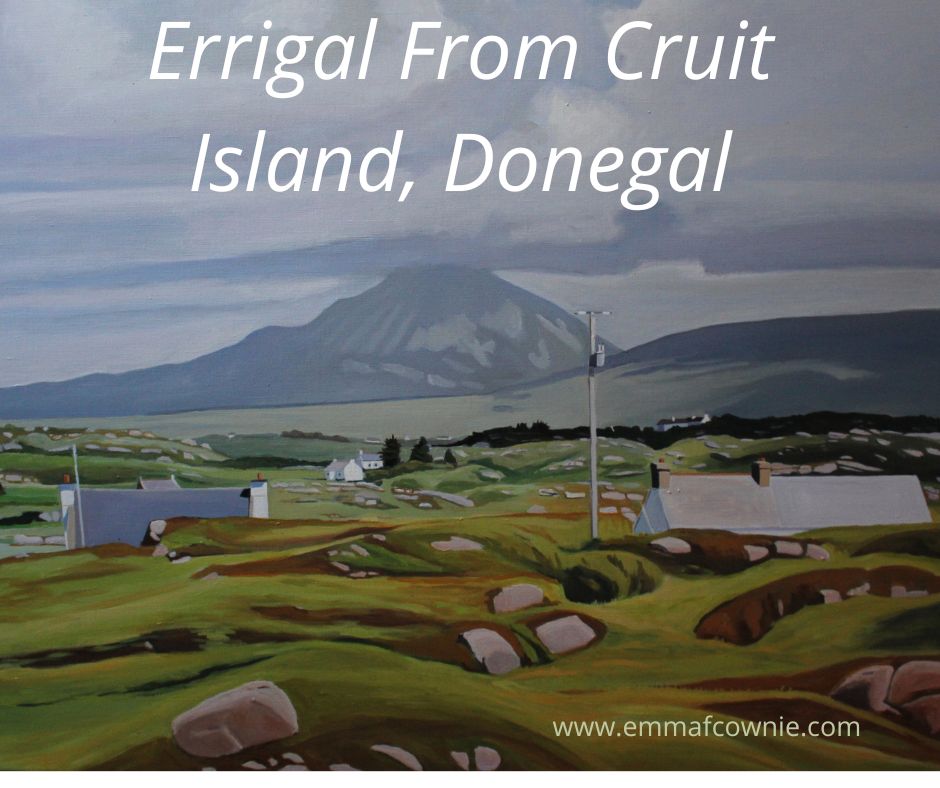
Errigal from Cruit Island, Donegal

Errigal From Cruit

There is a definite shift in the seasons.  In summer here, the light seemed to stretch on for eve;  well past 11pm. Suddenly the days have started shortening fast. It is now dark before 9pm.   It has rained solidly for the last two days. In typical Donegal fashion, the sun has come out and everything is bright and fresh.

Artimus (aka Artie) our Donegal rescue cat has just passed me to go outside in the catio to smell the breeze.  He used to be a stray. It’s hard to believe as he’s so beautiful and such a softie. He now enjoys the warmth and comforts of indoor life (especially hiding under the towel rail)  but he still enjoys the smells and sounds of rural life outside. We lost three pets in the last year (two cats and a dog) and I am not letting him outside when there’s a busy road at the bottom of the garden. I cant face the heartache, if I dont have to. So Séamas, built a catio. Or the cat veranda as I like to call it. Both of our cats, enjoy it but Artie, especially so but not when it’s cold. He’s been in and out of it four times in the last twenty minutes. I think he wishes it was warmer. He must have found life as a stray really tough!

Artie in the Catio (through the window)

Catio - aka cat veranda
Catio – aka cat veranda

Artie - indoors
Artie – indoors

Errigal from Cruit Island, Donegal:-This was one of a pair of large paintings I started before I got ill. It sat in it’s greyscale state for over a month and a half until I recovered enoungh stamina to complete it! Large painting require a lot of strength as you lift your arms/hands above your head, even if you are just moving the canvas.  I was very glad to finish it.

Donegal Greyscale #1

I enjoyed painting the rolling landscape; splattered with rocks. I took great pleasure in adjusting the colours in oil paint and “tightening up” the details. The rash of rocks amongst the boglands is quite unique to this part of Donegal. Further south towards, Glencolmcille, there are far fewer bolders and rocks. There the bogland blankets the landscape uninterupted. There are far fewer houses there too. This area of Donegal, the Rosses, however, is dotted with houses old and new. I like that the old houses nestle in the nooks and crannies of the landscape; keeping out of the prevailing westerly winds and showers.

Painting of mountain Errigal from Cruit Island. Donegal _ Emma Cownie
Errigal from Cruit Island. Donegal _ Emma Cownie


Buy the painting here

Gentle Artie came from AnimalsinNeedDonegal – They found him a home because long-haired stray cats don’t live long lives outside in Donegal, their long coats are hard to keep fully dry.

Here’s their facebook page here  They also have a charity shop in Donegal Town and you can make donations here. You can also follow them on Instagram

Artie - He a wee dote
Artie – He’s a “wee dote”


Posted on 13 Comments

On the cover – Eugene Vesey

Eugene Vesey
I was delighted to give permission to Eugene Vesey, poet and author, to use my artwork on the back of his book “Opposite Worlds”.  In the story, the main character Frank spends his honeymoon with Mary on Gola island.
My painting,  “Up From the Pier, Gola” looks great on the back of this edition -You can get a print of my painting here https://www.artmajeur.com/…/12510206/up-from-the-pier
Eugene sent me two copies of the book, which I am half way through and enjoying a lot. See the book on Amazon here https://www.amazon.co.uk/Opposite-Worlds-Eugene-Vesey/dp/1461075874 and on Barnes and Noble https://www.barnesandnoble.com/w/opposite-worlds-eugene-vesey/1104007157

Back Cover of Eugene Vesey’s book with my painting on it.

Me in front of the study and large scale version of “Up from the Pier, Gola” in my old Swansea studio

Posted on 12 Comments

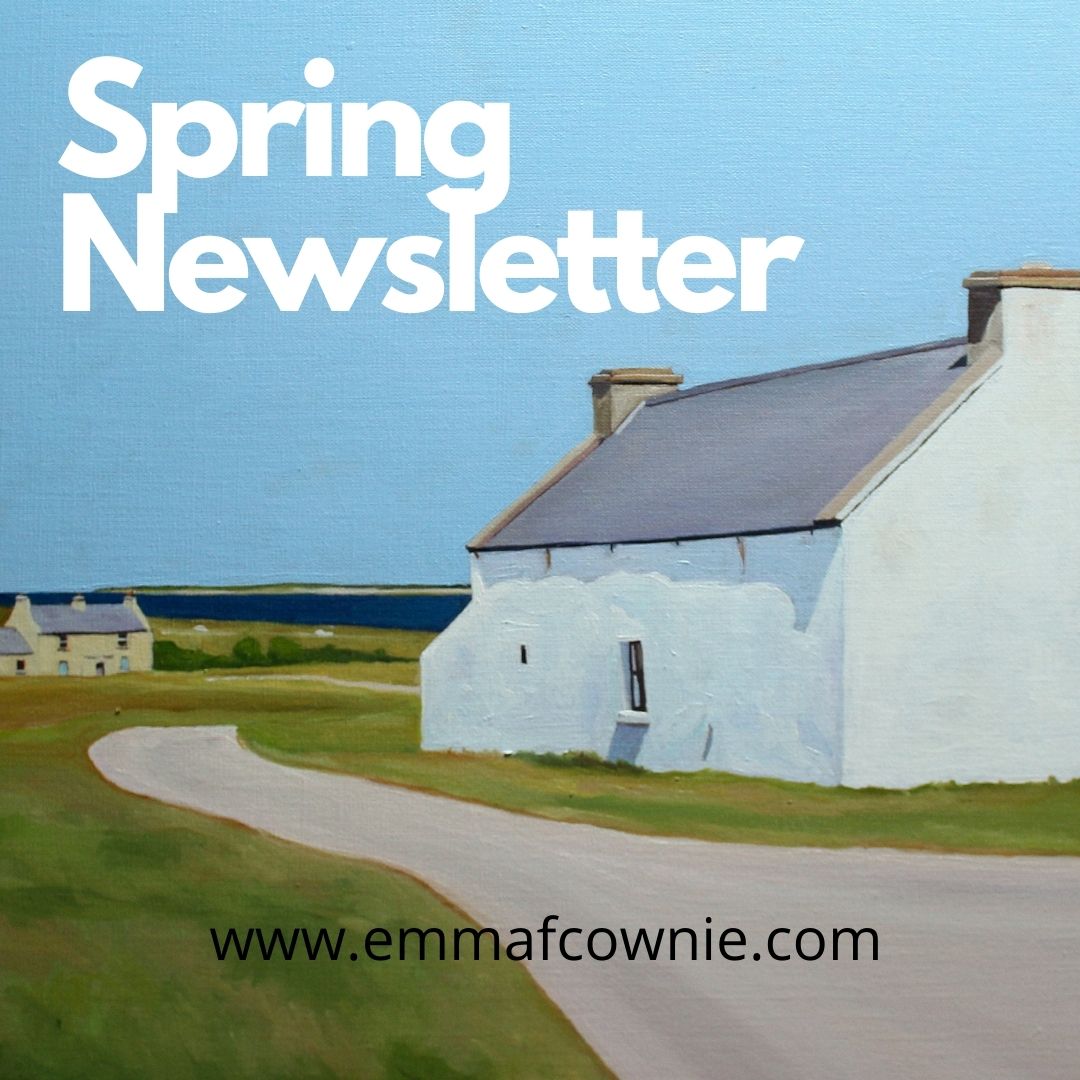
Spring Newsletter 2021

Newsletter Cover

Here’s my spring newsletter which you will see is heavy on the visual and very light on the text!

Spring Newsletter 2021 Page 1
See more Gola paintings 


Spring Newsletter 2021 Page 2
See Large paintings 

Spring Newsletter 2021 Page 2
See  All Recently Sold Work 


See! That was easy to look at. If you wish to get regular (no more than once a month) updates about my work and news about exhibitions sign up here


Posted on 26 Comments

A Better Day: Paul Henry Reimagined

A Better Day by Emma Cownie

I was recently commissioned by a collector to paint a version of a painting by Paul Henry.  This was quite a daunting request. At the moment, my top three favorite (dead) painters of the Donegal landscape are Paul Henry, and William Hubert Craig and Letitia Marion Hamilton.

Born in Belfast, Paul Henry studied art in Belfast and then Paris. He lived in London briefly, and then moved to Achill Island on the West coast of Ireland in 1910, with his artist wife, Grace. They lived here  until 1919 when they moved to Dublin. His paintings depict the West of Ireland landscape in a beautifully spare post-impressionist style.

Paul Henry’s paintings portray the rugged mountains, wind-swept trees, dark boglands and towering clouds of the west coast of Ireland.  His images of  Ireland are genuinely “iconic”. This is because in 1925 he was commissioned by the London Midland and Scottish Railway Company to design a travel poster.

irish-railway-poster-connemara-ireland-by-paul-henry-23-p (1)This poster for Connemara was distributed throughout the world (mostly in North America) to encourage tourists to explore the west of Ireland.  The Irish Times commented in that year: “If thousands of people in Great Britain and America have been led this summer to think over the claims of Ireland as holiday ground it is largely through the lure of Mr Paul Henry’s glowing landscape of a Connemara scene.”

Many people bought reproductions of the poster and more posters followed. 


Many of Paul Henry’s landscape paintings are in public galleries and museums but they also turn up at auction on a regular basis and almost always do “very well”.

The small painting that was auctioned this July, was the one I was commissioned to interpret. This was “Claddagh Village” painted in 1928. I do not know what the painting sold for, but the estimate was for a whopping €40,000 – €60,000

Claddagh Village
Claddagh Village

I had to think quite a bit about this painting and Paul Henry before I started work on my own version. I have never done versions of other artists’ works, although I have seen artists sketching famous paintings in art galleries.  I am the sort of artist who peers very closely at the surface of a painting in a gallery, to try and get a sense of how a painting was made.

I suppose I approached this task in a similar manner. I peered carefully at the impasto brushwork in the photograph of the painting. I looked at how he had laid the colours down. Although the paint was thick in places, in others it was applied thinly and the colour of the canvas/grounding showed through the paint. There was something about Paul Henry’s paintings that bothered me. I could not quite put my finger on it. How can I put it, they were all very blue, even when they had red in them. Indeed, “Claddagh Village” had curious splashes of red on the right-hand side of the painting, and I wasn’t sure what they were meant to represent. Was the hedge on fire? Surely not.

Part of the answer it turns out that Paul Henry was mildly colour bind. So when he used red it was probably squeezed neat from the tube. Greens, warm, cool, or otherwise, are often absent from his paintings. This caused me to pause. Should I copy Paul Henry’s colour scheme or use my own palette of colours? I decided I needed to know more. So I research the subject matter a bit more.


Claddagh was a fishing village in County Galway. It’s thatched cottages were pulled down in the 1930s, but old photographs of the original houses still survive.

These photos gave me a good sense of the chunky shape of these very old houses but not their colours. So I looked for modern photos of Galway thatched cottages for the colour. I finally, found some images of puffy clouds over Connemara and put together a reference sheet for colours and shapes. I decided although I would use Paul Henry’s composition I would not copy his colours, as such, use the reference images in the way I usually paint pictures.

Visual References for Paul Henry
Visual References

Once I had settled these questions in my mind, I put them to mind and painted. My canvas was about the same size (24x30cm) as the one he used (23x30cm). My choice of blue for the sky was very different from the beautiful (almost) duck egg blue Paul Henry used. My cloud was a summer cloud.

My shadows had more blue and mauve in them, that Henry’s which had a lot of grey/brown in them. Interestingly, had I been painting a watercolour version I probably would have copied his choice of colour for the shadows.

I dithered over the russet-coloured bush. I wondered if it had been green in real life or if the painting was done in autumn. In the end, I left it russet. I don’t think I conveyed the thickness of the thatch as well as Henry did. My thatch looks too new.

Right at the end as I painted the grey stone wall, I realised with an oddly blinding clarity that the smudges of red could only be a rain shower! How stupid was I to think that the bush was on fire? The whole painting was about a pair of small rain clouds producing a tiny gust of rain, whereas my version was about a hot sunny day.

Paul Henry’s painting is an infinitely superior painting to mine as it has movement too; in the rain shower, how he has painted the road, the depth of the shadow/reflection on the gable ends of the houses. He handles the paint so confidently. It tells a story, about a sudden shower, whereas mine is about space and empty street. I always thought that Paul Henry was the master of simplifying a scene, I just had not appreciated how effective his use of impasto paint was. I found that very appealing.

Now I understand why artists will make copies of the great masters, because you cannot truly understand how a painting is made until you try and put together your own version.  Looking at the surface of a painting will only get you so far in understanding it. I was not attempting to copy “Claddagh Village”, although that would have been interesting, but reimagine it. As many husband joked, it’s Claddagh village, just on a better day.

a
Claddagh Village – My version

Posted on 16 Comments

The Road by the Loch, Ireland

Landscape Painting of Donegal Ireland by Emma Cownie

A while back I came across a quote on the internet that has stuck in my mind:- “If I knew the world was to end tomorrow, I would still plant an apple tree today.” I was quite struck by this sentiment, especially in the light of current events.
I could not remember who said it. So I did some research. I was intrigued by what I discovered online. I found a number of statements:-

  1. It was originally said by Martin Luther, a 16th century German monk yoJyC
  2. It was originally said by Martin Luther King Jnr, the 20th century African-American Civil Rights Campaigner. NzGsK
  3. It wasn’t said by 1) or 2)!

This puts me in mind of one of my favourite internet memes by that teller-of-truth Abe Lincoln…
Lincoln-quote-internet-hoax-fake
Just joking!
The apple seed quote apparently originates in Nazi Germany in the 1930s, in the Protestant Confessing Church, which used it to inspire hope and perseverance during its opposition to the Nazi dictatorship.
To be honest, it doesn’t matter who said or when (although there’s a lesson about taking things at face value there) because I like the sentiment. No matter how dreadful things seem, they will pass. Eventually.
Here is my apple seed for this week.

Donegal Ireland landscape painting Emma Cownie
The Road by the Loch, Ireland (80x60cm/ 31.5×23.5″)


Posted on 13 Comments

Cottage in Roshin Acres, Ireland

Painting of Irish landscape

This is only a short post because my cold from hell isn’t shifting and I have been ordered to rest by Séamas, which as you see, I am failing to do!

I like red and orange. Especially in winter. I have noticed that I like to paint red and orange things in wintertime. I previous years it has been red coats on the harbor beach at Tenby, or grandparents buying ice-creams in Brynmill Park. This year it’s the autumnal orange foliage of Donegal.

Painting of Cottage in Donegal, Ireland

Cottage in Roshin Acres, Ireland (SOLD)

I painted this small painting over a number of days, over Christmas. I would usually paint a picture like this in one day but the light kept going and I wasn’t very energetic so I decided not to rush it and wait until the next day. I think my patience was well-rewarded.

I have painted this house before, in a much larger painting. It’s interesting how the more distant view produces a cooler more airy painting. 

Painting of Donegal landscape, Ireland
Roshin Acres, Ireland

(SOLD)


Posted on 31 Comments

In the Glynn Vivian Open Exhibition

Exhibition - Emma Cownie 2019

The Opening night of an “Open” exhibition is an affair full of nervous energy! This is because 90% of people in the room are artists who are all relieved/happy to have their work included in the exhbition in the first place and secondly have come to see where their painting/s have ended up? Are they in a corner? Can they be seen?

Open Exhibition is where the organisers invite or “call” for artists to submit their work (for a small fee). The best works are then selected to be included in the exhibition. There are massive national exhibitions (like the BP Portrait Prize) that are so massive that they have a preliminary round where digital photos are first sent for consideration. The Glynn Vivian, does it the old fashioned way by requiring artists to bring their paintings to gallery for submission. You can submit up to two works each. As, it’s only open to artists living in the Swansea area, it’s not too onerous to drop in the paintings.


All artists fear rejection. We are sensitive souls. So to have to face the prospect of being rejected (one or two paintings) isn’t pleasant. Inclusion isn’t automatic, even if your work has been included before (I was in 2017), especially as the people doing the choosing (or “curating”) change every year. This year’s curators were Richard Billingham and Durre
Shahwar. Richard is a photographer and filmer maker who was nominated for the Turner Prize in 2001. Shahwar is a writer, editor, and creative facilitator. Thankfully they chose both of the works I submitted.

I had deliberately decided to arrive an hour into the Opening party as I remember it being very crowded to last time I came in 2017. It was still very crowded at 3pm and the numbers only really thinned out after 4pm. There were 245 pieces in the exhibition. The two rooms in the gallery were filled to the brim with paintings (and artists). were overwhelmingly 2D art. Paintings, sketches and prints, but there were films and sculptures too.

Crowded Glynn Vivian Open

Of course, the first thing I did was try and find my paintings. They were in the second room. I was initially surprised to see that they were not together but had been arranged separately as part of themed groups of colours. I thought that the arrangement worked well. It’s a funny feeling seeing your paintings in amongst lots of other paintings. It’s like a familiar face amongst a crowd of strangers.

There’s no way I can get a photo of both paintings, I thought. Actually, for a long time, I could not get a photo of each painting as the gallery was so crowded.

Spring Light on Gola (top centre)

For some reason, people stood in front of my second painting, Autumn in the Rosses for the longest time.  Different groups of people too. So I had to wait quite a while to get a photo of it and even then I had a person’s shadow on it!

Spot my painting?
Spot my painting?
Autumn in the Rosses (top left)

It wasn’t just me trying to get a photo of my work. These artists were very excited about being in the exhibition. Their joy was a delight to see.

DSC_0040-001.JPG

"Textile Bouquet" by Eleanor Anne Owens
“Textile Bouquet” by Eleanor Anne Owens

There was so much to look at in the exhibition. There was such a variety of work too. Here are just a few that caught my eye. The most affecting work were the two bird sculptures by Mike Hill. One was made of fishing tackle detritus and the other was in the shape of a cormorant smothered in tar.  In fact, the tar-bird was so affecting that I had to fight back the tears. There were quite a few works that touched up the climate emergency and waste but these two, in my opinion, were the most powerful ones.

What are we Doing? What Have we Done? No.1 and No2.
What are we Doing? What Have We Done? No.1 and No2.
What are we Doing? What Have we Done? No.1 and No2.
DSC_0044-001
Dafydd Williams “A Coded Reverie”
Steve Pleydell "Margot"
Steve Pleydell “Margot”
Amanda Puleston "Doolin, Ireland"
Amanda Puleston “Doolin, Ireland” – It’s knitted art!


I particularly liked the animal/nature themed wall.

I also really liked Myles Lawrence Mansfield ” Rejections/Acceptance Machine”. I liked it even more when it was explained to me that it moved when you turned to handle! I always like things that do something. Thinking about it now, it may well have been a comment on the life of an artist!

DSC_0082-001
Myles Lawrence Mansfield ” Rejections/ Acceptance Machine”

I had to pleasure of meeting fellow artist Wendy Sheridan in real life (after many online interactions via social media).  She very kindly took my photo!

Emma Cownie Exhibition
Me at the Glynn Vivian

I would highly recommend visiting the Glynn Vivian to see all the works in the Open Exhibition. It’s on until 23rd February (closed on Mondays) and is free!

Find about more about the Open Exhibition here