


Donegal is a big mountaneous county in a big country. Imagine my shock when I discover that it’s only the 4th largest in Ireland (after Cork, Galway and Mayo) at 4,860 km2 (1,880 sq miles). It seems even bigger as there is no railway or motorways here, so it takes a long time to travel around all the mountains. One of joys of the county is that it’s relatively empty (the 5th least populated in Ireland) with 32.6 people per km2.
There is also a lot of coastline and the landscape varies from remote mountain bogland, rocky shores to lush rolling farmland in the east. Here are three small paintings I have completed recently that reflect some of this diversity.

The first painting is the furthest north – Malin on the Inishowen Peninsula. This peninsula is the furthest north in Ireland – Malin Head is represented by the red star nearest the top of the map above. It is further north than any part of Northern Ireland! This causes a lot of confusion for my parents who have never been to Ireland despite the fact that my father’s grandparents were from Cork.

The wee House at Malin is a cave, where folklore has it that no matter how many people enter it will hold all. It predates a monastic foundation and Holy Well. The cave and holy well were originally associated with the belief in the sanctity of water and local tradition states that the original foundation was built to exorcise evil from the area. The “Saint” venerated was St. Muirdhealach. He supposedly blessed the well (located in a cavern underneath the large rock directly in front of the ruins of the church).

The second is a view from Arranmore, the largest of the many islands off the coast of Donegal. This is represented by the red star furthest to the left/west on the map above.

And finally Muckish Mountain which lies further inland in West Donegal. I notice Muckish isn’t always included in Tourist maps (like the one bolow which has a red triangle for near by Errigal), yet its distinctive flat backed shape can see seen from Arranmore in the far west and even Carrigans in the far East of Donegal.


Find out more about County Donegal here: https://www.govisitdonegal.com/brochures-and-maps

This is a follow on from my last post about composition and large landscape paintings. Included a small study of a view of Arranmore, Donegal. The study used a diagonal composition.


When it came to a much larger painting (60x80cm – approx 24″ x 32″) I decided on a slightly different composition. It wasn’t that I didn’t think the small painting worked, because it did, but because paintings in the “landscape” format are more popular with collectors than those in “portrait” format. It might have something to do with wall space, I am not sure. If you are not sure what “landscape” and “portrait” format is, it’s just about which round the painting is positioned. “Landscape” has the longest side along the bottom, “portrait” has the shortest side along the bottom.
Landscape format allowed me to include the sweep of the hill as it fell away from the viewpoint towards the sea. This composition used the rule of thirds, so the painting has a different energy to the study.
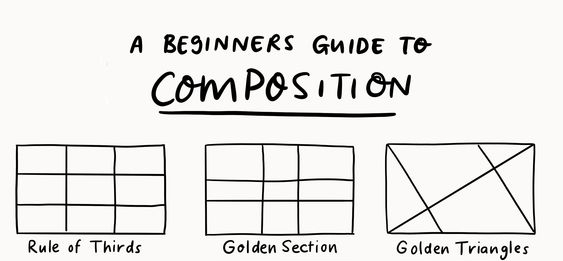

The position of the viewer is slightly different, it has moved to the left and so more of the house in the foreground can be seen. The larger painting also has a red tractor in the lane, which the study did not, which draws the eye down the lane: hence the title.

I particularly enjoyed painting the different textures of crops and grass in the field that were not visible in the study painting. The widened composition also included the large cross on the shore to the left. I did not realize it at first but the wall in the corner of the painting is a graveyard wall. This is the graveyard of St. Crone’s chapel. Saint Crone was a sixth-century Irish saint descended from King Niall Noígíallach (‘of the Nine Hostages’) and a contemporary of Saint Colmcille (St. Columba of Iona). Saint Crone was very active in the Rosses area. The parish of Dungloe on the mainland also takes its name from her; Templecrone.

So executing a study can be a useful tool in thinking about the composition of a larger work. It will show if a composition works or not but it can also suggest improvements and variations. Interestingly the study is a painting in its own right, it has a different, lighter feel to it. Small paintings often take just as much thought and effort as larger ones even if they are quicker to execute.
My PC just crashed. I am not sure if that’s a result of the effects of Storm Dennis (we had downpours all night long here) but I am going to stop here!


This is only a short post because my cold from hell isn’t shifting and I have been ordered to rest by Séamas, which as you see, I am failing to do!
I like red and orange. Especially in winter. I have noticed that I like to paint red and orange things in wintertime. I previous years it has been red coats on the harbor beach at Tenby, or grandparents buying ice-creams in Brynmill Park. This year it’s the autumnal orange foliage of Donegal.

Cottage in Roshin Acres, Ireland (SOLD)
I painted this small painting over a number of days, over Christmas. I would usually paint a picture like this in one day but the light kept going and I wasn’t very energetic so I decided not to rush it and wait until the next day. I think my patience was well-rewarded.
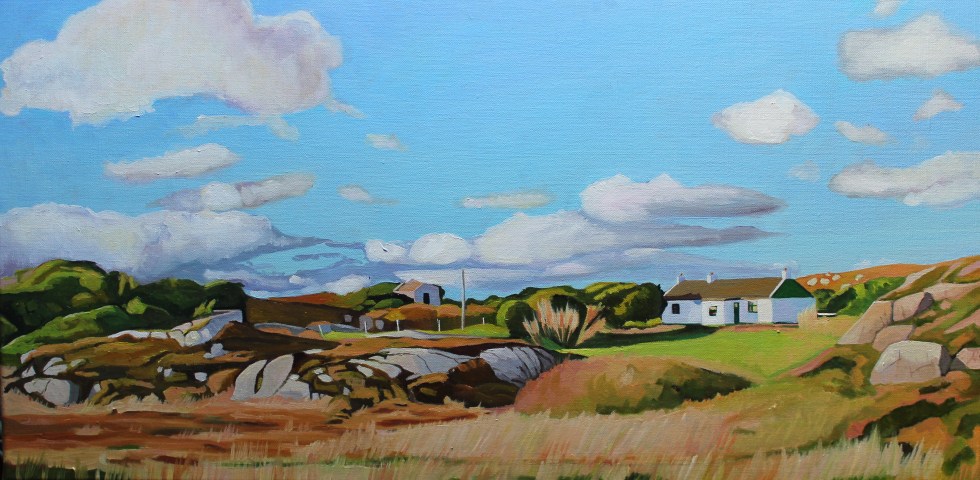
I have painted this house before, in a much larger painting. It’s interesting how the more distant view produces a cooler more airy painting.
(SOLD)

Autumn brings incredible colours to the west coast of Ireland. As the grass and bracken die off, they turn a fantastic shade of orange and pink. The pink granite rocks that litter the landscape accentuate the warm colours. They have provided me with much inspiration for my landscape paintings of Donegal, Ireland.

This series of paintings has been inspired by the Old Railway Walk which starts near Burtonport, near Dungloe in Donegal. There are no railways in Donegal anymore. There used to be. The line to Burtonport was built in 1903 as a joint venture by the British government and the Londonderry & Loch Swilly Railway Company to attempt to alleviate poverty in north West Donegal.

The trains used to carry fish from the port at Burtonport in Donegal to Derry, in the neighboring county. It also carried many seasonal workers to and from Derry and Scotland. After 1922 the line crossed from one country into another; from the Irish Free State into Northern Ireland.


In the 1940s, however, the Irish government decided to close down the railways in Donegal. I have never really found a clear explanation for why this happened but I am going to assume that the cost of running the line was an important factor. There were also concerns about the safety of the line.

In January 1925 disaster had occurred on the at the Owencarrow Viaduct when winds of up to 120mph blew carriages of the train off the viaduct causing it to partially collapse. Four poor souls lost their lives.

After the Second World War, the Irish government presumably decided it would cost too much to continue the maintenance of the line and it was closed in 1947. The Burtonport-Gweedore section closed in 1940. There is a great graphic on the Donegal Daily here illustrating the shrinkage and disappearance of the railways. Donegal became a very remote part of Ireland, with no railways and no (still) motorways. Communication with the area improved in 1986, however, when Donegal airport started operations.

It seems that for half a century nothing much happened on the old railway line. In 2009, however, there was a heavy snowfall, and some of the old railway line was cleared to access water mains that needed repairing. The remaining section was later cleared and gradually developed as a walkway with the support of the local community. A massive effort has gone into creating this beautiful and peaceful walk.


Here are some of my paintings inspired by my husband Seamas’s photographs of the railway walk.

There are many features of the old railway remaining which you can view along the way such as stations, gatehouses, accommodation crossings, lots of pillars, cuttings, embankments, a bridge and rusty gates. There are also lots of shelters for walkers to hide from passing showers to use.


Photo credit: James (Seamas) Henry Johnston
Youtube video- Siúlóid an tSean Bhóthar Iarainn—The Old Railway Walk by Ralph Schulz.
Find out more about the Railway Walk by clicking on the links below:-
http://www.therosses.ie/walking.html
http://www.walkingdonegal.net/article/walking-the-line/
http://magherycoastaladventures.ie/sli_na_rossan.html
Getting here: From Letterkenny and Dungloe – SITI Rural Transport – Tel 0749741644. From Dublin – Bus Eireann@ www .buseireann .ie From Scotland & Northern lreland – Doherty Travel (00353) 749521867
https://www.donegalairport.ie/ There are twice-daily flights from Dublin and Glasgow to Donegal airport via Aer Lingus and Logan Air . Donegal Airport : 00353(0) 74 95 48284.
.

This is a footnote to Sunday’s post about A Donegal year.
I had been trying to finish it but the weather and the light were so bad here in Wales over the weekend, I had to leave it until Monday. I struggle to see greens in poor light and as the grass at the bottom of the painting was so important to the success of the image, I decided to wait until I could see it.

It’s is such a joy to look at the bright blue skies of Donegal and the wonderful clear light.
See it here

Donegal has lots of breathtaking scenery. I love the coast and the old white houses and a lot of my recent paintings have been concerned with depicting a more intimate impression of Donegal. I don’t like to get into a rut, and I will switch subject matter to challenge myself and keep my work “fresh”.
Painting mountains is one way of doing that for me. I have painted three pictures of the Derryveagh mountains since October 2018. They are based on a series of photographs we took on a trip to Horn Head. For an excellent interactive map of the area click here

I had been worried about driving along precipitous cliff tops and we had parked up and walked up to Horn Head. The view was great but the overcast conditions did not make for particularly good photographs. We climbed up part of the spongey hill. I call it spongey because every time I put my put on something that wasn’t a rock, it sort of sank into the heather or boggy grass. It was very unsettling. So I leap from rock to rock. From here we took in the strong breeze and could see across to Dunfanghy.
There were also sweeping views across back towards Falcaragh and Bloody Foreland (Cnoc Fola in Irish). What a great name that is, it refers to the colour of the headland, not to some gruesome incident of the past. The light was in the “wrong” direction for decent photos but the view was lovely.

On the way back down to Dunfanaghy, the sun broke through the clouds off in the distance, we stopped and Seamas took some pictures. These are the photos the three paintings are based on.
These paintings are quite a commitment, in terms of effort and resources as they are physically large (for me, anyway) and mentally demanding. I usually like to paint bright and quite detailed landscapes. These paintings, in contrast, were an exercise in subtly and knowing when and where to include more or less details.

With all of them, I begin with the sky and work my way down the canvas. As with a lot of my work, I use the paint quite thinly and I find this helps keep the clouds feeling “light”. They are just layers of water vapor, after all. The linen canvas I use is primed with a clear primer so it is brown rather than white in colour. I find this brown works well as a base for dirty looking rain clouds!
My first two paintings I initially painted the distant mountains a range of graduating purples until I stood back and realised that they had to be lightened a lot. I spent a lot of time holding up my paint covered brush next to my reference photograph to compare the shades. I learned that the mountains had a lot of warm grey in them.

The greens of the mid area and the foreground were much easier to gauge although I still visually checked that my tones were correct by holding the paint next to the reference image. The many walls and varying tones of the fields required a great deal of concentration. This was the most detailed part of the painting. I wanted the viewer to look into the distance rather than be distracted by detailed grass in the foreground. So the grass in the foreground is quite flat with only the odd change in colour to hint at roughness.
By the time I had painted the third, most recent, painting in the series, I had learned from experience to keep the colour of the mountains light. The falling rain over the far mountain meant that most of the tones of the grass and bogland were much more muted than in the earlier paintings. There was a lot of greys and purples in the grass and gorse.
Each of the three paintings, although they are of a similar view, each has quite a different feel to it. They remind me how on some days you can stand and watch the light and colours change second by second in Donegal as the clouds move and showers sweep in from the west. The last one does that the most. I think my next challenge will be to paint a mountain scene without any houses at all, just sky and mountain and resist the urge to add detail!


I have been back in Wales for three days now and the big difference from Donegal is the temperature and light. It is much warmer in Wales. Last week I was wearing a jumper – here I am in a T-shirt. In Wales, last night it was very dark by 10 pm. In Donegal, however, the light seemed unending. I struggled to sleep, despite being very tired, because although the sunset was after 10pm, it didn’t seem to get properly dark until after well after 11pm. Then it started to get light pretty soon after 4am!
I would sometimes wake in the early hours and look at the dark as a novelty. That’s something I’ve never done in Wales. Yet, I got used to this abundance of light. I made me feel active. With no television to slump in front of, I would find myself doing things after tea, such as the evening I found myself sanding a table at 9pm. I got used to life without news on the radio, although I did listen to some podcasts I had downloaded before I left Wales.
The day we visited Arranmore Island was a sunny Saturday. No jumper, just a shirt. There are two ferry companies that operate from Burtonport Harbour, the Red, and the Blue. They run all year round. In the summer months, they put on extra sailings. We plan to catch the 12.30 ferry, which is the Red Ferry. That’s the favourite colour of Seamas, my husband’s, beloved football team, Liverpool, so he’s happy. The ferry is very busy. It’s delayed by 10 minutes as the last car fills the boat to capacity. There are lots of teenagers and families on board. We stand by the rails as all the seats are taken.

The journey to Arranmore is always a treat. The ferry is speedy. It takes not much more than 15 minutes to complete the three-mile journey. I love looking at the islands (and their houses) that lie alongside the route.

Rutland Island is one of the largest of these and lies to the west. There are some very beautiful modern houses on Rutland, alongside ruins which date from the 18th century. These were part of the planned settlement built by William Burton Conyngham. He also owned Arranmore Island. In my painting “From Ferry Coll” (below) you can see the remains of the fish landing and processing complex on the left side of the painting. There was also once a post office, houses, and a school-house here.

On the eastern side, lies the islands of Edernish, Inishchoo, and Eighter. Here there are old cottages tucked in amongst the rocks. There is sparkling sunshine, but once we leave the shelter of the islands, the sea becomes quite choppy.

When we arrive at Arranmore harbour there are lots of friends and families waiting for the ferry. There is a lot of waving and photos taking whilst we wait for the cars to drive off the ferry. Then the people can get off the ferry. There are lots of hugs, laughter, and chatter as the passengers finally get off the ferry. It’s a delightful scene.
Arranmore is well worth visiting. It is the second-largest Irish island (the largest is Achill, in County Mayo, if you want to know). It is seven square miles in size and it is dominated by an imposing hill called Cnoc an Iolair (“Hill of the Eagle”, 750 feet) which can be seen from most of the coast of Gweedore ad the Rosses. It has both sandy beaches along the south coast (three of them) and imposing sea cliffs (120 meters) along the west and north side of the island. Many of the islanders are native Irish speakers.
Many islanders used to support themselves through fishing, wild salmon in particular, but in 2006 the EU banned salmon fishing. This has caused a great deal of hardship and anger. It has also meant that many of the young people have been forced to move away in search of work, so the population of the island is dwindling and aging. You can watch a beautiful short film, “A Foot of Turf” about island life here.
Fortunately, the island has recently undergone huge technological advancement and has become the recipient of Ireland’s very first offshore digital hub. In celebration they wrote an open letter to American and Australia, hoping to entice new businesses to the island. Sadly, the story went viral and got distorted in the process. British tabloids, in particular, decided to reframe the story as the island being desperate for immigrants, “begging US citizens to move there” and decided to be offended that they “forgot” to invite British people, writing headlines like: “Anyone but the English”. This caused a great deal of distress on the island as this wasn’t what was intended at all. The letter was meant to appeal to American businesses to help boost the economy by giving islanders jobs – and visit the island.
So we are visiting the island. First, we made our way eastwards, towards the lifeboat station. We then backtracked and walk up the road past The Glen Hotel, which was the island’s first hotel in 1928. It was once the home of John Stoupe Charley, a Protestant from Antrim, who bought the island in 1855.

It was a long hilly road with a beautiful view across to the mainland. There were many old cottages and outbuildings here. The road was generally quiet but we were periodically passed by several cars. I like to take note of where cars are from, in Ireland registration plates in include letters to denote the county of registration. There were many with “DL” Donegal plates, but also plenty with “D” Dublin and Northern Ireland plates. Although I’d seen plenty of German and Dutch vehicles driving along the Wild Atlantic Way (past our house) there were none on this stretch of Arranmore road.

It’s considered good manners in Donegal (and elsewhere, of course) for the driver and pedestrian to acknowledge each other when the car has to slow to pass and the pedestrian has to clamber into the grassy verge. In Donegal, the driver will lift the index finger of his right hand. The pedestrian will similarly lift his or her finger but not necessarily raising the hand to do so. Smiles will be exchanged too. Nothing to exuberant, but friendly. It’s rare that this doesn’t happen, sadly it does on occasion and then it is followed by a short discussion between Seamas and myself about the drivers of particular makes of cars and/or people from NI/Dublin/hirecars.

We get so far and decide to retrace our tracks and walk in a big loop along the west side of the island, which provides us with sweeping views across to Burtonport and Dungloe. If you look carefully in the photo below you will be able to see the old courthouse to the right. This was built at Fal an Ghabhann (Fallagowan) around 1855.


Eventually, the road wound downhill. We could hear the sound of singing on the wind. A choir singing? We eventually came to a large white Community Hall, the doors were open and inside were lots of young people singing in Irish. These were some of the hundreds of teenagers who come to the island as part of a summer scheme to learn and improve on their Irish language skills.

As if to reinforce this, a tall teenage boy passes us and greets us in Irish. Seamas manages a greeting but then tells me that the lad had used a different form of words to the one he’d learned over 30 years ago. It seems that the Irish language is very similar to the Welsh, in that it has many regional variations in terms of accent, pronunciation, and words used.

We finally made it back to the harbour and had two delicious cheese paninis in the sandwich shop.

The journey back to Burtonport harbour on the Red ferry was very enjoyable, with the passengers still in a buoyant holiday mood, waving at the passengers on the Blue ferry as we passed. A holiday maker’s car alarm kept going off. His embarrassment levels pretty much matched that of his children’s amusement.
I kept a lookout for dolphins or seals but saw none. Only sea birds. An American told me that he’s seen Minke Whales in Clew Bay recently. We had seen dolphin on the way back from Tory island. He had a theory that there was a bumper crop of fish 8 miles out at sea, which was where the wildlife were. Usually, the waters around Burtonport would have plenty of seals and dolphins. That’s something to look forward to seeing another time.


I was born in Hereford, and educated in Cardiff. I am a professional artist, specializing in oil paintings of the landscapes of Wales and Donegal, Ireland. I have exhibited in various galleries, online galleries, in print and on digital LED screens throughout London, UK.

I have one of the top best selling artists on Artfinder over the last five years and have sold widely on other online galleries. I have sold hundreds of pieces of artwork online. I have had hundreds of happy collectors and my artwork hangs in homes across the world and in numerous countries.

I love light and colour. In my art, I am drawn to light and shadows and how they shape our emotions. I remember visiting the South of France as a teenager and being mesmerized by the dazzling light, I have been attempting to capture that excitement about light in my paintings ever since.

I try and make my colours bold and bright but as realistic as possible. I aim to make people look at the ordinary and see the extraordinary beauty in it.
I offer a personalised approach to art for business and I sell affordable, original and limited edition artworks to companies, such as John Lewis, across the globe.

Whether you would like a single piece for your office or boardroom, or are looking for larger numbers for a hotel or restaurant chain, I can help provide the right art for you.
The paintings are wrapped securely in bubble wrap and cardboard packaging. All paintings also have a Certificate of Authenticity. Most of my paintings are sold unframed. This is to lower delivery costs. If the paintings have been framed it will be stated.
In my paintings the effect of light is often ‘heightened’ and similar to the sophisticated, precise ‘Pixar’ like animated light. I seek to paint the ‘experience’ of light on colour and form.

To achieve this requires the heightening of the effect of light otherwise light can often be dampened or subdued by the absorbing colours. I am much more interested in how light invigorates, resonates, generates or dare I say it animates colour and form, rather than simply dressing it. This effect is underscored by my use of drawing lines around colours and form, as with the fauvists, and others have suggested this too gives off an animated feel or quality.

I want colour to be the product of being generated, animated by light as if light was the genesis of colour. Thus light creates the colour in a sense rather than colour simply being illuminated by it.

Rusty Roofed House (Arranmore)