Posted on 28 Comments

Maghery and Crohy Head, Donegal

Blog Cover Maghery

We are all told to stay local in Wales, until July anyway. I am still recovering from the operation to pin my broken leg so all of my journeys are very short, and very slow, anyway. I have been taking more adventurous journeys of the mind to Donegal, and to the little village of Maghery in particular.

It lies just a stone’s throw (4 miles or about a 10-minute drive) down the road from Dungloe (I regard Dungloe as the center of my universe when I am in Donegal because it has supermarkets like Lidls, Aldis, Supervalu, and The Cope).  The Irish name for Maghery Glebe is An Machaire. We know that people lived here over 5000 years ago because they built stone circles, left tombs, a Crannóg, and a stone fort.

Maghery Beach with Arranmore in the distance

We have only ever been to Maghery twice. On both occasions, it was to visit Crohy sea arch. We failed to find the arch, but we did see some very fine sea stacks called Na Bristí on our second visit. We also found found two beautiful beaches, a Napoleonic signal tower, and Second World War look out post and my favouite, and an Éire Sign.


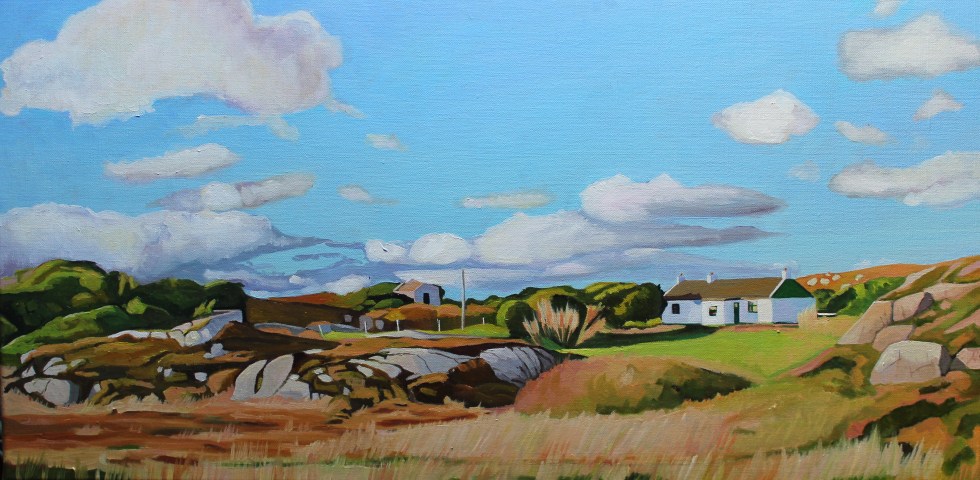
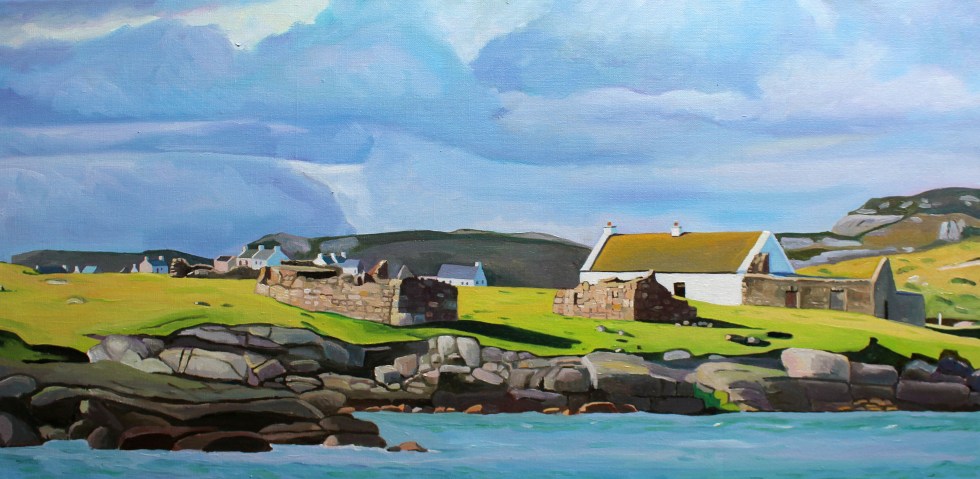
I would like to visit again, but instead, I can only visit online and “in paint”. The drive through the village has inspired my latest series of three paintings. (The first two paintings have gone to collectors in France and the USA). I was drawn to paint the pink and mauve old houses in particular, mixed in with the white stone cottages.

Driving into Maghery
Driving into Maghery SOLD
Pink House Maghery
Pink House Maghery – SOLD
Painting od Donegal Village
Through Maghery, Donegal Ireland

Its only now that I realise the mauve house in my 3rd painting is a very similar colour to the early morning sand on the pristine beach nearby.

IMG_20190331_095237-002

Maghery Beach, with Maghery village and  Napoleonic signal tower


Round the Bend, Maghery (Donegal)
Polite Houses of Maghery- Emma Cownie

People have been looking out at the Atlantic Ocean and the surrounding land from the hills near Maghery for hundreds of years. They haven’t always been admiring the view, either. During the Napoleonic Wars, a signal tower was built on the headland in the years 1804-6.

DSC_1147
Signal Tower at Maghery

This was one of a series of 12 towers built along the Donegal coastline, to watch out for invasion from French forces. We dont have these in Wales, although Wales invaded by a French force in 1797. That’s beacuse it was not built to protect the Irish population from the French, but because the British did not trust the Irish not to welcome the French with open arms. A few years earlier Irishman, Wolfe Tone, had attempted but failed to land a French force near Lough Swilly. The plan had been to throw the British out of Ireland. His landing failed but there was a successful landing of French forces further down the coast in Mayo. A brief declaration of an Irish Republic followed, but the Irish Rebellion ultimately failed, after a series of battles in Wexford culminating, in defeat at Vinegar Hill.

The signal tower is thus a symbol of deep mistrust by the British. This particular tower is well preserved and surrounded by walled farmer’s fields. The men who were garrioned here communicated with neighbouring signal towers by raising and lowering a large rectangular flag, a smaller blue pendant and four black balls in various combinations along a system centred on a tall wooden mast. This must have been very difficult if not impossible in poor weather conditions.

About 200 meters down the road is the Second World War Eire sign. I am not sure why but I was more excited to see this than the tower. Perhaps, because it was tucked away, designed only to be seen from the air. Perhaps also beacuse it is cut into the grass like a prehistoric chalk horse.

Eire 74 sign at Maghery

The letters spell the word Éire, which means “Ireland” in the Irish language. Over 80 of these numbered Éire signs were dotted around the coast of the Republic during the Second World War. I originally thought this was to warn German bombers that they were flying over a neutral country. This was important as neighbouring Northern Ireland, being part of the United Kingdom, was not neutral. I was wrong, the main purpose of these numbered signs was as a navigational aids for the Allied planes. 

Although the Republic were offically neutral they were indirectly involved in the war. In the Spring of 1939, expecting another European War, the British Government had asked the Irish Government to set up a Coastguard Service. The Irish Government agreed to build a series of small concrete huts, known as Look Out Posts (or LOPs) along the coast. There is this one at Crohy and there was another on Arranmore Island near by. The letters Eire (without the accent on the “E”) were written in stone nearby to give aircraft an idea of where they were. The stones were painted white. The numbers (74 in the case of Crohy) were added in 1942 after the Americans entered the war in December of 1941. (Thank you to Séan Bonner for this information).

These huts were pre-built in parts and assembled on site by the army (as the Coastguard Service was under the control of the army). The Irish Government agreed to build the huts and set up the service but on condition that they only would supply radios to the huts in the event of a war. Coast watchers worked around the clock in pairs, reporting every activity observed at sea or in the air by telephone.

As the aircraft would have seen it (Photo Credit:Conor Corbet)

Allied aircraft were allowed to fly over the Republic through the “Donegal Corridor” to airbases in County Fermanagh. These airbases were crucial to provide “cover” for the shipping convoys that came across the Atlantic bringing industrial raw materials and food to Britian. Without fear of air attack, German U-boats would operate as ‘wolf packs’, picking off the ships one by one. All flights were meant to take place at “a good height”. If any aircraft crashed, as at least six did, if they could claim they were on a non-combative mission, they would be repatriated. While it was easy for Allied pilots to make that claim, it was not realistic for Luftwaffe pilots to do so, they tended to be interned. Ireland also helped Britain in secret by setting up an armed air/sea rescue trawler called the Robert Hastie at Killybegs, Donegal, to help any shipping casualties and to supply planes that had run out of fuel.

I didn’t realise it at the time but this is just an updated version of the Napoleonic tower. The ruins above the Eire sign is that of a coast watch station. Coast watchers worked around the clock in pairs, reporting every activity observed at sea or in the air by telephone.

Further along the road is Crohy Head. I think techically is Crohy Head, South. Although there is space to park and a sign announcing its presence, you can sense that the local authority are not all wildly keen to promote this attraction in case people fall down the steep field/cliff face trying to get a good look at it.

IMG_3895
The Sign for Na Bristí

I am sitting here with my pinned leg resting on a chair, and it’s twitching unhappily at the sight of these photos now. My leg does not like to think about rough terrains right now. I can just about manage a slow walk around my local park these days (it’s going to be a long slow build up to full recovery). We must have been mad! I thought so at the time too. Still, my husband Séamas who climbed down to the beach to take some photos whilst I sat on the hill holding onto some yapping dogs. To my shame, there was an artist with his easel painting en plein air at the top of the field. I wonder if he could hearing me hushing the dogs and telling Seamas to hurry up.

Sadly, the light was, in my opinion, in the “wrong direction” and early morning would be a better time of day to catch the sea stacks. The sea arch, was just out of sight around the corner. I think that I will save up and buy a drone to take photographs from higher up without imperilling any of my (or my husbands’) limbs! Or a boat. Things to dream about from my chair.

Here is a marvelous drone photo of Crohy Head.

Crohy Head
Sea Stacks and Sea Arch at Crohy Head (Photo: Gareth Wray)

See Prints of Donegal                               See Donegal paintings

As with all of Ireland, you scratch the surface and discover an ocean of history. These are some of the sites I used for research:-

Information & photos

http://maghery.ie/maghery_history.html – this is an excellent site

https://www.townlands.ie/donegal/boylagh/templecrone/maghery/maghery-glebe

https://www.irishtimes.com/news/environment/ireland-s-napoleonic-era-signal-towers-1.1253929

http://eiremarkings.org/

Local walks

http://magherycoastaladventures.ie/sli_na_rossan.html

http://www.walkingdonegal.net/article/maghery-dungloe-coastal-walk/

Posted on 16 Comments

The Road by the Loch, Ireland

Landscape Painting of Donegal Ireland by Emma Cownie

A while back I came across a quote on the internet that has stuck in my mind:- “If I knew the world was to end tomorrow, I would still plant an apple tree today.” I was quite struck by this sentiment, especially in the light of current events.
I could not remember who said it. So I did some research. I was intrigued by what I discovered online. I found a number of statements:-

  1. It was originally said by Martin Luther, a 16th century German monk yoJyC
  2. It was originally said by Martin Luther King Jnr, the 20th century African-American Civil Rights Campaigner. NzGsK
  3. It wasn’t said by 1) or 2)!

This puts me in mind of one of my favourite internet memes by that teller-of-truth Abe Lincoln…
Lincoln-quote-internet-hoax-fake
Just joking!
The apple seed quote apparently originates in Nazi Germany in the 1930s, in the Protestant Confessing Church, which used it to inspire hope and perseverance during its opposition to the Nazi dictatorship.
To be honest, it doesn’t matter who said or when (although there’s a lesson about taking things at face value there) because I like the sentiment. No matter how dreadful things seem, they will pass. Eventually.
Here is my apple seed for this week.

Donegal Ireland landscape painting Emma Cownie
The Road by the Loch, Ireland (80x60cm/ 31.5×23.5″)


Posted on 31 Comments

The Art of the Large Landscape Painting

Landscape painting Ireland

Failures are always a challenge. When I used to be a Secondary school teacher, I always learned more about teaching when I faced a difficult class than a nice docile one. They made me go away and think about what I was doing and how I could do it better. Painting is no different.


I have been thinking about the composition of larger paintings. When I used to think about painting a scene I used to think in terms of  “that’s a small painting, it won’t “stretch” to a larger canvas”, or “That’s a mountain, definately, therefore, it’s subject suitable for a large canvas”. I am parodying myself somewhat but generally, I have this feeling that small birds belong on small canvases and big landscapes belong on larger ones.

My thinking was challenged by a commission I did in the summer where a client asked for a very large version (120 x 90cm) of a relatively small painting (41 x 33 cm). So I scaled up and despite my anxiety, it worked. This was important as my confidence had been dented by a previous large landscape painting that hadn’t work out for me.

Painting of Gola, Donegal
Small and Big Versions

It got me thinking about composition. I understood the basics and had looked of compositional grids in Artbooks as a teenager and thought I’d internalized them. I realized that I had got sloppy. I’ll explain.

A Beginners Guide to Composition

I am not going to do an information dump about theories of composition here (I have added links to some good blogs on the subject below) but the “rule of thirds” is one that springs to mind here.  The idea that you should look for naturally occurring in divisions of thirds in a scene and try and locate points of interest at the intersection of the “Golden section”.


I had been influenced by ideas of composition from photography and the work of artist-turned photographer, Henri Cartier-Bresson,in particular.

Rule of Thirds - Henri Cartier Bresson
Rule of Thirds – Henri Cartier Bresson

I liked his use of diagonals in particular, and this has influenced my paintings of urban scenes.

When I came to Donegal I was so blown away by the vast overarching skies and majestic landscapes. I got very excited by everything I saw. I tried to capture everything. The houses, the mountains, the sea, and the sky. Most of the time it worked.

You can probably look through these paintings and tick off the composition approaches I instinctively used; the diagonal, the pyramid, the rule of thirds and so on. They all worked.

Then, it really pains me to admit it. I lost it. I got carried away and overreached myself and painted this big beast.

Painting of Donegal Coast
Sailing By Edernish

What was I thinking? There is far too much sky in this painting. Worse than that, it was a large canvas. There are things I like about the painting, the light on the island in the bottom half of the painting, but the sky was just too vast. It pained me that I had such a large reminder of my errors of judgment. I don’t mind screwing up every now and then but I hate waste and that was an expensive canvas. It’s no coincidence that I am planning a blog post on reusing stretcher bars to stretch my own canvases.

My confidence was dented. It put me off large paintings for quite some time. It wasn’t until I did the commission I mentioned earlier, that I got thinking about what had gone wrong. I realized that I had to rigorously apply the same rule of composition to large canvases as I instinctively did to my small ones. So I tried an experiment, I took a successful composition of a medium size painting and did a much larger version of it.  This composition was based on a compound curve.

Over to the Rosses
Over to the Rosses 60x40xm
landscape painting of Ireland
View From Arranmore, Ireland 92x73cm

It wasn’t a copy of the smaller painting. It wasn’t meant to be, although it was meant to encapsulate the same feel of the smaller work, with some adjustments. I have included some more detail, changed the tree, and added a shadow and a ditch in the bottom third of the painting. I think it worked.

I have since done another small oil sketch of another composition before I scale it up. It’s another diagonal composition. Although, the larger version will not be “portrait” format but my usual “landscape” orientation.

I will add the larger version later in the week. So you will have to wait to see if that composition works as well as this smaller one. Watch this space!


Blogs on composition

http://photoinf.com/Golden_Mean/L_Diane_Johnson/The_Basics_of_Landscape_Composition.htm

http://www.workovereasy.com/2019/06/13/a-beginners-guide-to-composition/

https://feltmagnet.com/painting/Value-Pattern-Painting-Composition


Posted on 13 Comments

Cottage in Roshin Acres, Ireland

Painting of Irish landscape

This is only a short post because my cold from hell isn’t shifting and I have been ordered to rest by Séamas, which as you see, I am failing to do!

I like red and orange. Especially in winter. I have noticed that I like to paint red and orange things in wintertime. I previous years it has been red coats on the harbor beach at Tenby, or grandparents buying ice-creams in Brynmill Park. This year it’s the autumnal orange foliage of Donegal.

Painting of Cottage in Donegal, Ireland

Cottage in Roshin Acres, Ireland (SOLD)

I painted this small painting over a number of days, over Christmas. I would usually paint a picture like this in one day but the light kept going and I wasn’t very energetic so I decided not to rush it and wait until the next day. I think my patience was well-rewarded.

I have painted this house before, in a much larger painting. It’s interesting how the more distant view produces a cooler more airy painting. 

Painting of Donegal landscape, Ireland
Roshin Acres, Ireland

(SOLD)


Posted on 21 Comments

Goodbye 2019 and Hello 2020!

Seamas and me!

A year’s a long time in art. When I look back at my paintings from early 2019, it feels like I made them much longer ago than that! This selection of “popular” (most likes/biggest reach) is based on my Instagram account, there are many more images that I shared on Facebook, that were also popular but are not included here. The work in progress photos are often very popular, sometimes they are more popular than the final painting!

The most popular nine posts/paintings are all of Donegal, Ireland, paintings.

Paintings of Donegal. Ireland
A selection of some of my most popular Donegal paintings from 2019

Here are my most popular posts/paintings of landscapes, people and animals of Gower, Wales and Stroud, England.

Paintings by Emma Cownie
Some more of my most popular paintings from 2019

Finally, a selection of commissioned work. I particularly enjoyed painting the beautiful Maine Coon cats, especially as pet portraits are usually of the canine variety!

Selection of Commissioned work from 2019

My personal favorite from 2019 is this one. There is something about the neatness of the houses on the island that I relish in this painting.

Painting of Ireland
Owey in Spring

Of course, the irony is that one of my most popular posts of 2019 on social media was not a painting but a photograph that my husband took on the spur of the moment of us in woolly hats (and my new Donegal jumper) on Christmas Day!

Seamas and me!
Seamas and me!

Here’s wishing everyone a Happy, Healthy and Prosperous 2020!


See more of my work here 

Posted on 18 Comments

The Burtonport Old Railway Walk, Ireland

Paintings of Ireland

Autumn brings incredible colours to the west coast of Ireland. As the grass and bracken die off, they turn a fantastic shade of orange and pink. The pink granite rocks that litter the landscape accentuate the warm colours. They have provided me with much inspiration for my landscape paintings of Donegal, Ireland.

Painting of Donegal Ireland
Autumn in the Rosses, Ireland

This series of paintings has been inspired by the Old Railway Walk which starts near Burtonport, near Dungloe in Donegal. There are no railways in Donegal anymore. There used to be. The line to Burtonport was built in 1903 as a joint venture by the British government and the Londonderry & Loch Swilly Railway Company to attempt to alleviate poverty in north West Donegal.

Steam train at Burtonport, Donegal
Steam trains at Burtonport, Donegal

The trains used to carry fish from the port at Burtonport in Donegal to Derry, in the neighboring county. It also carried many seasonal workers to and from Derry and Scotland.  After 1922 the line crossed from one country into another; from the Irish Free State into Northern Ireland.

Donegal Railways in 1906
Railways in 1906: Credit: Donegal Daily.com
Gweedore train station (Mount Errigal in the distance)

In the 1940s, however, the Irish government decided to close down the railways in Donegal. I have never really found a clear explanation for why this happened but I am going to assume that the cost of running the line was an important factor. There were also concerns about the safety of the line.

Owencarrow Viaduct, Donegal

In January 1925 disaster had occurred on the at the Owencarrow Viaduct when winds of up to 120mph blew carriages of the train off the viaduct causing it to partially collapse. Four poor souls lost their lives.

Owencarrow Viaduct
Owencarrow Viaduct

After the Second World War, the Irish government presumably decided it would cost too much to continue the maintenance of the line and it was closed in 1947. The Burtonport-Gweedore section closed in 1940. There is a great graphic on the Donegal Daily here illustrating the shrinkage and disappearance of the railways. Donegal became a very remote part of Ireland, with no railways and no (still) motorways. Communication with the area improved in 1986, however, when Donegal airport started operations.

Painting of the Rosses, Ireland
The Railway Walk, Ireland

It seems that for half a century nothing much happened on the old railway line. In 2009, however, there was a heavy snowfall, and some of the old railway line was cleared to access water mains that needed repairing. The remaining section was later cleared and gradually developed as a walkway with the support of the local community. A massive effort has gone into creating this beautiful and peaceful walk.

The Burtonport Old Railway Walk

Here are some of my paintings inspired by my husband Seamas’s photographs of the railway walk.

Painting of Donegal landscape, Ireland
Roshin Acres, Ireland
Ireland landscape painting
Long and Winding Road, Ireland

There are many features of the old railway remaining which you can view along the way such as stations, gatehouses, accommodation crossings, lots of pillars, cuttings, embankments, a bridge and rusty gates. There are also lots of shelters for walkers to hide from passing showers to use.

Photo credit: James (Seamas) Henry Johnston

Youtube video- Siúlóid an tSean Bhóthar Iarainn—The Old Railway Walk by Ralph Schulz.

Find out more about the Railway Walk by clicking on the links below:-

http://www.therosses.ie/walking.html

https://www.ireland.com/en-gb/what-is-available/walking-and-hiking/walks/destinations/republic-of-ireland/donegal/burtonport/all/1-94786/

http://www.walkingdonegal.net/article/walking-the-line/

http://magherycoastaladventures.ie/sli_na_rossan.html 

Getting here: From Letterkenny and Dungloe – SITI Rural Transport – Tel 0749741644. From Dublin – Bus Eireann@ www .buseireann .ie From Scotland & Northern lreland – Doherty Travel (00353) 749521867

https://www.donegalairport.ie/  There are twice-daily flights from Dublin and Glasgow to Donegal airport via Aer Lingus and Logan AirDonegal Airport : 00353(0) 74 95 48284.


.

Posted on 31 Comments

In the Glynn Vivian Open Exhibition

Exhibition - Emma Cownie 2019

The Opening night of an “Open” exhibition is an affair full of nervous energy! This is because 90% of people in the room are artists who are all relieved/happy to have their work included in the exhbition in the first place and secondly have come to see where their painting/s have ended up? Are they in a corner? Can they be seen?

Open Exhibition is where the organisers invite or “call” for artists to submit their work (for a small fee). The best works are then selected to be included in the exhibition. There are massive national exhibitions (like the BP Portrait Prize) that are so massive that they have a preliminary round where digital photos are first sent for consideration. The Glynn Vivian, does it the old fashioned way by requiring artists to bring their paintings to gallery for submission. You can submit up to two works each. As, it’s only open to artists living in the Swansea area, it’s not too onerous to drop in the paintings.


All artists fear rejection. We are sensitive souls. So to have to face the prospect of being rejected (one or two paintings) isn’t pleasant. Inclusion isn’t automatic, even if your work has been included before (I was in 2017), especially as the people doing the choosing (or “curating”) change every year. This year’s curators were Richard Billingham and Durre
Shahwar. Richard is a photographer and filmer maker who was nominated for the Turner Prize in 2001. Shahwar is a writer, editor, and creative facilitator. Thankfully they chose both of the works I submitted.

I had deliberately decided to arrive an hour into the Opening party as I remember it being very crowded to last time I came in 2017. It was still very crowded at 3pm and the numbers only really thinned out after 4pm. There were 245 pieces in the exhibition. The two rooms in the gallery were filled to the brim with paintings (and artists). were overwhelmingly 2D art. Paintings, sketches and prints, but there were films and sculptures too.

Crowded Glynn Vivian Open

Of course, the first thing I did was try and find my paintings. They were in the second room. I was initially surprised to see that they were not together but had been arranged separately as part of themed groups of colours. I thought that the arrangement worked well. It’s a funny feeling seeing your paintings in amongst lots of other paintings. It’s like a familiar face amongst a crowd of strangers.

There’s no way I can get a photo of both paintings, I thought. Actually, for a long time, I could not get a photo of each painting as the gallery was so crowded.

Spring Light on Gola (top centre)

For some reason, people stood in front of my second painting, Autumn in the Rosses for the longest time.  Different groups of people too. So I had to wait quite a while to get a photo of it and even then I had a person’s shadow on it!

Spot my painting?
Spot my painting?
Autumn in the Rosses (top left)

It wasn’t just me trying to get a photo of my work. These artists were very excited about being in the exhibition. Their joy was a delight to see.

DSC_0040-001.JPG

"Textile Bouquet" by Eleanor Anne Owens
“Textile Bouquet” by Eleanor Anne Owens

There was so much to look at in the exhibition. There was such a variety of work too. Here are just a few that caught my eye. The most affecting work were the two bird sculptures by Mike Hill. One was made of fishing tackle detritus and the other was in the shape of a cormorant smothered in tar.  In fact, the tar-bird was so affecting that I had to fight back the tears. There were quite a few works that touched up the climate emergency and waste but these two, in my opinion, were the most powerful ones.

What are we Doing? What Have we Done? No.1 and No2.
What are we Doing? What Have We Done? No.1 and No2.
What are we Doing? What Have we Done? No.1 and No2.
DSC_0044-001
Dafydd Williams “A Coded Reverie”
Steve Pleydell "Margot"
Steve Pleydell “Margot”
Amanda Puleston "Doolin, Ireland"
Amanda Puleston “Doolin, Ireland” – It’s knitted art!


I particularly liked the animal/nature themed wall.

I also really liked Myles Lawrence Mansfield ” Rejections/Acceptance Machine”. I liked it even more when it was explained to me that it moved when you turned to handle! I always like things that do something. Thinking about it now, it may well have been a comment on the life of an artist!

DSC_0082-001
Myles Lawrence Mansfield ” Rejections/ Acceptance Machine”

I had to pleasure of meeting fellow artist Wendy Sheridan in real life (after many online interactions via social media).  She very kindly took my photo!

Emma Cownie Exhibition
Me at the Glynn Vivian

I would highly recommend visiting the Glynn Vivian to see all the works in the Open Exhibition. It’s on until 23rd February (closed on Mondays) and is free!

Find about more about the Open Exhibition here 

Posted on 21 Comments

Over to Inishkeeragh, Ireland

I love looking at maps and finding out the names of places. This is particularly true of the islands that litter the coast of West Donegal near the Rosses. I am always asking my husband, what island is that? He’s usually pretty good at knowing the names (I check on a paper map later). In the summer I spotted a house on a tiny slip of an island to the south of Arranmore.  Can you see it in this photograph below?

View from Arranmore

View from Arranmore

Closer. See it now?

Inishkeeragh

Inishkeeragh

I thought it was just one lone house (was that another house at the other end of the island, maybe?). What glorious solitude! What must it be like to stay on that island all with the spray of the sea so close looking at big Arranmore? This is my painting of the island.  I was curious about the feint outlines of ruined houses I could see either side of the restored summer house. I wondered about them and their families.

Inishkeeragh-001
Over to Inishkeeragh (SOLD)

Map of Inishkeeragh (Google)

This is Iniskeeragh. Ireland (like Wales) is rich in descriptive place names. They usually describe are named after features of the landscape, such as hills, rocks, valleys, lakes, islands, and harbours. In Irish, its name is “Inis Caorach” which means “Sheep or Ewe Island”. So either sheep were kept on the island (it seems pretty small for that) or its a shape reminded people of a ewe, which might be more likely?

Inishkeeragh (Google)

After some research (online and in books) back home I discovered that the island had at least 12 families living there permanently, it also had a schoolhouse. I find this incredible for such a small, lowing lying island. It’s 650m x 300m (2132ft x 984ft) in size. I tried to work that out in football pitches. It’s the equivalent to 40 football pitches, so maybe its not as tiny as I think. It is very low. It’s no higher than 11 feet above sea level. Yet you can read their names in the 1901 census here. The family names of the farming families are familiar Donegal ones: Gallagher, Boyle, Sweeney, Rodgers, O’Donnell and a sole Bonner, Grace (35) who was listed in the census as a knitter, she was one of only 2 knitters on the island. 

Ruins on Inishkeeragh:- Photo credit Roger Curry

These Donegal islands may seem remote to modern eyes, but they played their part in the culture and history of modern Ireland.  Gola Island, Gweedore, may well have served as the model for Robert Louis Stevenson’s Treasure Island. Two men from Gola, Patrick McGinley and Charles Duggan, were aboard the Asgard, the yacht that brought arms into Howth in north county Dublin in 1914, in preparation for the Easter Rising of 1916.  Tiny Inishkeeargh also had its connection with the wider world. Writer and political activist Peadar O’Donnell (1893-1986) was a for a time teacher’s assistant at the school on the island and he set his second novel, The Islanders, here.  Peadar went on to become one of Ireland’s foremost radicals of the 20th-century.

School House:- Photo credit Roger Curry

Life was tough on the island. Roise Rua described her work on the island kelp-making as “tedious and exhausting”. The tenants had to pay rent of £50: £26 for the use of the land and £24 for the use of the seashore – making kelp, picking winkles or shellfish, dulse and the like.” Sadly, like many other Donegal island communities, such as Owey and Gola, the people of Inishkeeragh was forced to relocate to the mainland in the 1950s.

Inishkeeragh Village:- Photo credit Roger Curry

Sea levels played a big part as at least twice in the twentieth century an exceptionally high tide coinciding with a bad gale forced the islands to take refuge in the two houses that had lofts. They apparently spent hours “in terror, fearing the overloaded floors would collapse.” A storm in 1953 washed away the pier and the government of the day would not pay for it to be repaired. This meant that subsequent storms swept through the houses and within 5 years all the families were forced to leave the island.

Photo Credit: Roger Curry
Inishkeeragh – Photo Credit: Roger Curry

There was a reunion of Inishkeeragh families and their descendants in 2015 on the island. Internationally renowned Country singer, Daniel O’Donnell, was part of the celebrations (his mother was born on nearby, Owey Island).

Daniel O'Donnell and Inishkeeragh
Daniel O’Donnell and the Inishkeeragh Reunion

You can see the photos of the day on their facebook page here. You can visit the island with Arranmore Charters, be sure to book beforehand.

Addition sources for Inishkeeragh (Inis Caorachin) came from:

Atlas of County Donegal, Jim Mac Laughlin and Sean Beattie (2013)

Donegal Islands, Ros Harvey and Wallace Clark (2003)

Roger Curry’s Donegal photos can be found at https://pbase.com/rogercurry/image/51657229

Posted on 18 Comments

A Donegal Year

It was a year ago that I painted my first painting of Donegal. Here it is. It is a small one.
Old School, Owey Island
It’s quite a modest painting. You could say that I started off tentatively. I was feeling my way. The light in Donegal is very clear and the scenery is beautiful. That’s an overused word in this age of social media, but it is beautiful. My husband, Seamas (he likes counting things) tells me that I have painted over 50 Donegal paintings (including 3 commissions). That pretty much averages out at one a week. I am pleased to say that I have already sold over half of them. I discovered that I had to use a different palette from the one that I use in Wales. The greens and yellows were more yellow ochre than lemon yellow and the sea was more turquoise (but not quite as turquoise as I first painted) thanks to the clear water.  I loved the rocky landscape of the Rosses. It was a landscape like no other I’d seen before. Someone has said to me that it’s quite alien, like a moonscape in places. I love the granite rocks. We have a massive one behind our cottage in Donegal. I feel very affectionate towards it. It’s a protective presence, especially when it’s windy. Of course, when you are in a different country to the one you were brought up in, everything seems fascinating. I have loved painting both the modern Donegal houses as well as the old cottages. I will freely admit I am quite obsessed by landscape spotted with old cottages on the Donegal islands, on Arranmore and Gola in particular.
donegal painting of Gola, West Donegal.
Spring Light on Gola
I haven’t really got to grips with the mountains of Donegal. What I mean is that I need to visit them a lot more, walk up them and get to know them better. So far I have just admired the “Seven Sisters”, including Mount Errigal and Muckish from a distance.
Painting of Irish mountain
Swirling Clouds Round Errigal
Of course, the real joy of Donegal is the clouds. The changes skies. I am used to it raining, (I have lived in Wales for over 25 years) but the light is different by the North Atlantic Ocean. It is often more slivery, and more changeable.   I think about Donegal every day when I am in Wales. My husband will place his current favourite Donegal paintings in the bedroom and in the lounge so he can look at them whilst we still have them. Here’s my most recent painting Donegal painting. I am currently working on a painting of Arranmore Island, unfortunately, it rained so much here yesterday, the light went and I have yet to finish it.
Donegal painting
Back Road to Burtonport
 
Posted on 18 Comments

Painting the Derryveagh Mountains

Painting the Derryveagh Mountains

Donegal has lots of breathtaking scenery. I love the coast and the old white houses and a lot of my recent paintings have been concerned with depicting a more intimate impression of Donegal. I don’t like to get into a rut, and I will switch subject matter to challenge myself and keep my work “fresh”.

Painting mountains is one way of doing that for me. I have painted three pictures of the Derryveagh mountains since October 2018. They are based on a series of photographs we took on a trip to Horn Head. For an excellent interactive map of the area click here

Horn Head, Donegal
Horn Head, Donegal

I had been worried about driving along precipitous cliff tops and we had parked up and walked up to Horn Head. The view was great but the overcast conditions did not make for particularly good photographs.  We climbed up part of the spongey hill. I call it spongey because every time I put my put on something that wasn’t a rock, it sort of sank into the heather or boggy grass. It was very unsettling. So I leap from rock to rock. From here we took in the strong breeze and could see across to Dunfanghy.

There were also sweeping views across back towards Falcaragh and Bloody Foreland (Cnoc Fola in Irish). What a great name that is, it refers to the colour of the headland, not to some gruesome incident of the past. The light was in the “wrong” direction for decent photos but the view was lovely. 

View Towards Bloody Foreland

On the way back down to Dunfanaghy, the sun broke through the clouds off in the distance, we stopped and Seamas took some pictures. These are the photos the three paintings are based on.

These paintings are quite a commitment, in terms of effort and resources as they are physically large (for me, anyway) and mentally demanding. I usually like to paint bright and quite detailed landscapes. These paintings, in contrast, were an exercise in subtly and knowing when and where to include more or less details.

Donegal painting
Across to Dunfanaghy SOLD

With all of them, I begin with the sky and work my way down the canvas. As with a lot of my work, I use the paint quite thinly and I find this helps keep the clouds feeling “light”. They are just layers of water vapor, after all. The linen canvas  I use is primed with a clear primer so it is brown rather than white in colour. I find this brown works well as a base for dirty looking rain clouds!

My first two paintings I initially painted the distant mountains a range of graduating purples until I stood back and realised that they had to be lightened a lot. I spent a lot of time holding up my paint covered brush next to my reference photograph to compare the shades. I learned that the mountains had a lot of warm grey in them.

Painting of Donegal mountains
Wild Wind Over Dunfanaghy SOLD

The greens of the mid area and the foreground were much easier to gauge although I still visually checked that my tones were correct by holding the paint next to the reference image. The many walls and varying tones of the fields required a great deal of concentration. This was the most detailed part of the painting. I wanted the viewer to look into the distance rather than be distracted by detailed grass in the foreground. So the grass in the foreground is quite flat with only the odd change in colour to hint at roughness.

By the time I had painted the third, most recent, painting in the series, I had learned from experience to keep the colour of the mountains light. The falling rain over the far mountain meant that most of the tones of the grass and bogland were much more muted than in the earlier paintings. There was a lot of greys and purples in the grass and gorse.

Each of the three paintings, although they are of a similar view, each has quite a different feel to it. They remind me how on some days you can stand and watch the light and colours change second by second in Donegal as the clouds move and showers sweep in from the west. The last one does that the most. I think my next challenge will be to paint a mountain scene without any houses at all, just sky and mountain and resist the urge to add detail! 

Rain over Dunfanaghy
Rain over Dunfanaghy SOLD)

Free global shipping on paintings and prints